
How to Calculate eCommerce TCO for a Marketplace

eCommerce TCO is the total cost of ownership of your commerce platform, counted across every year you keep it. This chapter covers the five lines of the annual bill and your dependence on the vendor who sends it.
You sign a platform contract once. The bill from that contract lands in your profit and loss account every month for the next several years.
Recalculate that bill at a GMV twice the size of today's. The most expensive line in your costs is your own growth. You will see that for the first time in the quarter, the business starts to work.
This article breaks down:
- What does eCommerce TCO look like at double the GMV?
- Which 5 lines make up the annual eCommerce TCO bill?
- Which line grows in a straight line, which in steps, and which not at all?
- How does a GMV fee land on your thinnest commission category?
- How do you measure dependence on a platform vendor?
- Who maintains this after the implementation team leaves?
Key insights
- Two fee constructions can carry the same price today and leave you with very different bills once you grow. Ask your vendor for your bill at double the GMV before you sign.
- Your annual bill has five lines: platform fee, infrastructure, people, partner services, and development and change. Only one of those five is the platform fee, and the contract you sign prices that one line.
- A GMV fee and partner services grow with your sales. Infrastructure comes in steps, and development and change stays flat. People grow only when your seller count grows.
- A GMV fee charges the same rate on every category. Your thinnest commission category therefore gives up the largest share of its margin. Check what each rate leaves after the fee before you set the commission grid.
- Write the six handover documents while their authors are still on the project. Give each one an owner and a review date before the team disperses.
- Count what you can't rebuild from an export, then count the months your team would need to reproduce one of your own settlements.
What does eCommerce TCO look like at double the GMV?
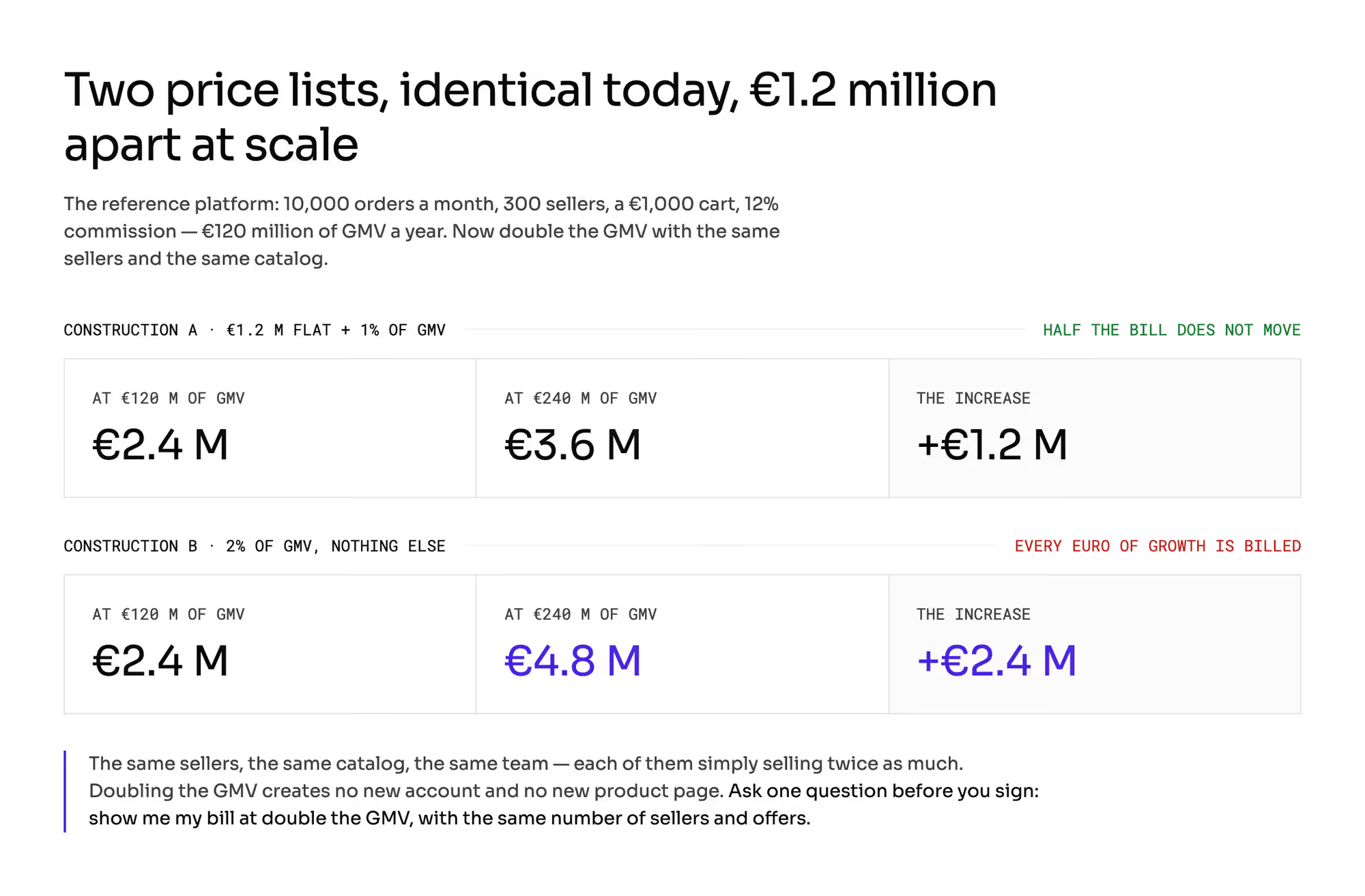
Two fee constructions can cost the same today and leave you with very different bills in three years. The reference platform for this chapter is 10,000 orders a month, 300 sellers, 200,000 active offers, a €1,000 cart and a 12% commission. That gives you €10 million of GMV a month and €120 million a year.
- Flat fee with a GMV supplement on top: €1.2 million a year plus 1% of GMV, which is another €1.2 million. Together €2.4 million.
- Fee calculated on GMV alone: 2% of €120 million. Together €2.4 million.
Now double the GMV. Your sellers, your catalog and your team stay as they are, and each seller sells twice as much.
At €240 million a year, the first construction costs 1.2 + 2.4 = €3.6 million and the second €4.8 million. One sentence in the price list made a difference of €1.2 million a year. On the day you signed, you had no way to tell the two constructions apart.
A fee on GMV charges you more as you sell more, and your use of the accounts and the product pages stays where it was. Doubling the GMV at the same number of sellers creates no new account and no new product page, and you pay twice as much all the same. Practitioners who maintain large platforms call it a cost they can't escape.
Because startup scale here is 300 orders a month and €300,000 of GMV, the construction does pay you back in the first months. One percent of that GMV is €3,000 a month, and the same one percent is €100,000 a month at target scale.
So the vendor carries part of your launch risk, and you pick the moment in the contract term at which you want to pay less. Read the marketplace business case for how that choice shifts your zero point.
Ask your vendor for your bill at double the GMV, with the same number of sellers and offers. One sentence in an email settles a multi-year contract.
Which 5 lines make up the annual eCommerce TCO bill?
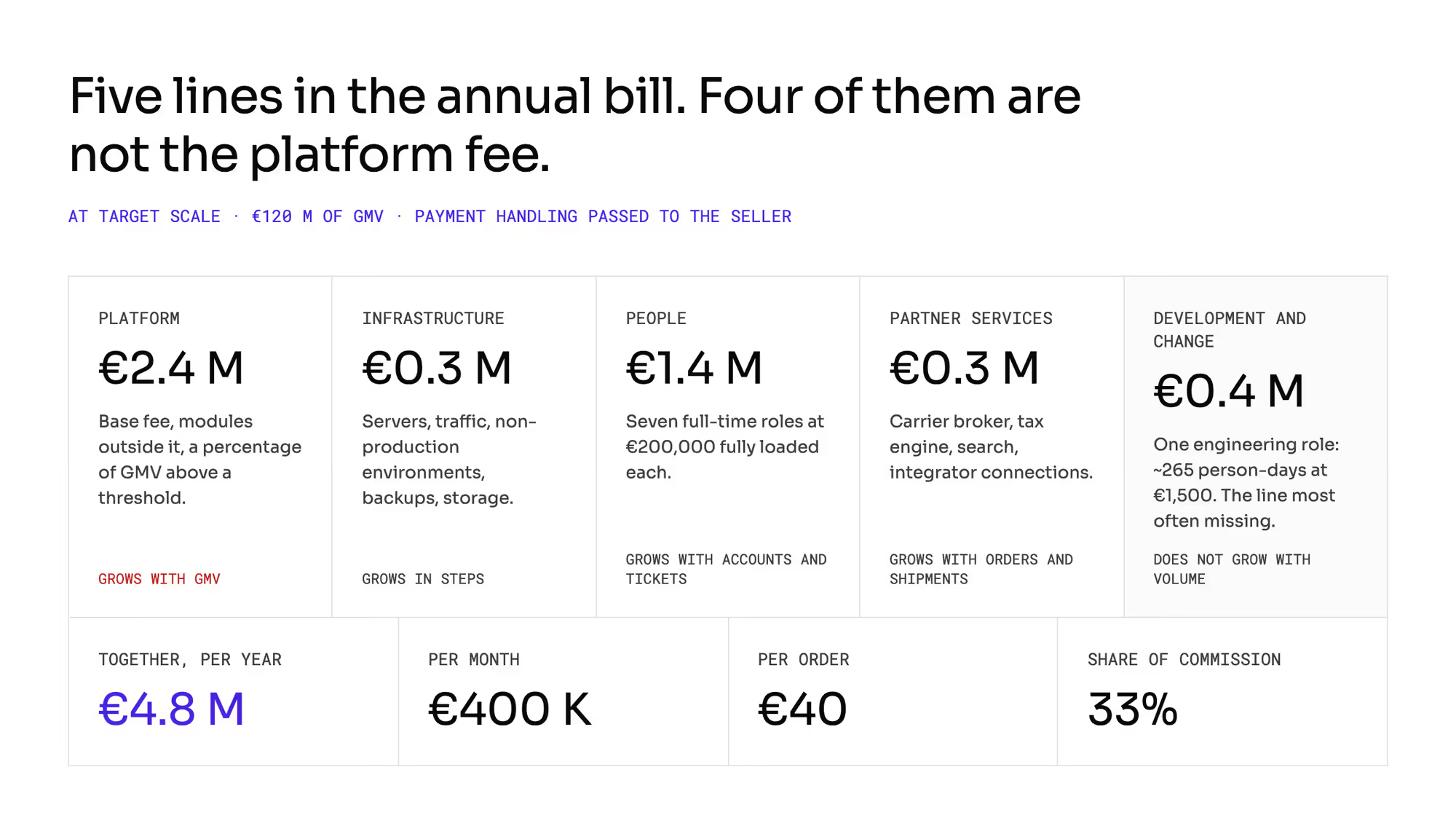
Maintaining a marketplace costs you five lines, and only one of them is the platform fee. The amounts below sit at target scale, and they assume you pass the payment handling fee to the seller as a separate line and keep it out of your commission.
Take that fee on yourself, and you add a sixth line. One and a half percent of €120 million is €1.8 million a year, and the amount doubles as soon as your sellers double what they sell.
1. Platform
Platform costs €2.4 million a year at this scale. The line holds the base fee and the modules outside the base price, plus a percentage of GMV above an agreed threshold. Read the marketplace platform scope for what a base price usually includes.
Practitioners describe contracts in which the vendor bills the advertising module as a percentage of the revenue it generates, and you should count that as a GMV fee on a narrower base.
2. Infrastructure
Infrastructure costs €0.3 million. The line covers servers, traffic and data storage, plus backups and every environment other than production.
You buy capacity in jumps, and this line grows in steps. Read marketplace configuration management for how many environments you need.
3. People
People cost €1.4 million, which is seven full-time roles at €200,000 of fully loaded annual cost each. Those seats go to category managers, onboarding, seller support, settlements, and catalog quality.
Read the eCommerce team structure for who they are and what each of them does all day, and count the roles there before you accept this line as yours.
4. Partner services
Partner services cost €0.3 million. You pay a carrier broker, a tax engine and a search engine, plus the fees for every connection your seller integrators keep open to your platform.
These costs grow with the number of orders you take and the shipments your sellers send, and the size of the cart makes no difference to them.
5. Development and change
Development and change costs €0.4 million, and most maintenance budgets leave the line out. The spend looks like part of the implementation, and it is fixed and annual.
The amount is the equivalent of one engineering full-time role, or roughly 265 person-days at €1,500. You pay it for a new field required by a regulation and for a change at your payment provider. You also pay it to swap one integrator for another, and for things you can't name yet.
Together, the five lines come to €4.8 million a year, or €400,000 a month. That is 4% of GMV and one third of the annual commission of €14.4 million, and at 120,000 orders a year it works out at €40 per order.
Which line grows in a straight line, which in steps, and which not at all?
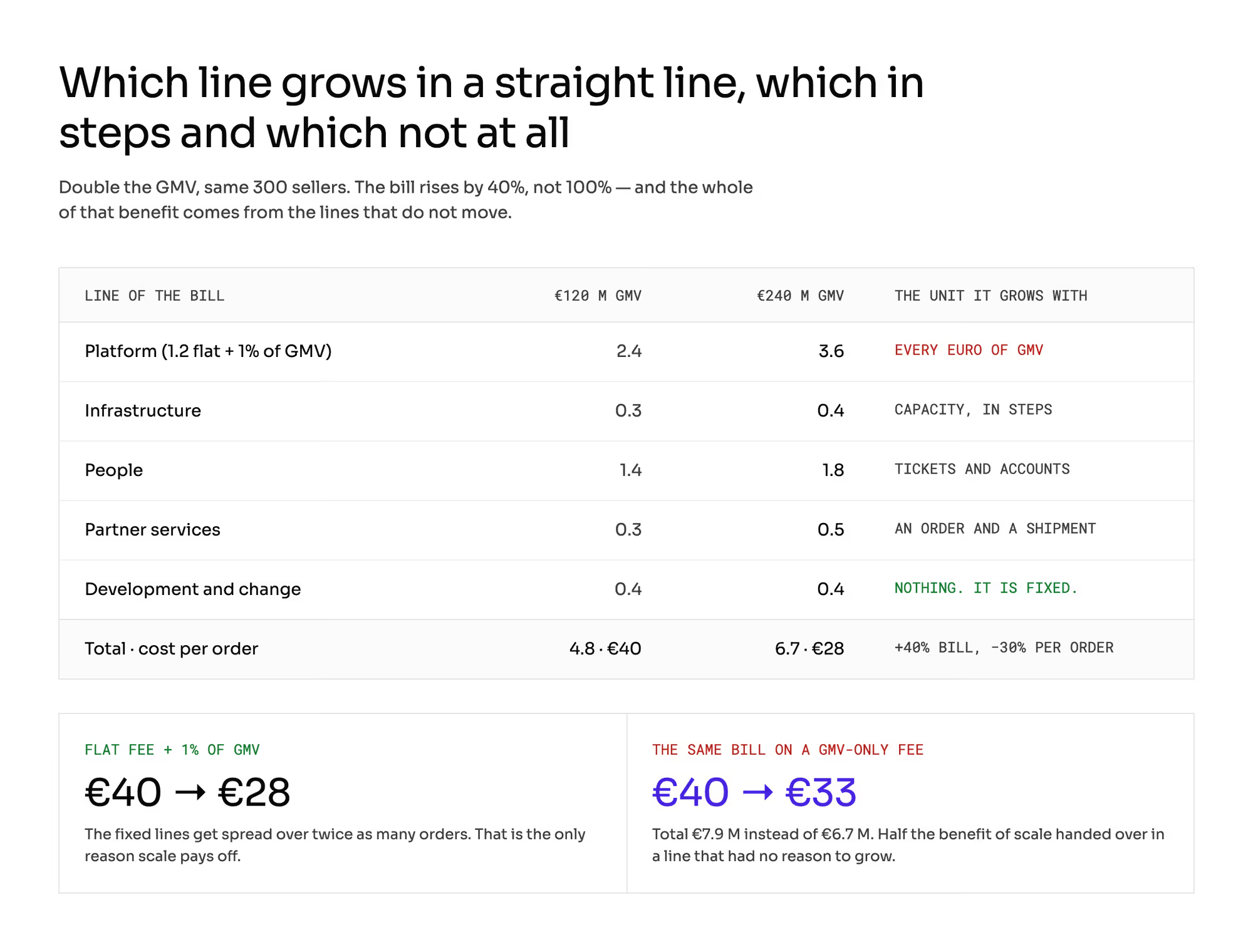
Doubling your GMV changes three of the five lines and leaves two of them alone.
The GMV rose by 100%, and the bill rose by 40%. Because the flat fee, development, and part of the infrastructure are spread over twice as many orders, unit cost falls from €40 to €28.
Put the GMV-only fee into the platform row instead. The platform line becomes €4.8 million, the bill rises to €7.9 million, and unit cost then stops at €33.
Half the benefit of scale goes to your vendor, in a line that carries no extra work for them.
You can also double your GMV the other way, with 600 sellers instead of 300, each of them selling what they sell today. People then become your fastest-growing line, and every new seller brings an account, tickets, and exceptions on top of the parcels.
Ask your board which of those two ways it intends to grow. One GMV target can mean either route, and the two bills differ.
How does a GMV fee land on your thinnest commission category?
Your 12% is an average across a basket of categories, and commission rates differ several times over between them. Consumer electronics sits in the order of a few percent, and clothing and accessories reach the teens or the mid-twenties.
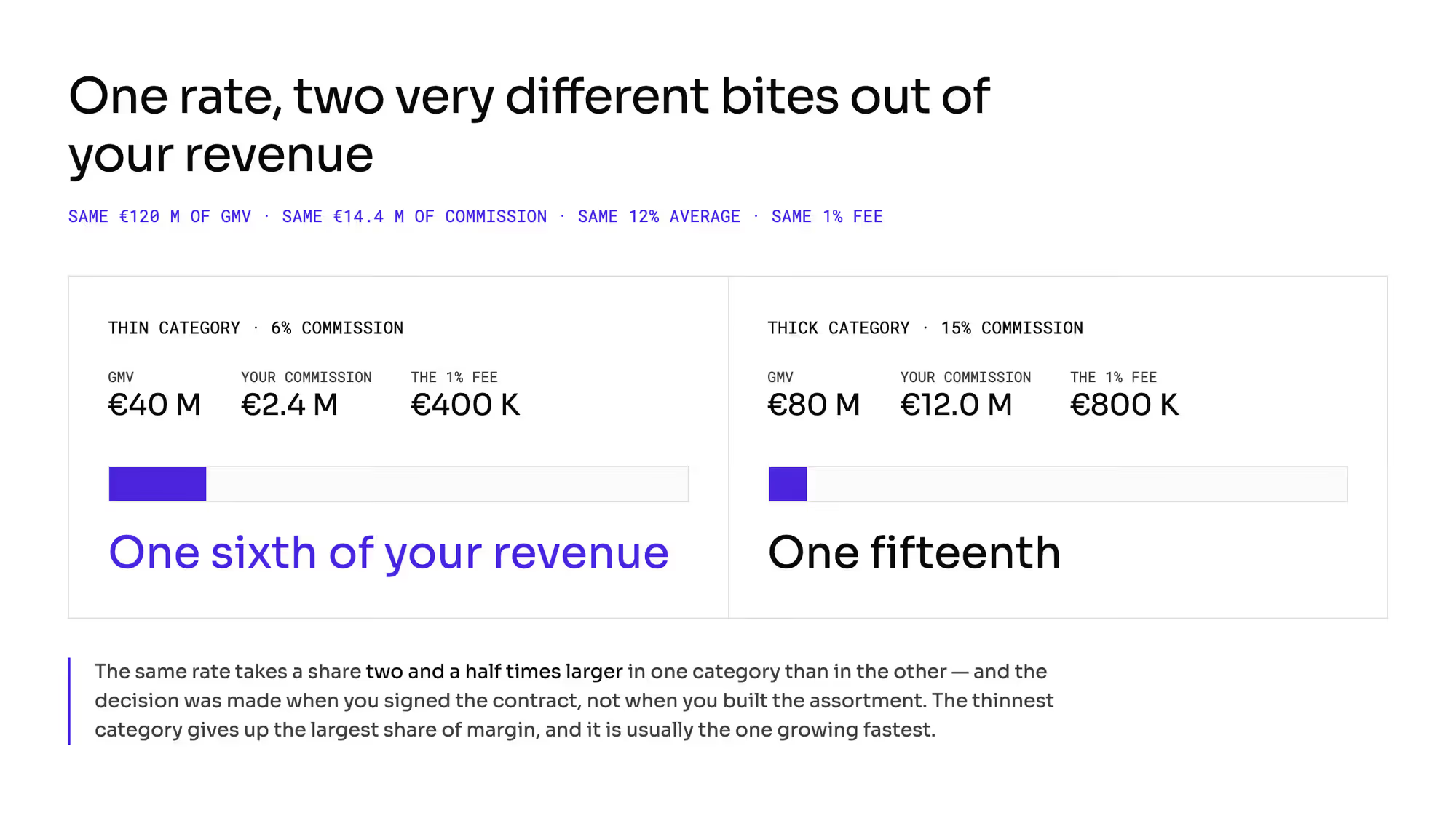
Split the same GMV along that line. You do €40 million a year in a category with a 6% commission and €80 million in a category with a 15% commission. That is €2.4 million plus €12.0 million, and your commission revenue is €14.4 million at a 12% average.
Now charge one percent of GMV on both categories at the same rate.
- The thin category pays €400,000 in fees against €2.4 million of commission. That is one sixth of your revenue.
- The thick category pays €800,000 against €12.0 million. That is one fifteenth.
The thin category hands over one sixth of its commission and the thick one hands over one fifteenth. You signed that outcome into the contract before you knew the assortment. The category with the thinnest commission gives up the largest share of margin, and volume usually grows fastest in that same category.
Check how much of each rate is left after the fee before you set the commission grid. Read how much commission a marketplace can charge for the grid itself.
How do you measure dependence on a platform vendor?
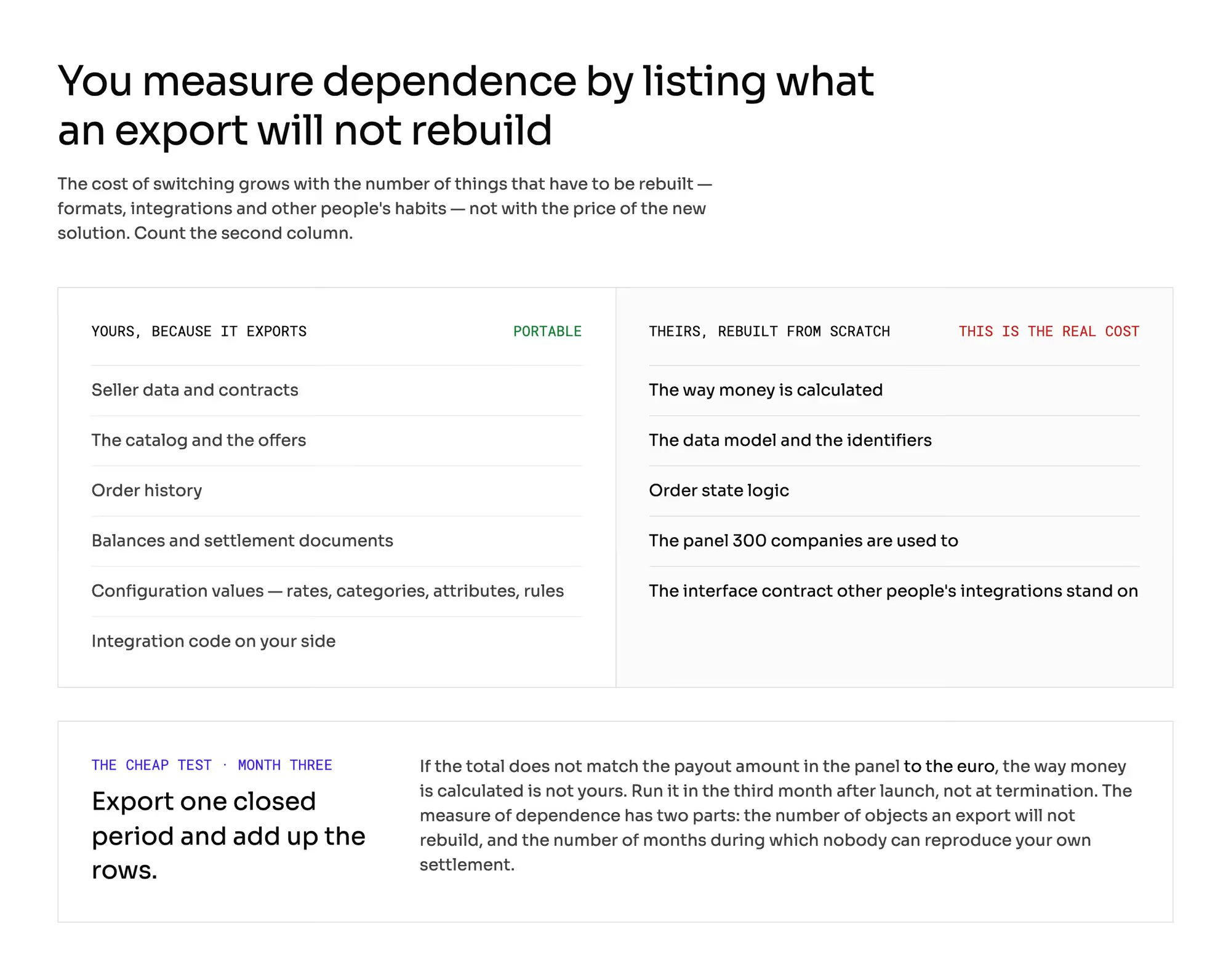
Because warnings about depending on a single vendor usually come from another vendor, treat the claim carefully. The mechanism behind it is real.
Switching costs rise with the number of things your team has to rebuild, and formats and integrations are part of that, as are the habits of 300 seller companies. The licence for the new platform is usually a small part of the bill.
Split your estimate into two columns and count the second one.
Yours, because you can export it:
- Seller data and contracts.
- The catalog and the offers.
- Order history, balances, and settlement documents.
- Configuration settings such as rates, categories, and attributes.
- Integration code on your side.
Theirs, because your team has to rebuild it from scratch:
- The way money is calculated.
- The data model and the identifiers.
- Order state logic.
- The panel of 300 companies are used to.
- The interface contract other people's integrations stand on.
Read API versioning and rate limits for marketplace sellers for what one change to that interface contract costs.
Test that list in the third month after launch. The test takes an afternoon, and it starts with a full settlement export for one closed period that you add up row by row.
If the total doesn't match the payout amount in the panel to the euro, your vendor owns the way money is calculated. Practitioners describe teams spending months rebuilding someone else's arithmetic inside their own reporting.
Count what you can't rebuild from an export. Then count the months your team would need to reproduce one of your own settlements.
Write the exit plan before signature. After signature, you can only request it. Three things belong in the contract:
1. What data do you receive on demand, in what format, and within what time?
Name the format in the clause. Your finance team can add up a file, and they can't add up a PDF of a statement.
2. How many full exports a year come at no charge?
Put a number of free exports in the contract. Without one, your team needs approval every time it wants to repeat the test above.
3. What do you receive if the vendor ceases to exist?
A third-party code deposit sometimes answers this. Code on its own is worth very little without a build environment and documentation. Write the release conditions into the clause.
Read eCommerce migration to a marketplace for the migration itself, which is a separate operation with its own schedule.
Who maintains this after the implementation team leaves?
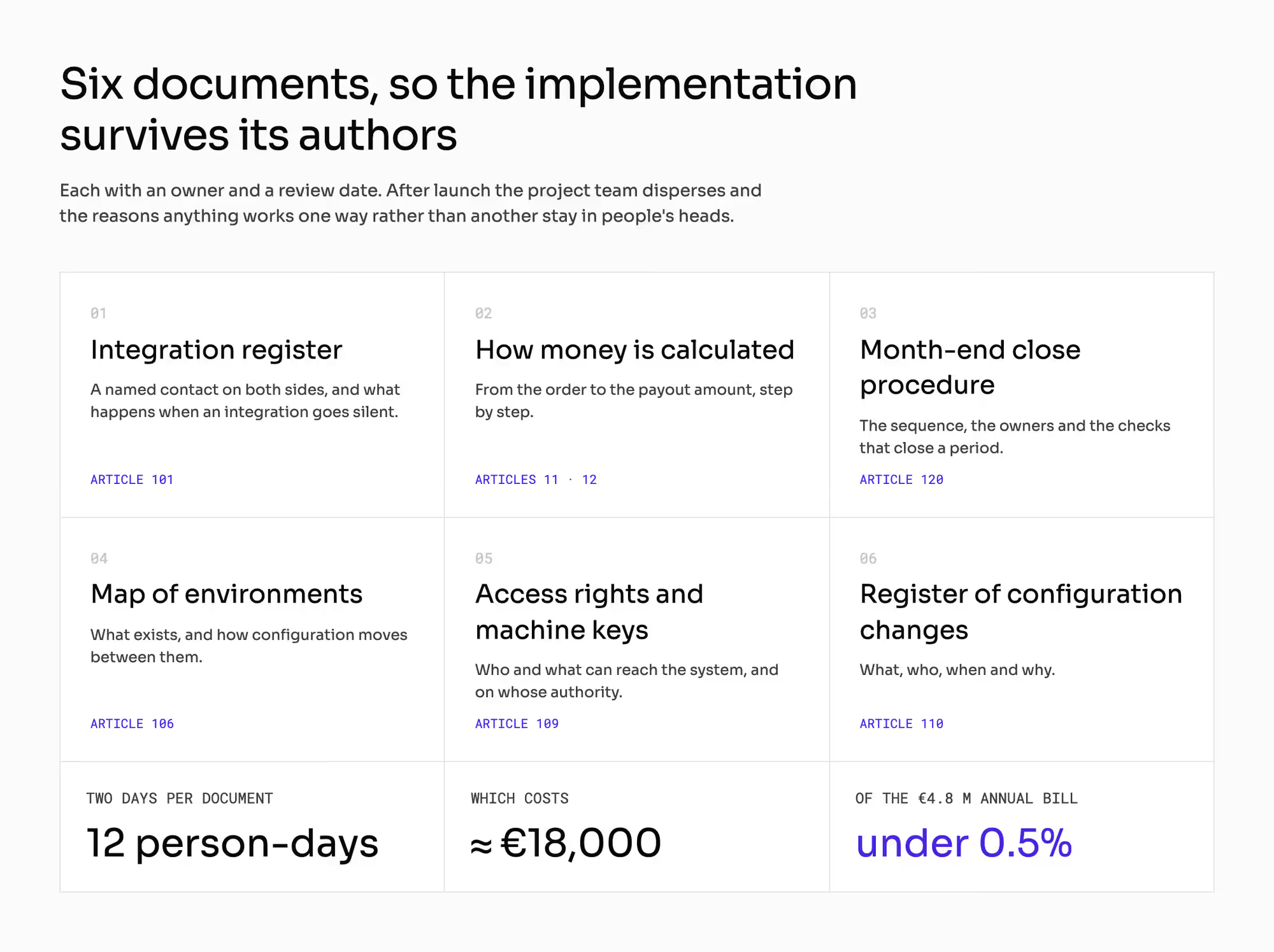
Your project team disperses after launch, and the knowledge of why anything works one way stays in people's heads.
Write six documents so that someone can take the implementation over without its authors, and give each one an owner and a review date. Read the marketplace manager for dependence on people.
1. Integration register
Name a contact on both sides of every integration. Describe what your team does when one of them stops sending data. Read marketplace integrations for which integrations you need.
2. Description of how money is calculated
Follow one order from the moment it lands to the payout amount. Read the marketplace ledger and marketplace payment reconciliation for the mechanics.
3. Month-end close procedure
Write down the sequence of the close week and the seller statements. Read the month-end close process for that week.
4. Map of environments
Draw how a change gets from one environment to the next, and name who can promote it. The chapter on configuration management linked above covers the detail.
5. Register of access rights and machine keys
Record who holds which role, and which integration each machine credential belongs to. Read SSO vs MFA on a marketplace for roles and offboarding.
6. Register of configuration changes
Record what changed, who changed it, when, and why. Read the audit log on a marketplace for what to record and how long to keep it.
Two days per document is twelve person-days, or roughly €18,000, which sits below half a percent of the €4.8 million annual bill. Skip them and the first change in a regulation after the authors leave becomes an excavation. Half the time goes on establishing how your own platform works today.
What does eCommerce TCO change in your marketplace?
1. Construction and base get negotiated together
Negotiate the construction and the base together with the rate. A percentage with no defined base can mean gross GMV including shipping. It can also mean GMV after returns, or selected categories only. Those are three different bills.
2. Maintenance bill comes back to the commission grid
A platform fee that takes a sixth of your commission in a thin category belongs in the conversation about that category's rate. The chapter on marketplace commission linked above covers the rate itself.
3. Implementation spend stays a separate calculation
The spend before launch and the date you reach zero are a separate calculation, and the marketplace business case linked above covers both. Your maintenance bill starts in the month you reach that date.
How do you calculate your own eCommerce TCO in 6 steps?
1. Five rows filled at today's GMV
Fill the five rows at today's GMV. Use your own rates and your own fully loaded cost per role. Fifteen minutes is enough for a first pass.
2. Same table at double the GMV
Repeat the table at double the GMV. Hold your sellers and your offers where they are. The difference between the two totals is the number you negotiate on.
3. Payment handling fee as a sixth row
Add the payment handling fee as a sixth row if your commission absorbs it instead of passing it to the seller. One and a half percent of GMV belongs in your own bill as soon as your commission carries it.
4. GMV split by commission band
Split the GMV by commission band. Check how much of each rate is left after the platform fee.
5. List of what an export leaves behind
List what you can't rebuild from an export. Start with the count of objects, then put a euro figure on them.
6. Settlement export for one closed period
Ask for a settlement export for one closed period. Add up the rows against the payout amount in the panel.
How do you check eCommerce TCO with a vendor?
- What is my bill at double the GMV, with the same number of sellers and offers? Ask for it line by line.
- What is the percentage calculated on, and at what threshold does it switch on? Ask whether that threshold holds for the whole term. Ask whether a return reduces the base and whether shipping goes into it.
- Which lines sit outside the base price, and how is each one billed? A vendor who bills a module as a percentage of the revenue it generates is charging you a second GMV fee.
- How many regulation-driven changes are included in the price each year? Ask who performs them and within what time.
- Does a full export reproduce the amounts from the panel to the euro? Ask for a sample of one closed period before signature.
- What do I receive if you cease to exist? Ask which data and which documentation, and ask who rules that the release condition has been met.
Which mistakes do operators make with eCommerce TCO?
1. Bill calculated at today's GMV
Two offers cost the same today and differ by €1.2 million a year once the company succeeds. You learn that from the invoice, and the difference was in the price list on the day you signed.
2. GMV fee carried into a thin category with no arithmetic
You grow fastest in the category that leaves you the least of every euro, and for a year it looks like a volume success.
3. Export mistaken for an exit plan
Your team can't reproduce the panel's amounts from the file, and you have a set of numbers with no way to change vendors.
4. Maintenance costed without the development line
The budget balances to zero in a year in which no regulation and no integration changed. Your marketplace hasn't had such a year yet.
What do you still have to settle about eCommerce TCO?
You still have to calculate the implementation spend and the date you reach zero, and you still have to plan the migration to another platform. Read the marketplace business case and eCommerce migration for both.
The choice between buying and building is a separate question, and the marketplace platform scope covers it. An employee who leaves takes knowledge with them, and the marketplace manager covers that kind of dependence.
You depend on your vendor for the objects you can't export, and on your people for everything they never wrote down.
Ask a lawyer before you enter a multi-year contract. Read marketplace GDPR for handing over seller and buyer data on an export or a change of vendor. Read the P2B Regulation for your information duties toward sellers when you change the rules.
Read marketplace order documents for how long you keep settlement documents. Their tax content sits in marketplace invoicing, marketplace e-invoicing, and marketplace credit notes.
Go through four families of regulation with your lawyer:
- Protection of personal data.
- Transparency in the platform-to-seller relationship.
- Data portability and changing providers of digital services.
- Retention of accounting records.
Every amount in this chapter comes from an invented platform. Fill the five rows with your own rates in fifteen minutes, and the arithmetic still holds.
Summary: How do you calculate eCommerce TCO for a marketplace?
Your five annual lines are platform, infrastructure, people, partner services, and development and change. At the reference scale, they come to €4.8 million a year, or €40 per order.
Then calculate the same five at double the GMV. Doubling the GMV raises the bill by 40% and drops unit cost to €28, and a fee charged on GMV alone takes you back to €33.
Check what the fee leaves you in your thinnest category before you set the commission grid. One percent of GMV costs you a sixth of your commission at a 6% rate and a fifteenth at 15%.
Count what you can't rebuild from an export. Ask for a settlement export in the third month after launch. Write the six handover documents while their authors are still on the project.
Want to see your bill at double your GMV before you sign a multi-year platform contract?
Frequently asked questions on eCommerce TCO
What is eCommerce TCO?
eCommerce TCO is the total cost of ownership of an eCommerce or marketplace platform across the years you keep it. It covers the platform fee, infrastructure, people, partner services, and the annual spend on development and change. The contract price is one of those five lines.
How do you calculate total cost of ownership for a marketplace platform?
Add up five lines for a full year: the platform fee, infrastructure, people, partner services, and development and change. Then recalculate the same five at double your sales volume, holding the number of sellers and offers where they are. The gap between the two totals tells you what the fee construction will cost you as you grow, and the contract price on its own never shows it.
What is a GMV fee on a marketplace platform?
A GMV fee is a platform charge calculated as a percentage of the turnover your marketplace handles. You pay more as you sell more, and your use of the system stays flat. The fee takes the largest share of your commission in your thinnest categories.
Ready to build?
We build marketplaces whose settlement arithmetic you can reproduce from your own export, to the euro.