
How Much Commission Can a Marketplace Charge?

How much commission a marketplace can charge is settled by the seller's arithmetic rather than by your target margin. The rate is the price of access to your demand, and a price has one property that matters here, which is that it can go unpaid.
The commission is the one number a seller will compare against another channel before they upload a single product to you. Set it by starting from your own financial model, and you will learn about the mistake only when the category you cared about turns out to have no offers in it.
At that point, you will decide the category is weak.
This article breaks down:
- Why does the seller's alternative set your rate?
- Which dimensions can a rate vary by?
- When does a percentage rate stop working?
- What else does the seller pay you?
Key insights
- The seller's alternative sets your rate, because your 12% of a €1,000 price is 46% of their margin: once their own store leaves them €160 against your €140, your catalog fills with whatever they cannot sell elsewhere.
- A rate can vary by six dimensions, which are category, condition, brand, seller group, period, and volume, and you will maintain two of them and three with difficulty, because every grid is typed in by hand, category after category.
- A percentage rate stops working on cheap orders: €4.80 on a €40 order against €6 of handling loses €1.20 every time, which is €60,000 a year at 50,000 such orders, so the grid needs a floor or a flat element beside the percentage.
- The seller pays you on six lines, and the flat ones are regressive: at 12% plus €200 a month and €2 an order, a large seller pays an effective 12.4% and a small one 14.2%, so the long tail carries the fixed fees.
Why does the seller's alternative set your rate?
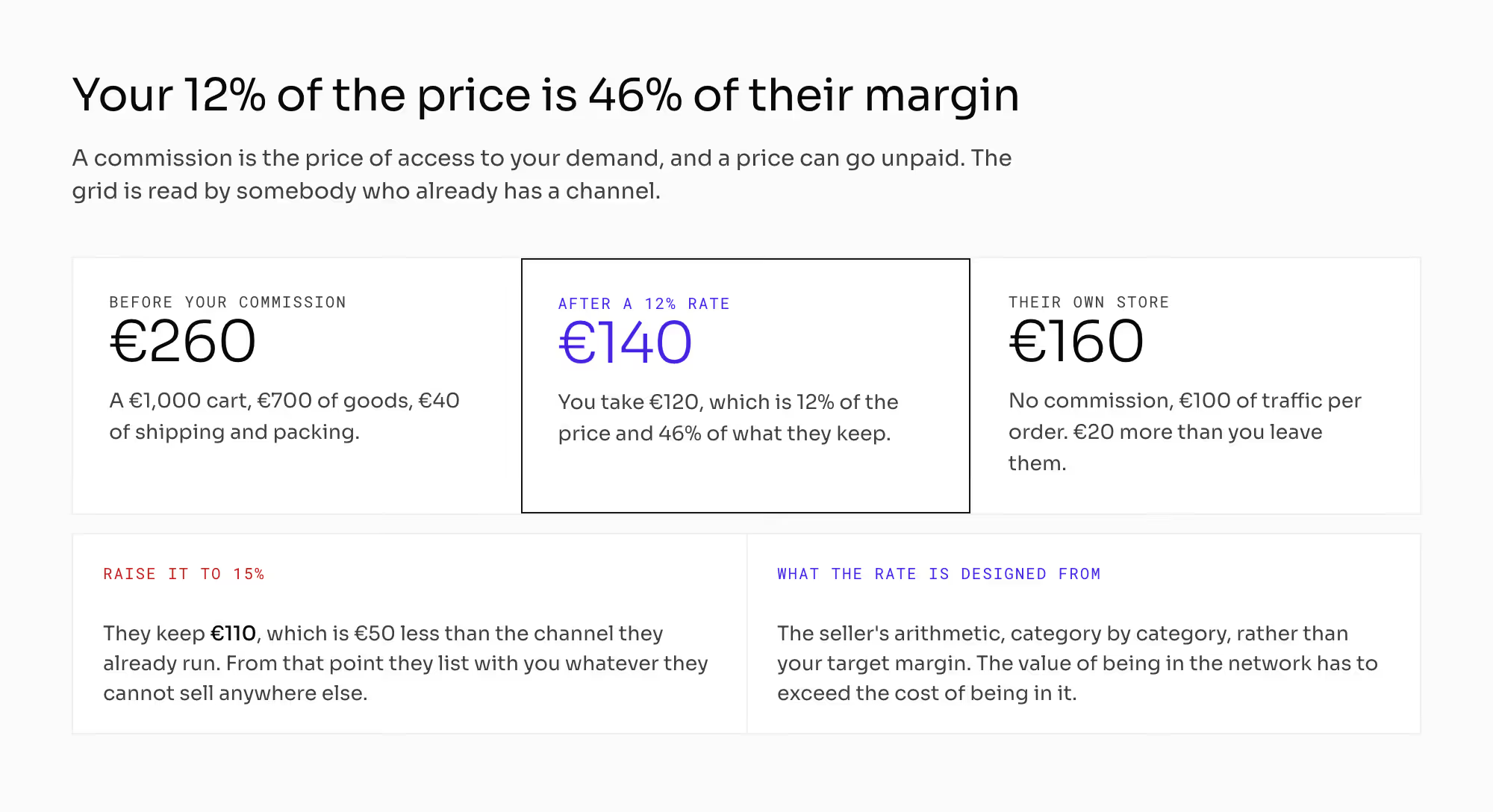
A commission is the price of access to your demand. A price has one property that matters here: it can go unpaid.
Take the canonical example of this series: a cart of €1,000, a commission of 12%, and €880 left for the seller. The numbers are hypothetical and picked so that the arithmetic stays easy to follow.
To you, that €120 is 12% of the price. To the seller, it is not 12% of anything.
Assume the goods cost them €700, and shipping and packing cost another €40. Before your commission, they were keeping €260.
After it, they keep €140. Your 12% of the price is 46% of their margin.
Now, their alternative. The same goods in their own store: they pay no commission, but they pay for traffic.
Call it €100 per order. That leaves them €160, which is €20 more than they get from you.
Your channel still enters the game, because your traffic is already there. Raise the rate to 15%, and they keep €110.
That is €50 less than the channel they already run. At that point, they will list with you whatever they cannot sell anywhere else, and that is exactly what you should expect to find in the catalog.
This arithmetic, rather than your target margin, is the starting point. You design the grid from the seller's arithmetic, one category at a time.
Observers of platform markets put it as a single condition for durability: the value of being in the network has to clearly exceed the cost of being in it, and a rate set too high does not so much raise your revenue as push supply into other channels.
Which 6 dimensions can a commission rate vary by?
The tools on the market go about equally deep here, though their lists of dimensions differ in the details. The set that repeats looks like this:
1. Category
The primary dimension and the only one with a natural economic justification: the category is what carries the seller's margin.
2. Condition of the goods
New, ex-display, refurbished, used.
The same product in worse condition has a lower price and a thinner margin, so an identical percentage rate means something different to the seller.
3. Brand or supplier
Sometimes a separate dimension alongside the category, and it usually serves one purpose: to let in a brand that otherwise could not afford to come in.
4. Seller
By assigning them to a different grid rather than typing a private rate against their name.
It looks like a detail, and it is the difference between a policy and an exception.
5. Period
A rate that runs from one date to another date, usually for the start of a relationship or for a season.
6. Volume and price band
They exist in the tools, but they belong to thresholds, caps, and negotiated rates, because they follow a different logic: this is no longer the grid, it is a departure from it.
The mechanics repeat from one tool to the next. A grid has a default rate that flows down the category tree, and specific rules override it.
The rules are ordered, and the first match wins, so their order is part of the rate. The number of grids carries a price too: each one is a separate object to maintain whenever the price list changes, and the rates are typed in by hand, category after category.
With a few thousand subcategories, a typo is a matter of time rather than competence. That is why keeping the grid consistent with the document the seller signed gets a chapter of its own (the rate in the system against the signed document).
A practical limit: you will maintain two dimensions, three with difficulty. Category plus condition of the goods is manageable.
Category plus condition plus brand plus period plus seller group produces a matrix nobody will read in full, and the person who has to read it is the one running the commercial conversation.
Why is one rate for the whole catalog a choice of assortment?
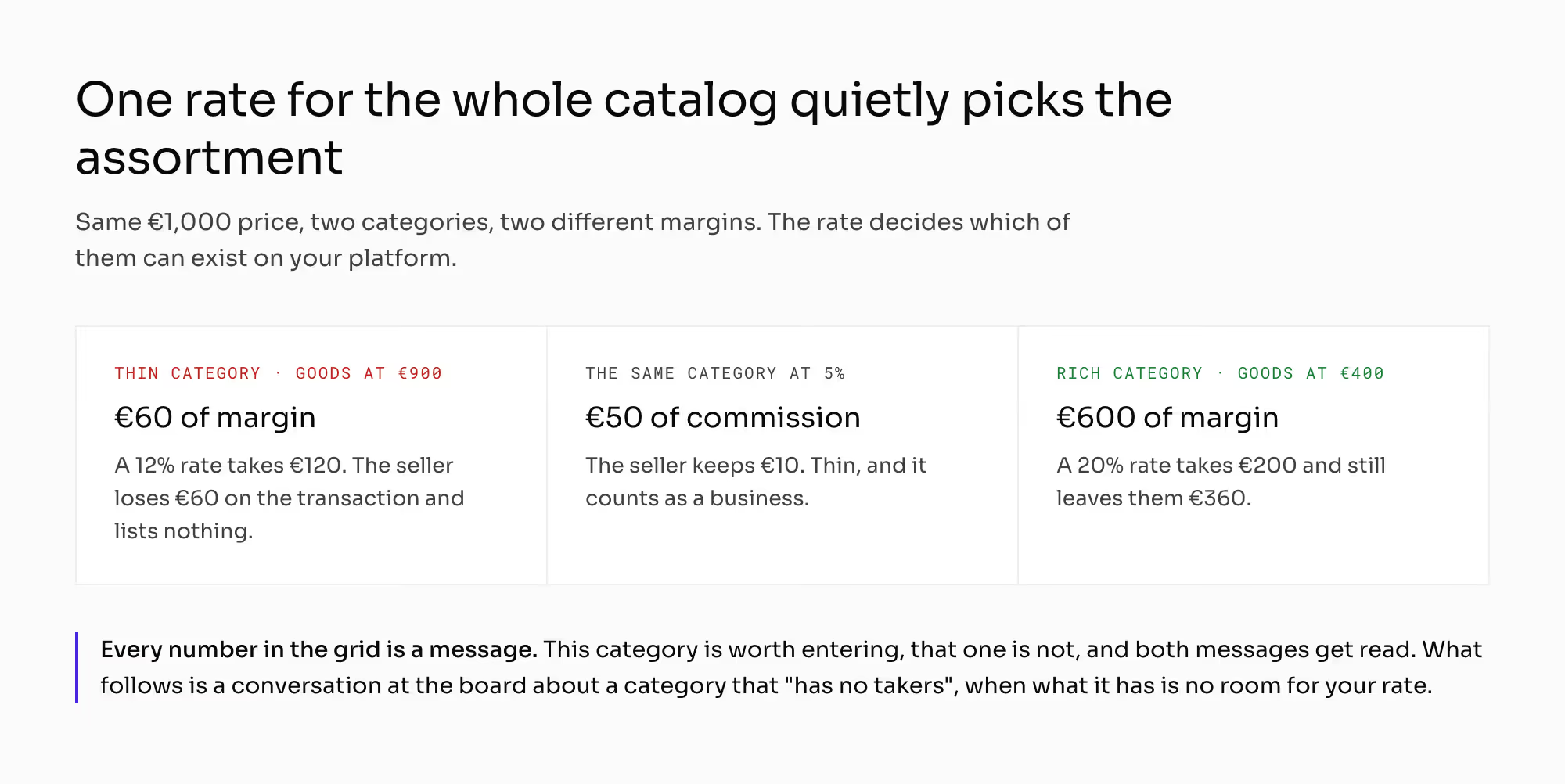
This is the heart of it. Go back to the seller's arithmetic, this time in a different category.
Goods sold for the same €1,000, but bought for €900, with €40 of shipping, leave the seller €60 of margin before your commission. Your 12% is €120.
The seller loses €60 on the transaction and will not list a single unit. For that category to exist at all, the rate has to come down to somewhere near 5%.
The commission is then €50, the seller keeps €10, and that is thin, but it counts as a business. The other way round: a category where they buy at €400 and sell at €1,000 will carry 20% (€200) and still leave them €360.
Hence a conclusion that never shows up in a finance spreadsheet: a single rate for the whole catalog is a quiet choice of assortment rather than a neutral decision. It picks the high-margin categories and rules out the volume ones.
Then the recruitment team explains to the board that in that category "there are no takers." There are takers. There is no room for your rate.
Every number in the grid is therefore a message: this category is worth entering, that one is not. Before you set it, know which message you are sending, because both of them will be read.
When does a percentage rate stop working?
A percentage rate is the default, and it scales with the price, but it has one place where it stops working: cheap orders.
A €40 order at a 12% commission gives you €4.80. Handling that order (taking the payment, any support request, the settlement and the payout) costs you, say, €6.
You lose €1.20 on every transaction you wanted more of. At 50,000 orders like that a year, that is €60,000 of loss generated by growth.
The market solves this in two ways, and both of them can be combined with a percentage rate. The mix: 12% plus €2 an order turns that €40 order into €6.80 and the €1,000 cart into €122.
The floor: the commission is 12%, but never less than €6. The construction "a percentage or a minimum amount, whichever is higher" is a standard, and so is a flat fee in categories with a low unit value.
A flat amount on its own, with no percentage, is useful where you do not want an argument about the base the commission is calculated on. It does not scale with the price, and on more expensive assortment it hands almost all of the upside to the seller.
What do a commission floor and a cap protect?
These are two thresholds inside the published grid rather than exceptions for a chosen few.
The floor is the minimum commission amount on a transaction. At a 12% rate, a floor of €6 starts to bite below a price of €50, because 12% of €50 is exactly €6.
Below that the seller pays proportionally more: on a €40 order, that €6 is 15% of the price.
The cap is the maximum commission amount on a transaction. At a 12% rate, a cap of €300 starts to bite above a price of €2,500.
A €10,000 piece of equipment would cost the seller €1,200 in commission. With the cap, it costs €300, an effective rate of 3%.
Practitioners who recruit in high-price categories describe the cap as the condition for starting the conversation at all: on large amounts, even a low rate produces a figure no distributor will accept.
The floor and the cap apply to everyone who was given that grid. A cap negotiated individually for one seller is a different thing, and it has a chapter of its own: thresholds, caps and negotiated rates.
Which 5 rate constructions can a marketplace choose from?
Rate construction | Commission on a €40 order (€) | Commission on the €1,000 cart (€) | Commission on a €10,000 order (€) | Effective rate on the €1,000 cart (% of price) | What it protects |
|---|---|---|---|---|---|
Percentage only (12%) | 4.80 | 120.00 | 1,200.00 | 12.0% | simplicity and comparability |
Percentage plus amount (12% + €2) | 6.80 | 122.00 | 1,202.00 | 12.2% | the profitability of cheap orders |
Amount only (€5 an order) | 5.00 | 5.00 | 5.00 | 0.5% | no argument about the calculation base |
Percentage with a floor (12%, min. €6) | 6.00 | 120.00 | 1,200.00 | 12.0% | the long tail, with no loss on it |
Percentage with a cap (12%, max. €300) | 4.80 | 120.00 | 300.00 | 12.0% | the presence of high-price categories |
Which other lines does a seller pay you on?
The level of the commission only makes sense in the context of the rest of the bill, because the seller compares the total. The full map looks like this:
- A subscription. A fixed fee for a period, independent of sales. It is sometimes an alternative to a higher commission, and it moves risk onto the seller.
- A fee per order or per line. It covers the handling cost described above directly.
- Fulfillment fees. These apply when you warehouse and ship on the seller's behalf.
- Penalty fees. For cancellations, missed deadlines, service quality.
- Advertising and paid visibility. A separate line with economics of its own, selling paid visibility. Public estimates put advertising at the shelf at around one-fifth of digital advertising spend, so this is a line of the same class rather than an add-on to the commission.
- Paid services for sellers. Data, analytics, help with listing. Each one with a contract of its own.
Add the total up at a 12% rate, a subscription of €200 a month, and a fee of €2 per order. A large seller: 100 orders at €1,000 is €100,000 of turnover, €12,000 of commission, €200 of subscription and €200 of fees.
Together, that is €12,400, or 12.4%. A small one: 10 orders at €1,000 is €10,000 of turnover, €1,200 of commission, €200 of subscription and €20 of fees. Together, that is €1,420, or 14.2%.
The flat elements of your grid are regressive: the smaller the seller, the higher the rate they really pay. It is worth saying out loud at the committee that fixed fees push out the long tail, which is exactly the assortment the marketplace was built for.
A single average will not show this. An effective rate computed across your whole GMV is dominated by the largest sellers, so it shows you the rate paid by the ones who will stay anyway.
Compute it in bands of seller size.
What does the commission grid change about the rest of your build?
1. A rate without a base is not a rate
Which amount you calculate it from, where and when the payment is split, and who bears the fee for processing the payment: four independent parameters, all of them in split payments and who pays the fees. A 12% commission on two different bases is two different numbers.
2. A refund has arithmetic of its own
Whether the commission goes back to the seller, and what part of it does, is settled by the commission on a refunded order. A grid that adds up beautifully on sales comes apart in a category with a high proportion of returns.
3. The commission is not your revenue yet
Whether your books show €120 or €1,000 is settled by "Marketplace Revenue Recognition: Do You Book the Commission or the GMV?". Every commission and every fee enters the ledger as a separate, named line: the ledger behind a balance and payment reconciliation.
4. Changing a rate changes the terms of the relationship
How you inform sellers sits in the rules on decisions about sellers and the documents you sign with a seller. Treat the date a new grid takes effect the way you treat the date an amendment to a contract takes effect.
5. Promotions, codes and loyalty are all paid out of the same amount
Campaigns, codes and points all draw on the same amount: campaigns on somebody else's assortment, discount codes and who funds them, and loyalty points on somebody else's offers. Price parity is covered in the chapter on how far you can control a seller's price.
How do you work out your own commission grid?
- Build the seller's arithmetic in every category you want to have. Price, cost of goods, shipping, returns. What comes out is the margin your commission has to fit inside.
- Price their alternative. What one order costs them in the channel they already have. If you do not know, ask three sellers from that category. They will answer, because it is a number they live with every day.
- Work out your own cost of handling one order and check the price at which the percentage rate stops covering it. That is your floor.
- Check the top end. Which commission amount kills the commercial conversation in a high-price category? That is your cap.
- Add up all the lines and compute the effective rate separately for a small, a mid-sized, and a large seller.
- Work out how many grids you will maintain. Not how many you need. How many somebody will realistically update when the price list changes, without getting it wrong.
One control question for the vendor demo: show us a commission rule as an object. What can it be defined by, what is the order of the rules, does it have a validity date, and can it be set through the API or only by hand? The last part settles whether your grid is a policy or a monthly task for a human being.
Which mistakes do operators make about commission rates?
1. Setting the rate from your own target margin
The number comes out of the finance model, goes into a presentation, and only recruitment discovers that in half the categories it leaves the seller nothing.
2. One rate for the whole catalog
Convenient and fair-looking, and in practice it picks the assortment for you.
3. A percentage with no floor
Growth in the number of cheap orders makes your result worse. That one is unusually hard to explain to a board.
4. No cap in a high-price category
The category simply never comes into being, and nobody connects that to the rate.
5. Too many dimensions at once
A matrix a salesperson cannot summarize is a source of disputes and corrections rather than a grid.
6. A penalty fee with no reference to the value of the order
A €50 penalty on a €40 order leaves the seller €10 underwater on a transaction that never happened.
What do you still have to settle about your own grid?
This is a map of mechanisms rather than legal advice. Confirm four things by name before you publish a grid:
- Whether and how you may differentiate rates between sellers, and what conditions you can attach to a lower rate. This is the area of competition law, which is also where the price parity questions in how far you can control a seller's price come from. A lawyer.
- How you change terms toward business sellers, and with how much notice. This is the area of regulations on transparency in platform-to-seller relations, covered from the operational side in the rules on decisions about sellers. A lawyer.
- How you label paid visibility when one of your revenue lines influences the order in which offers appear. This is the area of rules on advertising and fair commercial practices, and the address for it in this series is set out in the chapter on price history and discount messages. A lawyer.
- How you document and tax the commission and the fees. The document side is explained in the chapter on who issues which invoice. Whether the rate matches the commercial document is the rate in the system against the signed document. A tax advisor.
Our claim is narrower and independent of those answers: a rate cannot be designed without the other side's arithmetic. That is the only part of the problem you settle on your own, and before launch.
Summary: How much commission can you charge?
As much as the seller's margin leaves after their own alternative, which is a different number in every category and never the one in your financial model. Your 12% of the price is 46% of what they keep, and the channel they already run costs them €100 per order, so the gap between those two figures is the whole negotiation.
Everything else in a grid follows from it. Category is the only dimension with an economic justification behind it, because the category is what carries their margin.
A single rate across the catalog quietly picks your assortment, and the categories it rules out are the ones recruitment will later describe as having no takers. And the fixed elements you add for safety fall hardest on the smallest sellers, which is the assortment the marketplace was built to carry.
Ask a vendor to show you a commission rule as an object: what it can be defined by, in what order the rules match, and whether it carries a validity date. Building a marketplace where the grid is a policy rather than a monthly task for a person?
Frequently asked questions on marketplace commission rates
How much commission do marketplaces charge?
Marketplace commission is whatever still leaves the seller a margin after the channel they already have, which is why the same platform runs 5% in one category and 20% in another. Goods bought at €900 and sold at €1,000 carry €60 of margin, so a 12% rate takes €120, and the category never gets listed. Work the rate out from their side of the table, category by category.
Should a marketplace charge a flat fee or a percentage?
A percentage scales with the price and a flat amount covers the cost of handling an order, so most grids end up carrying both. A €40 order at 12% brings in €4.80 against roughly €6 of handling. A mix of 12% plus €2, or a floor of €6, turns that order profitable without touching the rate on an expensive cart.
What is a commission floor and a commission cap?
A floor is the minimum commission on a transaction and a cap is the maximum, and both apply to everyone holding that grid. At a 12% rate, a €6 floor starts to bite below €50, and a €300 cap starts to bite above €2,500, which turns a €10,000 order into an effective 3%. In high-price categories the cap is often the condition for having the conversation at all.
Ready to build?
We build marketplaces where a commission rule is an object with dimensions, an order of matching, and a validity date.