
Sales Compensation Plan for a Marketplace: Who Gets Credit for 1P and 3P Sales

A sales compensation plan is the set of rules that decides what each person in your company gets paid. This chapter covers the four bases a marketplace bonus can sit on, the address third-party sales get credited to, and the protection you put on a result you're about to take away.
Your own goods are 1P, and a seller's goods are 3P. Both arrive through the same product page, and your bonus plan usually pays for one of them.
Your board announces a direction once a year, and your people are paid under the bonus plan twelve times a year. When those two messages differ, people follow the pay.
A year later, you read a report that shows weak demand. The real cause is an absence of a reason to sell.
This article breaks down:
- Why does your sales compensation plan beat the board's announcement?
- Which 4 calculation bases can a marketplace bonus sit on?
- Who gets credit for third-party sales on your marketplace?
- How do you split credit between a country and the group?
- Which measure shows that your sales incentive structure works?
Key insights
- Your sales compensation plan says what each person gets paid for. That makes it the strategy your company executes.
- A bonus on third-party GMV pays your team to cut the commission. Volume rises, and your commission falls, and the bonus base grows on the volume alone.
- No one argues for third-party sales when no result depends on them. Every decision about letting a brand in then settles at its default answer, and the default is no.
- Protecting a unit's result costs less than the delay that resistance adds to your ramp. Put the protection in the budget with a step-down schedule and an end date.
- The spread between comparable units tells you whether the plan works. Average those units together and the whole difference your plan made disappears.
Why does your sales compensation plan beat the board's announcement?
Your bonus rules carry more weight than a board resolution. They say what a person gets paid for, and your people read them more carefully than any other document in the company.
The direction is obvious, and no one objects in the meeting. Then a seller's offer never reaches the customer. The unit that was supposed to prepare a seller for a foreign market does that work in the last week of the quarter.
No one blocked anything, and everyone did exactly what you pay them to do. The first year produces no event you could react to.
Economists call the mechanism multitasking. A person with several jobs puts their effort into the one you pay for, and the other jobs stop getting done.
A measure that becomes a target also stops being a good measure, and individual pay for results lowers how willing people are to help each other.
Resistance department by department belongs to organizational change management on a marketplace. The payout on a single order and the argument with one sales rep belong to channel conflict on a marketplace.
This chapter keeps the mechanics of the plan: your board settles the calculation base and the address of the credit before the first period opens. It also settles the protection on a result you take away.
Which 4 calculation bases can a marketplace bonus sit on?
The calculation base matters more than the size of the bonus. The size decides how hard a person tries, and the base decides which way they try.
Every number in this chapter comes from the series reference platform at target scale: 10,000 orders a month, 300 sellers, a €1,000 cart, and a 12% commission. That gives €10 million of GMV and €1.2 million of commission a month, or €14.4 million a year.
Which base do you calculate the bonus on? | What is the base worth at target scale (€ million a month)? | Which behavior does the base pay for? | What does that behavior cost you? | When is the base right? |
|---|---|---|---|---|
Third-party GMV | 10.00 | cutting the commission and letting every seller in | €1.98 million a year, going from 12% to 9% | the first 2 to 3 quarters, while supply is short |
Third-party commission | 1.20 | raising the rate and dropping thin categories | €2 million of GMV a month and 60 sellers | once you have reached supply mass |
Margin on your own goods | 0.00, because 3P doesn't enter it | blocking someone else's offer in your own category | up to €14.4 million of commission a year | never, once you have a marketplace |
Unit's combined result | own margin + 1.20 | choosing the cheaper source of the same sale | one definition of both components | as the target, after the transition period |
1. Third-party GMV
Third-party GMV pays for volume and punishes price. A team on this base raises its own number by cutting the commission.
Go from 12% to 9% and assume GMV rises 15%, to €11.5 million. The bonus base grows by that 15%, and commission falls to €1.035 million (€11.5 million × 9%). That costs you €165,000 a month and €1.98 million a year.
Use this base for the first two or three quarters while supply is short, and put its end date in the same document that announces it.
2. Third-party commission
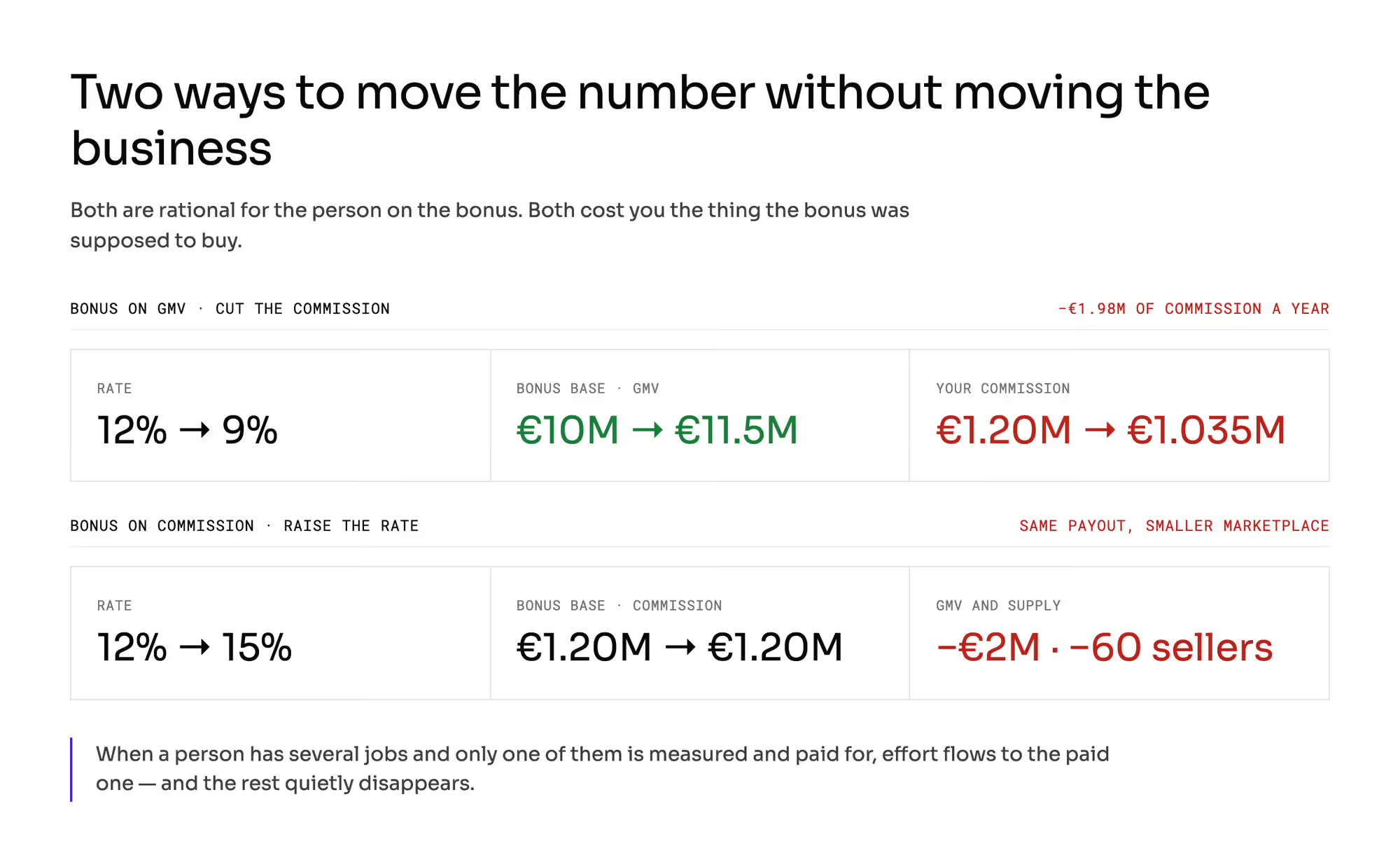
Commission pays for the rate and punishes supply. Raise the rate from 12% to 15% and you lose 20% of GMV on it.
The bonus doesn't change. €8 million × 15% is exactly €1.2 million, and GMV is €2 million a month lower. The marketplace has 60 fewer sellers, or 20% of 300.
Each of those decisions is rational for the person on the bonus, and each one costs you what the bonus was meant to buy.
3. Margin on your own goods
Margin on your own goods contains no third-party sales at all. It's the most common base in trading companies, and blocking someone else's offer pays in full on it.
Someone else's offer is worth zero to the person on that bonus and costs them real time. For anyone on this base, €14.4 million of commission a year sits outside their own result.
4. Unit's combined result
Combined result pays for the cheaper source of the same sale. Aim at it as the target base after the transition period.
Your own margin and the third-party commission land in one number. A seller's offer then stops competing with the person who decides whether to show it.
One definition of both components has to exist first, and marketplace analytics starts there. Until both are calculated the same way in both reports, you can't defend this bonus in front of the person who earned it.
Who gets credit for third-party sales on your marketplace?
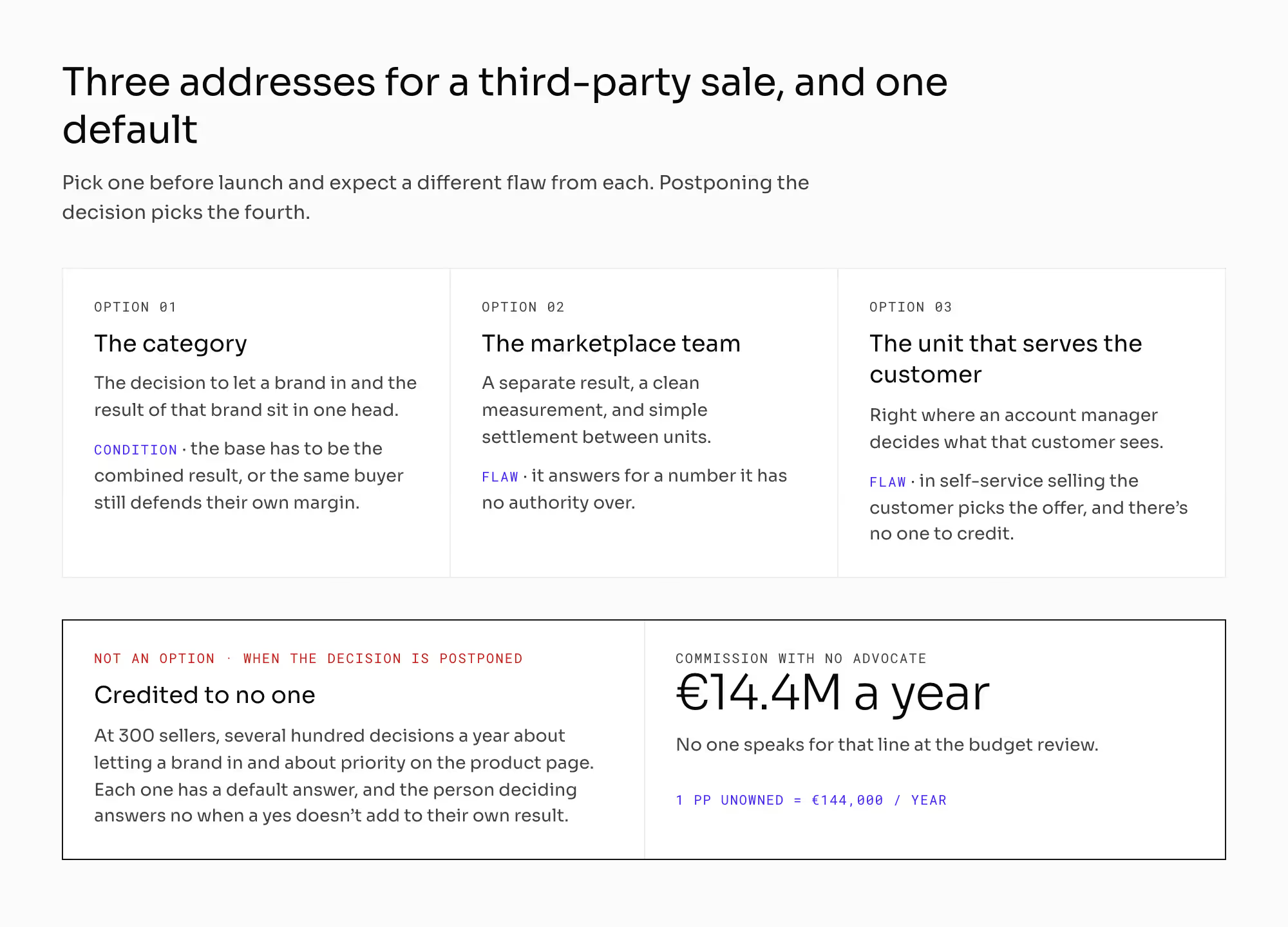
Pick one of three addresses for third-party sales before launch, and expect a different flaw from each. Postponing the decision gives you the fourth address below.
1. Category
Sale lands in the result of the category buyer who owns it. That buyer also decides whether to let a brand in, and one person then holds the decision and the result.
The base has to be the combined one for that to hold. On a 1P margin base, the same buyer still defends their own margin.
2. Marketplace team
Marketplace team gets a separate result and a clean measurement, and settlement between units stays simple.
The team answers for a number it has no authority over, and its influence on the category passes through other people's decisions.
3. Unit that serves the customer
Crediting the unit that serves the customer works when an account manager decides what that customer sees, and a B2B distributor with named account managers can use it.
Check how many of your sales pass through a person first. In self-service selling, the customer picks the offer, and there's no one to credit.
4. No owner at all
Third-party sales with no owner get no one to defend them. At 300 sellers, somebody makes several hundred decisions a year about letting a brand in and about priority on the product page.
Every one of those decisions has a default answer, and the person deciding answers no when a yes doesn't add to their own result.
That line is worth €14.4 million of commission a year, and at the budget review no one speaks for it.
Executive sponsor for a marketplace settles who answers for the marketplace P&L, and this chapter asks whose bonus a transaction attaches to.
How do you split credit between a country and the group?
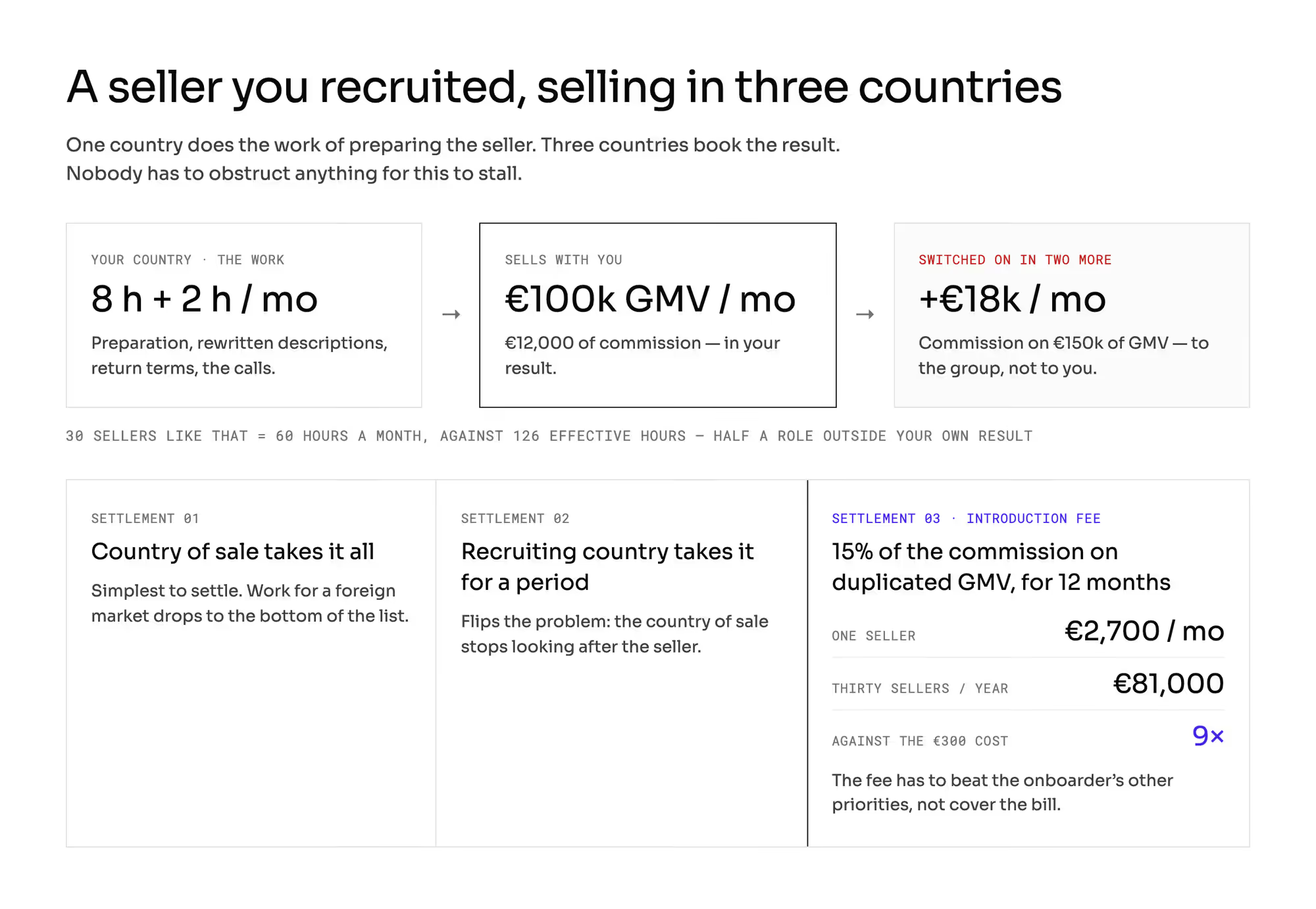
Practitioners call one arrangement the sharpest tension of the whole rollout: a seller recruited and prepared in one country sells in three, and only the country of sale books the result.
The recruiting country rewrites that seller's descriptions for a foreign market and explains different return terms. It also takes the seller's calls, and none of the turnover reaches its own result.
Treat the reference platform as one country of the group. A top-tier seller does €100,000 of GMV a month with you, and your commission on that seller is €12,000.
That same seller, switched on in two more countries, adds €150,000 of GMV and €18,000 of commission a month for the group. Your own result stays where it was.
Your cost is on the order of eight hours of preparation and two hours a month answering questions. Thirty sellers like that is ten percent of your base, and the sellers who get duplicated are your best ones.
Those thirty sellers come to 60 hours a month. One full-time role is 126 working hours a month, and those 60 hours take close to half of it.
1. Country of sale takes the credit
Country of sale books the turnover and the recruiting country gets no line at all. This arrangement is the simplest to settle.
Work for a foreign market drops to the bottom of the list, and your best sellers are then the slowest to switch on in a second country.
2. Recruiting country takes the credit for a fixed period
Recruiting country books the duplicated turnover for a named number of months. The country of sale then serves buyers with no line in its own result, and it stops looking after the seller.
Use this only when recruitment is the scarce work in the group, and write the end date into the same document.
3. Introduction fee
Country of sale takes the credit for the sale, and the recruiting country gets a named line item. That line is a share of the commission on the duplicated GMV, for a fixed time.
At 15% over twelve months, your country gets €2,700 a month from one seller (15% of €18,000) and €81,000 a year from thirty. Two hours of support at €150 an hour cost €300, and the fee is nine times that cost.
The fee has to beat the onboarder's other priorities, and covering the bill alone leaves the work at the bottom of the list.
Before you design the fee, check whether your system can split that result at all. Top-tier products rarely carry the country as a reporting dimension of its own.
You assemble it out of a sales channel, a price list, a shipping zone, and a separate commission grid. A seller operating in two countries is sometimes two accounts, and a bonus report built on a dimension the system doesn't hold ends up in a spreadsheet.
When the units sit in different countries, settling the fee has a tax side as well. Put that question to an advisor before the first payment.
How long do you protect a unit's result during the transition?
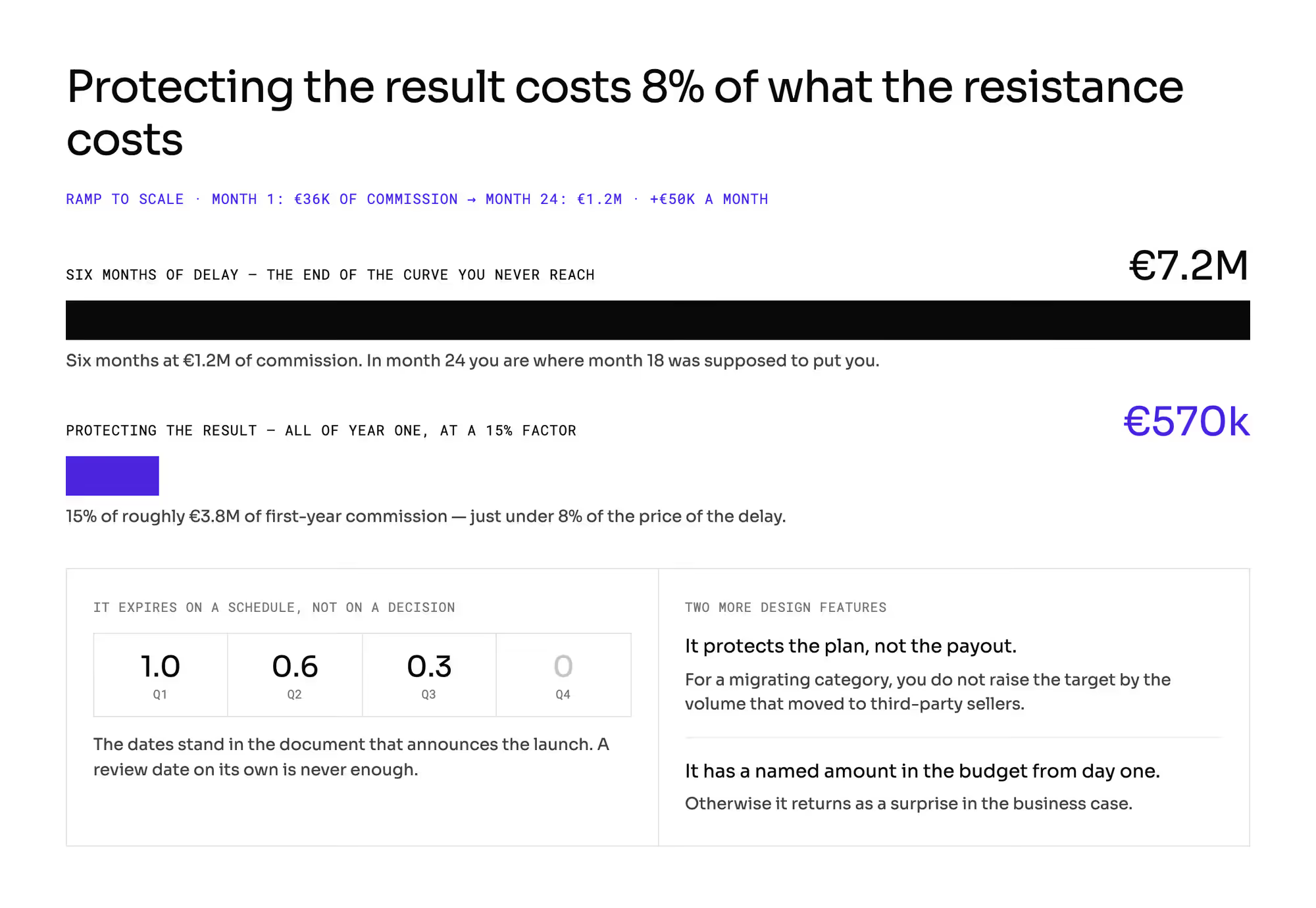
Protecting the result is cheaper than a year of resistance. Price that resistance first, from the ramp you expect to target scale.
You reach target scale in about two years: from 300 orders and €36,000 of commission in the first month to 10,000 orders and €1.2 million in the twenty-fourth. An even ramp adds roughly €50,000 of commission a month: (1,200 − 36) ÷ 23.
Push that curve back by half a year and month twenty-four lands where month eighteen was supposed to. Six months off the end are worth up to €7.2 million of commission (6 × €1.2 million).
Month twelve gives €593,000 (36 + 11 × 50.6), the monthly average of that ramp is €315,000, and commission in the first year is about €3.8 million. Cover all of that commission at a 15% factor, and you get €570,000. That is just under 8% of the price of a six-month delay (0.57 ÷ 7.2).
1. Expiry on a schedule
Factor steps down by quarter: 1.0 / 0.6 / 0.3 / 0, and those dates stand in the document that announces the launch.
A review date on its own isn't enough, and someone has to hold that review in a quarter that has no room for it.
2. Plan protected instead of the payout
You protect the plan, and the payout follows from it. Take a unit whose category is migrating, and don't raise its target by the volume that migrated to third-party sellers.
Protect the payout instead, and the unit stops treating its own result as real. The target is the number your people work to.
3. Named amount in the budget
Protection carries a named amount in the budget from day one. Otherwise it returns as a surprise in the marketplace business case, and you explain €570,000 in the same meeting that questions the rollout.
Changing the rules of pay is a change to the terms of employment with its own procedure, form, and notice period. Settle all three with a lawyer and with HR before you announce anything.
Which measure shows that your sales incentive structure works?
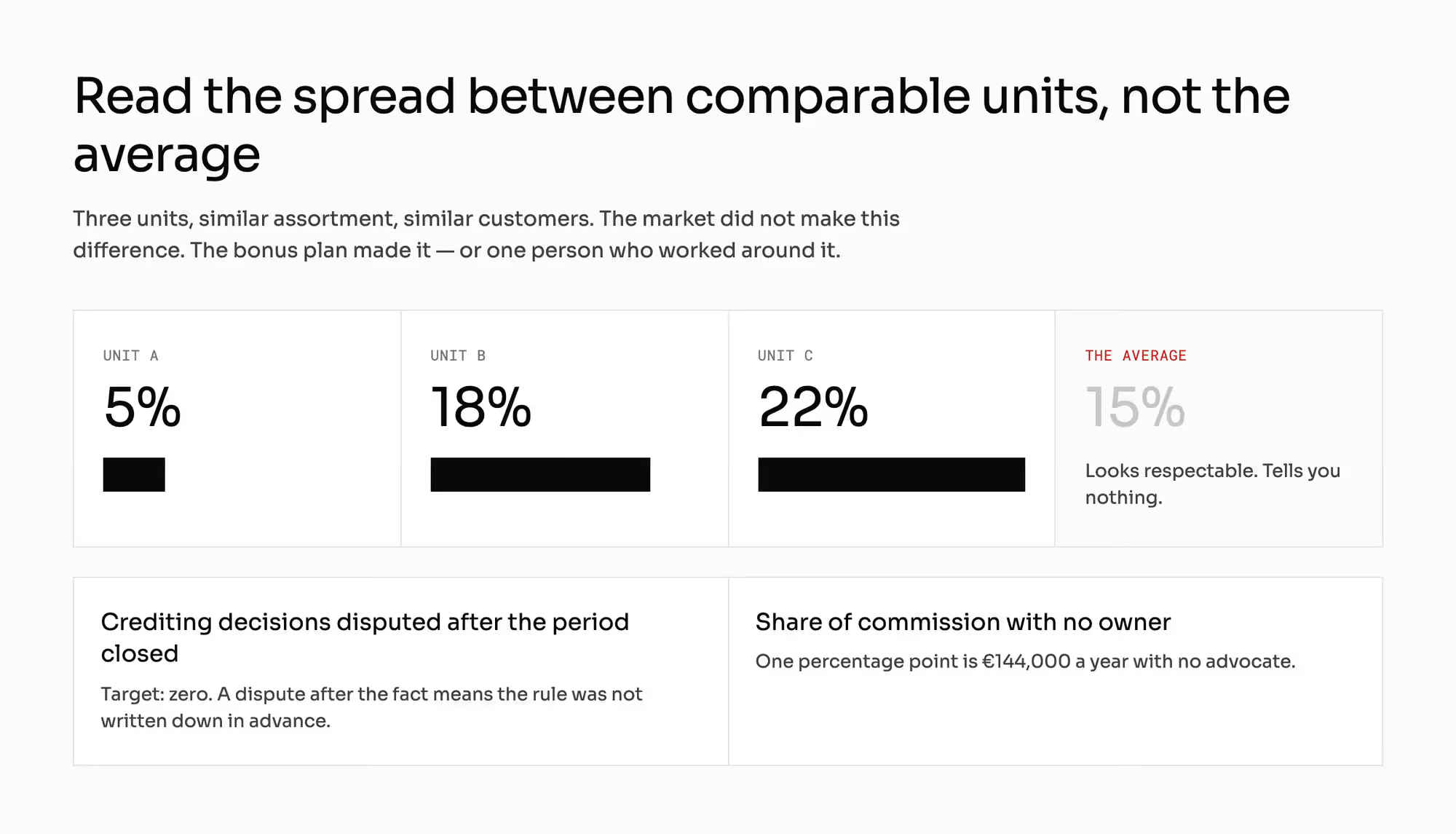
Look at the spread between three comparable units with a similar assortment and a similar customer base.
The share of third-party sales sits at 5%, 18%, and 22%. Those three numbers average 15%, and the average hides every bit of the difference.
The market didn't make that spread, and your sales incentive structure did. One person working around the plan can produce the same result.
Two cheaper numbers sit alongside that spread.
1. Disputed crediting decisions after the period closed
Target is zero. A dispute after the fact means the rule wasn't written down in advance, and your team argues it out during the month-end close.
2. Share of commission with no owner
One percentage point is €144,000 a year with no advocate. Measure it as the commission booked into categories whose owner sits on a 1P margin base.
What does a sales compensation plan change in your marketplace?
Your bonus plan belongs in the scope of the rollout. A plan settled after go-live is settled a year late, and in that year your people learn what the company pays for.
1. Data requirement behind the credit
To calculate a bonus on the combined result, or on commission from duplication, the system has to pin a transaction to a unit, a country, and an account manager. Treat that as a data requirement and design it with the rest of your data model.
A dimension added after launch has to be backfilled, and backfilled data can't settle a bonus for a period that has closed.
2. One definition of both components
Both components of the combined result have to share one definition, and without it you can't defend the bonus.
Own margin and third-party commission have to mean the same thing in the unit report and in the group report. What lands in the financial statements is a separate question, answered by marketplace revenue recognition.
3. Duties toward your sellers
If your bonus plan influences how offers are shown, you take on a decision trail and a set of duties toward sellers. P2B Regulation on a marketplace sets out both.
4. Personal data behind the credit
Data you need to credit a transaction to an account manager has its own regime, and marketplace GDPR sets the roles.
How do you set up a sales compensation plan before the first period?
Four steps fit into the weeks before the period opens.
1. List every role that can block third-party sales
Write the roles down with the base each bonus is calculated on: the category buyer, the category manager, the unit director, the account manager, and the country director. Mark the ones whose base counts third-party sales as zero.
2. Choose a base per role
Each role has a different lever, and one base for everyone fails. Put the supply team on GMV for the first quarters and the category on the combined result. Write the end date for every temporary base on the same line.
3. Write down the crediting rule for 3 cases
Three cases cover most of what arrives in the first year: a category that carries its own SKUs, a category that carries none, and a seller recruited in another unit.
Date that document before the period starts. A rule dated after the fact turns into a negotiation, and the stronger unit wins it.
4. Cost out the protection and schedule its step-down
Put the protection in the budget with its quarterly factors and its end date. Then make the three measures from the section above a standing item in the quarterly review, next to the gates in the phase gate review.
How do you check a sales compensation plan with a vendor?
- Does a transaction carry the business unit and the country as reporting dimensions, instead of as a text field?
- Can you export GMV and commission broken down for the bonus calculation, and on what cadence?
- Is a seller operating in several countries one entity in the report, or several accounts?
- Does every order record the account manager who sold it?
- Which of those dimensions can you add after launch, and what happens to the periods that already closed?
The third answer decides whether an introduction fee is calculable.
Which mistakes do operators make with sales compensation plans?
Each of these four mistakes looks like an absence of demand.
1. Direction announced without a change to the calculation base
The first year looks like weak demand, and your organization spent all of it correctly executing the previous strategy.
2. Third-party sales credited to no one
Several hundred decisions a year settle at no by default, and at the first budget cut there's no one to defend the line.
3. Crediting rule agreed after the period closes
Work for another unit drops to the bottom of the priority list, and the same argument comes back every quarter in the same shape.
4. Protection with no step-down schedule
After a year, the unit treats the factor as base pay, and removing it then costs more than the protection was worth.
What do you still have to settle about your sales compensation plan?
This chapter gives no bonus amounts and no pay benchmarks. Those depend on your labor market, and the marketplace manager covers who is available to hire.
It doesn't settle who answers for the marketplace P&L or what resistance looks like department by department. Settling with one sales rep has its own chapter too, linked above.
It also doesn't fix the definitions the calculations above stand on. Agree those with your analytics owner before you agree the bonus.
This chapter isn't legal or tax advice. Before you announce a new plan, ask about four families of regulation:
- Employment law, in the part covering pay and changes to the terms of employment.
- Transfer pricing and settlements inside a group, if you credit anything between entities or countries.
- Protection of personal data, if calculating the bonus requires data from orders.
- Transparency in the platform-to-seller relationship, if the bonus influences how offers are shown.
The arithmetic above is hypothetical and still holds when you substitute your own GMV, your own commission, and your own ramp to scale.
Summary: Who gets credit for 1P and 3P sales on a marketplace?
Credit third-party sales to the category buyer who decides whether the offer appears, and calculate that buyer's bonus on the unit's combined result.
On a margin basis, a seller's offer is worth zero to them. On third-party GMV, your team cuts the rate, at a cost of €1.98 million of commission a year.
Inside a group, let the country of sale book the turnover and pay the recruiting country an introduction fee on the duplicated GMV. At 15% that's €2,700 a month from one seller against €300 of support cost.
Protect the result of units whose category is migrating, with a factor that steps down 1.0 / 0.6 / 0.3 / 0. Four quarters of that cost about €570,000 against €7.2 million for half a year of resistance.
Then read the spread between comparable units at every quarterly review. Set the base first, then the credit, and the amount last.
Building a marketplace your own organization has a reason to sell?
Frequently asked questions on sales compensation plans
What is a sales compensation plan?
A sales compensation plan is the set of rules that decides what each commercial role in your company gets paid for. It names the base the bonus is calculated on and the result each transaction is credited to. On a marketplace, it has to cover your own goods and third-party offers in the same document.
How do you pay a sales team for third-party marketplace sales?
Pay them on a base that includes the commission from third-party sales, usually the unit's combined result. A bonus on margin from your own goods counts a seller's offer as zero and pays in full for blocking it. The payout on a single order is worked out in the chapter on channel conflict.
Who should get credit for third-party sales on a marketplace?
Credit the result to the person who decides whether the offer reaches the customer. In most companies, that person is the category buyer, and leaving the question open credits the sale to no one. Your whole third-party commission line then reaches the budget review with no advocate.
Ready to build?
We build marketplaces in which every transaction carries the business unit and the country your bonus report has to split it by.