
Marketplace Operations: Daily, Weekly, and Monthly Routine

Marketplace operations are the recurring work of keeping a marketplace selling, from clearing the approval queue to paying sellers out. This chapter covers the twelve lines of that work, the cadence each one belongs in, and the minutes a single pass takes.
Your marketplace takes orders at night and at the weekend, and your team doesn't work those hours.
Offers pile up in the approval queue overnight, and over the weekend the clock keeps counting on a response time you promised the seller yourself.
You get an operating calendar either way, and you either design it or your team builds it around whoever shouts loudest.
This article breaks down:
- Why does Monday open with three days of marketplace orders?
- What decides which cadence a line of marketplace operations belongs in?
- Which 12 lines make up marketplace operations, and how long does one pass take?
- How many hours a month do marketplace operations take at each scale?
- Who is on duty, and what gets handed over at the end of the day?
Key insights
- Your marketplace takes orders on all seven days, and your team works five of them. Monday opens with the weekend queue on top of its own.
- Two constraints set the cadence of each line. Review a line more often than the shortest deadline it can break. Review it more often than your tool keeps the data.
- The routine takes no more hours at target scale than at starting scale, while the turnover behind it multiplies. Count the minutes on your own lines before you staff them.
- Your worst ratio of routine hours to commission falls in the first month after go-live. The whole catalog arrives then, and your sales have barely started.
- Your threshold breaks when the manual share of offers goes up, with sales exactly where they were. Measure that share every month next to the moderation minutes.
Why does Monday open with three days of marketplace orders?
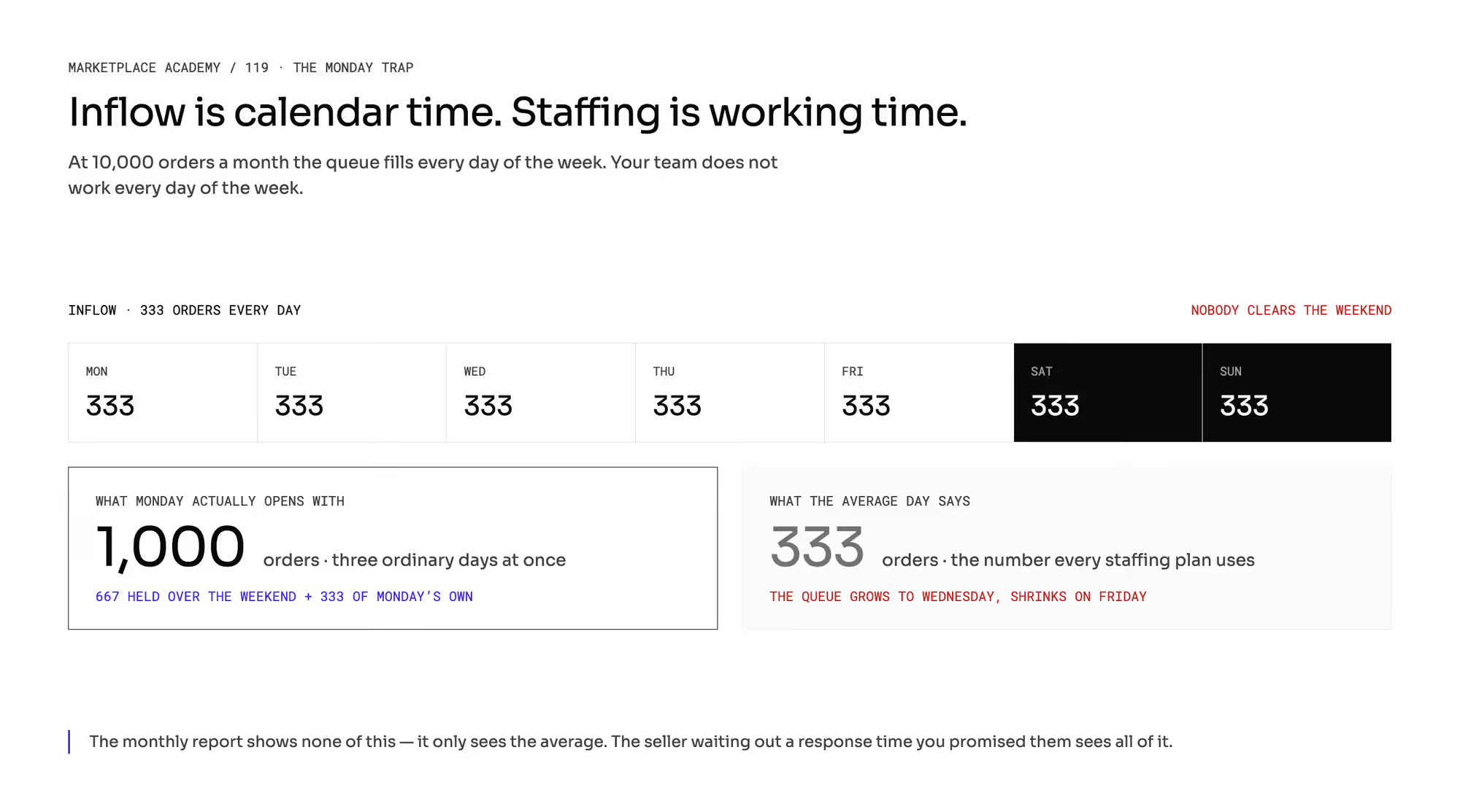
Orders arrive on all seven days of the week, and your staffing covers five of them.
Take 10,000 orders a month, the target scale this series keeps coming back to. That works out to about 333 orders a day, on every day of the week.
The weekend puts 667 aside, and Monday adds its own 333. On Monday morning, a thousand orders are waiting, three ordinary days of them at once.
Offers waiting for approval pile up the same way, and so do messages from sellers and the counter that measures your response time.
Monday trap is a schedule built on the average day, and it comes back in every staffing plan.
An operating calendar differs from a list of good practices in three ways you can check:
- Owner: a role with a name attached, instead of a department.
- Version: the date it changed and the reason.
- Hours: every line says how many minutes one pass takes.
Date every change to the calendar and write the reason next to it. The next duty officer then sees why a cadence changed, and so does the person who inherits the whole calendar.
A line with no minutes on it can't be staffed. Routine without hours is the second mistake worth its own name. Such a calendar fits on one slide, and it doesn't fit into the week.
Practitioners who describe failed rollouts name the same gap. Those companies had the process written down, and no one owned the everyday work.
Your team then works to whoever escalates, and in practice that means the seller who emailed the board. That seller almost never has the most urgent problem.
What decides which cadence a line of marketplace operations belongs in?
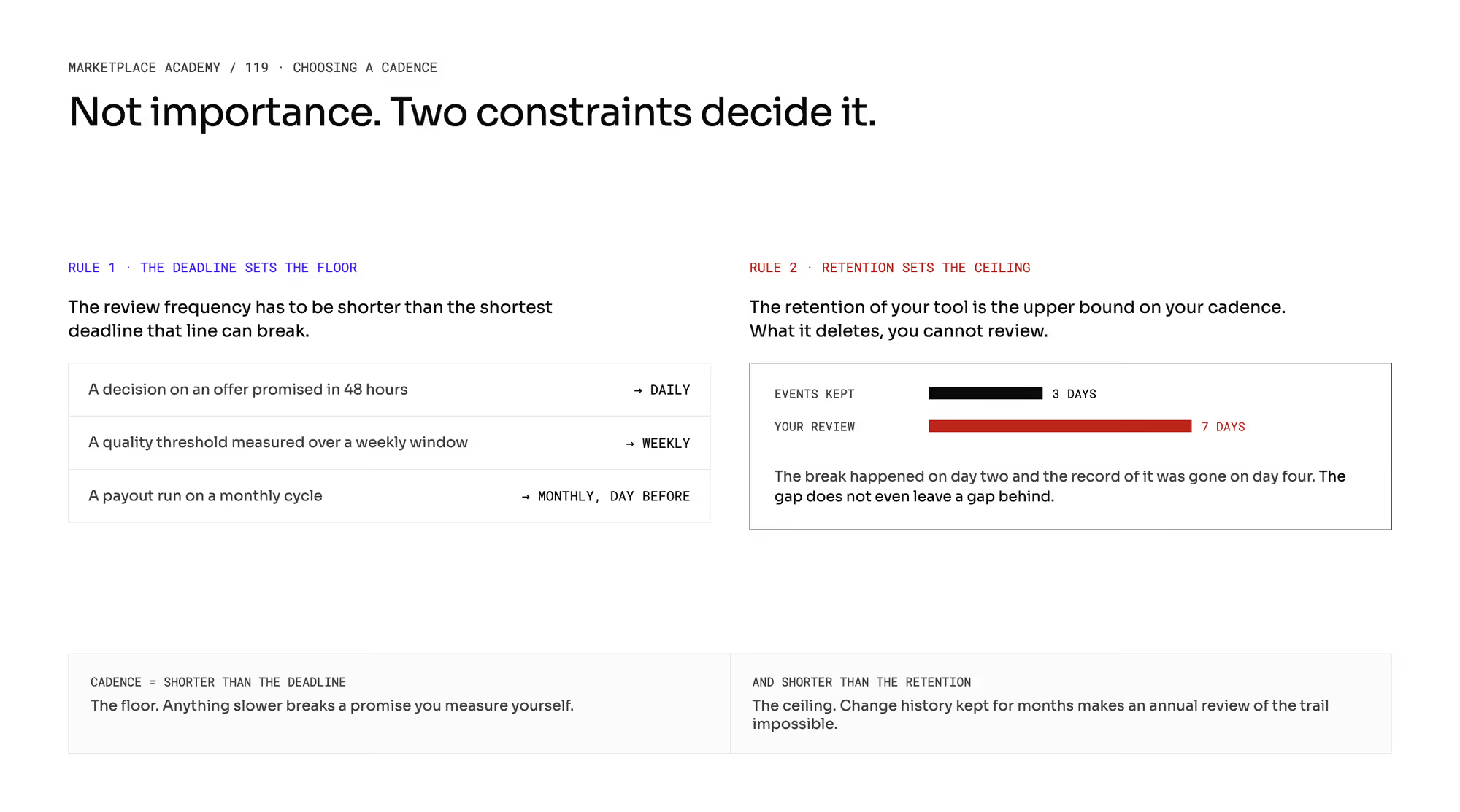
Review frequency has to be shorter than the shortest deadline that line can break.
A 48-hour promise on an offer decision puts that line in the daily cadence, and a weekly review breaks the promise before anyone looks at it.
Your published promise to sellers is the deadline for that line, and a quality threshold measured over a weekly window needs only a weekly review.
A monthly payout cycle needs a monthly pass, and you hold that pass no later than the day before the cycle.
Retention of your tool sets the upper bound on your cadence. Some products delete unconsumed integration events after a few days and give you no way to replay them.
Review silence in a data channel once a week and the data is gone before anyone notices the break. Change history behaves the same way, and with a log kept for a few months you can't review the trail once a year.
Turn that into a number before you set a cadence. If your tool keeps unconsumed events for three days, the review of silence in the data channels belongs in the daily cadence.
The mechanisms behind both constraints have their own chapters, in webhook integration and the marketplace audit log. Both set a limit on the calendar.
Which 12 lines make up marketplace operations, and how long does one pass take?
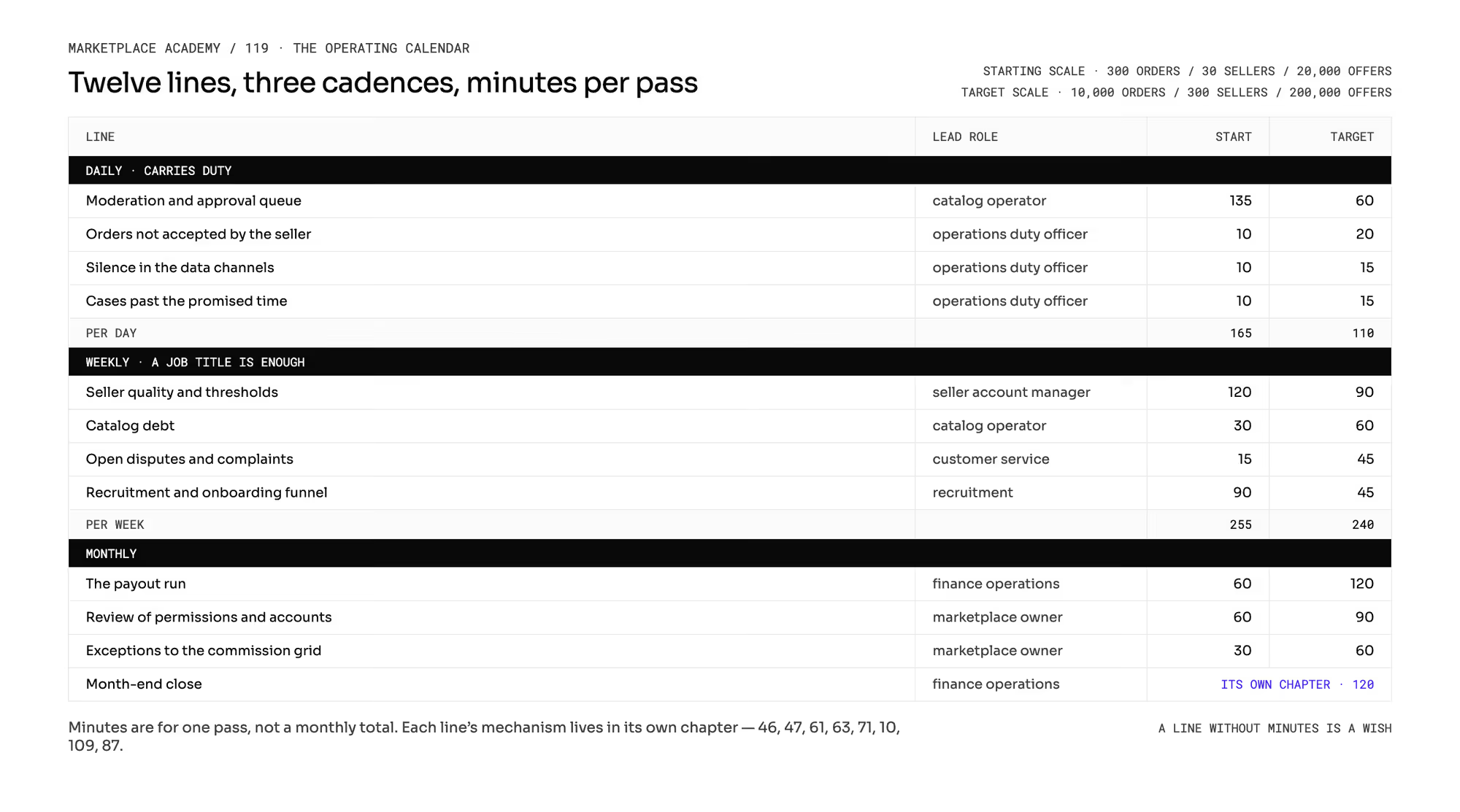
Every number in the table is the minutes for one pass of one line. Starting scale is the first month after go-live: 300 orders, 30 sellers, and 20,000 offers.
Target scale is 10,000 orders, 300 sellers, and 200,000 offers, reached in about two years. The cart is €1,000 and the commission 12% in both.
Each line has its own chapter behind it. Quality thresholds sit in marketplace seller quality metrics. Month-end close takes a week of work and has a chapter of its own.
Four of the twelve lines are daily, four are weekly, and four are monthly. Marketplace payment reconciliation settles the cadence for reconciling money, and it overrides this table.
Write the lead role next to every line before you measure anything. A line with two roles on it gets measured twice and staffed once.
Take a planning heuristic on the order of a hundred sellers a year per recruiter, and check that order of magnitude against your own numbers before you use it.
One recruiter-month comes to about eight sellers. A funnel reviewed once a month looks at a sample of eight, and you can't tell from eight whether something has jammed.
The approval queue carries the same kind of arithmetic. 20,000 offers in the first month is 667 a day, and at a manual share of 10% about 67 of them reach a person. Those 135 minutes then buy about two minutes per offer.
This chapter counts minutes, and headcount is a separate calculation that starts from the monthly total of those minutes.
How many hours a month do marketplace operations take at each scale?
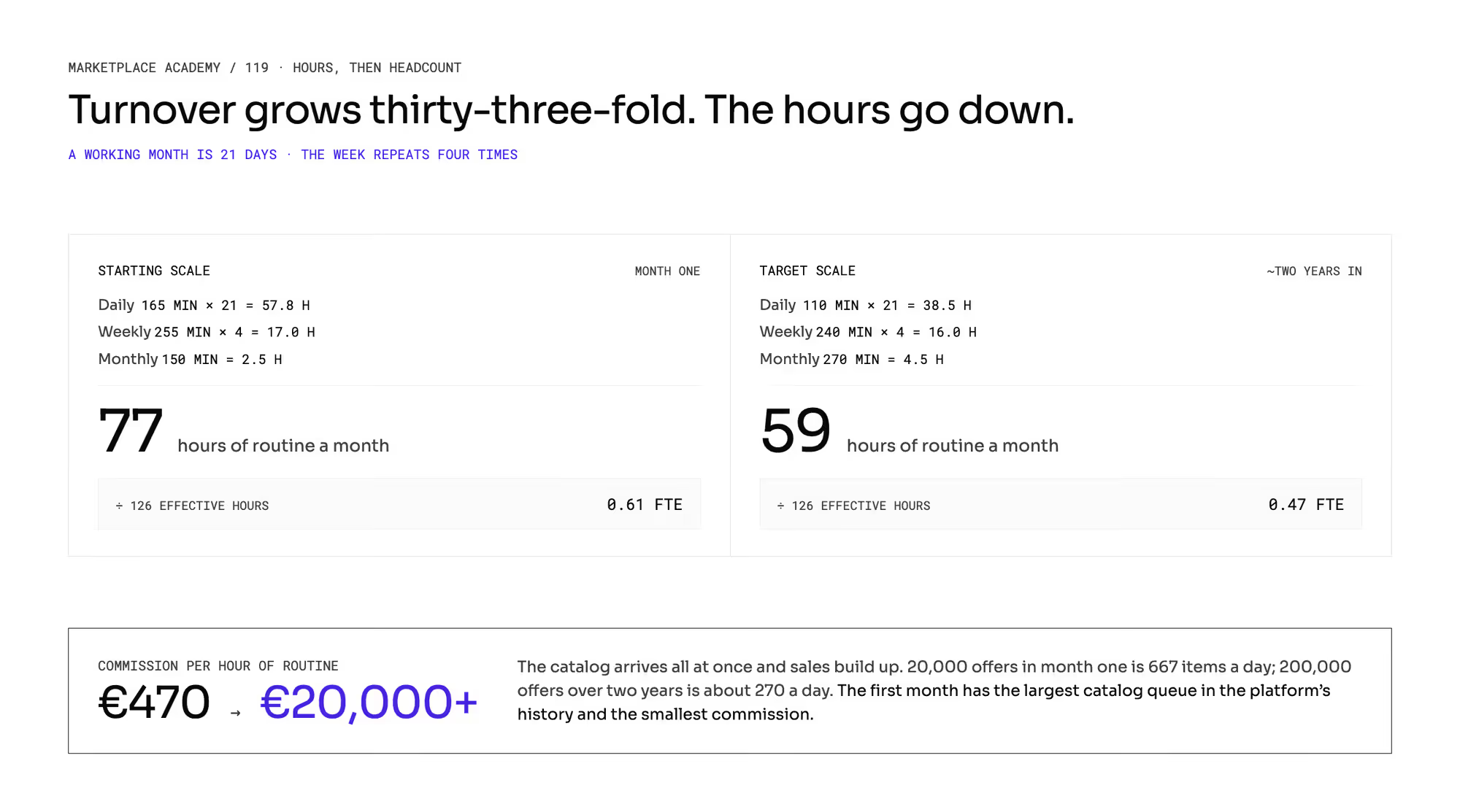
A working month is 21 days and the week repeats four times.
At target scale the daily lines are 60 + 20 + 15 + 15 = 110 minutes, just under two hours. Over 21 days that gives 38.5 hours.
Weekly comes to 90 + 60 + 45 + 45 = 240 minutes, or four hours a week and 16 hours a month. Monthly is 120 + 90 + 60 = 270 minutes, or 4.5 hours. That's 59 hours a month in total.
At starting scale the daily lines are 135 + 10 + 10 + 10 = 165 minutes, and over 21 days that's 57.8 hours.
Weekly comes to 120 + 30 + 15 + 90 = 255 minutes, or 17 hours a month. Monthly is 60 + 60 + 30 = 150 minutes, or 2.5 hours. That's 77 hours a month in total.
Convert those hours into headcount, and an eight-hour day gives you the wrong divisor.
Planners who staff queues subtract unavailable time from scheduled time. They call the difference shrinkage: breaks, training, meetings, and vacation.
Take a quarter off 168 nominal hours and you're left with 126 working hours. The starting routine is 0.61 FTE and the target one 0.47.
Both figures cover the routine alone, and anything outside the twelve lines is on top of them.
Split the monthly total by the lead role in the table before you talk about people. At starting scale the catalog operator carries 49 hours of it and the duty officer 10.5, out of the 77 in total.
Commission per hour of calendar at the start is €36,000 divided by 77 hours, or about €470. At target scale it's €1,200,000 over 59 hours, or more than €20,000. The gap between the two is more than forty-fold.
Your whole catalog arrives in the first month, and your sales build up over two years.
20,000 offers in the first month is 667 items a day, and 200,000 offers built over two years is about 270 a day. The first month has the biggest catalog queue of the whole rollout and €36,000 of commission to pay for it.
Where does the routine stop fitting?
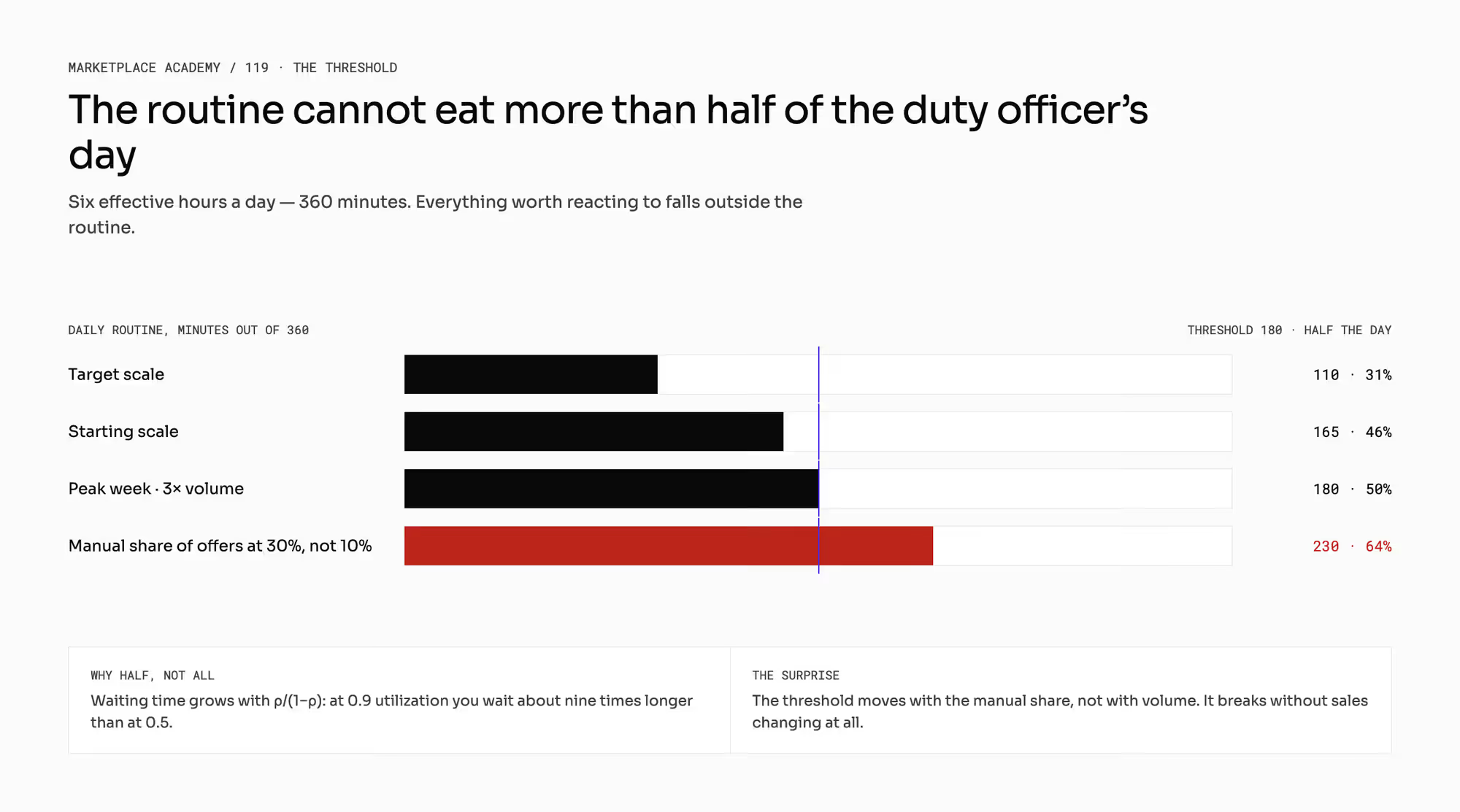
Routine stops fitting well before the sum of hours exceeds one full-time job. A duty officer has about six working hours a day, and three hours of routine leaves little for anything else.
Almost everything worth reviewing sits outside the routine. Waiting time grows with a factor of ρ/(1−ρ), and at a utilization of 0.9 you wait about nine times longer than at 0.5.
Teams that keep systems available plan for at most two incidents per twelve-hour shift, and handling one of them and writing it up takes on the order of six hours.
The routine can't take more than half of the duty officer's day. Starting scale is 165 minutes out of 360, or 46%. Target scale is 110 out of 360, or 31%.
Your threshold breaks on the manual share of offers. Count that share as the offers a person opens, divided by all the offers that arrive.
At 30% of offer inflow reaching a person, up from 10%, daily moderation grows from 60 to 180 minutes. The daily routine then grows from 110 minutes to 230.
Sales stay the same, and the threshold still breaks. Ask what share of offers reaches a person today before you plan a single shift.
Measure that share every month and put it next to the moderation minutes in the same table, and one line of the table then explains the other.
Who is on duty, and what gets handed over at the end of the day?
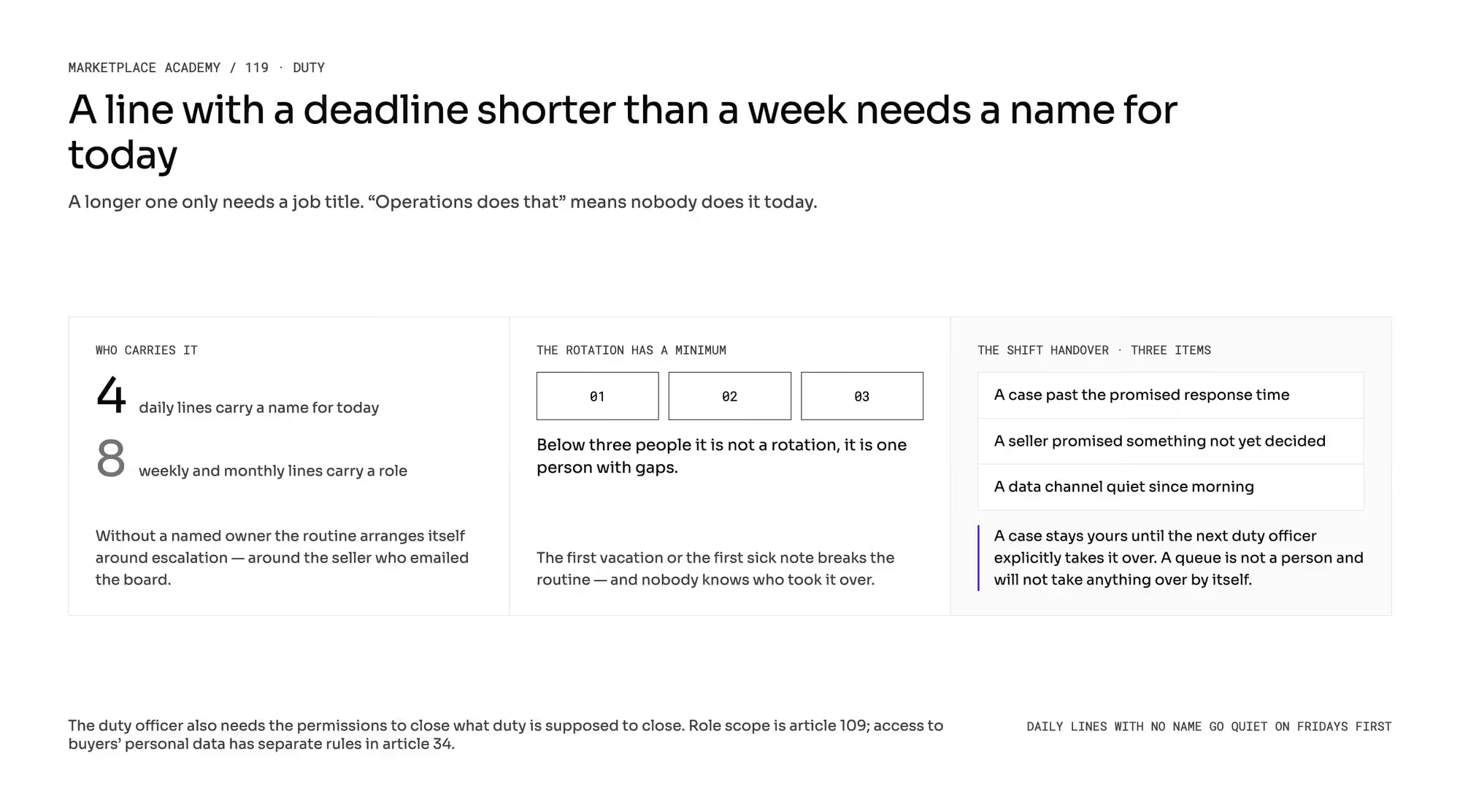
A line with a deadline shorter than a week needs a name for today, and a line with a longer deadline needs a job title. In the table above, four daily lines carry duty, and the other eight don't.
A duty rotation needs at least three people. The first vacation or the first sick note breaks the routine, and no one knows who took the open cases over.
Teams keeping services up around the clock use a sharper rule. Duty doesn't exceed a quarter of working time, and full coverage of the clock then needs on the order of eight people.
Your own duty covers working hours only, and your weekend queues still carry over to Monday.
Write the name of today's duty officer where the whole team can see it. A rota kept in one person's calendar stops working on the day that person is away.
What goes into the shift handover?
Shift handover is a short note at the end of the day listing what is open and why. One rule from on-call practice copies straight into the procedure: a case stays yours until the next duty officer explicitly takes it over. A queue isn't a person and won't take anything over by itself.
Three items go into the note:
- Case past the promised response time.
- Seller who was promised something that hasn't been decided.
- Data channel that has been quiet since morning.
The duty officer also needs the permissions to close what duty is supposed to close. Scope of roles belongs to SSO vs MFA, and access to buyers' personal data has separate rules in marketplace GDPR.
How does a peak week change marketplace operations?
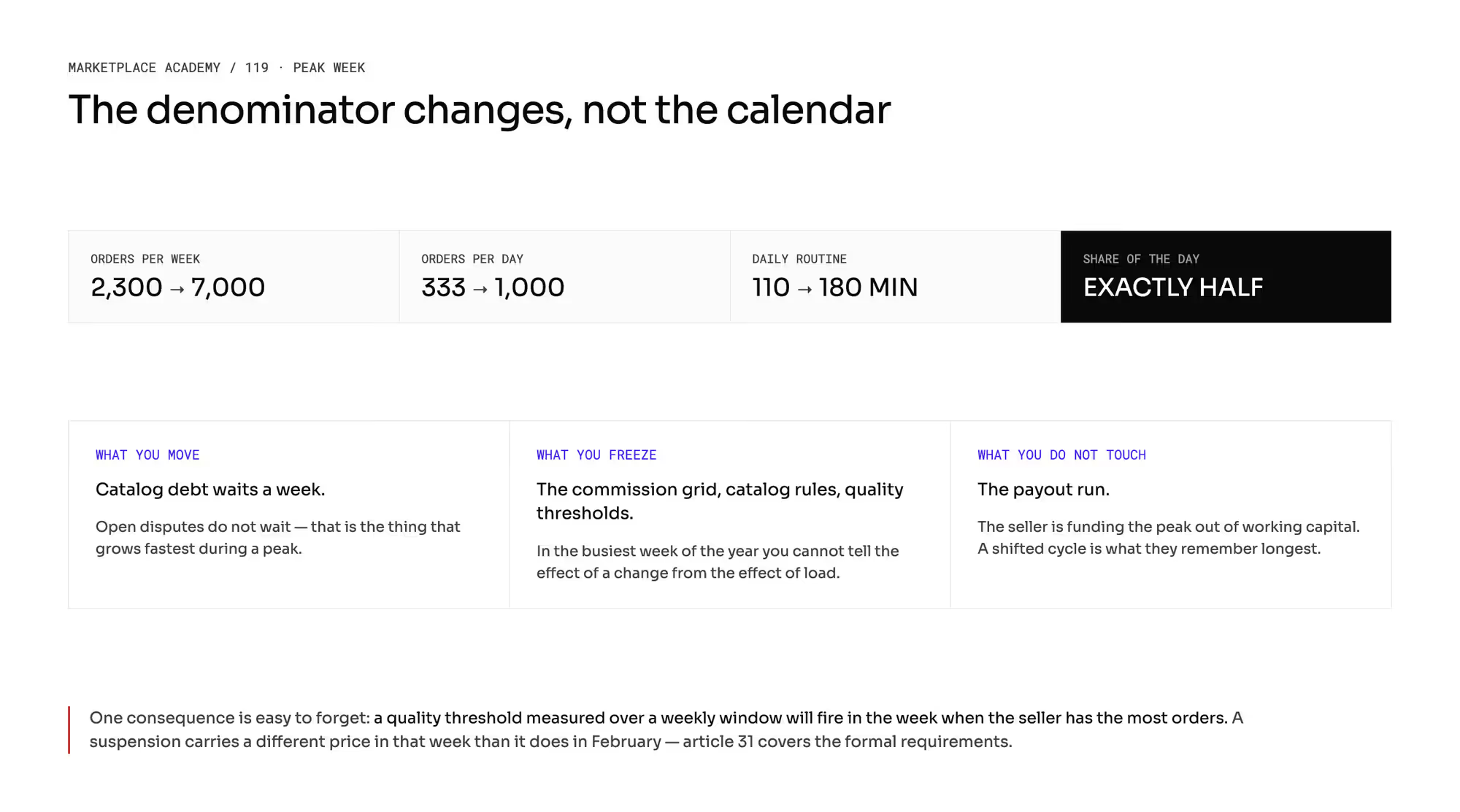
Pick the peak week out of last year's order data and count the days it covered, and assume it does three times the volume of an ordinary one. An ordinary week at target scale is about 2,300 orders. That's 10,000 divided by 4.3 weeks, and a peak one is 7,000.
That gives you 1,000 orders a day instead of 333. Orders not accepted by the seller go from 20 to 60 minutes, and cases past the promised time go from 15 to 45.
The daily routine then comes to 180 minutes, exactly half the duty officer's day. That leaves three hours for everything the peak itself produces, and the figure holds only while no part of the routine breaks.
You make three decisions before the peak begins, and all three hold for the whole week.
1. What you shift
Catalog debt will wait a week, and one week of delay on a weekly line costs you a single pass.
Open disputes grow fastest during a peak, and their review stays on schedule.
2. What you freeze
Freeze changes to the commission grid, to catalog rules, and to quality thresholds. Systems teams call this a freeze window. In the busiest week of the year, you can't tell the effect of a change apart from the effect of load.
A quality threshold measured over a weekly window will fire in the week when the seller has the most orders. A suspension carries a different price in that week than it does in February, and P2B Regulation on a marketplace describes the formal requirements of that decision.
3. What you don't touch
Leave the payout cycle alone. The seller is funding your peak out of working capital, and a shifted cycle stays with them longer than anything else you do that week.
Tell your sellers before the week starts if any payout date has to change.
What do marketplace operations change in your marketplace?
Your calendar is an input to staffing. First the sum of hours split by role, then the conversation about headcount.
1. Staffing follows the hours
eCommerce team structure for a marketplace carries that conversation, and the marketplace manager covers where you find those people. This chapter gives both of them input on hours and roles.
Split the hours by lead role before that conversation. A total of 59 hours spread over five roles doesn't make one job.
2. Tool choice follows the same hours
Bulk actions, change history, and exports that make sense can be the difference between a team of three and a team of ten doing the same work. Cost every line in the table twice, once with bulk actions and once without.
3. First weeks get their own calendar
The first weeks after go-live carry a denser routine than anything in this table, and hypercare after a marketplace launch describes it. Operators who launched with a calculated team rebuilt it after go-live anyway, and the launch routine is a separate exercise.
How do you build version 1 of your operating calendar in 7 steps?
Seven steps take you from an empty page to a calendar with minutes on every line.
1. List the lines and the shortest deadline each one can break
Write down the deadline for each line, and leave the ranking of importance out of this step.
2. Assign a cadence shorter than that deadline
For a line that depends on an integration, make it shorter than the retention of the tool as well.
3. Measure the minutes for two weeks, on two different people
One person's timings measure that person.
4. Add the minutes up monthly and divide by 126
The result in FTE goes into the staffing conversation.
5. Mark the duty lines and count the rotation
Anything under three people is one person with gaps.
6. Set up a shift handover
Give it a list of open cases and a rule of explicit takeover.
7. Plan the peak week
Decide what you shift, what you freeze, and what you don't touch.
How do you check marketplace operations with a vendor?
- Which of these twelve lines can be done as a bulk action, and how many items fit in one action?
- How long do you keep unconsumed integration events, and can the team replay them after a gap?
- How long do you keep change history, and who can read it without a developer?
- Can the panel give a duty officer a list of cases past the promised response time, on one screen?
- What share of offers reaches a person in a comparable marketplace on your platform today?
The first two answers decide the minutes in your table, and the last one decides whether your threshold holds.
Which mistakes do operators make with marketplace operations?
Operators repeat five mistakes with the operating calendar, and each one is visible in the document before it reaches the work.
1. Routine without hours
Your calendar carries frequencies with no minutes behind them, and you find out it doesn't fit into the day when the queue starts growing.
2. Monday trap
A plan built on the average day, when Monday gets three days of inflow. The queue grows until Wednesday and shrinks on Friday, and a monthly average hides the whole cycle.
3. Duty assigned to a job title
"Operations does that" means no one does it today. Your team skips the daily lines with no name on them, starting on Fridays.
4. Cadence longer than the retention of the tool
You review once a week something the tool deletes after three days, and afterwards you can't tell that a break happened.
5. Calendar designed for the target scale
The worst ratio of hours to commission falls in the first month: €470 of commission per hour of routine against more than €20,000 later. Anyone who plans staffing for the target alone goes through launch with no slack.
What do you still have to settle about marketplace operations?
This chapter doesn't say how many people you need or who should own the marketplace, and those belong to the eCommerce team structure and the executive sponsor. This calendar gives both of them input on hours and roles.
It doesn't settle how you're allowed to build a duty schedule either. Employment law and pay policy cover availability outside working hours and work on days off. They also cover daily rest, weekly rest, and how duty time gets paid.
With staff in several countries, local collective agreements come in on top. Build the calendar with HR and a lawyer before you write in the first name.
How long to keep the documents this routine produces is carried by marketplace order documents. Each of the twelve lines has its own chapter, and this one takes only their cadence.
The minutes in the table are an assumption, and your own measurement takes two weeks of timing one pass of each line.
Summary: What does a marketplace operations routine look like day to day?
Four lines in daily marketplace operations: the approval queue, orders the seller hasn't accepted, silence in the data channels, and cases past the promised time. Four lines sit in the weekly cadence and four in the monthly one. Each line carries a cadence shorter than the deadline it can break.
Expect 77 hours a month at starting scale and 59 at target scale, and 126 working hours a month turns those into 0.61 FTE and 0.47. The first month costs the most per euro of commission.
Give the four daily lines a named duty officer with a rotation of at least three people. Keep the routine under half of that officer's day, and watch the manual share of offers.
Then plan one peak week in advance: catalog debt waits, the commission grid freezes, and the payout cycle stays where it is.
Building a marketplace whose everyday work you can staff before go-live?
Frequently asked questions on marketplace operations
What are marketplace operations?
Marketplace operations are the recurring work of keeping a marketplace selling between releases. It covers the approval queue, orders a seller hasn't accepted, seller quality, disputes, payouts, and permissions. Each of those lines has a cadence, a lead role, and a measured number of minutes per pass.
How many people do marketplace operations need?
The twelve lines of routine come to less than one full-time role at either scale. Count the minutes on each line, add them up monthly and divide by the net working hours a person really has. Everything outside the twelve lines sits on top of that, and your duty officer needs room in the day for it.
What is the difference between daily, weekly, and monthly marketplace operations?
Cadence follows the shortest deadline a line can break. Your published promise on an offer decision puts that line in the daily cadence, and a quality threshold measured over a weekly window needs a weekly review. A monthly payout cycle needs a monthly pass, and a second limit applies on top: never review less often than your tool keeps the data.
Ready to build?
We build marketplaces with the bulk actions, exports, and change history that decide whether your calendar needs three people or ten.