
Launch Readiness Checklist for a Marketplace: 6 Signatures Before Go-Live

A launch readiness checklist is a list of the people whose signatures condition your go-live date, and each name on it carries one sentence about what that person confirms.
From launch day on, your documents go into other people's companies. Your transfers go into other people's banks, and your customer service team answers for someone else's goods.
You need to know whose signature is the condition for your date, and operators who find that out in the last week have no time left to act.
This article breaks down:
- What does launch readiness mean before a marketplace go-live?
- Which 6 signatures does a launch readiness checklist need?
- Which evidence do you demand instead of a declaration?
- Which gaps block a launch, and which ones can you launch with?
- How do you write conditional approval with a date?
- What do you do with a veto a week before an announced date?
Key insights
- A launch readiness checklist carries six names, and each one has a right of veto. A task list records what has been done and leaves the outcome with no owner.
- Collect the six reviews in parallel, and order each piece of evidence well before the date. One after another, they take longer than any launch calendar allows.
- Since a screenshot of the settings shows only intent, you sign under a completed case.
- A gap is blocking when it produces an artifact outside the company that you can't take back on your own. A gap that costs only your own people's work gets a date and an owner.
- A conditional approval holds only when its date carries a default consequence. The cost of a condition grows along with your volume, and the date on it is the only thing that caps it.
- A week of delay is cheapest in the first month and costs more every month after that. Announce the month outside the company, and announce the day once the signatures are in.
What does launch readiness mean before a marketplace go-live?
Launch readiness is a list of people with the right of veto. A task list records what has been done, and a gate records who bears the consequence if the work was done badly.
Six names sit on that gate, and completion percentages don't appear on it.
Hold a launch that no one in your company can stop, and you have a deadline. A deadline shifts when the cart doesn't work, and the failure shows up on a screen.
A deadline doesn't shift when the sales document goes out with the wrong company's details. It doesn't shift when a payout fails to match the bank statement, and your demo shows neither of those.
Write down by name the people whose signature conditions the launch, and then ask each of them two questions:
- Do you know the launch doesn't happen without you?
- What exactly are you confirming?
The first question finds a veto that exists only in your head, and the second finds a rubber veto. Someone holds a signature, can't say what they answer for, and signs everything in front of them.
Ask the reverse question as well: who else believes they can stop the launch? Someone you didn't ask will raise a veto in the last week.
Other fields have had a formal approval step for decades. In information security, a named person issues that approval and formally takes on the risk of operating the system, and no document or committee takes that risk for them.
In the public sector, digital services face an independent panel review before launch, and a red rating from that panel blocks the next phase. In both fields, the person delivering the project doesn't carry the consequence.
Your platform vendor will hand you a useful checklist before launch. Practitioners describe its limit in plain terms: you get a system and a sheet of items, and responsibility for the outcome stays with you.
An item on somebody else's list has no owner on your side. A signature names the owner.
The chapter on the decisions you take at the start of a marketplace covers what you settle at the start of the project. Your six signatures come a few weeks before go-live.
Which 6 signatures does a launch readiness checklist need?
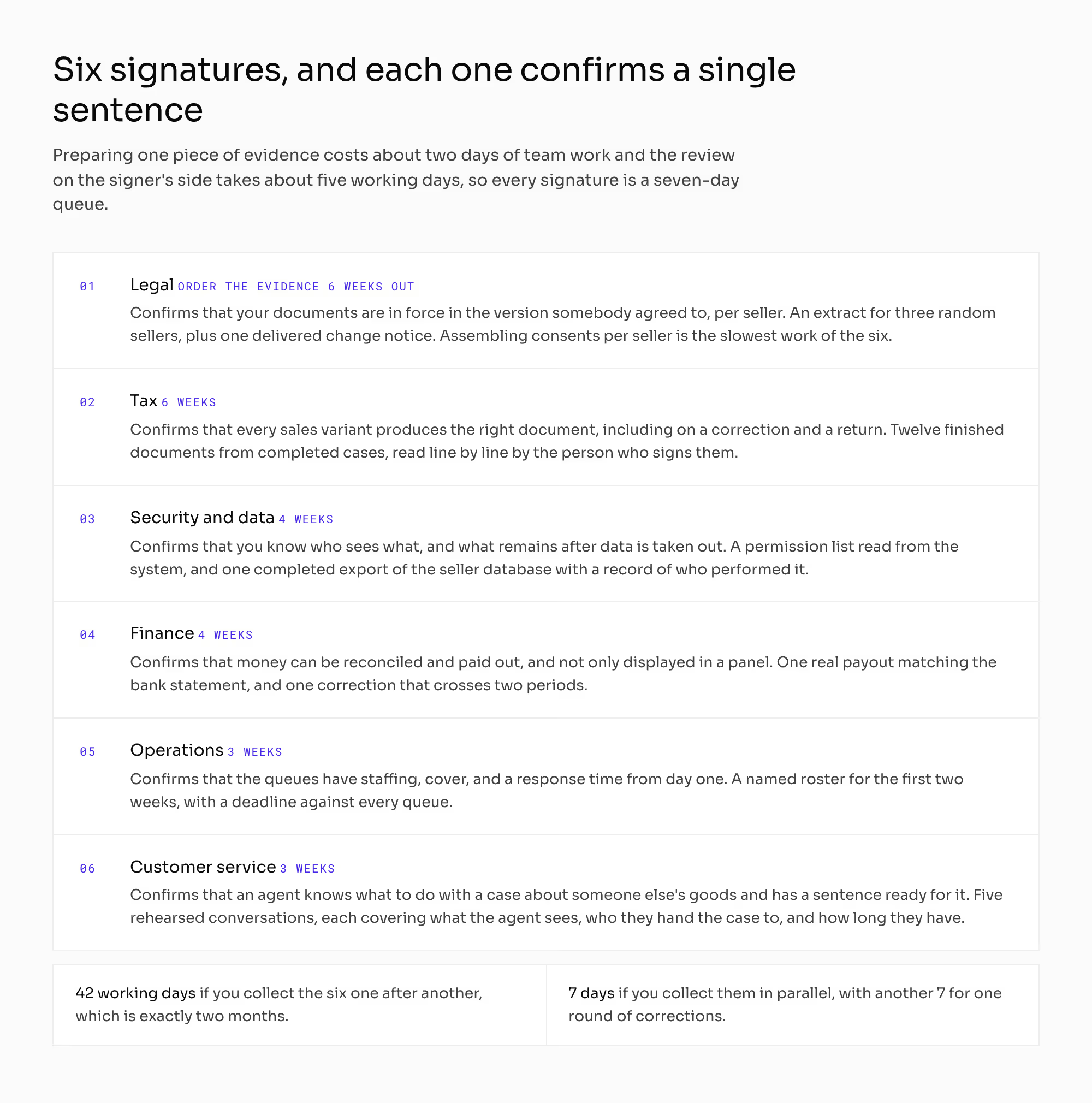
Six domains can produce a gap that reaches outside the company and can't be repaired quietly, and each domain gets one sentence that says what the person confirms.
No one can refuse a sign-off under "the project is ready" for a named reason.
Count each lead time as a queue in which preparing one piece of evidence costs about two days of team work. The review on the signer's side takes about five working days, and those two add up to seven days.
Six signatures collected one after another are 42 working days, exactly two months. Collect them in parallel, and you need seven days, with another seven for one round of corrections.
1. Legal
Legal confirms that your documents are in force in the version somebody agreed to. The evidence is an extract for three random sellers, with one delivered change notice behind it.
Since assembling consents per seller is the slowest work of the six, order that extract six weeks out.
2. Tax
Tax confirms that every sales variant produces the right document, including on a correction and a return. The evidence is twelve finished documents, read line by line by the person who signs them, and a screen showing the settings doesn't qualify at this gate.
3. Security and data
Security and data confirms that you know who sees what, and what remains after data is taken out. Two artifacts carry that signature: a permission list read from the system, and one completed export of the seller database with a record of who performed it.
Four weeks covers both, and the export is the harder one to produce.
4. Finance
Finance confirms that the money can be reconciled and paid out, and a panel that displays a payout isn't evidence of one. The evidence is one real payout matching the bank statement, with one correction that crosses two periods, and four weeks is enough to produce both.
5. Operations
Operations confirms that the queues have staffing, cover, and a response time from day one. The evidence is a named roster for the first two weeks, with a deadline against every queue, and three weeks is enough to assemble it.
6. Customer service
Customer service confirms that an agent knows what to do with a case about someone else's goods and has a sentence ready for it. The evidence is five rehearsed conversations, and each rehearsal covers three things:
- What does the agent see?
- Who do they hand the case to?
- How long do they have?
Which evidence do you demand instead of a declaration?
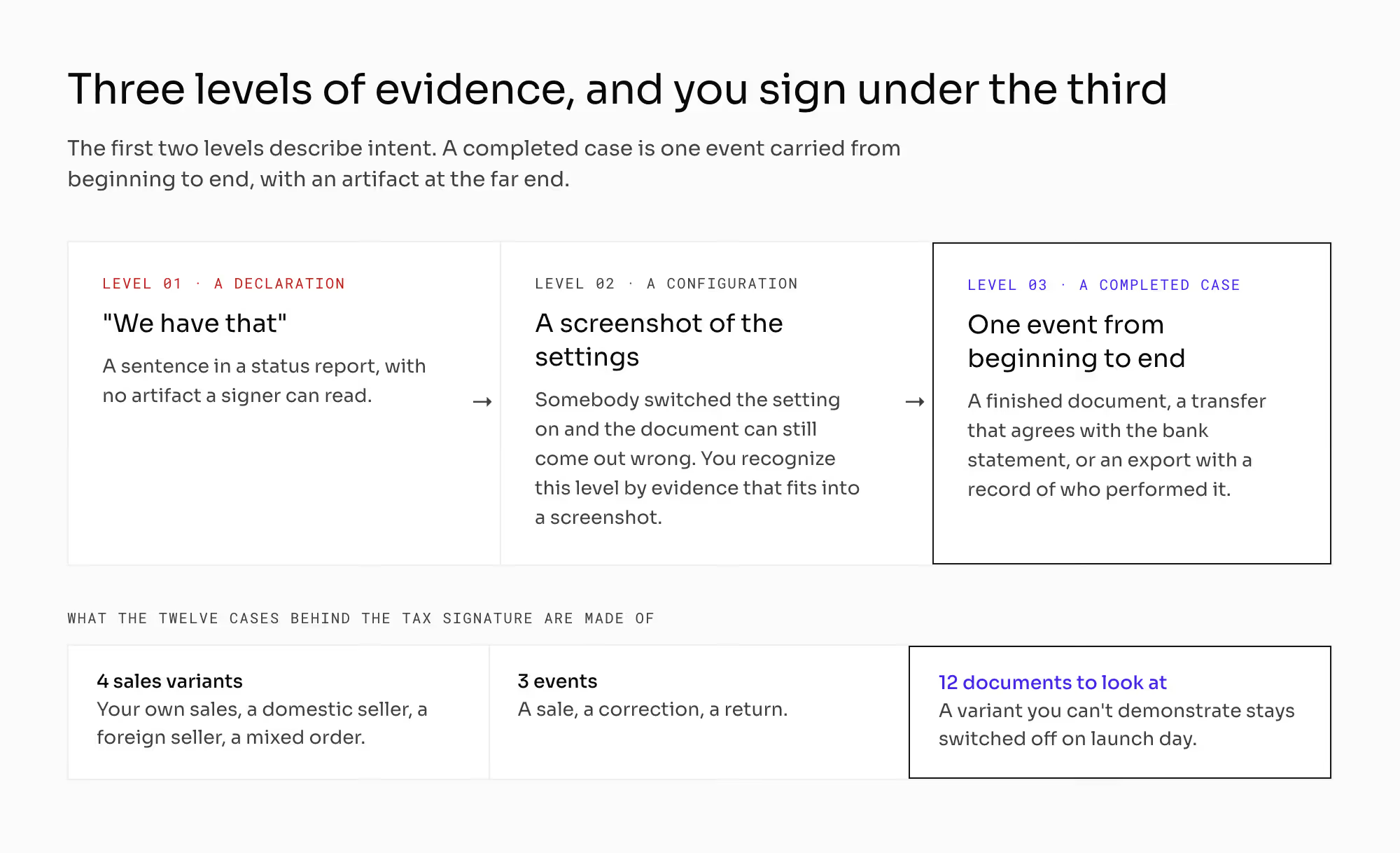
Evidence of readiness comes at three levels. A declaration sounds like "we have that". A configuration is a screenshot of the settings. A completed case is one event carried from beginning to end, with an artifact at the far end.
Since the first two levels describe intent, you sign under the third one only.
List the sales variants you allow at launch:
- Your own sales.
- A domestic seller.
- A foreign seller.
- A mixed order.
Then multiply by three events: a sale, a correction, and a return. Four times three is twelve completed cases and twelve documents to look at. A variant you can't demonstrate stays switched off on launch day.
The chapters on marketplace invoicing and marketplace e-invoicing cover what has to stand in the documents themselves.
Money works the same way. Because preview balances can drift from real ones, the evidence is a transfer that agrees with the bank statement.
In data, the evidence is a completed export of the seller database with a record of who performed it. Practitioners describe such an extraction as a minute's work that sometimes leaves no record at all.
Who should see which data is settled by marketplace GDPR. The chapter on the audit log on a marketplace covers what is left behind after the operation.
You'll find how to plan the cases themselves in UAT testing before a marketplace launch, and a signer puts their name under each finished case.
Which gaps block a launch, and which ones can you launch with?
A gap is blocking when it produces an artifact outside the company that you can't take back on your own. The difficulty of the repair has no part in that judgement.
The signer in each domain applies the criterion. Only that person knows what is irreversible there.
Your sponsor decides whether to launch despite a gap, in writing and under a name. The sponsor answers for the result in front of the board, and you'll find the role in the executive sponsor for a marketplace.
Under a rule of internal control older than marketplaces, authorization, execution, and review can't meet in one person.
1. Blocking gap
A blocking gap produces an artifact in the first week that leaves your company for good, and four of them cover most cases:
- A document at the buyer.
- A transfer at the seller.
- Disclosed data.
- An obligation toward a consumer.
Your own team can't withdraw any of those. Somebody else holds the artifact.
2. Gap you can launch with
A tolerable gap costs your own people's work and no one else's. A month-end close done manually sits in that category, and so do a document issued manually and a shift beyond the roster.
Each of those has a price in hours, and you write those hours down before you agree to the gap.
3. Gap whose cost grows with volume
Some gaps cost little at launch and become headcount in the second year. Take cases about someone else's goods and assume that around 5% of orders produce one. Replace that share with your own measurement once you have it.
In the first month, 5% of 300 orders is 15 cases, fewer than one per working day. At 10,000 orders a month it is 500 cases, about twenty-four a day. Give a gap like that a date and an owner.
How do you write conditional approval with a date?
Everyone at the table has heard "we are launching, we will add that later". The condition then dissolves over the following quarter, and a form with five fields holds it together:
- What exactly doesn't work. Name the variant, the queue, or the document. A project area is too wide to close.
- What replaces it until it's fixed, with named staffing. A substitute with a department name on it has no owner.
- Date the condition is removed. Write that date in the same document as the launch date.
- Owner of the condition. One person reports it closed and answers questions about it in week six.
- What happens automatically if that date passes? Teams fill this field in least often.
A default consequence has to hurt your side. Switch a category off, put seller intake on hold, or pay out manually with a second pair of eyes. A condition without such a consequence has no force.
Other fields do this as standard, and approval to operate comes there with a register of open items. Each item carries an owner, resources, and a planned closing date.
A conditional rating in a review of digital services lets the service go ahead, and the panel then reassesses it after a window counted in months.
Limit the exposure of the condition by volume as well, and suppose it covers a sales variant worth a tenth of your orders. In the first month, that is 30 orders out of 300, which is €30,000 of turnover and €3,600 of commission.
At target scale, the same condition is 1,000 orders, €1 million of turnover, and €120,000 of commission a month. The cost of a condition grows along with you, and a date on the condition is the only thing that caps it.
What do you do with a veto a week before an announced date?
In the first month, 300 orders at €1,000 each is €300,000 of turnover and €36,000 of commission. A week of delay costs you 75 orders, €75,000 of turnover and €9,000 of commission, which is less than the monthly cost of one full-time person.
Two years later, at 10,000 orders, a week costs 2,500 orders and €2.5 million of turnover. The commission on those orders is €300,000, thirty-three times the first figure.
A week of delay is cheapest in the first month. The argument about it is rarely about money, and usually about the promise given to sellers or to the market.
1. Check whether the veto covers the whole launch or a slice of it
Narrowing the launch is sometimes cheaper than shifting it, and you can take out one sales variant, one category, or one country.
Narrow the scope and keep the organizational commitment. A launch at half throttle gives your company a documented way of closing the subject a year later as a failed experiment. You'll find that line in a marketplace pilot versus a full launch.
2. Separate the announced date from the launch date
Outside the company, give the month, and give the day once the signatures are in. It costs one sentence in the announcement, and your team then has no reason to sign under pressure in the last week.
3. Write down who lifted the veto and on what basis
A veto lifted in a meeting with no record of it hasn't been lifted. Someone raises it again at the first failure, and by then no one remembers who gave way or what they got for it.
Write one line in the register with the name, the date, and what replaced the missing evidence.
Operators who meet a veto a week before launch made the mistake three months earlier. They announced the date outside the company before the signatures were collected.
What does a launch readiness checklist change in your marketplace?
Your signatures and the evidence behind them stay useful after go-live, and operators reuse them in the first weeks and again in the first quarterly review.
1. Pre-launch gate separated from a phase gate
A pre-launch gate stands on signatures and works before anything starts, and a phase gate stands on numbers gathered after the fact.
Your team uses a phase gate to settle whether the phase worked, and you'll find it in the phase gate review.
2. Evidence bought once and used twice
When you start changing settings under live traffic, the cases collected for the signatures are your reference material.
Compare a new payout with the one that agreed with the bank statement before launch, and you find the number that broke. You'll find those first weeks in hypercare after a marketplace launch.
3. Conditional approvals as the first item in the backlog
Conditional approvals are the first item in the backlog after launch, and each one goes on the weekly review agenda with its owner and its default consequence.
Without a place on that agenda, their dates pass and no one notices, and you'll find the weekly review in marketplace operations.
How do you build a launch readiness checklist in 6 steps?
Six steps take you from a list of tasks to a list of names.
1. Write down six names
Departments don't hold a veto, and a team name in that field gives you an email address.
2. Give each one sentence about what they confirm
A sentence longer than one line covers two domains, and two domains split at the first dispute.
3. Order evidence instead of a declaration
Use the lead time from the table. Order it a week before launch, and no one has time to react to a refusal.
4. Ask all six for a list of gaps
Make them sort the gaps into two buckets: produces an artifact outside the company, or costs only your own people's work. The signer sorts them.
5. Turn every gap from the second bucket into a condition with five fields
Include the default consequence if the date passes.
6. Ask who outside the six believes they can stop the launch
Add that veto to the list, or cancel it openly.
How do you check launch readiness with a vendor?
- Can you export a list of roles with their permissions from the system, and in what format?
- Does an export of the seller database leave a record of who performed it and when?
- Can finance produce one payout statement that matches a bank statement before launch?
- Which sales variants can produce a finished document today, including a correction and a return?
- Where does the approval trail for a configuration change live, and can a signer read it without your team's help?
Which mistakes do operators make with a launch readiness checklist?
Operators make these five mistakes while their status slides stay green. Your company carries the consequence in the first week.
1. Task list pretending to be a gate
A hundred items with ninety-five ticked off carry no names. No one refused the launch, and no one had the standing to refuse it.
2. Signature under a configuration instead of a completed case
Somebody switched the setting on, and the document still came out wrong. You recognize this one by evidence that fits into a screenshot.
3. Condition with no date and no default consequence
After a quarter, no one remembers that something operates temporarily, and the workaround has staffing of its own by then.
4. Project owner releasing themselves from a condition
Your project owner is measured on the date, which makes their "this isn't a blocker" predictable.
5. Date announced outside the company before the signatures were collected
Every veto costs money from that moment on, and your team pushes all of them down, the correct one with the rest.
What do you still have to settle about launch readiness?
You still have to plan the tests themselves, and you'll find them in UAT testing before a marketplace launch. The first weeks after go-live are hypercare after a marketplace launch. A cutover and rollback plan sits outside both.
The documents you collect signatures under have chapters of their own, and the marketplace seller agreement covers contracts and terms. The P2B Regulation covers your obligations toward sellers with the trail of decisions they require.
The chapter on marketplace order documents covers what you produce and what you keep, and marketplace liability draws the limits of an intermediary's liability.
Whether any of the six signatures is required of you by law is a question for a lawyer and a tax advisor. Ask it with a finished list of names in hand, and go through five families of regulation with them:
- Protection of personal data, for who sees seller and buyer records.
- Transparency toward the business users of a platform, for decisions you take about a seller.
- Consumer law, for what you owe a buyer of someone else's goods.
- Documenting of sales for tax purposes, for the twelve tax documents.
- Liability of an intermediary, for the cases you answer for yourself.
Ask who signs on your side and what they sign for.
Every number above is hypothetical. Substitute your own order volume, your own commission, and your own ramp to scale, and the arithmetic still holds.
Summary: Which signatures does a marketplace need before go-live?
A marketplace needs six signatures before go-live: legal, tax, security and data, finance, operations, and customer service. Each signer confirms one named thing, and no one can refuse a sign-off under "the project is ready" for a specific reason.
Behind every signature sits a completed case, and four sales variants multiplied by three events give you twelve documents for the tax signature. Finance signs under one payout that matches the bank statement.
Order the evidence six weeks out and collect the six reviews in parallel. One after another, they take 42 working days, against seven days plus seven for corrections.
Then sort the gaps with the signer, and give every tolerable gap a date and a default consequence. Announce the month outside the company, and announce the day once the signatures are in. Building a marketplace that has to pass a sign-off like this before a fixed date?
Frequently asked questions on launch readiness
What is a launch readiness checklist?
A launch readiness checklist is a list of the people whose signatures condition a go-live date, with one sentence on what each of them confirms. A task list records what has been done, and no one on it answers for the outcome. On a marketplace, the checklist holds six signatures, and a completed case sits behind each one.
Who signs off on a marketplace launch before go-live?
Six roles sign off on a marketplace launch: legal, tax, security and data, finance, operations, and customer service. The sponsor decides whether to launch despite a gap, in writing and under a name. Each signer classifies the gaps in their own domain, and only they know what is irreversible there.
What evidence do you need before a marketplace go-live?
You need one completed case per signature, carried from beginning to end, with an artifact at the far end. Tax needs twelve finished documents, and finance needs a payout that matches the bank statement. Order each piece three to six weeks before the date, and leave about a working week for the review on the signer's side.
Ready to build?
We build marketplaces that can produce the payout and permission evidence your signers ask for before go-live.