
Marketplace Manager: Hiring, Time to Self-Sufficiency, and Retention

Marketplace manager is the person who holds your seller base, your commission exceptions, and the rules your catalog is configured with. This chapter covers who you hire into that job, how long they need and what you lose when they resign.
There are more seats to fill than there are people who have operated a marketplace, and their price rises every time another company nearby launches a platform of its own.
Settle in advance which part of their work stays with you. If you leave that open, you learn the answer at the first resignation.
This article breaks down:
- What does a marketplace manager do?
- Which 2 kinds of knowledge walk out with a marketplace manager?
- Where do marketplace managers come from?
- How long does a marketplace manager need to become self-sufficient?
- What does losing a marketplace manager cost on one portfolio?
- Who competes with you for a marketplace manager?
- Which 3 artifacts stay behind when a marketplace manager leaves?
Key insights
- Marketplace manager covers six functions, from account management through to product ownership. That person also settles every case no rule covers.
- Your replacement arrives with the market experience already in place. Knowledge of your own rates and catalog rules has no buyer, and it has to be rebuilt from whatever was written down.
- Marketplace managers most often arrive from another platform, and you are mainly buying a contact network on the supply side. No degree and no certificate lead to this job.
- Six roles each need months of ramp-up and a block of other people's work. Your recruitment budget pays for none of those hours, and the people who stayed pay them.
- Count a departure on the portfolio one account manager holds as vacancy plus ramp-up times the drop in its turnover. That gives you a figure you can plan with.
- Put a yearly departure rate in the plan and check it against your own numbers after a year. Demand for this specialization grows faster than the supply of people.
- Three artifacts survive a resignation: a register of exceptions, a justification written at the decision, and a named deputy. Each takes minutes to produce, and your team spends years reconstructing a missing one.
What does a marketplace manager do?
Marketplace manager covers six functions on a platform in which other companies hold the stock and set their own prices. At the start, one person usually carries several of them. Each function splits off into a role of its own as the seller base grows.
Every number in this chapter comes from one hypothetical platform with 10,000 orders a month, 300 sellers and 200,000 offers. With a €1,000 average cart and a 12% commission, turnover is €10 million a month and commission is €1.2 million.
1. Account management
Your account manager holds a portfolio of sellers and the promises made to each of them, and some of those promises were agreed to out loud and never written down.
2. Onboarding
Your onboarder gets a signed seller to its first sale. The work turns on which integrators really map your categories, and whoever tried them holds that knowledge.
3. Catalog and data quality
Your catalog owner decides what gets rejected and what passes. A few rules in there must never be touched, and touching one breaks the feeds of your largest sellers.
4. Finance and reconciliation
Your reconciliation owner closes the period and chases differences between systems. One line never matches, and whoever first traced that line knows the reason.
5. Trust and safety
Your trust and safety owner suspends sellers and reinstates them. Some thresholds stand high on purpose, and you rarely find the reason in the configuration.
6. Product ownership
Your product owner decides how a field is mapped and which process gets a workaround. Each workaround was chosen for a reason, and the reason stays after that person leaves.
Which 2 kinds of knowledge walk out with a marketplace manager?
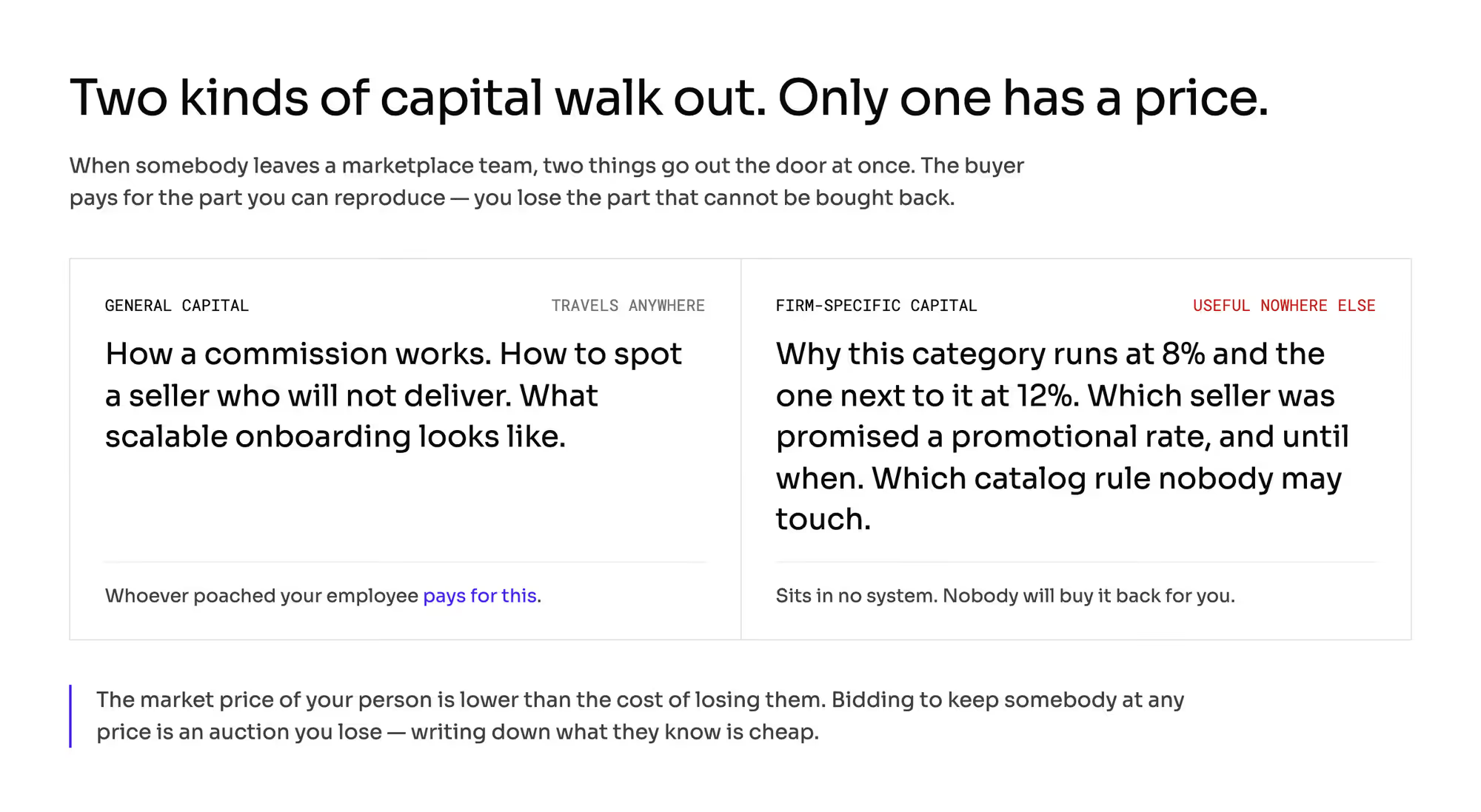
Two different things leave at once when someone resigns, and you can buy only one of them back.
1. Market experience you can rehire
Market experience covers how a commission works, how to spot a seller who will fail to deliver, and what scalable onboarding looks like. General capital travels to any operator, and whoever poached your employee pays for it.
Your replacement arrives with the general half in place, and labor economics contrasts that general capital with capital useful at one employer and nowhere else.
2. Knowledge of your own configuration
Firm-specific capital is knowledge about your own marketplace. Three examples of it:
- Why this category stands at 8% and the one next to it at 12%.
- Which seller was promised a promotional rate, and until when.
- Which catalog rule breaks the feeds of your three largest sellers.
You will see the loss of that knowledge in your numbers. None of it sits in any system, and no one on your team was negligent about it.
A change produces a record of itself. A record of the reason appears only when someone decided in advance that reasons would be written down.
This layer is called tacit knowledge, and it travels through direct contact while documents carry little of it. A company that captures none of it ends up with corporate amnesia.
Whoever hires your person pays the market rate for the general capital, and your firm-specific capital has no buyer at all. The market price of your person sits below the cost of losing them, and no counter-offer closes that gap. Writing what they know into a register costs far less.
What does one forgotten commission exception cost?
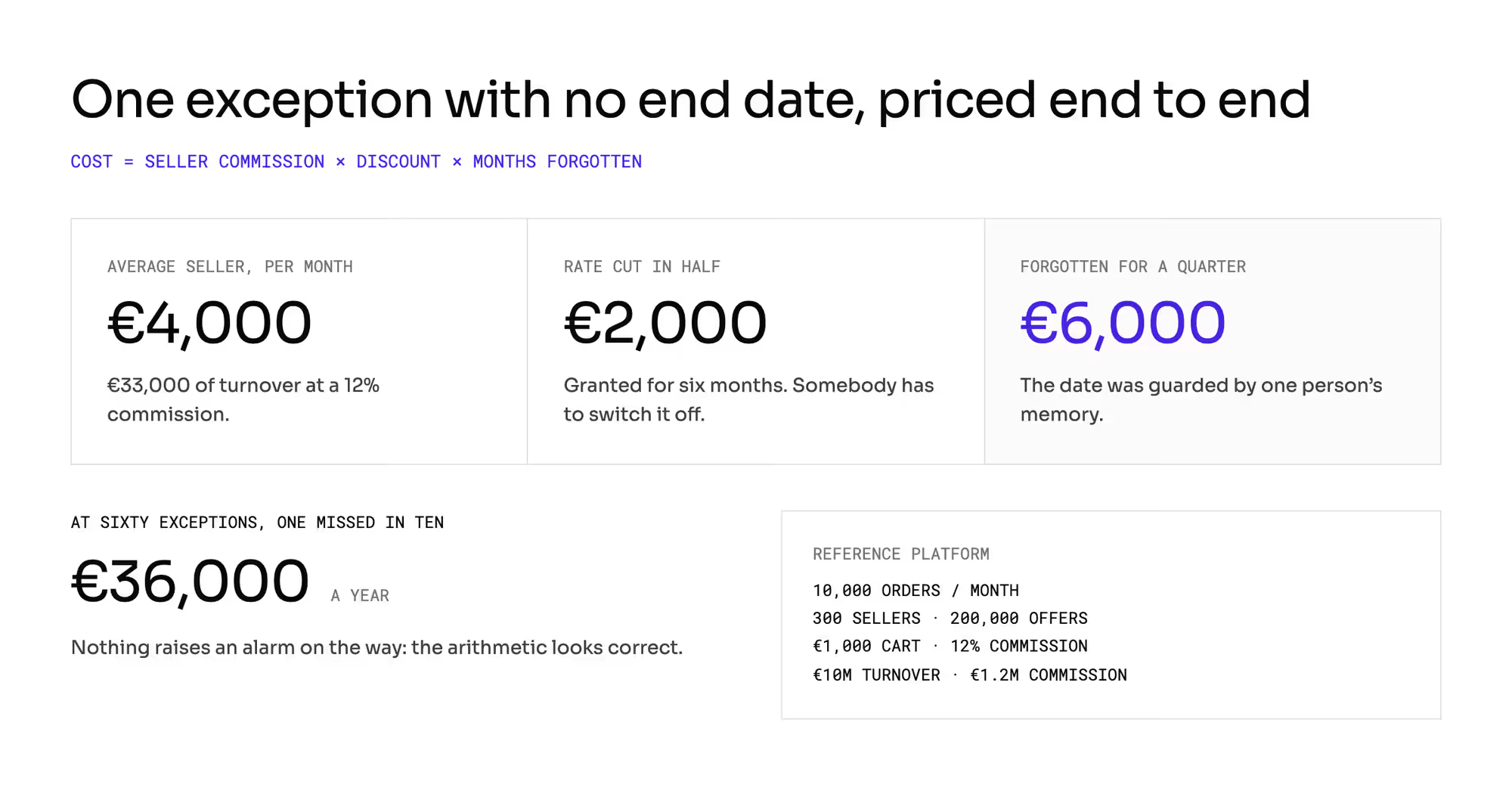
A seller gets their rate cut in half for six months, and someone has to remember to switch it back afterwards. In rollouts of this size one person's memory and a line in a spreadsheet hold that date.
The average seller does €33,000 of turnover a month and pays €4,000 of commission, and half of that commission is €2,000 a month.
An exception forgotten for a quarter costs €6,000. At sixty exceptions with one missed in ten, that is €36,000 a year. Because the arithmetic looks correct the whole way, no alarm goes off.
Where do marketplace managers come from?
No degree and no certificate lead to this job. The only training on offer teaches one particular vendor panel.
Because the market produces these people more slowly than new platforms appear, practitioners argue outright that vendors should found schools of their own. Every new operator staffs up from the same pool you do.
1. From another marketplace
This route is the most common and the most expensive, and you are mainly buying a contact network on the supply side.
Practitioners describe seller recruitment as work done out of that person's own address book, and a form on your website signs far fewer sellers.
The first dozen signatures arrive faster than the plan assumes, and the person who signed them takes the address book away.
2. From your own organization
A buyer or a category manager brings knowledge of the category, margins, and negotiation. The instinct to write a rule doesn't carry over.
Where a buyer settles each case on its own, an operator with three hundred cases a month has no hours left. The chapter on product approval covers where the line falls between a rule and a single decision.
On a marketplace, you don't set the price, and you can't see someone else's warehouse. Both instruments this person used to steer the result stop existing, and a buyer notices that a few months in.
3. From the seller side
Someone who has listed on other people's platforms understands what a seller fails to grasp in a settlement. They shorten the queue of seller requests from their first week.
In exchange, they need a few months to stop seeing every dispute through one side's eyes.
How long does a marketplace manager need to become self-sufficient?
Pricing this starts with two numbers per role: how many months to self-sufficiency, and how many hours of other people's work the ramp-up eats.
You plan headcount with the second number, and a full-time role is about 126 net hours a month in the chapter on eCommerce team structure.
Which function? | How long to self-sufficiency? (months) | How many hours of other people's work? (hours) | What disappears with the person? | Where does the gap show first? (measure) |
|---|---|---|---|---|
Account manager | 6 | 120 | who holds which exception, and what was promised to whom out loud | portfolio turnover |
Onboarder | 3 | 60 | which integrators really map your categories | time to first sale |
Catalog and data quality | 4 | 80 | which rules must never be touched | share of rejections in the queue |
Finance and reconciliation | 6 | 100 | where the standing mismatch on one line comes from | length of the month-end close |
Trust and safety | 4 | 60 | which threshold stands high on purpose | jump in the number of suspensions |
Product owner | 9 | 160 | why this field is mapped the way it is | number of workarounds in the process |
The six roles together come to 580 hours of other people's work. That is more than four and a half full-time months, and the recruitment budget pays for none of it. You pay it with the time of the people who stayed.
What does losing a marketplace manager cost on one portfolio?
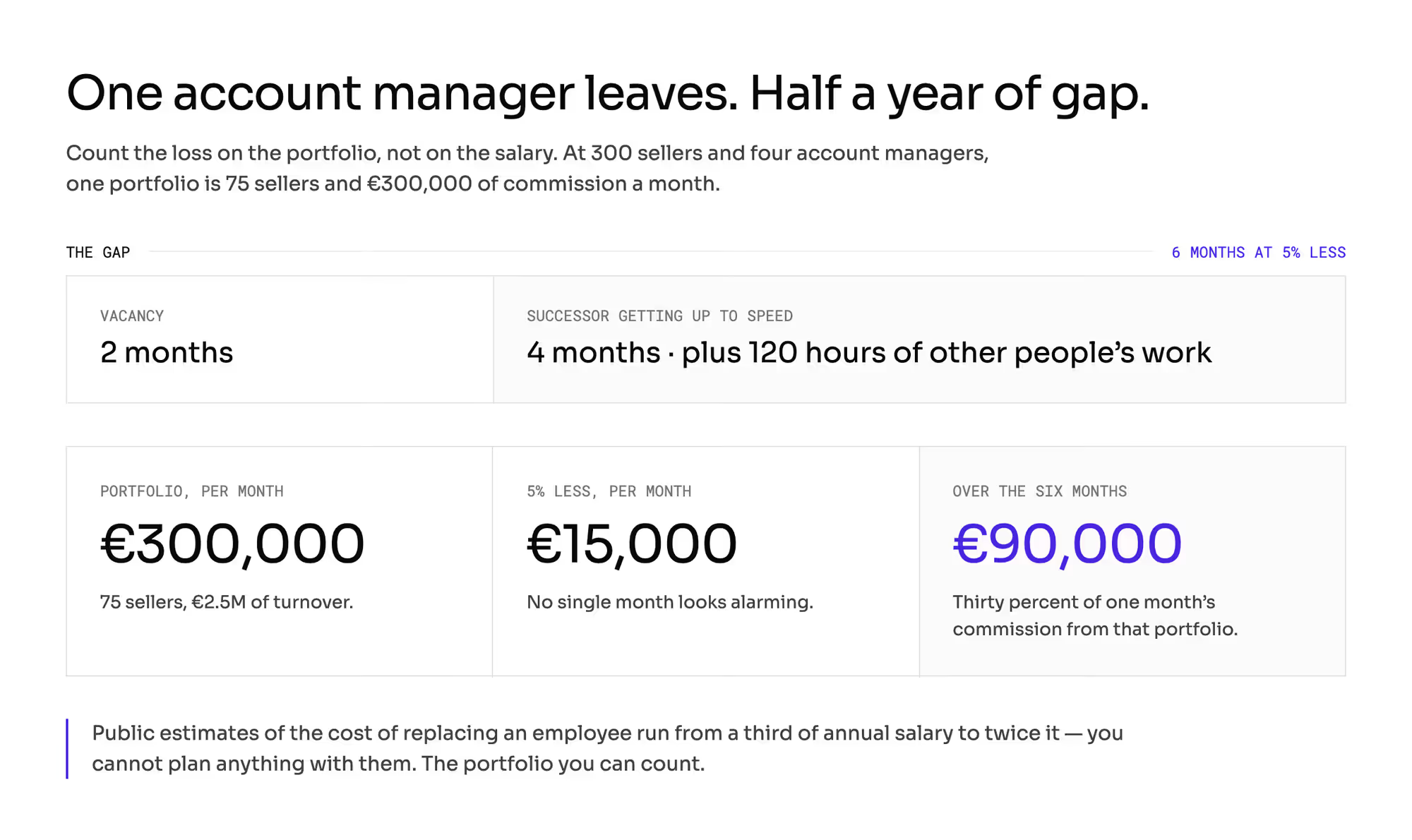
Count the loss on one account manager's portfolio. At 300 sellers and four account managers, that portfolio holds 75 sellers and €2.5 million of turnover, with €300,000 of commission a month.
Losing an account manager gives you two months of vacancy and four months for the successor to reach self-sufficiency. That is half a year. If the portfolio delivers 5% less over that stretch, you lose €15,000 of commission a month and €90,000 in total.
Ninety thousand euros is thirty per cent of one month's commission from that portfolio, and 120 hours of other people's work go on top.
Public estimates of replacing an employee range from a third of annual salary to twice it, and your own portfolio arithmetic gives you a figure you can plan with.
At the starting scale, the same calculation gives a different answer. At 30 sellers and 300 orders, you have €36,000 of commission a month and no four portfolios. You have one person who knows every seller by name.
At that scale, the first-order risk is your configuration, written right now and held inside one head. Six exceptions exist, and writing them down costs fifteen minutes today. In two years you will have sixty of them and no way to reconstruct the reasons.
Who competes with you for a marketplace manager?
Four buyers bid for the person you trained. Each one wants a different part of what that person knows.
1. Another operator on the same technology
Your person lets them skip half a year of getting up to speed. That makes your person worth more there than a candidate from the general market, and this buyer is the hardest one for you to outbid.
Every additional platform on the same engine sets off poaching, and the pool of trained specialists is shared across the whole market.
2. Your larger sellers
They buy knowledge of how an operator thinks, and your person knows where a rule ends and who grants an exception past it. Sometimes that person switches to the other side of the table.
3. Integrators and implementation agencies
They need someone who has sat on your side of the relationship, and your six months of ramp-up become sales material for them.
4. Platform vendor
Implementation and partner roles at the vendor suit anyone who knows the product from the operator's seat.
Put a departure rate of 15 to 20% a year in the plan. Because demand in this specialization grows faster than supply, check that rate against your own numbers after a year.
On a team of eight that is one to two departures a year, and one role a year goes through the full cycle of vacancy and ramp-up. Whether you may contractually limit a departing person's work for a competitor is a question for a lawyer.
How do you measure dependency on one marketplace manager?
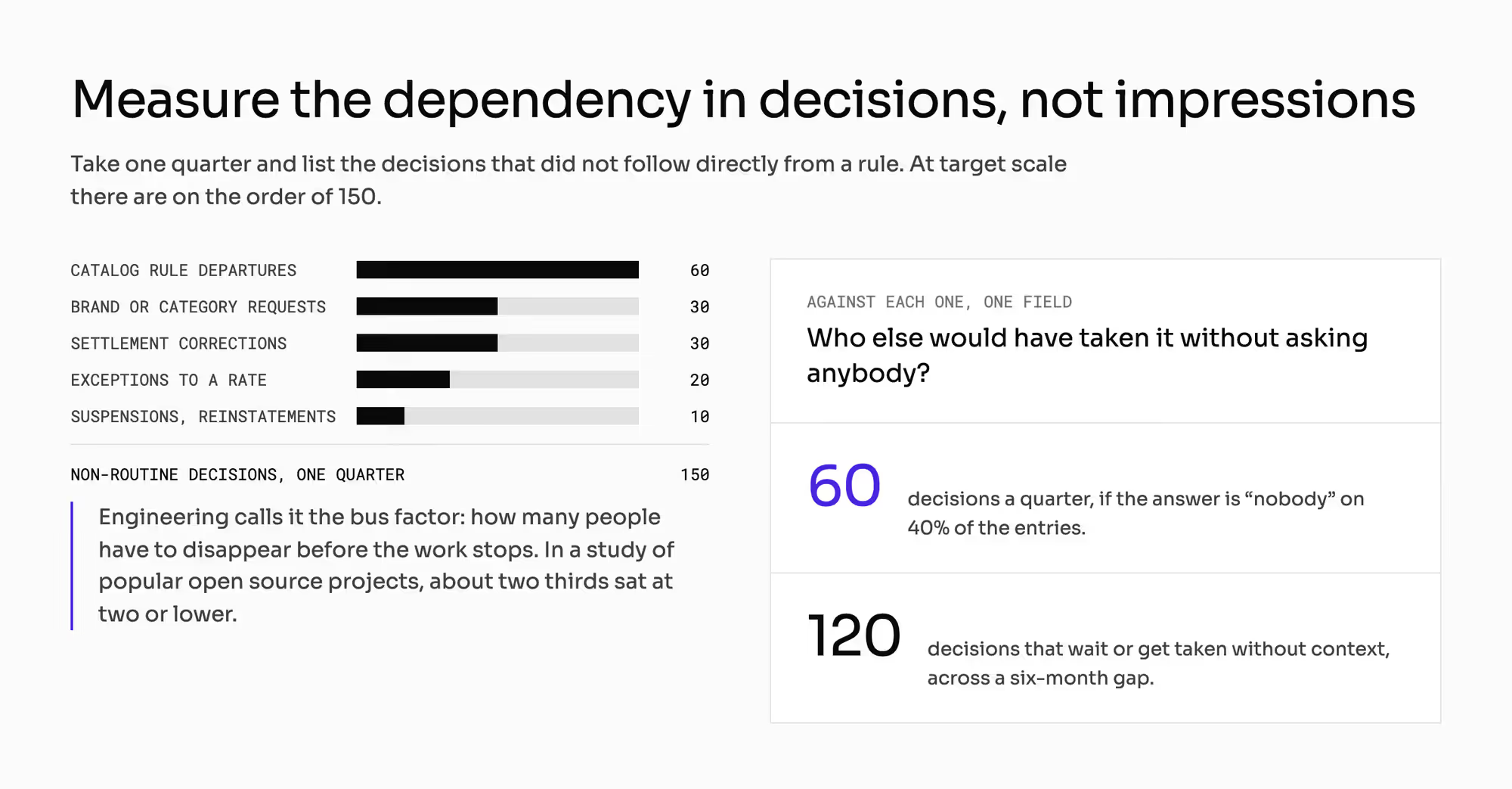
Measure dependency as the number of decisions in the last quarter that exactly one person could have settled. Engineering calls that number the bus factor, and it counts how many people have to disappear before the work stops.
On many popular open-source projects, the bus factor sits at two or lower. Companies count the same thing when they mark critical roles in a succession plan.
Take one quarter and list the decisions that didn't follow directly from a rule, and at target scale there are on the order of 150:
- 30 requests for a brand or a category.
- 20 exceptions to a rate.
- 10 suspensions and reinstatements.
- 60 departures from a catalog rule.
- 30 settlement corrections made outside the procedure.
Against each one, add a single field: who else would have taken it without asking anyone. Suppose the answer is "no one" on 40% of the entries.
That gives you 60 such decisions a quarter, and a six-month gap holds up 120 of them. Your team either waits on each one or takes it without context.
Where a decision waits and who has the right to take it belongs to the chapter on the approval workflow. The trail it leaves behind belongs to the chapter on the marketplace audit log. A decision with no justification on it also vanishes from the company when its author resigns.
Which 3 artifacts stay behind when a marketplace manager leaves?
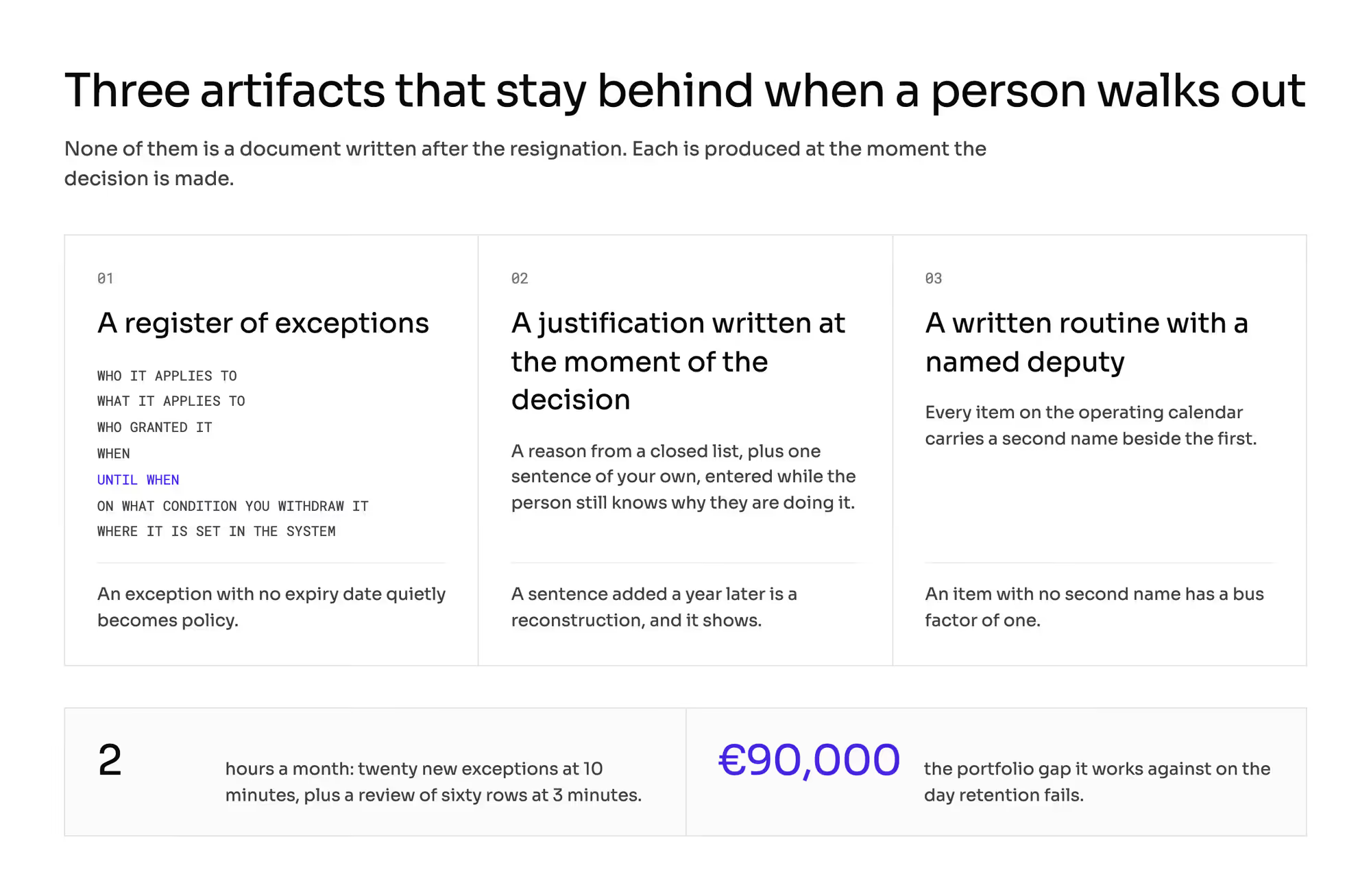
Three written artifacts survive a resignation. Each one takes minutes to produce, and your team spends years reconstructing a missing one. Together they cost more than 6 hours a quarter, or two hours a month.
1. Register of exceptions
Register of exceptions holds one row per exception, with seven fields on it:
- Who it applies to.
- What it applies to.
- Who granted it.
- When they granted it.
- Until when it stands.
- On what condition you withdraw it.
- Where it is set in the system.
The "until when" column earns the whole register. An exception with no expiry date turns into policy, and no one can say when it did.
Writing 20 new exceptions a quarter at 10 minutes each is 3.3 hours. A review of sixty rows at 3 minutes each is 3 hours. Negotiated rates belong to the chapter on commission exceptions, and the chapter on commission rate drift covers the grid against the document you gave sellers.
2. Justification written at the moment of the decision
Take a reason from a closed list and add one sentence of your own, entered while the person still knows why they are doing it. A sentence added a year later is a reconstruction, and your reader can see that immediately.
What you have to justify and deliver to the seller belongs to the chapter on P2B regulation.
3. Written routine with a named deputy
The operating calendar belongs to the chapter on marketplace operations, and an item with no second name on it has a bus factor of one.
Name the deputy when you write the item, and a notice period won't leave you with a volunteer and no handover time.
What does a marketplace manager change in your marketplace?
Four plans change once you have priced a departure, and each one is usually written as though the team was permanent.
1. Headcount plan gains two lines
Your headcount calculation already names the functions and the hours. Add the ramp-up hours taken off the people who stayed, and add the vacancy as a standing annual item.
2. Bonus system decides who stays
A bonus system keeps people better than any retention program. How credit is split between your own sales and third-party sales belongs to the chapter on the sales compensation plan.
3. Offboarding is two separate operations
Removing access is technical work, covered by the chapter on SSO and MFA. A seller leaving has different mechanics, covered by the chapter on seller offboarding.
4. Team cost enters the model as a growing line
Put it in the chapter on the marketplace business case as a line that grows with the seller base. Dependency on one person costs the most during hypercare. Becoming independent of the vendor belongs to the chapter on eCommerce TCO.
How do you test your dependency on one marketplace manager in one afternoon?
Six steps, done before anyone hands in a resignation:
- Pick one person and assume they are gone as of tomorrow. Write down what stops in the first week.
- Against every non-routine decision from the quarter, write down who else could have taken it. The share of "no one" entries is your score.
- Ask for the register of exceptions. If it doesn't exist, assemble one from the commission grids, the correspondence, and your account managers' memory. Time how long that takes.
- Check the dates. Count the exceptions with no expiry date. Count the ones that have outlasted what the person who granted them intended.
- Calculate the stake: portfolio turnover times commission times the assumed drop times the length of the gap.
- Ask candidates where they are leaving from and why. In a pool this narrow, the answer also tells you how long they will stay with you.
Which mistakes do operators make with a marketplace manager?
Each of these five mistakes is comfortable while the person is still in the building. All five become visible in the week after they resign.
1. Exception with no date
A promise made for six months is in its third year, and the person who guarded that date has left.
2. Promotion into being the only one
Your best person gets the hardest cases. A year later, they are the only one who understands them, and no one on your team chose that dependency.
3. Retention counted in money alone
You bid for general capital in a market where the buyer sets the price. Your specific capital carries no price in that auction, and you lose it anyway.
4. Handover during the notice period as the whole plan
Two weeks of conversations transfer a list of headings. Tacit knowledge transfers through joint work on live cases, planned before the departure.
5. Recruitment started on the day of the departure
You have a two-month vacancy and four months to self-sufficiency ahead of you, and each week of delay adds another week with a portfolio and no account manager.
What do you still have to settle about a marketplace manager?
This chapter doesn't say how many people you need or for which functions, and the queue arithmetic for that sits in the chapter on eCommerce team structure.
It also doesn't design salaries or bonuses, and it gives no ranges. Ranges differ per market and go out of date faster than a document does. The chapter on the sales compensation plan covers how credit is awarded.
Teaching sellers belongs to the chapter on seller support and education. Removing access belongs to the chapter on SSO and MFA.
This chapter doesn't settle anything in employment law. A non-compete, trade secret protection, and the limits on handing over documentation are questions for a lawyer, and three families of rules are worth asking about:
- Employment rules in each country you hire in.
- Trade secret protection and what counts as one.
- Personal data protection, since one register of exceptions often holds seller information and personal data at once.
The roles under data protection belong to the chapter on marketplace GDPR. Retention belongs to the chapter on order documents.
None of the numbers above is yours, and the conclusion holds at whatever scale you put in. Put in your own portfolio, your own length of vacancy, and your own count of exceptions.
Summary: What does a marketplace manager do and what does a departure cost?
Marketplace manager covers six functions, from account management and onboarding through to product ownership. Self-sufficiency takes 3 to 9 months per function. All six together eat 580 hours of other people's work.
Two kinds of knowledge leave with the person, and your replacement arrives with only the market experience in place. Knowledge of your own configuration has to be rebuilt from whatever was written down.
Price a departure on the portfolio: at €300,000 of commission a month and a six-month gap at 5% less, one account manager is worth €90,000. Sixty forgotten exceptions a year cost €36,000 more.
Put 15 to 20% a year of departures in the plan. Write down the exceptions, the reasons, and the deputies.
Hiring into a marketplace team where one person currently holds every exception in their head?
Frequently asked questions about a marketplace manager
What does a marketplace manager do?
Marketplace manager holds the seller portfolio, approves what enters the catalog, and grants or withdraws commission exceptions. That person also settles the cases no rule covers, from brand requests to rate exceptions and suspensions. At the start, one person covers several of the six functions at once.
How long does it take to train a marketplace manager?
Self-sufficiency takes months per function, and the product owner takes the longest of the six. The ramp-up also eats hours of other people's work, and those hours come off the people who stayed. Your recruitment budget carries none of them.
What does it cost when a marketplace manager leaves?
Price it on the portfolio that person held: the vacancy, the successor's ramp-up, and the turnover the portfolio loses in between. Hours of other people's work go on top, and so does every exception that expires with no one watching. Public replacement-cost ranges won't give you a figure you can plan with.
Ready to build?
We build marketplaces whose configuration is written down, so your exceptions and your rules don't walk out with one person.