
Hypercare After a Marketplace Launch: Support Hours, Fix Times, and the End Date

Hypercare is the period of heightened support that opens on launch day and closes on a date you set in advance. This chapter covers the hours hypercare support costs and the date the period ends.
Your platform is live, and your sellers are selling. You will still repair something every day for the next six weeks.
Some operators pass through this period in six weeks, and others are still inside it a year later. The difference is the number of days between noticing a problem and repairing it.
This article breaks down:
- What does hypercare cover after a marketplace launch?
- Why won't your panel show you the first defect?
- Who answers the phone in the evening, and who can promise money?
- How many hours does hypercare support cost across six weeks?
- Which measure tells you hypercare is working?
- What can you change on the fly, and what needs a window?
Key insights
- Hypercare covers a daily review of orders and the repairs that come out of it. The damage grows in a straight line with repair time, and speed is the lever you have in this period.
- Your panel won't show you the first defect. At launch volumes, a broken step looks no different from a quiet day. Your sellers see all of it and tell you first.
- Name a launch duty officer for the evening calls, and give support a spending limit before the first promise. Set that limit in carts, and check its exposure against your commission before launch.
- Convert hypercare support into hours before you sign, and count the normal routine on top of it. One person can't take evening duty and the daytime round on the same day. Put two people in rotation.
- Write the end date and three exit criteria into the budget before launch. End it when no new fix stops an order, repair time sits inside your terms of business, and evening duty goes quiet.
- Change content, thresholds and staffing on the fly. A change to the meaning of records already written belongs in a window. A rate concession needs an expiry date on it, and its cost grows with your turnover.
What does hypercare cover after a marketplace launch?
Hypercare covers a daily review of orders and the repairs that come out of it. A named person also phones your sellers in the evening.
Because every operator makes repairs in the first weeks of a marketplace launch, you can't judge a rollout by the number it needs. Ask how long each one takes instead.
Operators describe the same first month, in which a few early signs look promising straight away, and the first complaints arrive in the same week.
The starting scale of this series is 300 orders a month, 30 sellers and 20,000 offers, on a €1,000 cart at a 12% commission. That gives you €300,000 of turnover and €36,000 of commission in the first month.
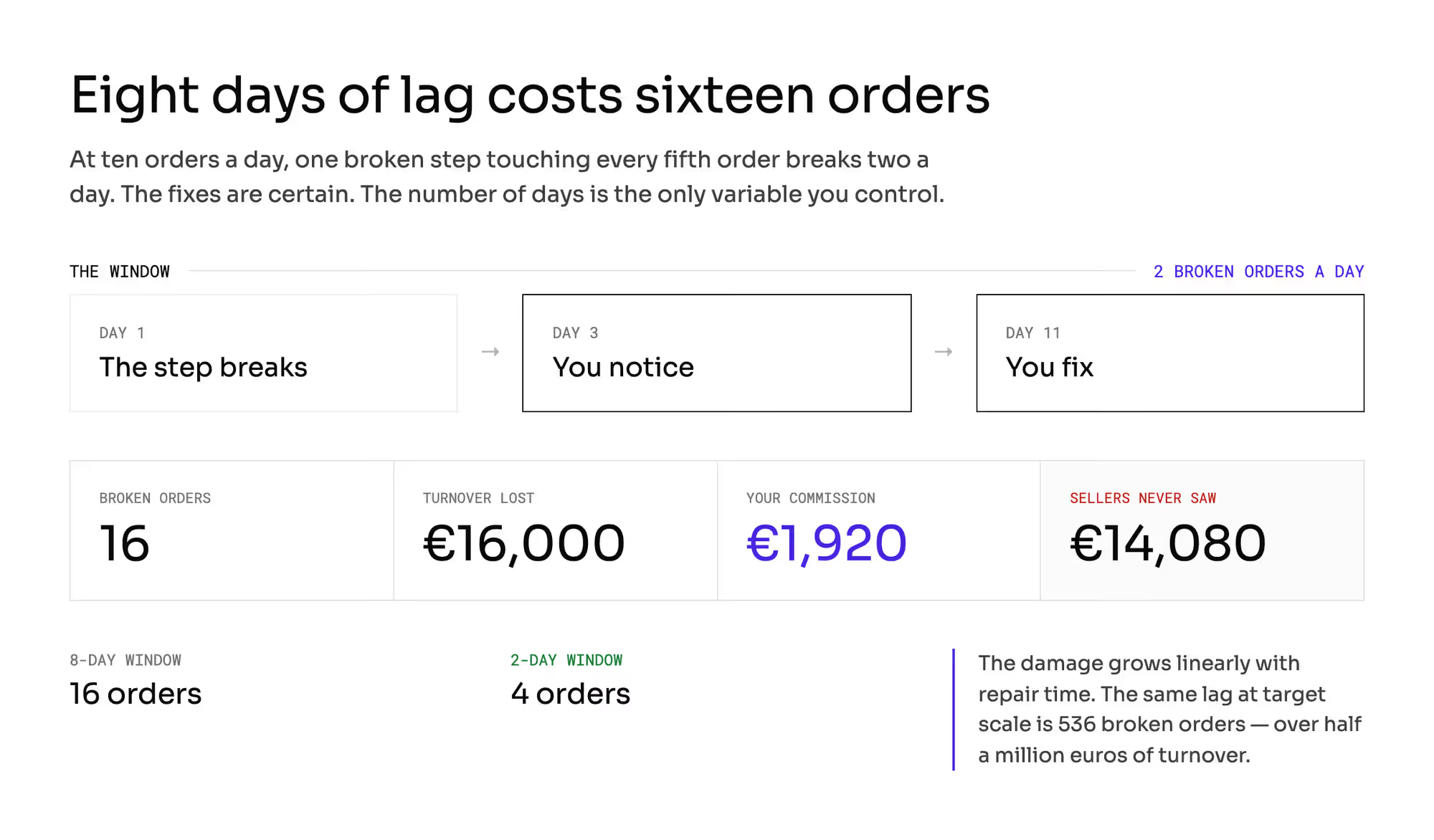
300 orders a month is ten orders a day. Assume one broken step in the order path that touches every fifth order, which is two orders a day.
You notice it on the third day, and you repair it on the eleventh. Eight days times two orders is 16 orders, worth €16,000 of turnover and €1,920 of your commission. Your sellers lose the other €14,080 (16 × €880).
Shorten the window from eight days to two, and you lose four orders. The damage grows in a straight line with repair time, and speed is the lever you have in this period.
Target scale is 10,000 orders a month and 300 sellers, and you reach it about two years out. Eight days of delay means 67 broken orders a day and 536 across the window, which is more than half a million euros of turnover.
Why won't your panel show you the first defect?
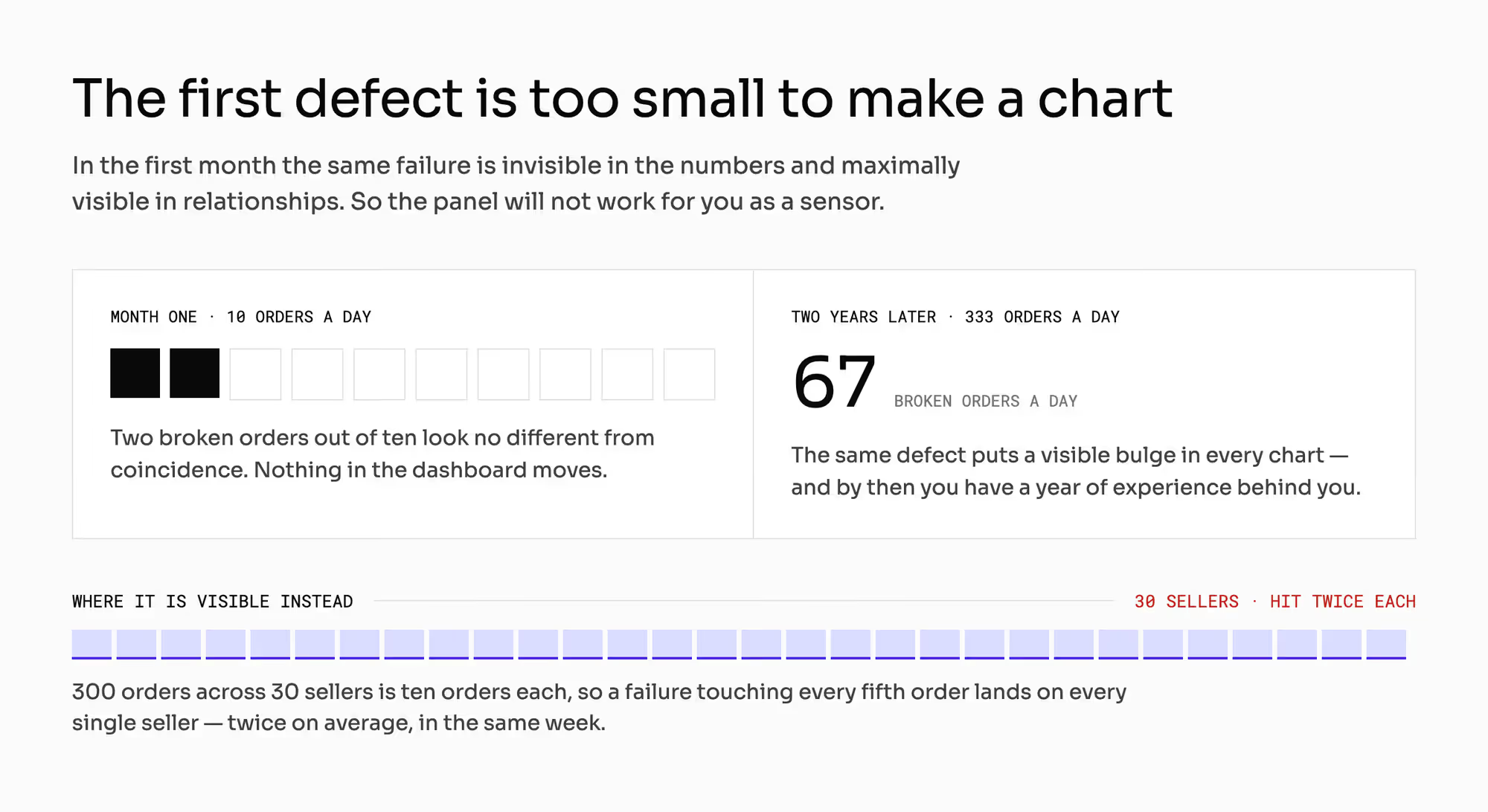
Two broken orders out of ten a day look no different from coincidence, and in your panel you can't tell them apart from a quiet day.
At target scale the same defect is 67 orders out of 333, which shows as a bulge in every chart, and by then you have a year of experience behind you.
In the first month the numbers hide the defect and your sellers see all of it. 300 orders across 30 sellers is ten orders per seller, and a failure on every fifth order hits each seller twice on average.
A panel measures what someone chose in advance to measure. Every line of a good launch checklist comes from someone else's accident, and your own first defect isn't on any checklist yet.
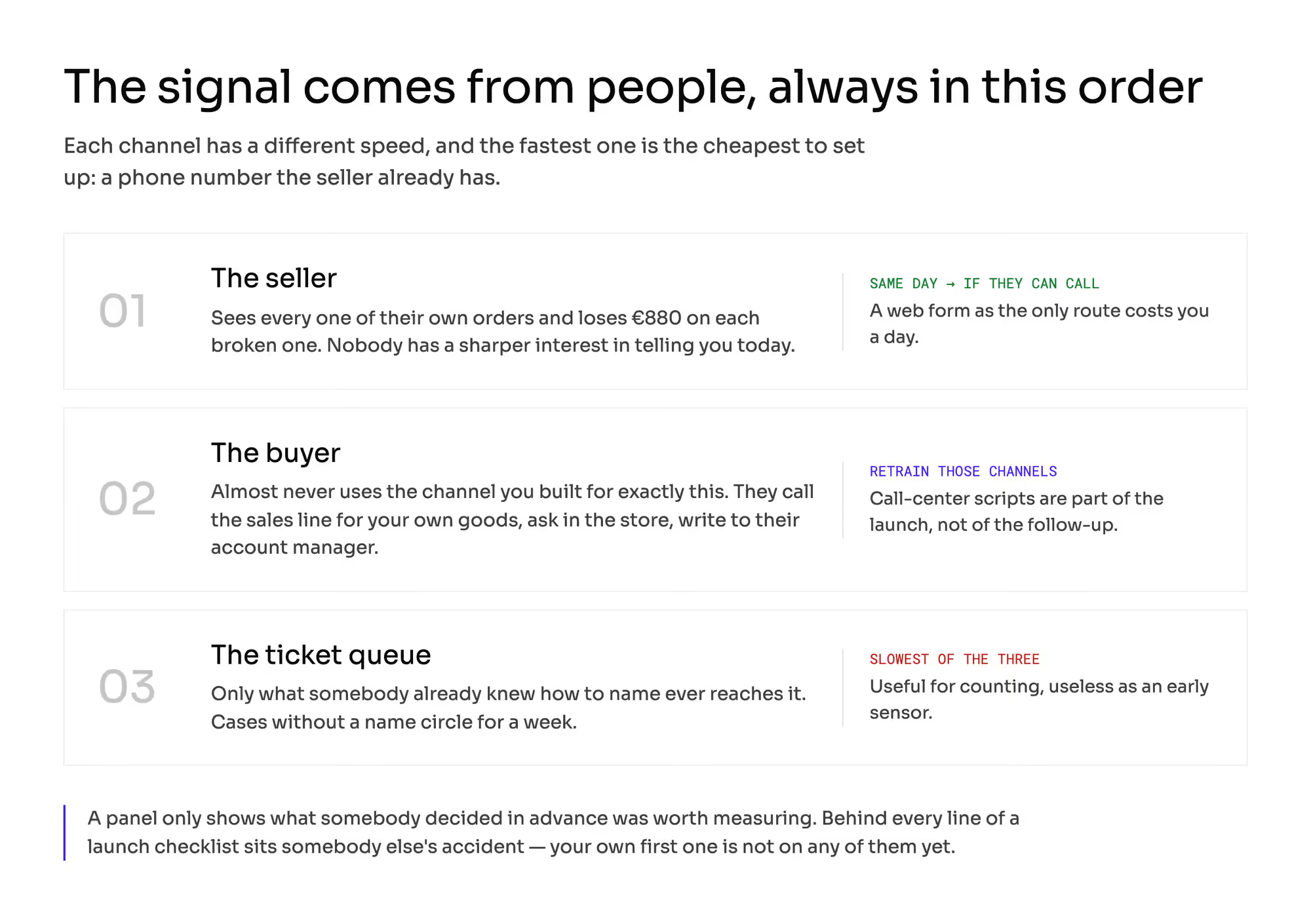
People tell you first. Your sellers reach you before your buyers, and your buyers reach you before the ticket queue.
1. Seller
Your seller tells you first. They see every one of their own orders, and they lose €880 on each broken one.
Your seller has to know which person to call and on which number, and a web form as the only route costs you a day.
2. Buyer
Your buyer tells you second, and they rarely use the channel you built for this. They call the sales line for your own goods or ask the staff in the store, and some write to their account manager instead.
Those channels are staffed by people who know little about a seller's products. Train them and rewrite the call center scripts as part of the launch itself.
Practitioners also observe that conversion and service ratings fall in the first weeks. The fall is the price of selling someone else's goods in your own store, and it doesn't mean a system broke.
3. Ticket queue
Your ticket queue tells you this. A case only reaches it once someone knows how to name it, and an unnamed case circles for a week.
The chapter on seller requests on a marketplace covers the mechanics of that queue. The chapter on marketplace seller support and education covers what you teach your sellers.
Who answers the phone in the evening, and who can promise money?
Your launch duty officer answers the evening calls, and your support team approves compensation up to a stated amount. Both of those are named people, and a department can't do either job.
1. Launch duty officer
Your launch duty officer holds the list of thirty seller phone numbers. You can call all thirty sellers after their first order, and thirty calls take about seven hours in total. That makes it the cheapest piece of research in the whole rollout.
The same person calls a seller in the evening when an order has stalled, and a seller who dispatches the next morning has until the end of the day to react.
2. Monetary mandate for support
Your support team needs a spending limit before the first promise. Buyers raise requests on a few percent of orders, and at 300 orders that is about 15 cases in the first month.
Assume every fifth case ends in compensation at the full cart price, and your maximum exposure is then €3,000, which is 8% of the first month's commission.
Write the limit into the procedure once, and let support close a case worth up to one cart on its own. The launch duty officer decides anything above that. Without a limit, cases sit in escalation for two days, or someone promises the buyer an amount you can't recover from the seller.
Whether a promise from your support binds you or binds the seller depends on who you are in the transaction. The chapter on marketplace liability settles that, and the chapter on marketplace customer service covers who answers the buyer.
How many hours does hypercare support cost across six weeks?
Vendors and implementation firms put this line in their proposals as hypercare support. Because most of them describe it in one sentence about increased availability, convert it into hours before you sign.
The hours below are the excess over the normal routine at the starting scale, across six weeks.
What does the team do? | How often? | Minutes per pass | Passes in six weeks | Hours across the period | What happens to it at the end? |
|---|---|---|---|---|---|
Reviewing yesterday's orders one by one | daily | 30 | 30 | 15 | disappears |
Fix briefing: what was found and what was repaired | daily | 20 | 30 | 10 | drops to a weekly rhythm |
Call to a seller after their first order | once per seller | 15 | 30 | 7.5 | stays in onboarding |
Evening phone duty, first two weeks | daily | 180 | 10 | 30 | disappears |
Seller requests above the normal queue | daily | 40 | 30 | 20 | returns to the normal queue |
Review of the fix list with the marketplace owner | weekly | 60 | 6 | 6 | drops to a monthly rhythm |
Explaining individual settlements to sellers | weekly | 45 | 6 | 4.5 | folds into the month-end close |
The total is 93 hours across six weeks. A full-time role gives about 126 usable hours a month, which is 189 hours across six weeks, and hypercare support takes just under half of it.
The normal routine comes on top of that, and the chapter on marketplace operations puts it at 77 hours a month, which is 115 hours across six weeks.
Add the two, and you need 208 hours against 189 available. Because one person can't take evening duty and the daytime round on the same day, put two people in rotation.
Evening duty is thirty of the ninety-three hours, and all thirty fall in the first six weeks. Your commission in that period is €54,000, and you will never collect less.
When does hypercare end, and what proves it?
Put the end date in the budget on day one, and make any later shift require a written justification from whoever asks for it. Write three exit criteria down in advance, and agree on them before anyone has a reason to argue about them.
1. Two weeks with no fix stopping an order
Two weeks pass with no new fix stopping an order. The fix list still grows, and none of the new items touch the order path.
2. Median repair time inside your terms of business
Median repair time sits inside what you promised in your terms of business. Measure it on the same clock you used in the promise.
3. Two quiet weeks on evening duty
Evening duty goes two weeks without a call that needed a decision. Don't count calls your team could close from the procedure.
Once all three clear, go back to your normal operating calendar. You then explain settlements as part of the month-end close, and the chapter on the month-end close process covers that week in detail.
Your first thirty sellers get a level of service you can't sustain at three hundred. Seller number 40 will see a different standard and will discuss it with the first thirty. Tell them plainly which part of the service was one-off.
Which measure tells you hypercare is working?
Measure the days between noticing a problem and repairing it. Your turnover is too small in this period to separate a trend from noise, and so are your seller count and your offer count. You can't read anything into the difference between 280 orders and 320 orders in a month.
Technical maintenance teams split the repair time from the time since the failure started, and they call the gap between the two the detection delay. At ten orders a day, that delay is days long. Count days since the first broken order to judge your sensors, and count days since you noticed to judge how fast your team reacts.
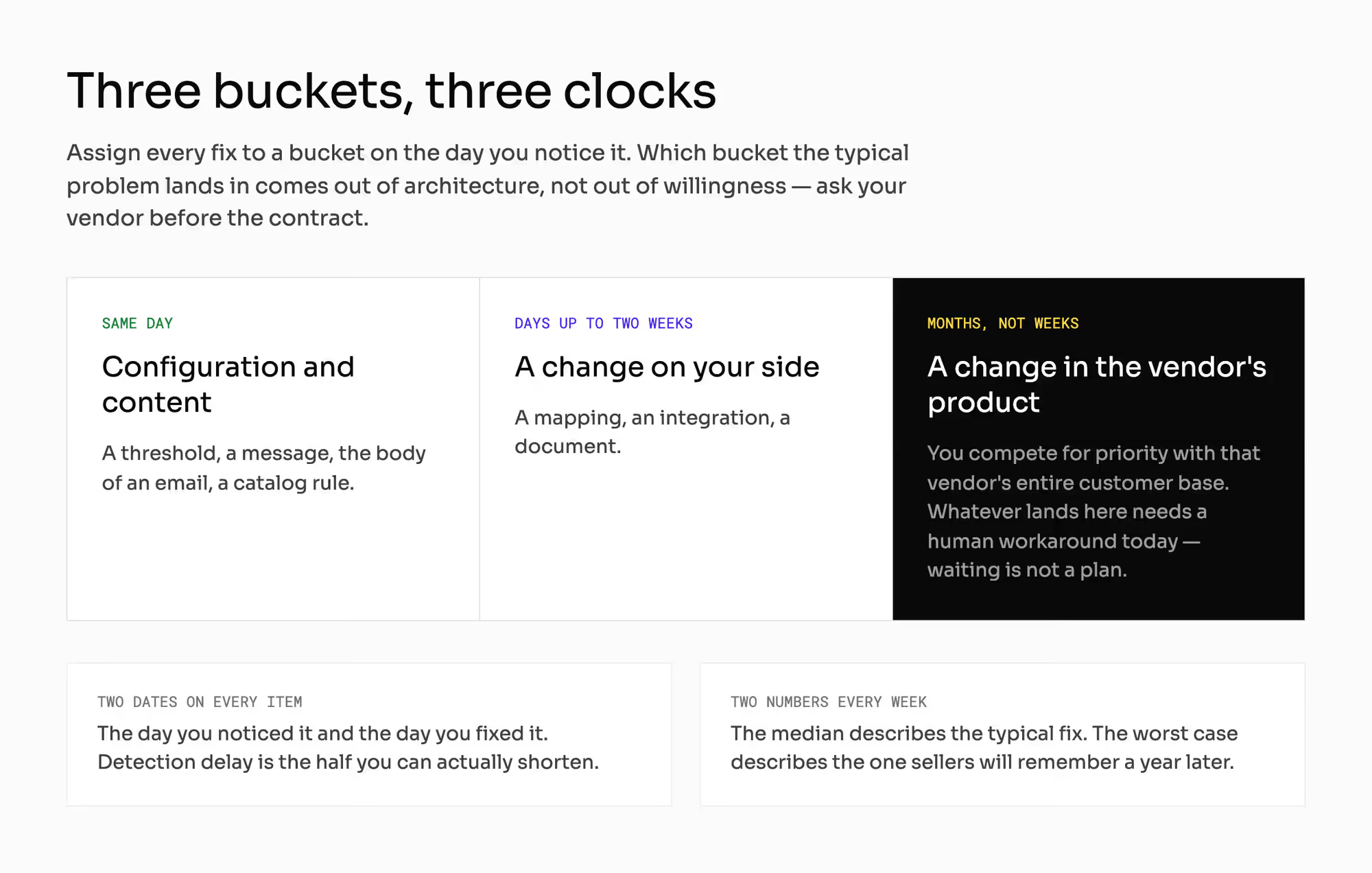
Report two numbers a week: the median and the worst case. The median covers the typical fix, and your sellers will remember the worst case a year later. The chapter on the phase gate review covers gates and phase measures.
Because each bucket has a different clock, put every fix into one of 3 buckets on the day you notice it. Pick the bucket first, then promise the seller a date.
1. Configuration and content
Configuration and content covers a threshold, a message, the body of an email, or a catalog rule. You repair it the same day from the panel, with no release involved. Tell your sellers the same day as well, or they report the same case again next week.
2. Change on your side
Change on your side covers a mapping, an integration, or a document. Your own release process sets the pace, and a change like that takes days, sometimes up to two weeks. Because items with no owner wait for the next sprint planning, give each item a named owner on the day you log it.
3. Change in the platform vendor's product
Change in the vendor's product takes months in the rollouts I know of, and one operator competes for priority with that vendor's whole customer base.
Whatever lands in this bucket needs a human workaround today. Add the workaround to your hypercare hours, and count those hours against the budget you set. Waiting costs you two broken orders a day until the vendor gets to you.
What can you change on the fly, and what needs a window?
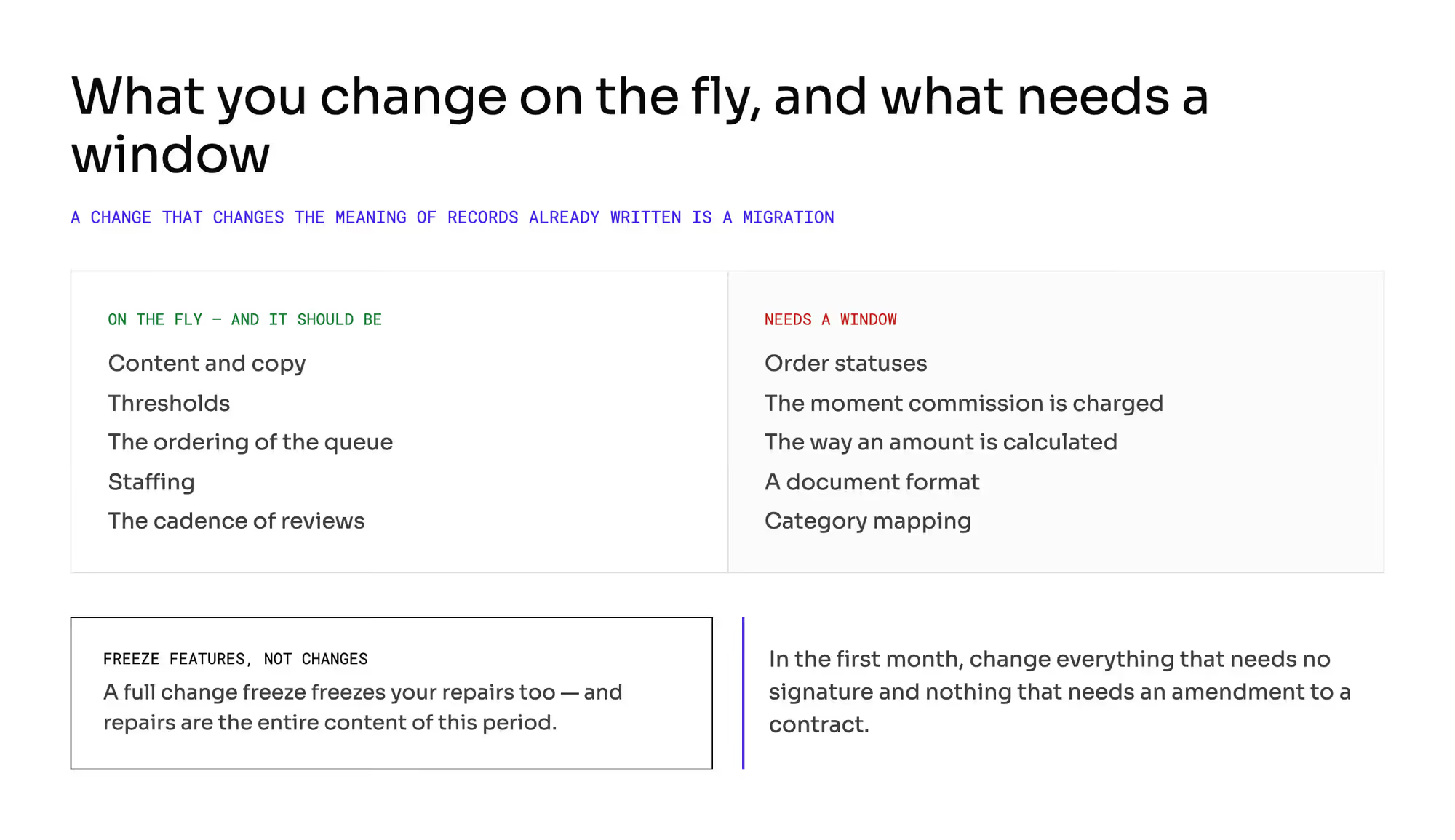
A change to the meaning of records already written is a migration. Schedule it inside a window and tell your sellers the dates. Five changes fall under that rule:
- Order statuses.
- The moment commission is charged.
- The way an amount is calculated.
- A document format.
- Category mapping.
Change everything else on the fly. These are the weeks meant for it:
- Content.
- Thresholds.
- The ordering of the queue.
- Staffing.
- The cadence of reviews.
Release practice separates a freeze on new features from a freeze on all changes. Take the feature freeze in the first weeks. A full change freeze also stops your repairs, and repairs are the whole job in this period.
Commercial terms are different, and a concession to the seller who asks for a lower rate in week two looks cheap. Dropping from 12% to 10% on €300,000 of turnover costs you €6,000 a month. At target scale, the same two points cost €200,000 a month, and turnover grows thirty-three times between the two scales.
You will want to withdraw that concession later. A withdrawal is a change of terms to the seller's disadvantage, and it carries requirements about notice and form. The chapter on the P2B Regulation on a marketplace sets out those requirements.
Grant a concession only with an expiry date on it, and record it in your register of exceptions.
In the first month, change what needs no signature, and leave anything that needs an amendment to the contract.
What does hypercare change in your marketplace?
1. Repair speed comes out of architecture
Your platform's architecture sets your repair speed. Ask your vendor how much you can change by configuration and how much needs a deployment, before you sign the contract. Those two answers show which bucket your typical problem lands in.
2. Hypercare support is a budget line
Put hypercare support in the business case as a cost line. Show the 93 hours next to the rest of the costs, in the period with the lowest commission. The chapter on eCommerce TCO for a marketplace covers what you pay after that period.
3. Systems behave as specified
Your systems behave exactly as specified in these weeks, and you still repair something every day. The chapter on the uptime SLA for a marketplace covers availability and failure modes.
How do you set up hypercare in 6 steps before launch?
1. Launch duty officer named for every day
Name a launch duty officer for every day, by first name. Give them the list of seller phone numbers. A department can't hold that list.
2. One fix list with three buckets
Keep one fix list with three buckets. Put two dates on every item: the day you noticed it, and the day you repaired it.
3. Support mandate set in carts
Set the support mandate in carts. Calculate its exposure against commission before anyone makes the first promise.
4. Evening phone window for two weeks
Open an evening phone window for two weeks. State the start time and the end time. Agree it with HR first.
5. Two numbers shown every week
Show two numbers every week. Report the median days from noticing to repair, and the worst case.
6. End date in the budget before launch
Put the end date of hypercare into the budget before launch. Write the three exit criteria next to it.
How do you check hypercare with a vendor?
- Which changes can I make from configuration, and which need a deployment? Take an order status and category mapping as examples.
- How long does a change in your product take from the day I report it? And where does one operator sit in your priority queue?
- Can you freeze new features without freezing my own repairs?
- How many hours of hypercare support does your proposal contain? Break them down by activity and cadence.
- What happens to a defect you can't repair inside my window? Say who builds the workaround.
Which mistakes do operators make with hypercare?
1. Hypercare with no hours and no end date
It finishes after two days because no one had the time. Or it drags on for nine months because no one announced the end.
2. Waiting for a signal from the panel
Two broken orders a day don't make a chart, and thirty sellers will see them in the same week.
3. Fixes with no shared list
You repair what the loudest seller reported, and the defect on the largest number of orders stays open. Without a date of noticing, you can't tell whether your team is getting faster.
4. Price concession in the first month
It costs you €6,000 in the month you grant it, and €200,000 a month by the time you want to take it back.
5. Promise with no mandate
Cases sit in escalation for two days, or support promises the buyer an amount you can't recover from the seller.
What do you still have to settle about hypercare?
Unavailability and degradation are a separate subject, and so are the operational calendar and the phase gates. Both have chapters of their own, linked above. Read marketplace seller registration and onboarding for the form your first sellers fill in and for their first sale.
You also have to settle how to organize evening duty, and what the person who takes it is owed. Employment law and your internal pay rules govern both, and you settle them with HR before launch.
Your duty officer will read buyer data out to a seller over the phone. The chapter on marketplace GDPR sets the roles, and the family of regulations on the protection of personal data applies here as well.
Confirm the formal requirements with a lawyer before you change terms toward a seller. They sit in the regulations on transparency in the platform-to-seller relationship, and the chapter on the P2B Regulation covers the mechanism. The chapter on marketplace order documents covers how long you keep what this period produces.
Every figure above comes from an invented platform, in which I assumed ten orders a day, thirty sellers and six weeks. Yours will differ. Copy the method of counting and substitute your own figures.
Summary: How long should hypercare last after a marketplace launch?
Give hypercare a stated length, and six weeks works at a starting scale of 300 orders a month and 30 sellers. End it on three written criteria. The fix list goes two weeks without stopping an order, median repair time sits inside your terms of business, and evening duty goes two weeks without a call that needed a decision.
Budget 93 hours of hypercare support across those six weeks, and the normal routine takes another 115 hours in the same period. That is 208 hours against 189 available. Put two people in rotation from day one.
Measure the days between noticing a problem and repairing it. Show the median and the worst case every week. Eight days instead of two costs you 16 orders at 300 orders a month, and 536 at target scale.
Change what needs no signature and leave the rest for a window. A rate cut granted in week two costs you €6,000 that month, and the same cut costs €200,000 a month at target scale.
Planning the first six weeks after your marketplace launch?
Frequently asked questions on hypercare
What is hypercare?
Hypercare is a fixed period of heightened support straight after a launch. A named team reviews every order and repairs what the launch exposed. The period ends on criteria you write down before go-live.
How long does hypercare last after a marketplace launch?
Hypercare lasts until three written exit criteria are met, and the end date belongs in the budget before launch. No new fix stops an order, repair time sits inside your terms of business, and evening duty goes quiet. A period with no end date either finishes in the first days or drags on for most of a year.
What does hypercare support include?
Hypercare support includes a daily review of yesterday's orders, a daily fix briefing, and a call to every seller after their first order. It also covers evening phone duty in the first weeks and seller requests above the normal queue. Ask your vendor to break the line down by activity and cadence before you sign.
Ready to build?
We build marketplaces in which a broken step in the order path gets found and repaired in days instead of weeks.