
Organizational Change Management for a Marketplace: Which Departments Change and Which Push Back

Organizational change management in a marketplace means naming what each department loses when third-party sellers arrive. You then settle what each of them gets in return, and this chapter covers the three currencies of that loss and the seven departments that change.
A department that can't say what it loses delays the work instead. No one picks up the task, and the answer you got last week changes in the next meeting.
If you don't write down what each department loses, you call that delay an attitude problem. You can't fix an attitude problem with a budget or with a date.
This article breaks down:
- Which 3 currencies does resistance to a marketplace come in?
- Which 5 columns does a loss register need?
- Which 7 departments change when you add a marketplace, and what does each one lose?
- Why is organizational change management harder than the technical layer?
- In which order should you talk to each department?
Key insights
- A department pushes back to defend a metric it reports on, a decision it used to own, or hours it never planned for. Each of the three goes in the register with a number next to it.
- Customer service carries the largest single loss, and the cases arrive about goods the team didn't send. Count its new hours before the volume arrives, and give the team one view of the external order.
- An integration has one owner and one acceptance date, and the hours a marketplace adds have six owners and no date. No director sees the whole of them inside their own area, and no one raises the total in time.
- Order the conversations by the cost of taking the answer back. Legal and finance come first: their answers become fields in the data model.
- Compensation with no owner and no date doesn't get delivered. The department heard a promise and saw no change, and it won't believe your next one.
Which 3 currencies does resistance to a marketplace come in?
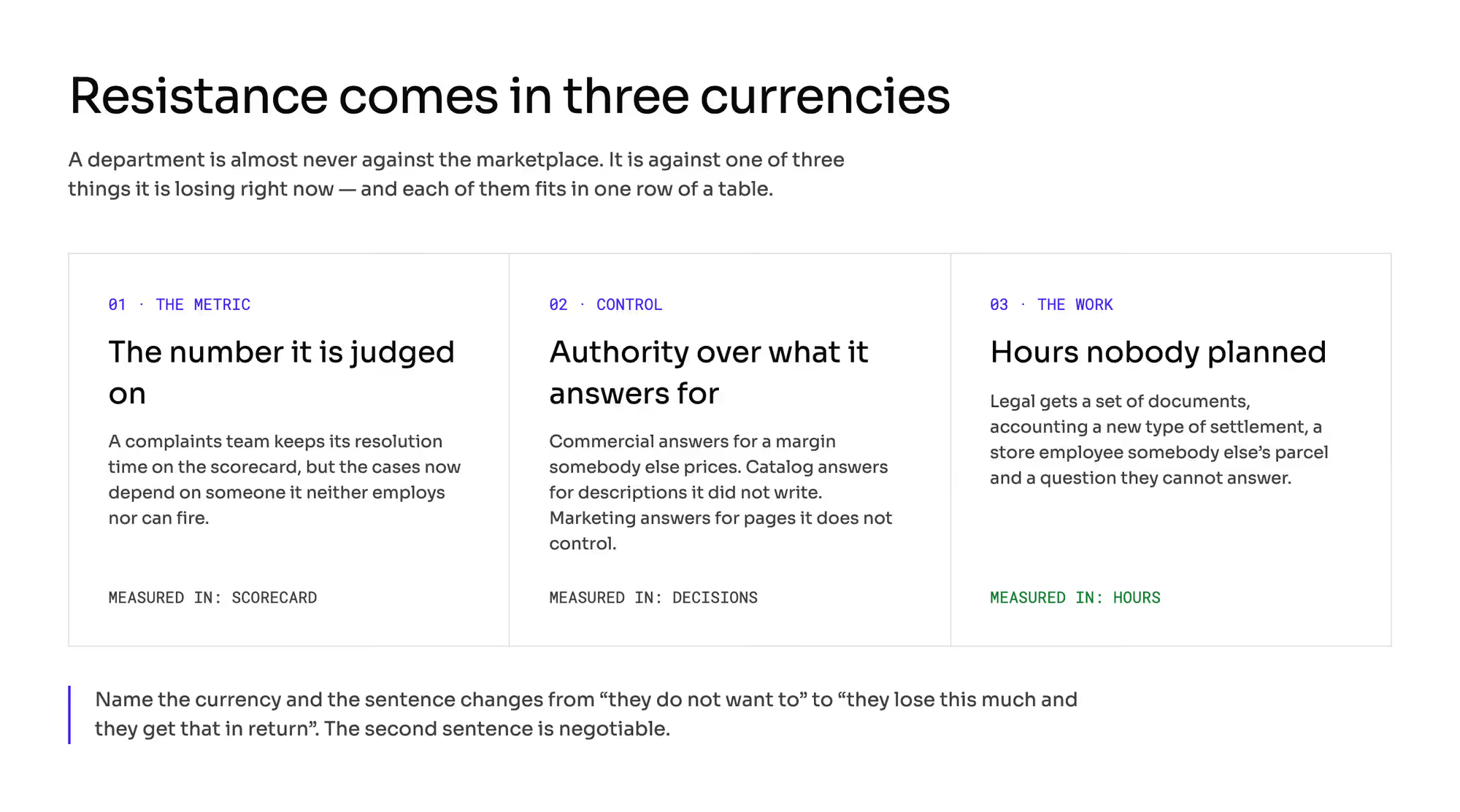
A department can lose a metric it reports on, a decision it used to own, or hours it never planned for. Each of the three takes a different compensation, and a department can lose two of them at once.
Before you argue with a department, write its loss down in one of the three currencies.
1. Metric the department is judged on
A department loses this currency when its own scorecard starts depending on a company it doesn't employ. Your complaints team has delivered its own resolution time for years, and it now gets cases that depend on a seller it can't manage or dismiss.
Ask which numbers the department reports upward to the board every month. Any number on that list that a seller can change is a loss, and the team reads it correctly as a change to how it gets paid.
2. Control over a result the department answers for
A department loses this currency when someone outside it takes decisions the department is measured on. A commercial manager answers for the margin on a category in which a seller now sets prices. The catalog team answers for the quality of descriptions it didn't write.
Name which decisions stay with the department, which ones pass to a rule in the system, and which ones belong to the seller.
3. Work no one planned
A department loses this currency when the change arrives as hours that exist in no plan. Legal gets a full set of documents to work through, and accounting gets a settlement type it has never processed. A store employee gets a parcel of someone else's goods, and the buyer asks a question the employee can't answer.
Because you can count hours and put them in a budget, every department below gets its number in hours a month.
Which 5 columns does a loss register need?
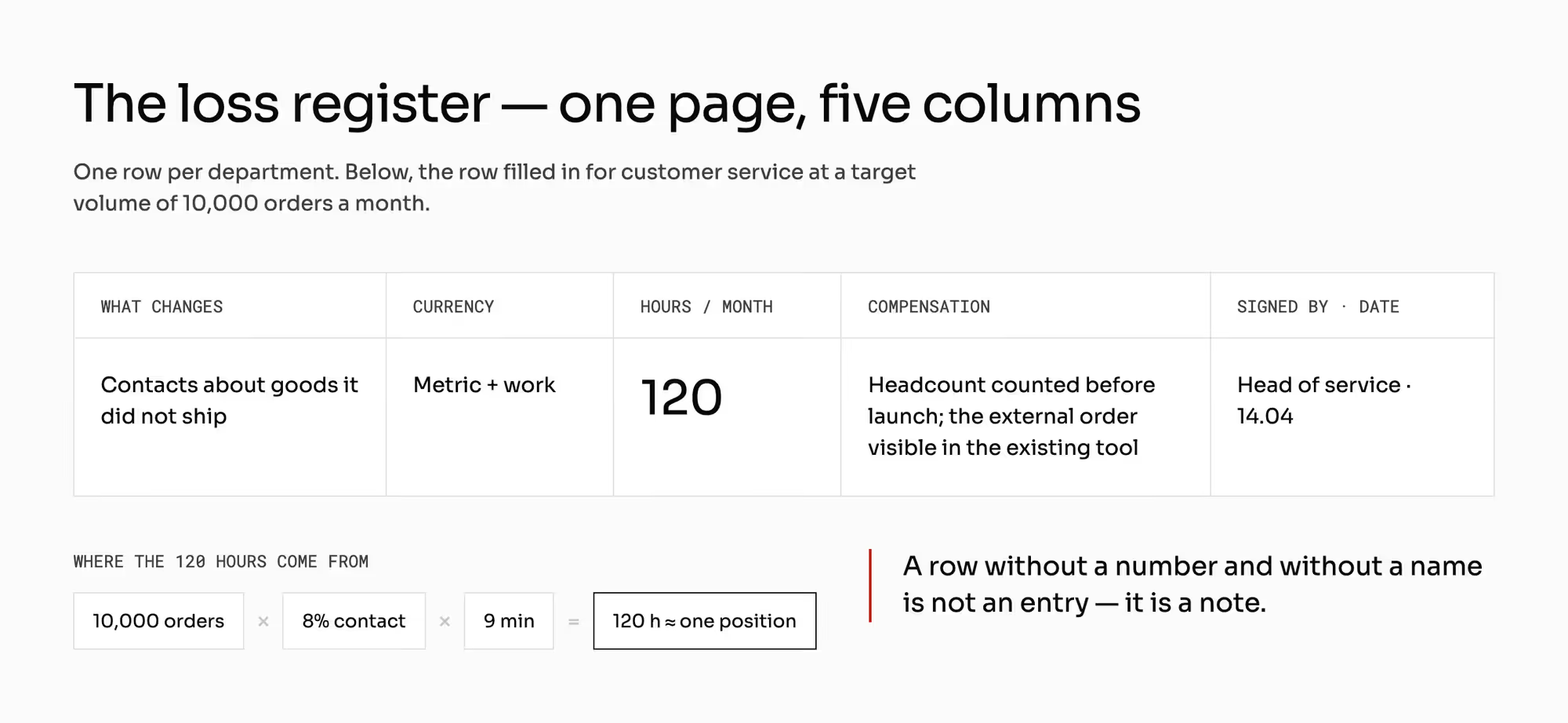
A loss register is one page with one row per department and five columns against each row, and you fill it in before the scope is signed.
Fill in every column, or the row stays a note. With the register in hand, you stop arguing about willingness and start on the size of the loss.
The price of the compensation is the part you negotiate, and the loss itself is the part you measure.
Writers on organizational change describe the same mechanism more generally: a department creates obstacles when its own interest diverges from the company's. A mechanism like that can be redesigned.
1. Change from day one
One sentence in the department's own words. "Contacts about goods we didn't send" belongs here.
2. Loss currency
Metric, control, or hours. Each currency needs its own compensation, and a department that loses two of them gets both written in.
3. Hours a month at target volume
One number, from your own volume and your own handling time. A department with no number here gets no headcount.
4. Compensation and its owner
A new metric, a role with its own export, or counted headcount, against a person's name.
5. Signature and date
The signature belongs to the director whose department carries the loss, and the date is when the compensation has to be in place.
Which 7 departments change when you add a marketplace, and what does each one lose?
Every number below comes from the reference marketplace used across this series. That marketplace takes 10,000 orders a month from 300 sellers with 200,000 active offers, at a €1,000 cart and a 12% commission.
Which department changes? | What changes from day one? | Which currency does it lose? | New work at target scale (hours a month) | What compensation works? |
|---|---|---|---|---|
Customer service | contacts about goods it didn't send | metric and hours | 120 | headcount counted before launch, one view of the order |
Commercial and buying | price and assortment outside its decision | control and metric | 20 | a new metric before the old one goes |
Finance and accounting | payouts to 300 entities, a document type it has never issued | hours | 10 | a role of its own with an export and a specification |
Legal and tax | a scope clause in every policy | hours | 3, plus 50 one time | a seat at the table at the model stage |
Marketing and SEO | pages and a feed carrying someone else's content | control | 12 | completeness rules at the entrance, a target for third-party traffic |
IT | a new integration layer | hours | a budget of its own | one owner of the data contract |
Stores and logistics | someone else's parcel on the counter | hours, at rare intervals | 20 across a hundred stores | one page of procedure, one phone number |
1. Customer service
Customer service gets contacts about someone else's goods before anyone tells the team they are coming. Eight percent of 10,000 orders produce a contact, and 800 cases at nine minutes each come to 120 hours a month.
That's close to a full-time position in a department that already answers for its own resolution time.
Count the headcount for those 120 hours before the volume arrives. Give the team one view of the external order in the tool they already work in. The chapter on marketplace customer service covers who answers the buyer first and where the handover threshold sits.
2. Commercial and buying
Commercial and buying get an assortment they didn't negotiate and a price they didn't approve. At 200,000 active offers and one price change per offer per month, 200,000 pricing decisions a month get taken outside the department, which revises its own price list once a quarter.
A mixed offer puts an external price next to your own item on one product page, and your buyer answers for the margin on both.
Give the department a new metric before you take the old one away, along with the demand data from external offers it can use in its own negotiations. Commercial literature has described channel conflict since the first wave of direct selling, and only the number of decisions a month is new.
The chapter on channel conflict covers the bonus arithmetic on an external sale. The chapter on sales compensation plans covers the plan behind that bonus.
3. Finance and accounting
Finance and accounting get a settlement type they have never processed. At target scale, €10 million of turnover passes through your account. Your commission on that is €1.2 million, and €8.8 million is money you pay out to someone else and document.
At 300 sellers and ten percent asking about a statement, 30 cases a month at 20 minutes each come to another 10 hours. Give finance a role of its own, with an export and a published specification that makes the accounting report and the panel produce the same number.
The chapter on the month-end close process covers the close week and the seller statements. The chapter on marketplace invoicing covers who issues which invoice on a third-party sale. The chapter on marketplace e-invoicing covers invoicing for a seller, and the chapter on marketplace credit notes covers corrections.
4. Legal and tax
Legal and tax get new obligations from day zero, and the department gets no budget for them. Every existing promotion, contest, and program policy on your site needs a scope clause that says whether it covers external offers.
Twenty-five documents at two hours each come to 50 hours, once. Twenty promotions a year then leave a standing load of roughly 3 hours a month.
The chapter on P2B regulation covers the decision trail toward a seller. The chapter on marketplace order documents covers how long you keep each document. The chapter on marketplace liability covers your role toward the goods.
5. Marketing and SEO
Marketing and SEO answer for the ranking of pages whose content they don't write. A seller is under no obligation to fill in the fields your paid channel requires, and your product feed rejects every offer that misses one.
At 200,000 offers and fifteen percent missing a complete set of fields, 30,000 offers stay outside the feed. The team finds out from the rejection report, and reading that list takes 12 hours a month.
Put a completeness rule at the entrance instead of reading that report every month. The chapters on product data quality and catalog rules cover what you can enforce before publication. The chapter on marketplace SEO covers how to maintain pages that carry many offers.
6. IT
IT gets a new integration layer and stops being the only source of truth. A new integration layer is legitimate work with a budget of its own, and IT plans it the way it plans any other connection.
IT's own conventions stop applying to the data, which now arrives from 300 companies with no obligation to follow them. One owner has to hold the data contract and refuse the changes that break it.
The chapter on marketplace integrations covers which systems you connect and in what order. The chapter on single source of truth covers which system owns which field. The chapter on eCommerce TCO covers what the layer costs to keep alive.
7. Stores and returns logistics
Stores and returns logistics get a problem that comes up a few times a month, and a procedure written for a frequent event doesn't hold at that interval. At 10,000 orders and eight percent returns, you get 800 returns a month.
One in ten of those returns comes back to a store, which makes 80 items of someone else's goods a month. At a quarter of an hour each, they come to 20 hours, or 12 minutes per store per month across a hundred stores.
No one remembers the steps of a procedure they use once every two weeks. The compensation fits on one page at the counter, and it gives the employee one phone number to call and one sentence they can't say: "those aren't our goods".
The chapter on the eCommerce return policy covers what one return costs you. The chapter on marketplace dispute resolution covers a buyer's dispute with a seller.
Why is organizational change management harder than the technical layer?
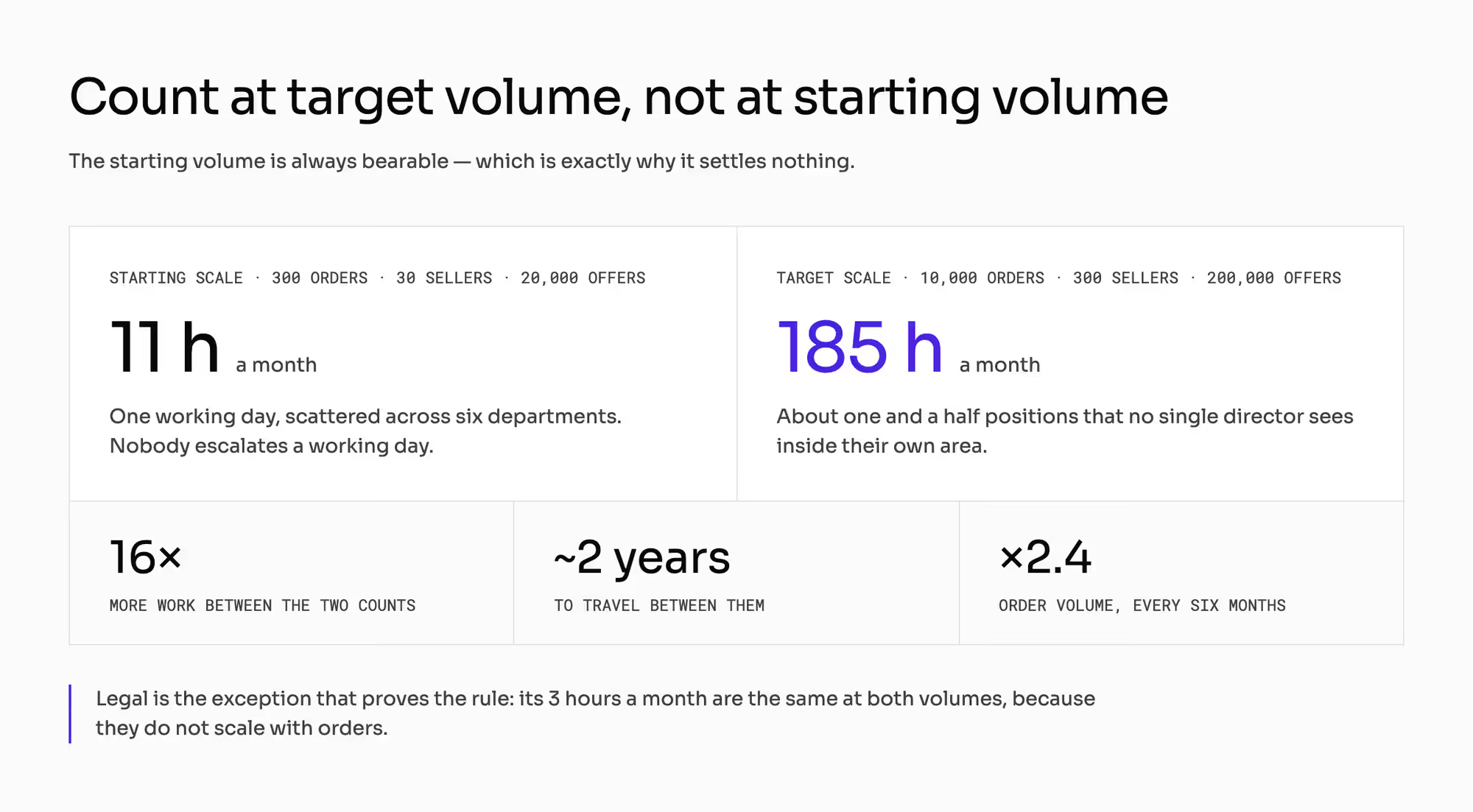
Add up the hours column: 120 + 20 + 10 + 3 + 12 + 20 comes to 185 hours a month. At 126 genuinely productive hours per position, that's about one and a half people.
At 300 orders, 30 sellers, and 20,000 offers, 24 contacts come to 3.6 hours. Commercial and marketing scale with the number of offers and take 2 hours and 1.2 hours.
Finance answers three questions in 1 hour, returns to stores take half an hour, and legal stays at its 3 hours.
Together that comes to about 11 hours a month. No one builds a headcount case on one working day a month.
185 hours is more than sixteen times 11 hours, and about two years separate the two. Order volume grows thirty-threefold over those two years, at a multiplication of roughly 2.4 every six months.
An integration has one owner and one acceptance date. The 185 hours have six owners and no date. No director sees the whole of it inside their own area, and no one raises it in time.
Practitioners who have finished a year-long rollout don't name the code as the hardest part. They name the change entering every process at once, and the friction with service and store staff whose work changes underneath them.
In reviews of failed rollouts, the first mistake is treating a marketplace as a technology project, and the technology itself turns out to be the easiest task on the list. Most cross-departmental teams in those reviews come out as dysfunctional.
In which order should you talk to each department?
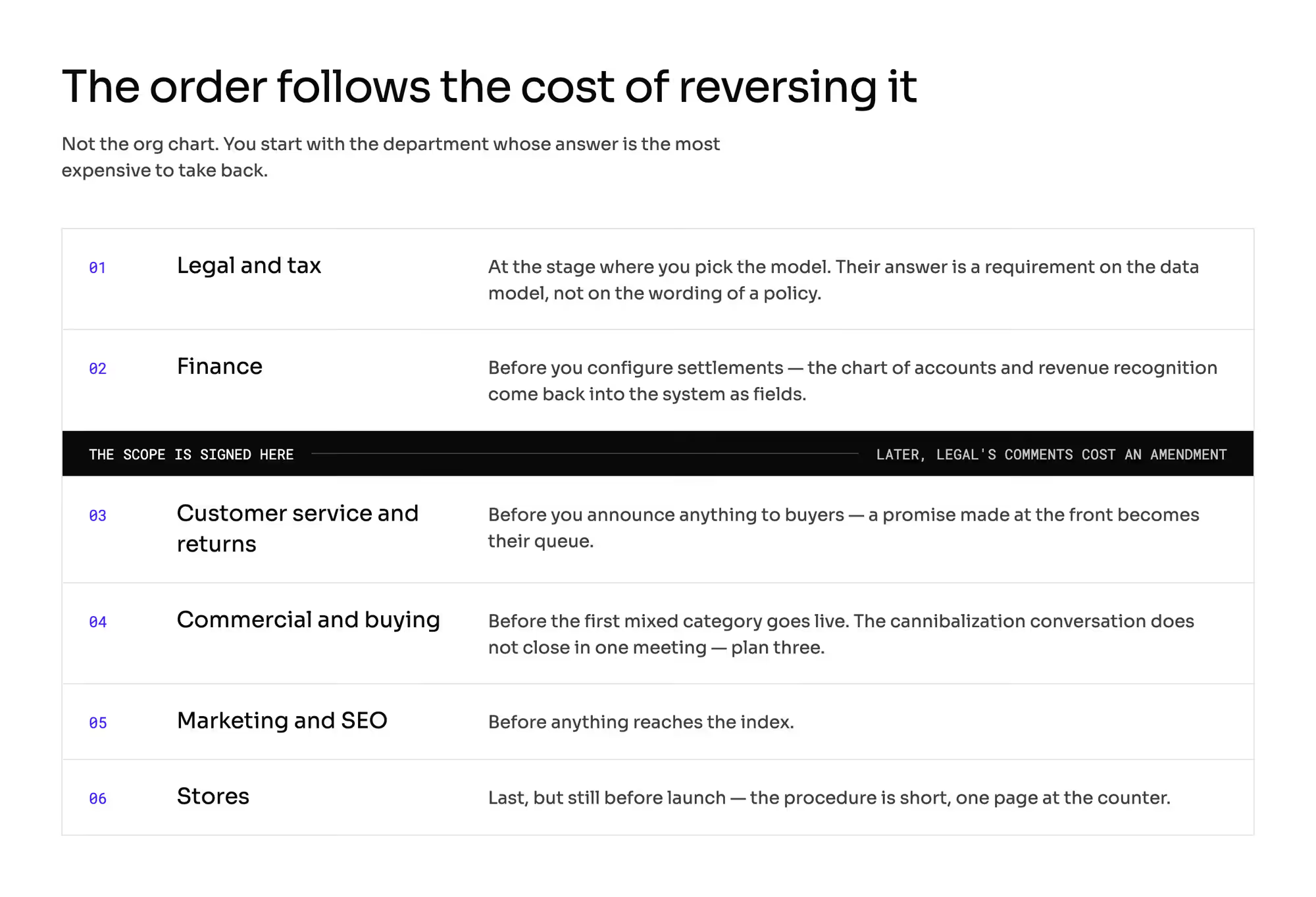
You start with the department whose answer costs the most to take back, and seniority has little to do with that cost.
The first two conversations happen before the scope is signed. Any later and legal's comments become a change of scope, which means an amendment and money.
1. Legal and tax, at the stage when you pick the model
Legal's answer settles who issues which document and what it contains, and those answers become fields in the data model. Ask them last and the only answer left is a refusal to sign.
2. Finance, before you configure settlements
The chart of accounts and revenue recognition come back into the system as fields on a settlement, and a decision taken later arrives as a change request with a price on it.
3. Customer service and returns, before you announce anything to buyers
A promise made at the front becomes their queue a week later. Give them the handover threshold in writing before the campaign brief goes out.
4. Commercial and buying, before the first mixed category
The cannibalization conversation doesn't close in one meeting. Plan three of them. Say which one you chose, deliberate cannibalization or accidental, and the argument gets shorter.
5. Marketing and SEO, before anything reaches the index
A page template that holds many offers is expensive to change once those pages rank.
6. Stores, last and still before launch
A store manager who hears about external parcels from a buyer answers the way they see fit.
What does organizational change management change in your marketplace?
1. Loss register feeds staffing
The hours in the third column become positions and roles. A department with 120 hours a month gets headcount, and one with 3 hours gets a named person.
The chapter on eCommerce team structure covers how many people you need. The chapter on the executive sponsor covers who owns the marketplace inside your company.
2. Compensating a metric is a project
A department that loses a metric needs a different metric on its scorecard. Give it the new one before you take the old one away.
A resolution time that depends on 300 sellers becomes a time to first response that the team still controls.
3. Some resistance disappears once decisions have a place
A department is sometimes against the marketplace because no one can say who approves what. That loss is hours spent chasing an answer, and it ends when you give the decision an owner and a deadline.
The chapter on the approval workflow covers which decisions wait, and for how long.
4. Narrow pilot doesn't reduce the number of departments
Narrowing the categories reduces the volume and leaves the number of departments where it was: legal still clauses every policy, and stores still get a parcel they didn't pack.
The chapter on the marketplace pilot covers the choice between a pilot and real volume. The chapter on hypercare covers the support hours and the fix times of the first weeks after launch.
How do you build a loss register in 5 steps?
- List departments instead of people, and the seven rows above are your starting point.
- Give each department a loss currency: metric, control, or hours. If none of the three fits, the department drops out of the register.
- Count the hours at target volume. Starting volume is always bearable, and it doesn't settle the staffing question.
- Attach a compensation to every loss, with an owner and a date. Without a name, it won't be delivered, and without a date, it arrives after launch.
- Review the register after the first full month of sales. A contact rate of twelve percent changes the headcount line by half a position.
How do you check department permissions with a vendor?
- Can I assemble a role out of individual permissions, or do I get a fixed set of a dozen or so roles? The answer settles whether accounting gets a view of its own.
- Does a department see a queue of its own, or a list belonging to everyone? A team that filters someone else's list treats the panel as a second inbox.
- Do the export and the change history work without the vendor being involved? A support ticket per export costs an hour a week.
Which mistakes do operators make with organizational change management?
Every mistake below reads as normal progress in a steering committee, and you see the consequence a quarter later.
1. Treating resistance as an attitude
When you argue about attitude, the loss stays where it was, and the same department raises the same objection a quarter later.
2. Inviting legal and tax to approve instead of to design
A department that wanted to help gets remembered as the one that blocked the launch, and you pay for its comments twice.
3. Sizing the load on departments at starting volume
The headcount you counted at starting volume holds for a quarter. By the sixth month, the work is more than twice as large, and no one can point to the week it changed.
4. Compensation with no owner and no date
When a department hears a promise and sees no change, your next promise to it costs twice as much.
5. Procedure for a rare event written as if the event were frequent
The employee at the counter improvises from whatever they remember of the process. The buyer hears a sentence no one authorized, and a page of three steps would have prevented it.
What do you still have to settle about organizational change management?
This chapter doesn't design the team or the bonus for the people who carry this work. The chapter on eCommerce team structure covers how many people you need, and the chapter on the executive sponsor covers the owner of the whole.
A commercial manager's payout on an external offer belongs to the chapter on channel conflict.
This chapter also leaves out the model for serving the buyer and seller training.
This chapter isn't legal or tax advice, and it doesn't give you a threshold or a deadline. Four families of rules are worth asking about before you hand departments new duties:
- Personal data protection, in the part about employee access to data from other people's orders. The chapter on marketplace GDPR covers the roles.
- Transparency between the platform and the seller, which is where the requirement for a justification and a decision trail comes from.
- Liability of intermediating parties, which settles what the front line may promise a buyer.
- Labor law, in the part about changing a job scope and a bonus condition.
Your own numbers will come out different once you repeat the count on your own volume and your own handling time per case.
Summary: Which departments change when you add a marketplace?
Seven departments change, and six of them carry new hours. At 10,000 orders a month, customer service carries 120 of those hours, commercial 20, stores 20, marketing 12, finance 10, and legal 3, plus 50 hours once.
Each of them loses a metric, a decision it used to own, or hours that exist in no plan. Write the loss down with its number, its compensation, an owner, and a date. The argument about attitude ends once every row carries those four entries.
Talk to legal and finance before the scope is signed, and their answers become fields in the system. A late answer arrives instead as a change of scope with an amendment behind it.
Adding third-party sellers to a company in which six departments already answer for their own numbers?
Frequently asked questions on organizational change management
What is organizational change management on a marketplace?
Organizational change management on a marketplace is the practice of naming what each department loses when third-party sellers arrive, and settling what it gets in return. The output is a loss register with one row per department and a signature on each row. Each row names the currency of the loss, the hours it costs a month, and the compensation.
Which department resists a marketplace most?
Customer service and the commercial department push back hardest, because both are measured on numbers a seller now influences. Customer service answers for a resolution time that depends on a company it can't manage. Commercial answers for a margin on a category in which a seller sets prices.
How many hours a month does a marketplace add to each department?
A marketplace adds new hours to six of the seven departments it changes, and customer service takes the largest share. Commercial and the stores come next, then marketing and finance. Repeat the count with your own contact rate and your own handling time per case.
Ready to build?
We build marketplaces that give customer service and finance a queue of their own before the first seller arrives.