
Executive Sponsor for a Marketplace: Who Runs It Inside Your Company

An executive sponsor is the board-level person who owns a marketplace's business case and clears the blocks its day-to-day owner can't clear alone. This chapter covers the two seats above a marketplace and the mandate each one carries.
You've chosen a platform, and the board has approved a budget, and someone now has to answer for the result every quarter.
Many companies leave that question open until launch, and the seat then goes to whoever has time for it. That person spends the first two years explaining a result whose causes they can't change.
This article breaks down:
- What is an executive sponsor on a marketplace?
- Which 5 causes of a weak first year can your owner change alone?
- How many hours a month does an executive sponsor owe your marketplace?
- Which 3 placements can a marketplace have inside your company?
- Should your marketplace have its own P&L?
Key insights
- An executive sponsor and an operational owner are two different jobs, and a marketplace needs both seats filled from the start.
- Write down the five most common causes of a weak first year and mark the ones your owner changes alone. Fewer than three means you've designed a reporting function.
- A sponsor owes your marketplace a standing monthly slot to read one page of numbers and a fixed deadline for settling a priority dispute. Put both in the calendar before the name goes on a slide.
- Three placements are available: inside eCommerce, inside the category teams, or as a separate unit. Each one leaves your owner asking a different director for the causes they can't settle alone.
- A manager who answers for one shared account settles every tie against the marketplace, and your own stock earns more in that account. Give the marketplace an account of its own, with the internal services it buys priced into it.
What is an executive sponsor on a marketplace?
An executive sponsor and an operational owner are two different jobs, and companies that treat them as one fill neither seat properly.
Marketplace rollouts fail most often when no sponsor and no day-to-day owner are named, and both seats have to exist from the start. Companies also treat the whole project as an IT delivery or lock the marketplace inside one business unit, and those two failures appear just as often.
1. Sponsor at board level
The sponsor owns the business case and keeps the budget alive through the first mid-year cut. They also settle priority disputes between units, and no one else in the company stands above all of them.
The sponsor clears the blocks the owner can't clear alone, and an operational owner who has authority over no one leaves every disagreement with another director waiting.
2. Operational owner of the marketplace
The operational owner directs the marketplace day to day. They admit and suspend sellers, set rates inside the agreed bands, and answer for the numbers every week.
The owner also watches the queues, and sellers feel an unwatched queue as a long wait that no weekly report shows.
Which 5 causes of a weak first year can your owner change alone?
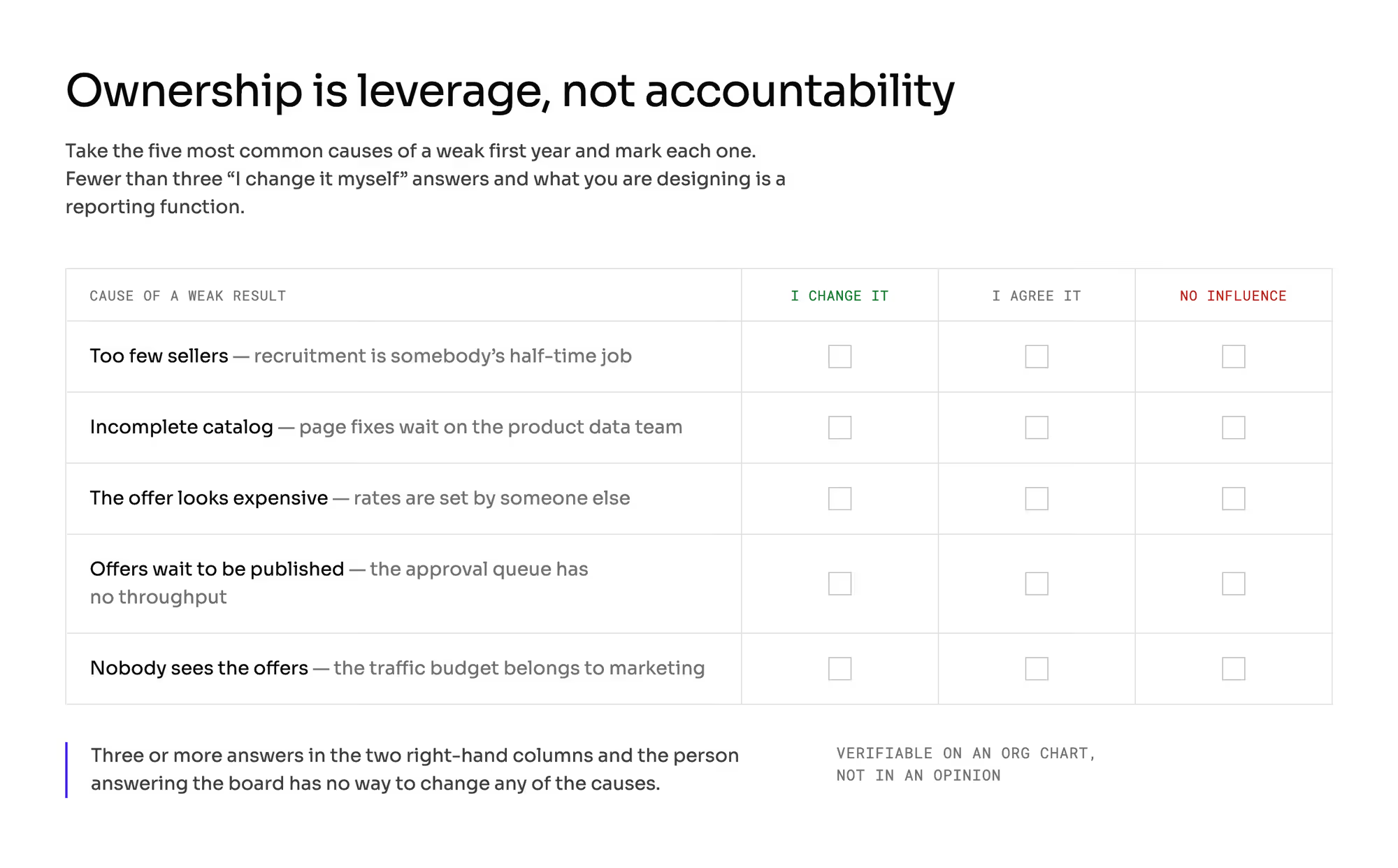
Ask who answers the board when the result disappoints it, and then ask whether that same person can change any of the causes. An owner with accountability and no authority is on report duty.
Write down the five most common causes of a weak result in the first year:
- Too few sellers have signed, because recruitment is someone's half-time job.
- Your catalog is incomplete, because fixes to product pages wait on the product data team.
- Your offer looks expensive, because someone else sets the commission rates.
- Offers wait to be published, because the approval queue has no throughput. The chapter on product approval covers its capacity.
- No one sees those offers, because marketing holds the traffic budget and gets measured on your own sales.
Three or more marks in the two right-hand columns mean you're designing a reporting function.
Against each cause, put one of three answers:
- I change it myself this week.
- I agree it with someone who has their own priorities.
- I have no influence over it.
Three answers from the second or the third line mean you have a person who reports the result. Until the result misses the plan, the two jobs look identical.
Managers and sponsors describe the sponsor's job differently on almost every point. They agree on one point that you can check on an org chart: the sponsor holds authority over the unit that has to give something up.
How many hours a month does an executive sponsor owe your marketplace?
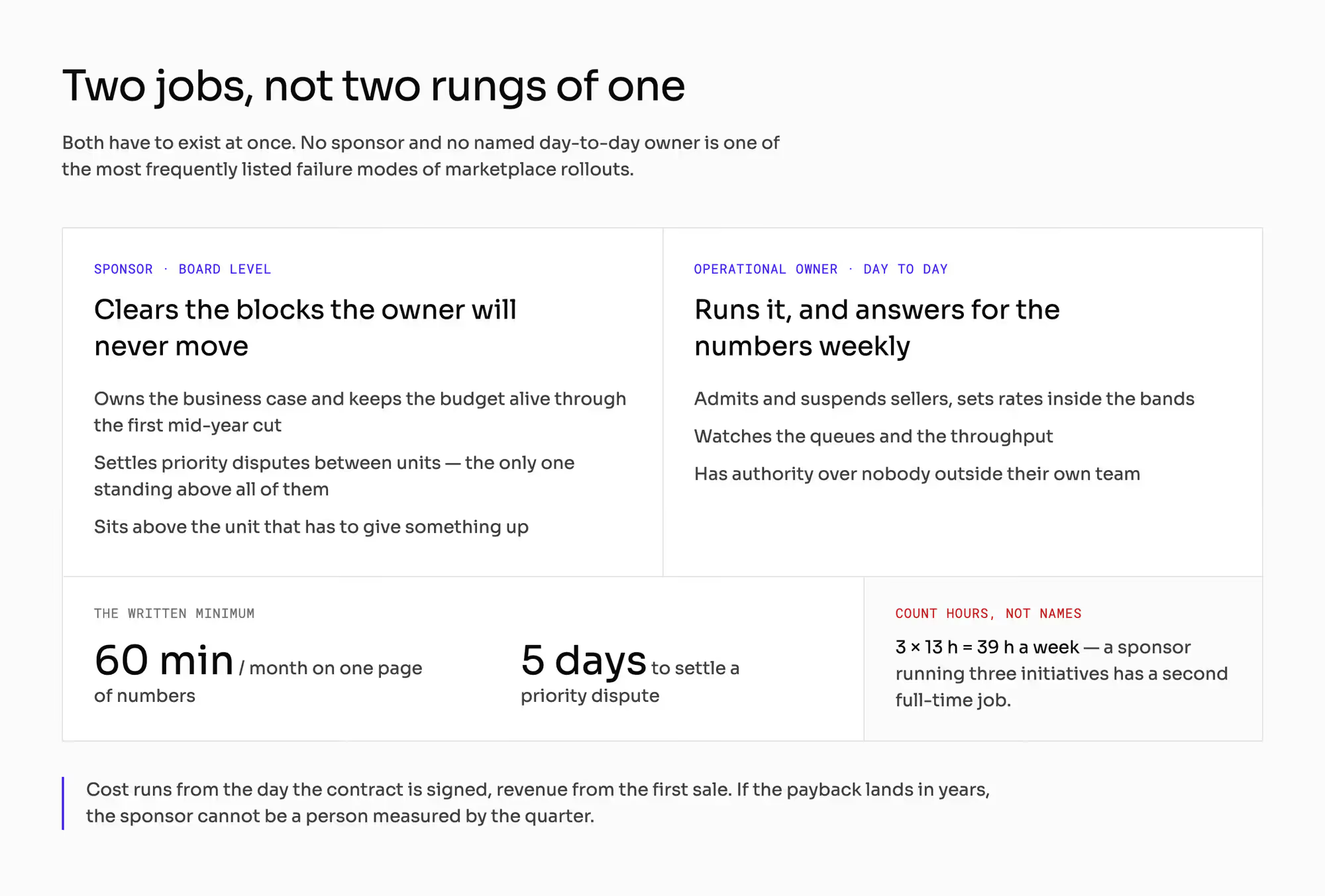
Count the sponsor's hours in the calendar before you put a name on a slide. A sponsor in name only takes the seat and leaves the job undone.
Sponsorship of one large initiative takes on the order of 13 hours a week, and a senior sponsor usually holds several at once. Three of them come to 39 hours a week and amount to a second full-time job on top of their own work.
Write down 60 minutes a month to review one page of numbers, and 5 working days to settle a priority dispute. About half of organizations give their sponsor no regular report at all, and a sponsor with no numbers intervenes after the fact.
Cost starts on the day you sign the contract, and revenue starts with the first sale.
A sponsor measured by the quarter will cut a cost that pays back in years, and their own result gives them no other choice.
The chapter on marketplace metrics covers what the board will judge the result by. The chapter on the marketplace business case covers the payback calculation.
Which 3 placements can a marketplace have inside your company?
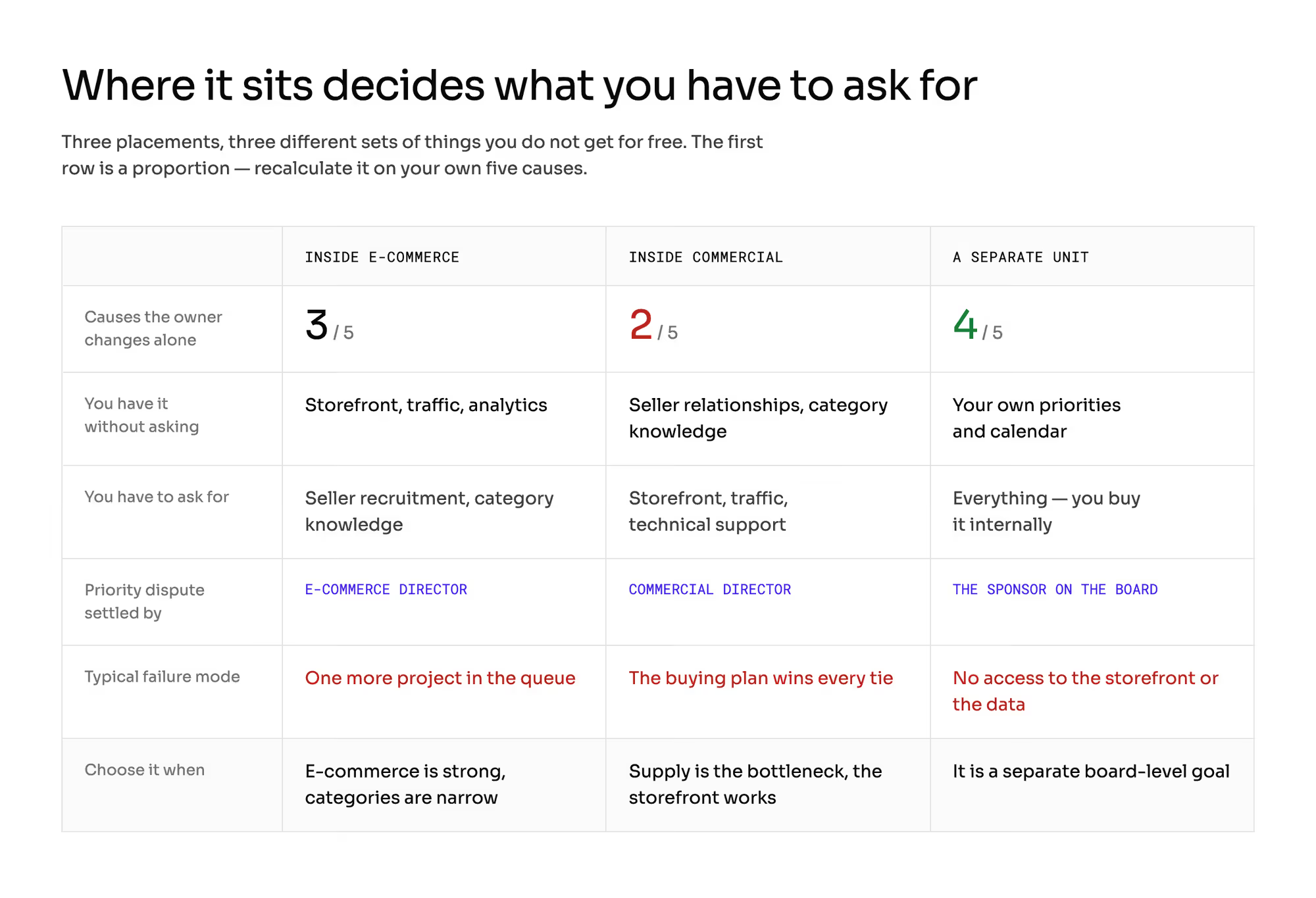
Three placements are available, and each one leaves you asking another department for something different. Choose deliberately, and expect to spend the next two years negotiating with the director that choice puts opposite you.
1. Inside eCommerce
Inside eCommerce, you get the online store and the analytics, plus people who understand conversion. You don't get supplier relationships or category knowledge, and seller recruitment then waits for people who are measured on something else. This placement suits a 1P retailer with narrow categories.
2. Inside commercial
Inside the category teams, you get the supplier relationships and a feel for margins, from people who already know which suppliers exist. The conflict then lands inside one person's job: the same person delivers the buying plan and opens a channel in which someone else's goods compete with that plan.
Practitioners call it commercial friction on mixed assortments, and both sides pull their own way.
This placement suits a B2B distributor whose bottleneck is supply and whose online store performs. The chapter on organizational change management sets out what each department stands to lose.
3. Separate unit
A separate unit gives you authority and a calendar of your own. You buy the online store, the warehouse capacity and the product data from inside the company, and those internal charges start in month one.
Settle the service agreements with eCommerce and analytics before you switch anything on.
What does the placement decide? | Inside eCommerce | Inside commercial | Separate unit |
|---|---|---|---|
How many of the 5 causes does the owner change alone? | 3 | 2 | 4 |
What do you have without asking? | online store, traffic, analytics | seller relationships, category knowledge | your own priorities and calendar |
What do you have to ask for? | seller recruitment, category knowledge | online store, traffic, technical support | everything you buy internally |
Who settles a priority dispute? | eCommerce director | commercial director | sponsor on the board |
What is the typical failure mode? | marketplace becomes one more project in the queue | buying plan wins every tie | unit with no access to the online store or the data |
When do you choose it? | strong eCommerce and narrow categories | supply is the bottleneck and the online store performs | marketplace is a separate board-level goal |
Recalculate the first row against your own five causes.
Should your marketplace have its own P&L?
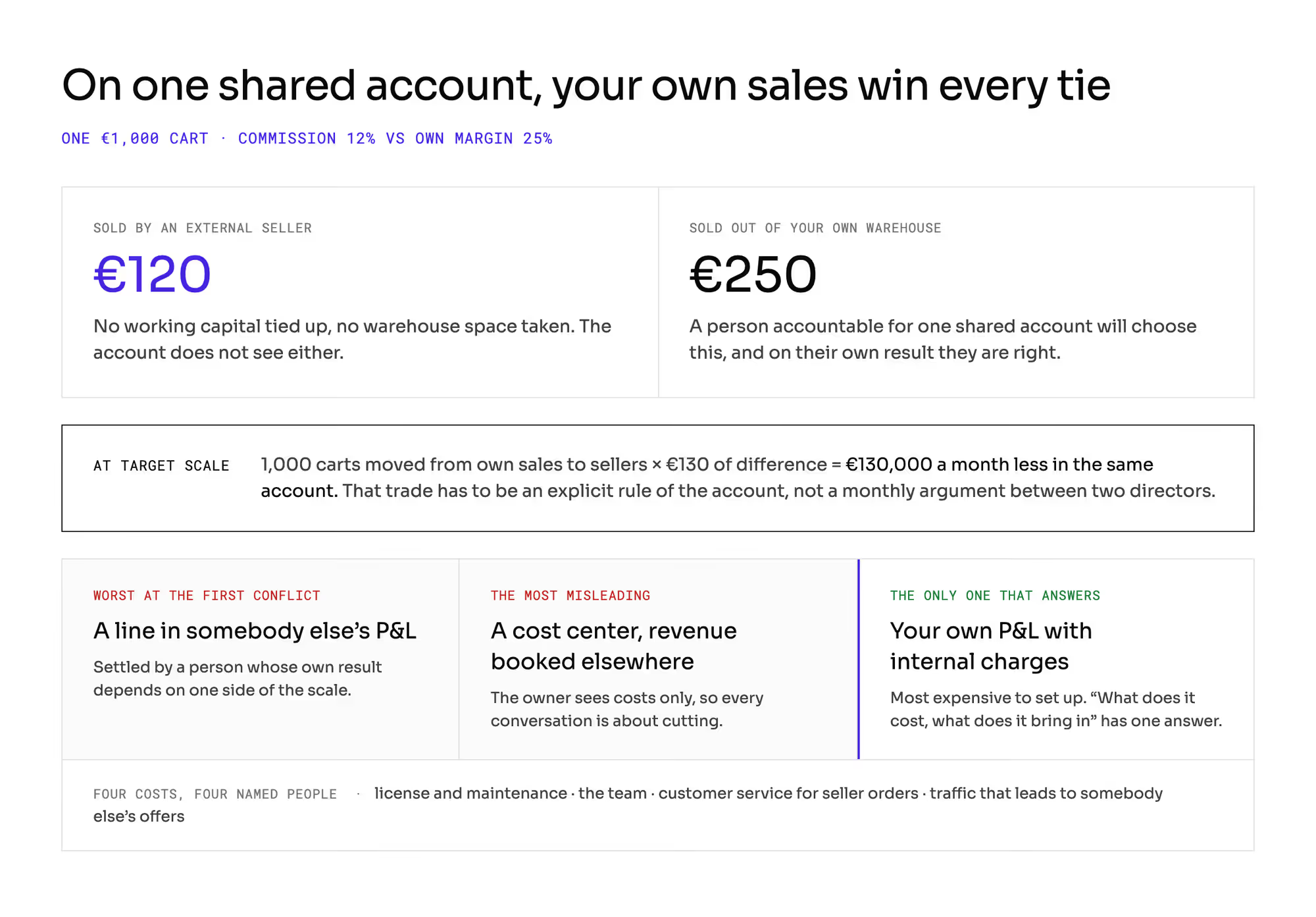
Take the P&L decision deliberately and expect every other priority dispute to follow from it.
A €1,000 order sold by an external seller at a 12% commission leaves €120 with you, and the same order out of your own warehouse at a 25% margin leaves €250.
A manager who answers for one shared account will choose the €250 every time. They are measured on that account, and €250 is the better number in it.
At 10,000 orders a month, 1,000 carts shifted from your warehouse to sellers cost that account €130 each and €130,000 in total.
A seller's sale doesn't tie up your working capital or take warehouse space, and neither saving appears in that account. Write the trade into the account as a rule and keep it out of the monthly argument between two directors.
Assign four costs to named people before launch, and each one becomes a dispute later:
- License and maintenance for the platform.
- Team, including the people lent to you by other departments.
- Customer service for seller orders.
- Traffic that leads buyers to someone else's offers.
The last one gets skipped most often, and whoever pays for a campaign wants its result counted on their side. The chapter on announcing a marketplace launch covers that argument.
In the first month after launch, 300 orders at a €1,000 cart give you €300,000 of GMV and €36,000 of commission. At a fully loaded €15,000 a month per head, that commission pays for just under two and a half people and leaves the license uncovered.
At target scale, the same commission is €1.2 million a month and €14.4 million a year, and the owner needs both numbers in the first week. The board will ask why the marketplace isn't earning yet, and an owner with the arithmetic answers in one sentence.
The chapter on marketplace revenue recognition covers how that revenue lands in the books.
Your account can take one of three shapes. Each one changes who settles the first conflict.
1. Line in someone else's P&L
This shape costs the least to set up, and at the first conflict it gets settled by a person whose own result depends on one side.
2. Cost center with the revenue reported somewhere else
The owner sees costs and no revenue, and every conversation about the marketplace turns into a conversation about cutting it.
3. Own P&L with internal charges for services
This shape takes the most work to set up and gives you a single answer on what the marketplace costs and what it brings in.
Which decisions does the marketplace owner settle, agree, and escalate?
Write the mandate as three lists on one page and have the sponsor and the owner both sign it.
1. Settles alone
- Admitting and suspending a seller within the published policy.
- Commission rate anywhere inside the bands of the grid.
- Exception to a rate for a seller below the materiality threshold.
- Campaign up to an agreed budget.
- Quality thresholds, and rejection of an individual offer.
2. Agrees with another department
- Rate outside the bands, with finance.
- New category, with commercial and legal.
- Change to the terms and conditions toward sellers, with legal.
- Promotion that eats into the margin on your own sales.
3. Escalates to the sponsor
- Change to the platform model. The chapter on marketplace platform models covers that choice.
- Entry into a new market.
- Switching off a seller with a large share of GMV.
- Any change to a multi-year contract with a supplier.
Write the materiality threshold as a number, and keep a decision about one seller's rate out of the board calendar. At target scale, a seller with 1% of GMV brings in €100,000 a month and €12,000 of commission.
Without a threshold, exceptions travel from person to person all the way up, and on a monthly board rhythm, the average wait is about two weeks and the longest is four.
Your sellers experience that wait as your response time, and your terms say something shorter.
The permissions matrix has to mirror the mandate, and products differ in what they let you change.
Some give you a fixed list of a dozen or so roles, and the vendor decides what each role can do. Others let you compose a role out of several dozen permissions.
A function is sometimes hidden by default and has to be requested by ticket. The chapter on the approval workflow covers where a decision waits and who records it.
Every decision has exactly one approver, and two sponsors or a committee in that seat only double the waiting time without adding safety.
Which 4 departments need a named person and a response time?
A marketplace reaches into four departments outside your own team, and each one has to give you a named person and an agreed response time. A department name on its own gives you no one to ask.
Write down 5 working days for an opinion on a change to the terms. A number like that goes into a procedure and gets checked, and no one can check "legal is involved".
Two reporting lines bring their own documented problems, and people in them end up accountable for work they have no control over.
1. Legal
Legal owns the terms and their versioning, plus the conditions you set toward sellers. The chapter on P2B regulation covers ranking and the justification you owe a seller on suspension.
Processing of buyer and seller data is a separate question with a separate owner. The chapter on marketplace GDPR covers which role your company holds.
2. Finance
Finance owns the chart of accounts and revenue recognition, and it also sets the rhythm of a month-end close that looks different from a close on your own sales.
The chapter on the month-end close process covers the close week and the seller statements.
3. Tax
Tax decides who issues which document and what the document says. The chapter on marketplace invoicing covers who invoices whom.
The chapter on e-invoicing covers invoicing in a seller's name. The chapter on credit notes covers corrections.
4. Marketing
Marketing owns the traffic budget that reaches seller offers, and you settle whose side its result counts on before the first campaign. After the money is spent, both sides claim the same sales.
What does an executive sponsor change in your marketplace?
Naming the sponsor and the owner changes what five other teams can plan, and staffing and pay are the two that change first.
1. Staffing follows the mandate
Headcount follows the mandate, and you can only count hands once you know what the owner settles alone. The chapter on eCommerce team structure covers the numbers and the functions.
2. Each placement creates a different opponent
Inside eCommerce, the roadmap owner pushes back; inside the category teams, it is the buyer who owns the plan, and a separate unit argues with the departments that now invoice it.
3. Owner with no P&L has no bargaining position
An owner with no account of their own can't offer a trade inside the company. They ask other teams for traffic and for developer time with no budget to offer back.
4. Mandate has to reach the pay plan
A mandate that doesn't reach the pay plan stays on paper. The chapter on the sales compensation plan covers credit for 1P and 3P sales.
5. Measures are set before the owner is named
Set the measures the board will judge the owner by before you name the owner. An owner who inherits a measure they never saw spends the year defending the measure.
How do you settle marketplace ownership in one afternoon?
Do the six steps in this order:
- Write down the five causes of a weak result and give each one of the three answers. Fewer than three "I change it myself" answers means you're designing a reporting function.
- Check on the org chart whether the sponsor stands above the unit that has to give something up. If they don't, the priority dispute comes back higher up anyway.
- Count the sponsor's hours in the calendar. 60 minutes a month plus 5 working days is the minimum worth signing.
- Write the mandate as three lists on one page, with the materiality threshold given as a number. An empty list means you don't have a mandate yet.
- Assign the four costs to named people. An unassigned cost ends up with whoever has the least room to refuse it.
- Check the permissions on a test environment.
How do you check the owner's mandate with a vendor?
- Can the owner change a commission rate without involving your team?
- Can the owner suspend a seller without involving your team?
- Do I compose operator roles myself, or do I pick from a fixed list that you control?
- Which functions are hidden by default and have to be requested by ticket?
- Does every rate change and every suspension leave a trail with a name and a timestamp on it?
The third answer tells you whether the product can hold the mandate you wrote. Ask to see the permissions screen of a live operator account.
Which mistakes do operators make with marketplace ownership?
Five appointments go wrong often enough to name, and all five pass a board review without a question.
1. Owner chosen for availability
You get the person who has time because they have no one under them, and they report the five causes accurately every month.
2. Sponsor in name only
The name appears on a slide, the calendar shows zero hours, and no page of numbers reaches the board in any month.
3. Marketplace as a line in an account that earns differently
Every tie gets settled against the marketplace, and the manager follows the better number in their own account.
4. Mandate agreed verbally, permissions set up differently
The owner answers for rates they can't change without raising a ticket with the vendor, and they find that out during the first negotiation with a large seller.
5. Committee as the approver
You get a calendar of meetings, and the seller waits for the next one.
What do you still have to settle about your executive sponsor?
The chapter on eCommerce team structure covers headcount and the functions behind it. The chapter on the sales compensation plan covers credit for the result.
The chapter on the launch readiness checklist covers who can block a launch.
This chapter doesn't settle the form of your owner's authority. Powers of attorney and the limits of liability for the people who manage a company belong to the rules on company representation. Put that question to a lawyer before you sign the mandate.
The mandate described here says who takes a decision operationally, and who binds the company is a separate question. The numbers above are calculated on the reference platform of this series, and your own scale changes every one of them.
Summary: Who owns a marketplace inside your company?
A marketplace needs two seats filled at once, and the executive sponsor on the board owns the business case and clears the blocks the day-to-day owner can't clear. The owner admits and suspends sellers and sets rates inside the bands, and they answer for the numbers every week.
Test the appointment against the five causes of a weak first year, and an owner who can change fewer than three of them alone only reports the result. Check the sponsor's authority on the org chart and their hours in the calendar.
Each placement puts a different director against you, and whoever owns the account wins the argument.
A €1,000 cart leaves €120 of commission or €250 of your own margin, and a manager on one shared account picks the €250.
Then check that the permissions matrix mirrors that mandate. Naming an owner for a marketplace and working out what that seat has to control?
Frequently asked questions on marketplace ownership
What is an executive sponsor?
An executive sponsor is the board-level person who owns a project's business case and the budget behind it. On a marketplace, they settle priority disputes between units and keep that budget alive through the first mid-year cut. They sit above the unit that gives something up, and you can check that on an org chart.
What is the difference between a sponsor and a marketplace owner?
A sponsor owns the business case and the budget, while the marketplace owner directs the operation day to day. The sponsor settles disputes between departments and stands above all of them. The owner admits and suspends sellers, sets rates inside the agreed bands, and reports the numbers every week.
How many hours a month does a marketplace sponsor need?
A marketplace sponsor needs a standing monthly slot to read one page of numbers and a fixed deadline for settling a priority dispute. A senior sponsor usually holds several large initiatives at once, and together they amount to a second job on top of their own work. Count the hours in the calendar before you agree to the name.
Ready to build?
We build marketplaces for operators who need the mandate and the permissions settled before the first seller signs.