
Audit Log on a Marketplace: What to Record, Who Sees It, and How Long to Keep It

An audit log is a record of who did what in a system, when, and with what result. On a marketplace, it also has to show who decided to act against a seller and on what grounds.
A year from now, a seller will ask why you took their offer down. You'll get one day to answer, and the answer depends on what your platform records today.
Your platform records data changes without any extra work. It records decisions only if you set that up before launch.
This article breaks down:
- What is the difference between a system log and an audit trail of decisions?
- Which 6 fields make an audit log entry usable as evidence?
- Which 2 marketplace events do audit logs most often miss?
- How long should audit log retention last, and what does it cost?
Key insights
- The difference between a system log and an audit trail of decisions is the reason behind each change. A system log records what the platform did. An audit trail records who decided it, on what grounds, and with which facts in front of them, and it exists only if someone designed it before launch.
- Six fields make an audit log entry usable as evidence: who acted, when, what changed, the state before and after, the grounds for the decision, and the way in. The way in tells a person's edit apart from a seller's file import and from your own automatic rule.
- The 2 marketplace events audit logs most often miss are actions inside a seller's account and exporting data in bulk. An action taken on a seller's behalf looks like the seller's own. An export changes no data and leaves no trace unless you log it.
- Audit log retention should last as long as the longest of four clocks: seller disputes, settlement documents, personal data, and security incidents. Five years of entries for a marketplace with 10,000 orders a month take about 30 GB and cost about €3 a month to store.
What is the difference between a system log and an audit trail of decisions?
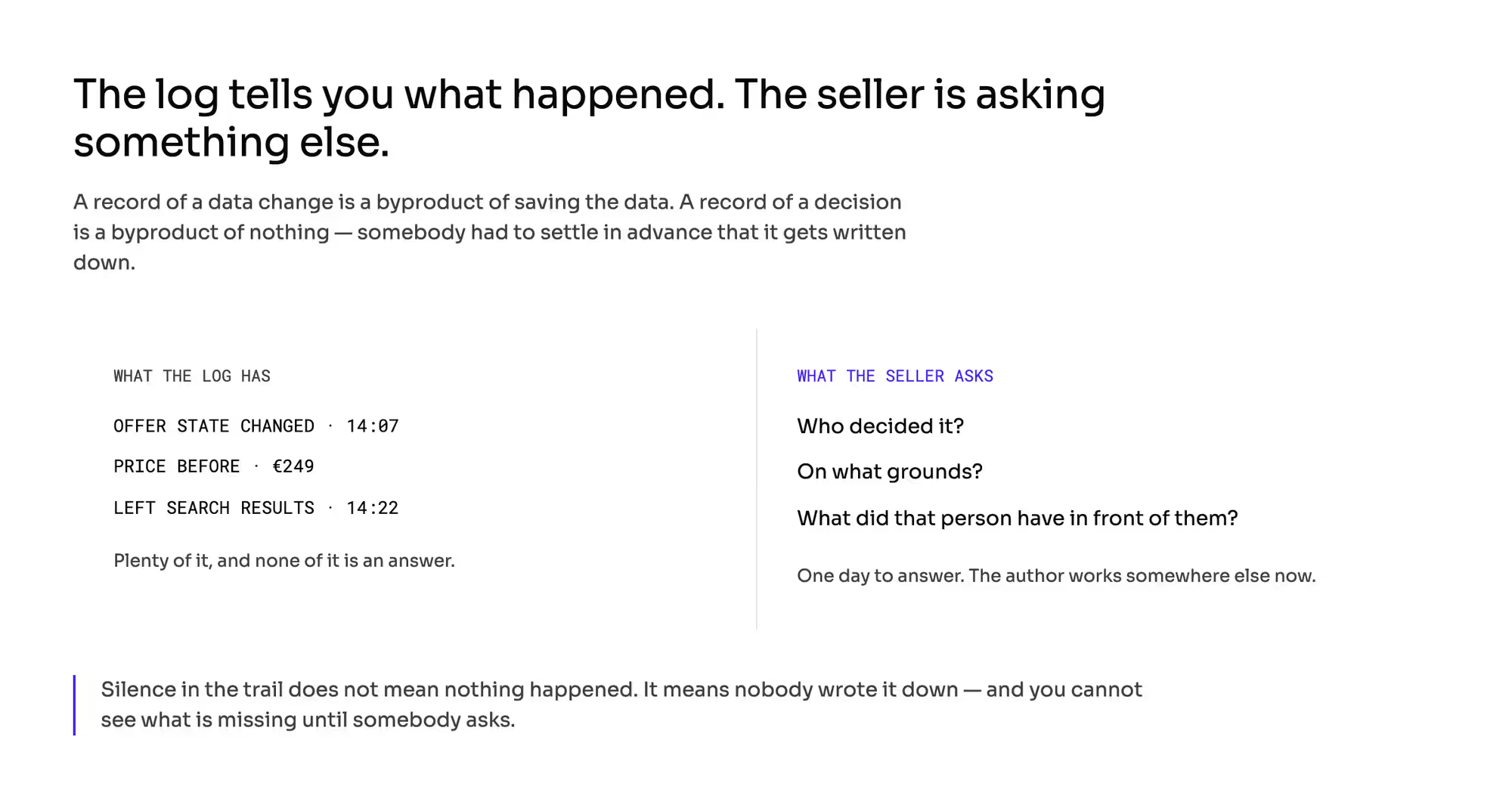
A seller writes to you about an offer you took down a year ago. They say it cost them the season, and they want to know why.
They have a right to an answer and time to wait for it. You have one day to reply.
You open the system logs, and they hold plenty. The offer changed state at 2:07 p.m. It cost €249 before that, and it dropped out of search results fifteen minutes later.
The logs tell you what happened, and the seller asks something else. They want to know who decided it, on what grounds, and what that person saw at the time.
The platform records a data change each time it saves the data. You'd have to work hard to end up without one.
Someone has to design audit logging before it can record decisions. That design has the operator pick a ground from a list. The system then stores that ground together with what the operator saw.
If the trail shows no reason, no one recorded the decision. You can't see what's missing until someone asks. They usually ask a year later, when the person who decided works somewhere else.
This series uses one hypothetical marketplace as its standard example: 10,000 orders a month, 300 sellers, and 200,000 active offers. The average cart is €1,000, and the commission is 12%.
That gives each seller about 33 orders a month, or €33,000 of sales.
A month of unjustified suspension costs that seller €29,040. That's 33 orders at €880 each after commission. It costs you €3,960 of lost commission, or 33 orders at €120.
Without a recorded reason, you can't show the seller that the decision was right. The chapter on the P2B regulation covers your duty to justify a decision and send it to the seller. This chapter covers what the platform keeps afterward.
Which 6 fields make an audit log entry usable as evidence?
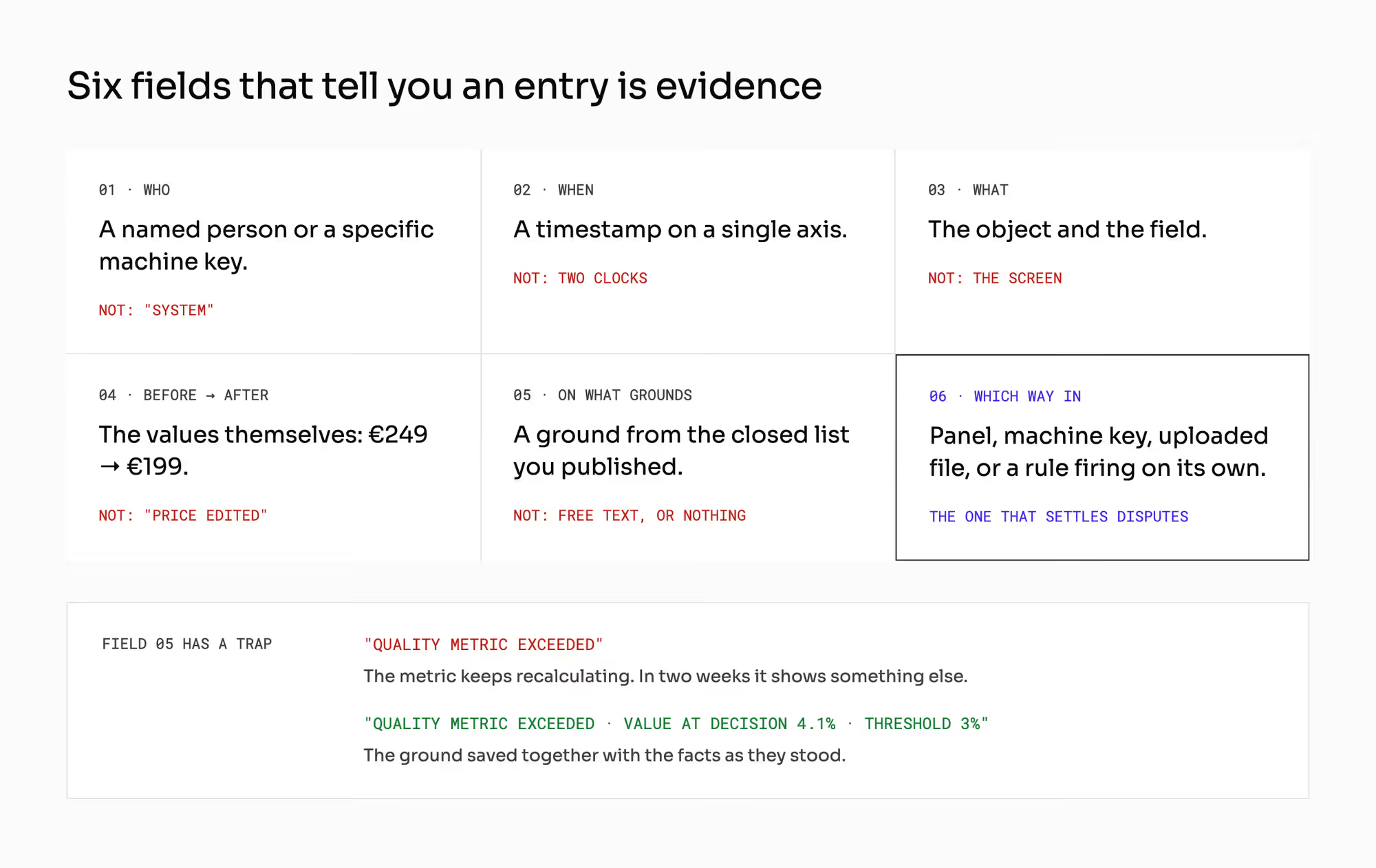
Control AU-3 of NIST SP 800-53 sets out what an audit record has to contain. On a marketplace, that comes down to six fields.
1. Who acted
Name a person or a specific machine credential. An entry with "system" in this field gives you no answer.
2. When it happened
Use one clock for every timestamp. If two systems use two clocks, their records of the same day won't match.
3. What changed
Record the object and the field. The screen the operator used tells you little.
4. State before and after
Store the old and the new content of the field. An entry that says "Price edited" proves little. An entry that says "€249 to €199" shows what changed.
5. Grounds for the decision
Pick the ground from a closed list. Use the same list you published to your sellers.
Save the ground together with a snapshot of the facts at the moment of the decision. A quality metric keeps recalculating, and two weeks later it shows something else.
An entry that reads "quality metric exceeded" loses its meaning within weeks. An entry that reads "quality metric at 4.1% on the day of the decision, threshold 3%" still holds a year later.
6. Way in
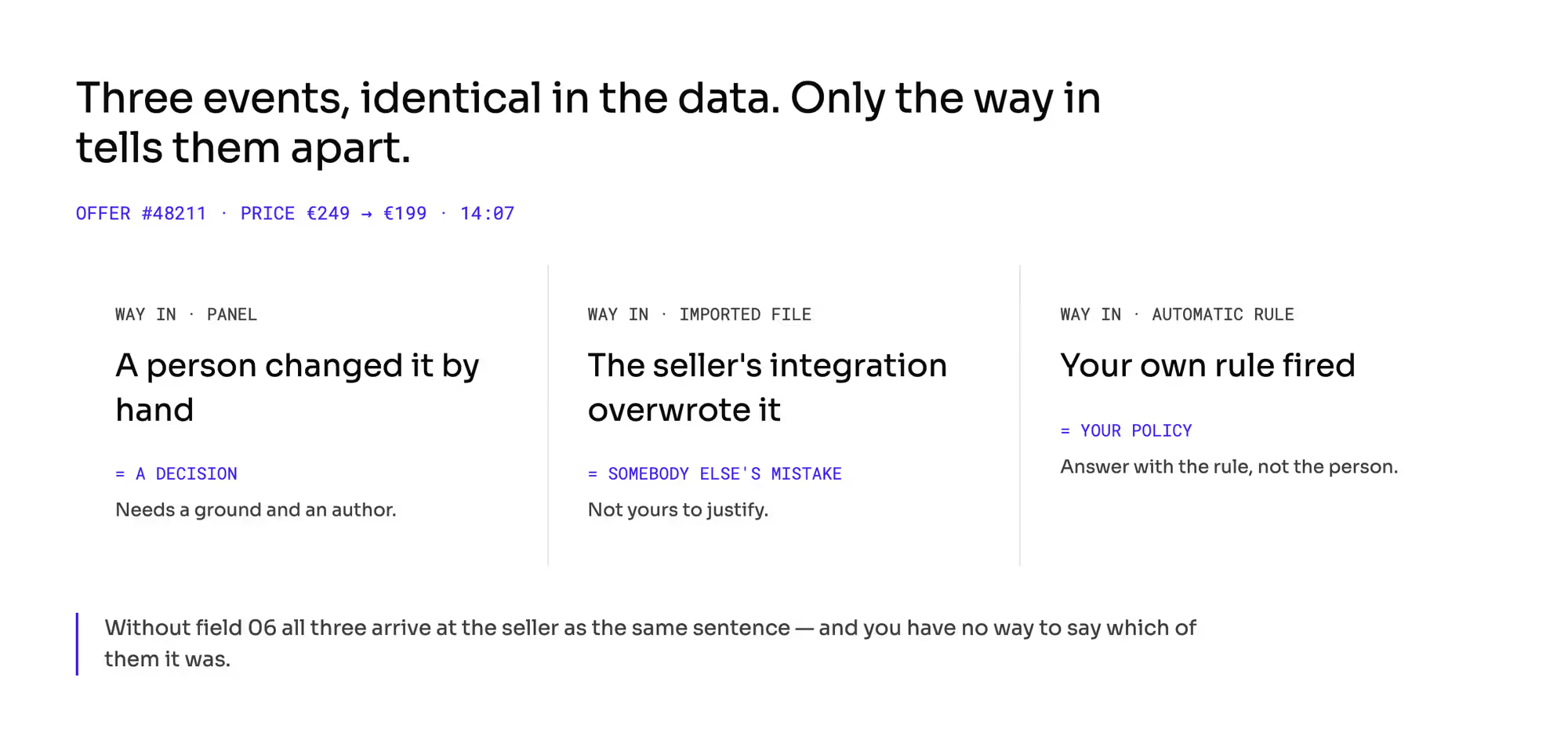
Record whether the change came through the panel, a machine credential, an uploaded file, or a rule that fired on its own. Teams rarely put this field on a requirements list, and you need it to settle most disputes.
Ask the vendor "who, and which way in" next to "what changed". Three events look identical in the data without this field.
A person edited the price in the panel. The seller's integration overwrote it with a file. Your own rule fired on its own.
The first is a decision. The second is a mistake in someone else's system, and the third is your policy.
Which 2 marketplace events do audit logs most often miss?
Both events leave a misleading trace or none at all. Each one needs its own class of entry.
1. Acting inside a seller's account
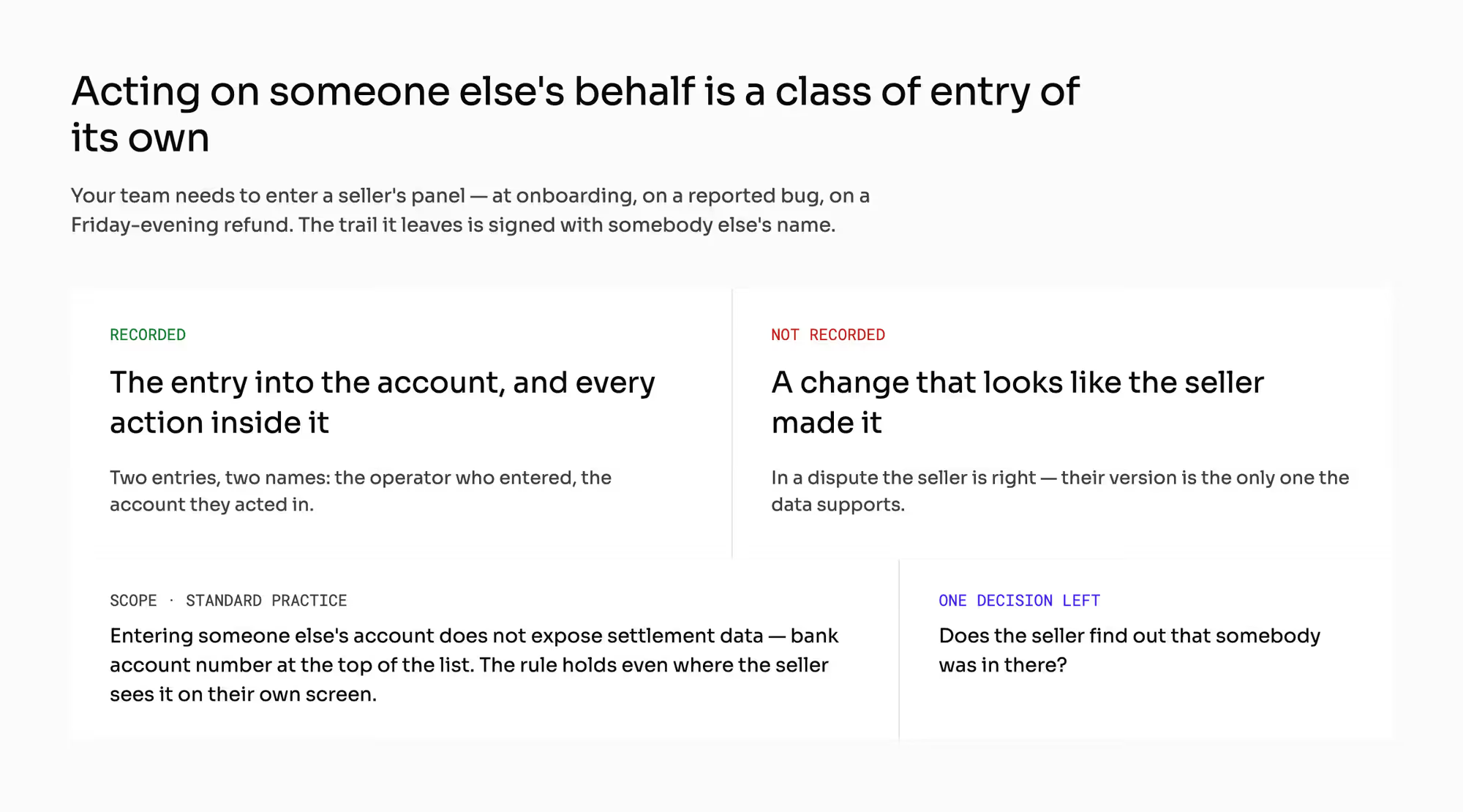
Sooner or later, your team gets a way to enter a seller's panel and act in their place. It happens during onboarding and when you reproduce a reported bug. It also happens when someone has to click a refund through on a Friday evening.
You need that capability. Treat it as its own class of event, because it leaves a trail signed with someone else's name.
The market has no single standard here. Check it on the demo.
Some platforms record both the entry into the seller's account and every action inside it. Others don't record the entry at all.
Then all that remains is a change that looks like the seller made it. In a dispute, the seller wins, because their version is the only one the data supports.
Then settle the scope. Make sure that entering someone else's account doesn't expose settlement data, starting with the bank account number. The rule holds even though the seller sees that number on their own screen.
Decide one more thing yourself: whether the seller finds out that someone from your team was in their account.
2. Bulk reads and exports
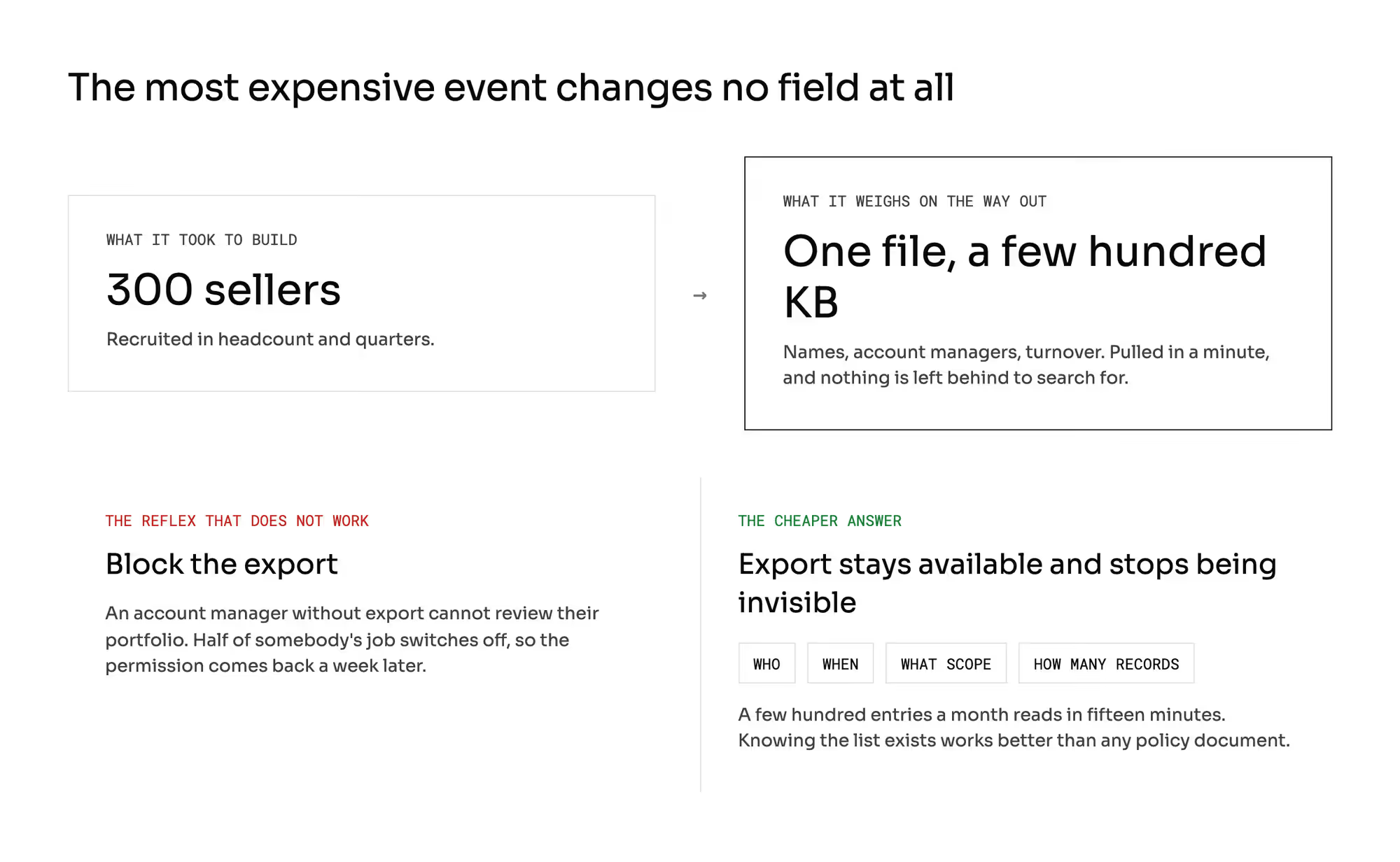
The bulk read and the export are worth the most to an outsider, and they change no data. An employee who is leaving still holds their access.
In a minute, they pull the full seller list with contacts and sales figures. The platform keeps no searchable trace of that minute.
Recruiting 300 sellers took people and quarters of work. The file with their names, account managers, and sales weighs a few hundred kilobytes.
An export of 200,000 offers with prices is your sellers' complete price list. An export of orders is the list of your buyers.
Blocking export doesn't help. The people you'd want to take export from use it every day. An account manager without export can't review their portfolio.
Teams that remove the permission switch off half of someone's job. They usually restore it within a week.
It's cheaper to keep export open and log every use. Each entry holds the author, the time, the scope, and the record count.
A few hundred such entries a month take about fifteen minutes to read. People who know the list exists think twice before pulling a file. That stops more people than a policy document does.
How long should audit log retention last, and what does it cost?
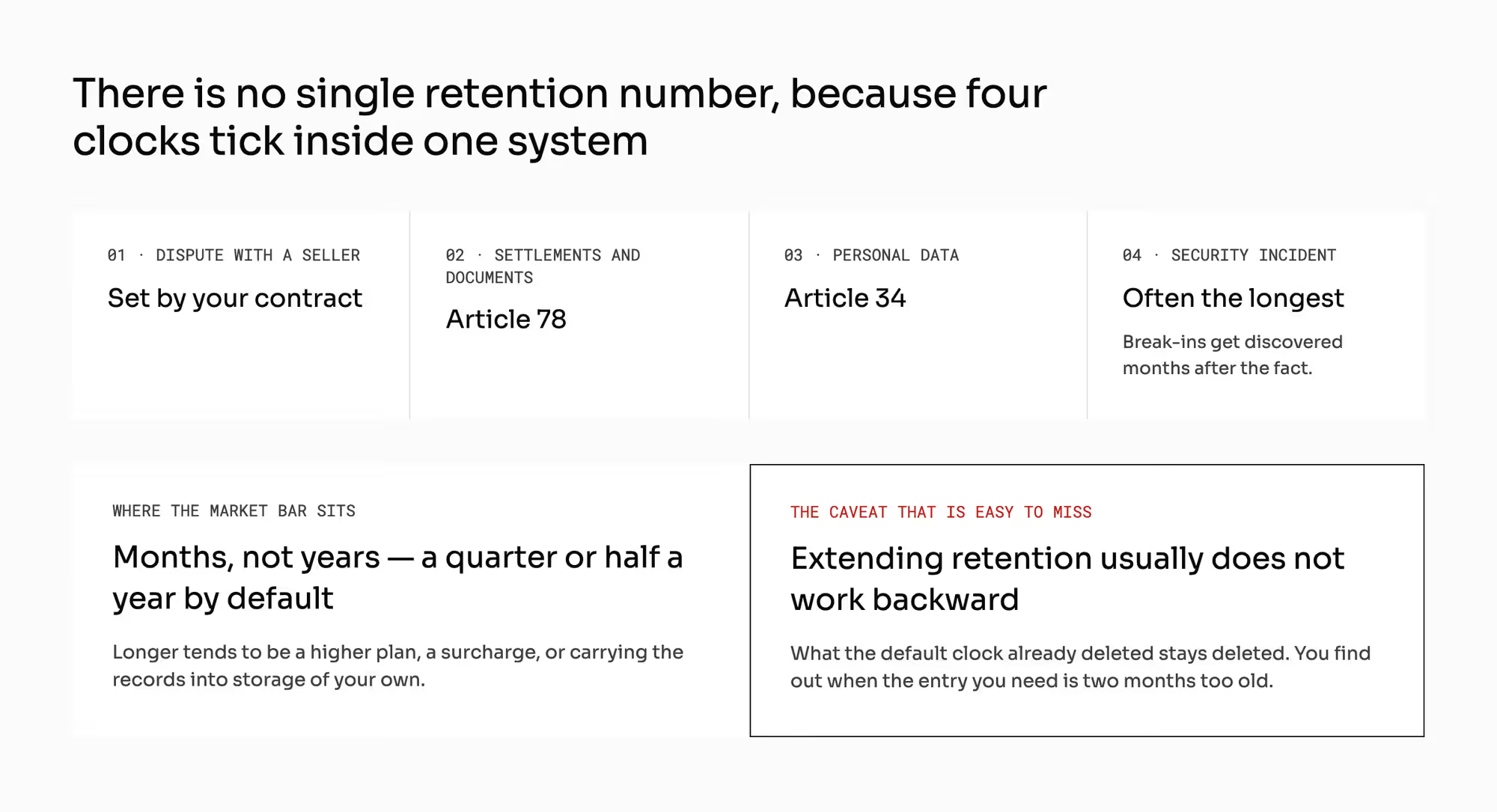
Four clocks set retention inside one system: seller disputes, settlement documents, personal data, and security incidents. Your contract with sellers sets the first one.
The chapter on marketplace order documents covers the second clock. The chapter on marketplace GDPR covers the third.
The fourth is often the longest. Companies discover break-ins months after they happen.
What audit log retention do vendors offer by default?
Vendors often count default retention in months. A quarter or half a year is common.
Longer storage tends to need a higher plan, a surcharge, or an export to storage of your own. Extending retention usually doesn't work backward, and entries the old setting deleted stay deleted.
How many audit log entries does a marketplace produce?
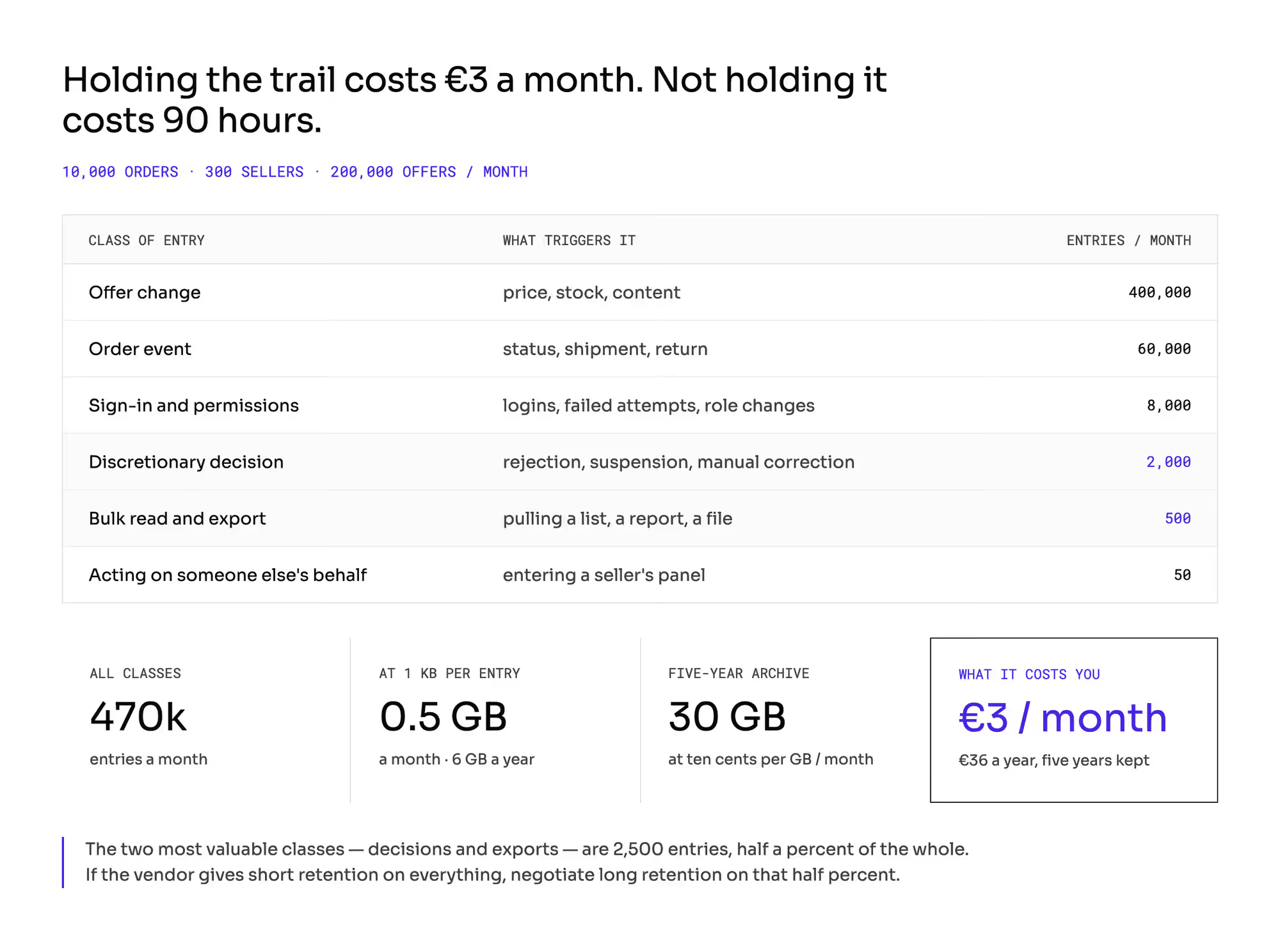
Take 200,000 offers that change twice a month and 10,000 orders with six events each. The table adds the other classes of entry on the same platform.
That's about 470,000 entries a month. Assume a generous one kilobyte per entry, with the before and after states inside.
The total is 0.5 GB a month, 6 GB a year, and 30 GB over five years.
Storage costs a few cents per gigabyte a month. A five-year archive costs €3 a month if you assume ten cents per gigabyte to be safe. That's €36 a year.
What does audit log retention cost you beyond storage?
Holding this data costs very little at marketplace scale. You pay more when you have to produce an entry on demand. You also pay when a default setting deleted the entry before anyone asked for it.
The two most valuable classes in the table are decisions and exports. Together they make 2,500 entries a month, about half a percent of the total. If the vendor offers short retention on everything, negotiate long retention for that half percent.
Who should see the audit trail on a marketplace?
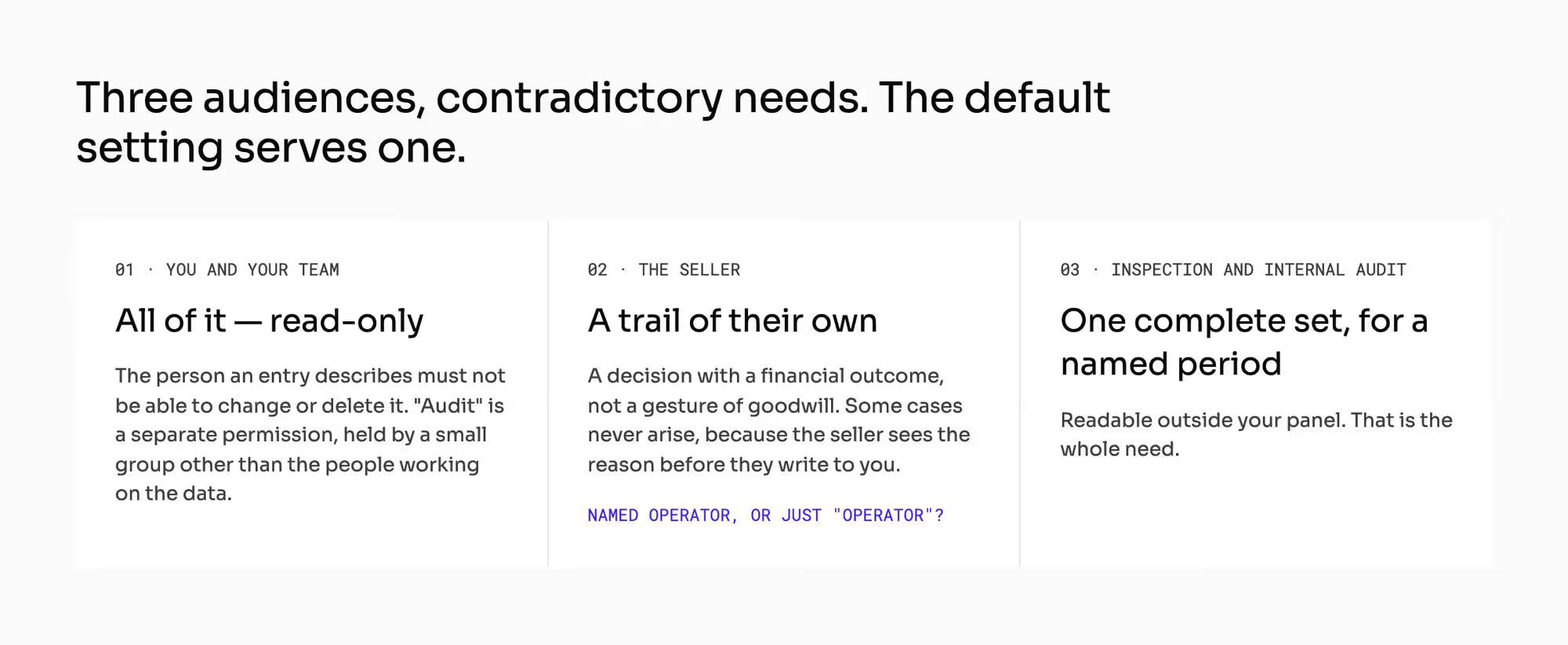
The trail has three audiences with conflicting needs. Default settings usually serve only your own team.
1. You and your team
Your team needs the whole trail, with one exception. The person an entry describes must not be able to change or delete it.
NIST SP 800-53 treats protection of audit information as a control of its own, AU-9. One of its enhancements limits management of audit logging to a small group of privileged users. Set up "audit" as a separate read-only permission.
2. Sellers
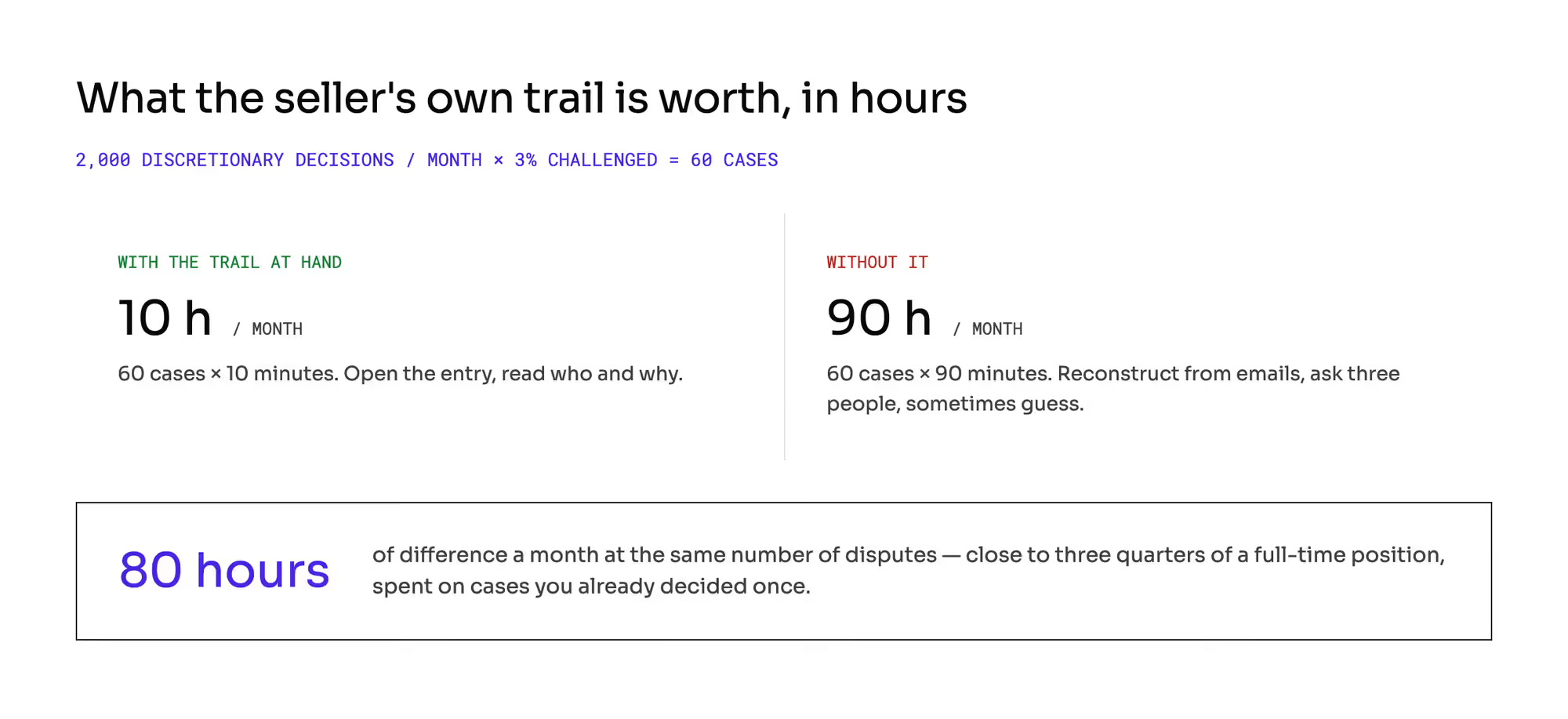
Whether each seller gets a trail of their own changes what disputes cost you.
Take 2,000 discretionary decisions a month. They include rejections, offers taken down, corrections, and suspensions. If sellers challenge 3% of them, you handle 60 cases a month.
With the trail at hand, a case takes 10 minutes. Sixty cases take 600 minutes, or 10 hours a month.
Without the trail, you rebuild each case from emails and questions to three people. Sometimes you guess. At 90 minutes a case, that's 5,400 minutes, or 90 hours a month.
Disputes without a trail cost 80 more hours a month, about half of a full-time role. Five years of storage for the whole log costs €3 a month. Some of the 60 cases also never arise, because the seller sees the reason before writing to you.
Decide whether the seller sees your operator's name or only the word "operator". Some platforms show only the word.
A named trail is more credible, and an anonymous one shields your people from pressure. Make that choice on purpose.
3. Inspections and internal audit
Inspectors and your internal auditors need a complete set of entries for a named period, readable outside your panel. Check that the platform can export that set without help from your developers.
What does an audit log change in your marketplace?
Each account in the audit trail has to belong to one named person or one named system. If five people share a technical account called "integration", each entry can only tell you it was one of those five.
The chapter on SSO vs MFA covers roles and company logins. The chapter on seller data isolation covers who can access which seller's data.
You also need to know which system owns each object. If the price comes from your product information system, an entry saying "price changed" only records a decision someone made in that system. The chapter on the single source of truth covers which system owns which data.
A log of integration events doesn't replace a trail of decisions. Treating one as the other gives you a false sense of safety. The chapter on webhook integration covers the traffic between systems.
Who at your company may make a given decision is a separate question from whether the platform records it. Settle it in your internal approval rules.
How do you check an audit log with a vendor?
Start with a reconstruction test on the vendor's demo or reference installation. It takes half a day and tells you more than a full set of answers to a request for proposal.
- Can the platform tell you, from a single source, who took down an offer a year ago, on what grounds, what the field held before and after, and which way the change came in?
- How long did the answer take? If it took more than fifteen minutes, or someone had to ask a colleague what they remember, the platform failed the test.
- Does the same test work on an order with a manual correction? Corrections often happen quickly and outside the process, and the trail is thinnest there.
- Can you get the list of exports from the last 30 days with the author, the scope, and the record count? If the vendor can't produce the list, record that as a finding.
- Can an administrator delete an entry about their own action? Treat "Yes, but no one does that" as a yes.
Then ask the vendor five more questions:
- What is the default retention for each class of entry, and what does extending it cost?
- Can we export entries to storage of our own?
- Does an entry tell a person, a machine credential, and a file import apart?
- Do you record entry into a seller's account together with every action inside it?
- What does a seller see of the trail on their own account?
Which mistakes do operators make with marketplace audit logging?
1. Designing the audit trail as a security feature only
The trail covers sign-ins and permissions and leaves out discretionary decisions. Sellers ask about those decisions.
2. Saving the reason without the facts behind it
Two weeks later, the metric shows a different number. The justification stops holding up, even though no one falsified anything.
3. Leaving reads and exports outside the audit log
You record every change down to the field. Someone can still export the entire seller base and leave no trace.
4. Inheriting retention from default settings
No one chose that period, and it decides how far back your records go. You find out when the entry you need is two months too old.
5. Letting the same person change data and administer the log
If one person can do both even once, the whole trail stops counting as evidence. That holds even when no one touched an entry.
What do you still have to settle about marketplace audit logs?
This article doesn't explain your legal duties toward sellers. The chapter on the P2B regulation covers what you must justify, to whom, and by when. The chapter on marketplace liability covers your liability as an intermediary for content.
This article doesn't settle the retention periods the law requires. An audit entry can be personal data, and the duty to keep it can clash with the duty to erase it.
The chapter on marketplace GDPR covers that conflict. The chapter on marketplace order documents covers the clocks for order documents.
Settle two areas of regulation with a lawyer:
- Personal data protection.
- Transparency toward the businesses that sell on your platform.
This article doesn't cover reconciling numbers or designing permissions in general:
- The chapter on commission rate drift covers commission rates that stop matching the commercial agreement.
- The chapter on marketplace analytics covers why a BI report disagrees with the admin panel.
- The chapters on seller data isolation and SSO vs MFA cover who sees which data and how people get their roles.
The numbers here are hypothetical and easy to check in your head. Put in your own count of discretionary decisions and your own share of contested cases.
Summary: How do you build an audit log that answers a seller a year later?
An audit log answers a seller a year later only when it records decisions next to data changes. Each entry needs six fields, and the grounds need a snapshot of the facts from the day of the decision.
Two events need their own class of entry: acting inside a seller's account and exporting data in bulk. Without that class, the first looks like the seller's own action, and the second leaves no trace.
Five years of audit log retention costs about €3 a month on a marketplace with 10,000 orders a month. Disputes handled without a trail cost 80 extra hours a month.
Building a marketplace that can show any seller who decided, on what grounds, and which way the change came in?
Frequently asked questions on audit logs
What is an audit log?
An audit log is a record of who did what in a system, when, and with what result. On a marketplace, a usable audit log also records the grounds for each decision and the way the change came in.
What is the difference between an audit log and an audit trail?
An audit log is the stored set of entries, and an audit trail is the chain of entries that lets you follow one decision from start to finish. Many teams use the two terms as synonyms. On a marketplace, the trail has to connect a seller's question to the person who decided.
How long should you keep audit logs?
You should keep audit logs as long as the longest of four clocks: seller disputes, settlement documents, personal data, and security incidents. Vendor defaults are often a quarter or half a year. On a marketplace with 10,000 orders a month, five years of entries cost about €3 a month to store.
Ready to build?
We build marketplaces that record who made each decision, on what grounds, and which way the change came in.