
Phase Gate Review for a Marketplace Rollout: What Each Gate Has to Prove

A phase gate review is the meeting that ends one phase of a rollout and opens the next. You bring the threshold the phase had to meet and the result it produced, and then you decide.
This chapter covers the two halves of a gate, the three groups of measures it needs, and the volume at which a percentage starts to mean something.
In product development, the same arrangement is called a stage gate, and it carries over to a marketplace rollout almost unchanged.
A phase ends on the calendar whether or not it worked. You have a date and a budget approved for one phase, and a committee meets on that date.
Hardly anyone writes down what counts as a pass, and the review then becomes an account of the work delivered. No one takes a decision about the next two quarters, and the phase carries on.
This article breaks down:
- What does a phase gate review have to prove?
- Which 3 groups of measures does every gate need?
- Why doesn't a percentage threshold work at launch volume?
- Which gate measures become readable at which volume?
- Which 3 conditions make a gate decision binding?
- Which 4 measures react to your own policy instead of your service?
Key insights
- A gate has two halves. Most companies write down the first and skip the second, so no one at the review can say "we didn't pass".
- Three branches follow a miss: another quarter for the same phase, one category kept, or a return to your own goods. They cost different amounts, and the one you might take sets the measure you collect from day one.
- One measure from each of three groups keeps a gate honest. A gate built from three supply measures passes on a platform where no one bought anything.
- A rate measured on a launch quarter's events carries a margin wider than the difference you are trying to see. At that volume, you gate on counts and on median times.
- A binding gate carries a number, a date, and an owner of the decision from outside the phase. Drop one of the three and the review still happens, and no decision comes out of it.
- Four marketplace measures improve on paper when you change your own policy. A rate on closed orders, the share of disputed cases, seller-marked on-time shipping, and the share of rejected orders all shift without a parcel reaching a buyer any sooner.
What does a phase gate review have to prove?

A gate has two halves. The first says what has to be true to enter the next phase, and the second says what you do when it isn't.
Without the second half, no one at the review says "we didn't pass". A sentence with no continuation lands as an accusation across the table.
The same person who asked for the budget presents the result. Research on organizational decisions has described this for decades: someone who committed to a decision in public finds it hard to reverse, and someone personally responsible for it finds the reversal harder still.
Although the money already spent tells you little about the next two quarters, your team will treat it as a reason to carry on. An appeal for honesty won't change that, and one page written a quarter earlier does the work.
You can fail a gate in three ways, and each one has a price.
- Extend: the same phase gets another quarter against the same criterion.
- Narrow: you keep one category, or one group of sellers, and drop the rest.
- Close: you go back to selling only your own goods.
You price all three branches from the cost model in the marketplace business case.
The measure you need depends on the branch you might take. If you expect to narrow to one category, a criterion counted across the whole platform is useless, and you won't know which category to keep on the day of the review.
You need that same measure broken out by category from the first day of the phase, and a narrowing to your best sellers needs a per-seller measure on the same terms.
A gate can stop the work, and a status meeting can't. If no one at the table can halt the next phase, you're holding a status meeting.
Which 3 groups of measures does every gate need?
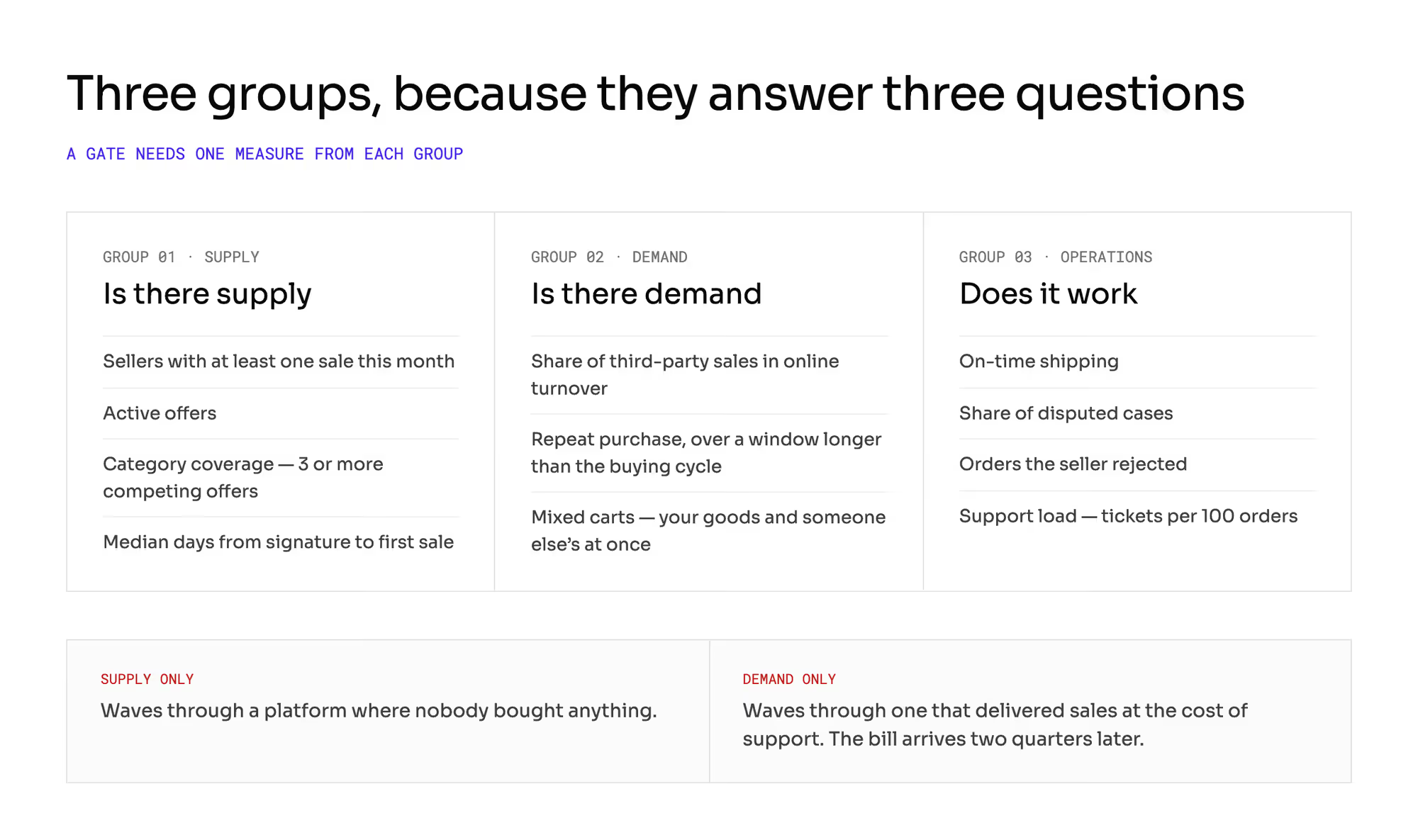
A gate needs one measure from each of three groups. Ready-made sets of marketplace metrics usually cover revenue growth and customer satisfaction. They add leaner operations, sales rep productivity, and the pace of signing up supply, and you can borrow the whole arrangement if it suits you.
Five measures are missing from sets like that. On-time delivery, the share of defective orders, and time to a seller's first sale are three of them, and sellers leaving and the share of third-party sales are the other two. Each one shows that a marketplace doesn't work, a set written to sell software has little reason to carry them, and you add them yourself.
1. Supply: is there anything worth buying?
Four counts show whether the sellers who signed are selling:
- Sellers with at least one sale in the month.
- Active offers.
- Category coverage, as the share of categories with three or more competing offers.
- Median time from contract signature to a seller's first sale.
Watch the first count for the size of your live base, and watch category coverage for whether a buyer has anything to choose between.
2. Demand: are buyers taking the offers?
Three counts show whether buyers take the offers:
- Share of third-party sales in online turnover.
- Repeat purchase, as the share of buyers with a second order. Use a window longer than your purchase cycle.
- Share of carts holding your own goods and someone else's at once.
Repeat purchase is the slowest of the three to read, and a buyer who came back has told you the first purchase was good enough.
3. Operations: what did the sales cost?
Four counts show what those sales cost you to deliver:
- On-time shipping.
- Share of disputed cases.
- Share of orders the seller rejected.
- Support load, as tickets per hundred orders.
A gate built from three supply measures passes on a platform where no one bought anything. A gate built from demand alone passes on a platform that bought its sales with support time, and you get that bill two quarters later.
Why doesn't a percentage threshold work at launch volume?
Every threshold rests on a count of events, and at launch you don't have those counts yet.
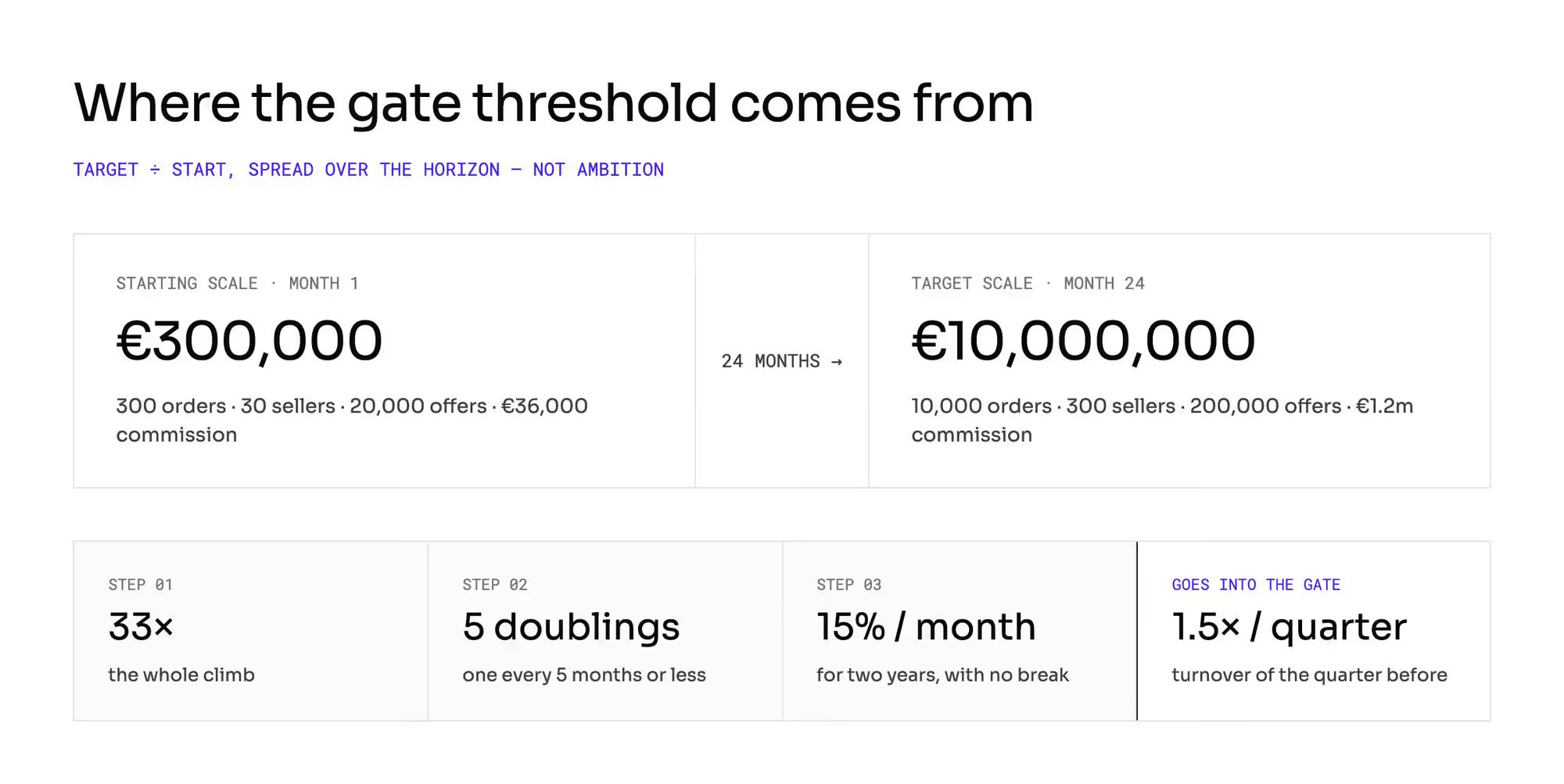
The starting scale is 300 orders a month, 30 sellers, and 20,000 offers. The target scale is 10,000 orders, 300 sellers, and 200,000 offers. In both cases, the cart is €1,000, and the commission is 12%.
That gives €300,000 of turnover and €36,000 of commission in the first month, against €10 million and €1.2 million at the end, and about two years separate them.
The pace between those two scales sets your thresholds. Growing thirty-three times over is about five doublings, and five doublings in 24 months means a doubling every five months or less. That is 15% month over month with no break for two years.
A quarterly gate spans a little under one doubling, and the criterion lands at about one and a half times the turnover of the quarter before. That figure comes from your target and your horizon.
At 300 orders and a late share of around 5%, you have 15 late parcels. An observed 5% then means somewhere between 2.5% and 7.5%. The margin around it is about ±2.5 percentage points, and at 10,000 orders that margin is ±0.4 points.
Margins shrink with the square root of the number of events, and thirty-three times the volume narrows this one by a little under six.
A quarter with no disputed case still has an upper bound. One division gives it: three divided by the number of observations. At the 900 orders of a starting quarter, that's 0.33%, which at the target scale is up to 33 disputes a month.
Thirty-three disputes a month is a queue, and it needs a person on it. Read a zero in a small sample as "we don't know".
Pinning a rate of a few percent to within one point takes about 2,000 observations. The formula is four times the share, times its complement, divided by the square of the margin. At 300 orders a month you gather that for more than half a year, and at 10,000 orders you gather it in under a week.
Per-seller measures read worse at this volume. With thirty sellers, one of them leaving is 3.3 points on the churn rate, and the grain of the measure is larger than the difference you want to see.
300 orders across 30 sellers is 10 orders per seller per month, and with 20,000 offers, a single offer sells statistically once every 66 months.
One order whose tracking number didn't come through pushes a seller's rate across a threshold, and practitioners report that as the common case.
Mature rating systems hold an activation threshold for this. Below a minimum number of orders or ratings, the rate isn't calculated at all, and your gate needs the same device. The suspension thresholds themselves are in marketplace seller quality metrics.
At the starting scale, gate on counts and times. The number of late shipments, the number of sellers with a first sale, and the median days from signature to first order all read at thirty events.
Which gate measures become readable at which volume?
Which measure, and in what unit? | Which group? | What does it settle? | How many events before it reads? | What do you use instead at the starting scale? |
|---|---|---|---|---|
Sellers with a sale in the month (accounts) | supply | whether supply is alive or has only registered | works from 1 | none needed |
Time to a seller's first sale (days) | supply | whether onboarding ends in revenue | a median from about 10 sellers | a named list with dates |
Category coverage (% of categories with 3 or more offers) | supply | whether the buyer has anything to choose from | works from day one | none needed |
Share of third-party sales (% of online turnover) | demand | whether the channel carries real weight | about 300 orders per order of magnitude | the figure in euros |
Repeat purchase (% of buyers with a 2nd order) | demand | whether the first purchase was any good | a window longer than the purchase cycle, about 1,000 buyers | the count of returning buyers |
Mixed cart (% of orders with your goods and someone else's) | demand | whether the offer has grown into the assortment | about 2,000 orders per ±1 point | the count of such orders |
On-time shipping (% of shipments inside the promised time) | operations | whether the promise on the page is true | about 2,000 orders per ±1 point | the count of late shipments |
Share of disputed cases (% of orders with a dispute) | operations | whether a problem is the exception | about 2,000 orders per ±1 point | the count of cases and their reasons |
Support load (tickets per 100 orders) | operations | whether support grows more slowly than sales | from about 300 orders | the same measure, without the trend |
Which 3 conditions make a gate decision binding?
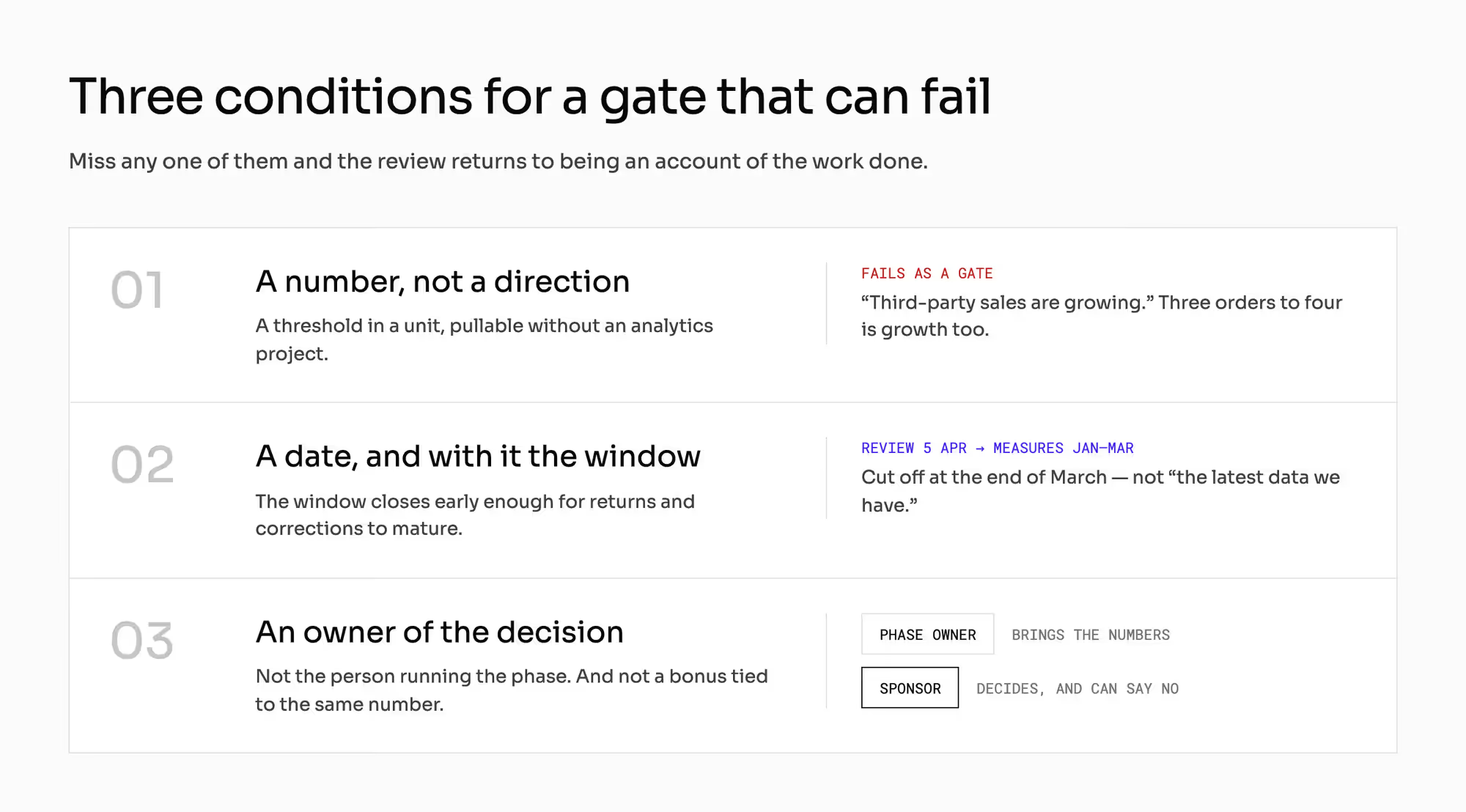
Every binding gate carries three things: a number, a date, and a named owner of the decision. Drop one of the three and the review still happens, and no decision comes out of it.
1. Threshold in a unit you can pull
Because going from 3 to 4 orders counts as growth, "third-party sales are growing" passes every review you hold. Write the criterion as a threshold in a unit from the table above, and make sure you can pull that number without an analytics project.
Practitioners spend more effort on one job than on any other, and that job is tracking who dropped and in which category. A number that costs three days of an analyst's time doesn't reach the review, and someone brings an easier one.
2. Date, with the measurement window attached
Close the measurement window early enough before the review for returns and corrections to land. Those two keep changing a closed month long after it ends.
A gate set for April 5 therefore measures January through March, cut off at the end of March. Two correct numbers for the same period can still differ, and you'll find the reason in marketplace analytics. The definitions that already apply there go into the gate.
3. Owner of the decision, from outside the phase
The person held to account for delivering the phase doesn't rule on its failure. They bring the numbers, and the sponsor or the committee takes the decision.
Who answers for the marketplace inside your company is settled in the executive sponsor chapter. A bonus that depends on the same number for both of them creates a second problem, and you'll find that one in the sales compensation plan.
Which 4 measures react to your own policy instead of your service?
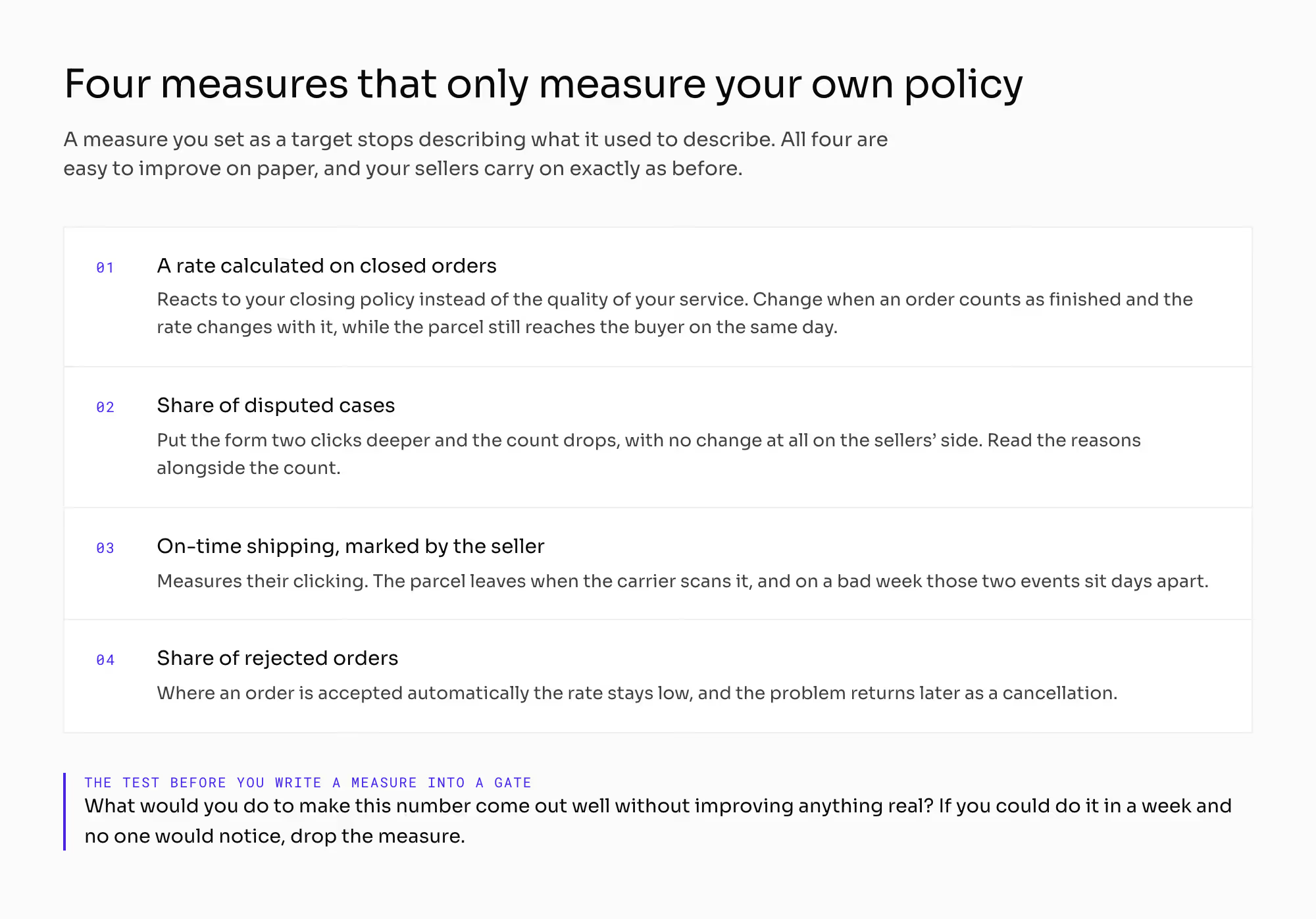
A measure you set as a target stops describing what it used to describe. Four marketplace measures are easy to improve on paper, and your sellers carry on exactly as before in all four cases.
1. Rate calculated on closed orders
Count a rate over closed orders, and you're reading your closing policy. Change when an order counts as finished, and the rate changes with it. The parcel still reaches the buyer on the same day.
Closing a marketplace order carries the accounting side, and you settle the closing rule before such a rate goes into a gate.
2. Share of disputed cases
The share of disputed cases falls when filing a case gets harder. Put the form two clicks deeper, and the count drops with no change at all on the sellers' side.
Read the reasons alongside the count, and if the count drops while the reasons stay the same, you changed the reporting.
3. On-time shipping marked by the seller
On-time shipping is counted from the moment the seller marks the shipment, measured by their clicking. The parcel leaves when the carrier scans it, and on a bad week those two events sit days apart.
Take the status from the carrier wherever you have that connection. Where you don't, gate on the count of late parcels and name the source of the date.
4. Share of rejected orders
The share of rejected orders depends on whether rejecting is an action at all. Where an order is accepted automatically, the rate stays low, and the problem returns later as a cancellation.
Count cancellations after acceptance as well. Without them, the rejection rate describes your configuration.
Before a measure goes into a gate, ask what you would do to make this number come out well without improving anything real. If you could do it in a week and no one would notice, drop the measure.
In the first quarter, some orders are suddenly fulfilled by someone else out of someone else's warehouse, and buyer satisfaction usually drops. Gate its return to the level from before launch.
What does a phase gate review change in your marketplace?
Your team starts recording differently on the first day of the phase.
1. Scope of the question a gate asks
A gate asks whether one phase delivered what it promised, and it doesn't ask why you're building a marketplace. Read the chapter on marketplace metrics for that question and for the conflicting intentions behind it.
Splitting the venture into phases belongs to the marketplace pilot chapter, and here you're looking at the crossing between two of them.
2. Recording from day one of the phase
Record events from the first day of the phase. You can't fill history in afterwards, and a measure you introduce halfway through doesn't have an earlier period to compare at the review.
Write the definition next to each measure, and if you change it in week six, you now have two measures under one name.
3. Gate just before launch
A gate just before launch carries a list of signatures instead of numerical thresholds. Who can block a go-live is set out in the launch readiness checklist.
The first numbers after launch are distorted too, and you'll find what distorts them in hypercare after a marketplace launch.
4. Duties that follow a "no"
A gate that ends in suspended or closed seller accounts puts three duties on you. Each decision needs a justification, a delivery to the seller, and a trail, and P2B regulation on a marketplace covers all three.
Repeat purchase is calculated on buyer data, and the scope and period of that processing are settled in marketplace GDPR.
How do you write a phase gate on one page?
Six steps fit on a single page.
1. Three measures, one from each group
Write down three measures and take one from each group. Beyond five, the committee spends the meeting reading a table, so three is the number that reaches a decision.
2. Denominator behind each measure
Check the denominator of each measure against the volume expected on the day of the review. If the number of events comes out under a few dozen, swap the percentage for a count.
3. Threshold derived from the target and the horizon
Derive the threshold from your target and your horizon. The one and a half times a quarter calculation above is the worked example for the reference platform.
4. Review date and measurement window, set apart
Set the review date and the measurement window as two separate dates. Leave a gap between them for returns and corrections to land.
5. "No" branch you can carry out
Add the "no" branch and check you can carry it out with the measures you're already collecting. A branch that narrows to one category fails if you only collect a platform total.
6. Owner of the decision and the person who brings the numbers
Name the owner of the decision, and name the person who brings the numbers. Those are two different people, and the page carries both names.
How do you check phase gate measures with a vendor?
- Which of the nine measures in the table above does the panel report without an export?
- Can I break each one out by category and by seller, and over a period I choose?
- Does the panel carry an activation threshold below which a seller's rate isn't calculated?
- When a return or a correction lands after a month closes, does the figure for that month change?
- Which event timestamps come from the carrier and the payment provider, and which from a seller clicking a button?
Which mistakes do operators make with phase gates?
You can make all five of these mistakes and look diligent doing it. The cost arrives a year later, and by then no one can point back to a moment of choice.
1. Gate with no "no" branch
A gate with no alternative written down passes every time, and a year later no one can name the point at which turning back was still possible.
2. Threshold in percentage points on a volume that can't carry it
A starting quarter gives you a dozen or so events, and you then take an investment decision on a difference you can't measure.
3. Gate built only from supply measures
You have the sellers, and you have the offers. You don't have the buyers, and the result formally passes.
4. Owner of the phase ruling on its failure
Even an honest person finds reasons to push the date back by a quarter. After the third push you have your answer, and no one has written it down.
5. Criterion changed during the phase
A threshold you can correct after the result is in measures the result. Lock the criterion in the document that opens the phase.
What do you still have to settle about your phase gate review?
This chapter doesn't say why you're building a marketplace, and it doesn't split the venture into phases. The chapter on marketplace metrics takes the first question, and the marketplace pilot chapter takes the second.
It also doesn't settle which of two correct turnover numbers is yours. That's the job of marketplace analytics, and its definitions go straight into the gate.
This chapter gives no seller quality thresholds and no conditions for suspension. You'll find those in marketplace seller quality metrics, and the cost model in the marketplace business case prices the closing branch.
This chapter isn't legal advice. Two families of regulation apply when the result of a gate touches sellers or buyer data. One covers transparency between a platform and its sellers, and P2B regulation on a marketplace carries the mechanism. The other covers protection of personal data, and marketplace GDPR covers that one. Raise both with your lawyer.
Both reference platforms here are invented, and they show how the arithmetic behaves. Your own thresholds come out of your volume and your purchase cycle, and you count them the same way.
Summary: What does each gate in a marketplace rollout have to prove?
Each gate has to prove that the phase met a threshold written down before it opened, and it has to carry the branch you take when the threshold is missed. An extension, a narrowing, and a closure cost different amounts. The measure you collect from the first day depends on which one you might take.
One measure from each of three groups keeps the answer honest. Count whether sellers sell, whether buyers buy, and what the delivery costs you.
At the starting scale, the thresholds are counts and times. An observed 5% late rate on 300 orders sits anywhere between 2.5% and 7.5%, and pinning it to within one point needs about 2,000 observations.
Then set the review date with a closed measurement window, and give the decision to someone who isn't delivering the phase. Setting the exit criteria for the next phase of your rollout?
Frequently asked questions on phase gate reviews
What is a phase gate review?
A phase gate review is a scheduled decision point at which a phase either meets the criteria for entering the next phase or takes a written branch for failure. The criteria are set before the phase opens, and they name a threshold, a measurement window, and an owner of the decision. A review that can't stop the work only reports progress.
What is the difference between a phase gate and a status meeting?
A gate can stop the work, and a status meeting can't. Check for a written branch covering a result that falls short, and check that someone outside the phase has the authority to take it. Without both, the review reports progress and the next phase opens by default.
Which metrics should a marketplace phase gate use?
Use one supply measure, one demand measure, and one operational measure, in units your volume can carry. Sellers with a sale, the share of third-party sales, and on-time shipping cover the three groups at target scale. Below the volume that makes a percentage readable, gate on counts and on median times.
Ready to build?
We build marketplaces that report supply, demand, and operations as separate numbers, so every gate in your rollout has a figure to decide on.