
How Does an Approval Workflow Work on a Marketplace?

An approval workflow names the role that settles a case and the deadline it has for it. It also names the object the case waits in and the threshold at which the case escalates. This chapter covers the seven decisions a marketplace operator settles every month and the fields each of them needs.
A marketplace produces several discretionary decisions every working day, and almost none of them has a place of its own in your company.
The seller then waits until somebody scrolls their inbox far enough to find the request.
This article breaks down:
- Where does a discretionary decision physically wait?
- Which 7 decisions belong in your approval matrix?
- Why do sellers wait weeks when the whole queue takes 43 hours a month?
- What does a week of waiting cost you and the seller?
- Why does every row of the matrix need a stand-in?
- Which repeatable decisions should become a written policy?
Key insights
- Every decision needs four fields: one role, an escalation threshold, a deadline in working days, and an object it waits in. A case with no object waits in somebody's inbox.
- Express the escalation threshold as the annual cost of the concession. The same points off the commission cost little with a small seller and a great deal with a large one, and a threshold in percentage points treats both requests as one decision.
- The whole decision queue takes less than one full-time position, and sellers wait weeks in it anyway. The case waits in one person's inbox, and only that person can release it.
- Every day you take off the median wait gives back a day of commission on every decision that blocks a seller's sales. One role to keep the queue clear costs less than the waiting it removes.
- One named person on a row fails on the first long vacation. Write a backup role next to every decision, give it a permission you can switch on for the period, and give the stand-in a queue they can see.
- If the last ten decisions of one class all went the same way, you have a policy no one wrote down. Write the rule down, let the clear cases through automatically, and leave a person only what the rule excludes.
Where does a discretionary decision physically wait?
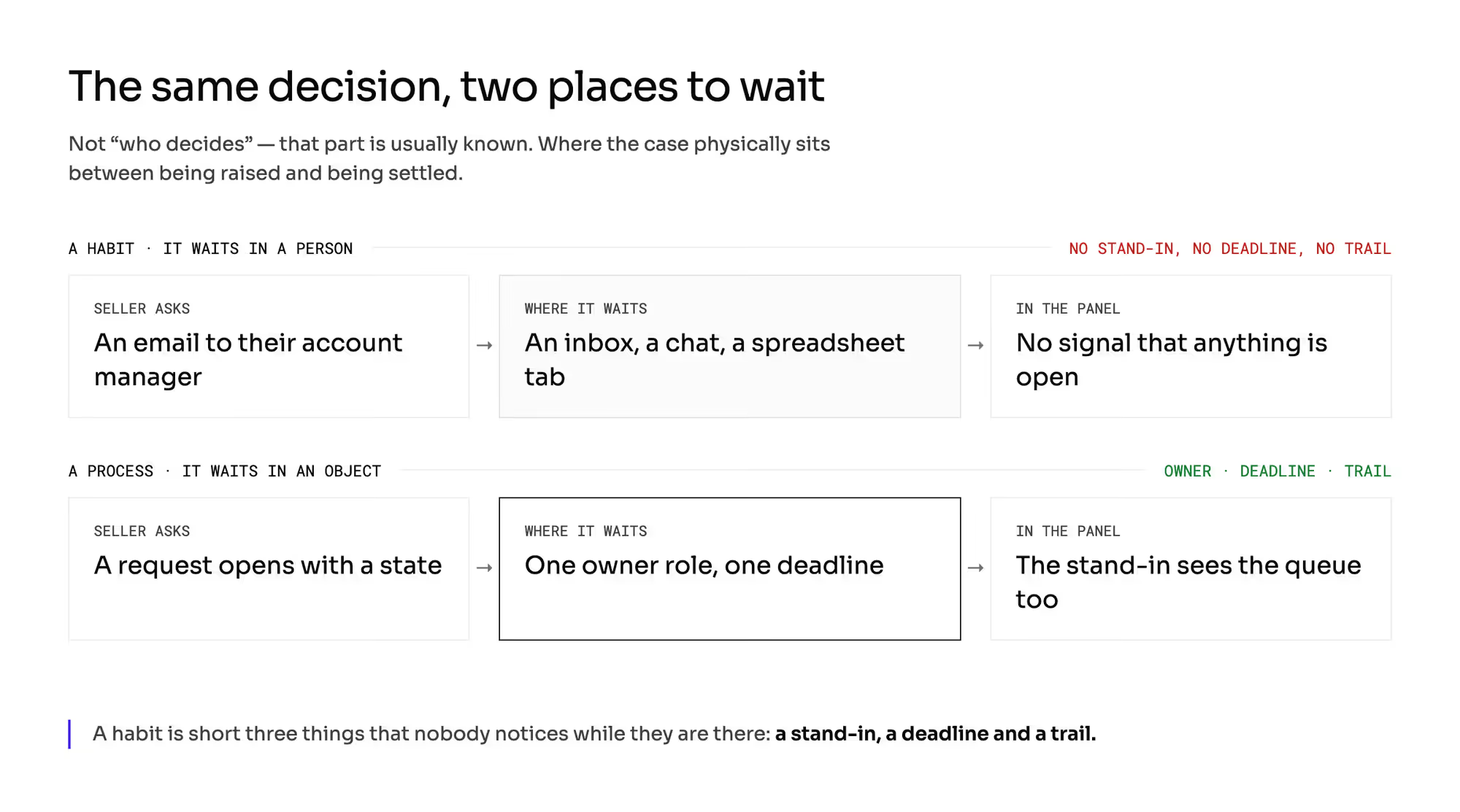
List every decision that somebody in your company has to approve, from a seller admission to a settlement exception. Where does the case sit between being raised and being settled?
You already know who makes each decision, and few operators can say where the case waits.
Offer approval belongs to the chapter on product approval, which covers manual and automatic approval of a seller's offers. This one covers the decisions your own people take about sellers, commissions, and campaigns.
Most answers name an inbox, a spreadsheet with tabs, or next Monday's meeting. A habit lacks a stand-in, a deadline, and a trail, and no one misses any of the three while the usual person is at their desk.
Practitioners operating large platforms describe the same chain, in which a seller asks for a brand to be cleared and writes to their account manager. The team copies the request into a file, and somebody makes a decision and passes it to the product system.
The administrator gets no signal in the panel that there is anything to settle.
A shared inbox wired up as the platform's notification address puts every case in one list, and four people then look at that list. Willingness to act drops as the number of people present goes up, and a message addressed to one person by name draws longer and more helpful replies than one sent to a group.
In some panels, the "read" state is shared across the whole role, and the first click hides the case from the rest of the team. The chapter on seller requests covers brands, categories, and exceptions as the seller raises them.
Which 7 decisions belong in your approval matrix?
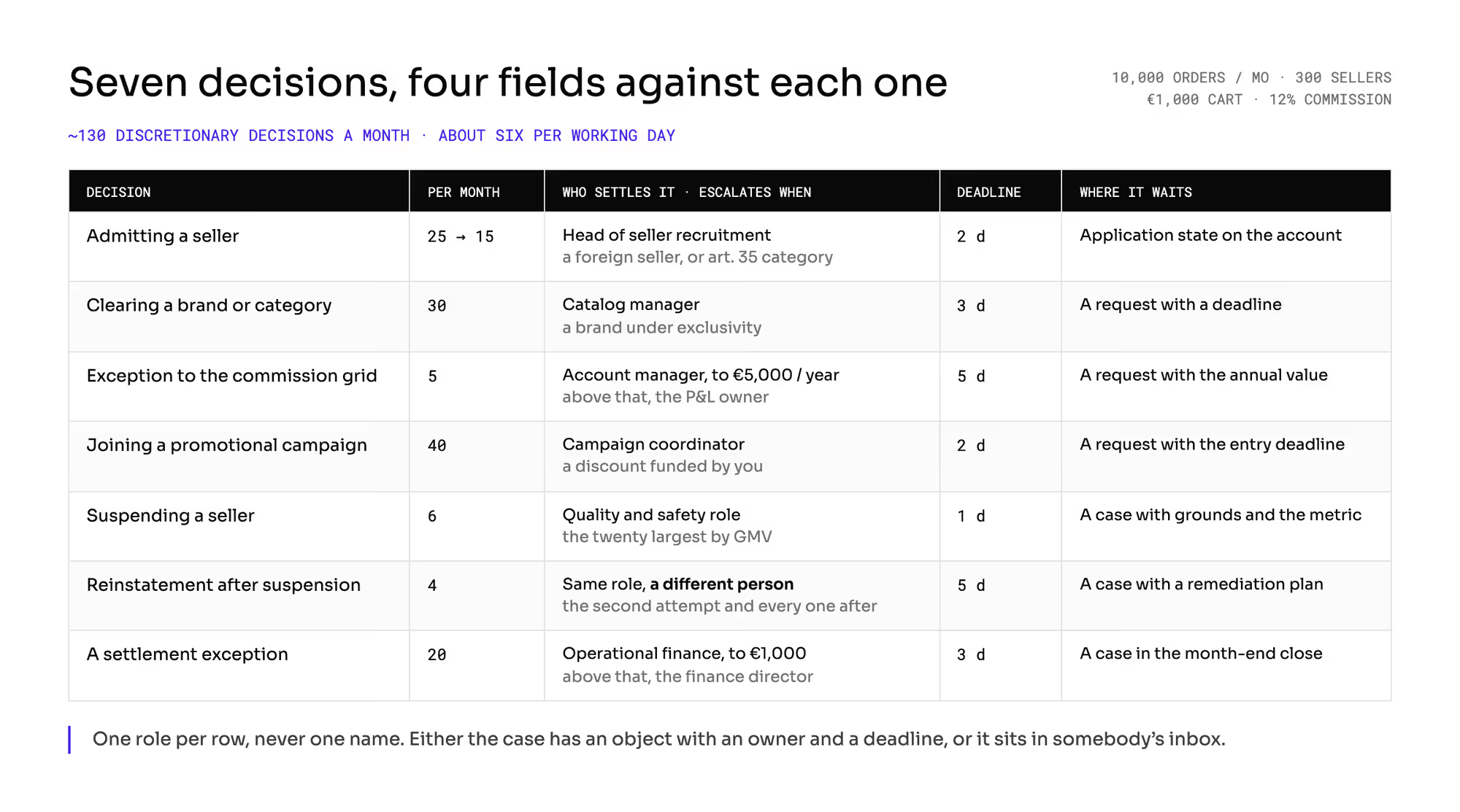
Every number below comes from the reference platform used across this series. That platform takes 10,000 orders a month from 300 sellers with 200,000 active offers, at a €1,000 cart and a 12% commission.
That comes to €10 million of GMV a month, and discretionary decisions at that scale come to about 130 a month, or six per working day.
Every row of the approval matrix needs four fields. Because a responsibility matrix allows one accountable party per task, the first field holds exactly one role.
The remaining fields are the escalation threshold, the deadline in working days, and the object the case waits in, which needs visibility for the stand-in.
Express the escalation threshold as the annual cost of the concession. Three points off the commission for a seller doing €33,000 of GMV a month is €990 a month and €11,880 a year. The same three points for a seller ten times that size are €9,900 a month and €118,800 a year.
A threshold in percentage points treats those two requests as one decision, and your account manager gives away a hundred thousand euros a year on the same form.
The "where it waits" column needs an object with an owner and a deadline, and any case without one sits in somebody's inbox.
Why do sellers wait weeks when the whole queue takes 43 hours a month?
130 decisions a month at twenty minutes per case is 2,600 minutes, or roughly 43 hours, which is a quarter of a full-time job. The entire decision queue takes one person a little over one working day a week.
The product approval queue is production capacity, and at a real inflow of offers it turns into headcount.
The queue of organizational decisions has no throughput problem, and sellers wait weeks in it anyway. The case waits in one person's inbox, and only that person can release it.
You can count the wait with the law of queues, in which the average number of cases in the system equals the inflow times the average time to get through.
At 26 cases sitting unsettled and an inflow of 130 a month, the average wait is 26 divided by 130, which is a fifth of a month, or six days.
A quarter of a job sounds like something you can hand to whoever has room this month. Waiting time grows in proportion to utilization divided by its complement.
A person loaded to 90% doesn't settle cases 10% slower than one loaded to half. They settle them many times slower, and you always hand these decisions to somebody who is already busy with something else.
What does a week of waiting cost you and the seller?
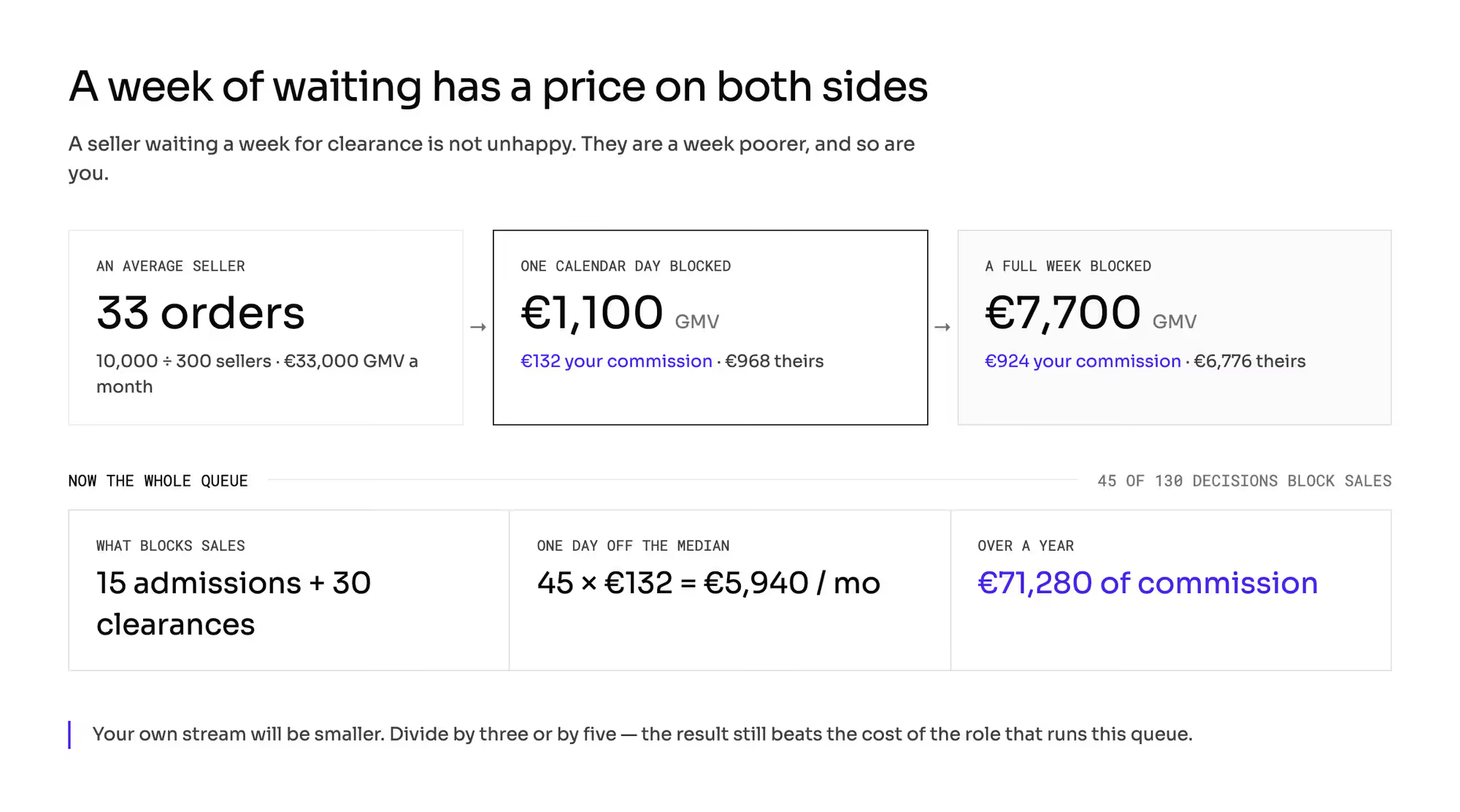
A seller waiting a week for clearance loses a week of sales, and you lose your commission on them.
The average seller does 10,000 divided by 300, which is 33 orders a month, or €33,000 of GMV. Your commission on that is €3,960, and the seller keeps €29,040.
Per calendar day, it comes to €1,100 of GMV, €132 of commission, and €968 for the seller. A week of a full block therefore costs €7,700 of GMV, €924 of your commission, and €6,776 of their revenue.
From the matrix above, 45 decisions a month block sales: 15 seller admissions and 30 brand clearances. Each of them holds back a stream the size of an average seller. Every day you take off the median is worth 45 × €132 = €5,940 of commission a month, or €71,280 a year.
Your own stream will be smaller, and dividing by three or by five still leaves more than the cost of one role. Delay costs money in this process as it does in any other.
The deadline in the matrix is a promise to the seller, and you break it without noticing. You promised a decision in three days, and at a median of six you are already late.
The chapter on P2B regulation covers what you have to justify and deliver when you refuse.
Why does every row of the matrix need a stand-in?
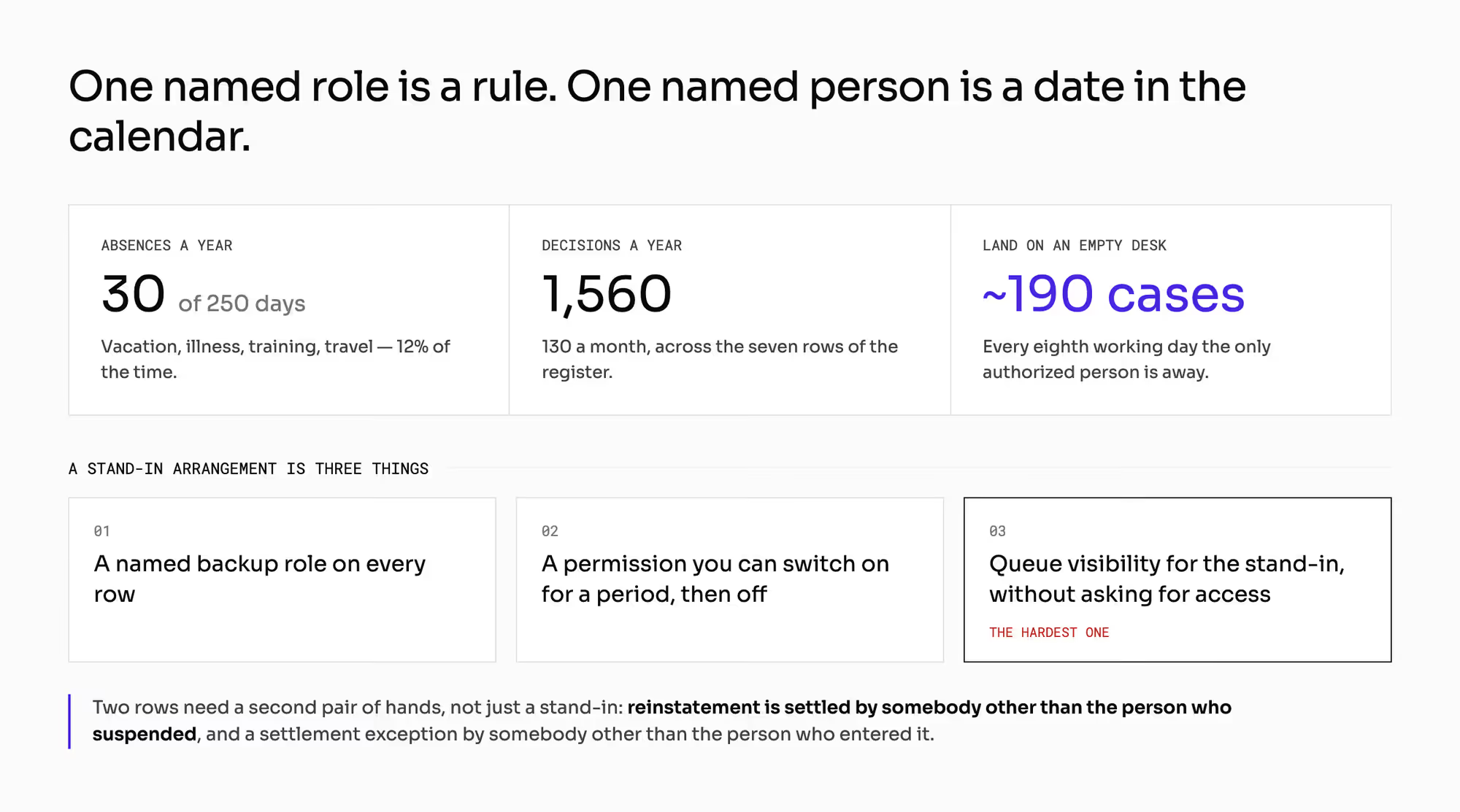
One named role per decision is a design rule. One named person fails on the first long vacation, and every case in that queue waits for their return.
Vacation, illness, training, and travel take up something like 30 working days out of 250 in a year, which is 12% of the time, or every eighth working day.
At 1,560 decisions a year, roughly 190 cases land on a day when the only authorized person is away.
A stand-in arrangement needs three things:
- A named backup role on every row. Write the backup in the matrix next to the role that settles the case, and the answer exists before anyone needs it.
- A permission you can switch on for a period and off again. The stand-in gets the access for the two weeks of a vacation and loses it afterwards.
- A queue the stand-in can see without a request for access. The cases sit in the inbox of the person who is away, and most operators find this item the hardest to arrange.
The market is split here, and a demo is the only way to tell which half your vendor sits in.
Some products give you a fixed set of operator roles. The vendor controls the permission list, and several of those roles can't be narrowed at all. Others let you build your own role out of a few dozen permissions and show you the dependencies between them.
Permissions overlap. After a year, the person who manages roles isn't sure what a role can still do. The stand-in then waits for access, or gets more of it than the job needs.
Reinstatement after a suspension is settled by somebody other than the person who imposed it. A settlement exception needs the same separation from the person who enters it into the system.
One person shouldn't authorize, record, hold, and reconcile the same transaction, and auditors call that separation segregation of duties.
Which repeatable decisions should become a written policy?
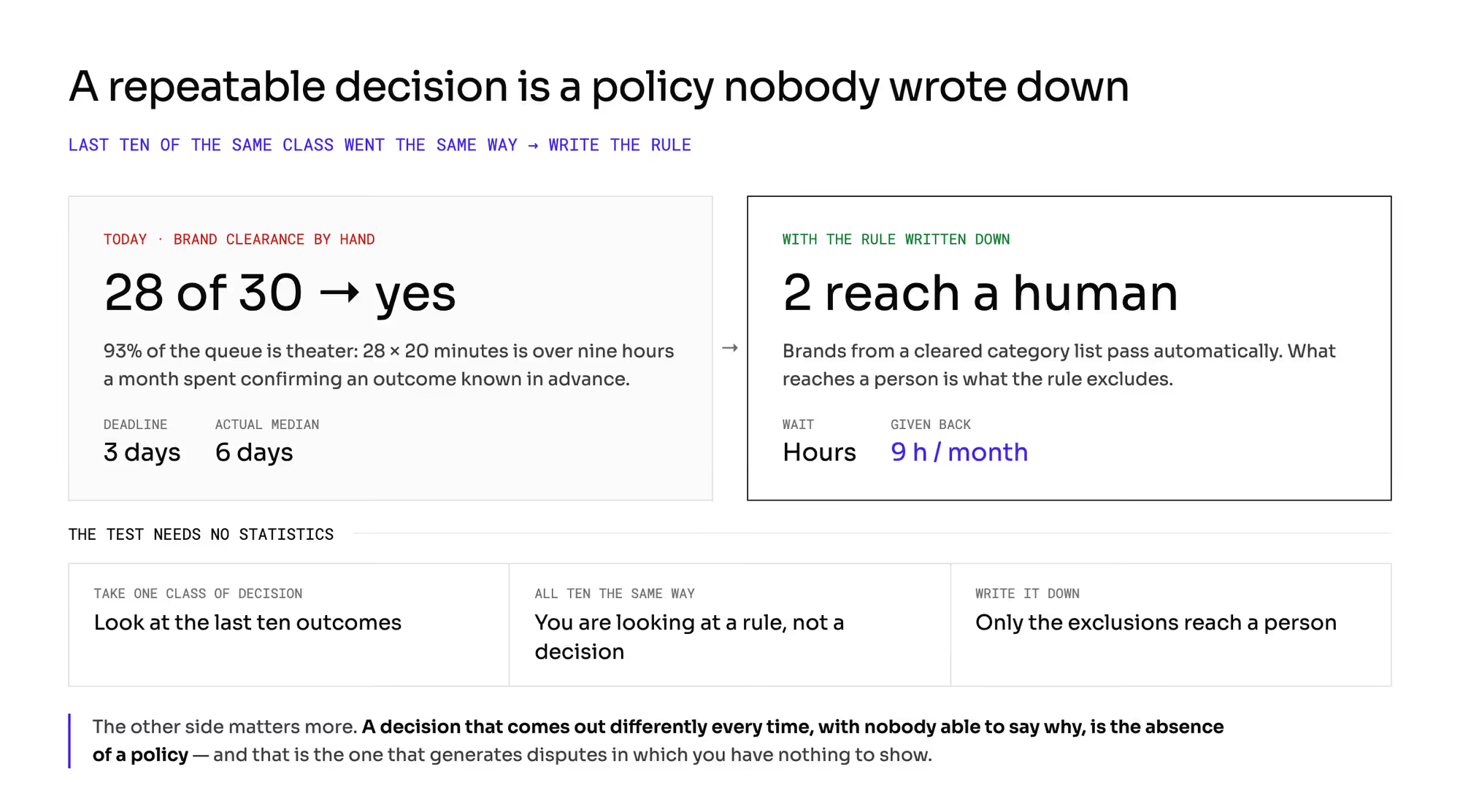
Take the thirty monthly requests for brand clearance and check how they end. The answer is yes in 28 of 30 cases, which makes 93% of that queue a confirmation of what everyone expected.
Twenty-eight cases at 20 minutes each is over nine hours a month, and the seller waits six days for each of them.
If the last ten decisions of the same class all went the same way, write the rule down. Brands from a cleared category list go through automatically, and a human sees only what the rule excludes.
Thirty requests a month then come down to the two the rule excludes. The three-day deadline drops to hours, and the role gets nine hours a month back.
A decision that comes out differently every time has no policy behind it. Those are the ones that generate disputes in which you don't have anything to show.
The chapter on the marketplace audit log covers what has to stay in the system after a decision.
What does an approval workflow change in your marketplace?
1. Decision matrix feeds staffing
Seven rows map onto roles, and a role is part of somebody's job. Add these hours to their other duties before you count a position. The chapter on eCommerce team structure covers the headcount.
2. Deadlines go into the operating calendar
A decision with a two-day deadline needs a slot in the rhythm of the week. Without that slot, no one acts on the deadline. The chapter on marketplace operations covers the daily and weekly routine.
Settlement exceptions follow a second clock, and the month-end close shuts them. The chapter on the month-end close process covers that week and the seller statements.
3. Thresholds need a mandate above them
A threshold that escalates to the P&L owner needs somebody who holds that mandate. The chapter on the executive sponsor covers who stands there.
Thresholds are also an incentive mechanism, and they decide who may give away a piece of the commission in exchange for GMV growth. The chapter on sales compensation plans covers how that pays out.
How do you audit your approval workflow in one afternoon?
- List the discretionary decisions from the last thirty days. Take them from what happened in those thirty days, because the rulebook describes a different process. Fewer than twenty items means the list is incomplete.
- Against each one, write down the object the case waited in. Count the entries that say "inbox", "chat", and "spreadsheet" separately, and that count is your habit metric.
- Calculate the median time to settle, and the ninetieth percentile. The median describes your typical seller, and the ninetieth percentile describes the one who writes to the board.
- For the three most frequent classes, check the distribution of outcomes. Above ninety percent one way, you have a candidate for a rule.
- Cross out three days of vacation for every decision-making role and name who settles cases in that time. Write that name in the matrix, even where the honest answer is that the case waits.
How do you check an approval workflow with a vendor?
- Is a seller request an object with an owner, a state, and a deadline, or only a message in a thread? An object lets you count how many cases are waiting right now.
- Are "read" and assignment per person or per role? A read state shared across a role hides the case from everyone else the moment one person opens it.
- Can I build my own operator role, and can I see the dependencies between permissions? A role you can't narrow gives your stand-in access to payouts.
Which mistakes do operators make with an approval workflow?
Every mistake below leaves a matrix that looks complete on paper. Ask how many cases are waiting right now, and each of them shows up.
1. Matrix with no "where it waits" column
A grid of roles and thresholds describes intentions and leaves the cases where they were. No one can tell you how many cases are open, and the queue has no length and no median.
2. Shared inbox as the place where things wait
Four people look at the same list, and each of them assumes somebody else will pick it up. Some cases never come back, and the reports don't show which ones.
3. Threshold in percentage points instead of annual cost
The same exception is worth a thousand euros with one seller and a hundred thousand with another, and the same person settles both.
4. One named person instead of one named role
The process works until the first longer vacation, and then no one else has the permission to see what is waiting.
5. Settling a case whose outcome is known in advance
You pay for the queue and for the wait, and you buy no control. Nine hours a month of that is one working day.
What do you still have to settle about your approval workflow?
This chapter doesn't carry the arithmetic of the product approval queue, and the bottleneck in that queue is throughput. The chapter on product approval covers that calculation. The chapter on seller requests covers how a seller raises a request and how an operator picks it up.
This chapter also doesn't settle the quality thresholds at which an account should be suspended. The chapter on seller quality metrics covers what to measure and when to suspend. The chapter on seller reinstatement covers probation after a suspension.
The chapter on the marketplace audit log covers what has to remain in the system after a decision and for how long. The chapter on P2B regulation covers what you owe a seller in the substance and the form of a refusal. The chapter on marketplace liability covers the liability of an intermediary.
This chapter isn't legal advice, and an entry about a decision holds personal data about your own people and about people on the seller's side. The chapter on marketplace GDPR covers who is the controller and who is the processor.
Documents produced by a settlement exception have clocks and content of their own. The chapter on marketplace order documents covers what you produce and what you keep. The chapters on marketplace invoicing, marketplace e-invoicing, and marketplace credit notes cover the documents themselves.
Settle two families of regulation with a lawyer: the protection of personal data, and transparency toward the businesses that sell on your platform.
The numbers in this chapter are invented so you can check them in your head. Put in your own inflow of decisions, your own medians, and your own thresholds.
Summary: How does an approval workflow work on a marketplace?
An approval workflow gives every discretionary decision one accountable role, a threshold, a deadline, and the object the case waits in. Seven decisions cover a marketplace at 10,000 orders a month, from admitting a seller to a settlement exception.
The whole queue is 43 hours a month, and the wait doesn't come from a shortage of capacity. The wait comes from cases sitting in one person's inbox, and from thresholds written in percentage points.
Put a named stand-in and a switchable permission on every row of the matrix. Check the outcome distribution of your three most frequent decision classes. A class that goes one way nine times out of ten belongs in a rule. The role behind it then gets nine hours a month back.
Building a marketplace in which a seller gets an answer inside the deadline you promised?
Frequently asked questions on approval workflows
What is an approval workflow?
An approval workflow names the role that settles each case, the deadline it has, and the object the case waits in. On a marketplace, it covers everything from a seller admission to a settlement exception. An operator settles several of these decisions every working day, and each one carries a deadline the seller reads as a promise.
What is an approval matrix?
An approval matrix is a table with one row per decision and four fields against each row. Those fields are the accountable role, the escalation threshold, the deadline in working days, and the object the case waits in. Write the threshold as the annual cost of the concession.
How long should a seller wait for a decision on a marketplace?
Set a deadline for each class of decision and measure your own median against it. A seller admission and a brand clearance both block sales, and those two classes need the shortest deadlines you can hold. A median above the deadline you published costs you commission on every day of the gap.
Ready to build?
We build marketplaces in which every seller request is an object with an owner, a deadline, and a stand-in.