
Month-End Close on a Marketplace: Statements, Adjustments, and Seller Questions

The month-end close process on a marketplace is the week in which you settle the period and send every seller a statement. This chapter covers the sequence of that week and the queue of questions the statements produce.
You close the books once, and then 300 independent companies check your arithmetic inside the same week.
Each seller works from its own orders and its own returns. The number on its statement is that company's whole result for the month.
Plan this week in advance, and your team won't spend three days answering emails or pay the sellers after the date you promised.
This article breaks down:
- What happens during the month-end close process on a marketplace?
- Which 7 steps does the close week follow?
- How many hours does the queue of settlement questions cost you?
- Which 4 classes of seller questions arrive in the close week?
- How do adjustments from an earlier period change a payout?
- Who owns each role during the month-end close?
- When does the close become a bottleneck for the whole company?
Key insights
- Reconcile the money before any statement leaves. Send first, and your sellers dispute a number you haven't confirmed yourself.
- Check a sample of your largest sellers' statements before the batch goes out. That sample costs a fraction of the hours a bad batch costs you in answers.
- Price the question queue from two quantities: tickets in the close week and average handling time. Almost all of that inflow arrives in the first days after the send.
- Four classes of questions cover almost the whole queue. The largest is a seller whose own spreadsheet disagrees with your total, and a published specification of the calculation removes it.
- Adjustments from earlier periods are the expensive class, and each one is an investigation across two periods. A source period and an order number on every line turn it into a lookup.
- The person who takes in a settlement complaint can't release the transfers. Three roles hold the close week, and a team of two covers them only by keeping those duties apart.
- Set a threshold for the share of the month your close may take, and set it before the first one. Past that share the close has stopped being a finance task, and recruiting and campaigns stop with it.
What happens during the month-end close process on a marketplace?
Month-end close on a marketplace is a week of verification carried out by other companies. You close once, and then all 300 sellers check your arithmetic separately.
One row in your summary report is a seller's entire result for the channel, and an error worth €200 costs your team as much time as one worth €20,000.
Matching the money across systems belongs to the chapter on marketplace payment reconciliation, and this chapter deals with the close week itself. That chapter covers the platform against the payment provider, the bank, and your accounting.
Your close week is a queue with a measurable throughput. In queueing theory, the number of items waiting equals the arrival rate times the handling time of one item, and you can estimate both quantities before your first close.
You also pay in this week for whatever you didn't write down during the month. An adjustment with no description stays invisible for 30 days, and a rate someone corrected manually stays invisible just as long.
In the close week, a seller asks about each of them, and someone on your team has to answer by name.
Which 7 steps does the close week follow?
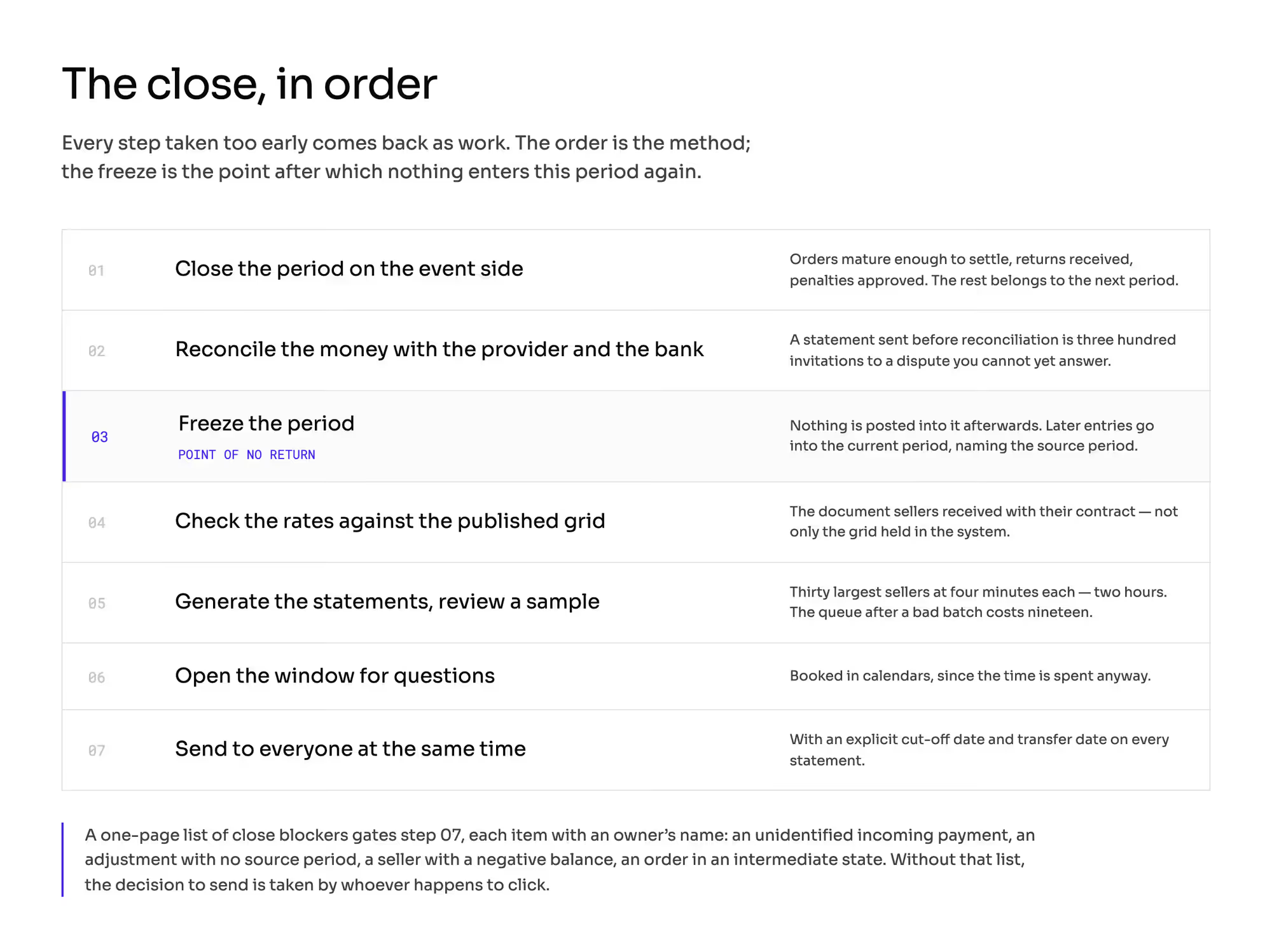
If you take a step too early, your team repeats it later. This order holds for one payout cycle and repeats for each cycle you operate.
1. Close the period on the event side
Settle the orders mature enough to settle, and take in the returns that arrived up to the last day. Approved penalties and compensations belong here too, and everything else belongs to the next period.
2. Reconcile the money before you send anything
Match the platform against the payment provider and the bank statement before a single statement leaves. Send first and you correct the number yourself two days later, in front of all 300 sellers.
3. Freeze the period
After the freeze, post into the current period and name the source period on every line. Leave the period open after the send, and your seller and your accountant hold two different numbers. The marketplace ledger chapter covers why balances have to match the transfer to the cent.
4. Check the rates against the document sellers signed
Compare the rates used in the calculation with the grid each seller received with their contract. The gap between the grid in the system and its published version is covered by the chapter on commission rate drift.
5. Generate the statements and review a sample
Produce the batch, then look at a sample before any of it leaves. Check that each line expands to an order and that the lines add up to the transfer.
6. Book the window for questions
Since your team spends those hours either way, put them into people's calendars before the batch goes out.
7. Send to every seller at the same time
One send, with an explicit cut-off date and payout date written on the statement. Sellers compare statements with each other, and a staggered send gives them one more thing to ask about.
Keep a one-page list of close blockers, with an owner's name against every item. Any one of them stops the send:
- Incoming payment you can't identify.
- Adjustment with no source period on it.
- Seller whose balance has gone negative.
- Order still sitting in an intermediate state.
Without that list, the person who clicks first makes the decision for everyone.
Check a sample of statements before the batch leaves. Your 30 largest sellers carry about half of turnover, and checking their statements at 4 minutes each takes 2 hours. Answering the questions after a bad batch takes 19 hours from the same two people.
How many hours does the queue of settlement questions cost you?
Practitioners who deliver large rollouts put explaining settlements among the heaviest permanent loads on a seller support team, and few operators price that load before launch.
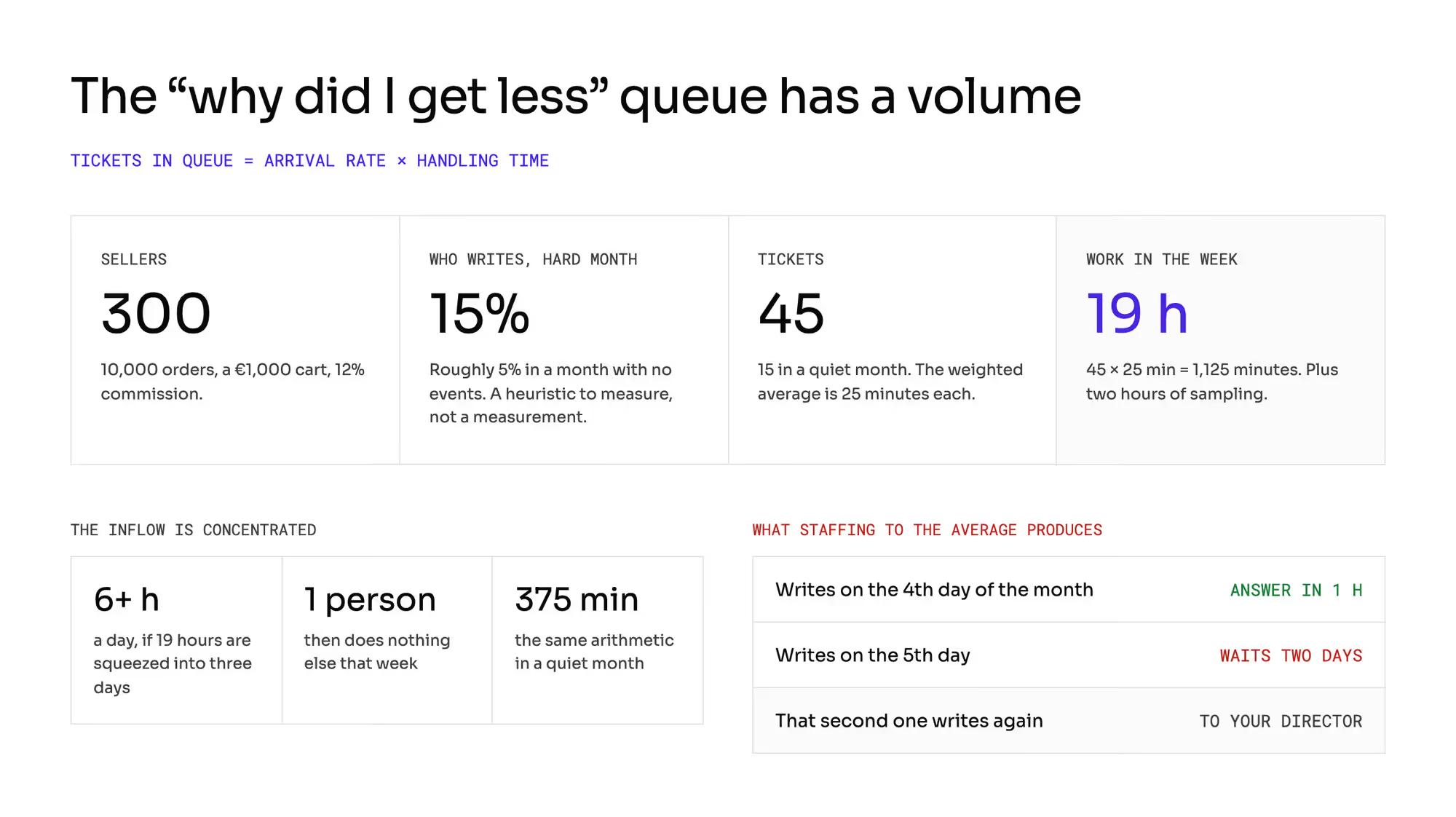
Every number below comes from one hypothetical marketplace with 10,000 orders a month and 300 sellers. With a €1,000 average cart and a 12% commission, sellers are owed €8.8 million of that turnover.
Test this heuristic against your own numbers. In a quiet month, on the order of 5% of sellers write to you. In a month carrying adjustments from earlier periods, on the order of 15% do.
At 300 sellers, that is 15 tickets in a quiet month and 45 in a hard one. A weighted average of 25 minutes per ticket turns 45 tickets into 1,125 minutes, just under 19 hours. Squeezed into three days, that is over six hours a day.
Almost all of the inflow arrives inside three days. Contact centre planners see the same behaviour whenever load approaches throughput, and staffing this week for the monthly average makes the wait grow non-linearly through the peak.
A seller who writes on the fourth day of the month gets an answer within an hour. A seller who writes on the fifth waits two days and then writes again to your director.
Which 4 classes of seller questions arrive in the close week?
Four classes of questions cover almost the whole queue, and the table below gives the share and the handling time for each.
Which question arrives? | What share of close-week tickets? (%) | How long does one ticket take? (minutes) | What removes it before it arises? | Who answers? (role) |
|---|---|---|---|---|
"The total doesn't agree with my spreadsheet" | 35 | 20 | published specification of the calculation, with every line expandable to the order | finance operations |
"Where does this deduction come from" | 30 | 15 | named deduction categories instead of one aggregate line | seller support |
"Where is the return from the previous period" | 20 | 60 | source period on every adjustment line | finance operations |
"When do I get the transfer" | 15 | 10 | cut-off date and payout date on the statement | seller support |
1. Total doesn't agree with my spreadsheet
Your seller counted the month from its own order export and reached a different figure. Publish the specification of the calculation precisely enough for a seller's accountant to reproduce the amount, and make every line on the statement expand to the order behind it.
2. Where does this deduction come from?
One aggregate line called "other" produces this ticket every month, and a seller reading it can't tell what took the money. Name every deduction category on the statement:
- Commission for the period.
- Returns on orders sold in the period.
- Adjustments carried from earlier periods.
- Additional fees your contract allows.
- Penalties and compensations.
- Reserve held against future returns.
3. Where is the return from the previous period?
Nine tickets a month at 60 minutes each is 540 of the 1,125 minutes. One ticket in five takes almost half the hours, and each one is a separate investigation across two periods.
Put the source period on every adjustment line, and your team stops opening these.
4. When do I get the transfer?
Fifteen per cent of your sellers ask for a date you already know. Write the cut-off date and the payout date on the statement itself, and sellers who read it there don't write to ask.
Which 3 levers cut the queue before it forms?
Build all three levers before launch. Each one costs far more to add later.
1. Visible basis of calculation
Let the seller expand a line down to the order without asking anyone. A seller with that access finds the difference faster than your team can explain it.
2. Draft statement two days before the cut-off
Send a provisional statement ahead of the real one and mark it openly as provisional, and part of the questions then arrive while you still have capacity.
3. Open list of deduction categories
Publish the categories once and use the same names your sellers read in their contract, and sellers who see two names for one deduction write to ask which applies.
A seller asking about one specific amount wants access to the calculation. No Help Centre article gives them that access, however carefully you write it.
How do adjustments from an earlier period change a payout?
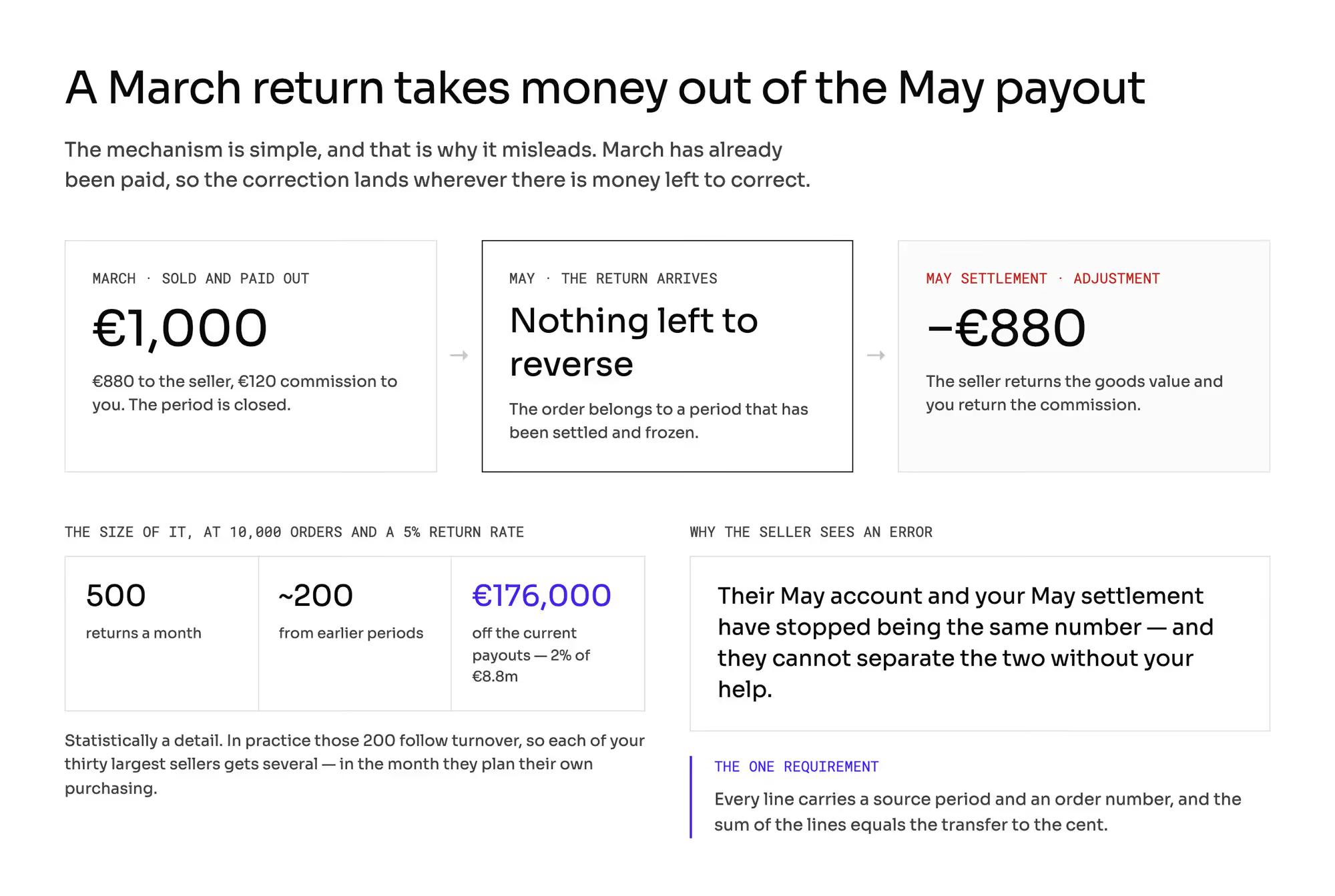
A return on an order sold in March arrives in May, and because you already paid March, the money comes out of the May settlement.
A €1,000 return at a 12% commission means minus €880 for the seller. Since you give the commission back as well, the deduction stops at €880.
At a 5% return rate, 10,000 orders give you 500 returns a month. A typical returns window puts around 200 of them on orders sold in earlier periods.
200 returns at €880 is €176,000 taken off the current payouts, 2% of the €8.8 million owed to sellers. Those 200 adjustments follow turnover, and the 2% lands unevenly across your sellers. Each of your 30 largest sellers gets several of them in the month when that seller plans its own purchasing.
Your seller's own May account and your May settlement have stopped being the same number, and your seller reads the difference as an error. Your seller can't separate the two without your help.
Practitioners name this as the main reason teams build their own settlement layer next to the platform. The amounts are often correct, and the statement still can't show where they came from.
Every line has to carry a source period and an order number, and the sum of the lines has to equal the transfer to the cent.
Which period an adjustment belongs to for tax is settled by the chapter on marketplace credit notes together with your advisor.
Who owns each role during the month-end close?
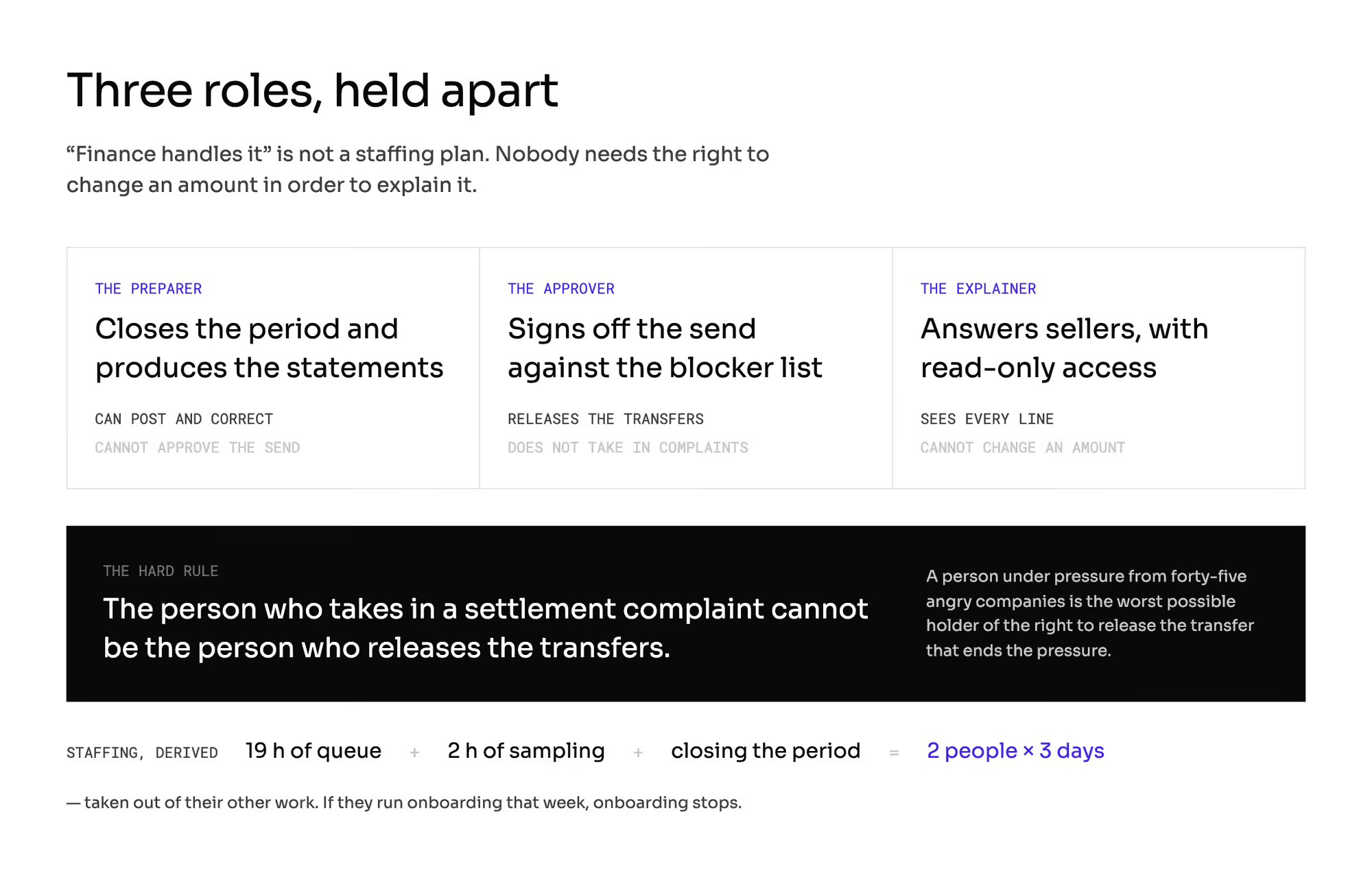
This week has three roles, and three different people hold them. A team of two covers them by keeping the explaining apart from the release of money.
1. Preparer
Your preparer closes the period and produces the statements, and the blocker list belongs to the same person.
The preparer needs the right to post while the period is open and loses that right at the freeze.
2. Approver
Your approver signs the decision to send, checked against the blocker list. Write that name down and keep it the same every month.
In a small team, the finance director approves, and a trail of each approval answers a later question about one batch.
3. Explainer
Your explainer answers sellers and holds read-only access to the statements, and no one needs the right to change an amount in order to explain it.
Without the same expandable lines the seller sees, this role doubles the handling times in the table above.
The person who takes in a settlement complaint can't release the transfers. Four duties belong in different hands under internal control standards: authorizing a transaction, holding access to funds, keeping the records, and verifying them. Under the same security standards, one user may not hold every permission needed to abuse a system alone.
Keep the right to release a transfer away from the person who answers 45 angry companies.
Nineteen hours of queue plus two hours of sampling plus closing the period fits into two people over three days, and those three days come out of their other work. If they handle seller onboarding that week, onboarding stops.
Who belongs on the team permanently is settled by the chapter on eCommerce team structure. The operating calendar sits in the chapter on marketplace operations.
When does the close become a bottleneck for the whole company?
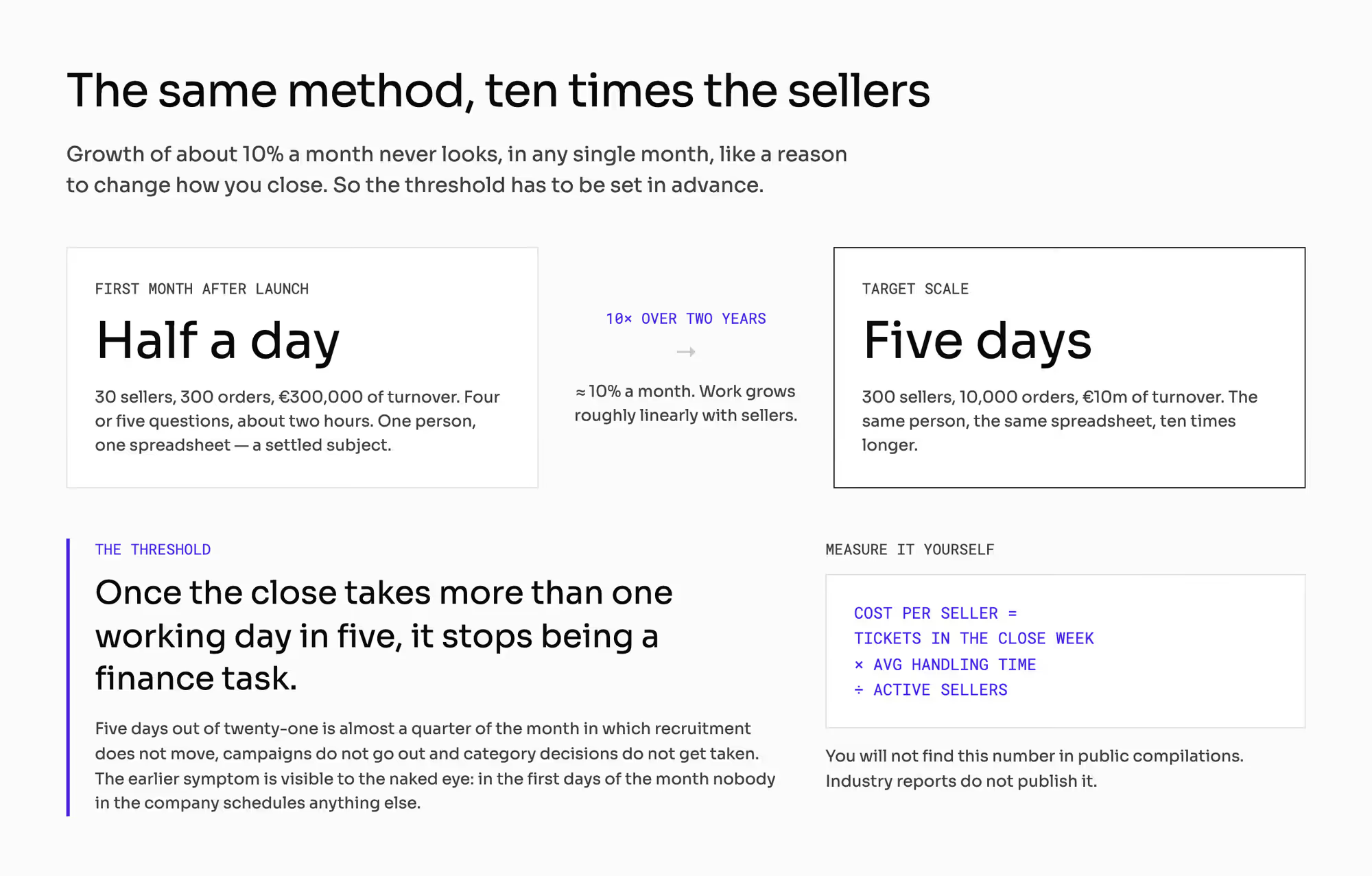
In the first month after launch, you have 300 orders, 30 sellers and €300,000 of turnover.
Four or five questions arrive, about two hours of work. The entire close fits into half a day of one person working in a spreadsheet.
At target scale, you have 300 sellers, and the work grows roughly linearly with the seller count. Half a day turns into five days, and one person with one spreadsheet takes ten times as long.
A tenfold increase spread over two years is around 10% a month, and you won't see a reason to change your method in any single month of that series.
Set the threshold in advance. Once the close takes more than one working day in five, it has stopped being a finance task. Five days out of 21 is almost a quarter of the month, and in those five days your team doesn't recruit sellers and doesn't send campaigns.
In the first days of the month, no one in the company schedules anything else.
No published benchmark carries the cost of servicing one seller. Measure it yourself: tickets in the close week times average handling time, divided by active sellers.
What does the month-end close process change in your marketplace?
Five decisions change once you have priced this week, and each of them looks unrelated to the close.
1. Ledger construction sets the cost of the week
Without a source period on an adjustment, each adjustment becomes a separate investigation. With the source period on the line, the same question becomes a lookup.
2. Reconciliation has to finish before the statements leave
Otherwise you explain to 300 sellers a number you haven't confirmed yourself, and they remember that for months.
3. Payout cycle sets how often this queue repeats
Three cycles a month give you three smaller peaks and three times as many chances to diverge. The chapter on marketplace seller payouts covers the cycles.
4. Management reports have to count turnover the same way
A report that counts turnover differently from the statements creates a second queue of questions inside your company. The chapter on marketplace analytics covers why a BI report and an admin panel disagree.
5. Disputed settlement is a ticket with an owner
A reply to a disputed settlement needs an owner and a deadline, like any other request. The chapter on seller requests covers that queue.
How do you design your close week in one afternoon?
Six steps, each short enough for a single sitting. Do them before your first batch of statements goes out.
- Write the sequence down as seven dated steps and give each one an owner. People plan around the dates.
- Build the blocker list and put a name against every item. Someone has to be able to clear each item before the send.
- Name the person who signs the decision to send. Write that name down before the first batch.
- Book the hours for questions in people's calendars, and book all nineteen of them.
- Write down how fast a seller gets an answer and treat it as an obligation. Without that in writing, your team sets the time under pressure.
- Measure your own two quantities in the first quarter: tickets in the close week and average handling time.
How do you check the month-end close process with a vendor?
- Where does a seller answer their own question about a difference? An export to a spreadsheet leaves every question with your team.
- Is the specification of the calculation published precisely enough for a seller's accountant to reproduce the amount?
- Can a provisional statement go out before the cut-off, and is it marked openly as provisional?
- How long does generating 300 statements take, and what happens when one fails? The vendor has to name the failed statement.
- Can the support role see the statements without the right to change amounts and without the right to release payouts?
Check the fifth answer on the vendor's own permission screen, and ask which of those permissions come bundled together.
Which mistakes do operators make with the month-end close process?
Each of these five mistakes saves time in the week it happens, and your team pays it back within a month.
1. Statements sent before the money was reconciled
You then explain a number you will change yourself two days later, and sellers remember the correction for months.
2. Statement delivered as an export with no source lines
Technically, the seller can reach the amount. The sharpest sellers do reach it, and the rest write to you.
3. Adjustments thrown into one bucket with no source period
Almost every 60-minute ticket comes from a missing source period, and one missing field produces nine investigations a month.
4. Same person explains the settlement and releases the transfer
This stays convenient until the first real dispute. The fastest way to end that conversation is a transfer, and the same person can release it.
5. Close calendar that ends at the send
Your question window is part of the operation, and a calendar that stops at the send leaves 19 hours of work unplanned.
What do you still have to settle about the month-end close process?
This chapter doesn't settle how you match money between systems. The chapter on marketplace payment reconciliation does that. The marketplace ledger chapter settles how balances are built.
It also doesn't settle the content of documents. What accompanies a correction and how long you keep settlement evidence belong to the chapters on marketplace credit notes and marketplace order documents, plus your tax advisor.
The form and deadline for answering a disputed settlement is carried by the chapter on P2B regulation. Buyer data in an attachment to a statement is carried by the chapter on marketplace GDPR.
Three families of regulation belong on a list for your lawyer:
- Transparency rules in the platform-to-seller relationship.
- Protection of personal data that travels with a statement.
- Accounting rules and document retention periods.
The numbers in this text are invented for the sake of the arithmetic, and the same calculation gives your own answer once you measure your own two quantities.
Summary: How does the month-end close process work on a marketplace?
The month-end close process starts on the event side and ends with the questions the statements produce. You settle the period, then reconcile the money against the provider and the bank. You then freeze the period, check the rates, review a sample, and send every statement at once.
At 300 sellers, 45 tickets at a weighted 25 minutes each is 19 hours. A control sample of your 30 largest sellers costs 2 hours against that.
Adjustments from earlier periods are the expensive class, and the source period on each line removes almost half of those hours.
Hold the three roles apart, and the person who answers 45 angry companies won't be the one who releases the transfer.
Building a marketplace whose statements explain themselves to 300 sellers in the same week?
Frequently asked questions on the month-end close process
What is the month-end close process on a marketplace?
Month-end close process on a marketplace is the sequence that settles a period, produces a statement for every seller, and answers the questions those statements raise. It starts with closing orders and returns on the event side. Reconciliation against the payment provider and the bank comes next, and the week ends after the payout date written on the statement.
How long does month-end close take on a marketplace?
Month-end close takes a week, and the queue of questions the statements raise fills most of it. The work grows roughly with your seller count, and the first close after launch fits into part of one person's day. Set a threshold in advance for the share of the month it may take, and past that share it has stopped being a finance task.
Why do sellers say they got less than they expected?
Most of those questions come from adjustments that belong to an earlier period, such as a return on an order sold in an earlier month. You already paid that month out, and the return comes off the current settlement. Put a source period and an order number on every line, and your seller can trace the figure alone.
Ready to build?
We build marketplaces whose statements show a seller where every deduction came from, so your close week doesn't turn into a support queue.