
Marketplace Business Case: What It Costs and When It Pays Back

A marketplace business case is the month-by-month account of what your marketplace costs you and what it brings back. This chapter covers the three quantities that stand in for a payback date and the four cost lines behind them.
Your board will ask for the date you break even, and no public material carries that date.
You will answer for a borrowed number at every review for the next three years. A project that offers no date at all gets a one-year budget and dies at the first cost review.
This article breaks down:
- Why does no study publish a payback period for a marketplace?
- Which 4 cost lines does a marketplace business case spread across a calendar?
- How do you model commission revenue with a ramp?
- How do you calculate the cash trough and the zero point?
- Why does one month of delay cost you more than one month?
- How does a vendor's fee construction change your numbers?
Key insights
- Three quantities stand in for the payback date: the deepest cash trough, the month the cumulative account returns to zero, and the slip multiplier.
- Four cost lines fill the calendar, and each one starts in a different month. They are the platform fee, the implementation work, the people hired before the first sale, and the recruiters for your first sellers.
- You read through a monthly cost profile and count the zero point from the day of signature. Three separate dates get called payback, and you agree inside the company which one is which.
- A linear ramp and an S-shaped ramp reach the same target scale on the same date and collect different commission along the way. Someone on your team assumes that shape, and their name goes next to the assumption.
- A flat fee and a fee built on a percentage of GMV can cost the same at your target scale and differ at every volume below it. A fee on GMV is cheap in the trough and expensive after success.
- Slip multiplier is always greater than one, and every month of delay therefore pushes the zero point out by more than a month. Your launch date is the most expensive line in the business case.
Why does no study publish a payback period for a marketplace?
Industry studies report growth in GMV, the share of sales coming from third-party sellers, and how fast offer counts rise. Four numbers stay out of them:
- Cost of the implementation.
- Platform fee.
- Cost of the team.
- Month in which you break even.
Platform vendors publish those studies, and advisors who work with platform vendors publish the rest. Neither side earns money from printing a payback period.
The sample in such a study usually covers the platforms that were live for the whole period under review, and the ones that stopped don't appear in it at all.
Why build a marketplace, and which metrics prove it worked, covers how to define success without that date.
Even when you hold a payback period, it remains an incomplete measure that ignores what money is worth over time and disregards everything after the payback date.
Since that date doesn't exist, calculate three quantities in its place. Your investment committee reads these:
- Trough is the deepest point of the cumulative account. Your company puts that amount in before anything comes back, and you finance exactly that amount.
- Zero point is the month in which the cumulative account returns to zero, counted from the day the contract is signed. Selling starts much later.
- Slip multiplier is how far the zero point travels for every month the implementation is late. It's always greater than one.
Which 4 cost lines does a marketplace business case spread across a calendar?
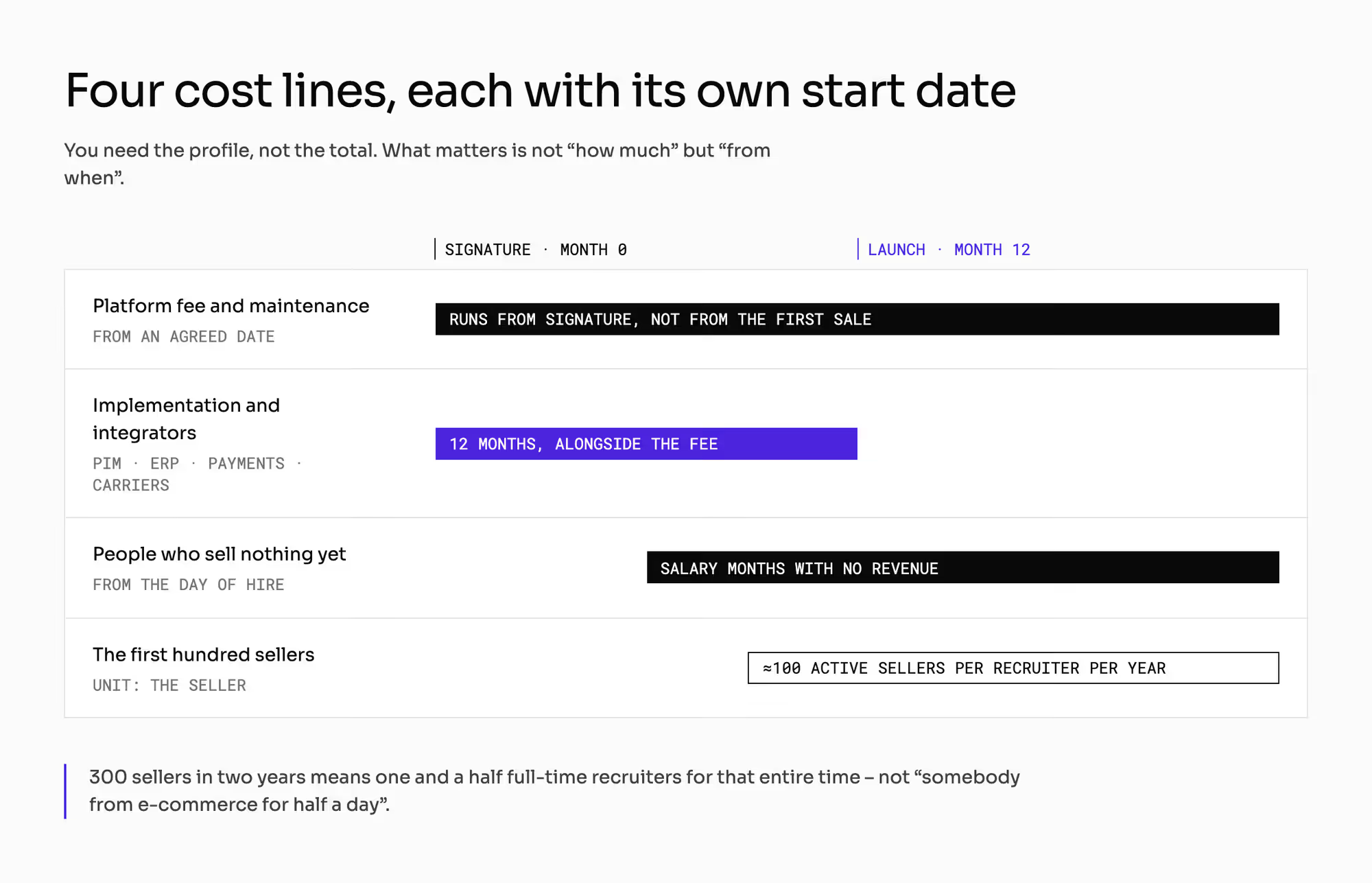
Four lines carry the cost, and each one starts in a different month. Enter every one of them with its own start date, and read the trough off the monthly profile. A single total won't give you one.
1. Platform fee and its maintenance
Start date matters more here than the amount. Practitioners describe contracts with a subscription that starts months before the first sale, on a date the parties agree in the contract.
Some functions also sit outside the base price:
- Payouts to sellers.
- Extended reporting.
- Advertising module billed as a percentage of revenue.
Because a per-transaction line grows with your ramp, ask which of those three carry a price per transaction.
What the price includes is settled by what is included in a marketplace platform, and until that's settled you're guessing at this line.
2. Implementation work on your side and at the integrators
The largest part of the project sits outside the platform itself. Your PIM and your ERP carry work of their own, and so do the payment provider and the carriers. Search and your online store add more work on top.
This line has two parameters: the amount, and the number of months over which it stands alongside the platform fee. Both go into the calendar as a start month and an end month.
The acquisition price is often a fraction of the total cost of ownership. Your purchasing department has seen the same mechanism on other contracts.
3. People on the payroll before the first sale
Salaries start on the day of hire, and the first commission arrives many months later. Five roles usually land before launch:
- Head of marketplace.
- Seller recruiter.
- Onboarder.
- Category manager.
- Finance ops for settlements.
Put a hire date against each role in the same calendar, and a role hired at the start of a twelve-month implementation is twelve months of salary against no commission.
How many of them you need is settled by the eCommerce team structure for a marketplace. Every one of those months on the payroll is a month of cost with no revenue.
4. Recruiting and onboarding the first 100 sellers
You count this line in sellers. One recruiter brings something on the order of a hundred sellers to activity in a year, and the euro amount follows from that headcount.
Check the figure against your own hiring and treat it as an order of magnitude and no more. 300 sellers in two years means one and a half full-time recruiters for that whole time.
How do you model commission revenue with a ramp?
Every number below comes from one hypothetical platform, and the table holds it at two moments.
What does the platform look like at each scale? | Startup scale, first month after launch | Target scale, after about 2 years |
|---|---|---|
Orders a month (count) | 300 | 10,000 |
Sellers (count) | 30 | 300 |
Offers (count) | 20,000 | 200,000 |
GMV a month (€) | 300,000 | 10 million |
Commission per month at 12% (€) | 36,000 | 1.2 million |
Average cart is €1,000 at both ends, and the commission is 12%, and target scale therefore gives €120 million of GMV a year.
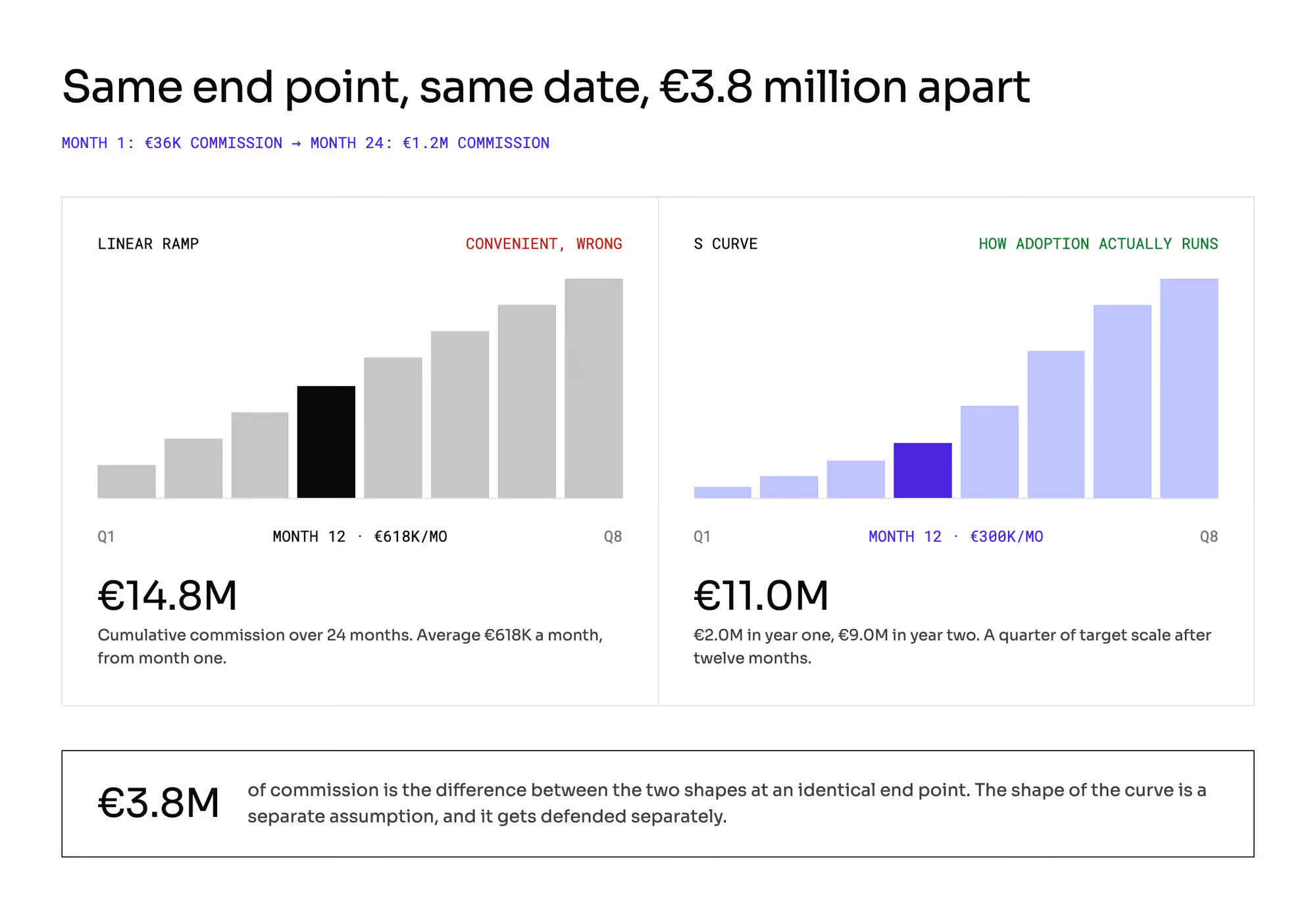
The platform grows from the first column to the second across 24 months. Adoption of a new channel follows an S-curve: slow at the beginning, fast in the middle, and flattening at the end.
A linear ramp from €36,000 to €1.2 million across 24 months gives an average monthly commission of €618,000, or (36 + 1,200) ÷ 2. Over two years, that's €14.8 million.
An S-shaped ramp sits at a quarter of target scale after the first year, or 2,500 orders and €300,000 of commission a month.
Year one then averages (36 + 300) ÷ 2 = €168,000 a month, or €2.0 million. Year two averages (300 + 1,200) ÷ 2 = €750,000 a month, or €9.0 million. Together that's €11.0 million.
Both ramps reach the same end point on the same date, and they differ by €3.8 million in commission. Someone in your team assumes a shape for that curve, and their name goes next to the assumption.
How do you calculate the cash trough and the zero point?
Your monthly cost after launch stays yours to calculate, and it holds the platform fee together with maintenance and salaries.
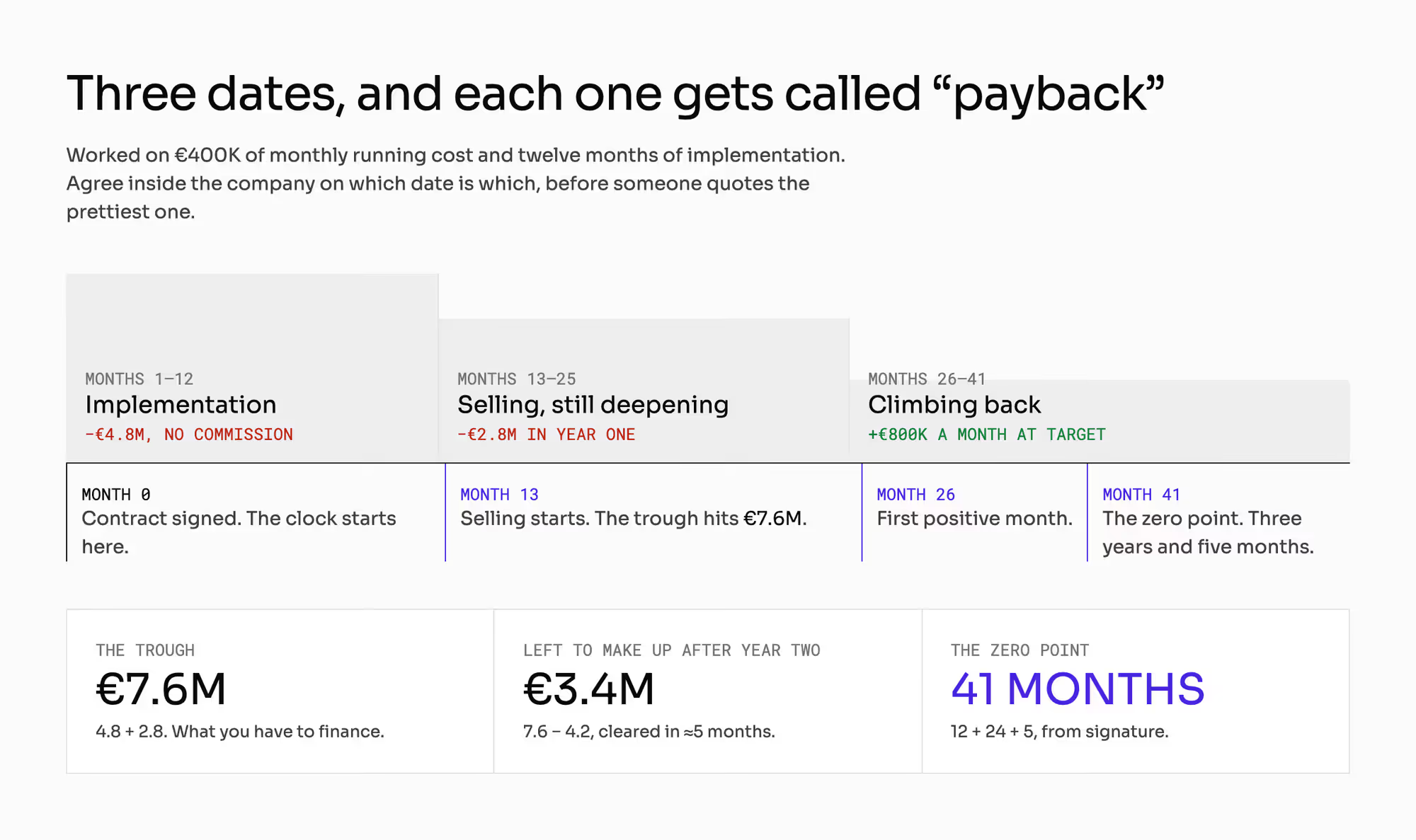
The calculation below uses €400,000 a month in that slot, and the implementation takes twelve months with the same monthly outflow across that period.
- Implementation: 12 × 400,000 = €4.8 million before the first euro of commission arrives.
- First year of selling on the S ramp: commission €2.0 million against a cost of €4.8 million, so a loss of €2.8 million.
- Trough: 4.8 + 2.8 = €7.6 million, about thirteen months after launch. Monthly commission passes €400,000 there, and the account stops getting deeper.
- Second year: commission €9.0 million against a cost of €4.8 million, so a surplus of €4.2 million. What's left to make up is 7.6 − 4.2 = €3.4 million.
- At target scale, the monthly surplus is 1,200 − 400 = €800,000, so 3.4 ÷ 0.8 ≈ five months.
- Zero point: 12 + 24 + 5 = 41 months from the day the contract was signed, or three years and five months.
Selling starts in the thirteenth month, the first positive month falls in the twenty-sixth, and the money returns in the forty-first. Each of those three dates gets called payback on a different slide.
Before someone quotes the prettiest one to the board, agree inside the company on which date is which.
Why does one month of delay cost you more than one month?
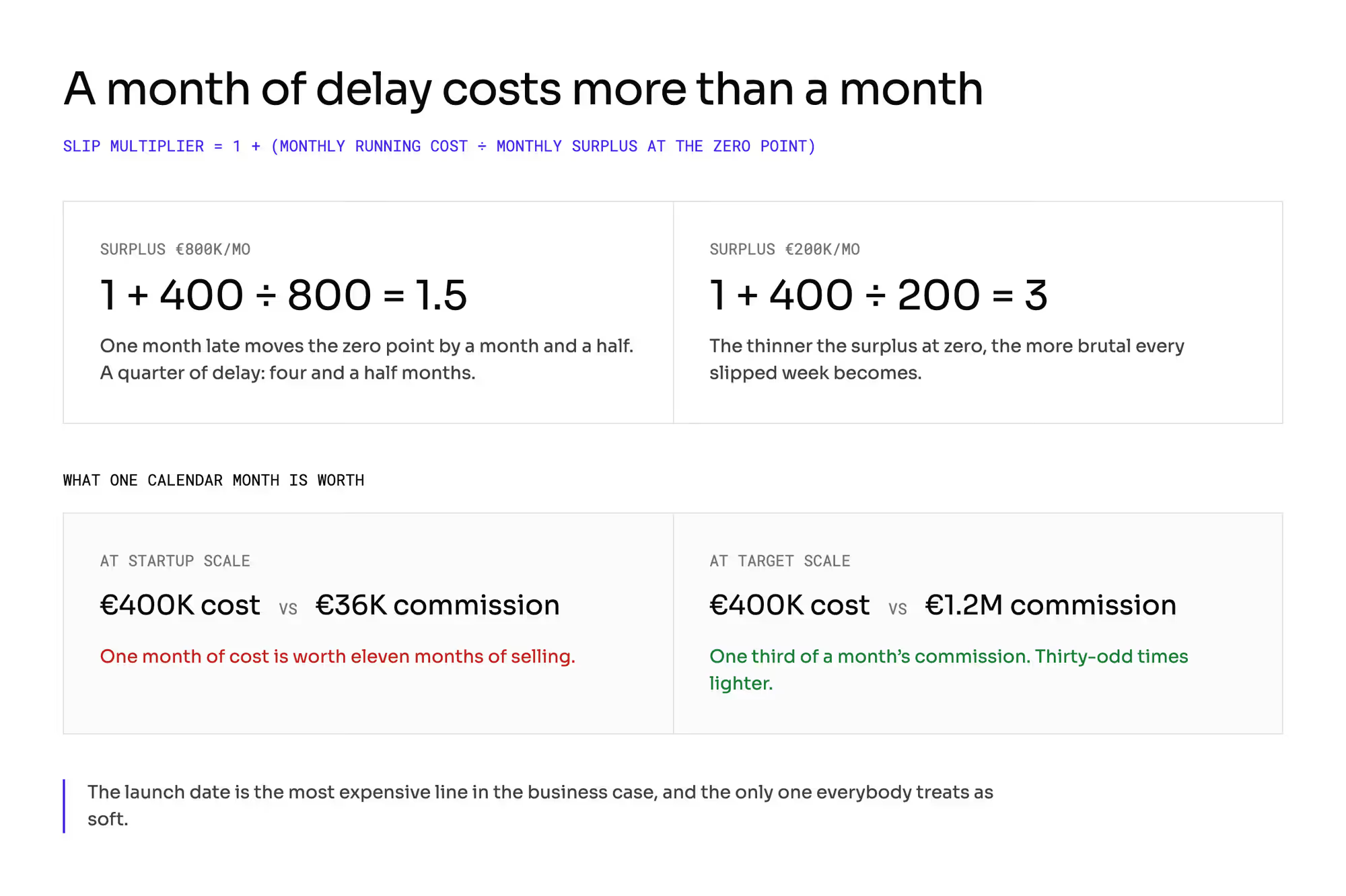
The fee starts at signature, and the first sale comes later. A month of slippage adds a full month of cost with no revenue, and it pushes the whole ramp to the right.
You only make that month back with the surplus you hold around the zero point. Slip multiplier = 1 + (monthly cost ÷ monthly surplus at the zero point).
In the calculation above, that's 1 + 400 ÷ 800 = 1.5, and every month of delay therefore pushes the zero point out by a month and a half. At a surplus of €200,000 the multiplier would be 1 + 400 ÷ 200 = 3.
At startup scale, a month of cost is €400,000 while a month of selling brings in €36,000 of commission. One of the first is worth eleven times the second.
At target scale that same month of cost is one third of a month's commission (400 ÷ 1,200), and a calendar month therefore weighs thirty-odd times less after two years than it does at the start.
Your launch date is the most expensive line in the business case, and the only one everyone treats as soft. Marketplace integrations: what to connect and in what order covers the order you connect them in, and the slowest of them usually sets your launch date.
How does a vendor's fee construction change your numbers?
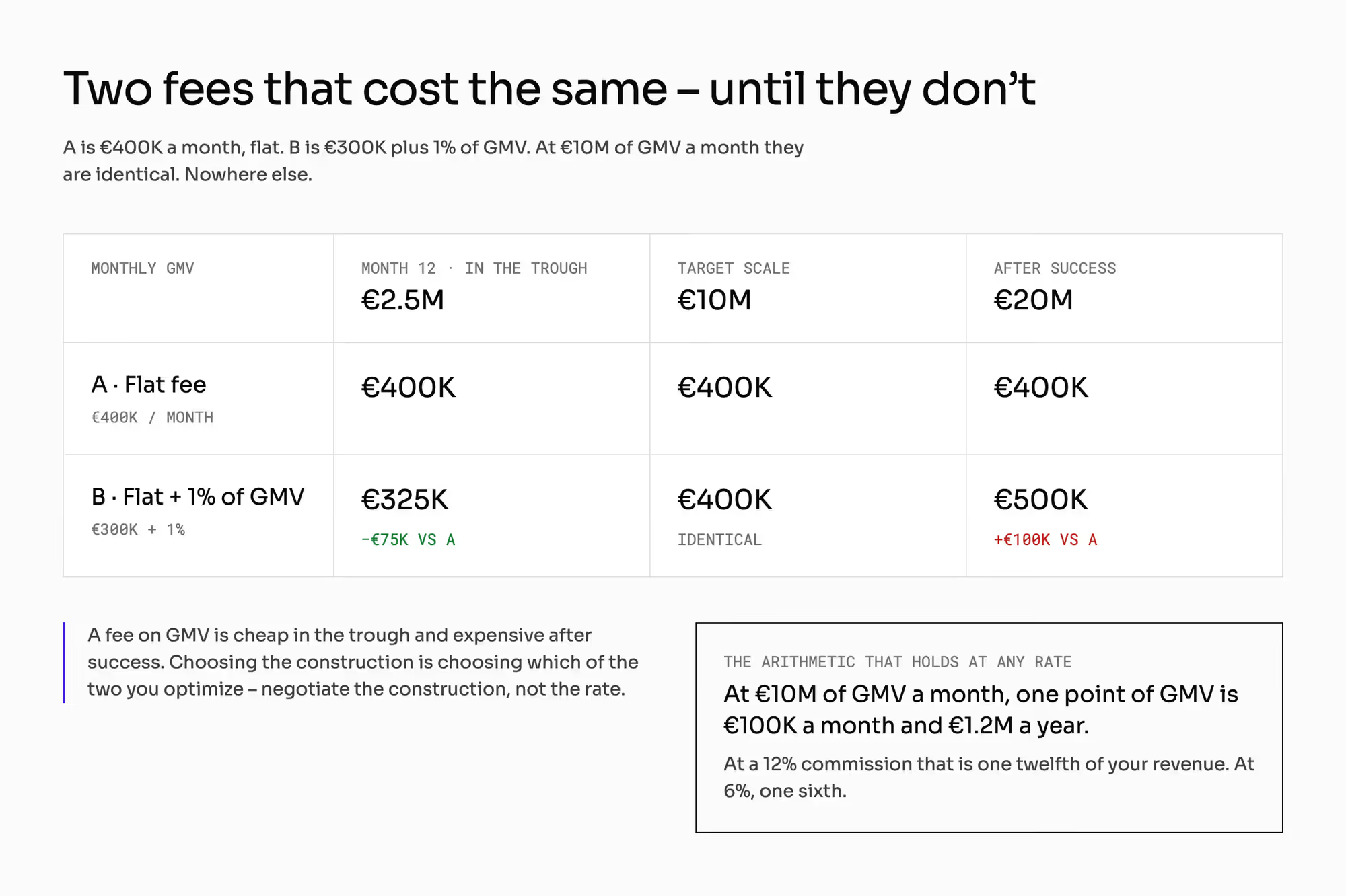
Platform contracts come in two families: a flat fee, and a flat fee plus a percentage of GMV switched on above a threshold the parties usually agree.
Practitioners describe both parameters as negotiated case by case, and comparing headline rates between two offers therefore tells you little.
Take two constructions that cost exactly the same at your target scale. A is €400,000 a month, flat. B is €300,000 a month plus 1% of GMV, and at €10 million of GMV that's 300 + 100 = €400,000.
Month twelve brings €2.5 million of GMV, and B then costs 300 + 25 = €325,000. That's €75,000 less than A, and you're sitting in the trough in month twelve.
Double the target scale gives €20 million of GMV a month, and B then costs 300 + 200 = €500,000. That's €100,000 more than A, and you've succeeded by the time you reach that volume.
A fee calculated on GMV is cheap in the trough and expensive after success. Pick the construction that suits the moment you care about more, and eCommerce TCO for a marketplace covers what the platform costs after launch.
At €10 million of GMV a month, one percentage point of GMV is €100,000 a month and €1.2 million a year. At a 12% commission, that takes one twelfth of your revenue, and at a 6% commission it takes one sixth.
In categories with a thin commission, this construction hurts twice as hard, and how much commission a marketplace can charge covers how to build the grid itself.
Which 3 ramp scenarios should you price?
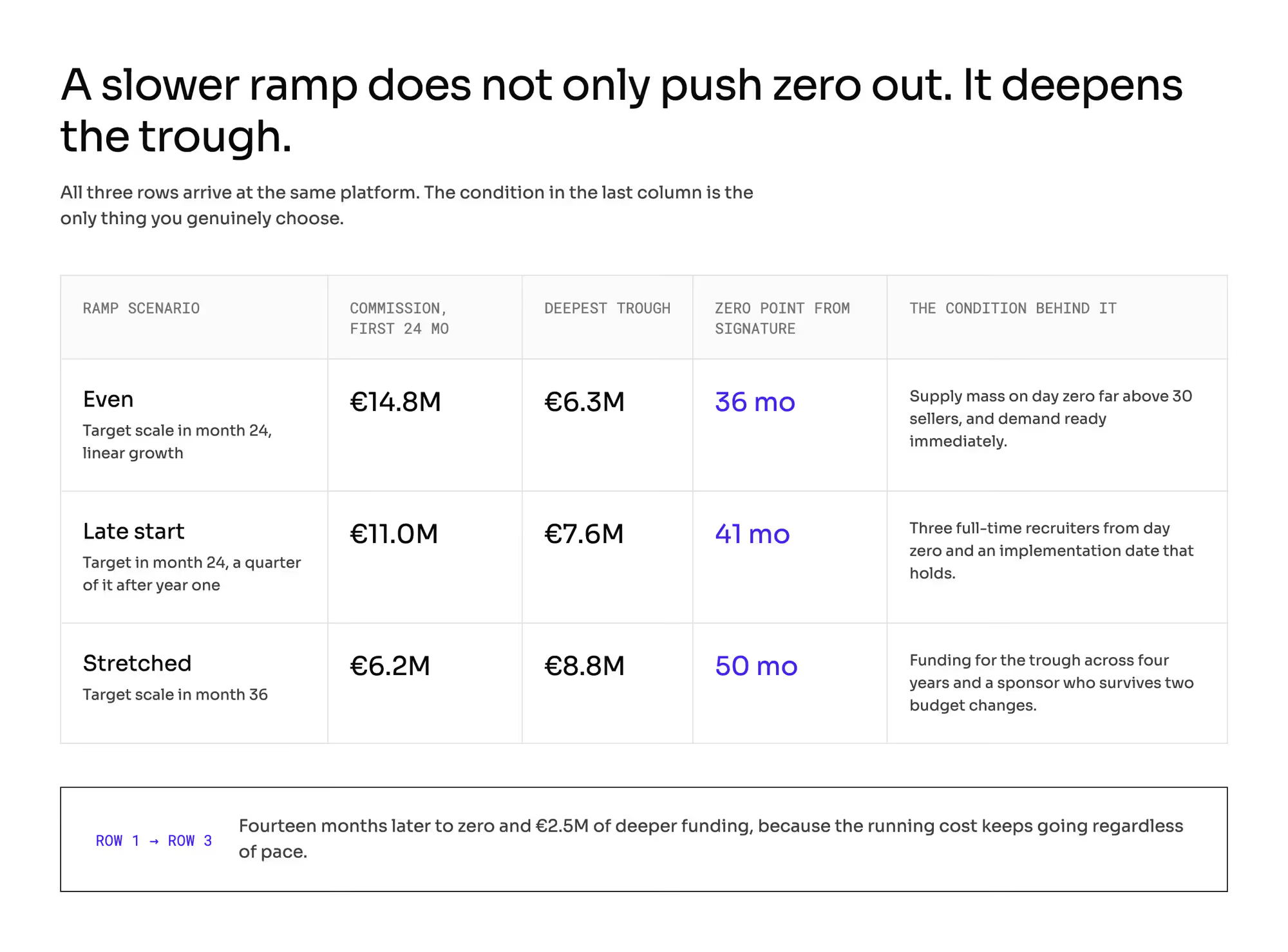
All three scenarios arrive at the same platform, and they differ only in how fast they get there. The last column holds the condition each one needs.
A slower ramp deepens the trough as well as pushing the zero point out. Your monthly cost continues at the same rate whatever the pace of growth.
The even scenario and the stretched one are fourteen months and €2.5 million of funding apart. You choose the condition in the last column, and the rest of the row follows from it.
What does a marketplace business case change in your marketplace?
A 41-month horizon changes who can own this project, which figure you report, and how you phase the launch.
1. Sponsor outlasts the horizon
Your sponsor has to last as long as the horizon you have just calculated. A zero point in the fourth year rules out an owner who is assessed quarterly.
Who holds that mandate is settled by the executive sponsor for a marketplace, and the goal and the measures of success get built before the model. When you decide what the channel is for, you decide the shape of the ramp.
2. Commission or GMV decides how the project looks
Whether you report commission or GMV changes how the same project looks on the same slide. One shows €1.2 million a month, and the other shows €10 million.
That call belongs to marketplace revenue recognition, and it gets settled before the first board pack. Finance and the commercial team otherwise bring two different companies to the same meeting.
3. Pilot resets the ramp
Choosing between a pilot and a start with real volume resets the ramp. A stretched ramp costs you €2.5 million of extra funding and fourteen months.
Marketplace pilot versus full launch settles that choice, and you take it before you fix the ramp so the model can follow.
How do you build a marketplace business case in 6 steps?
Take these six steps in order before the investment committee meets.
- Spread the four cost lines across a monthly calendar, each with its own start date. A single total won't give you the trough.
- Fix your monthly cost after launch. That single number governs both the trough and the slip multiplier.
- Write the shape of the ramp down as an assumption with an owner's name on it. Whoever promises a quarter of target scale after a year answers for that figure at the review.
- Calculate the trough, the zero point, and the slip multiplier with the three operations above.
- Price both fee constructions at the same target amount. The difference in the zero point is your negotiating argument.
- Come back to the model after two quarters with real data and correct the ramp. A business case gets reviewed during the project and compared against the option of doing none of it.
How do you check a marketplace business case with a vendor?
- On which day does the fee start, and what triggers it?
- At what level of GMV does the percentage switch on, and how is it calculated?
- Which lines in your offer sit outside the base price?
- What happens to the fee when the implementation is late, and what happens when the delay is on your side?
- What does this same contract cost at double our target GMV?
The first answer sets the start of your cost calendar, and your trough rests on it. Because an answer given in a meeting doesn't survive a change of account manager, ask for every figure in the offer document.
Which mistakes do operators make with a marketplace business case?
Every one of these mistakes understates what your company has to finance.
1. Model counted from the start of selling
The whole implementation period drops out of the account. In the calculation above, that's €4.8 million, or two-thirds of the trough. Your board then approves about a third of what the project needs.
2. Linear ramp dropped in for convenience
An S curve and a straight line differ by €3.8 million of commission at an identical end point. No one spots the gap before the third quarter, when the actuals arrive.
3. Fee rate negotiated instead of the construction
A discount cuts the flat fee once. The construction of the fee changes what you pay in every month of the contract, and you price both before you argue about a percentage.
4. Launch date treated as soft
At a slip multiplier of one and a half, a quarter of delay puts you four and a half months further from zero. Everyone in the project treats the date as the softest line in the plan.
5. One date presented as the whole investment case
Without the trough, your board doesn't know how much it has to finance. A zero point on its own answers a different question from the one the treasurer is asking.
What do you still have to settle about your marketplace business case?
Since those amounts differ for every company, this chapter gives no platform price and no implementation price. Put your own figures into the same six steps.
eCommerce TCO for a marketplace covers maintenance after launch, cost at double the volume, and a change of vendor. Why build a marketplace, and which metrics prove it worked, sets the goal and the measures of success.
Your auditor and your tax advisor classify the implementation spend in the books, and they choose between an expense of the period and an asset. Put the question to them in the family of accounting standards and income tax rules.
From exactly which day does the fee start, and what happens when the slippage is on the vendor's side? Have a lawyer read that clause, and treat the date in it as one of the most expensive numbers in your model.
Summary: What does a marketplace business case cost and when does it pay back?
No study will hand you a payback period, and your marketplace business case carries three quantities in its place. The trough is the deepest point of the cumulative account and the amount you finance. The zero point is the month that account returns to zero, counted from signature. The slip multiplier is how far that month travels for every month of delay.
Four cost lines fill the calendar, each with its own start date. The platform fee and the implementation work are two of them. The people on the payroll before the first sale and the recruiters for the first hundred sellers are the other two.
On the hypothetical platform here, twelve months of implementation at €400,000 a month puts €4.8 million in before any commission arrives. The trough reaches €7.6 million and the zero point lands in month 41.
You assume a shape for the ramp, and your assumption changes every figure after it. A straight line and an S curve reach the same end point and differ by €3.8 million.
A fee built on a percentage of GMV is cheap in the trough and expensive after success, and one point of GMV at target scale is €1.2 million a year.
Price all three ramp scenarios and show the board the trough next to the date. Building a marketplace your investment committee has to finance for three years before it returns?
Frequently asked questions on marketplace business cases
What is a marketplace business case?
A marketplace business case is the month-by-month account of what a marketplace costs and what it brings back, counted from the day the contract is signed. It carries four cost lines and a commission ramp. Its three outputs are the deepest cash trough, the month the account returns to zero, and the slip multiplier.
How long does a marketplace take to pay back?
No independent study publishes a payback period for a marketplace, and you calculate it from your own cost profile and your own ramp. You count it from the day the contract is signed, and the fee starts long before the first sale. Three separate dates get called payback, and the other two are the start of selling and the first profitable month.
What is the cash trough in a marketplace business case?
Cash trough is the deepest point of the cumulative account. Your company puts that amount in before anything comes back, and your treasurer has to finance it. You read it off a monthly cost profile, and a single project total won't show it.
Ready to build?
We build marketplaces with a cost profile your investment committee can finance month by month.