
Marketplace Integrations: What to Connect and in What Order

Marketplace integrations are the connections between your marketplace platform and the systems your company and your sellers already use. This chapter covers the systems you connect as the operator, from your ERP and PIM to the tools sellers use to upload offers.
You've bought a platform and set a launch date. The board has also given you a list of priorities.
Your launch date holds only if you connect a dozen or so systems you already own in the right order. If you get the order wrong, you find out in the month when every part is built, and the parts don't work together.
This article breaks down:
- How do you set the order of marketplace integrations?
- Which 4 decisions does every connection to your marketplace need?
- Which 5 groups of marketplace integrations go live in a fixed order?
- Which integrations can you defer past your marketplace launch, and what does each one cost?
Key insights
- To set the order of marketplace integrations, ask one question of every pair of systems: what happens if you switch on B before A works? The hard dependencies form chains, and the longest chain sets your launch date.
- Every connection to your marketplace needs 4 decisions: one direction, a named owner on each side, a mode of exchange, and a fallback for an outage. An eight-hour outage on one connection holds up 110 orders at 10,000 orders a month. That's €110,000 of turnover and about €13,000 of commission.
- The 5 groups of marketplace integrations go live in this order: foundation, supply, demand, order and money, then settlement and visibility. Inside a group, the order is free. Between groups, it never changes.
- You can defer an integration past your marketplace launch when you know its substitute, its cost in hours, who pays, and the threshold that breaks it. Manual payouts to 300 sellers cost you 30 hours a month. A delivery status based on elapsed time can leave your sellers financing €5.3 million.
How do you set the order of marketplace integrations?
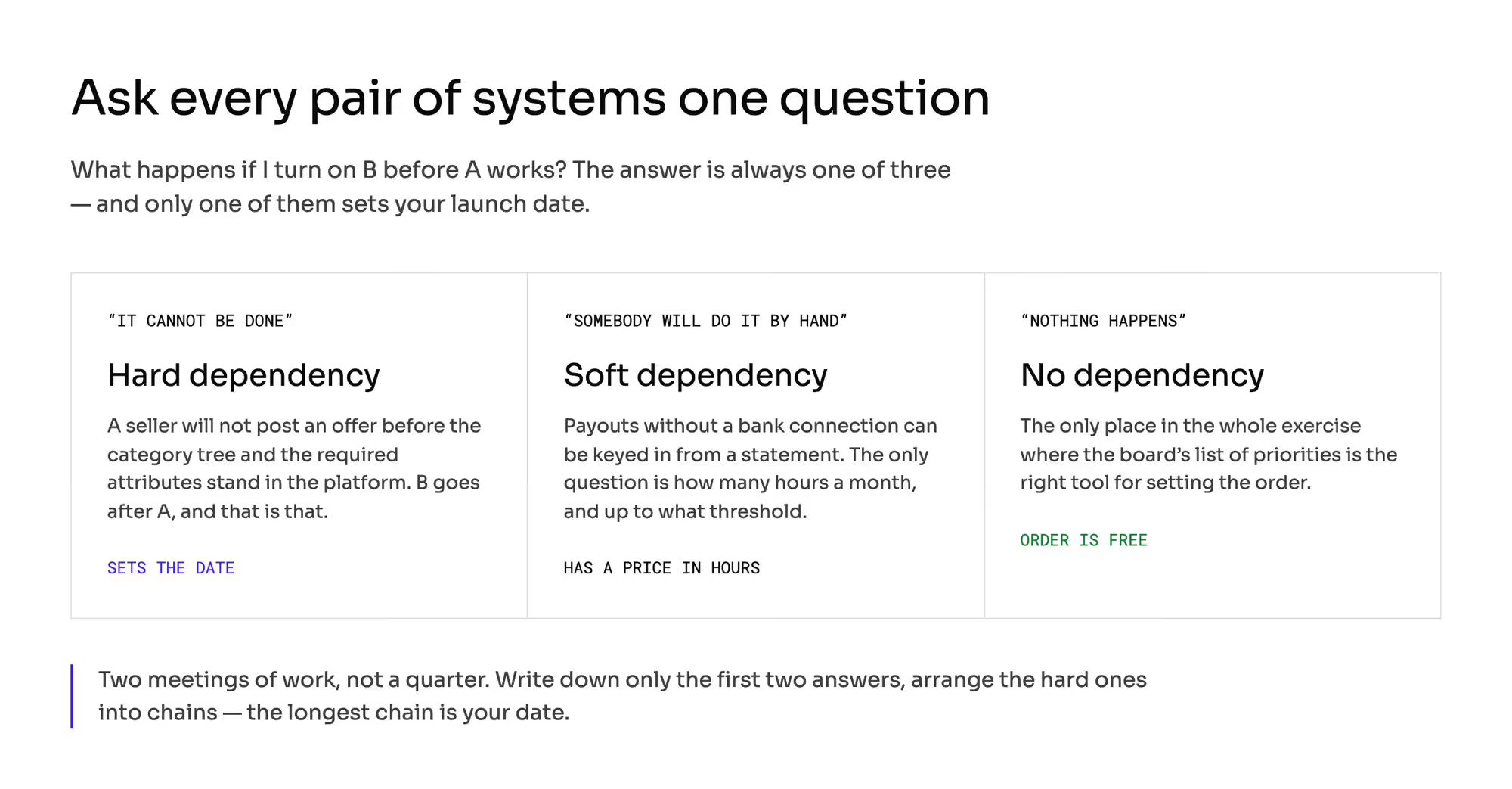
You don't need a map of arrows to set the order. Ask every pair of systems one question: what happens if you switch on B before A works? You'll get one of three answers.
- "It can't be done." This is a hard dependency. A seller can't post an offer until the category tree and the required attributes exist in the platform. B goes after A, and there's no way around it.
- "It can be done, but someone does the work manually." This is a soft dependency. It's the only one of the three answers where you can count the cost in hours. Without a bank connection, you can still pay sellers with transfers keyed in from a statement. You need to know how many hours a month that takes and at what volume it stops working.
- "It makes no difference." The two systems don't depend on each other. Use the board's priority list to set the order of these pairs.
Going through every pair takes two meetings. The hard dependencies line up into chains, and the longest chain gives you your launch date.
Project planners call that chain the critical path. It's the longest sequence of dependent tasks in which no task has any slack. A one-day delay on any of them delays the whole project.
You build the critical path from dependencies. The board builds its list from importance. The two lists always differ.
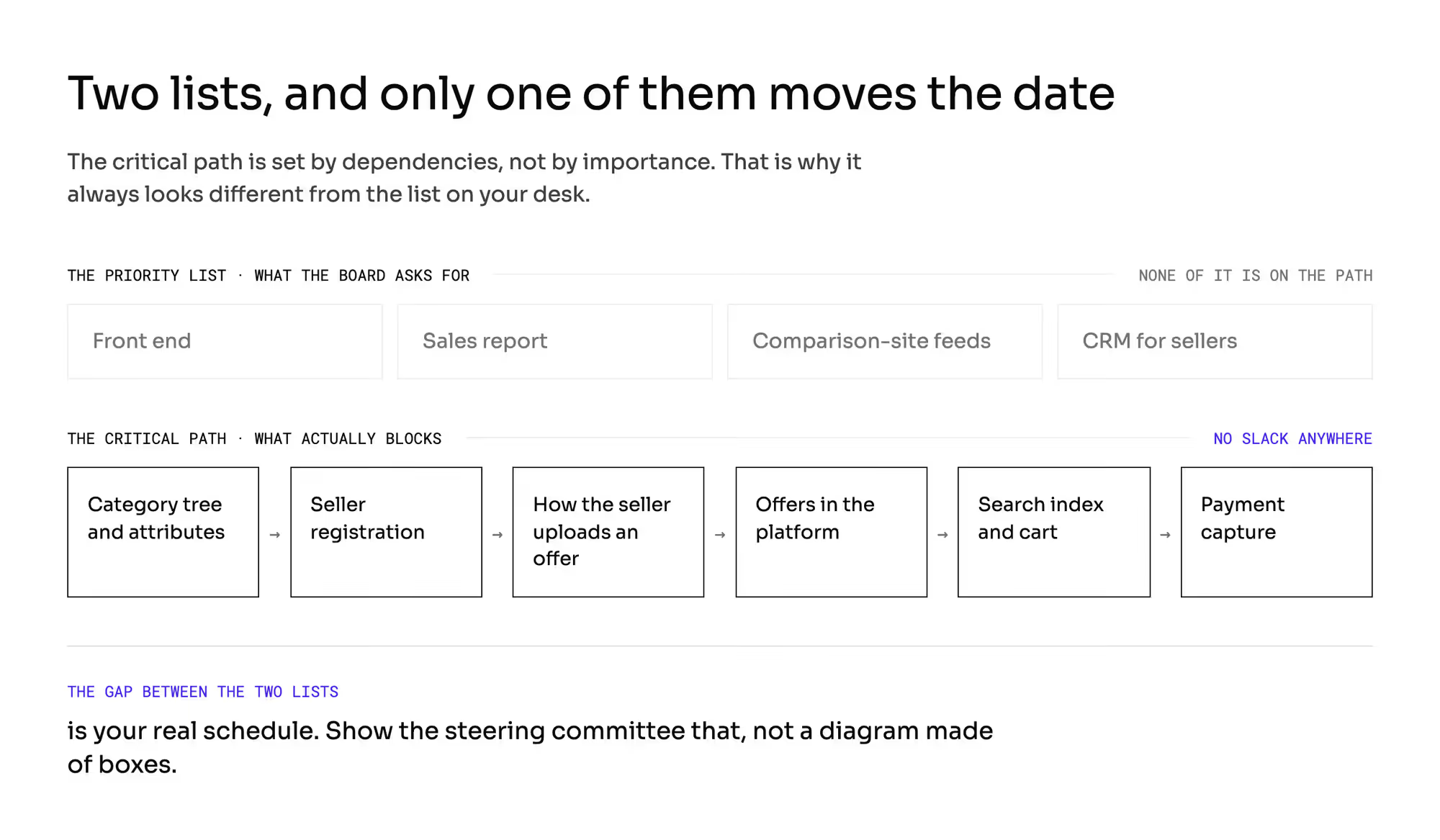
The board wants to see the front end and a sales report. The critical path starts with the category tree and the tool sellers use to upload offers. Neither of them appears on any slide.
Your real schedule includes the work that sits on the critical path and is missing from the board's list. Show that work to the steering committee instead of a diagram made of boxes.
Which 4 decisions does every connection to your marketplace need?
The chapter on what a marketplace platform includes covers which systems the vendor delivers in the price. This chapter assumes you've made that choice. It deals with one thing only: the order in which you switch connections on.
For each of the 14 systems in the table, write down which way the data flows, who owns it on the other side, and how the data is exchanged.
Which system, and what lives in it? | Which way does the data flow? | Who owns it on the other side? | How is the data exchanged? |
|---|---|---|---|
PIM: descriptions, photos, attributes | categories out, products back | product data | in batches |
ERP: orders and accounts | orders out, settlements back | finance | in batches |
Warehouse: stock levels for your own goods | stock levels into the platform | logistics | live |
Payment capture | cart out, confirmation back | finance | live |
Payout to the seller | a statement to the bank | finance | in batches, on a cycle |
Tax engine: rates and rules | order out, rate back | accounting | live |
Carriers or a shipping broker | tracking number out, status back | logistics | live |
Seller integrators | offers in, orders out | the seller | live or in batches |
Search: the index of offers | offers into the index | front end | in short batches |
CMS: content and category pages | content to the front end | marketing | live |
Identity directory: who signs in | users into the platform | security | live |
CRM: the relationship with each seller | events into the CRM | sales | in batches |
Data warehouse and reporting | all data into the warehouse | analytics | in batches, once a day |
Feeds: your offers for comparison sites | offers to outside channels | marketing | by file, on a cycle |
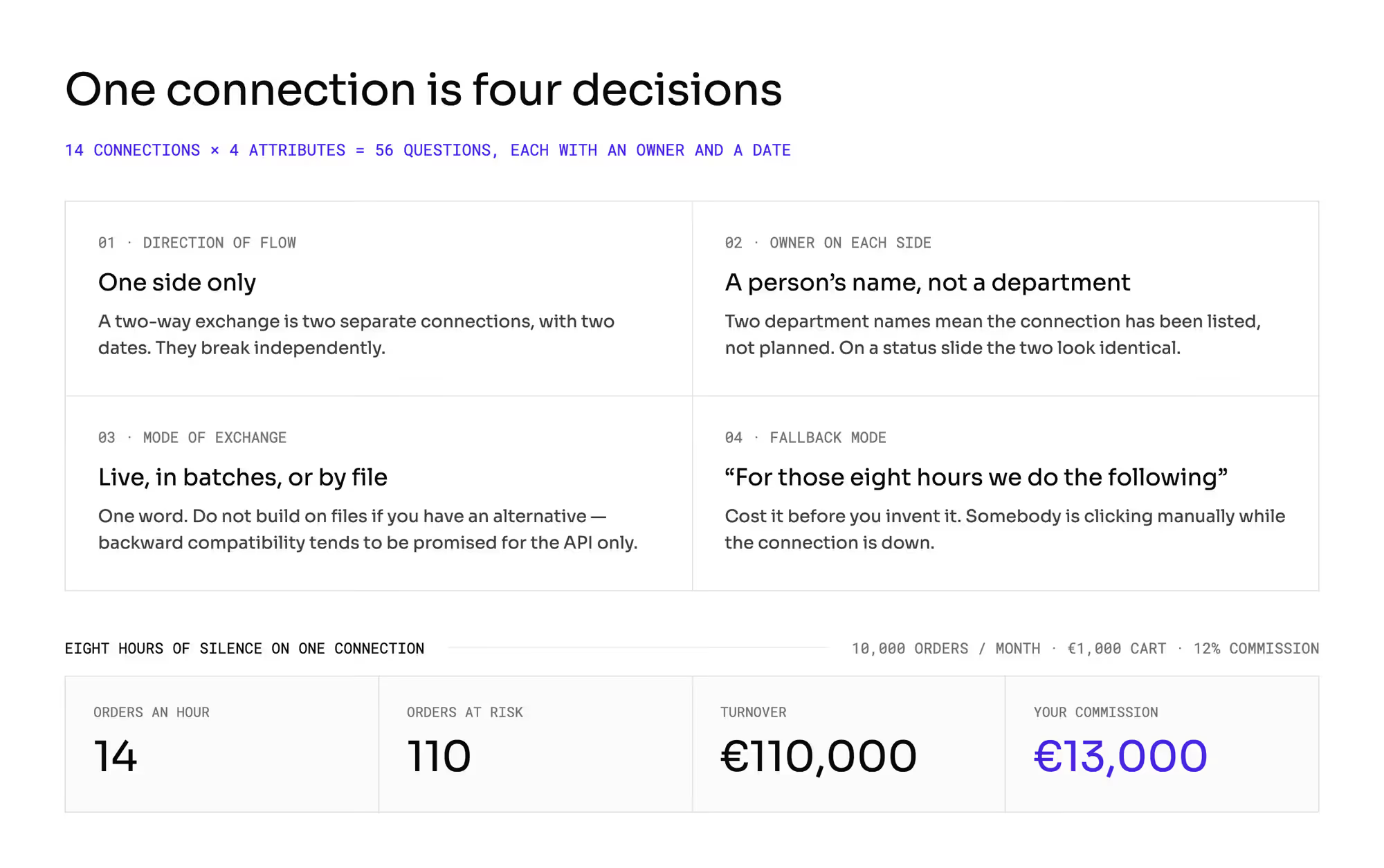
1. Direction of the data flow
Write the direction one way only. A two-way exchange is two separate connections with two dates. They have different owners, and they break independently.
The direction doesn't tell you whose price wins when both systems hold a price for the same product. That's a separate decision, and the chapter on single source of truth covers it.
2. Owner on each side
The owner is a person's name on both sides. A connection with two department names on it is on the list, but no one has planned it. On a status slide, it looks the same as a planned connection.
When the other side is a seller, the owner is someone at your company. That person needs the standing to pick up the phone and call the seller.
3. Mode of exchange
Write the mode in one word: live, batch, or file. Platform vendors give one rule in their own implementation guides: avoid file-based exchange whenever you have another option. Some of them state it twice in the same document.
The column layout inside a file changes between versions. Vendors usually promise backward compatibility for the API only. An API is the agreed way one system asks another for data.
A marketplace API integration survives a version change more often than a file exchange does. The chapter on webhook integration covers how the modes differ in practice.
4. Fallback for an outage
The fallback is a sentence that starts with "For those eight hours, the team does the following." Work out what the fallback costs before you design it.
Every number in this chapter comes from a hypothetical marketplace. It has 10,000 orders a month and 300 sellers with 200,000 offers. The average cart is €1,000, and the commission is 12%.
Those 10,000 orders a month give you 333 orders a day. That's about 14 orders an hour.
An eight-hour outage on one connection holds up 110 orders worth €110,000. Your commission on those orders is about €13,000.
The chapter on marketplace uptime SLA covers outages of the whole platform. The fallback here covers one connection and the person who does its work while it's down.
Which 5 groups of marketplace integrations go live in a fixed order?
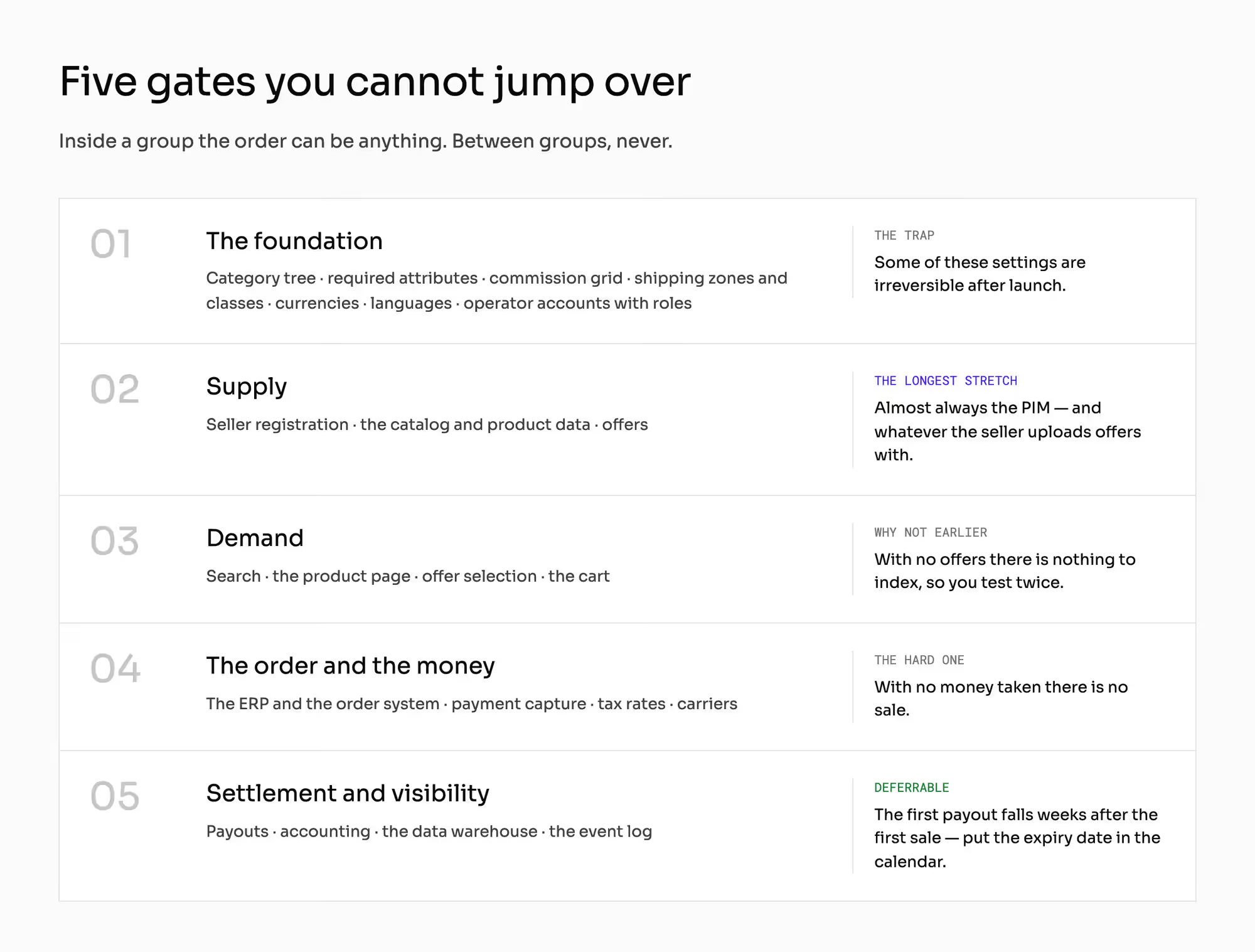
All 14 connections fall into five groups. Inside a group, you can switch connections on in any order. Between groups, the order never changes.
1. Foundation
The foundation gives you a place to load data. Until it's in place, sellers and products have nowhere to go. This group holds:
- The category tree and the required attributes for each category.
- The commission grid.
- Shipping zones and shipping classes.
- Currencies and languages.
- Operator accounts with their roles.
Some of these settings can't be changed after launch, or only the vendor can change them. Ask which ones before you configure anything.
Connect company single sign-on right away, before a hundred local accounts exist. The chapter on SSO vs MFA covers sign-in and roles.
2. Supply
Seller registration comes first. The catalog and product data follow, and offers come last.
This is the longest stretch of the critical path. Most of the work in it usually goes into the PIM. The PIM is often the biggest block of work on large rollouts, and teams estimate it worst.
This group also holds the tool a seller uses to upload offers. Teams usually find out about this dependency too late.
Your sellers may work in a popular integrator that has no connection to your platform. Someone then has to build that connection, and neither the platform vendor nor the integrator starts without an order.
The chapter on the marketplace seller panel covers what sellers can do on their own side.
3. Demand
This group holds search and the product page. It also holds offer selection and the cart. Search has no data to index until sellers have posted offers.
A front end built before the supply group gets tested on invented data. Your team then tests it a second time on real data.
4. Order and money
This group covers ERP integration and the order system. It also holds payment capture, tax rates, and carriers.
This group has one hard dependency. An order counts as a sale only after you've taken the payment.
An order can also arrive by a second route, straight from a large customer's procurement system. The chapter on punchout catalogs covers that path.
5. Settlement and visibility
The last group holds payouts, accounting, the data warehouse, and the event log. You can push this group past launch day, because the first payout falls a few weeks after the first sale.
The deferral has an expiry date, though. Put that date in the calendar on the day you decide to defer.
Which integrations can you defer past your marketplace launch, and what does each one cost?
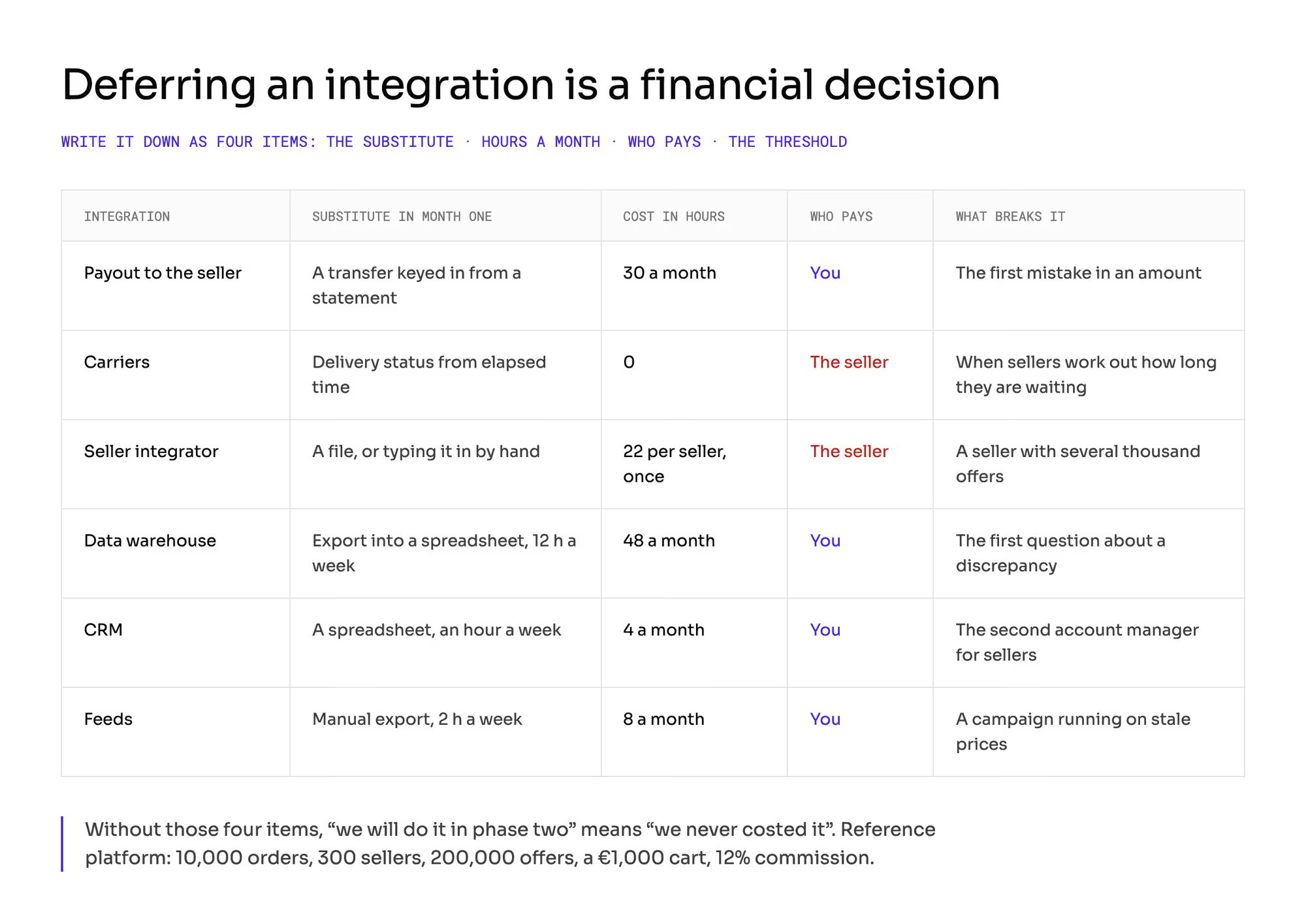
Deferring an integration is a normal decision. Defer only when you know the substitute, its cost in hours, and the threshold at which it breaks.
1. Payouts to sellers
Three hundred sellers and two payout cycles a month give you 600 transfers. Each transfer takes three minutes.
That makes 1,800 minutes a month. You spend 30 hours a month keying in payouts.
Your team can manage that workload. The work involves other people's money. Manual payouts stop working the first time someone types in the wrong amount.
2. Carriers
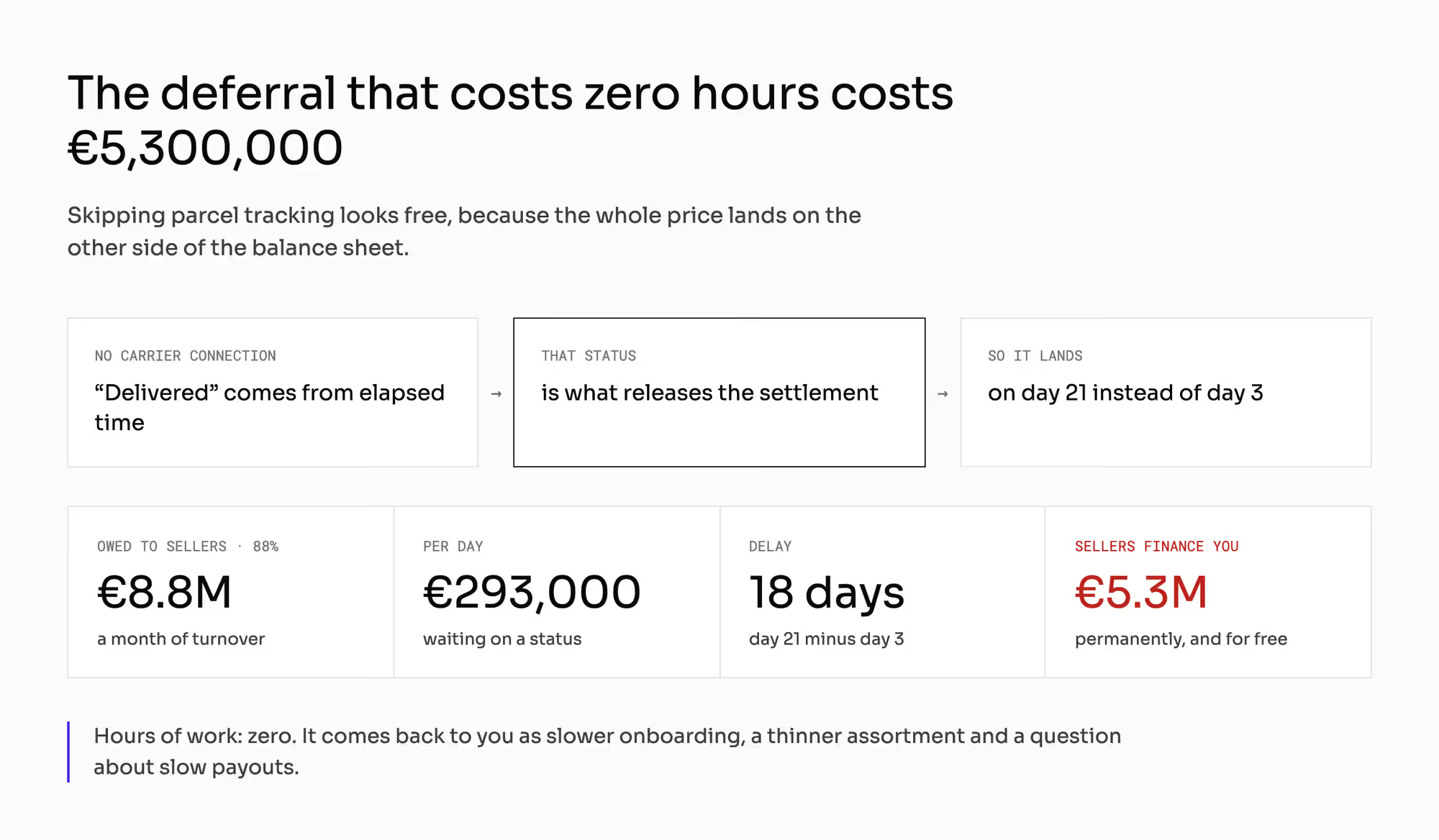
If you have no parcel tracking, the platform sets the "delivered" status after a fixed number of days. That status releases the settlement to the seller.
Sellers are owed 88% of turnover. On €10 million of turnover, that's €8.8 million a month. Per day, it comes to about €293,000.
Say the status lands on day 21 instead of day 3. The 18 days in between add up to €5.3 million.
Your sellers finance that sum for you permanently. Your team spends zero hours on it.
They carry that cost on their own balance sheets. Later, you pay for it with slow onboarding and complaints about slow payouts.
3. Seller integrator
Your 200,000 offers across 300 sellers average 667 offers per seller. At two minutes per offer, a seller types for 22 hours before earning a single euro.
A seller who has typed in offers once won't agree to do it again. A seller with several thousand offers won't do it even once.
Why do integrations take up most of a marketplace project?
A single connection is rarely hard to build. The work grows with the number of connections times the decisions each one needs.
Fourteen connections with four decisions each give you 56 questions to settle. Each question needs an owner, a date, and a consequence.
Every connection also needs a test environment and a way to promote settings between environments. The chapter on configuration management covers environments and how configuration travels between them.
The platform subscription usually starts on the day you sign, and the first sale comes later. You pay the subscription for every month of delay, and you make no sales in that month.
Teams usually plan the data alignment at the end of the schedule and give it attention last. Delays build up there.
How do point-to-point and hub integrations compare on a marketplace?
Count the connections before you talk to your IT team. Fourteen systems plus the platform give you 15 points to connect.
If every system talked to every other one directly, you'd have 105 connections. That's 15 times 14, divided by 2. With the platform as the hub, you have 14 connections.
What does each setup mean for your marketplace? | Every system talks to every other | Every system talks to the platform |
|---|---|---|
Connections for 15 systems (count) | 105 | 14 |
Connections after you add a 16th system (count) | 120 | 15 |
Connections each system maintains (count) | 14 | 1 |
How the maintenance cost grows (shape) | quadratically | linearly |
What a version change in one system touches (scope) | up to 14 connections | 1 connection |
The difference in cost stays small at first. You see it only in the third year.
What do marketplace integrations change in your marketplace?
Integration work sets your launch date more than any feature does. It also creates costs that the project budget doesn't show.
1. Launch date follows the longest chain
Your launch date depends on the longest chain of dependencies, whatever the most important integration is. To shorten the project, you shorten that chain. Speeding up work outside the chain leaves the date where it is.
2. Deferral is a financial decision
Write every deferral down as a cost. It needs the substitute and its hours a month, plus the side that pays and the threshold. If a deferral lacks those four items, calling it "phase two" only hides that no one counted the cost.
3. Part of the cost lands on sellers
Sellers carry part of the cost of a deferral. You pay for it later with slower onboarding and a thinner assortment. Sellers also start asking why their payouts are slow.
4. Integration map keeps growing
Every new channel or country adds rows to the map. So does every new type of assortment. Each row needs two names on it before anyone delivers it.
How do you map marketplace integrations in two meetings?
The exercise fits into two meetings with the owners of the connected systems. Do the steps in this order:
- List systems instead of functions, and fill in four columns for each one: direction, two names, mode of exchange, and fallback. If you can't fill in a field, write that down. It tells you what's still missing.
- Ask the ordering question of every pair of systems that touch. Write down only two answers: "it can't be done" and "someone does it manually."
- Arrange the hard dependencies into chains and measure the longest one. That's your launch date, and you now have the reasoning to defend it.
- Count the hours and the threshold for every soft dependency. The total of those hours is staff time that the project budget doesn't include.
- Compare the result with the board's priority list and show the gap. Once people see the gap, they stop arguing about the launch date.
How do you check marketplace integrations with a vendor?
Ask these five questions, and ask to see each answer on screen:
- What do I have to configure before the first seller uploads the first offer?
- Which of those settings can't be changed after launch?
- Which seller integrators are you connected to in production today, and which are only on your roadmap?
- What happens to the data when one connection goes silent for eight hours, and how do I find out?
- How many environments do I get, and how do I promote configuration between them?
The third answer tells you whether your supply group can start on time. Ask for the names of live marketplaces that use each integrator.
Which mistakes do operators make with marketplace integrations?
Each of these mistakes looks like normal progress on a status slide. It shows up later, when the launch date slips.
1. Ordering integrations by business priority
A front end ready in month three waits until month nine for offers. You pay for six months of frozen work. No one is to blame, because every team delivered its part on time.
2. Finding the seller integrator after signing sellers
You've recruited supply that has no way to list its goods. Your launch date now depends on an integrator you can't influence.
3. Naming a department as the owner
Two teams wait for each other for three weeks. Both of them report that they aren't blocked.
4. Deferring without costing the substitute
The hours disappear across several teams at once. Manual work has no budget line of its own, and its hours never add up in one place.
What do you still have to settle about marketplace integrations?
This chapter doesn't decide who wins when two systems hold different data. Direction of flow and data ownership are two separate decisions. The chapter on single source of truth covers ownership, and the chapter on webhook integration covers the mode of exchange.
This chapter also leaves out what you buy and what you build. The chapter on what a marketplace platform includes covers that choice. The chapter on the marketplace seller panel covers the seller's side.
This chapter doesn't say how many people will operate this layer after launch. Count that separately, once you know which connections you keep.
This chapter isn't legal advice. Before you switch on the first connection, write down two points for your lawyer:
- The flow of personal data into the data warehouse, the CRM, and outside channels, and who processes that data for you. The chapter on marketplace GDPR covers the roles.
- The content and retention period of the documents that come out of the accounting integration. The chapter on marketplace order documents covers what you produce and what you keep.
Put in your own numbers for orders and sellers. Add your offer count and your average cart, then calculate how many hours a month your deferred integrations cost you.
Summary: In what order do you connect marketplace integrations?
You connect marketplace integrations in the order of their dependencies. The longest chain of hard dependencies sets your launch date. The board's priority list only decides the order between systems that don't depend on each other.
Foundation and supply go live first, and demand follows. Order and money come next, with settlement and visibility last. Supply is usually the longest stretch, because of the PIM and the tool sellers use to upload offers.
Every connection needs a direction and two named owners, plus a mode of exchange and a fallback. Every deferral needs a substitute and a count of its hours. It also needs a payer and a threshold.
Ask a vendor which seller integrators are connected in production today. Building a marketplace that has to connect to your ERP and PIM before a fixed launch date?
Frequently asked questions on marketplace integrations
What are marketplace integrations?
Marketplace integrations are the connections between a marketplace platform and the systems around it, such as the ERP and the PIM. Each connection has a direction, an owner on both sides, and a mode of exchange. Sellers' own tools connect through integrators or through the API.
What does ERP integration do on a marketplace?
ERP integration on a marketplace sends orders from the platform to the ERP and brings settlements back. Finance usually owns the ERP side of the connection. It belongs to the order and money group, after the catalog and offers are in place.
Are marketplace integrations the same as an integration marketplace?
Marketplace integrations and an integration marketplace are two different things. An integration marketplace is an app store of ready-made connectors for one software product. Marketplace integrations are the connections between your own marketplace and your company's systems.
Ready to build?
We build marketplaces that connect to your ERP, PIM, and payment provider in the order your launch date depends on.