
UAT Testing Before a Marketplace Launch: 4 Test Classes You Can't Skip

UAT testing is the acceptance check your business side performs on a finished system. It confirms that the platform behaves the way your contracts and your documents say it should.
Four classes of tests stand between a finished platform and a launch date, and each class has a different owner and a different pass criterion.
You can tick off a complete test list and still launch with a defect worth tens of thousands of euros a month. Most test lists check whether the screens work and never compare an amount with a contract.
User acceptance testing on a marketplace also has to confirm the amounts, and your platform pays other companies out of your commission grid and your refund policy.
This article breaks down:
- What does UAT testing have to prove on a marketplace?
- Which 4 classes of UAT testing does a marketplace launch need?
- How do 4 numbers from one order settle your money tests?
- Which 4 scenarios fall off a marketplace test list?
- How do you size a load test on your peak hour?
Key insights
- Your team gives a functional test the verdict "it works". Finance gives a money test the verdict "it agrees to the cent". One team working from one list finishes the first class and leaves the second.
- A refund on one seller's line can leave that line's commission sitting in your own account. Your refund policy settles which version is correct, and a test only shows you which one the system implemented.
- A return that lands after the payout leaves your money at the seller until the next cycle. Check whether a receivable arises against that seller, and whether it comes off the nearest payout.
- Size the load test on your peak hour. Take the peak-day and peak-hour multipliers from your own retail sales history. A test tuned to the average checks a small fraction of the load you're afraid of.
- Money tests need the longest calendar of the four classes. One pass of a scenario takes a payout cycle, and a fix needs a second pass.
What does UAT testing have to prove on a marketplace?
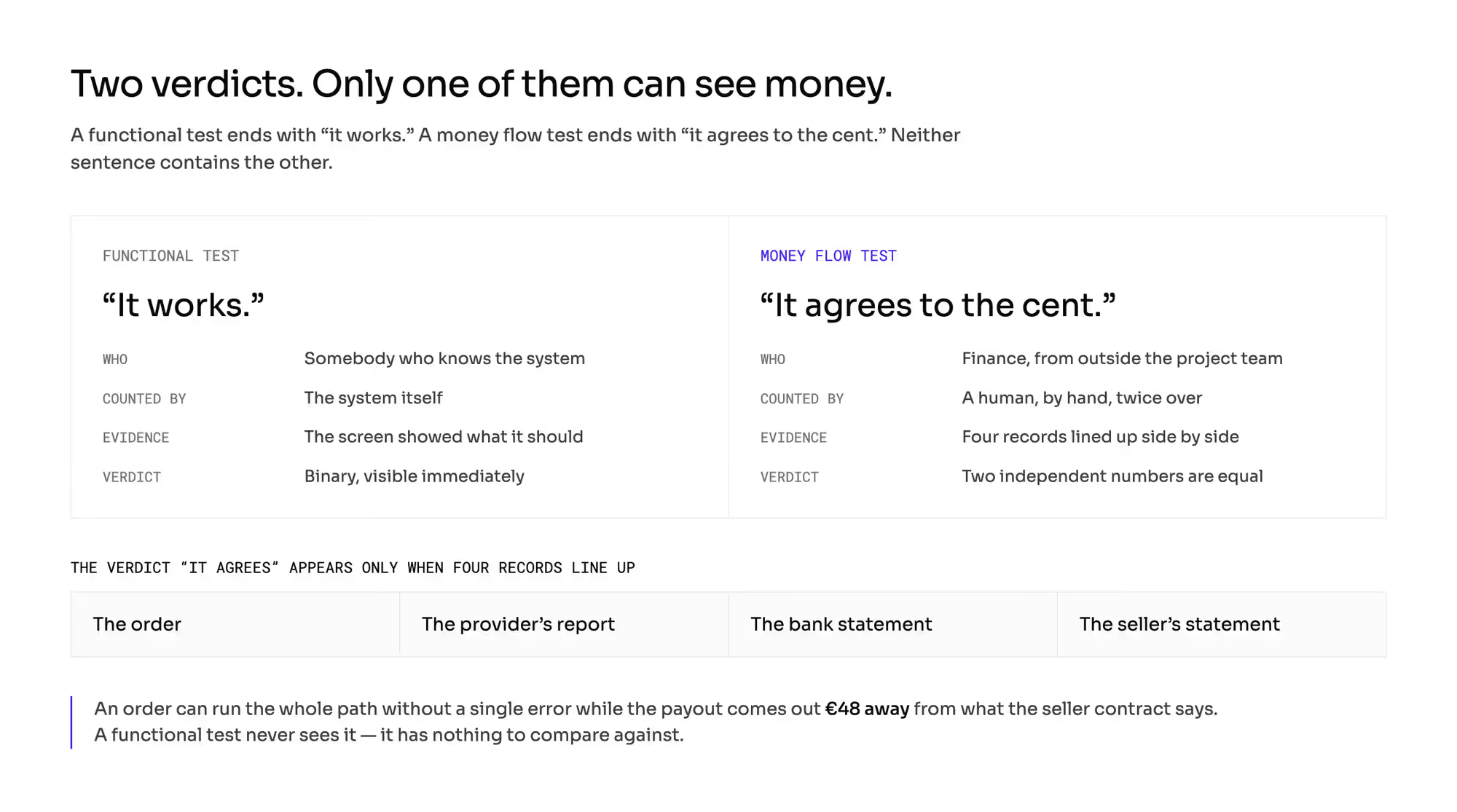
Your team gives a functional test the verdict "it works". Somebody walked the path, and the screen showed what it was supposed to show.
A functional verdict is binary and visible immediately, and the person who gives it knows both the system and the path it was supposed to follow.
Finance gives a money test a different verdict: "it agrees to the cent". That verdict is the equality of two numbers counted independently. The system produces one number, and a person with your commission grid and your refund policy in front of them produces the other.
No screen shows you the second verdict, and you get it after you line up four documents:
- The order.
- The payment provider's report.
- The bank statement.
- The statement you sent the seller.
"It works" and "it agrees to the cent" are separate verdicts, and an order can pass through the whole path without a single error. The payout on that order can still land forty-eight euros away from the amount in the seller contract.
Your team has one number to check a functional test against, and the system produced that number itself.
By the standard of internal control, reconciliation is a control separate from processing the transaction. A control performed with the same tool that calculated the amount confirms only itself.
The person who configured the commission grid repeats their own assumption when they check it. Acceptance belongs to the business side, and the team that built the system doesn't give it.
Put both classes on one list in front of one team, and you get the first one, without bad faith on anyone's part. The functional list has several hundred items, and the money list has a dozen or so, and both carry the same deadline.
Your team can close the functional list in a few days, and the money class needs a real payout cycle to elapse. It also needs people who don't sit in the project.
Which 4 classes of UAT testing does a marketplace launch need?
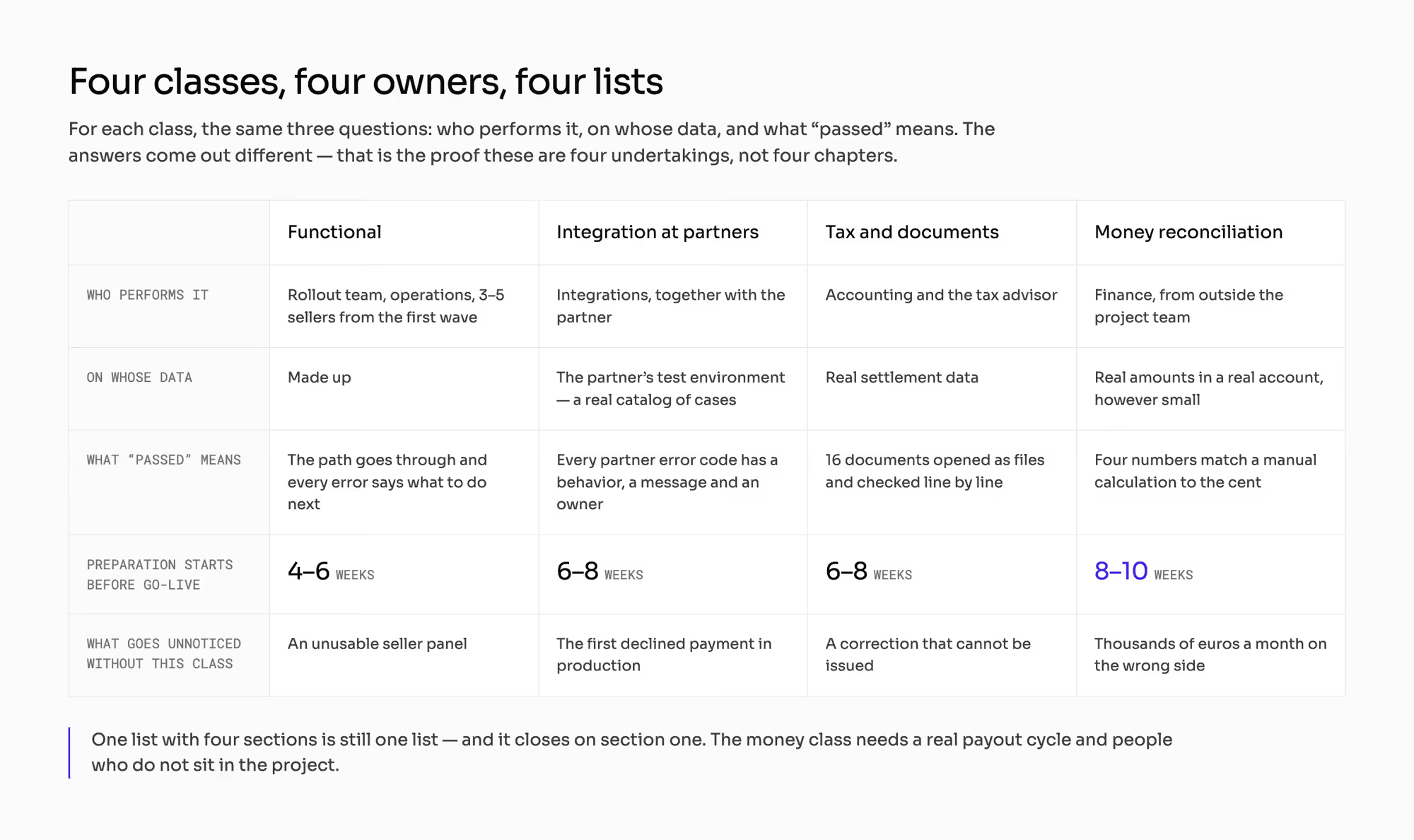
Each class has a different answer to the same three questions, and you ask all three before you plan the class:
- Who performs the class?
- Whose data does it use?
- What does "passed" mean?
1. Functional tests on two paths
Since everyone in your company has bought something online, anybody can test the buyer's path.
The seller's path is the most weakly tested part of a rollout, and the people clicking through it aren't sellers.
Sit three to five sellers from your first wave in front of the panel for two days. Have them go through registration, a file upload of a hundred offers, accepting an order, printing a shipping label, and handling a return.
Every question they ask is a future ticket of yours multiplied by thirty launch sellers. Passed means the path goes through, and every error carries a message that says what to do next.
2. Integration tests on your partners' test environments
Stubs don't count as integration tests. A stub returns what you told it to return and confirms your idea of the partner.
Your payment provider publishes a catalog of cases you'd never invent:
- Cards declined for a specific reason.
- Transactions flagged as suspicious.
- A dispute won and a dispute lost.
- A refund first pending and then rejected.
- A charge against a closed account.
Your carrier and your accounting work the same way. Ask for an export that somebody loads into a chart of accounts.
Passed means every error code from your partner has a behavior, a message, and an owner on your side, and the success path on its own doesn't pass this class. Settlement in a test environment is usually immediate, and in production it takes days.
3. Tax and document tests
Tax and document tests belong to finance and to your tax advisor. Your test team doesn't perform this class, and a tester can't tell a correct tax document from an incorrect one.
The chapters on marketplace invoicing and marketplace credit notes cover what the documents have to contain. This class needs staffing of its own, and you build its matrix from three variables:
- Seller domestic or foreign.
- Buyer a consumer or a business.
- Goods domestic or imported.
Eight combinations each carry a sales document and its correction, which gives you sixteen documents to look at. Passed means one person opened each document as a file and checked it line by line before putting their name under it.
4. Money reconciliation from payment to payout
Reconciling the flow of money starts at the buyer's payment and ends at the seller's payout. Finance performs it on real amounts pushed through a real payment provider, however small those amounts are.
You recalculate the result on paper, and you'll find the method in marketplace payment reconciliation. The same calculation is the pass criterion for this class, and the procedure a working company follows after launch is a separate matter.
How do 4 numbers from one order settle your money tests?
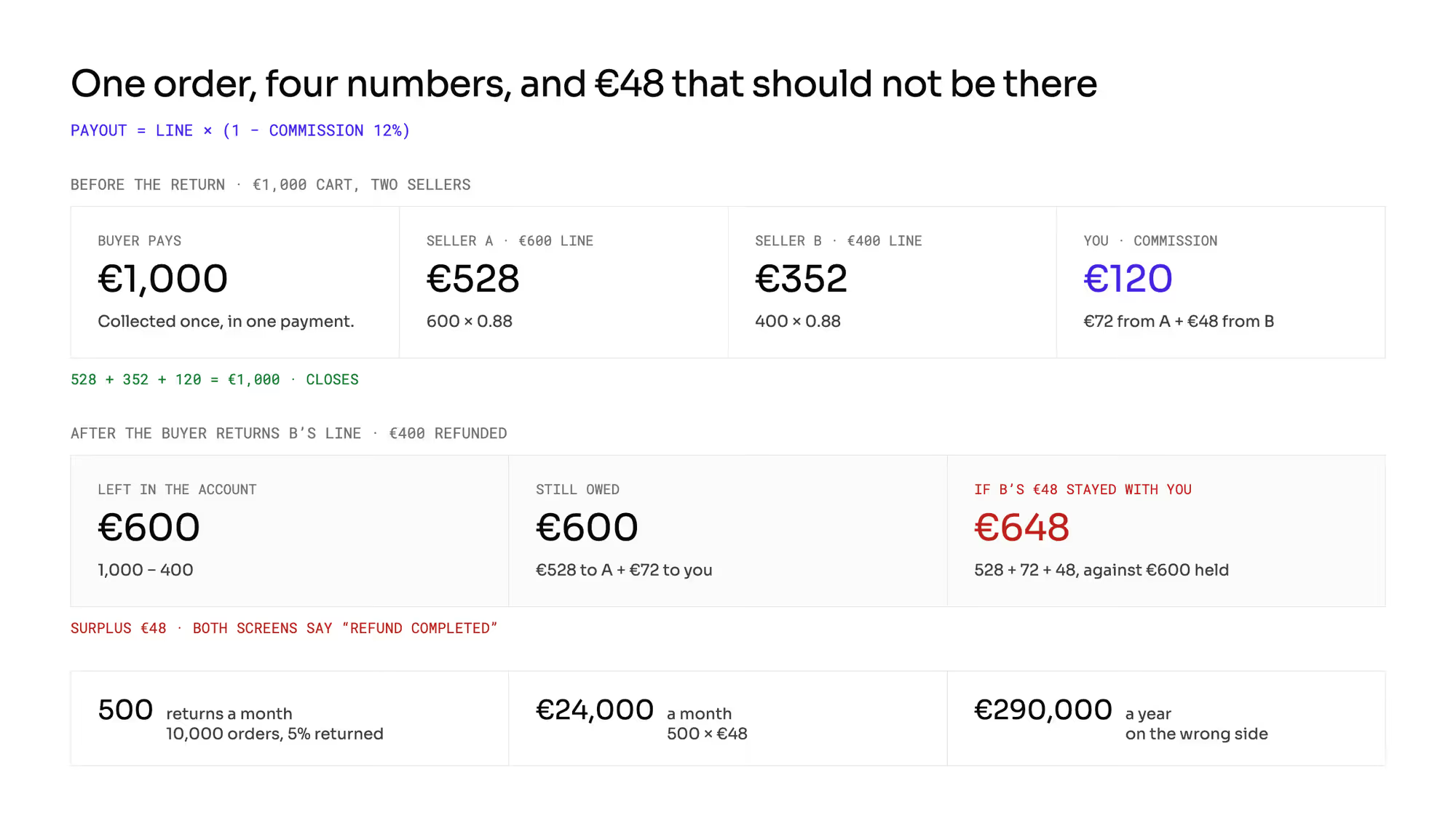
The reference cart of this series is €1,000 with a 12% commission, split between two sellers. Seller A has €600 of that cart and seller B has €400.
Seller A is owed 600 × 0.88 = €528, and seller B is owed 400 × 0.88 = €352. Your commission is 72 + 48 = €120.
Those three numbers add up to €1,000, which is exactly what the buyer paid.
Now the buyer returns the line from B and gets €400 back. That leaves €600 of the collected money to cover €528 for A and €72 for you.
Leave the €48 commission from B's line with yourself, and you hold 528 + 72 + 48 = €648 against €600 in the account. You are forty-eight euros over, and both panels show the refund as completed.
Your policy on commission on refunds settles which version is correct for you, and you read the commission on a refunded order before you write the pass criterion.
A test doesn't set that policy. You learn from the test which policy the system implemented, and then you compare it with your contracts with sellers.
At 10,000 orders a month and a return rate of around 5%, you get 500 returns. At €48 each, that comes to €24,000 a month and close to €290,000 a year on the wrong side, and both sellers and auditors notice that gap.
Four numbers have to agree to the cent with a calculation on paper:
- Amount collected.
- Amount paid out.
- Commission.
- Balance left over.
The person who performs that calculation didn't configure the system and signs off on the result.
Which 4 scenarios fall off a marketplace test list?
Four scenarios outside the happy path carry most of the money risk. Put each one on the list with a name and a date against it.
1. Partial return from an order with two sellers
A buyer returns one seller's line and keeps the other, and you check whether the sum still closes after the refund.
You'll find how the cart and the payment split in multi-vendor checkout.
2. Return after the payout
Seller B received their €352 on Monday. The buyer returns on Thursday, and you refund €400 from your own account.
Does a €352 receivable against B arise, and does it come off the nearest payout?
At 500 returns a month with 20% landing after the payout, you have 100 such returns. 100 × €352 = €35,200 a month, or more than €420,000 a year of your money sitting at other companies.
3. Cancellation after shipment
The parcel is on its way, and the order drops out of active status, which raises three questions:
- What happens to the shipping label?
- What happens to the commission?
- What is due from a buyer who takes delivery anyway?
Write the answer to each one before launch and give all three to your customer service team for the first week.
4. Seller suspended with open orders
You suspend a seller who has twenty open orders, which raises three questions:
- Who sends those parcels out?
- Who answers the buyers?
- Does the payout for them go out?
Top-tier products have several suspension modes with different consequences for open orders. A seller account can never be deleted on those products. Ask your vendor which modes exist on your platform, and ask what each one does to an open order.
Duplicate event and an order that hangs
The same event delivered twice belongs on the list as well. So does an order that hangs after the confirmation of a capture or a refund never arrives and the retries continue without a limit.
You'll find the mechanics of both in idempotency and in the marketplace uptime SLA, and in each case you check three things:
- What does the buyer see?
- What does the seller see?
- Does the case wait somewhere with an owner?
How do you size a load test on your peak hour?
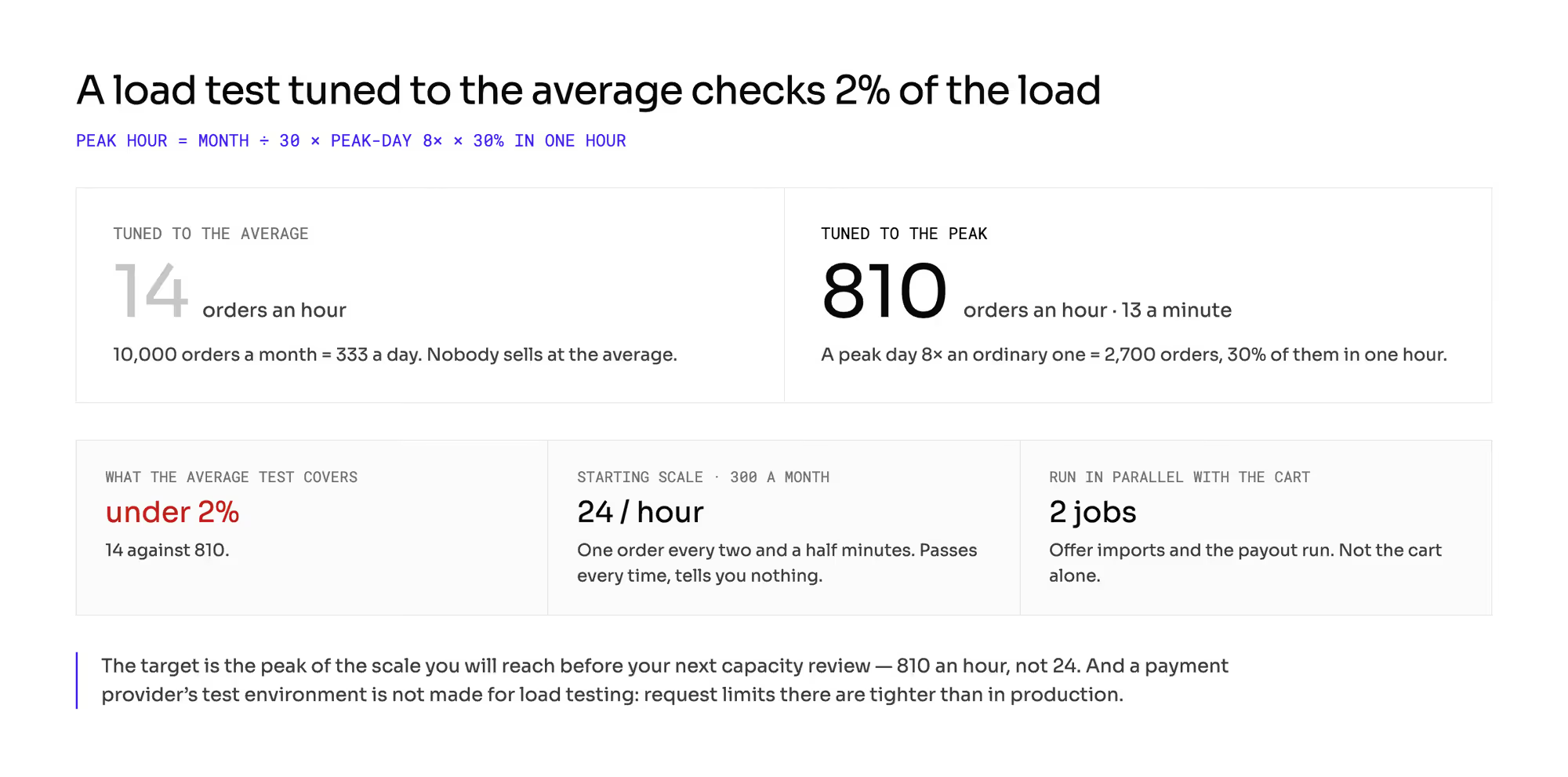
Target scale of 10,000 orders a month is 333 orders a day, or an average of about 14 an hour. No one sells at the average.
Take two planning multipliers from your own retail sales history. Assume a peak day eight times heavier than an ordinary one, with 30% of that day falling in a single hour.
Those two multipliers give you 2,700 orders in a day and about 810 in the peak hour, and eight hundred and ten orders an hour is 13 a minute. Tune the test to fourteen an hour, and you check under two percent of the load.
At starting scale, 300 orders a month is 10 a day. An eightfold peak is then 80 orders in a day and 24 in the peak hour.
One order every two and a half minutes passes every time, and you learn little from that result.
Size the test on the peak of the scale you'll reach before your next capacity review. With two years to get to target scale, that is 810 orders in an hour. Don't load the cart on its own while offer imports and the payout cycle go in parallel with it.
A payment provider's test environment isn't built for load testing. Request limits there are tighter than in production, and some providers write that into their documentation.
What does UAT testing change in your marketplace?
The money class sets the shape of your whole test calendar, and more people can compress the other three classes while leaving this one where it is.
1. Calendar set by the payout cycle
With payouts three times a month, one pass of "a return after the payout" takes about twenty days. After a fix, you need a second pass, which brings two iterations of a single scenario to forty days.
Preparation for this class therefore takes eight to ten weeks. Ask whether finance can trigger the settlement cycle manually on the acceptance environment. In top-tier products, that is sometimes a developer-only capability, and your test schedule is then your payout schedule.
2. Test data refreshed more than once
An environment refreshed once at the start passes everything, and stale test data gives green results on cases your production data won't contain.
The chapter on configuration management on a marketplace covers where to take test data from and how to promote it between environments. Detaching buyer data from real people is settled by marketplace GDPR.
3. Evidence separated from the decision
Your evidence from these four classes is a set of completed cases with numbers and signatures against them. Who has the right to stop the launch on that basis is settled by the launch readiness checklist.
A working store you migrate needs a separate class of checks on migrated data, and you'll find those in migrating from an existing platform.
How do you set up UAT testing in 6 steps?
Six steps fit into the weeks before the first class starts.
1. Split the list into four lists with four owners
One list with four sections is still one list. Your team closes section one and stops there.
2. Write down the pass criterion for each class before you start
No one fails a criterion written after the results.
3. Work out the tax and document matrix on paper
Three variables give eight combinations and sixteen documents. That is the scope of the class.
4. Put the eight scenarios from outside the happy path on the list as separate items
Give each one a name and a date: a partial return from two sellers, a return after the payout, a cancellation after shipment, a suspension with open orders, a duplicate event, an order hanging on a confirmation, a declined payment, and a lost dispute.
5. Order four demonstrations from your vendor and ask to see each one on screen
Your vendor shows them on the acceptance environment.
6. Set the date after which no configuration changes go in
Settings changed after that date invalidate the test.
How do you check UAT testing readiness with a vendor?
- Can finance trigger a settlement cycle manually on the acceptance environment, or does that need a developer?
- Which catalog of test cases does your payment partner publish, and does it cover disputes and refunds?
- What happens to open orders when a seller is suspended, and which suspension modes exist?
- Where does the approval trail for a test case live, and who can read it?
- Which request limits apply on the test environment, and what do you use for load testing instead?
Which mistakes do operators make with UAT testing?
Each of these mistakes produces a green test report, and a seller or an auditor finds the defect a month later.
1. One list, one team, one deadline
Your team closes the functional list and leaves the money class open. No one has to decide to strike it.
2. Reconciliation test performed by the person who configured the rates
The result confirms the assumption behind the configuration, and you can't tell it apart from a correct result.
3. Integrations checked against stubs
Your team meets the first real declined payment and the first lost dispute in production, in the week they have the least time for them.
4. Load test tuned to the average
A green result covers two percent of the load you're afraid of.
5. Money class dropped into the last week
Since one pass takes as long as a payout cycle, you have no room left for a fix.
What do you still have to settle about UAT testing?
You still have to decide what the correct answer is in each of those scenarios. Whether commission comes back on a refund is settled by the commission on a refunded order. How a cart and a payment split is settled is handled by multi-vendor checkout.
What the system does with a duplicate event is settled by idempotency. How it behaves when a partner fails is settled by the marketplace uptime SLA. You learn from the tests which of those decisions was implemented.
You also have to decide which evidence from the tests you keep, and your retention period is a separate decision. Your duties toward sellers, with the trail of decisions they require, sit in the P2B Regulation, and the chapter on marketplace order documents covers retention.
Raise three families of regime with your lawyer while you plan test data and evidence:
- Protection of personal data, in the part covering buyer records you copy into a test environment.
- Transparency toward the business users of the platform, in the part covering decisions you take about a seller during a test.
- Documenting of sales, in the part covering the sixteen documents the tax class produces.
The matrix of sixteen documents is the scope of your tax check, and your advisor confirms whether each document is correct.
Every number above is hypothetical. Substitute your own return rate, your own peak multiplier, and your own payout cycle, and the arithmetic still holds.
Summary: Which tests do you have to pass before a marketplace launch?
Pass four classes before a marketplace launch, each with its own owner and its own pass criterion.
Your rollout team and selected sellers take the functional class, and your integrations team works on your partners' test environments. Accounting and your tax advisor take the documents, and finance from outside the project reconciles the money.
Since one pass of a scenario takes a payout cycle and a fix needs a second pass, give the money class eight to ten weeks.
Its pass criterion is four numbers agreeing to the cent with a calculation on paper. Put the eight scenarios from outside the happy path on the list by name, starting with a partial return from two sellers.
Size the load test on your peak hour, about 810 orders at target scale against an average of 14. The screens and the amounts need separate verdicts. Building a marketplace in which the payouts have to agree to the cent on day one?
Frequently asked questions on UAT testing
What is UAT testing?
UAT testing is the acceptance check a business side performs on a finished system before launch. It confirms that the system behaves the way the company's contracts and documents say it should. The team that built the system doesn't give that verdict, and on a marketplace the check covers four classes with four separate owners.
Who performs user acceptance testing on a marketplace?
People who answer for the result perform user acceptance testing on a marketplace. Operations and selected sellers take the functional class, and your integrations team works with each partner. Accounting takes the documents with your tax advisor, and finance reconciles the money from outside the project.
How long does UAT testing take before a marketplace launch?
Plan eight to ten weeks for the money class and four to eight weeks for the others. One pass of a scenario such as a return after the payout takes a full payout cycle. A fix needs a second pass, and your own payout cadence sets the length of the class.
Ready to build?
We build marketplaces in which finance can reconcile a payout to the cent before anyone signs off on the launch date.