
Ecommerce Team Structure for a Marketplace: How Many People You Need and for What

An eCommerce team for a marketplace is the group of people who admit sellers and settle what the marketplace owes them. This chapter covers how many of them you need at two scales, and which work produces each number.
You've approved the platform and the launch date, and the board now wants a headcount for the first year.
Most companies answer with a number they heard elsewhere, and the fifteen people another operator manages go straight into the plan.
Understaffing shows up after six weeks in the queues and in the sellers who stop replying. Overstaffing shows up only in the P&L.
This article breaks down:
- How do you size an eCommerce team for a marketplace?
- Which 7 queues does a marketplace team handle?
- How many hours do those queues take at 2 scales?
- Why does headcount grow slower than turnover on a marketplace?
- What can you automate instead of hiring, and where does that fail?
Key insights
- Multiply the events a month in each queue by the handling time of one event, then divide by the hours a person is really available for. Vacation, sickness, training, and meetings keep that figure below the hours in the contract.
- Seven queues carry the work: recruitment, onboarding, catalog, seller support, finance, trust and safety, and product and integrations. Six of them follow sellers and offers, and orders drive only finance and part of the trust and safety signals.
- Onboarding, seller support, and the catalog carry most of the hours at target volume, and onboarding alone carries most of them at the start. Repeat the count at both scales, and the difference between the two totals is your hiring plan.
- Headcount follows the number of sellers and the number of exceptions, and turnover grows through volume per seller that produces no new events. The month-end close costs almost the same at either scale, and the product role is needed in full from day one.
- Self-service onboarding, catalog rules, and a self-service report for sellers take the most hours out of the plan. Discretionary decisions, first contact with a new seller, a gap in a reconciliation, and an escalation outside working hours stay with a person at every scale.
How do you size an eCommerce team for a marketplace?
Every operational function on a marketplace is a queue with a unit of work, a number of events a month, and a handling time for one event. Multiply the events by the handling time to get hours, and divide those hours by what one person is available for to get full-time roles.
A full-time role is 8 hours across 21 working days, or 168 gross hours a month. Vacation and sickness take about a quarter of that, along with training and meetings.
What you really have is 126 net hours, and every calculation below divides by that figure.
Because work doesn't arrive evenly, a queue with a promised response time needs slack above the average, and a team staffed exactly to the average leaves sellers waiting often.
Add a fifth on top wherever you've committed to a deadline.
A benchmark won't do this for you. Someone else's headcount comes from their assortment, their share of self-service and their automatic gates, and only your own events and handling times fit your queue.
The chapter on product approval covers the approval queue as production capacity.
Which 7 queues does a marketplace team handle?
Your eCommerce team structure follows seven queues, and each one has a single unit of work and a single driver. Six of them follow sellers and offers, and orders drive only finance and part of the trust and safety signals.
Which function? | What is the unit of work? | Events a month at 30 sellers and 300 orders | Events a month at 300 sellers and 10,000 orders | Minutes per event | Hours a month at target scale |
|---|---|---|---|---|---|
Recruitment | signed seller | 3 | 15 | a multiplier instead of a time | about 1.4 full-time roles |
Onboarding | seller brought to their first sale | 3 | 15 | 480 guided / 120 self-service | 120 |
Catalog | page repaired, category mapped | 40 pages + 3 mappings | 375 pages + 15 mappings | 6 / 120 | 68 |
Seller support | contact | 90 | 450 | 12 | 90 |
Finance | mismatched item, settlement question | 6 + 6 | 200 + 60 | 8 / 15 | 66 |
Trust and safety | signal needing a decision | 2 | 48 | 15 to 90 | 22 |
Product and integrations | change released | backlog | backlog | not applicable | about 1 full-time role |
1. Seller recruitment
Recruitment takes a seller brought to signature as its unit of work, and the supply plan drives it with no effect from order volume. Count this one with a multiplier instead of a handling time.
2. Seller onboarding
Onboarding counts sellers brought to their first sale, and you spend about 8 hours walking one seller through it yourself.
Those hours cover the account, the verification at the payment provider, and the category mapping. The first import and its corrections sit inside the same 8 hours.
With good self-service, that figure drops to about 2 hours.
3. Catalog and data quality
Catalog work has two units: an item in the approval queue and a product page to repair. Split them into two rows, and keep the approval queue separate with its own policy and gates.
This queue grows with the number of offers, and order volume doesn't change it.
4. Seller support
Seller support counts contacts, and a new seller asks about three times as often as a seller of a year's standing.
The chapter on seller requests covers brands, categories, and exceptions. The chapter on seller education covers the material that takes questions out of this queue.
5. Finance and reconciliation
Finance has three units: the payout cycle, a mismatched item, and the question "why did I get this much". The last one arrives from sellers in the days after every statement.
The chapter on the month-end close process covers the close itself and the way you answer that question.
6. Trust and safety
Trust and safety counts signals that need a decision. A quality threshold crossed, a suspicion of abuse, and a request for reinstatement are events of very different lengths.
Those lengths range from 15 to 90 minutes, and the queue grows in steps.
7. Product and integrations
Product and integrations count changes released, and it scales with the length of the backlog alone. You need one full-time role from day zero, and the integrations have to exist before the first seller uploads an offer.
A starting marketplace can't halve this role.
How many hours do those queues take at 2 scales?
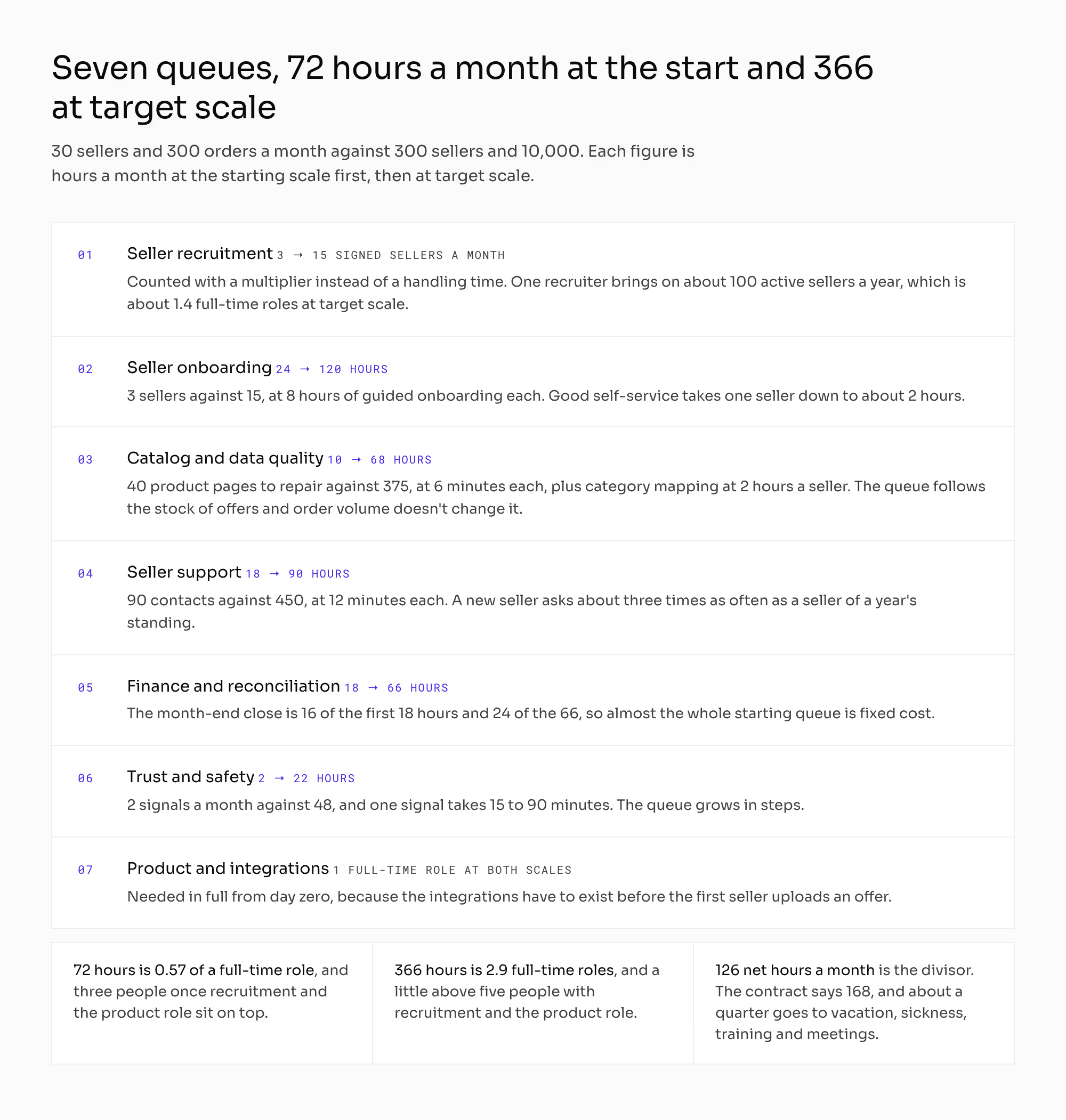
Target scale is 300 sellers, 10,000 orders a month, and 200,000 offers, and at a €1,000 cart and a 12% commission, that gives €10 million of turnover and €1.2 million of commission a month.
At 30 sellers, 300 orders, and 20,000 offers, the starting scale comes to €300,000 of turnover and €36,000 of commission.
1. Target scale, hour by hour
Onboarding takes 15 sellers at 8 hours, for 120 hours. Catalog starts with 7,500 new offers, and 5% of them need repair.
Those 375 pages at 6 minutes are 37.5 hours, and category mapping for 15 sellers at 2 hours each adds 30. The catalog comes to 68 hours.
Support counts 300 sellers at one and a half contacts each, and those 450 contacts at 12 minutes are 90 hours.
Finance counts 200 mismatched items at 8 minutes, or 27 hours. The month-end close adds 24 hours, and sixty settlement questions at 15 minutes add 15, for a total of 66.
Trust and safety counts 15 threshold cases at 40 minutes and 3 suspensions at 90 minutes. Add 30 abuse signals at 15 minutes, and the queue comes to 22 hours. The sum is 366 hours, or 2.9 full-time roles.
Recruitment adds one and a half roles, and the product role adds one, for a little above five people in total. That count excludes the approval queue and the person who directs the team.
2. Starting scale, same arithmetic
Onboarding takes 3 sellers at 8 hours, for 24 hours. Catalog starts from 800 new offers, and 5% of them is 40 pages at 6 minutes, or 4 hours. Mapping adds 6, for a total of 10.
A new seller asks three times as often as an established one. Support counts 90 contacts at 12 minutes, or 18 hours. Trust and safety takes two signals, or about 2 hours.
Finance takes 16 hours for the month-end close, and six mismatched items and six questions add two more. The finance queue comes to 18 hours, and 16 of them are fixed cost.
The sum is 72 hours, or 0.57 of a full-time role, and with recruitment and the product role, that comes to three people.
Why does headcount grow slower than turnover on a marketplace?
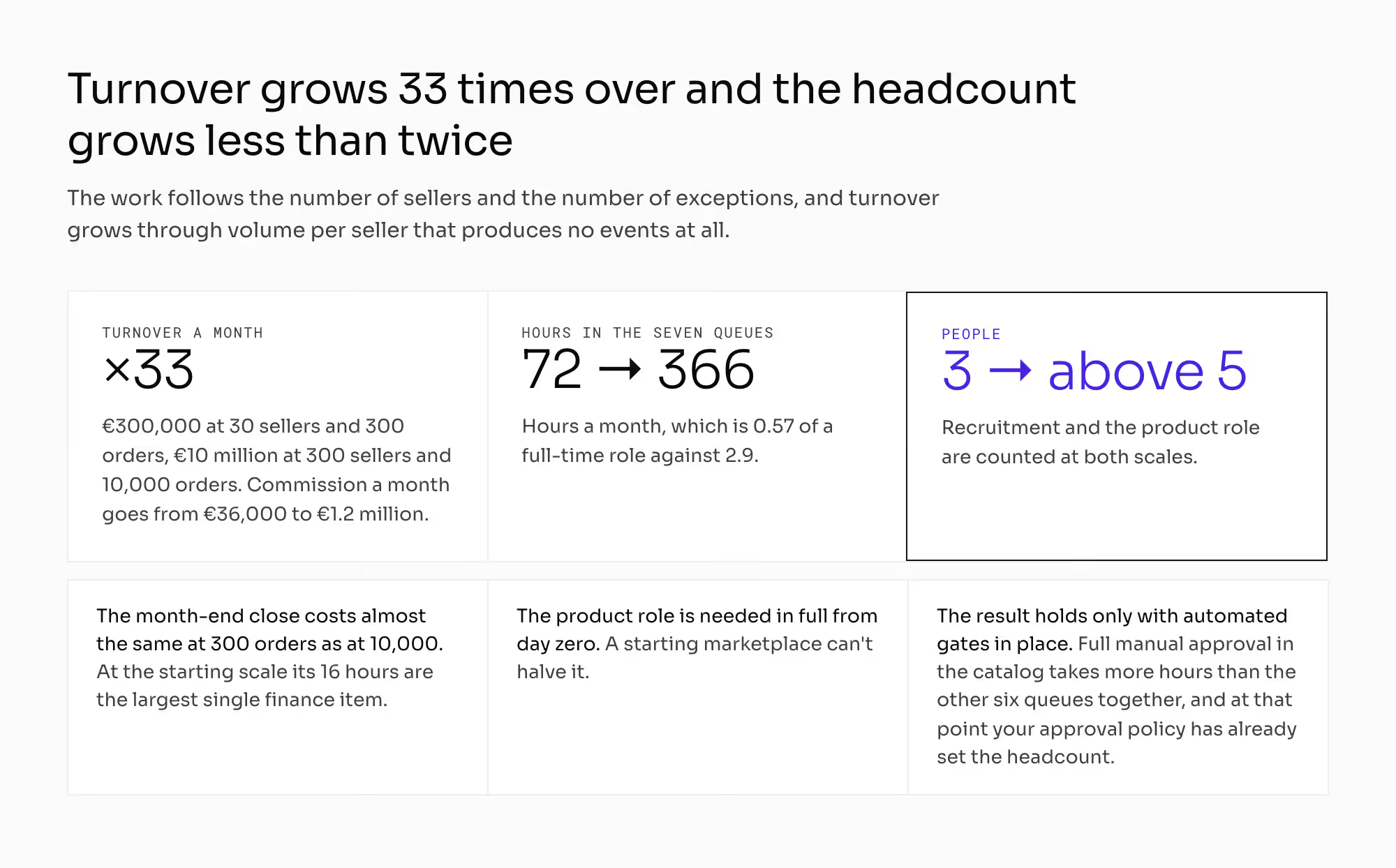
Turnover grows 33 times over between the two scales, and the headcount grows less than twice. The work follows the number of sellers and the number of exceptions, and turnover grows through volume per seller that generates no events.
The month-end close costs almost the same at 300 orders as at 10,000. The product role is needed in full from day zero.
The result holds only with automated gates in place, and full manual approval in the catalog takes more hours than the other six queues together. At that point, your approval policy has already set the headcount.
How do you count seller recruitment with a multiplier?
The unit here is an outcome, and counting hours won't give you the answer.
One recruiter working full time brings on about 100 active sellers a year, and the figure needs checking against your own numbers before you plan from it.
The figure depends on your vertical and on whether sellers in your category already work with an integrator. The time from the first conversation to the first offer changes it as well.
Going from 30 to 300 sellers in two years is 270 signatures, or about 135 a year. That is one and a half recruitment roles across the growth period, and the first months come in slower than the average.
At 300 sellers and churn on the order of 15% a year, you lose 45 accounts, and replacing them costs half a recruitment role before you grow at all.
Signing a seller doesn't give you access to their assortment. Practitioners observe that an experienced seller lists a subset of their catalog with a new partner, and a forecast built as sellers times their SKUs comes out high.
The conversation about what a seller will really list is separate work for a separate person. The chapter on the marketplace manager covers where to find these people and why they can disappear in the third quarter.
What can you automate instead of hiring, and where does that fail?
Automation works best on onboarding, where self-registration, a setup wizard, and ready-made mapping to the integrators cut 8 hours to 2.
At target scale, that saves 90 hours a month, and one change takes three quarters of a role off the plan.
It works on the catalog as well, where a rule takes away a task that should never have reached a person. In finance, a self-service report answers the most frequent question in the queue.
Four places stay with a person at every scale, and each one is worth a question to your vendor before the demo ends.
1. Discretionary decisions
A tool doesn't take an exception to a rate or a suspension off your desk, and it puts the decision in front of you faster.
2. First contact with a new seller
Practitioners from large rollouts agree that there is no seller who never has to enter the panel.
3. Explaining a gap in a reconciliation
The system shows the difference, and explaining it takes a person who knows both sides.
4. Escalation outside working hours
The chapter on hypercare covers the support hours after launch and the end date for them.
Which 2 marketplace jobs can't sit with the same person?
The account manager and trust and safety belong to two different people. An account manager is measured on the turnover of their portfolio, and a suspension wipes part of that turnover out.
The conflict is built into a measure you set yourself. The chapter on the sales compensation plan covers how that measure gets written.
Approval and custody of the asset stay with different people, and so do record keeping and reconciliation. The chapter on payment reconciliation applies the same four jobs to money and names who reconciles, who approves, and who releases a payout.
With three people you can't separate this by job title, and the mandate is what you separate instead.
A suspension then needs a second pair of eyes from outside commercial and a reason from a closed list, with a record of who took the decision.
That is the compensating control recommended to small organizations. The chapter on P2B regulation covers the justification you owe the seller afterwards.
Why does a starting marketplace team need a different set of roles?
A starting headcount isn't a smaller version of the target one. At the start, five of the seven functions come to less than half a role each, and people wear two hats as the right decision at that size.
Recruitment and onboarding grow in a straight line from day one, and finance and trust and safety jump at the first suspension and at the first quarter-end. The catalog grows behind the stock of offers.
Separate a function when it passes half a role and loses continuity alongside other work.
Mature operators double their team in the first year as well, and a manager can supervise fewer people when the work isn't uniform.
What does eCommerce team structure change in your marketplace?
The hours you counted reach the business case and the teams that lend you people.
1. Headcount enters the business case as a growing line
Five roles against €1.2 million of commission a month is a different proportion from three roles against €36,000. The chapter on the marketplace business case covers the payback calculation that proportion feeds.
2. Calendar and headcount are two decisions
The chapter on marketplace operations covers what happens on Monday and on the last day of the month.
Settle the owner and the sponsor before the headcount. The chapter on the executive sponsor covers that seat. The chapter on organizational change management covers which departments hand over people.
3. Every hour is borrowed until you hire
Every hour in that table comes out of another team's week until you hire, and plans slip when the lending team takes its hours back.
How do you count your own eCommerce team in one day?
Do the five steps in this order:
- Write down the seven queues and give each one a single unit of work. If a queue has two units, split it into two rows.
- Measure the handling time of one event in each queue for two weeks. Use the median.
- Derive the volume from the supply plan instead of the sales plan. Sellers and the growth of offers drive six of the seven queues.
- Divide by 126 hours, and add a fifth wherever you've promised a response time.
- Mark the functions below half a role and check that combining them keeps approval and reconciliation apart. Repeat the calculation for where you'll be in a year. The difference between the two results is your hiring plan.
How do you check team workload with a vendor?
- Do bulk actions and exports cover every object my team works on?
- What is the hard row limit on those bulk actions, and on an export?
- Do I define operator roles myself, or do I pick from a fixed list you control?
- Does entering a seller's panel leave a trail, and can selected fields be hidden inside it?
- Which self-service reports can a seller read without asking my team for a number?
The row limit is sometimes lower than your monthly batch, and 375 product pages a month is the figure to compare it against.
A fixed set of roles forces you into broader permissions than you want. The chapter on SSO and MFA covers sign-in and operator roles.
The trail is covered in the chapter on the audit log. Limits on looking at data about individuals are covered in the chapter on marketplace GDPR.
Which mistakes do operators make with marketplace headcount?
Five mistakes produce a headcount the board accepts, and six weeks later the queues show the gap.
1. Headcount taken from someone else's number
Their fifteen people describe their self-service and their gates, and the number is wrong for your company by two or three roles.
2. Counting on 168 hours
A gross full-time role produces a shortfall on the order of a quarter. The catalog has the weakest advocate in the room and absorbs that shortfall first.
3. Scaling headcount with turnover
A budget set as a percentage of turnover gives you overstaffing at scale and understaffing at the start.
4. Account manager with the right to suspend
The conflict appears at the first large seller with a high return rate, and a suspension that never happens leaves no trace in your reports.
5. Month-end close costed in proportion to volume
The close is a fixed cost, and at the starting scale it is the single largest finance item.
What do you still have to settle about your eCommerce team?
The chapter on the executive sponsor covers where these people sit in the structure. The chapter on the sales compensation plan covers credit for the result.
Experienced operators are sometimes harder to find than budget. The chapter on the marketplace manager covers that market.
This chapter doesn't put a price on your team in euros, and salary ranges date too quickly for a figure here. The chapter on eCommerce TCO covers the cost of the team.
This chapter also leaves out the form of employment and what your team is allowed to see in the data. Confirm the first with a lawyer, asking about the rules on employment and on the outsourcing of a function.
The numbers above are calculated on the reference platform of this series. Measure your own handling time for one event in each of the seven queues, then repeat the same arithmetic.
Summary: How many people does an eCommerce team for a marketplace need?
An eCommerce team for a marketplace is sized from its queues: multiply the events a month by the handling time of one event, then divide by 126 net hours. Leave the 168 gross hours of the contract out of it.
Seven queues add up to 366 hours a month at 300 sellers and 10,000 orders, or 2.9 full-time roles. Recruitment adds one and a half roles, and the product role adds one, for a little above five people.
The same arithmetic at 30 sellers and 300 orders gives 72 hours and three people. Turnover grows 33 times over between those two scales and the headcount grows less than twice.
Count recruitment with a multiplier of about 100 active sellers a year, and subtract 15% churn first. Keep the account manager and trust and safety apart, and separate the mandate where you can't separate the job titles.
Measure your own handling time for one event in each queue before you accept any of these numbers. Counting the people a marketplace needs before you commit to a launch date?
Frequently asked questions on marketplace team structure
How many people do you need to operate a marketplace?
A marketplace team is sized from seven queues, counted with your own events a month and your own handling time per event. Divide those hours by what one person is really available for, and add a fifth wherever you've promised a seller a response time. Recruitment and the product role sit on top of that total.
What does an eCommerce team for a marketplace do?
An eCommerce team for a marketplace handles seven queues, and they stretch from seller recruitment to the month-end close. Onboarding, catalog quality, and seller support sit between those two. Each queue has its own unit of work, and six of the seven follow sellers.
What is a full-time equivalent on a marketplace team?
A full-time equivalent on a marketplace team is the hours one person is really available for in a month. Vacation and sickness come out of the contracted month first, along with training and meetings. Divide the queue hours by that net figure, and add a fifth wherever you've promised a seller a response time.
Ready to build?
We build marketplaces for operators who want the headcount settled from their own queues before the first seller signs.