
Channel Conflict on a Marketplace: How to Pay Your Own Sales Team for Third-Party Sales

Channel conflict is the friction between two sales channels that serve the same customers. On a marketplace, it's usually your own sales team against the third-party offers in your catalog.
You can have plenty of sellers, a clean catalog, and a working checkout. Your company buyers still won't see third-party offers if your sales reps don't show them.
This article breaks down:
- Why does the same order pay your sales rep eight times less?
- Which 3 bonus designs can pay a rep for third-party sales?
- What is the substitution rate, and where is your threshold?
- Who books the result when two units work on one order?
Key insights
- The same order pays your sales rep eight times less when a seller supplies the goods. With a 1.5% bonus on revenue, a €20,000 order earns the rep €300 as your own sale and €36 as a seller's sale. With a 5% bonus on margin, the gap falls to 1.8 times.
- The 3 bonus designs that can pay a rep for third-party sales are a margin base, a margin multiplier, and a volume target. A 1.8 multiplier levels the payouts at €216 against €220. It costs €96 per order. At 5,000 orders a year, that's €480,000.
- The substitution rate is the share of third-party revenue you would have sold as your own. At a 22% margin and a 12% commission, shifting sales to sellers stops paying off above 54.5%.
- When two units work on one order, both can book it in their management reports. A €20,000 order then shows €40,000 across the unit reports and €20,000 in the company P&L.
Why does the same order pay your sales rep eight times less?
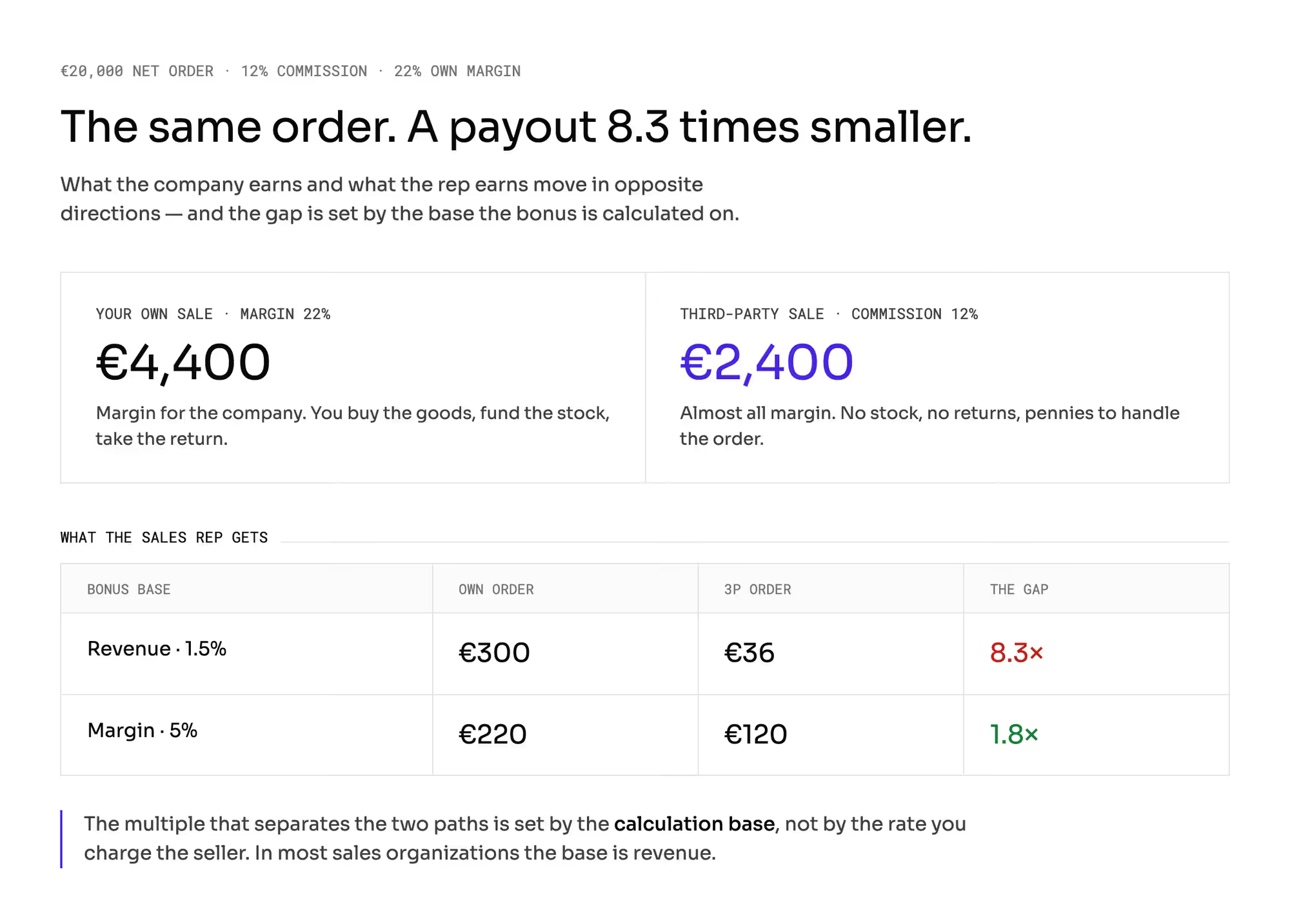
This series uses a €1,000 cart and a 12% commission as its standard example. Company orders are bigger. In this chapter, the cart is 20 times larger.
The order is €20,000 net, your commission is €2,400, and the seller keeps €17,600.
Compare the same buyer and the same sales rep on two kinds of orders. Your own sale at a 22% margin leaves you €4,400. A third-party sale leaves you €2,400 in commission.
Almost all of that commission is margin. You don't buy the goods, hold the stock, or take the return. The chapter on marketplace customer service works out the cost of handling one order, and it's small next to these amounts.
That's a decent trade for the company. The sales rep who has to sell it sees different numbers.
Say the rep earns a 1.5% bonus on the company's revenue from each order. That's €300 on your own order and €36 on a seller's order. The rep spends the same hour on the same conversation and earns 8.3 times less.
With a 5% bonus on margin, the rep gets €220 against €120. The gap falls to 1.8 times without any special marketplace rule.
The bonus base decides how big the gap is. The commission you charge sellers has little to do with it. Check the base first, because most sales organizations pay on revenue.
A rep who shows only your own goods under that plan does exactly what you pay them for. Economists have described this for decades. When someone has several tasks, and you only measure and pay for one, they put their effort into that one.
You see the same effect in how companies design sales bonuses. Companies design bonuses to push particular products. The bonuses keep pushing them even when no one planned it.
You measure this boycott by comparing numbers. Reps don't report offers they didn't show.
A missing offer doesn't show up in your data. Compare the share of third-party sales among buyers with an account manager and buyers who order by themselves.
If the first group is clearly lower on a similar assortment, you have your answer. You get it before the quarter closes. Otherwise, you spend a year hearing that the market doesn't want third-party offers.
Which 3 bonus designs can pay a rep for third-party sales?
Each design closes the payout gap, but each one causes a new problem. The table shows what each one pays on the same €20,000 third-party order.
Design (base the bonus is calculated on) | Sales rep payout on a €20,000 3P order (EUR) | Ratio to the payout on an identical order of your own (×) | Top-up out of your pocket on one order (EUR) | Main cost of the design (description) |
|---|---|---|---|---|
Revenue, starting state | 36 | 0.12 | 0 | the seller's offer never reaches the buyer |
Platform margin | 120 | 0.55 | 84 | margin known late; payout corrections |
Platform margin × multiplier of 1.8 | 216 | 0.98 | 180 | orders pushed to sellers; the multiplier becomes permanent |
Buyer revenue as the target, bonus unchanged | 36 | 0.12 | 0 | plan delivered, margin €180,000 a year lower per rep |
1. Bonus on margin instead of revenue
This is the cheapest change, and it works outside a marketplace too. It has two costs.
The margin on an order is sometimes known only after the sale. It arrives after a return, a correction or a supplier rebate. You either pay late or correct a payout you've already made.
The sales team also gets to see margin data or an estimate of it. That's a separate decision.
2. Multiplier for third-party sales
To level the two paths on a margin base, you need a multiplier of 1.8. €120 × 1.8 is €216, against €220 from your own sale.
The top-up is €96 per order. That's 4% of your commission on the order. At 5,000 such orders a year, you pay €480,000 of top-ups against €12 million of commission.
The multiplier tells your team that a euro from the marketplace is worth more. You'll also see orders pushed to sellers where your own sale was the better result. If the multiplier has no review date, the team will see it as base pay within a year.
3. Volume target that ignores where the goods come from
Here, the target counts the buyer's revenue. An order with a seller counts the same as your own. It costs you the least in cash, but it does the most damage.
Take a rep with a €6 million revenue target at a 22% margin. Hitting it delivers €1,320,000 of margin.
Now say 30% of the volume goes to third-party sales. That's €1.8 million, and the margin is €924,000 plus €216,000, or €1,140,000 in total.
The rep hits 100% of the plan, and you earn €180,000 less. Pair a volume target with a second number: the margin you made on that buyer.
What is the substitution rate and where is your threshold?
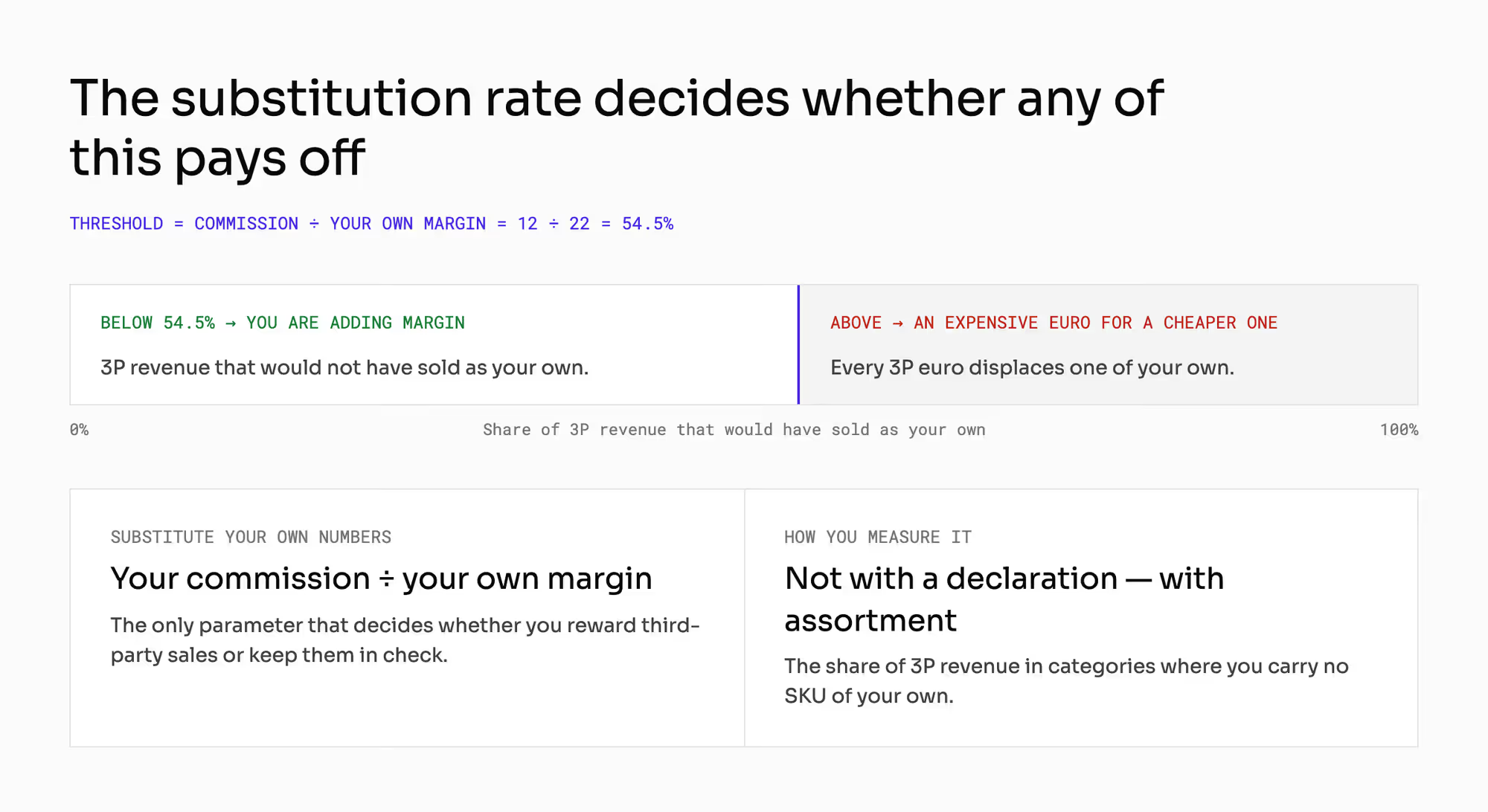
The numbers above assume the worst case. In that case, every euro from a seller replaces a euro of your own sales.
In practice, part of your third-party revenue comes from goods you don't stock and don't want to stock. That revenue is new and doesn't replace any of your own sales.
You can calculate the boundary. At a 22% margin and a 12% commission, shifting sales to sellers stops paying off once more than 54.5% of that revenue would have been your own sale. The threshold is 12 divided by 22.
If you stay below that threshold, you add margin. If you go above it, you swap your 22% margin for a 12% commission. Put in your own commission and margin to get your own threshold.
This threshold decides whether you reward third-party sales or hold them back. You won't measure it by asking people.
Measure it with your assortment instead. Look at the share of third-party revenue in categories where you have no products of your own.
Who books the result when two units work on one order?
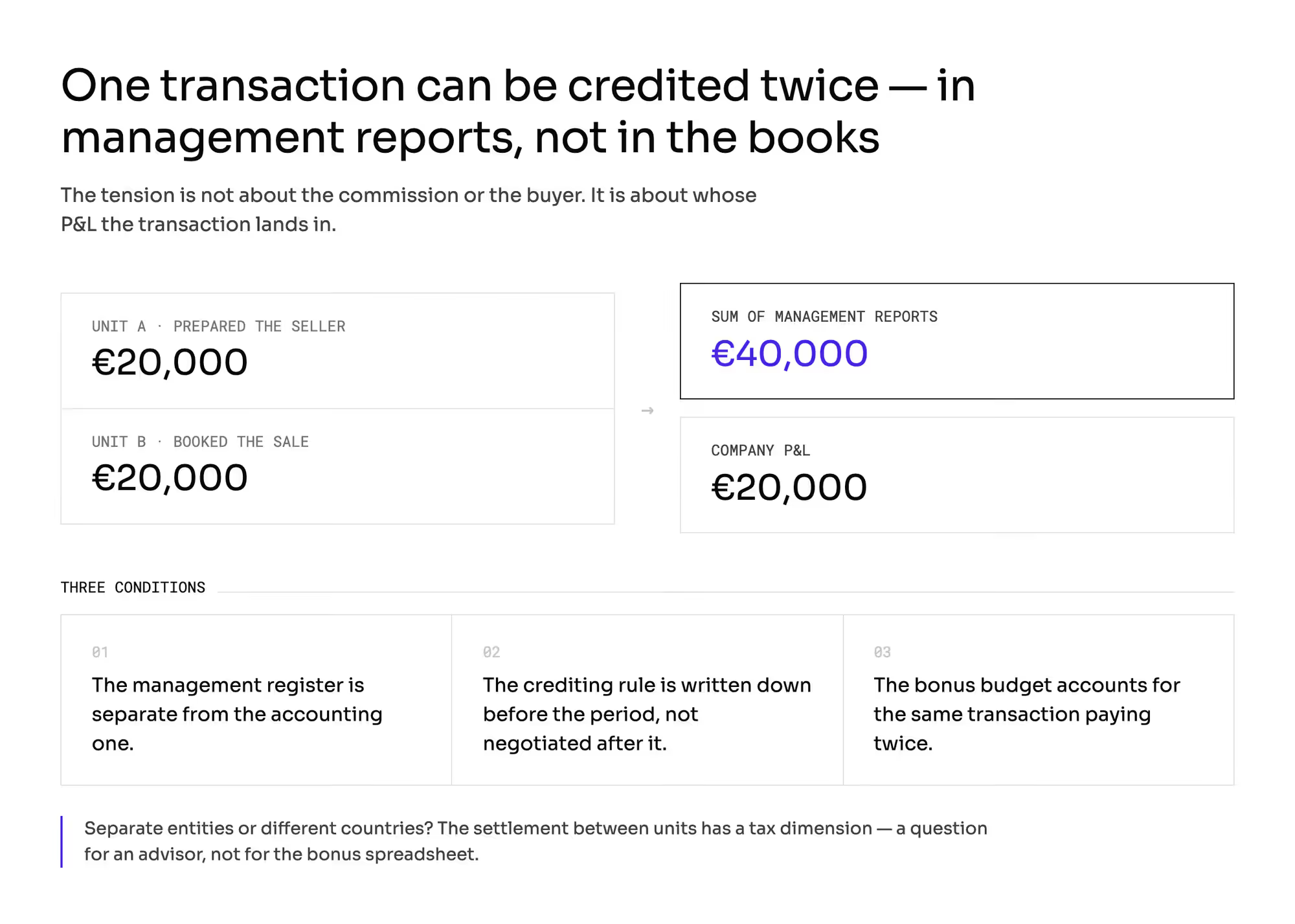
Practitioners say this causes more friction than anything else in the implementation. The question is whose P&L the order lands in.
Your sales team and your marketplace team each have their own plan. One product page and one cart still lead to one order. Both teams pull their own way, and the stronger side in the planning meeting wins.
The same thing happens between branches, segments and countries. The team that prepares a sale often isn't the team that books it.
One team got a seller ready to sell in another country and then answered that seller's phone calls. None of that revenue showed up in its own numbers.
No one has to sabotage it. The team just puts the preparation work at the bottom of its list.
One order can count for two units in the management reports and still appear once in the books. A €20,000 order then shows €40,000 across the unit reports and €20,000 in the company P&L.
It works under three conditions:
- The management reports are kept apart from the accounting books.
- The crediting rule is written down before the period starts, and no one renegotiates it afterwards.
- The bonus budget allows for the same order to be paid out twice.
If the units are separate legal entities or sit in different countries, the settlement between them has a tax side. Ask a tax advisor about it. You won't find the answer in your bonus spreadsheet.
What does a mixed order cost your account manager?
A company buyer has an account manager. They write to that person when one order arrives as two parcels on different dates.
The account manager stays the single point of contact and doesn't do the work. The case goes to your customer service channel. The account manager needs to know about it and doesn't need to handle it.
You can put a number on this. Take 200 mixed orders a month, and 8% of them lead to a question.
16 cases at 20 minutes each take 5.3 hours of account manager time a month. At €150 an hour, that's about €800.
The amount is small. But you're sending these cases to the most expensive person in the process. An hour of your support team's time costs a fraction of that.
Give the account manager a view of both parts of the order and the right to escalate. Keep them out of the support queue. The chapters on marketplace order splitting and the multi-vendor shopping cart cover how one order becomes several.
What can a sales rep not promise on a seller's offer?
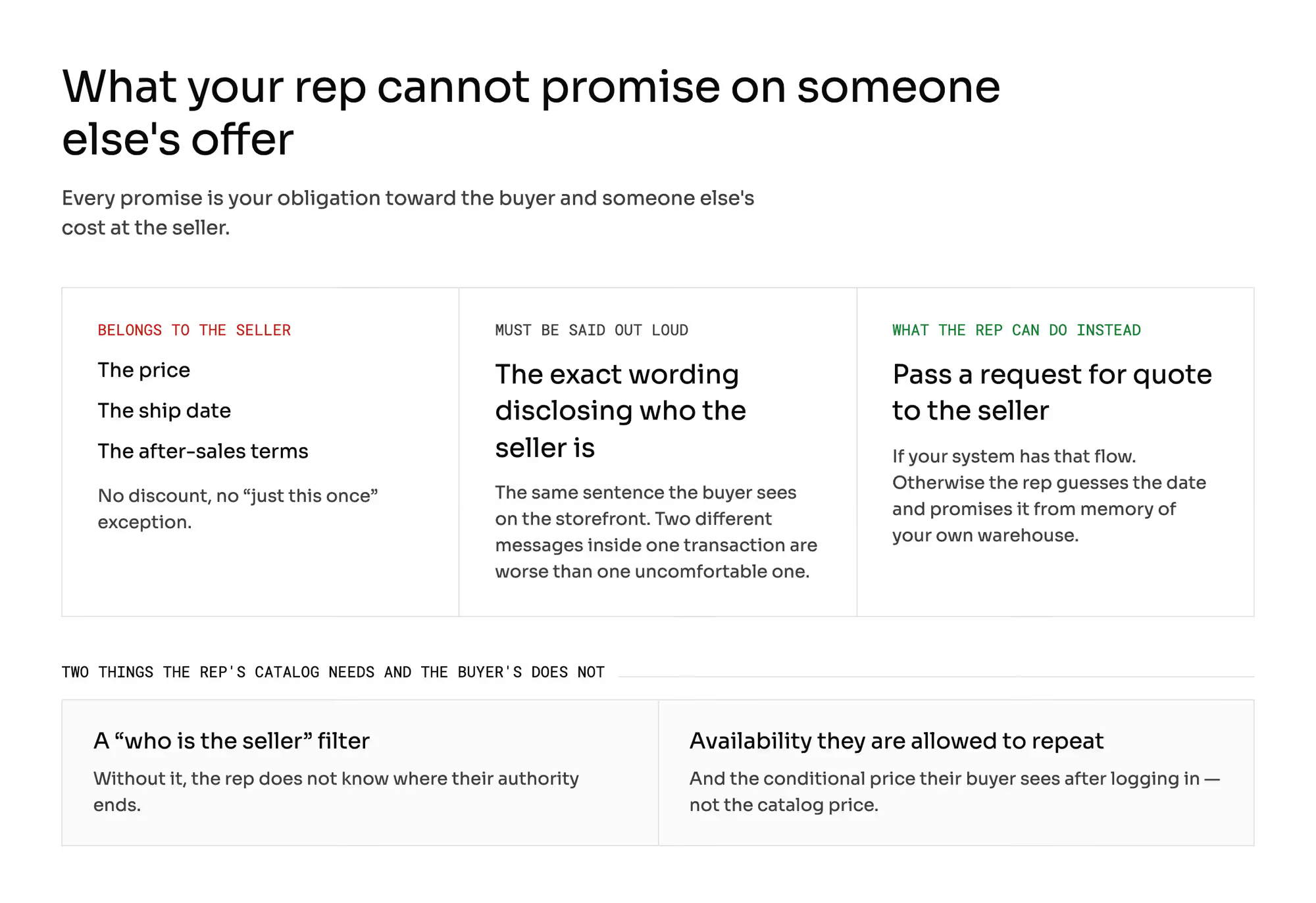
Reps are used to selling from your own warehouse. On someone else's offer, they promise things they don't control.
They promise the delivery date, the return terms, a discount, or a one-time exception. Each promise is your obligation to the buyer and a cost for the seller.
Put three things in the sales material before anyone picks up the phone:
- Which parts of the offer belong to the seller: the price, the dispatch date, and the after-sales terms.
- The exact sentence that tells the buyer who the seller is. It has to match what the buyer sees in your store, as the chapter on marketplace seller identity explains.
- What the rep can do instead of promising: send the seller a request for a quote. Your system has to support that flow.
The rep's catalog also needs two things the buyer's catalog usually lacks. One is a filter that shows who the seller is. The other is stock information the rep is allowed to repeat to the buyer.
Without the filter, the rep doesn't know where their authority ends. Without the stock information, they guess the date from what they know about your own warehouse. The chapter on marketplace buyer protection does the math on what your promise to the buyer costs.
In mature platforms, a seller's offer carries a default price and conditional prices. Those can apply to a buyer group, one organization, a channel, or a period. There's also a separate negotiation step before the order.
So the price a buyer sees after logging in may differ from the catalog price. The rep's tool has to show the price that applies to that buyer. The chapter on whether a marketplace can control seller prices covers whether you may negotiate the price of someone else's offer.
What does channel conflict change in your marketplace?
Channel conflict touches four parts of your build, and all four need a decision before launch.
1. Bonus plan
The bonus plan belongs in the implementation scope. If the bonus counts the platform's margin or the buyer's revenue, the system has to link every order to an account manager.
That's a data requirement. Design it together with the rest of your data model. The success metrics in the chapter on marketplace metrics need the same kind of planning.
2. Terms of employment
A change to the pay rules is a change to the terms of employment. It has its own procedure, form and notice period. Agree all three with a lawyer and with HR before you announce the new plan.
3. Seller commission
The commission you charge sellers is a separate topic. The chapters on how much commission a marketplace can charge and marketplace commission exceptions cover it. This chapter is about what your own people earn.
The chapter on marketplace seller recruitment covers finding sellers in the first place.
4. Data access and seller duties
The chapter on marketplace GDPR sets out the rules for a sales rep's access to order and buyer data. When you change seller terms, the P2B Regulation sets what you have to disclose.
How do you work out channel conflict on your own numbers?
Start with the bonus plan you already have:
- Write down the base of the bonus for every sales role. If it's revenue, you already know the cause.
- Calculate both payouts on one real order, your own and a third-party one of the same size. Show the result in euros.
- Calculate your substitution threshold as the commission divided by your own margin. Above it, the shift costs you money.
- Compare the third-party share among buyers with an account manager and buyers without one. The difference measures the boycott.
- Agree how orders are credited between units before the planning period. Write down that the unit reports add up to more than the P&L.
- Count the account manager hours that go into mixed orders. Compare them with the hourly cost of your support team.
Ask your platform vendor three questions:
- Does each order carry the account manager's identifier, and can you build a bonus report on it?
- Does the rep see the conditional price that applies to their buyer?
- Does your team see both parts of a mixed order in one view?
Which mistakes do operators make with channel conflict?
Each of these mistakes looks like weak demand in the report.
1. Bonus on revenue when the sale earns a commission
The seller's offer never reaches buyers served by your reps. Then your report shows it as a lack of interest in the market.
2. Multiplier with no review date
After a year, the team treats it as base pay. Lowering it turns into a conflict.
3. Volume target with no margin line
The plan is delivered, and the result is lower. No one can point to the moment it happened.
4. Crediting settled after the period closes
Preparation for another unit slides to the bottom of the list, and no one flags it.
5. Account manager as a support queue
Your most expensive staff hour gets spent on questions about a tracking number.
What do you still have to settle about your sales team?
This chapter doesn't set the commission you charge sellers, your customer service model, or the order split. Those topics have their own chapters, linked above.
It gives no pay benchmarks. Every number here is hypothetical.
You can reuse the arithmetic with your own numbers. Put in your own margin, your own commission, and your own bonus base.
It isn't legal or tax advice. Before you announce a new plan, ask about four areas:
- Employment law, for pay and for changes to the terms of employment.
- Personal data protection, if the rep sees data from other people's orders.
- Platform-to-business transparency rules, if your team affects how offers are shown.
- Transfer pricing inside a group, if you credit orders between entities or countries.
Summary: How do you pay your own sales team for third-party sales?
Pick a bonus base that doesn't pay less for the seller's offer. On revenue, a third-party order pays your rep 8.3 times less. The offer then never reaches the buyer.
On margin, the gap falls to 1.8 times. A multiplier can close the rest at a cost you can calculate.
Before you reward the shift, work out your substitution threshold: the commission divided by your own margin. Write down the crediting rule between units before the period starts. Keep account managers out of the support queue.
Ask a vendor whether every order records which account manager sold it. Building a marketplace your own sales team has a reason to sell?
Frequently asked questions on channel conflict
What is channel conflict?
Channel conflict happens when two channels that sell to the same customers compete for the same orders. On a marketplace, the most common case is your own sales team against third-party offers. The cause is usually a bonus plan that pays more for your own goods.
What is the difference between vertical and horizontal channel conflict?
Vertical channel conflict happens between levels of one distribution chain, and horizontal channel conflict happens between members at the same level. A brand arguing with its retailers is a vertical conflict. Two retailers of the same brand fighting over customers is a horizontal one. A company whose sales team competes with its own marketplace faces a third type, called multichannel conflict.
How do you manage channel conflict in eCommerce?
You manage channel conflict in eCommerce by paying people for the result the company wants. Base the sales bonus on margin instead of revenue, and add a multiplier with a review date if you need one. Then compare the third-party share among buyers with and without an account manager.
Ready to build?
We build marketplaces where every order carries the account manager who sold it, so your bonus report has the data it needs.