
Ecommerce Return Policy on a Marketplace: How Much Does One Return Cost?
An eCommerce return policy on a marketplace sets how long the buyer has, who pays for the return leg, and where the goods go back to, and the difficulty is that you write the promise while the seller carries most of what it costs.
The buyer judges your return policy before buying, and you pay for it a few weeks later. A marketplace adds a second difficulty.
The goods go back to someone you are bound to by a promise rather than to you, and not always by the cost of keeping it.
This article breaks down:
- When is a returnless refund cheaper?
- What does a longer return window buy?
- Who should pay for the return leg?
- Where should the goods go back to?
Key insights
- A returnless refund is cheaper below the price where recovery stops covering the return leg: €30 of handling against a 70% recovery puts that line at €43, and 1,800 shipments a year underneath it burn €16,200.
- A longer return window buys conversion and sells returns in the same gesture: 2.0% to 2.3% conversion against a 20% to 23% return rate leaves €196,650 instead of €180,000, and the gain ends where the returns outrun the sales.
- Who pays for the return leg sets the return rate: the buyer paying gives the lowest rate and the most friction in the cart, you paying needs a cost line of its own, and the seller paying needs a taxonomy that can attribute fault.
- The goods go back to one of four places, and the bill between them differs by a factor of two: nobody at €0, the seller at €30, one operator point at €42, a store at €20, and that consolidated point buys one criterion of condition for €120,000 a year.
Do you even want the returned goods back?
Giving the money back is settled elsewhere. Where you find the money once the seller already holds their €880, and which rail you send it on: that is explained in the chapter on who pays for a refund.
What happens to the commission and how you apportion fault: that is covered in the chapter on the commission on a refunded order. What the buyer is entitled to: that is set out in the chapter on who delivers the buyer's rights, and the length of the window the rules set is one for a lawyer rather than for this text.
That leaves the question those chapters never touch. What happens to the thing itself.
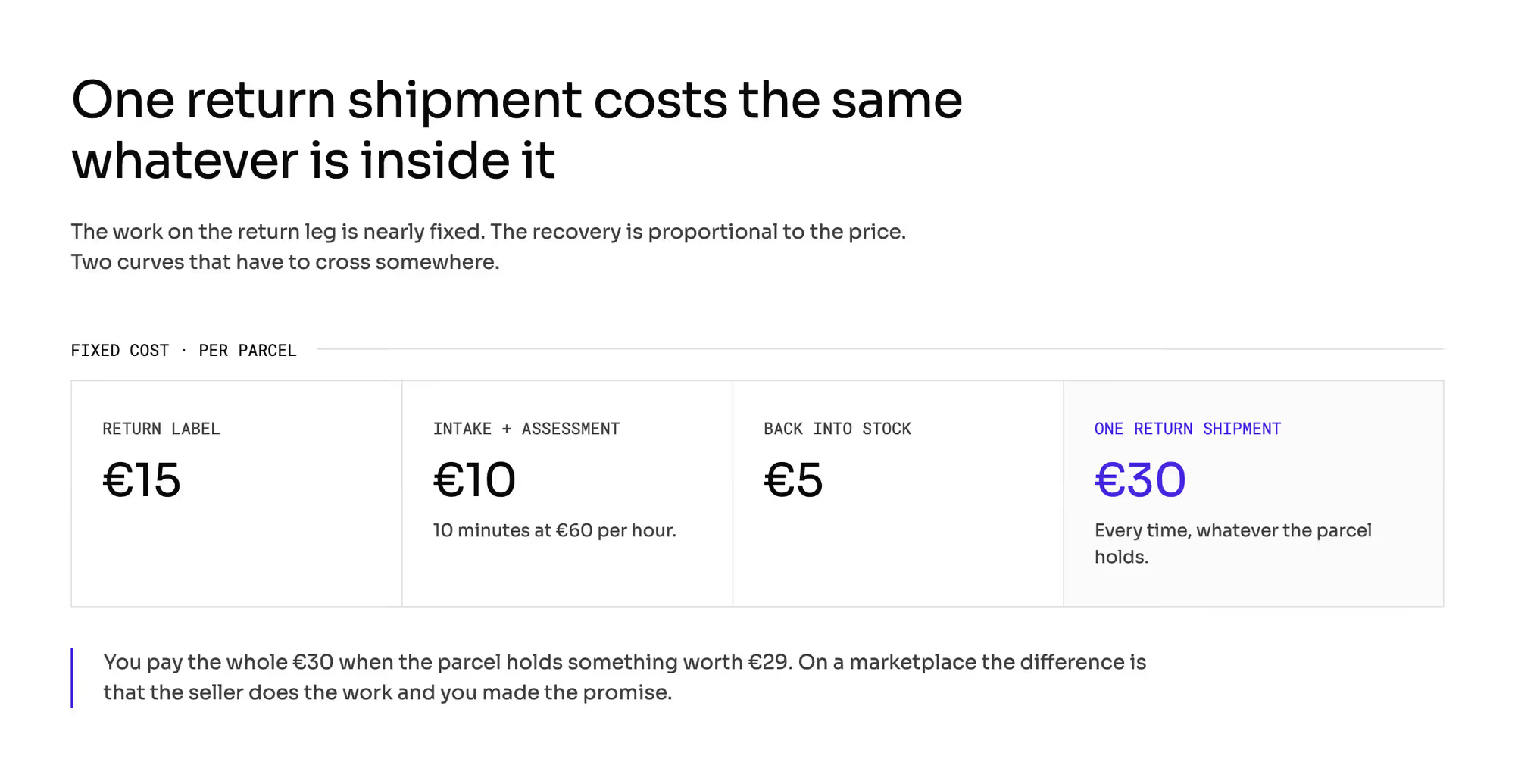
The return leg costs almost the same whatever is traveling on it. A return label, taking the parcel in, looking the goods over, putting them back into stock.
The work is nearly fixed, while the recovery is proportional to the price. Two curves that have to cross somewhere.
Put that fixed cost on the table. A label at €15, ten minutes of intake and assessment at an hourly cost of €60, so €10, and €5 to put the item back into stock.
In total, €30 for one return shipment. You pay it every time, including when the parcel holds something worth €29.
Returns handling gets estimated in the low single-digit percentages of turnover and is a services market of its own, because it is an operation of its own. The only new thing here is that the seller does the work and you made the promise.
When is a returnless refund cheaper than taking the goods back?
Returnless is the industry's word for this. It means one thing: you give the money back, and you do not ask for the goods.
It sounds like generosity. It is a cost decision the arithmetic forces on you.
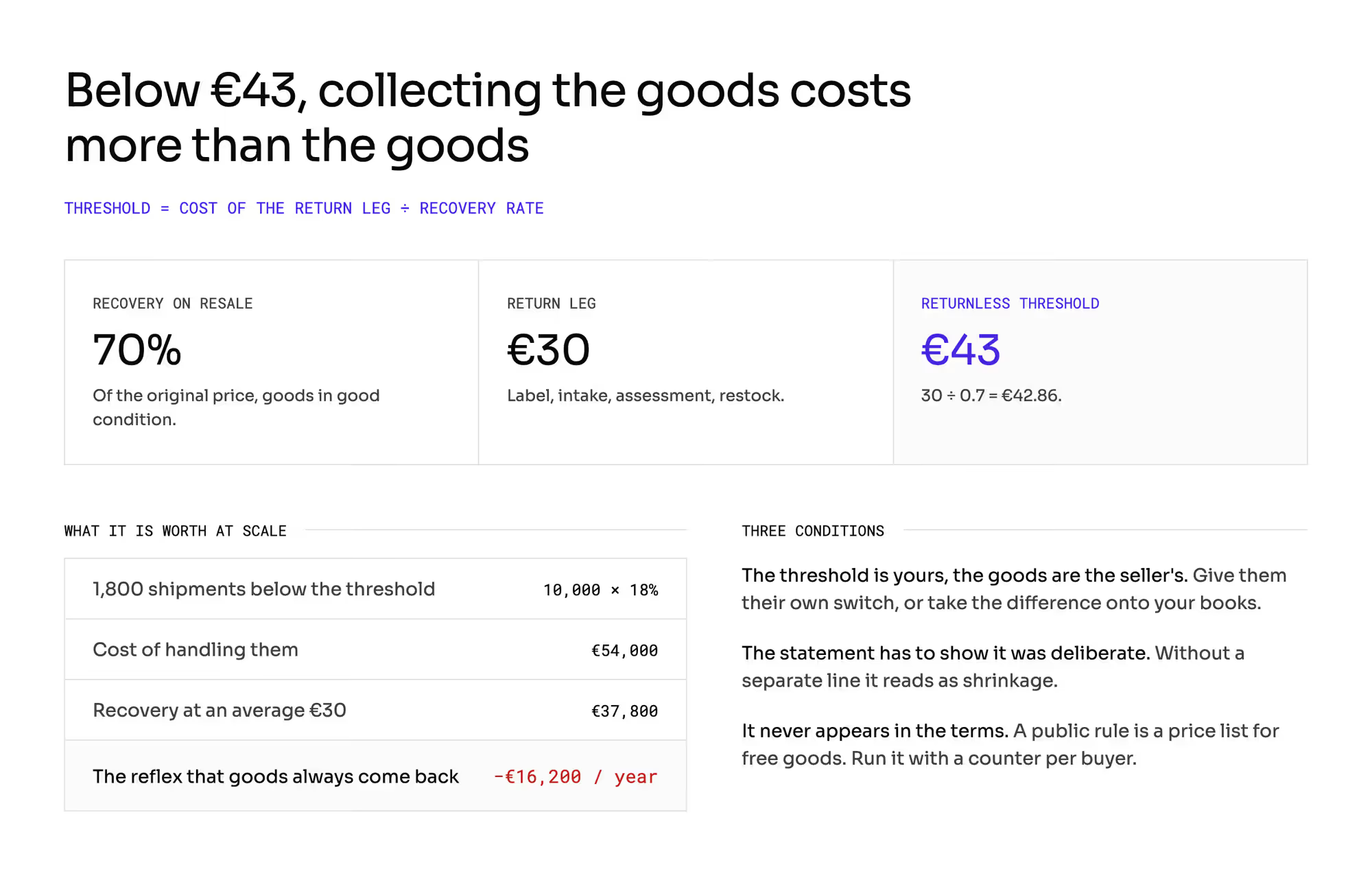
Assume goods coming back in good condition sell again at 70% of the original price. The recovery is then 0.7 times the price, and the return leg costs €30.
The two meet at 30 ÷ 0.7 = €42.86, call it €43. Below that price, sending the item back costs more than you get out of it.
Scale turns this into a budget line. At 10,000 returns a year, with 18% below the threshold, you have 1,800 shipments.
The cost: 1,800 × €30 = €54,000. The recovery at an average price of €30: 1,800 × €21 = €37,800.
The difference of €16,200 a year is the price of the reflex that says goods always come back.
Three conditions, without which the rule does damage:
The threshold is yours, but the goods are the seller's. Either you give them a switch with their own threshold, or you take the difference onto your books.
Giving away someone else's goods without the owner's consent ends in a statement they will refuse.
The settlement has to show that this was deliberate. The money goes back, and the goods do not.
Without a separate line on the statement, it reads as shrinkage.
A threshold said out loud to buyers stops being a cost rule and becomes a price list for free goods. The decision not to collect the item cannot be undone, because the thing is already with the buyer, and a public, deterministic rule hands everyone an instruction on how much they can take for free.
So the threshold runs with a counter per buyer, and it never appears in the terms as a promise.
What does a longer return window buy and sell?
Above the minimum, you can add a window of your own, and that is a commercial decision rather than a legal one. Work it out before marketing announces a number.
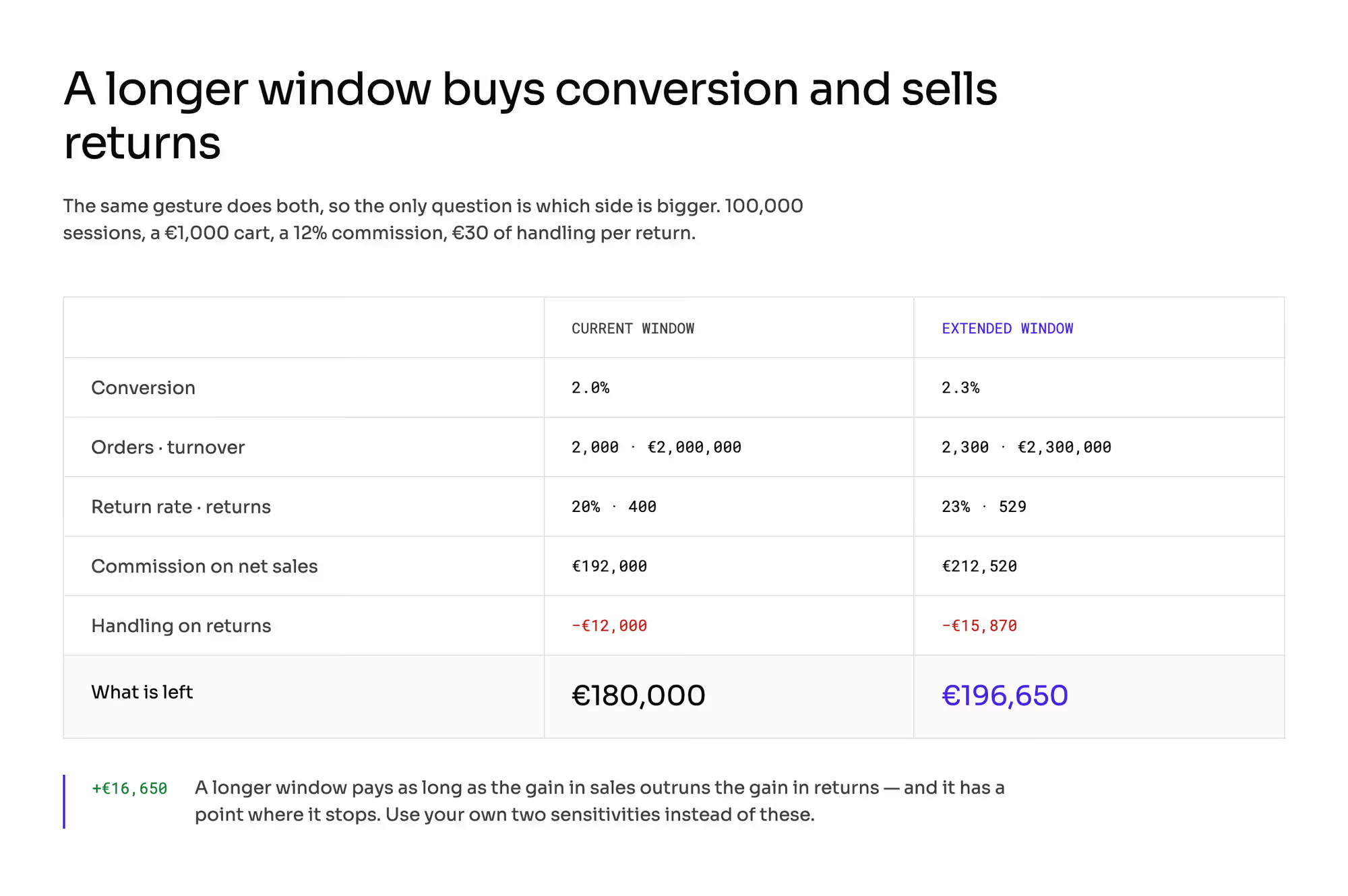
A longer window buys conversion and sells returns. The same gesture does both, so the question is which side is bigger.
Take 100,000 sessions and a €1,000 cart. At 2.0% conversion, you have 2,000 orders, so €2,000,000 of turnover.
At a 20% return rate, 400 orders come back, so net sales are €1,600,000, a 12% commission gives €192,000, and 400 returns at €30 of handling take away €12,000. That leaves €180,000.
Extend the window and assume 2.3% conversion and a 23% return rate. There are 2,300 orders and €2,300,000 of turnover, 529 returns, net sales of €1,771,000, a commission of €212,520, and handling costs of 529 × €30 = €15,870.
That leaves €196,650, which is €16,650 more.
A longer window pays as long as the gain in sales outruns the gain in returns, and it has a point where it stops. Use your own two sensitivities instead of ours.
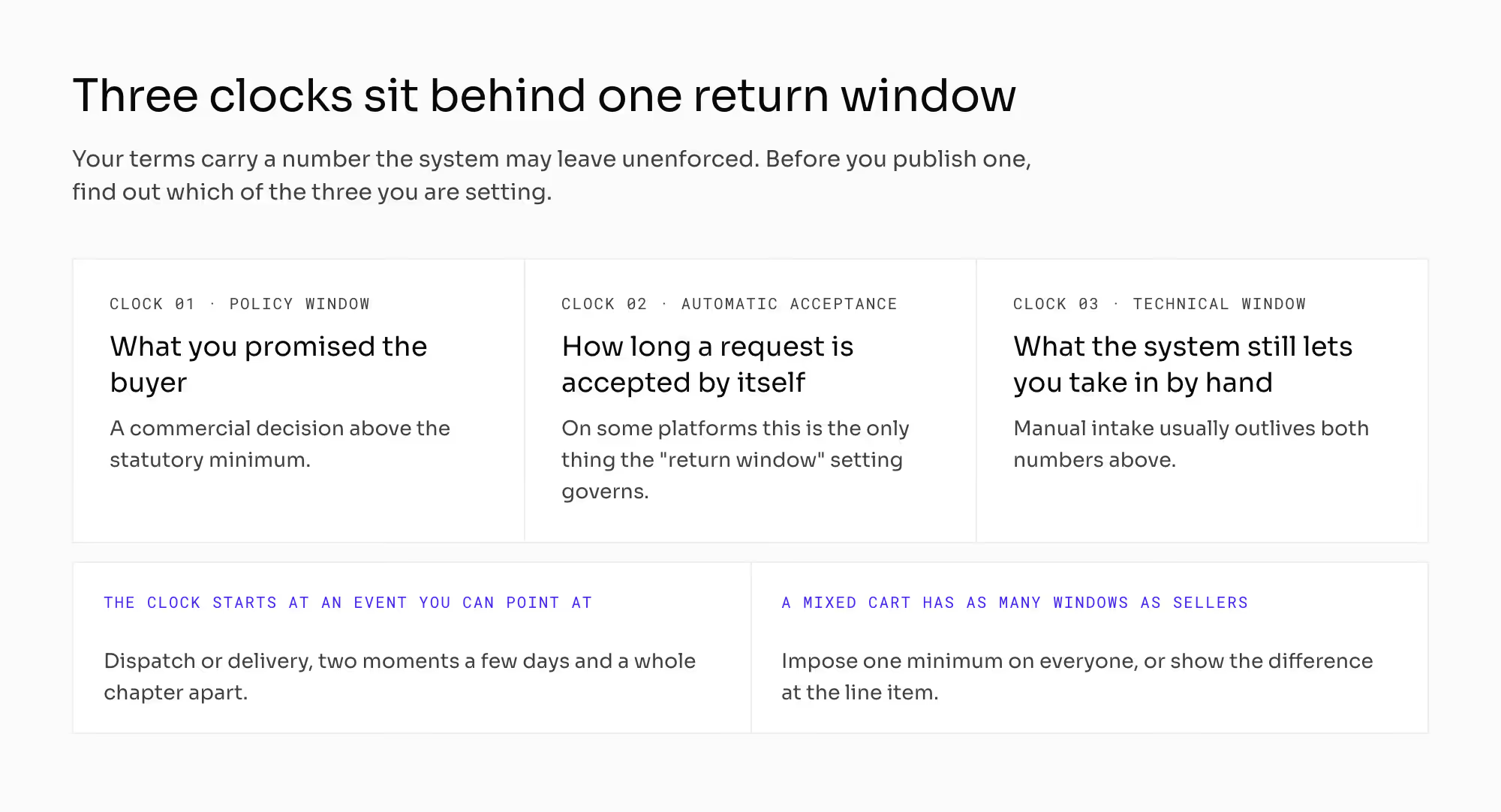
Three mechanical traps come with it:
There are three clocks rather than one. The policy window, the window for automatic acceptance of a request, and the system's technical window are different things.
On some platforms, the setting called "length of the return window" governs one thing only: whether a request is accepted by itself. After that, the return can still be taken in by hand.
Your terms then carry a number the system does not enforce.
The window runs from an event you must be able to point at. Dispatch or delivery, and those two moments are a few days and a whole chapter apart (when an order counts as delivered).
In a mixed cart, there are as many windows as sellers. The buyer sees one summary, and behind it stand two different policies plus your own sales.
Either you impose one minimum on everyone, or you show the difference at the line item.
Who should pay for the return leg?
The statutory minimum settles who bears the cost of sending the goods back. That is who pays for a refund.
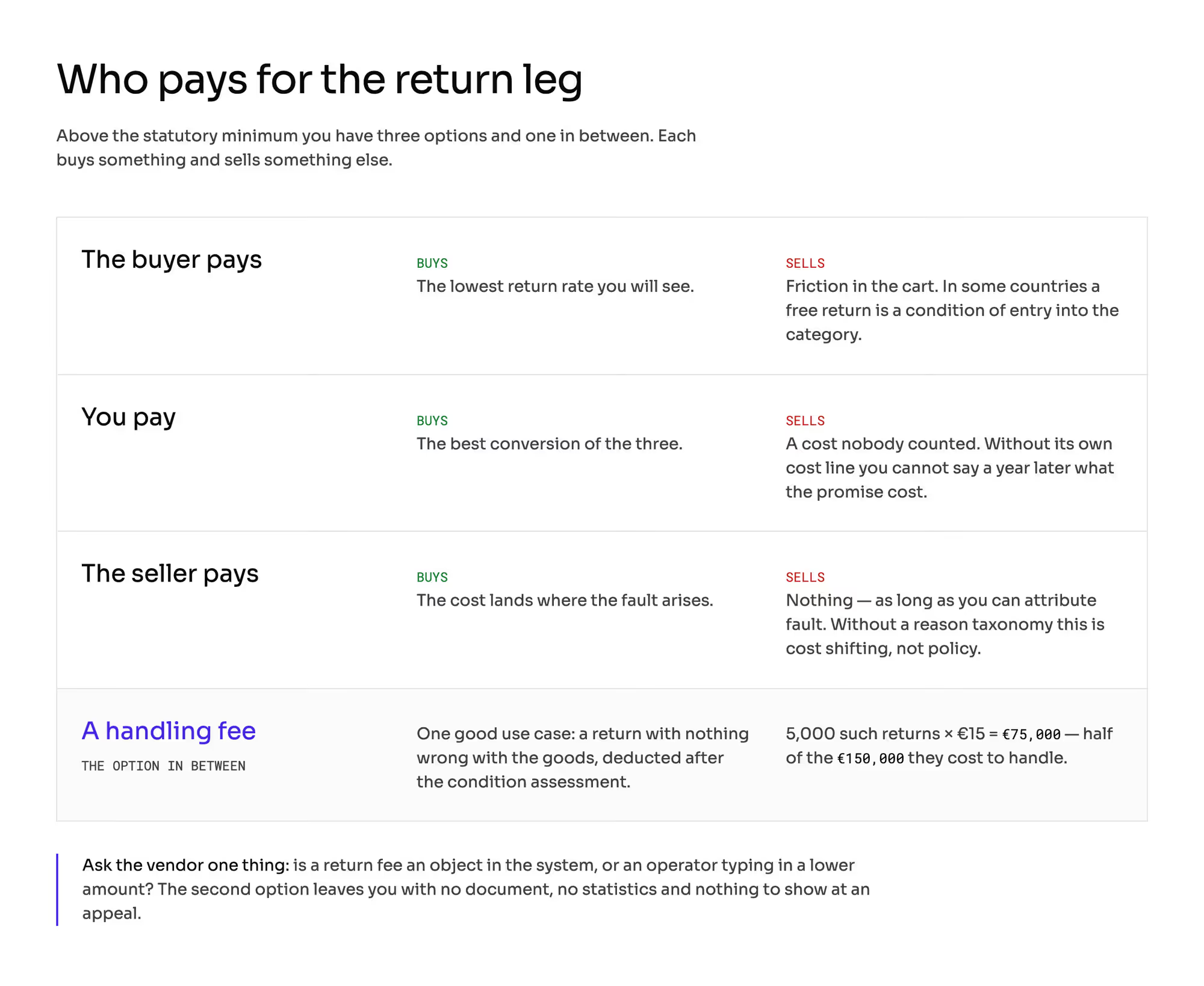
Above the minimum, you have three options, and each buys something different.
The buyer pays: the lowest return rate and the highest friction in the cart. In some countries, a free return is a condition of entry into the category rather than an advantage.
Multi-country operators then write it in as an obligation on sellers extending their offer into that market. The return policy becomes a gate on expansion.
You pay: the best conversion and a cost nobody has counted. A free return needs a cost line of its own.
Without one, a year later you cannot say what that promise cost you.
The seller pays: the cost lands where the fault arises (as long as you can attribute it). Without the taxonomy from the next section, this is cost shifting rather than policy.
A handling fee is the option in between, and it has one good use case: a return with nothing wrong with the goods, deducted after the condition assessment, covering part of the return leg. At 5,000 such returns a year and a fee of €15, that is €75,000, half of what handling them costs (5,000 × €30 = €150,000).
Whether you may charge it, and when, is a question for a lawyer rather than for a vendor.
The question to the vendor settles more here than it looks: is a return fee an object in the system, or a manual reduction of the amount? Some platforms have no return-fee management at all, and the only route is an operator typing in a lower figure.
You then have no document, no statistics, and nothing to show at an appeal. What you have is a discretionary decision by an employee on every parcel.
Which 4 return legs can the goods take?
The return address looks like a field in configuration. It is a choice of operating model.
Return leg | Cost of one shipment (€) | Time from request to condition assessment (days) | Who looks at the goods (role) | When to choose it (condition) |
|---|---|---|---|---|
Returnless | 0 | 0 | nobody | line item priced below the threshold, repeatable reason |
To the seller | about 30 | 3 to 6 | the seller | the default model, a typical assortment |
To one operator point | about 42 (30 plus onward transport) | 2 to 4 | your team | uniform assessment, disputes over condition |
To a physical store | about 20 | 1 to 2 | store staff | you have a network, and you want the buyer's visit |
A consolidated point buys consistency of assessment and sells money. The extra hop at 10,000 returns a year and €12 for transport on to the seller is €120,000.
What you get is one criterion of condition instead of several hundred. What you take on is physical handling of someone else's goods, one of the factors weighed in assessing your status as an intermediary (whether you are an intermediary or a seller).
A return in store is a separate model rather than a convenience. Your staff takes in a thing they did not sell into a warehouse with no record of it, and they have to know who to send it to and who pays for that.
Without that, you get a shelf of goods with no owner.
Why is a return reason a cost driver?
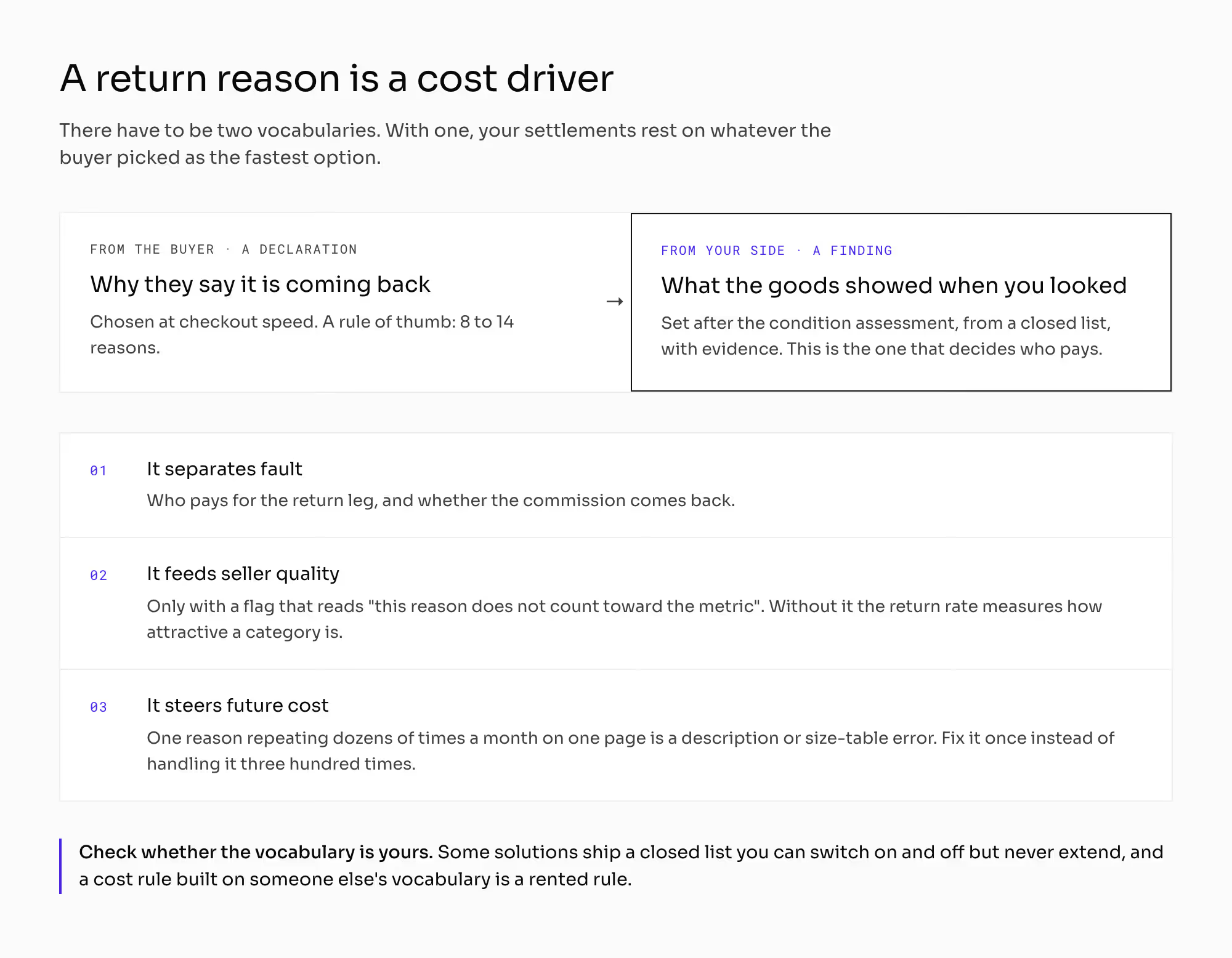
There have to be two reasons. The first comes from the buyer and is a declaration. The second is set by your team or the seller after looking at the goods, and it is a finding.
With one vocabulary, your settlements rest on whatever the buyer picked as the fastest option. The taxonomy does three things at once, and only that makes it worth the work:
- It separates fault, deciding who pays for the return leg and whether the commission comes back. The commission on a refunded order runs the mechanics of that second question.
- It feeds seller quality, but only when you can drop some reasons from the count. A change of mind says nothing about the seller. Damaged packaging says everything. The flag that reads "this reason does not count toward the metric" matters more here than the length of the list. Without it, the return rate measures how attractive a category is, and the thresholds from seller quality land on the wrong people.
- It steers cost in the future. A reason repeating several dozen times a month on one product page is usually a description or size table error. Fix it once instead of handling it three hundred times.
Check whether the vocabulary is yours. Some solutions ship a closed list of reasons: you can switch entries on and off, but not add your own. A cost rule built on someone else's vocabulary is a rented rule. A rule of thumb: 8 to 14 reasons on the buyer's side.
Who assesses the condition of returned goods?
The condition assessment is a decision separate from accepting the return, and it needs a record of its own: conforming or not conforming. Where it is not, the record carries a reason from a closed list and evidence.
Without that, you have no basis for reducing the amount, and none for a conversation about abuse.
It is usually done by the seller, the party with an interest in the outcome. That does not disqualify the model, but it forces three things: visual evidence of a negative assessment, a deadline for making it, and a route of appeal for the buyer.
What does a return policy change about the rest of your build?
1. A return policy goes into the contract with sellers as well as into the terms for buyers
Who pays for the return leg, what threshold applies to a returnless refund, and how long the seller has to assess condition are terms of cooperation. Changing them takes notice and a reason (the rules on decisions about sellers).
2. Return rate becomes a parameter in choosing the assortment
A category with a high return rate and a low unit price is expensive, whatever the commission.
3. Return data improves the catalog more cheaply than an audit
Catalog quality is explained in the chapter on what you can enforce on content, and every return produces a document rather than only a transfer. The correction and its period are covered in the chapters on who issues which invoice and corrections and credit notes.
How do you work out your own return threshold?
- Measure the cost of one return shipment in your own operation: the label plus the minutes of handling times the rate plus putting the item back into stock. Everything else follows from that figure.
- Establish the recovery as a percentage of price for three typical categories. The cost divided by the recovery is your threshold.
- Count how much of your return volume falls below the threshold. Below a few percent, do not build the rule. It will not pay for itself.
- Separate the two reason vocabularies and mark which ones do not count toward seller quality.
- Choose the return leg per category rather than globally. Heavy equipment and a €30 trinket do not share an answer.
- Ask the vendor four things: whether a return fee is an object or a manual correction of the amount · whether the reason vocabulary is editable and whether a reason can be excluded from the metric · whether the return address is set per seller and category · what exactly the "return window" controls.
- Set one alarm: the share of returnless refunds rising two months in a row.
Which mistakes do operators make about return policies?
1. A policy announced before anyone counted the cost of the return leg
The number lands on the site, the cost on the sellers, the unhappiness back on you.
2. One window for the whole assortment
Short shelf-life goods and high-value equipment have opposite risk profiles.
3. The returnless threshold as a promise in the terms
A cost rule turns into an instruction on how much can be had for free.
4. A return reason from one vocabulary, filled in by the buyer
Quality metrics and decisions about money then rest on that declaration.
5. A return in store with no path for the goods to get back to the seller
The model works for the buyer from day one and stops working for you after a month.
What do you still have to settle about your own return policy?
This article does not say what the buyer is entitled to, or for how long. That is set out in the chapter on who delivers the buyer's rights, and the length of the window the rules set is one for a lawyer to confirm.
This article does not describe a dispute over a defect or over conformity of the goods, because a return is a change of mind and a complaint is a dispute about the thing itself. That is explained in the chapter on who decides a disputed case.
This article does not describe the mechanics of giving money back (who pays for a refund), the fate of the commission (the commission on a refunded order), or a payment dispute (chargebacks and an empty seller balance).
Families of regulation worth asking a lawyer about with this list in hand:
- consumer protection in the part about withdrawal from the contract and information duties. That is the source of the minimum window, the cost of sending goods back, and what the buyer is told before the purchase.
- the rules on reducing a refund for diminished value of the goods. That is where the limits on condition assessment and the handling fee sit.
- regulations on transparency in the relationship between a platform and its sellers. That governs how you impose policy on sellers and justify decisions.
- fairness in commercial communication. This one bites the moment you present "free returns" as a benefit.
- product liability and product safety, when a damaged or recalled item comes back (whether you are an intermediary or a seller and product safety and recalls).
- personal data protection, covering the return address and the buyer's details held by the seller (who controls the personal data).
Every number above is openly hypothetical. The arithmetic travels, and the values do not: put in your own cost of a return shipment and your own recovery, because every conclusion depends on them.
Summary: How much does one return cost you?
More than the label, and the gap is where the policy gets decided. A return leg is close to fixed: the label, ten minutes of intake and assessment, putting the item back into stock, around €30, whatever is in the parcel.
Recovery is proportional to the price, so the two curves cross, and below that crossing point you are paying to collect goods worth less than the collection. Everything else in a return policy hangs off the same arithmetic.
The window you announce buys conversion and sells returns at once. The return address is an operating model rather than a field.
The reason the buyer picks is a declaration, and the reason your team records after looking at the goods is a finding, so settlements built on the first one rest on whatever was fastest to click.
Ask a vendor whether a return fee is an object in the system or an operator typing in a lower figure, and whether the list of reasons is yours to edit. Building a marketplace where the return policy is costed per category rather than announced for the whole catalog?
Frequently asked questions on an eCommerce return policy
What is a return policy on a marketplace?
A return policy on a marketplace is the rule that sets the window, the cost of the return leg, and the address the goods travel to. The part that makes it a marketplace question is the split between who promises and who pays: you write the policy for the whole platform, and the seller carries the handling on every parcel that comes back.
Who pays for return shipping on a marketplace?
Return shipping is paid by the buyer, by you, or by the seller, and each answer buys something different. The buyer paying gives the lowest return rate and the most friction in the cart; you paying needs a cost line of its own or the promise disappears into general costs; the seller paying works only where you can attribute fault to a reason recorded after the goods were examined.
What is an RMA process?
An RMA process is the return merchandise authorization step that turns a buyer's request into an approved return with a number on it. On a marketplace, that number carries two decisions the buyer never sees: which return leg the parcel takes, and who assesses the condition once it arrives, which is the only moment anybody looks at the goods.
Ready to build?
We build marketplaces where the return leg, the threshold and the reason vocabulary are set per category, and every return leaves a record of who assessed it.