
Marketplace Dispute Resolution: How to Settle a Dispute Between a Buyer and the Seller?

Marketplace dispute resolution is the process in which you settle a disagreement between a buyer and a seller who pays you a commission, which makes the design of the process a question of your own conflict of interest rather than a question about an inbox.
A complaint is the only matter on your platform where you settle a dispute between two parties. One of them pays you a commission.
If you do not design the process around that conflict, you will design it around convenience, and convenience here always has the same beneficiary.
This article breaks down:
- Which 4 things arrive in the same inbox?
- Which 3 arrangements can decide a case?
- When should a dispute hold a payout?
- Who closes a dispute?
Key insights
- The four things arriving in the same inbox are a question, a return inside the withdrawal window, a disputed case, and a payment claim, and sorting 4,000 messages by hand instead of classifying them at intake costs 113 hours a month.
- The three arrangements are the seller deciding alone, you as the first instance, and you as the appeal instance: at 600 cases a month they put 10, 200, and 40 hours on your desk, and the third one works only with a written threshold.
- A dispute should hold a payout only when an amount is in dispute, and the scope of that hold decides everything: €264 on the line, €880 on the order, or €38,720 on the balance, which is close to a hundred and fifty times the amount being argued over.
- Closing a dispute belongs to anybody except the party the allegation is about, and the word hides three outcomes: agreed between the parties, decided by you, and expired on a clock whose default beneficiary is the seller who pays you a commission.
Why does a marketplace decide disputes in a conflict of interest?
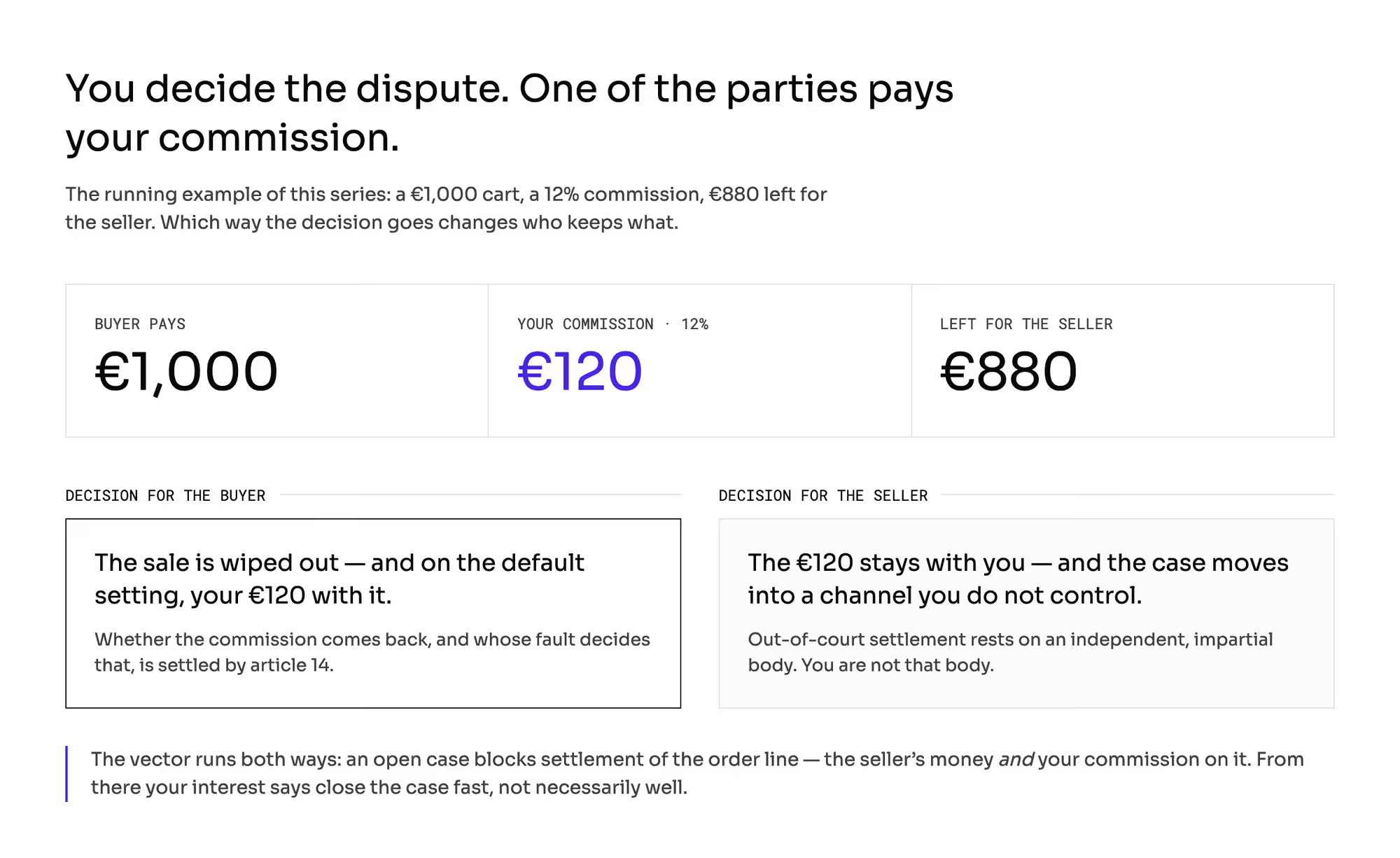
In every other decision, you stand beside the case. Here you stand inside it: on the side that funds your revenue.
Take the running example of this series: a €1,000 cart, a 12% commission, €880 left for the seller. A decision in the buyer's favor wipes out the sale, and on the default setting in most systems it wipes out your €120 as well.
Whether the commission comes back, and whose fault decides that, is settled by the commission on a refunded order. A decision in the seller's favor leaves the €120 with you and moves the case into a channel you do not control.
Work out your exposure, because it is one number. At 600 disputed cases a month and an average disputed value of €400, your own team decides on €240,000 a month.
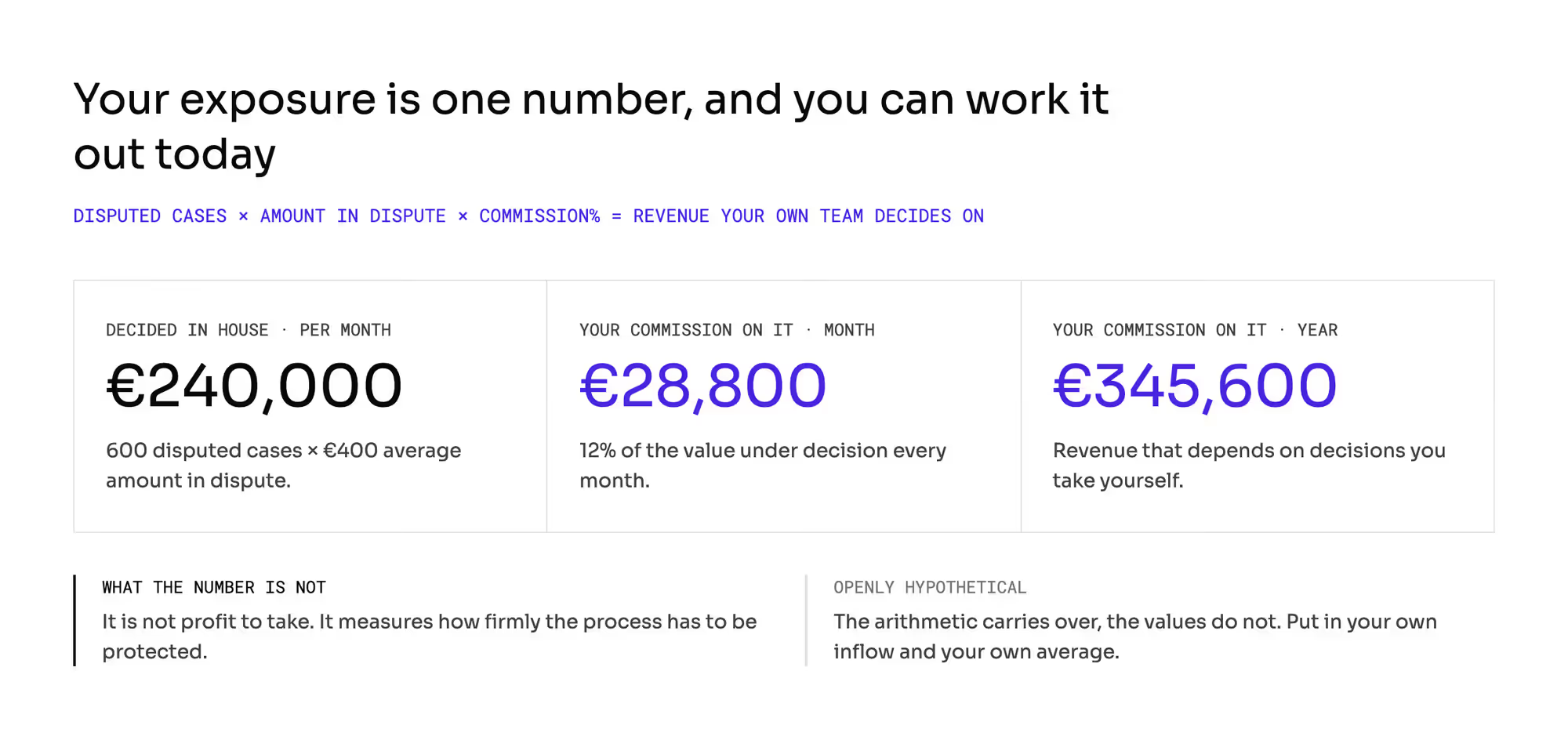
Your commission on that amount is €28,800 a month and €345,600 a year. That is how much revenue depends on decisions you take yourself.
That figure measures how firmly the process has to be protected rather than the profit you can take.
There is also a vector running the other way, and almost nobody thinks about it. In typical systems, an open case blocks settlement of the order line.
The block covers not only what the seller is owed but your own commission on that line. At that point, your interest tells you to close the case fast rather than well.
So the conflict runs both ways, and that is why you cannot leave it to itself.
You cannot remove the conflict. You can hold it down with three things.
Separating roles: whoever negotiates rates and volume with a seller does not decide a dispute that seller is a party to. Closed lists of reasons and outcomes, instead of discretion exercised case by case.
And a trail that can still be reconstructed a year later. Out-of-court settlement of consumer disputes rests by definition on a body that is independent and impartial.
The market knows that mechanism as ADR. You are not that body, and there is no point pretending you are.
What is worth doing is designing the process so the outcome can still be defended.
Which 4 things arrive in the same inbox as a dispute?
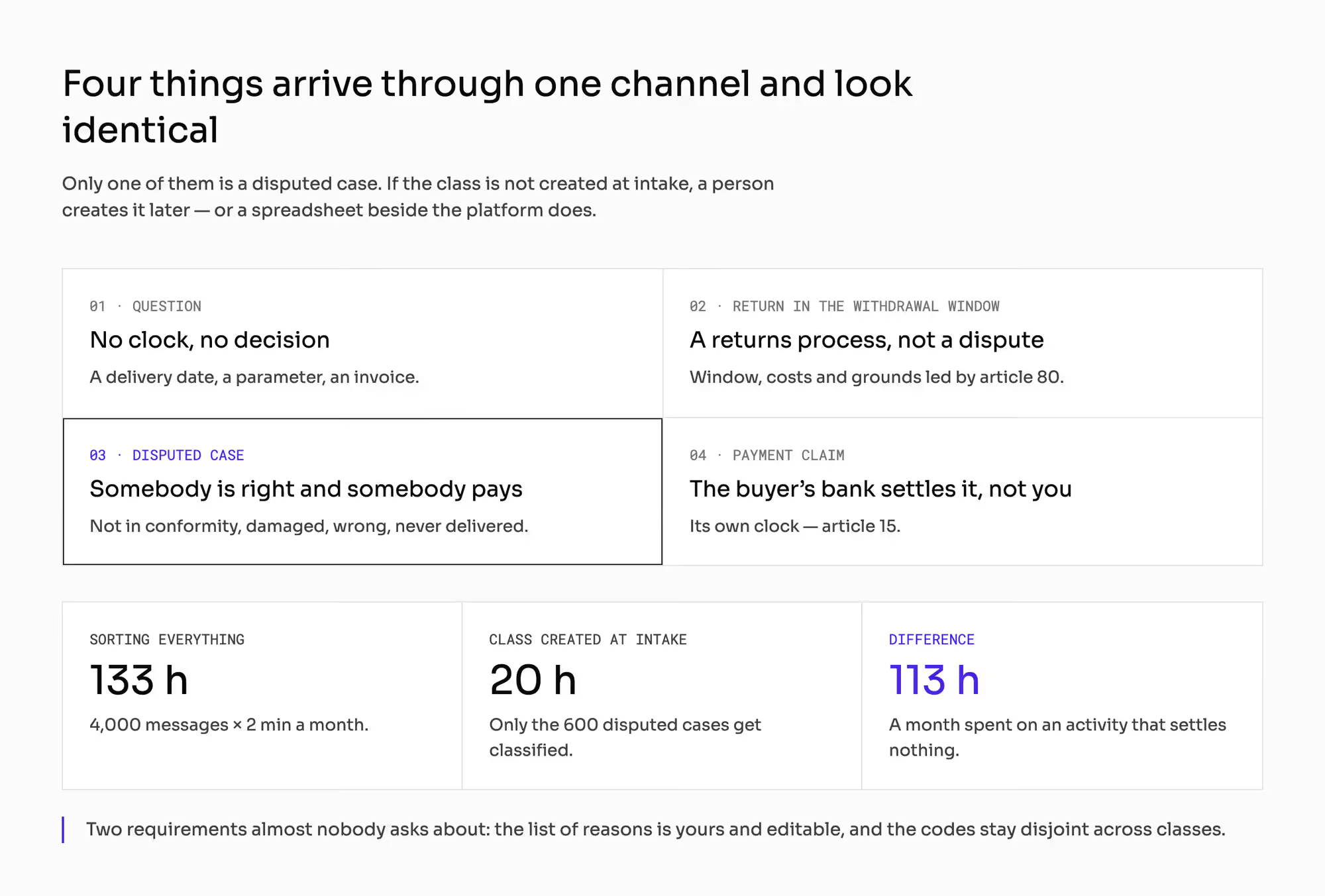
Four things arrive through the same channel and look identical:
- A question. About a delivery date, a parameter, an invoice. There is no clock on it, and it does not end in a decision.
- A return claimed inside the withdrawal window. A returns process rather than a dispute. The window, the costs, and the grounds are led by the return window and who pays for the return leg.
- A disputed case. Goods not in conformity, damaged, the wrong ones, never delivered. Somebody is right, and somebody pays.
- A payment claim. The buyer's bank settles it rather than you, and it runs on its own clock (chargebacks and an empty seller balance).
The market throws all four into one bucket, and that is a real gap rather than an interface detail. Practitioners on large implementations say it plainly: a message about an order and a complaint land in the same inbox with no attribute that tells them apart.
So a person sorts them, or an export into a system beside the platform does.
The cost can be counted. At 4,000 messages a month and two minutes to classify one case, sorting costs 8,000 minutes, which is 133 hours.
If the class is created at intake, you only classify the 600 disputed cases: 1,200 minutes, which is 20 hours. The difference is 113 hours a month spent on an activity that settles nothing.
The class has to be a field rather than a guess, and the dictionary of reasons has to be yours. Two requirements almost nobody asks about: whether the list of reasons can be edited, and whether the codes are disjoint across classes.
The same code used once as the reason for a message and once for a disputed case breaks everything downstream that reads the data. What to call the entitlement behind a case, and how withdrawal from the contract differs from a conformity problem, is led by who delivers the buyer's rights.
Which 3 arrangements can decide a marketplace dispute?
1. The seller decides alone
The cheapest and fastest arrangement, and the one where the party with a stake in the outcome decides. It works only under statistical oversight, never case by case.
2. You as the first instance
The best control over the brand and the worst bill. It also has an effect that costs never show: the more you perform on the seller's behalf, the more you look like the party who owes it.
The chapter on whether you are an intermediary or a seller describes that mechanism.
3. You as the appeal instance
The default recommendation, on one condition: the threshold for entry is written down in advance. The amount in dispute, how long the seller stays silent, how often the same case repeats with the same seller.
What does each way of deciding a dispute cost? | The seller decides alone | You as first instance | You as appeal instance |
|---|---|---|---|
Cases reaching your team (% of 600 a month) | 5 | 100 | 20 |
Work on your side (hours a month, 20 min per case) | 10 | 200 | 40 |
Time to first reply for the buyer | depends on the seller | yours, measurable | depends on the seller |
What you control | the distribution of outcomes rather than a single case | everything | cases above the threshold |
Main risk | a party to the dispute decides it | cost, and taking over the seller's role | a threshold set too high cancels the arrangement |
And one thing the design has to keep apart: who decides is a different question from who pays. If you decide and the seller funds it, your decision has to reach them with evidence and reasons.
Otherwise, it is indistinguishable to them from an arbitrary call. The form of a decision toward a seller and its service is led by the rules on decisions about sellers.
How many clocks run on a disputed case?
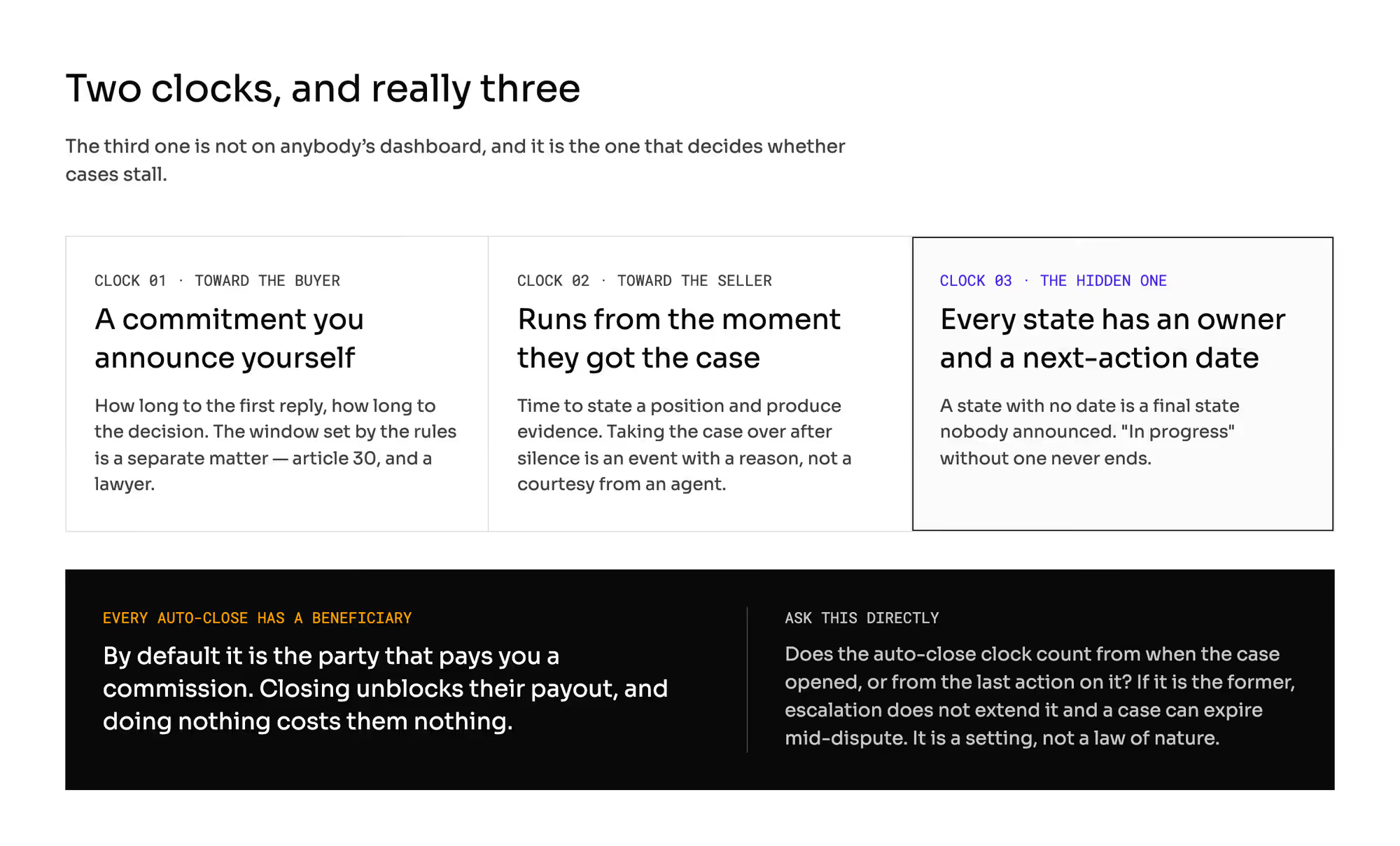
The clock toward the buyer is a commitment you announce yourself: how long to the first reply and how long to the decision. The window set by the rules is a separate matter, and its length is one to confirm with a lawyer.
The chapter on who delivers the buyer's rights covers that mechanism.
The clock toward the seller runs from the moment they got the case: how long they have to state a position and produce evidence. Taking a case over after their silence has to be an event in the process with a reason rather than a courtesy from an agent.
Whose money you then pay out of is settled by who delivers the buyer's rights.
The third clock is hidden, and it decides whether cases stall. A state of "in progress" with no date for the next action never ends.
The design rule fits in one sentence: every state of a case has an owner and a date for the next action; a state with no date is a final state nobody announced.
And a warning that counts for more in this category than the rest: every automation that closes a case on a timer has a beneficiary. Check who it is on your platform, because by default it is the party that pays you a commission.
Closing unblocks their payout, and doing nothing costs them nothing. On top of that sits a known piece of construction: the auto-close clock is sometimes counted from when the case opened rather than from the last action on it.
Escalation then does not extend it, and a case can expire mid-dispute, settled by nobody. Ask about this directly.
It is a setting rather than a law of nature.
When should a dispute hold a seller's payout?
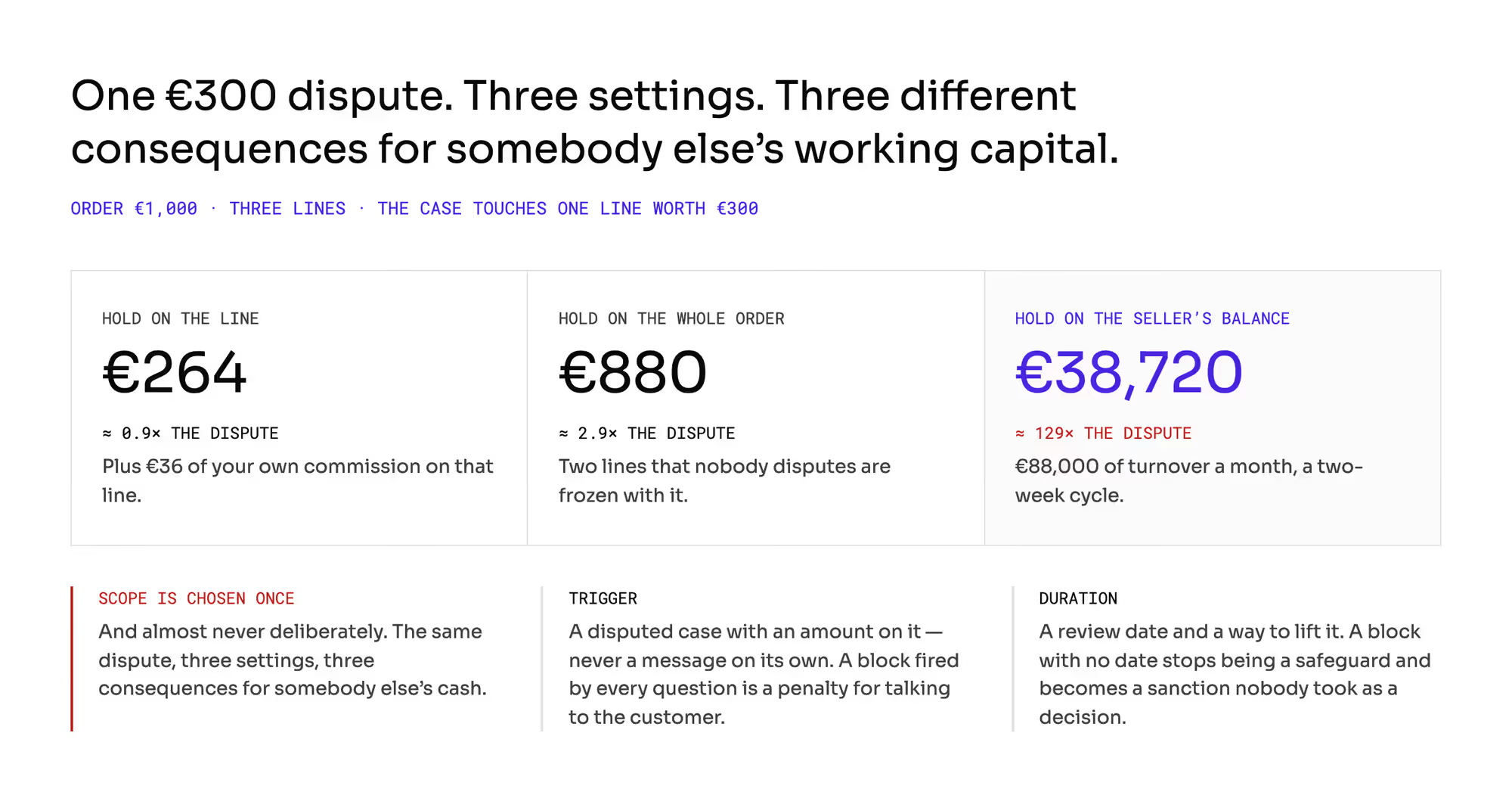
The tool itself belongs to payout cycles, holds and reserves: the block, the reserve, the payout cycle. Here you settle three things: when you may fire it, how wide it reaches, and how long it stays on.
The trigger is a disputed case with an amount on it rather than a message on its own. A block fired by every question turns into a penalty for talking to the customer.
Sellers work that out in two weeks.
Scope is the most expensive decision here, and it is almost never taken deliberately. An order worth €1,000 across three lines, with the case touching one line worth €300.
A block on the line freezes €264 for the seller, and along the way your €36 of commission on it. A block on the whole order freezes €880.
A block on the seller's balance, at €88,000 of turnover a month and a two-week cycle, freezes €38,720, which is close to a hundred and fifty times the amount in dispute. The same dispute, three settings, three different consequences for somebody else's working capital.
The duration needs a review date and a way to lift it. A block with no date stops being a safeguard and becomes a sanction nobody ever took as a decision.
And sanctions toward a seller carry formal requirements of their own and quality thresholds of their own (seller quality thresholds).
Who closes a marketplace dispute?
"Closed" means three different things, and mixing them breaks every metric. A case agreed between the parties, a case decided by you, and a case extinguished by a clock are three different outcomes.
A report that gives them as one number tells you only how many cases left the screen.
The party the allegation is about does not close the case about itself. The only sensible exception is logical rather than procedural: a seller may close a case unilaterally when they have fully met the demand, and then there is nothing to settle.
Every other outcome needs the other party's agreement or a decision from you.
A decision is an object rather than an email thread, and it has eight fields:
- the order line it concerns (rather than the order or the thread)
- the class of the case
- the amount in dispute
- the position of each party
- evidence with a date
- the decision maker
- the outcome from a closed list
- service of the decision
Evidence is a condition rather than an ornament: some systems require a photo or a document attached at closing, so the outcome can be reconstructed.
Two records instead of one. The decision toward the buyer and the decision on who funds it are two different decisions.
Practitioners describe implementations where the refund to the buyer and the commission going back to the seller are one inseparable action, and separating them becomes a workaround: refund first, claw it back with a correcting document. The effect on the process is worse than on the books: two financial events, and no record of who was at fault.
There is one metric that detects a conflict of interest, and it is cheap. The distribution of outcomes per decision maker.
Two agents with 300 cases a month each: the first decides for the buyer in 92% of cases, the second in 41%. That is a difference in policy rather than in the cases.
At an average of €400, it means €61,200 a month falling differently between you and your sellers.
What does dispute resolution change about the rest of your build?
1. Money runs on a separate track
Where you take the funds for a refund from: who pays for a refund. What happens to the commission, and how fault affects the settlement: the commission on a refunded order.
Your decision is an input into both of those processes, rather than a part of either.
2. The disputed case rate becomes a seller quality parameter
That rate is also a basis for thresholds and suspensions. Watch the feedback loop: a regime where you decide produces a different rate than one where the seller decides.
3. A policy more generous than the minimum is a separate decision with a separate payer
The promise made to the buyer and the funding behind it are led by "The promise you make to the buyer and who funds it", and commercial warranties, repairs and spare parts by warranties, repairs and spare parts.
4. Closing a dispute is not closing the order
That is settled by closing an order, and an open case can block your parting with a seller (the tail of obligations after a seller leaves).
5. Evidence in a case is personal data rather than attachments
Photos, addresses, and correspondence carry a retention period and access limits of their own: who controls the personal data.
How do you check dispute resolution with a vendor?
- Is a disputed case a separate object from a message, and is the class created at intake or added later by a person?
- Are the lists of reasons and outcomes mine and editable, and do the codes stay apart across classes of incoming items?
- Show me a case from three months ago: who decided, on what basis, what evidence is attached and when it was served on both parties.
- How far does a payout hold reach? The line, the order, or the balance. And is the scope a setting or a fixed rule?
- What does the auto-close clock count from, and does escalation extend it?
- Can the decision toward the buyer be recorded separately from the decision about who funds it, or is that one action?
Work out three numbers of your own before the meeting: the share of disputed cases in inbound traffic, the average amount in dispute per case, and the distribution of outcomes per decision maker over a quarter.
Which mistakes do operators make about marketplace disputes?
1. One queue for questions and for disputed cases
The pace is set by whatever there is most of, and the clock runs where there are fewest cases.
2. Decisions taken by the person who owns the commercial relationship with the seller
The problem here is not honesty. It is that you cannot defend such a decision to either party.
3. A payout block with no scope and no review date
The safeguard turns into a sanction, and the seller learns about it from their balance.
4. Auto-close treated as tidying the queue
It is a decision with a winner known in advance, taken by nobody and explained by nothing.
5. The outcome recorded in a free text field
A year later you cannot say in how many cases you found for the buyer, or how many of those the sellers funded. Those are the first two numbers anyone will ask you for.
What do you still have to settle about your own dispute process?
This article does not say what the buyer is entitled to, inside what window, or who carries the burden of proof. That is covered in the chapter on who delivers the buyer's rights and a conversation with a lawyer.
This text sits a layer above: the operating policy you build on top of the minimum, its cost, and the data it cannot run without.
This article does not settle the mechanics of money (who pays for a refund and the commission on a refunded order), the tools for holding payouts (payout cycles, holds and reserves) or the customer service model. Who talks to the buyer, on which channels and with how many people, is led by who answers the buyer.
Families of regulation to raise with a lawyer, as a list of topics rather than a ruling on whether they touch you:
- consumer protection in contracts concluded at a distance
- conformity of the goods with the contract and commercial warranty
- out-of-court settlement of consumer disputes, known in the market as ADR and ODR
- transparency between a platform and its sellers, the source of the duty to give reasons for a decision, to run an internal procedure for seller complaints and to publish statistics on their handling
- product liability
- protection of personal data in evidence
Every number above is openly hypothetical. The arithmetic travels, and the values do not.
Put in your own inflow of cases, your own average amount in dispute, and your own handling time.
Summary: Who decides a dispute on your marketplace?
You do, on the cases that cross a threshold written down in advance, and the whole design exists to make that decision defensible a year later. The conflict cannot be removed: one party to every dispute funds your revenue, and an open case blocks the settlement that pays you, so the pull runs in both directions at once.
What holds it down is dull and cheap. Roles kept apart, so the person who negotiates rates with a seller does not decide a case that seller is party to.
Closed lists of reasons and outcomes instead of discretion exercised case by case. A class assigned at intake rather than guessed by an agent.
And a decision recorded as an object carrying the line, the evidence, the decision maker, and the service on both parties. The metric that catches a drift costs nothing to run: the distribution of outcomes per decision maker.
Ask a vendor what the auto-close clock counts from, and whether escalation extends it. Building a marketplace where a dispute is an object with a threshold, a clock, and an audit trail?
Frequently asked questions on marketplace dispute resolution
Who resolves disputes on a marketplace?
Disputes on a marketplace are resolved by the seller, by the operator, or by the operator on appeal, and the third arrangement is the one worth building. It keeps the cost near the seller-first model while giving you the cases that matter, on one condition: the entry threshold is written down as amounts and events rather than left to whoever wrote in loudest.
Should a marketplace hold a seller's payout during a dispute?
A marketplace should hold a payout only where an amount is in dispute, and the scope has to be deliberate. On a €1,000 order with a €300 line in dispute, a hold on the line freezes €264, a hold on the order freezes €880, and a hold on the balance freezes €38,720 at €88,000 of monthly turnover.
Every hold needs a review date and a way to lift it.
What does it mean when a marketplace dispute is closed?
A closed dispute means one of three different things, and reporting them as one number tells you only how many cases left the screen. A case agreed between the parties, a case you decided, and a case extinguished by a timer are three outcomes with three different owners, and the last one has a beneficiary set by your default.
Ready to build?
We build marketplaces where a disputed case is an object with a class, a clock and a trail you can reconstruct a year later.