
Uptime SLA for a Marketplace: Performance, Availability, and Failure Modes

An uptime SLA is the clause in which a vendor commits to keeping a service available for a stated share of time. When the vendor misses that share, you get a credit on a later invoice.
You buy availability as one number in a contract. Then you have to decide what keeps working when part of your marketplace fails.
If you leave those decisions open, a support agent will make them during your first serious incident. The agent will have a few minutes and no mandate.
This article breaks down:
- What has to keep working on your marketplace when payment stops?
- How much GMV does each level of an uptime SLA put at risk?
- How does graceful degradation keep a marketplace selling during an outage?
- Why is your marketplace less available than any system it depends on?
Key insights
- Decide before launch what has to keep working on your marketplace when payment stops. The catalog, the cart, and search can stay up while checkout saves orders for later. Ask the same question about search, a single seller's channel, and the whole marketplace layer. The four answers become your availability policy.
- Each level of an uptime SLA puts a set amount of GMV at risk. On €10 million of GMV a month, 99.9% allows about 43 minutes of downtime. Those minutes cost €10,000 at an average minute and about €24,000 in the evening peak.
- Graceful degradation keeps a marketplace selling by switching off ratings, recommendations, and the exact delivery date while checkout stays up. Over one hour of evening peak, that trimmed mode loses about €5,000 of GMV, whereas a full stop loses €33,300.
- Your marketplace is less available than any system it depends on because the availability of a chain is the product of its links. Five links at 99.9% give 99.5%. That's about three and a half hours of downtime a month.
What has to keep working on your marketplace when payment stops?
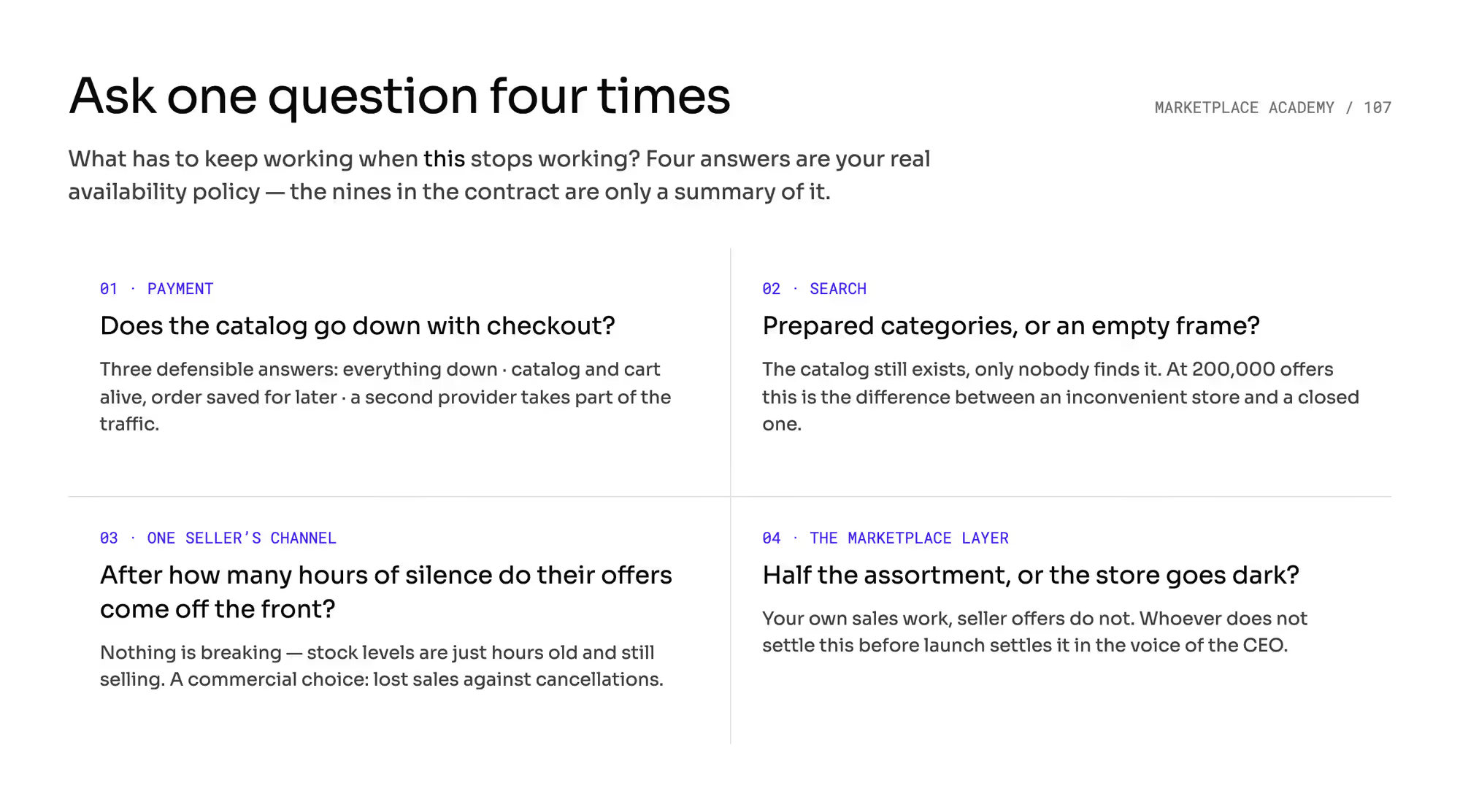
Ask this question about payment first. Then ask it about search, about a single seller's integration, and about the whole marketplace layer.
The four answers are your real availability policy. The number of nines in the contract only summarizes that policy. Two platforms with the same wording in their contracts can behave in completely different ways during an incident.
Drop the goal that everything has to work all the time. The authors of Google's Site Reliability Engineering book write that 100% is the wrong target for almost any service. Each extra nine costs far more than the one before it.
1. Payment
When payment stops, you can defend each of three answers:
- Checkout shows a message, and the catalog goes down with it. You don't want to show goods that no one can buy.
- The catalog, the cart, and search stay up. Checkout tells the buyer that payment will be back and saves the order to finish later.
- Some payment methods keep working. That takes a second payment provider and a way to switch traffic to it.
If you pick the second answer, buyers stay on your site. If you pick the third, you keep part of your revenue and pay for a second contract and a second integration.
2. Search
If search fails, buyers can't find anything in your catalog. Decide whether your online store then shows categories you prepared in advance or an empty frame with a message.
If you show prepared categories, buyers can still browse your 200,000 offers. If you show an empty frame, your store is closed. Prepare the fallback categories before launch, because you won't have time to build them during an outage.
3. Single seller integration
A seller's channel can go quiet without any error on your side. Their offers stay online with stock levels from several hours ago and keep selling.
Decide after how many hours of silence you take their offers down. You're choosing between lost sales and cancellations. The chapter on inventory synchronization counts what each cancellation costs you.
4. Whole marketplace layer
Your own sales work, but seller offers don't. Decide whether your store stays open with half the assortment and half the search results, or goes down as a whole.
If you don't settle this before launch, your CEO will settle it on the phone during an incident.
How much GMV does each level of an uptime SLA put at risk?
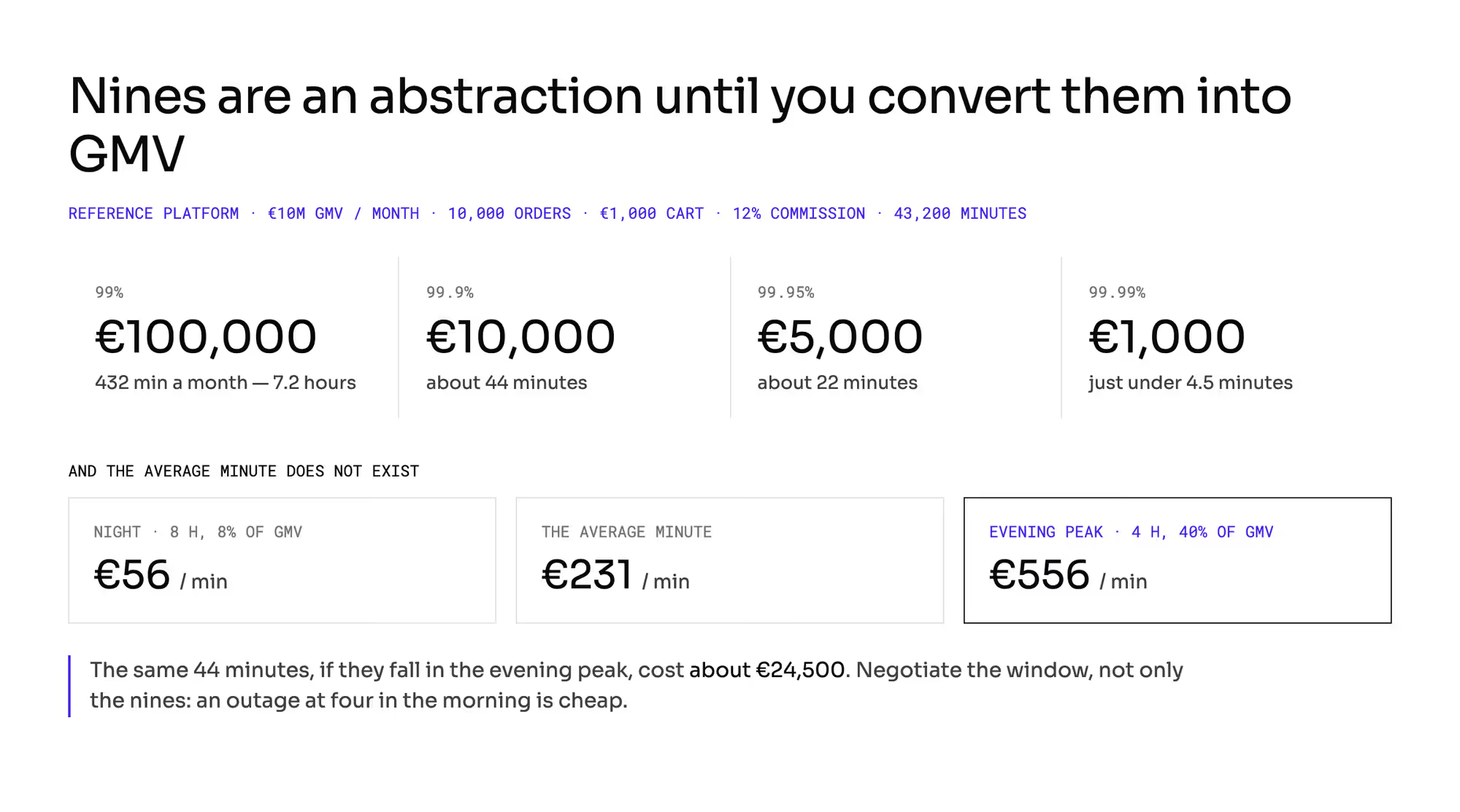
Convert the nines into GMV to see what they cost you. This series uses one hypothetical platform as its standard example: 10,000 orders a month, a €1,000 cart, and a 12% commission. That gives €10 million of GMV a month.
A 30-day month has 43,200 minutes. One minute on this platform carries about €231 of GMV.
An SLA uptime calculator turns the percentage into minutes of allowed downtime. You multiply those minutes by €231.
At 99%, the platform may be down for 432 minutes a month, or 7.2 hours. That's about €100,000 of GMV. The number still looks good in a proposal.
These figures use an average minute, and sales don't spread evenly across the day. Sales on a marketplace gather in a few hours of the day.
Take a day worth about €333,000 and assume that four evening hours hold 40% of it. Those 240 minutes carry €133,000. That's €556 a minute.
Eight night hours hold 8% of the same day. That's €27,000 across 480 minutes, and one night minute carries €56.
A minute in the evening peak is worth ten times a minute at night. A seasonal peak adds its own multiplier on top of that.
What does the uptime SLA promise? | How much downtime does it allow per month? | What does it cost at an average minute (€231)? | What does it cost in the evening peak (€556 a minute)? | What does it cost at night (€56 a minute)? |
|---|---|---|---|---|
99% | 432 minutes (7.2 hours) | about €100,000 | about €240,000 | about €24,000 |
99.9% | about 43 minutes | about €10,000 | about €24,000 | about €2,400 |
99.95% | about 22 minutes | about €5,000 | about €12,000 | about €1,200 |
99.99% | about 4 minutes | about €1,000 | about €2,400 | about €240 |
The same 43 minutes cost about €24,000 if they fall in the evening peak. Negotiate the window with your vendor along with the nines.
Ask when the vendor may do maintenance work. Ask whether the timing of an outage needs your consent or only their notice.
An outage at four in the morning is cheap. An outage on a Friday evening costs ten times as much.
How does graceful degradation keep a marketplace selling during an outage?
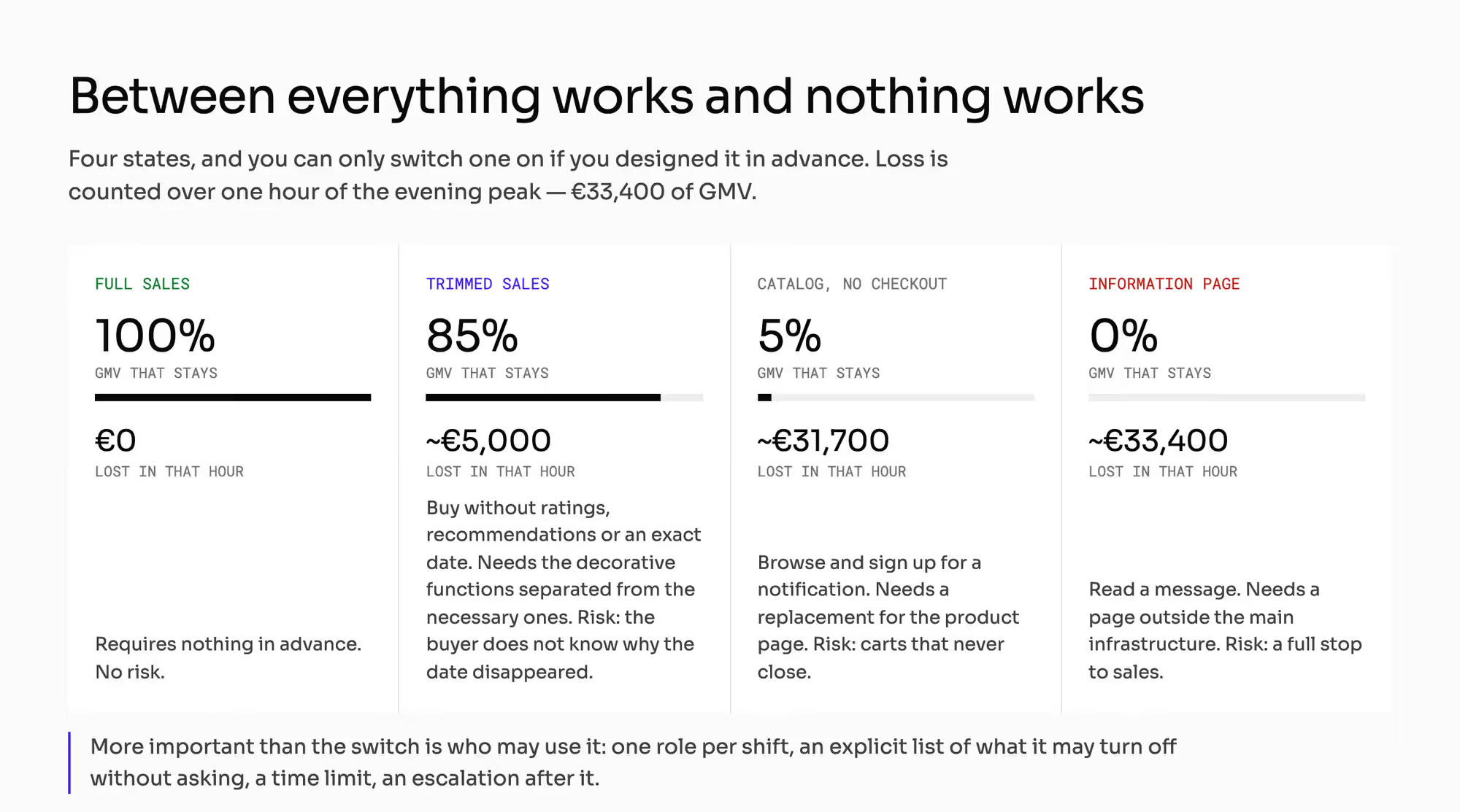
Graceful degradation is a mode in which the platform switches off some functions on purpose so the core of the sale keeps working. You can still earn in several such modes between full sales and a full stop.
Use such a mode only if you designed it in advance. You also have to know which traffic you may degrade.
Switching off ratings, recommendations, and the exact delivery date takes away most of the load. Assume conservatively that it costs you about 15% of conversions. Switching off checkout costs you all of it.
1. Mandate to switch the mode on
Switching off half the functions during an incident feels like admitting defeat. No one makes that call unless they hold an explicit mandate. The platform then stands still for three hours when it could have sold in trimmed mode.
Write the mandate the way you'd write a power of attorney:
- One role per shift holds the mandate.
- That role gets a written list of what it may switch off without asking.
- Each switch has a time limit.
- When the limit expires, the decision goes to a named person.
Each hour of evening peak in trimmed mode keeps about €28,000 of GMV that a full stop would lose.
2. Orders stuck halfway
Orders stuck halfway don't disappear. They wait in pending states and come back when the channel recovers.
The chapter on webhook integration covers queues, retries, and catching up on a backlog. The chapter on multi-vendor checkout covers what the buyer sees when part of the cart fails.
Why is your marketplace less available than any system it depends on?
Your own eCommerce store depends on two systems: the store itself and payment. A marketplace adds 300 sellers with their data channels, the external tools most of them work through, and the carriers.
When every link in a chain has to work, you multiply the availability of the links to get the availability of the whole. That's a basic formula of reliability engineering.
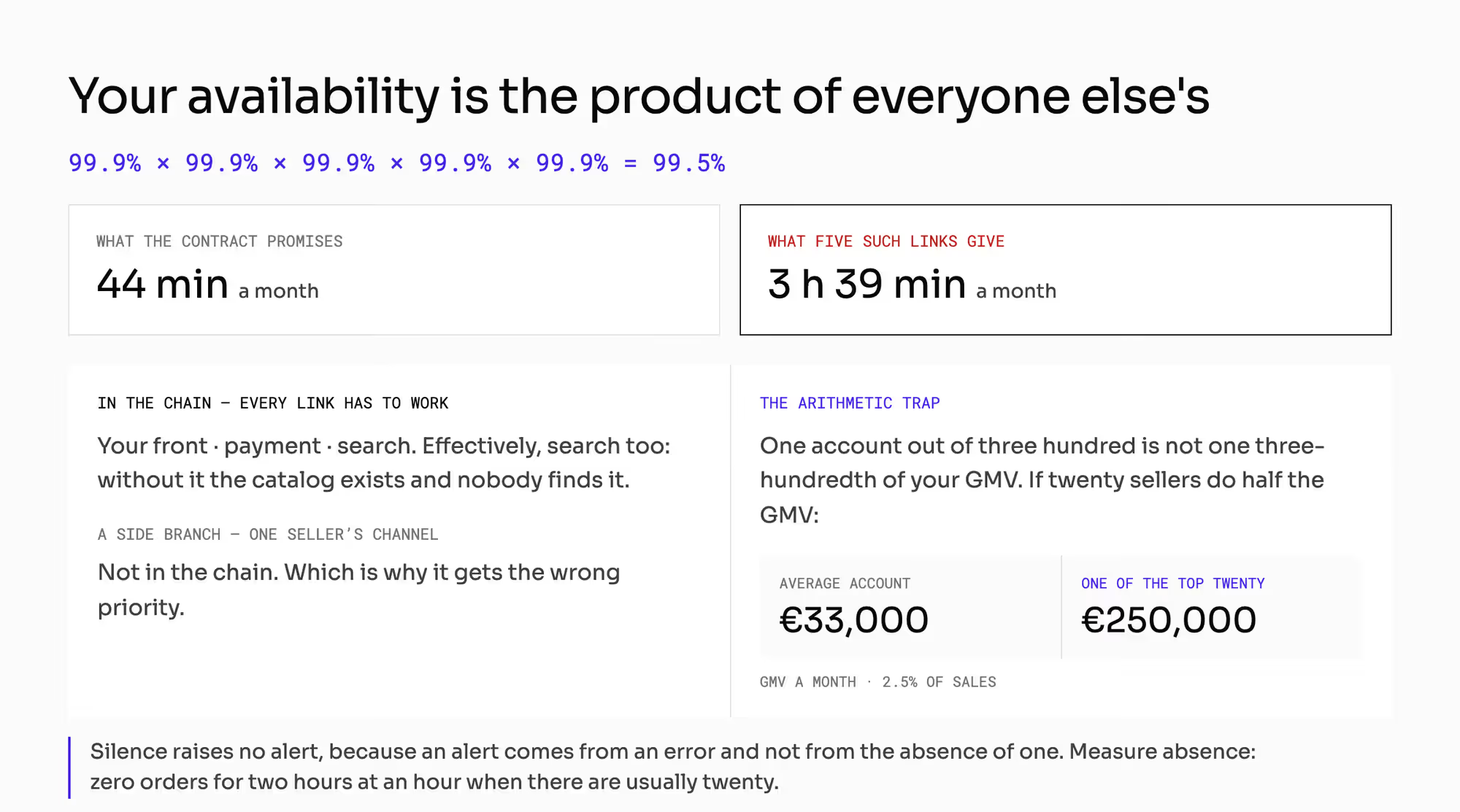
Five links at 99.9% give 99.5%. That's about three and a half hours of downtime a month instead of 43 minutes. Each new integration lowers the total, even when every link keeps its own promise.
1. Links in the chain and side branches
Separate the links of the chain from the side branches. Payment is in the chain, and in practice, search is too. A single seller's channel is a side branch.
2. Seller accounts weighted by GMV
A failure at one account out of 300 doesn't mean one three-hundredth of your GMV.
Say 20 sellers bring in half your GMV. Silence at one of them costs 2.5% of GMV. That's €250,000 a month.
The average account brings in about €33,000 a month. List the dozen or so accounts whose silence would be an incident for you. Monitor them separately.
3. Silence without an alert
Alerts fire on errors. A channel that has stopped sending anything produces no errors and looks flawless in your reports.
You catch it only if you watch for orders that don't arrive. One example is zero orders to a seller for two hours at a time of day when they usually get twenty. The chapter on marketplace API versioning covers the rate limits you set for partners.
How much recovery time and data loss can a marketplace accept?
Large buyers now ask for two numbers in every procurement process. The buying side often quotes them from memory.
The recovery time objective (RTO) is the longest you may be down. You count it to the moment sales work again.
The recovery point objective (RPO) is the period of records you may lose. If you take a backup every four hours, the worst case loses four hours of platform activity.
The smaller both numbers are, the more the setup costs and the harder it is to operate. You have three options, from the cheapest to the most expensive:
- Restore from backup. It costs the least and takes the longest.
- A standby site kept ready. It takes over once someone switches traffic to it.
- Two sites working in parallel. This is high availability in the full sense, and it costs the most.
The records a marketplace loses include money that belongs to someone else.
An hour of evening peak carries about €33,300 of GMV. Your commission is €4,000 of it. Sellers are owed the other €29,300.
You can't rebuild that from memory. The buyer has a confirmation in their inbox, and the seller sees the order in their own tool. Your side has no trace of it.
The chapter on marketplace order documents covers how long you keep transaction documents. The chapter on marketplace GDPR covers what you may hold in backups with buyer data. Confirm both with a specialist.
Settle three things before the two numbers go into a contract.
1. Scope of zero data loss
Zero loss can apply to everything or only to money and orders. You can usually load the catalog and the configuration again. They can carry a milder requirement.
That's the cheapest saving available, and you have to ask for it.
2. Person who triggers the failover
Automatic failover carries a risk of its own. A false alarm can cause downtime and data loss by itself.
If a person makes the decision, find out who it is at three in the morning. It can be someone at the vendor or someone at your company.
3. Date of the last full restore
Test the recovery plan regularly. Ask when someone last restored a backup from scratch.
If no one has ever restored a backup, you don't know that it works.
What does an uptime SLA clause give you when the vendor misses it?
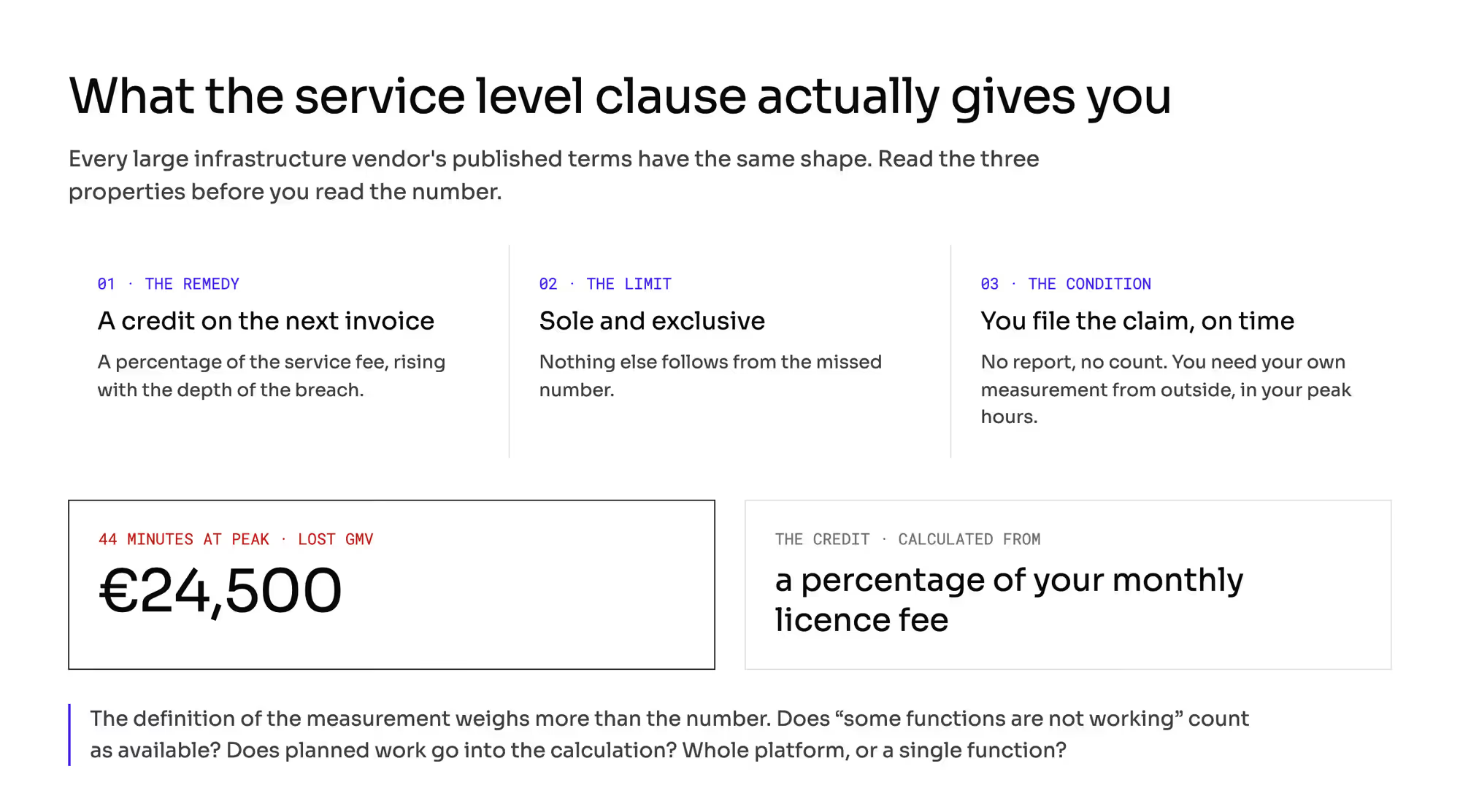
The public SLAs of AWS, Google Cloud, and Microsoft Azure all work the same way. The compensation is a credit on a later invoice, calculated as a percentage of the service fee. The credit grows with the size of the breach.
The credit is the sole and exclusive remedy. You have to file the claim yourself, within a stated deadline.
1. Credit against lost GMV
The credit doesn't cover lost GMV, and it isn't meant to. On this platform, 43 minutes in the evening peak cost about €24,000 of GMV. The vendor calculates the credit from the monthly license fee.
2. Your own measurement
If you don't report a breach, the vendor won't count it for you. You need your own measurement from outside the platform.
Your checks should cover the full purchase path during your peak hours. A page that opens can still fail at payment.
3. Definition of availability
How the vendor defines availability matters more than the percentage. Ask the vendor three questions about it:
- Does "some functions aren't working" count as available?
- Does planned maintenance count toward the total?
- Does the number cover the whole platform or a single function?
The same percentage commits the vendor to different things under different definitions.
How do the four degradation modes compare over one hour of evening peak?
One hour of evening peak carries about €33,300 of GMV. The table prices each mode over that hour. Every mode except full sales needs preparation before launch.
What does each mode mean? | Full sales | Trimmed sales | Catalog without checkout | Information page |
|---|---|---|---|---|
What the buyer can do | everything | buy without ratings, recommendations, or an exact date | browse and sign up for a notification | read a message |
Share of the hour's GMV that stays (%) | 100 | 85 | 5 | 0 |
GMV lost over the hour (€) | 0 | about 5,000 | about 31,700 | about 33,300 |
What you prepare in advance | no preparation | a split between decorative and required functions | a replacement for the product page | a page hosted outside your main infrastructure |
Main risk | none | the buyer doesn't know why the delivery date disappeared | carts that never close | a full stop to sales |
What does an uptime SLA change in your marketplace?
An uptime SLA affects more people than your infrastructure team. Your sellers feel every outage in their own metrics and their own working hours.
1. Seller metrics during your incident
Your incident changes your sellers' metrics. If the clock on accepting an order keeps going while your panel is down, you punish the seller for your own outage. Pause those clocks for the length of the incident.
The chapter on marketplace seller quality metrics covers thresholds and suspensions. The chapter on the P2B Regulation covers your duty to explain a suspension.
2. Trimmed mode in the launch budget
Put trimmed mode into the budget before launch. If you add it after the first incident, it costs the same.
You pay that amount after you've already lost the GMV and the trust.
3. Percentiles instead of the average
Measure response times with percentiles. The median describes the typical case. Only the high percentiles describe what buyers complain about.
Google's SRE book uses percentiles for response times for this reason. The chapter on marketplace analytics covers how to turn them into a management report.
4. Maintenance window for sellers
Sellers often upload files and recalculate prices at night. An outage outside the buyer peak can fall in the middle of their working day. Pick the maintenance window with both groups in mind.
How do you check an uptime SLA with a vendor?
Ask for these five things, and ask to see each answer in a demo:
- Show me your incident history for the last 12 months. Who writes those entries and when, and can customers see them without asking?
- Switch payment off live. What does the buyer see, what does the seller see, and what happens to carts and orders in progress?
- Stop one seller's channel for six hours. How will I find out, and after how long?
- How long does recovery take, and how many minutes of data do you lose? When did you last restore a backup from scratch? Give me the date.
- What traffic level did you test my configuration to, and at what level did it break?
If the vendor never tested to failure, they will find your platform's limit during your first peak.
Which mistakes do operators make with an uptime SLA?
All five cost the most in the evening peak, when a minute is worth €556 of GMV.
1. Buying nines without a window
The clause counts a monthly average, and you earn your GMV in a few hundred hours of the year. The vendor keeps to the contract, and you lose your most expensive minutes.
2. No intermediate mode
The system has two states: up and down. You have no mode to switch to. A fault in one element costs you the full GMV of the hour.
3. Switch with no owner
Trimmed mode exists, but no one may trigger it without the board. You switch it on at the end of the incident, when you no longer need it.
4. Counting sellers instead of GMV
A failure at one of 300 sellers can be a failure at 2.5% of your sales. Your team still handles the incident at the lowest priority.
5. Backups with no restore test
Backups are taken, and the report is green, but no one has ever restored one. You learn about the missing piece in the worst possible hour.
What do you still have to settle about an uptime SLA?
This article doesn't cover how systems exchange data and catch up on a backlog after an incident. The chapter on webhook integration covers that.
This article also leaves out four neighboring topics:
- The chapter on inventory synchronization covers the tolerance for stock level errors.
- The chapter on multi-vendor checkout covers checkout during a partial outage.
- The chapter on marketplace analytics covers management metrics.
- The chapter on API versioning covers the limits you set for partners.
This chapter isn't legal advice. Continuity requirements sometimes come from regulation and depend on your industry and scale. Name these areas to your lawyer:
- Rules on operational resilience and the continuity of digital services.
- Rules on cybersecurity for providers of digital services above a certain size.
- Data protection rules on backups and restoration.
Ask your lawyer whether you can replace the invoice credit with a different remedy. Ask also how much of the clause you can enforce in your case. A vendor's sales team can't answer either question.
All the numbers above are hypothetical. Put in your own GMV, your own hourly split, and your largest sellers' share. Every conclusion above depends on them.
The board has to agree in advance that someone may switch off half the service at nine in the evening without asking anyone. You can't buy that consent or write it into a vendor contract.
Issue that mandate before the first incident. If you don't, the incident lasts until you find someone who picks up the phone.
Summary: What does an uptime SLA protect on a marketplace?
An uptime SLA protects your right to a credit on a later invoice. On €10 million of GMV a month, 99.9% allows about 43 minutes of downtime. Those minutes cost €10,000 at an average minute and about €24,000 in the evening peak.
The credit doesn't cover that GMV. You protect that GMV with decisions you make yourself: what keeps working when payment or search fails, and who may switch on trimmed mode.
Your marketplace is also less available than any one vendor promises. Five links at 99.9% give 99.5%. Monitor the chain and your largest sellers separately, and test a full restore before launch.
Building a marketplace that keeps selling when payment, search, or a seller's channel fails?
Frequently asked questions on uptime SLAs
What is an uptime SLA?
An uptime SLA is a vendor's commitment to keep a service available for a stated share of time, such as 99.9% a month. If the vendor misses it, you get a credit on a later invoice. You have to file the claim yourself, within a deadline.
How does an SLA uptime calculator convert a percentage into downtime?
An SLA uptime calculator multiplies the minutes in a period by the share of time the service may be down. A 30-day month has 43,200 minutes.
At 99.9%, the calculator gives about 43 minutes of downtime. At 99.99%, it gives about 4 minutes. Multiply those minutes by your marketplace's GMV per minute to get the cost of the downtime the contract allows.
What is the difference between high availability and graceful degradation?
High availability keeps the whole platform up, and graceful degradation keeps the core of the sale working when part of the platform fails. High availability needs two sites working in parallel and costs the most. Graceful degradation switches off functions such as ratings and recommendations so checkout keeps working.
Ready to build?
We build marketplaces that keep selling when payment, search, or a seller's channel fails, with a trimmed mode your team can switch on.