
Marketplace Multi-Vendor Checkout: How to Handle Checkout When the Cart Holds Several Sellers

A multi-vendor checkout on a marketplace is the step where one payment is taken for several separate contracts, which is why it can succeed and fail at the same time.
Checkout is the last screen on which you can still avoid losing the transaction, and the first on which the buyer learns they are not buying from a single company.
You design it for the scenario in which everything works. It gets judged on what the buyer sees when only half of it works.
This article breaks down:
- Which 4 partial failures can break checkout?
- One order or three: how should you split it?
- How do delivery, address, and documents split?
- Which 3 cases break the usual assumptions?
Key insights
- The four partial failures that can break checkout are stock disappearing at one seller, a seller rejecting the order after the money moved, a seller who does not ship to that country, and a payment that only partly lands.
- Split the order before the build: one order per seller matches how the money and the obligations split, one order per cart matches what the buyer remembers paying, and either way they need one number to quote to support.
- Delivery, address, and documents split into one delivery address, several return addresses, and one document per seller, because the goods go back to whoever sold them.
- The three cases that break the usual assumptions are cash on delivery available at only some sellers, a gift card spread across three, and an operator coupon reducing lines at three companies.
Why does one marketplace payment cover several contracts?
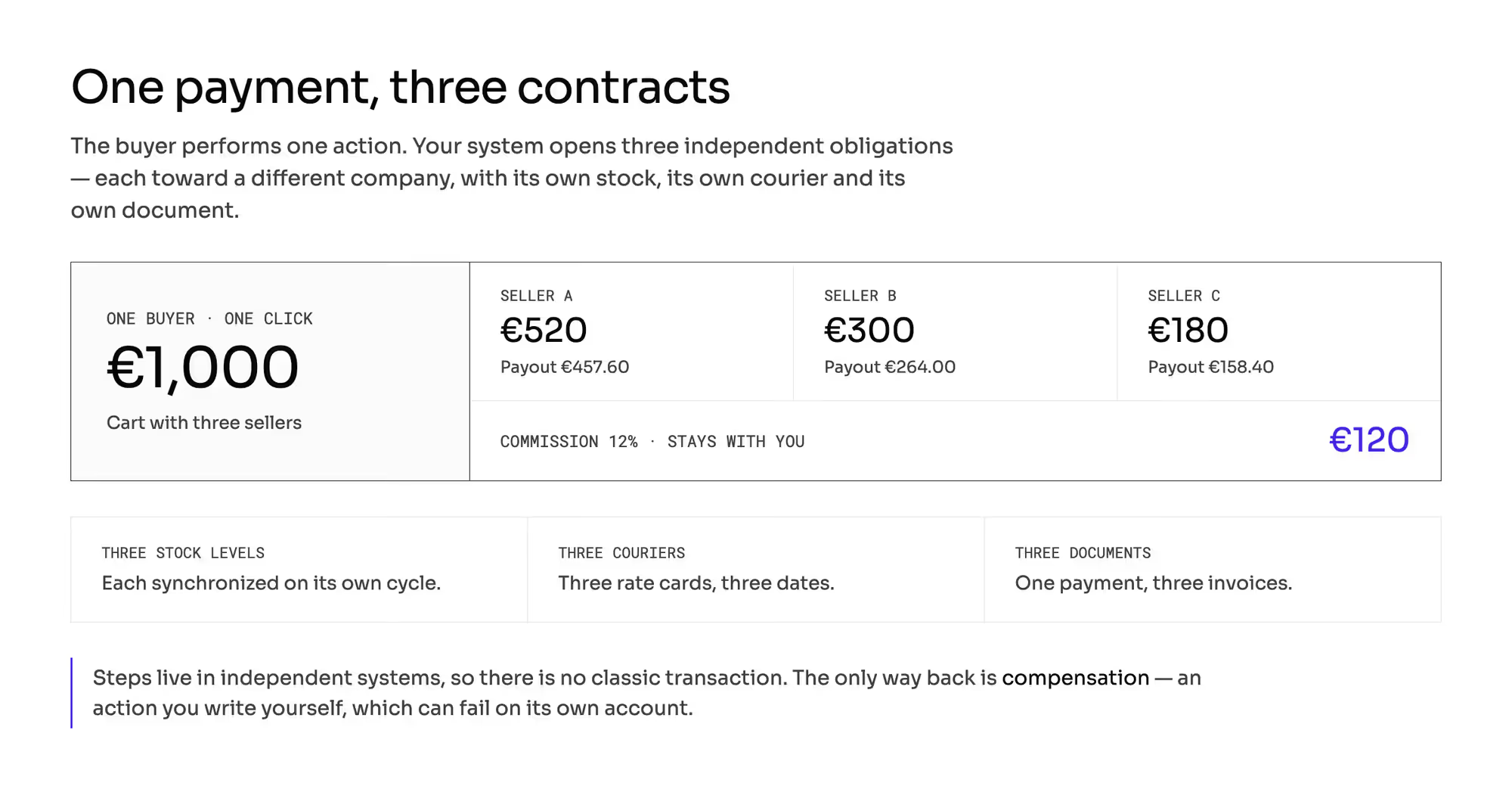
Take a €1,000 cart: €520 at seller A, €300 at B, €180 at C. The buyer performs one action.
They click "pay." At that moment, your system opens three independent obligations, each toward a different company, each with its own stock level, its own shipping time, and its own courier. At a 12% commission, you keep €120, and €880 goes out to be divided: €457.60, €264, and €158.40.
The mechanics of that split are "How Marketplace Split Payments Work and Who Pays the Fees?". What matters here is only this: there is one amount, and there are three recipients.
In a single database, a set of operations like that would be a transaction: all or nothing. Here every step lives in a different system: the stock level at the seller, the authorization at the payment provider, order acceptance in the seller panel, the label at the courier.
Public catalogs of architectural patterns say it outright. When an operation breaks down into steps in independent systems, there is no classic transaction, and the only mechanism for undoing anything is compensation: a separately written action that reverses the effect of a step that did succeed.
The same sources add two warnings, and both matter more for your checkout screen than for your backend. Compensation is not a simple "undo," because it has to apply business rules, and it can fail on its own account.
That is why a multi-seller checkout is not a form. It is a distributed transaction, and its quality is measured by what the buyer sees when the second of the three contracts does not come about.
Which 4 partial failures can break a multi-vendor checkout?
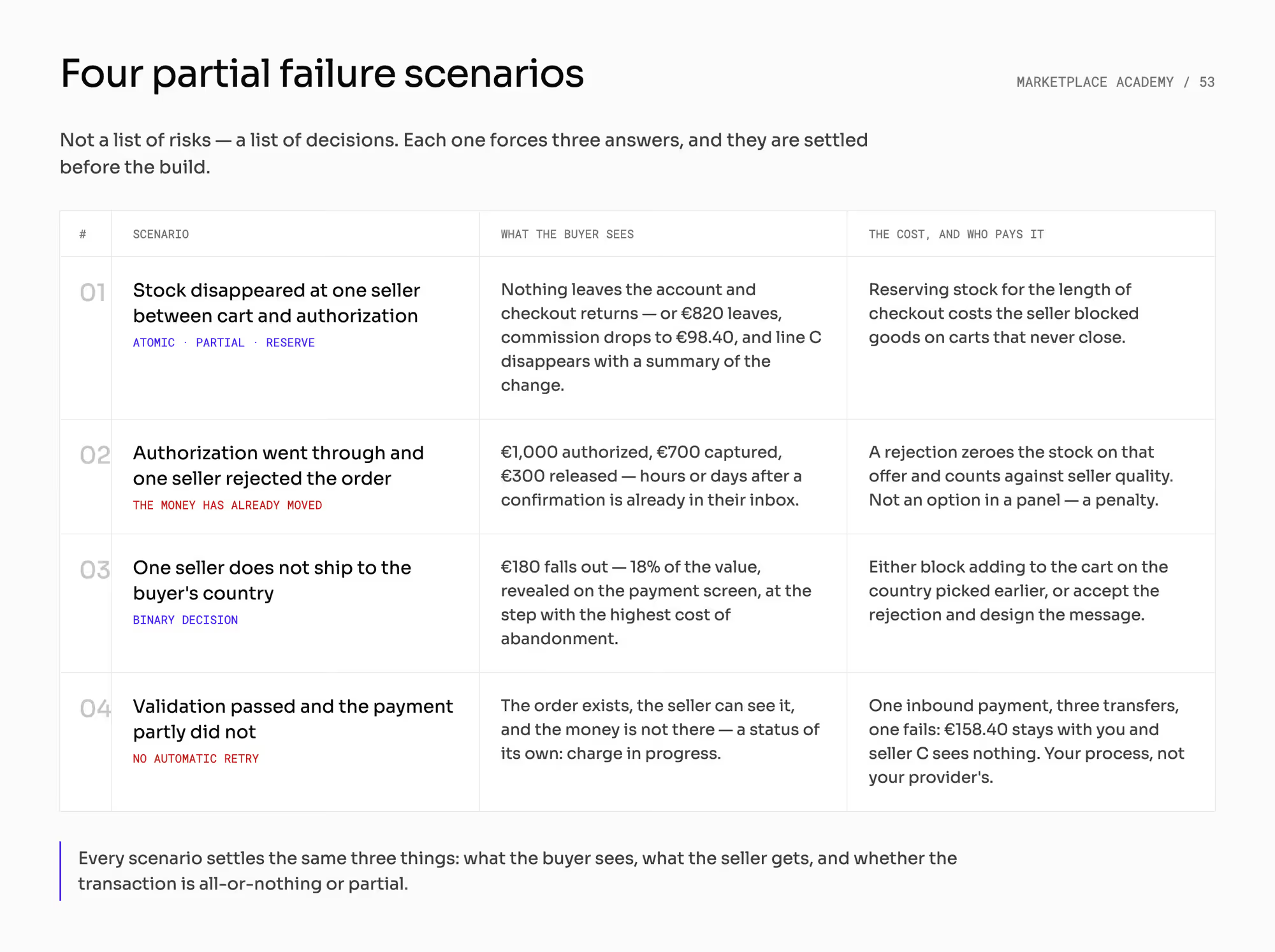
This is not a list of risks. It is a list of decisions.
Every scenario forces you to settle three things: what the buyer sees, what the seller gets, and whether the transaction is atomic (all or nothing) or partial. Settling them belongs at the gate before the build, because it determines the order model and the payment model.
1. The stock disappeared between the cart and the authorization
A classic, because the window between adding to the cart and clicking "pay" is often longer than the stock synchronization cycle. The atomic answer is that no €1,000 leaves the account, checkout comes back with a message, and the buyer starts over.
The partial answer is that €820 leaves the account, the commission comes to €98.40, and line C disappears together with a summary of the change. The third answer is to reserve the stock for the duration of checkout.
That one costs money, because the seller pays for blocked goods for carts that will never be closed. Pick one and write it down.
2. The authorization went through, and one seller rejected the order
This is the most expensive scenario, because the money has already moved. €1,000 is authorized, €700 may be captured, and €300 has to be released.
For the buyer, only one thing matters: who tells them, and how soon, because the rejection lands hours or days after the payment, and they already have an order confirmation in their inbox.
The seller pays as well. In the solutions we know, rejecting a line zeroes the stock level on that offer, and rejections are counted as a quality criterion with thresholds set at the level of single events.
Rejection is therefore not "an option in the panel" but a decision that carries a penalty. That changes how sellers behave in a way no demo will show you.
3. One seller does not ship to the buyer's country
This one gets settled not at checkout but at the moment the system first knows the address. If the cart calculates shipping on a default zone, the restriction surfaces only once the address has been entered.
That is the step where the buyer is most invested and least willing to change anything. On our cart, €180 falls out at that point, which is 18% of the value, revealed on the payment screen.
The decision is binary. Either you block adding to the cart on the basis of a country the buyer picked earlier, or you accept a rejection at checkout and design the message.
4. Cart validation passed and the payment did not
It comes in two forms, both documented in the technical documentation of payment systems. The first form is payment methods that confirm in days rather than in seconds: the order exists, the seller can see it, and the money is not there.
Practitioners describe this as a separate order status, "charge in progress," created specifically for that gap. The second form is quieter: one inbound payment and three transfers of funds, one of which does not go through.
Then €158.40 stays with you, seller C sees nothing at all, and a failed transfer does not retry itself. That is your process to design.
One order or three: how should a marketplace split it?
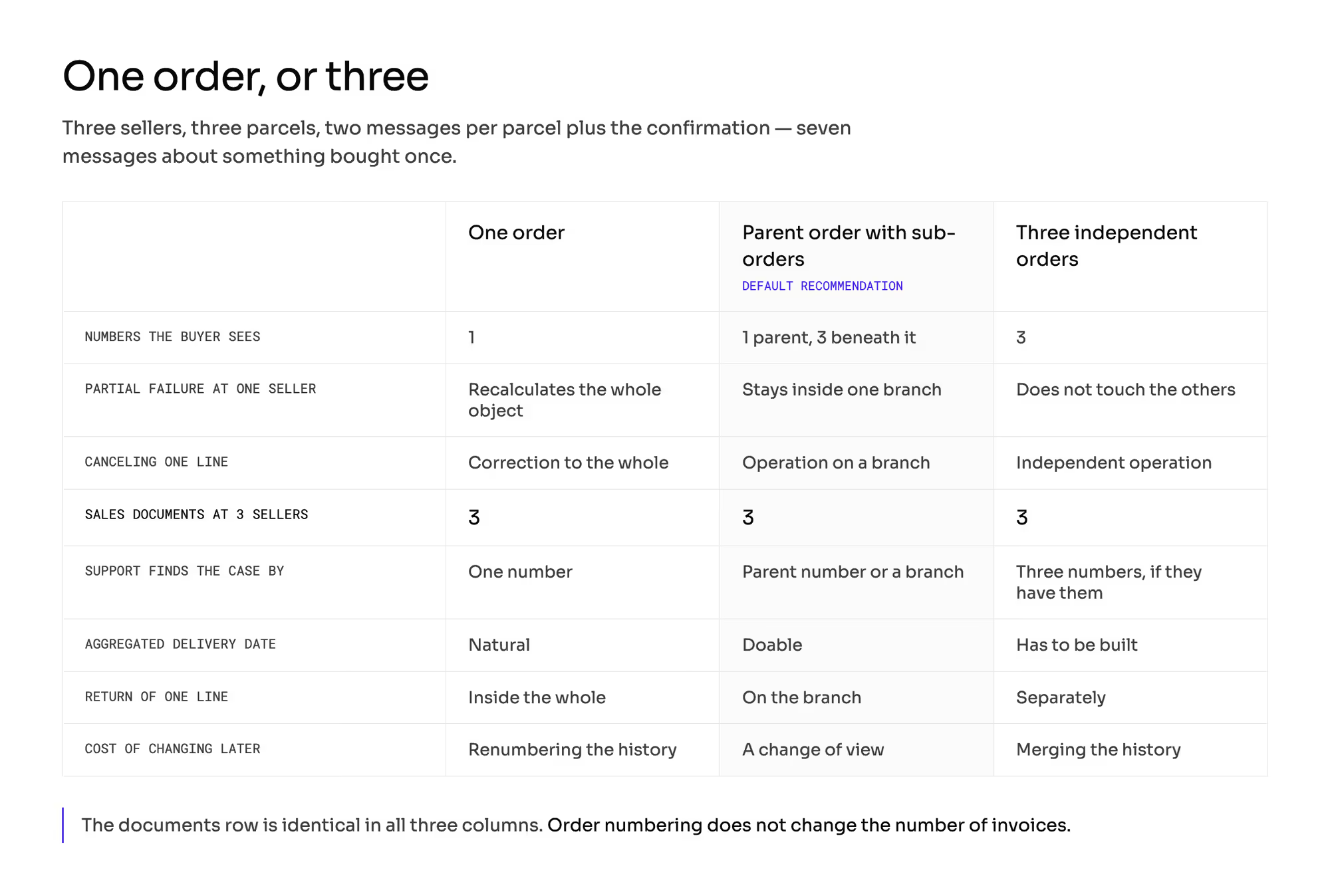
The market convention runs on three levels: the commercial order (what the buyer considers their purchase), the logistics order (always one seller, usually one parcel), and the line (one offer times quantity). Three levels are not bureaucracy.
They follow from scenario 2, because you have to have an object that can be rejected without invalidating the purchase.
The question is which of those levels gets a number the buyer can see. With three sellers and three parcels, at two messages per parcel plus the order confirmation, the buyer receives seven messages about something they bought once.
That is the real price of a bad choice in this table, and it gets paid in tickets to your support team.
The middle variant is the default recommendation: the buyer gets one number, your processes operate on branches, and a partial failure does not overturn the whole object. Look at the row about documents, though.
It is identical in all three columns. Order numbering does not change the number of invoices.
How do delivery, address, and documents split across sellers?
You cannot pick a single delivery method for the whole cart, because there is nobody to carry it out. Three sellers ship from three places, hold three courier contracts, and work off three rate cards.
Checkout therefore has as many delivery sections as there are sellers: three choices, three costs, three dates. Free shipping thresholds are counted separately in every section.
Folding three dates into one promise to the buyer is "Delivery Dates on a Marketplace: What You Can Promise". It is worth knowing what the market deliberately does not do: nobody optimizes the shipping cost across the sellers in a cart.
There is one delivery address, and there are several return addresses. The goods go back to the seller and not to your warehouse, and that is a separate process.
What the buyer expects in the way of documents is where your platform model becomes visible to the customer. The buyer remembers one payment and expects one invoice.
At checkout, only one thing counts: say it in advance, in the summary, rather than explaining it after the fact in a reply to a complaint.
Which 3 cases break the assumptions of a multi-vendor checkout?
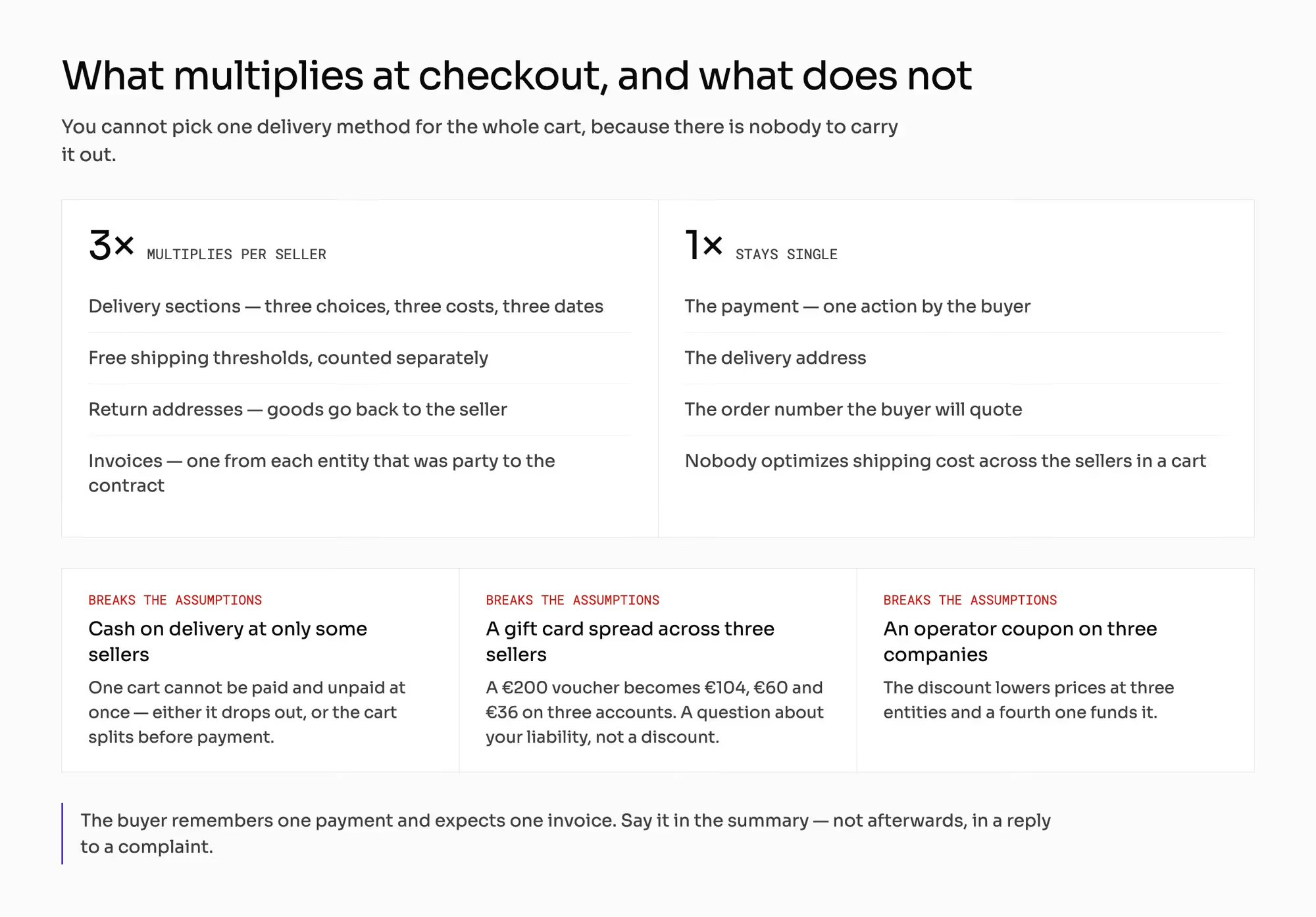
Each of them looks like a configuration detail and is a separate project.
1. Cash on delivery available at only some sellers
One cart cannot be paid and unpaid at the same time, so either cash on delivery drops out of a mixed cart, or the cart splits before payment.
2. A gift card spread across three sellers
A €200 voucher in our cart is €104, €60, and €36 on three different accounts. So the question about funds on that card is a question about your own liability.
3. An operator coupon reducing lines at three companies
The discount lowers the price at three entities, and a fourth one funds it. Who pays, and how it affects the commission, belongs to the chapter on promotions.
What does a platform vendor leave out of checkout?
Solutions in this class usually deliver a cart validation API. That means rechecking stock and price, and calculating the shipping charges.
It is a real and necessary layer. What they usually do not deliver is the checkout interface and the execution of the payment.
In integration contracts, those layers are sometimes typed explicitly as the operator's work, and at least one vendor in this class deliberately withdrew its own storefront and left the cart and the checkout on the operator's side, with the consequence that discounts and coupons then have to be calculated at your end and passed to the order as a final amount.
At the same time, a feature list can carry an entry about checkout support for marketplace offers. It is not untrue.
It is talking about validation. That is why the question "do you support marketplace checkout" has no diagnostic value: the answer is always yes.
The value sits in the question about the interface and about the handling of partial failure.
Worth setting that against one number: the average cart abandonment rate, measured across dozens of independent studies, runs at about 70%, and about 17% of the people who abandon say the process was too long or too complicated. In a single-seller store, you fight for one step.
Here you have three delivery sections and four failure scenarios on the same screen.
What does multi-vendor checkout change about the rest of your build?
1. Compensation cannot be added later, because the money has already moved
That is the most important conclusion in this article, and it is not about code but about the order in which work gets done. The happy path gets a specification and acceptance criteria.
The "half of it worked" path usually gets nothing, because it has no owner in the backlog. The consequence is predictable.
The first partial failure is resolved by hand, one transaction at a time, by a person in customer service. And reversing a transfer of funds to a seller works only if the seller still holds those funds with you.
Otherwise, you do not have a correction, but a receivable.
2. The order model is a decision made before the build
The partial failure row from the table above propagates into refunds (who pays for a refund and the commission on a refunded order), into document numbering, and into what your support team can even find a case by.
3. The rule for splitting an order between sellers is a separate operational decision
It belongs to the chapter on orders and logistics. Disclosing who sells is showing who the seller is, and the cart before the buyer clicks "pay" is a cart with several sellers.
How do you check a multi-vendor checkout with a vendor?
Six things to ask the vendor for.
- Place an order at three sellers and show the confirmation the buyer receives. How many numbers are there, and which one will they quote in a complaint?
- Zero the stock at one seller between the cart and the payment. What exactly does the buyer see, and how much comes off the card?
- Reject the order at one seller after payment. Who informs the buyer, when, and what happens to the stock level on that offer?
- Set one seller to not ship to the buyer's country. At which step does that surface: in the cart or at the address?
- Interrupt one of the three transfers of funds. Where do you see that one did not arrive, and who retries it?
- Show the partial failure screen from the demo. If there is none, that is not a missing screen. It means the message will be invented by a support agent in a conversation with a customer.
The control question that sums up all six: is the checkout interface your product, or our job?
Which mistakes do operators make about multi-vendor checkout?
1. Atomicity assumed in silence
Nobody decides that the cart is "all or nothing." It simply comes out of the implementation that way. Consequence: a single missing unit worth €180 kills a €1,000 transaction, and the buyer does not come back.
2. A partial order charged with no message
The opposite mistake. The system charges €820 and sends a confirmation for €820 without saying what dropped out. Consequence: the buyer waits for a third parcel that nobody shipped, and hears the truth for the first time from an agent.
3. Shipping restrictions checked after the address rather than before the cart
Consequence: the worst possible moment to reject a line, right before payment, at the step with the highest cost of abandonment.
4. One delivery section for the whole cart
It looks cleaner and works as long as two sellers use the same courier. Consequence: with the third one, you have to rebuild checkout rather than add a field.
5. Three invoices arriving as a surprise
The platform model is revealed in the buyer's inbox instead of in the order summary. Consequence: your support team explains the company's legal architecture in a reply to a complaint, one customer at a time.
What do you still have to settle about your own checkout?
This is not legal advice. Checkout is the place where the information duties toward the buyer converge – who is a party to the contract, what return terms apply at each seller, and which document they will receive – and how far those duties reach depends on your model and your market.
The families of regulation to name to your lawyer:
- rules on consumer rights and on information duties in distance selling
- rules on platform transparency, in the part about disclosing the identity of the seller
One thing is left that nobody will settle for you and that appears in no documentation: how your platform behaves when two of the three contracts come about. That is not a technical question. It is a question about how much you are willing to pay so that the buyer never has to pick up the phone.
Summary: What does a multi-vendor checkout have to settle?
What happens when part of it fails, and who the buyer thinks they paid. Four failures are worth designing for, and all four happen between the cart and the confirmation: stock vanishing at one seller, a seller rejecting after authorisation, a seller who cannot ship to that country, and a payment that lands in part.
Then one structural decision underneath them: whether a cart makes one order or one per seller, because everything downstream – the documents, the returns, the statuses the buyer sees – follows from it and none of it can be changed cheaply afterwards.
Ask a vendor to fail one seller's line on screen and show what the buyer is charged and told. Building a marketplace where checkout can partly fail without leaving anybody guessing?
Frequently asked questions on multi-vendor checkout
What is a multi-vendor checkout?
A multi-vendor checkout is the step where a marketplace takes one payment for items belonging to several sellers, each of which is a separate contract. It looks like an ordinary checkout and differs in one property: it can succeed for part of the cart and fail for the rest.
Should one cart produce one order or one per seller?
One cart can produce either, and the answer belongs in the design rather than in the code, because documents, returns, and statuses all hang off it. One order per seller matches how the money and the obligations split; one order for the whole cart matches what the buyer remembers paying. Whichever you pick, the buyer needs one number to quote to support.
What happens when one seller in the cart fails?
When one seller in the cart fails, what happens is whatever you decided in advance: charge for what succeeded, or fail the whole cart. Both are defensible. What is not defensible is charging for two-thirds of an order and sending a confirmation that describes all of it.
Ready to build?
If you want to walk through the four partial failure scenarios on your own cart before they turn into tickets for your support team, let's talk.