
How to Manage Marketplace Commission Exceptions: Thresholds, Caps, and Negotiated Rates

A marketplace commission exception is any departure from the published grid: a volume threshold, a cap, a minimum fee, or a rate negotiated with one seller, and what separates it from a discount is that it keeps working on every order until somebody switches it off.
This article breaks down:
- Why does an exception need an expiry date?
- Which 2 constructions can a threshold take?
- What do a cap and a minimum fee cost?
- What does the portfolio cost in a year?
Key insights
- An exception needs an expiry date because it keeps working until somebody switches it off: 6% instead of 12% on €250,000 a month is €15,000 a month, so a quarter of forgetting costs €45,000 that nobody approved.
- The two constructions of a threshold differ by €40,000 a year on one seller: progressive charges 10% on the excess and leaves €340,000, retroactive charges 10% from the first euro and leaves €300,000, and retroactive charges a whole year's benefit on the last cart before the line.
- A cap and a minimum fee are the same limit from two ends: a €300 cap starts giving money back above €2,500 and costs €49,500 a year on one account, while a €6 minimum fee lifts the effective rate on a €40 cart to 15%.
- The portfolio costs more than any exception in it: negotiated rates, a retroactive threshold and a cap together turn a 12% grid into an effective 9.8%, which is €2.14 million a year on €8 million of turnover a month.
Why does every commission exception need an expiry date?
The starting point of this series: a cart of €1,000, a commission of 12%, and €880 left for the seller. Everything below is a deviation from that line.
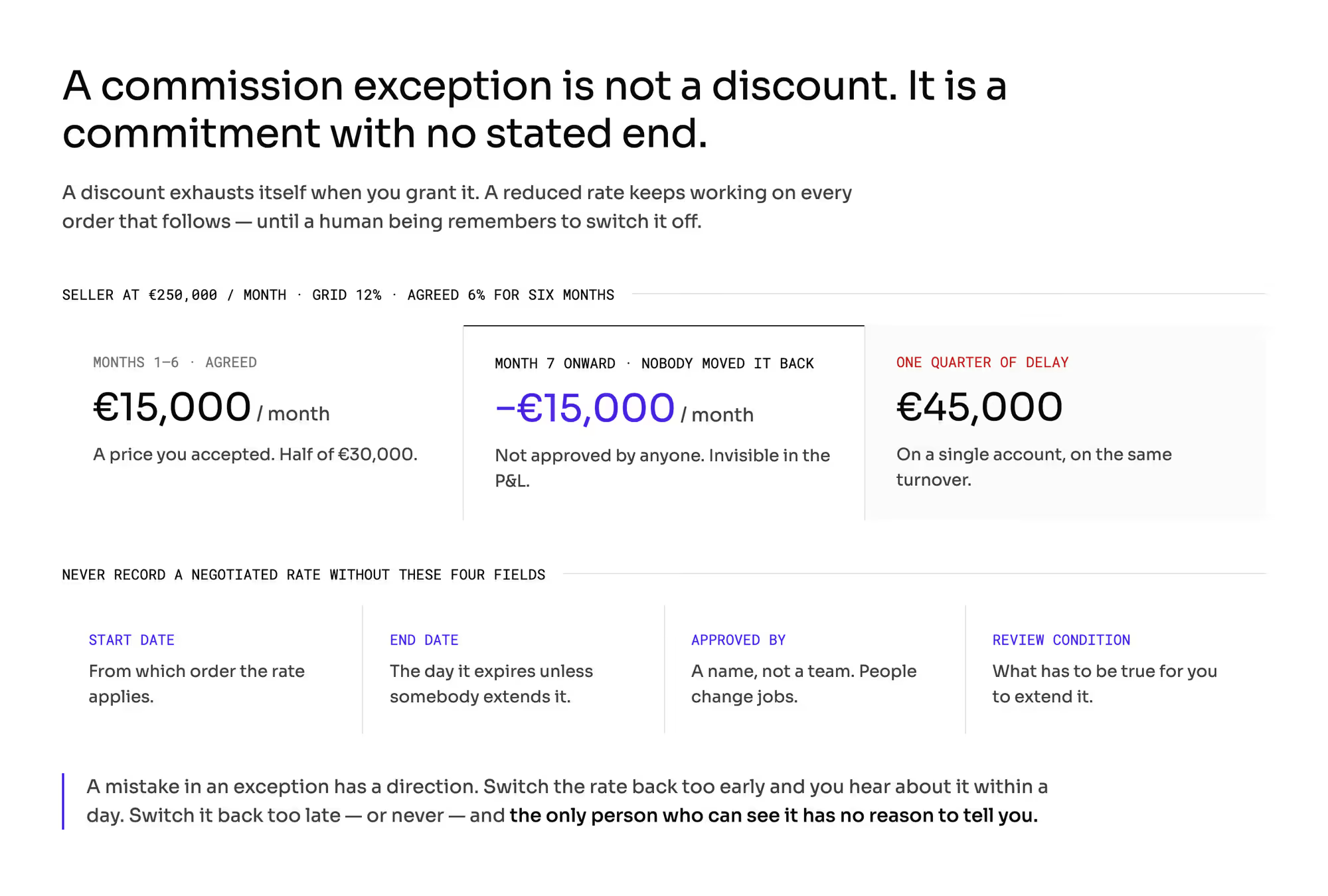
A commission exception is a commitment with no stated end rather than a discount. A discount exhausts itself the moment you grant it.
A reduced rate keeps working on every order that follows, until somebody switches it off. The person who switches it off has to be a human being who remembers why it went on in the first place.
Run the numbers on the seller who runs through this whole article: €3 million of turnover a year, which is €250,000 a month. On a 12% grid, they pay you €360,000 a year.
You give them 6% for the first six months, so instead of €30,000 a month you have €15,000, and that is a price you accepted. But if nobody moves the rate back after six months, every month of delay costs another €15,000, and a quarter of a year of delay costs €45,000 that nobody approved.
Lawmakers know the mechanism that closes this off as a sunset clause: a provision stops applying on a stated date unless somebody deliberately extends it. The default runs the other way: whatever is in force stays in force with no end date.
Your grid behaves in exactly the same way, except that nobody will notify you of the repeal. That is where the four fields come from, the ones without which a negotiated rate must never be recorded.
A start date, an end date, the name that approved it, and a review condition: what has to be true for you to extend it.
And here is the warning you will not find in any rate card. A mistake in an exception has a direction.
The seller remembers the rate. You are the one who has to remember the date.
If you switch them back too early, you will know within a day. If you switch them back too late, or never at all, you will never know, because the only person who can see it has no reason to tell you.
The portfolio of exceptions is the one parameter of your P&L that the other side watches more closely than you do. It watches in one direction only.
The market bar here is uneven. Some products let you schedule a rate change for a future date and keep a version history with an author on it.
In others, you set this by hand: you switch the promotional grid on, and then you have to remember to switch it off, because it does not flip by itself. With thousands of accounts, somebody eventually forgets.
Which 2 constructions can a volume threshold take?
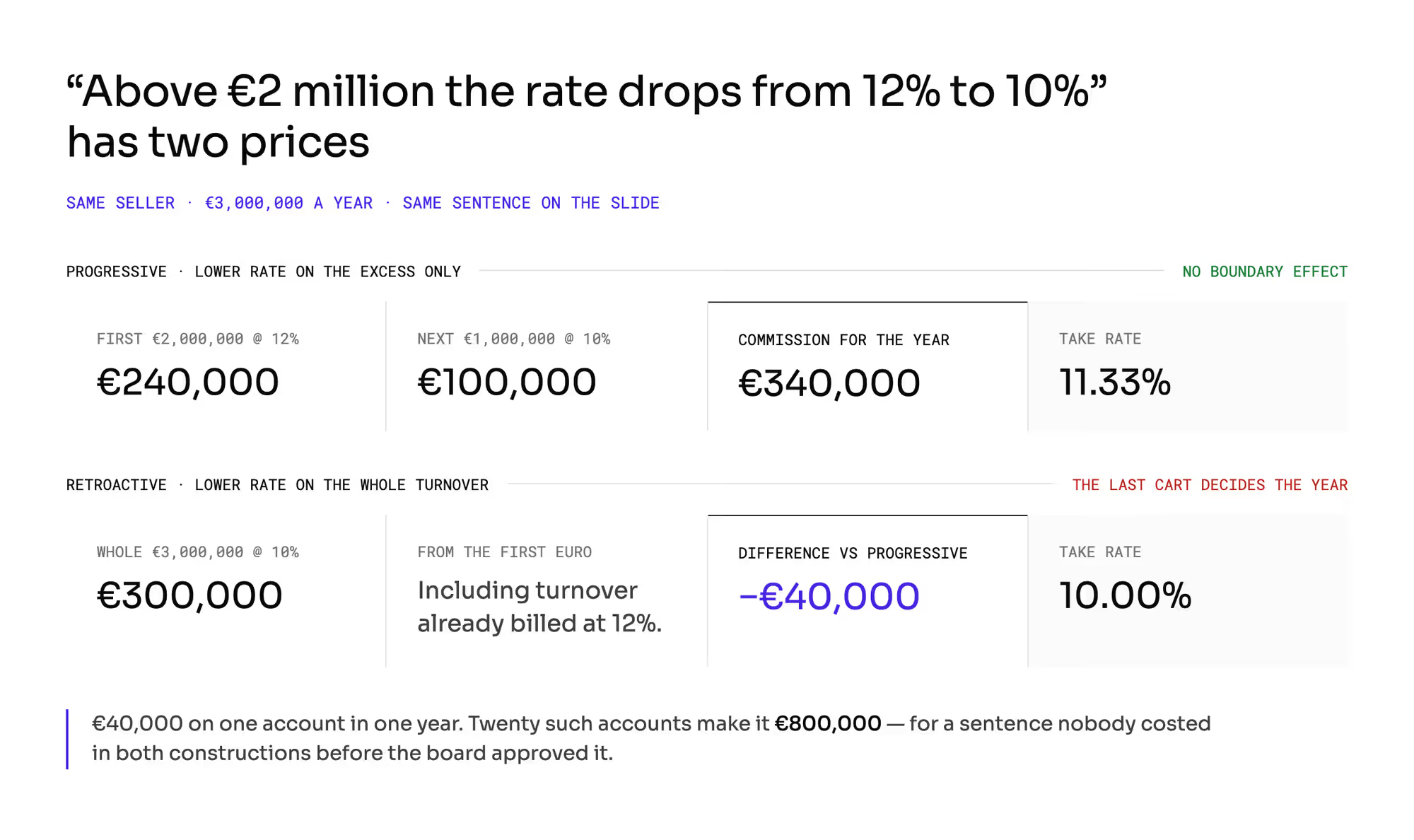
You announce that above €2 million of annual turnover the rate drops from 12% to 10%. That sentence has two different meanings, and both of them look the same on a slide.
1. The progressive construction
The lower rate applies only to the excess above the threshold.
Our seller pays 12% on the first €2 million, which is €240,000, and 10% on the next million, which is €100,000. Together, that is €340,000.
The effective rate works out at 11.33%. That figure is commission divided by turnover, and the industry calls it the take rate.
2. The retroactive construction
Once the threshold is crossed, the lower rate covers the whole turnover, from the first euro.
The same seller pays 10% on €3 million, which is €300,000, and their effective rate is a flat 10%.
The difference on one account in one year: €40,000. Twenty such accounts make it €800,000.
The amount is not the most important thing here. What matters more is what each construction does to the behavior of a seller sitting just below the threshold.
In the retroactive version, the benefit of a whole year hangs on one order. At a turnover of €1,999,000, the commission bill is €239,880.
At €2,000,000 it is €200,000. Selling a single cart of €1,000 cuts the annual bill by €39,880, and a seller who works that out will do everything in the last week of the period to make sure that cart happens.
In the progressive version, the last cart before the threshold costs them €120 of commission, and the first one after it costs €100. A difference of €20 changes nobody's behavior, and that is the point.
Analysts who study volume rebates describe it the same way: with a rebate calculated retroactively, the whole force of the incentive gathers on the last unit before the threshold, because that unit decides all the rest.
There is a second calculation that almost nobody runs before the announcement. A retroactive threshold lowers the rate for the sellers who would have crossed it anyway.
If €2 million of monthly turnover comes from sellers already above the threshold, on day one you hand back €40,000 a month and you do not buy a single euro of extra sales with it. A threshold changes behavior only in the narrow band beneath it.
That band is the one you have to measure.
Why is the period you count a threshold over part of the rate?
"Annual turnover" falls short of a definition. A calendar year, a rolling twelve months, and a year from the day the account was opened are three different thresholds for the same seller.
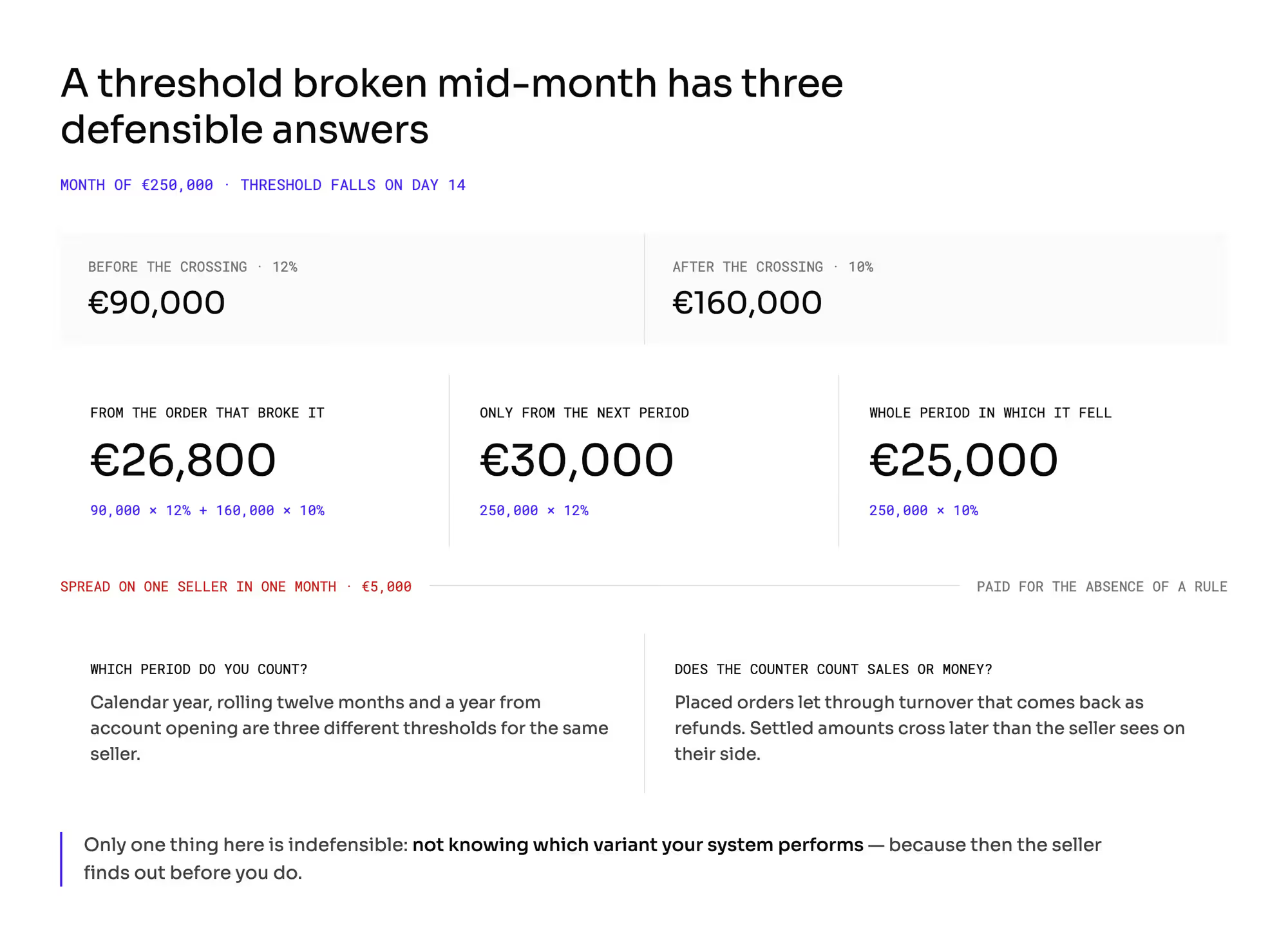
The most expensive case is a crossing in the middle of a period. A seller breaks the threshold on the fourteenth day of a month in which they sell €250,000: €90,000 before the crossing and €160,000 after it.
Three variants, each of them defensible:
- from the order that broke the threshold: 90,000 × 12% plus 160,000 × 10% = €26,800;
- only from the next period onward: €30,000;
- across the whole period in which the threshold fell: €25,000.
A spread of €5,000 on one seller in one month: paid for the absence of a rule rather than for a rule. Just one thing here is indefensible: not knowing which variant your system performs, because then the seller finds out before you do.
On top of that comes a question you cannot postpone: does the threshold counter count sales, or does it count money? A counter run off placed orders lets through turnover that will partly come back as a refund.
A counter run off settled amounts crosses the threshold later than the seller sees it on their own side. And if refunds take volume off the counter, settle whether a threshold once reached can be lost, and what happens then to commission you have already charged (the commission on a refunded order and the ledger behind a balance).
What do a cap and a minimum fee cost you?
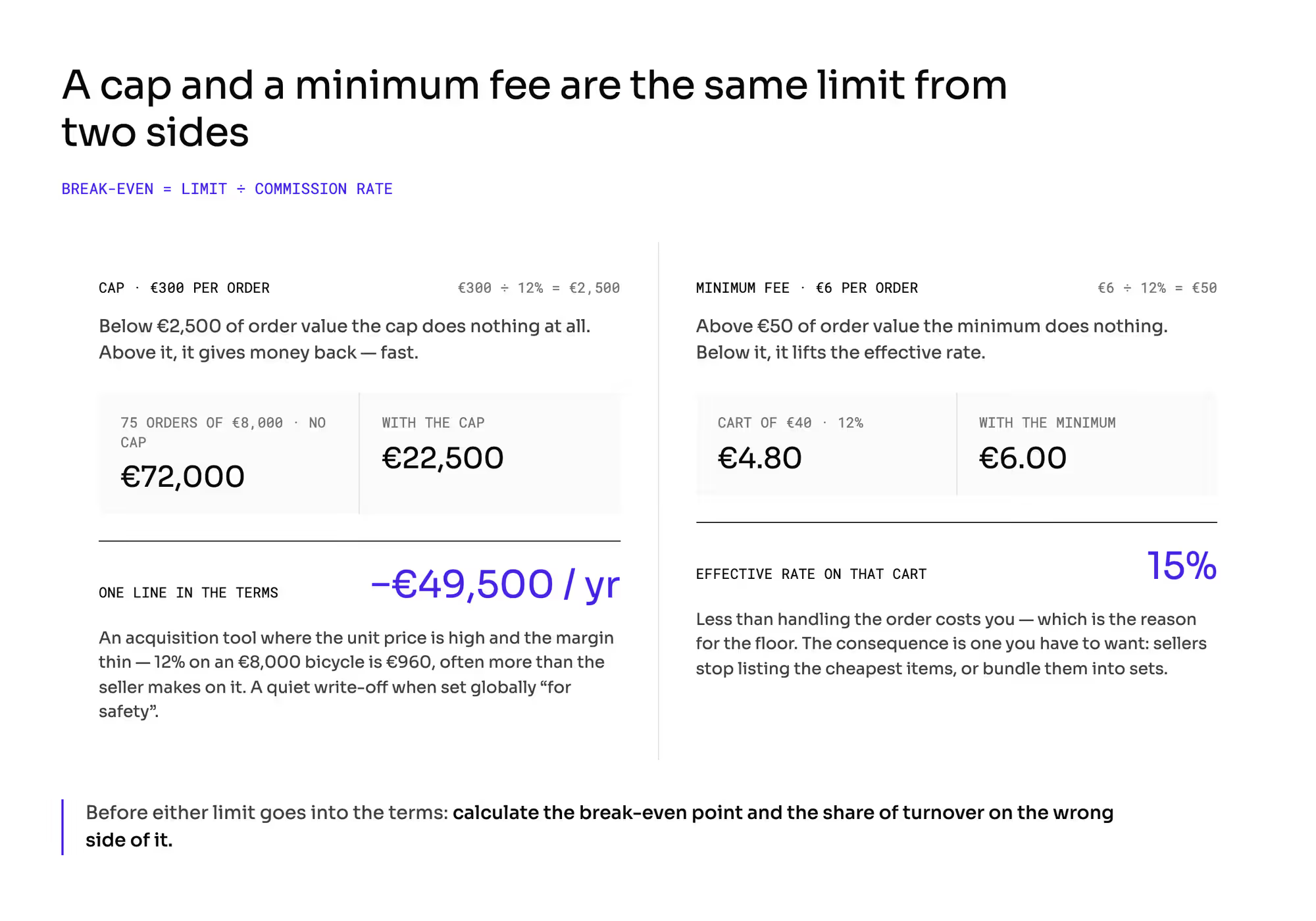
A cap is an upper limit on the commission amount from a single order: you pay 12%, but no more than €300. It has one break-even point: €300 divided by 12% is €2,500.
Below that value, the cap does nothing at all. Above it, the cap starts giving money back, and it does so fast.
Our seller makes their €3 million from two sources: 2,400 carts of €1,000 and 75 orders of €8,000. Without a cap, those 75 orders produce €72,000 of commission.
With a cap, they produce €22,500. One line in the terms costs €49,500 a year on a single account, and the effective rate drops to 10.35%.
That does not make the cap a mistake. In categories with a high unit price and a thin margin, it is sometimes the only condition on which a seller will open the conversation at all: a commission of 12% on a bicycle priced at €8,000 is €960, which is often more than the seller makes on the bicycle themselves.
The cap is an acquisition tool in that case, and you have to call it one. It turns into a quiet write-off of revenue when it gets set globally "for safety", with nobody having calculated how much turnover sits above the break-even point.
The minimum fee is the same limit from below. On a cart of €40, a commission of 12% is €4.80, which is less than handling the order costs on your side.
A minimum fee of €6 lifts the effective rate on that cart to 15%, and its break-even point sits at €50. The consequence is one you have to want: sellers stop listing the cheapest items, or they bundle them into sets.
What does each construction cost on one seller?
Every row runs on one profile: €3 million a year in 2,400 carts of €1,000 and 75 orders of €8,000, on a 12% grid.
Construction | Commission for the year (€) | Effective rate (% of turnover) | Difference against the grid (€ per year) | Change to the bill on the last cart before the threshold (€) | Who it acquires (type of seller) |
|---|---|---|---|---|---|
The grid with no departures | 360,000 | 12.00 | 0 | +120 | nobody in particular |
Retroactive threshold (10% on the whole turnover above €2 million) | 300,000 | 10.00 | −60,000 | −39,880 | the large seller who would have crossed anyway |
Progressive threshold (10% on the excess above €2 million) | 340,000 | 11.33 | −20,000 | +100 | the growing seller, with no boundary effect |
A cap of €300 on the order | 310,500 | 10.35 | −49,500 | does not apply | the seller of expensive goods |
What does a portfolio of exceptions cost in a year?
A single departure is always defensible. The sum of departures is nobody's decision, because nobody has ever seen it whole.
The base: 200 sellers, €8 million of turnover a month, a 12% grid, which is €960,000 of commission a month. Three items sitting on disjoint parts of that turnover:
- negotiated rates. €1.2 million of turnover at an average of 6%: €72,000 instead of €144,000, so minus €72,000;
- the retroactive threshold. €2 million of turnover at 10%: €200,000 instead of €240,000, so minus €40,000;
- the cap. €800,000 of turnover in 100 orders of €8,000: €30,000 instead of €96,000, so minus €66,000.
That leaves €4 million at the full rate, which is €480,000. Together, it comes to €782,000 instead of €960,000, and the effective rate of the platform is 9.8% rather than 12%. Over a year, the difference is €2.14 million.
The sentence for the committee: the grid says 12%, the P&L says 9.8%, and the difference is €2.14 million a year. Not one of these items is a mistake.
The mistake is that we are looking at them together for the first time.
What do commission exceptions change about the rest of your build?
1. A rate has to be an object with two dates
Without an end date, the exception is open-ended, and taking it away after a year looks like a price increase. That puts it inside the procedure for changing the terms of cooperation, the one the rules on decisions about sellers describes.
2. A threshold is a commitment toward everybody rather than toward one seller
You negotiate an exception with a single seller. You announce a threshold to the whole base, and there is no way to announce one "as a trial".
3. The threshold counter and the commission have to share one source of data about turnover
Otherwise, you have two truths about the same sale (payment reconciliation).
4. A rate negotiated out loud and never entered into the grid is invisible to settlement
That is exactly the drift the rate in the system against the signed document takes up.
How do you cost an exception before you announce it?
- Calculate the threshold in both constructions on a closed year. The same words differ by €40,000 per seller.
- Calculate how many sellers are above the threshold today. For them, you are lowering the rate on turnover already done. That is a cost rather than an investment.
- Calculate the band beneath the threshold. Only accounts within a quarter's reach of it will change their behavior. If that is three accounts, the threshold is a message rather than a lever.
- For the cap, calculate the break-even point and the share of turnover above it. For the minimum fee, calculate the share of orders below its point.
- Add up the portfolio of exceptions once a quarter and give one number: the effective rate of the platform next to the rate on the grid.
Which mistakes do operators make about commission exceptions?
1. A threshold announced without calculating both constructions
The board approves the sentence "above €2 million we give 10%", and finance finds out a quarter later that it was the retroactive version.
2. An exception with no end date
A condition granted "for the ramp-up" is still in force three years later, and the person who granted it changed jobs long ago. Nobody can justify it, and nobody can take it back.
3. A cap set globally instead of per category
Brought in for one category with expensive goods, it applies across the whole catalog and quietly lifts commission off the more expensive orders.
4. A portfolio of exceptions with no single owner
Each one approved separately, none of them counted together. The effective rate falls by two points in a year, and nobody can point to the decision that did it.
What do you still have to settle about your own exceptions?
Two things it does not settle are in a lawyer's hands. The first: what you have to describe in your terms of cooperation if you differentiate rates between sellers, and how much notice is needed to withdraw an exception. The mechanism is carried by the rules on decisions about sellers, and the family of regulations goes under the name P2B in the trade.
The second: whether rebates calculated retroactively and differentiated terms are permissible. That is the terrain of competition law, where the market position of the platform changes the answer. Ask that question before you announce the threshold.
Every number above is openly hypothetical. What transfers is the method of calculation rather than the values: tables of average commissions per category that circulate around the market usually come from sales materials rather than from a measurement of your own market.
Summary: What does a departure from the grid cost?
More than the slide said, and for longer than anybody intended. A discount exhausts itself when you grant it; a reduced rate keeps working on every order that follows, so the four fields that matter are a start date, an end date, the name that approved it, and the condition for extending it.
Around that sit three numbers worth having before the announcement. The same threshold written two ways differs by €40,000 a year on one account, and the retroactive version hands the entire benefit to the last cart before the line, which is exactly the behaviour it then produces.
A cap set globally for safety gives money back on every expensive order. And the portfolio, which nobody has ever seen whole, is the gap between the rate on your grid and the rate in your P&L.
Ask a vendor what happens on the day a negotiated rate expires, and whether a threshold can be set up both ways. Building a marketplace where every exception carries two dates and an owner?
Frequently asked questions on marketplace commission exceptions
What is a commission exception on a marketplace?
A commission exception is any departure from the published grid: a volume threshold, a cap, a minimum fee, or a rate agreed with one seller. What separates it from a discount is duration. It applies to every order until somebody takes it away, and the person who has to remember that is you rather than the seller.
Should a volume threshold be retroactive or progressive?
A progressive threshold charges the lower rate on the excess, and a retroactive one charges it on the whole turnover, and the difference on €3 million is €40,000 a year. Retroactive also concentrates the entire incentive on the last order before the line: at €1,999,000 the bill is €239,880, and at €2,000,000 it is €200,000, so one €1,000 cart is worth €39,880.
Why does a commission cap cost more than it looks?
A commission cap costs more than it looks because it does nothing below its break-even point and gives money back fast above it. A €300 cap on a 12% rate breaks even at €2,500, so 75 orders of €8,000 produce €22,500 instead of €72,000.
That makes it an acquisition tool in high-price categories and a quiet write-off when it is set globally.
Ready to build?
We build marketplaces where every exception carries a start date, an end date, and the name that approved it.