
Marketplace Seller Agreement and Terms: Which Documents Do You Need?
A marketplace seller agreement is the document that draws the boundary between you and a seller, and it is one of five your platform needs before the first offer goes live.
A marketplace's set of documents rarely falls over because one of them is missing. It falls over because two of them say different things, and a third one is in force in a version nobody can say who agreed to, or when.
This article breaks down:
- How many documents does a marketplace need?
- Who pays when two of your documents contradict each other?
- What does changing your marketplace terms require?
- Which 3 clauses matter most in a dispute?
Key insights
- Do not ask how many documents you need. Ask who contracts with whom. Five relationships, five documents.
- The seller sells to the buyer, and you are not in that contract. Your system still decides what it says.
- When your buyer terms and your seller terms disagree, you pay. Unclear wording is read in the buyer's favour.
- A commission rate is a version with a date. Overwrite the field and you cannot say what an order from last month was worth.
- Three files in the legal folder are 1,500 acceptance states in your database. Some sellers never clicked, because the person who did has left.
How many documents marketplace need?
The question "how many documents do we need" is put the wrong way around, and no lawyer will answer it until they get a map. Every document is the boundary of one relationship.
Settle who enters into a relationship with whom on your platform, and the number of documents falls out on its own.
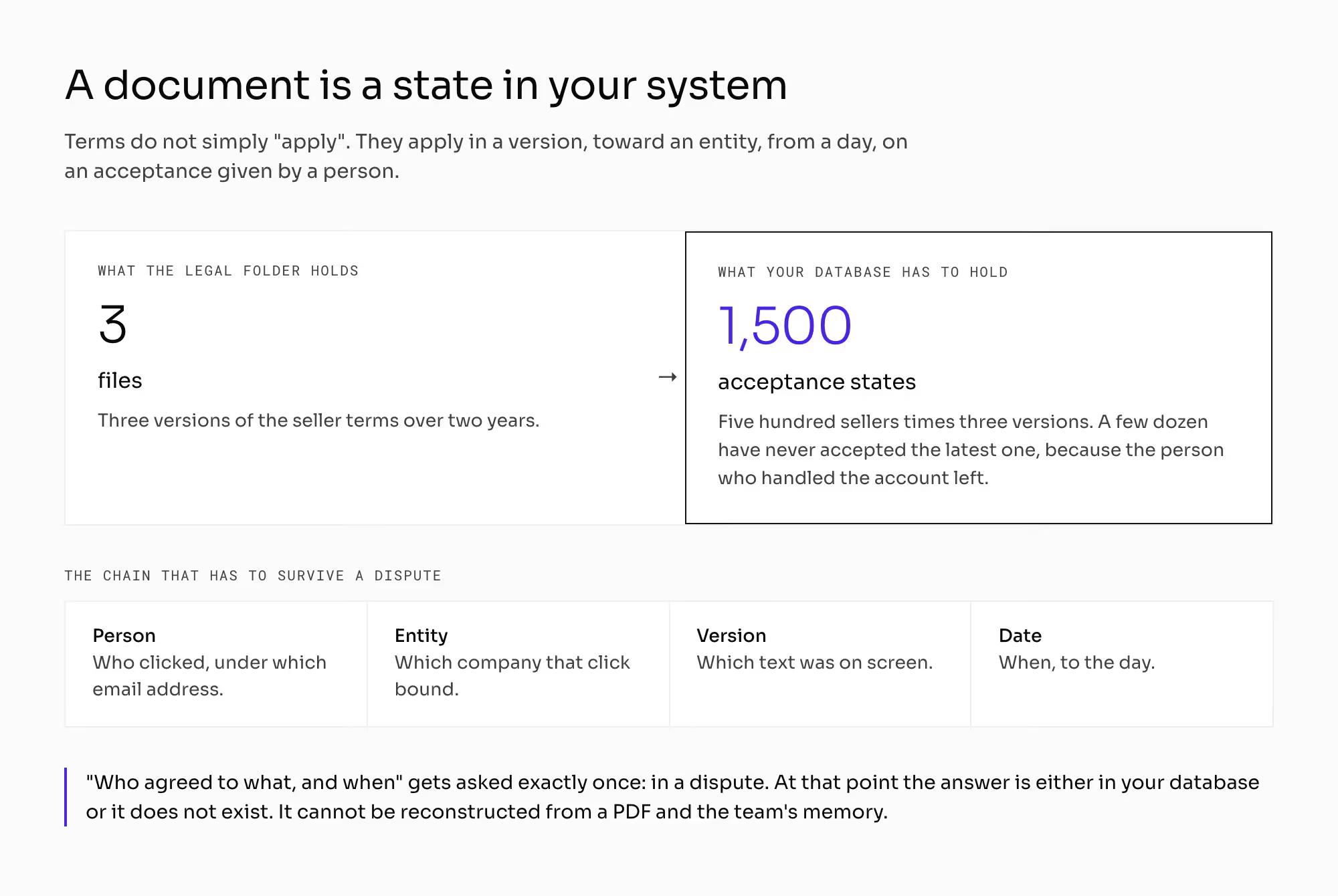
And there is the thing almost everyone forgets: a document is not a file, it is a state in your system. Terms do not simply "apply." They apply in a specific version, toward a specific entity, from a specific day, on an acceptance given by a specific person.
Run this on your own numbers. Five hundred sellers and three versions of the seller terms over two years is one thousand five hundred acceptance states.
A few dozen of them have usually never accepted the latest version, because the person handling the account left the company.
The question "who agreed to what, and when" gets asked exactly once: in a dispute. At that point you either have the answer in your database or you do not have it at all.
That state cannot be reconstructed afterward from a PDF and the team's memory.
Which 5 relationships need a document of their own?
Relationship | Who writes it | What it has to settle | The state in the system |
|---|---|---|---|
You ↔ buyer | you | the rules of purchase, who sells a given line, complaints, returns, data | the version in force when the order was placed |
You ↔ seller | you | fees, deadlines, service quality, parting ways, sanctions | version plus acceptance plus who gave it |
Seller ↔ buyer | you shape it, you are not a party | the minimum conditions a seller may not make worse | enforced offer fields and seller policies |
Data processing | you toward sellers, your vendor toward you | purpose, scope, duration, further sub-processing | the data passed across |
You ↔ vendors | almost always the vendor | payments, logistics, the platform, service levels | the deadlines and limits you promise onward |
The third relationship is the trap, and it wrecks projects. The contract of sale runs between the seller and the buyer, and you are not a party to it.
You still set its content, because your system decides which fields an offer has to carry and which policy the seller may not fall below. So you answer for a document you never sign.
Who is the party to the buyer is settled by "What Is the Merchant of Record in a Marketplace?". Who delivers consumer rights is "Marketplace Consumer Rights: Who Delivers Them?".
Two things are worth knowing early. The signature under a seller contract has all but disappeared.
The market moved to online acceptance, which puts the whole burden of proof on the register in your system. And the second: the set does not end at those five items.
In large e-commerce, practically every promotional campaign has terms of its own, and a marketplace forces you to review all of them. Each one quietly assumes the goods were yours.
Who pays when two of your documents contradict each other?
This is the most common real defect in the set, and it always shows on returns.
Say your buyer terms promise free returns. That is broader than the law requires, because it is part of your offer.
In parallel, your seller terms say the buyer carries the return shipping cost, and the goods go back to the seller. Each sentence makes sense on its own.
Together they open a hole: at 120 returns a month and €40 to send each one back, that is €4,800 a month assigned to nobody. You will pay it, because you made the promise.
The fine print will not fix this. Ambiguity in terms addressed to a consumer is resolved in the consumer's favor, and a clause found unfair simply does not bind them.
It gets cut out, and the rest of the document still binds you. A contradiction between your documents is therefore not a draw: it goes against you.
The same asymmetry comes back on individual concessions. If a side letter gives one seller a longer shipping window, the exception works toward that seller, and the delay still counts toward the metric for the whole platform.
Practitioners observe that some platforms count it exactly that way. The conclusion: check every concession to a seller against the promise it may quietly make to the buyer.
What does changing your marketplace terms require?
This is the core of the subject, and the part no amendment to the law will make stale. Changing your terms requires answers to five questions, and each is a function in your system.
1. Which version is in force, and from when
A version has to be an object with a date. An order from last quarter is judged against last quarter's version.
2. Who exactly accepted: a person or an entity
The market answer is "a person." The acceptance is given by a user under their own email address, and it binds the company. So keep the whole chain: person → entity → version → date.
The same goes for a seller operating in two modes at once, say as a third-party seller and as a supplier in dropship: two relationships, two documents, two separate acceptances.
3. Whether the notice was effective
Regulations on transparency in platform-to-seller relations require you to warn of a change in advance, to deliver it on a durable medium (a form the recipient can keep and reproduce), and to give the seller the right to terminate before the change takes effect. Confirm the notice window with a lawyer; it also depends on whether the change forces an integration rebuild.
The consequence, though, is unambiguous: a change made without completing that procedure is ineffective. Not "risky." Ineffective.
Which means the new rate you are already charging has no basis.
Hence the product conclusion. A mass announcement to sellers is a channel practically every platform has.
It is still not proof that a given recipient was notified. The proof is a record: to whom, when, in what form, and with how much warning.
4. What happens to sellers who have not accepted
Three answers, and you have to be able to execute all three: block the panel until they accept, block publication of new offers, or let them sell on the old terms. The first is the cleanest legally and the most brutal operationally.
In the middle of a season, it kills sales. The third is gentle and expensive, because it leads straight to the fifth question.
5. How long you keep two parallel regimes
A business decision with a hard technical consequence: in one month your fee engine has to calculate two rates for two groups of sellers and show which follows from what. If it cannot, a "transition period" does not exist as an option, however freely a lawyer would allow it.
Why are commercial terms per country an expansion gate?
The most expensive mistake in this area looks innocent: terms sent out for translation instead of for a rebuild.
Commercial terms do not carry across markets. Practitioners working in Western markets consistently note that free returns are often the market norm there, so they buy you nothing.
A seller selling on your platform without them has to agree to them before you let their offers onto the new market. The same goes for delivery times, service in the local language, and the route a dispute takes.
The conclusion is structural: your seller terms need separate sections per target country, and entering a new market becomes a gate at which the seller accepts an extra set of obligations. The good news: this is a quality control tool for expansion.
The bad news: it multiplies states, because four countries times three versions is twelve regimes inside one acceptance register.
Check one thing before you promise the board an expansion. Some platforms have a concept of a country channel, and some know only one country and one base currency per instance.
In that case, "terms per country" means separate installations, or a spreadsheet next to the system.
Why must your published rates match the grid in your system?
This is the most underrated item in the set. It looks like a configuration topic and is really a check against a document that is at once commercial and legal.
Take the canon: a €1,000 cart, a published commission of 12%, and €880 landing with the seller. Someone with the right permissions types 12.5% into the grid.
A typo while rolling out a new category, and it happens all the time. The seller now gets €875.
Across 400 orders, that is €2,000 charged with no basis in a document you published yourself.
Notice what this is not. It is not a configuration error to be quietly corrected.
It is a divergence between your system and the document your sellers are bound by. The effect is threefold: a refund of the overcharge, a correction of settlement documents for the whole period, and a conversation in which your commission grid stops being credible.
Practitioners admit openly that such mistakes happen and nobody catches them, because nobody compares the rates in the database against the published document.
The control is cheap, and hardly anyone has it: a recurring comparison of the grid from the system against the published version, with an alert on divergence and on any rate changed outside the process. The general rule: do not publish a condition you cannot reproduce from your system on demand.
Building the grid itself is a separate subject, and a chapter on commissions takes it up.
Which 3 clauses matter most in a marketplace dispute?
1. Insurance on the seller's side
A requirement to hold a policy matching the risk of the goods is a clause in your seller terms. Without it, a buyer's damage leaves you facing a counterparty with no cover.
2. Governing law and the court
A choice of law is permitted, but toward a consumer it does not strip them of the protection in force in their own country. A clause reading "the governing law is the law of our registered office" therefore does not do what the board thinks it does.
3. The route a dispute takes
Regulations require you to point sellers to mediation bodies inside the text of the document, and to give buyers information about the out-of-court route. This is the only place where your terms point outside themselves, and the central EU contact point for online disputes, named in terms of service for years, was recently switched off.
An item for periodic review, and for the calendar.
What does a marketplace seller agreement decide?
1. The acceptance register is a product requirement
A lawyer will write each of these documents. Nobody but you will make sure the system knows who accepted which version and when.
Without that, the whole set is unenforceable in a dispute.
2. Seller onboarding gains one more gate
Alongside the payout details and the verification from "Marketplace Seller Verification: KYC, Beneficial Owners, and Sanctions" comes acceptance of the right version for the right country. A seller with live offers and no acceptance is a risk.
3. Returns and the commission on a return inherit your documents
What you promised the buyer and what you allowed the seller to fix how the mechanisms in "Marketplace Refunds: Who Pays for Them and Out of What?" and "Who Keeps the Marketplace Commission on a Refunded Order?" behave.
4. Your duties toward sellers are a separate subject
Transparency, ranking, the justification for a suspension, and the appeal path belong to "P2B Regulation on a Marketplace: Ranking, Terms Changes, and Suspension". "Marketplace GDPR: Controller, Processor, or Joint Controller?" covers the scope of data passed to a seller and who its data controller is.
How do you check your marketplace documents with a vendor and a lawyer?
1. Questions for your platform vendor
- Show me the acceptance register: versions, their status, who accepted, and when, with a way into one seller's history.
- What does notice of a change of terms look like: a record per recipient with a date and a form, or only a mass announcement?
- Will the system hold two parallel rates in the same month, and will a report show what each follows from?
- What does the structure of terms per country look like when one seller sells on two markets with different rules on returns?
2. Questions for your lawyer
- Which of these five documents has to be a signed contract in our case, and which is enough as terms accepted online?
- What form and how much advance notice does a change of terms require, and how long may we keep two regimes?
- Which of our promises to buyers have to be mirrored by an obligation on the seller, so that they do not end up as our cost alone?
Which mistakes do operators make about a marketplace seller agreement?
1. Terms as a file swapped out on the server
Without a dated version, you cannot judge a past order or prove anything in a dispute. The swap is silent and irreversible.
2. An acceptance tied to a person but not to an entity
The person leaves the seller's company, and the acceptance stops binding anyone. It costs you only in a dispute, which is the latest and most expensive moment.
3. An announcement instead of a notice
A mass email reads like discharging the duty, and it is not. A change made that way can be ineffective, which means you are charging fees with no basis.
4. A published commission grid with no check against the system
One typo means refunding overcharges, corrections for the whole period, and the loss of your price list's credibility.
5. The set written after the platform is built
The documents then describe what the system already does instead of what it was meant to do, and every change to them turns into an IT project.
What do you still have to settle yourself about a marketplace seller agreement?
This guide is a map of relationships and mechanisms. It deliberately carries no names of provisions, no deadlines, and no thresholds.
Those you confirm by name, because they change faster than any document. One of the families of regulation listed below is itself the subject of work on replacing it, so read this as a list of topics for a conversation; "Marketplace Compliance: Adding a Required Attribute to a Million Offers" is devoted to the law changing mid-project.
Go to a lawyer with platform experience and walk through six families of topics. Do not ask whether they apply to you.
Ask to what extent:
- Regulations on transparency in platform-to-seller relations, known in the trade as P2B: the mandatory content of terms, the procedure for changing them, the justification of decisions, the naming of mediators.
- Consumer law: information duties, returns, and complaints, and who they are addressed to when the goods sold belong to somebody else.
- Unfair contract terms: which of your clauses are not binding even though the buyer accepted them.
- Personal data protection: whether the seller is an independent data controller of the buyer's data or acts as your processor, and what document that requires.
- Governing law, jurisdiction, and out-of-court dispute resolution, known in the trade as ADR and ODR.
- Competition law: if your terms carry pricing or parity commitments.
Our claim is narrower than any of those answers and independent of them: a lawyer will write the content of your documents, and it is your system that decides whether you can prove them. A version with no date, an acceptance with no entity behind it, and a notice with no trace void the best-written set there is.
That is the part you order together with the platform.
Summary: What makes a set of documents enforceable?
The record behind them. A version that is an object with a date, an acceptance tied to a person and to an entity, a notice with a record per recipient, and a commission grid that matches the published one.
A lawyer writes the content; your system decides whether you can prove any of it a year later.
Count your own acceptance states: sellers times versions, minus everyone who never clicked. Building a marketplace that has to prove who accepted which version, and when? Talk to us about the build.
Frequently asked questions on a marketplace seller agreement
What documents does a marketplace need?
One per relationship, and there are usually five. You to the buyer, you to the seller, the seller to the buyer, you to anyone supplying services on the platform, and the privacy documentation that sits across all of them. The count follows from the map of relationships, so settle that first.
Can a marketplace change its seller terms?
Yes, with advance notice on a durable medium and a right to terminate before the change takes effect. A mass announcement is not proof that a given seller was notified.
What counts is a record per recipient: to whom, when, in what form, and with how much warning.
Who is liable when the buyer terms and the seller terms disagree?
You are. Ambiguity in terms addressed to a consumer is resolved in the consumer's favour, and a clause found unfair does not bind them, while the rest of the document still binds you.
Free returns promised to buyers and return shipping charged to buyers in the seller's terms is the version of this that shows up most often.
Ready to build?
We build marketplaces that store who accepted which version of your terms, and on what date, for every seller in the catalog.