
Marketplace Seller Registration and Onboarding: From the Form to the First Sale

Marketplace seller onboarding is everything between a seller's signature and their first order, and it behaves like a funnel of seven gates rather than like a registration form.
A seller you recruited and never activated shows up in the report and never in the revenue. Between their signature and their first order stand several gates that nobody counts.
That is where most of the supply you already paid for disappears.
This article breaks down:
- When does seller onboarding end?
- Which 3 gates lose the most sellers?
- When does self-service become cheaper than a manager?
- How should a seller upload their first offer?
Key insights
- Seller onboarding ends at the first sale rather than at account activation, so the number worth reporting is the median time from registration to first order, measured per cohort.
- The three gates that lose the most sellers are payout verification, which your payment provider controls rather than you; the shipping setup, where a seller folds 60 of their own rates into your 6; and category and attribute mapping, which can run to 720 field decisions for one seller with 4,000 items.
- Self-service becomes cheaper than a manager above roughly thirty new sellers a month: at 6 hours per seller, 25 a month is already 1.25 full-time people, and because about one registration in five ends in a sale, the true cost is close to 29 hours per selling seller.
- A seller should upload their first offer through the route they will keep using: the panel suits ten items, a file works at any scale, and an integrator brings in the most items along with somebody else's mapping and description quality.
When does seller onboarding end on a marketplace?
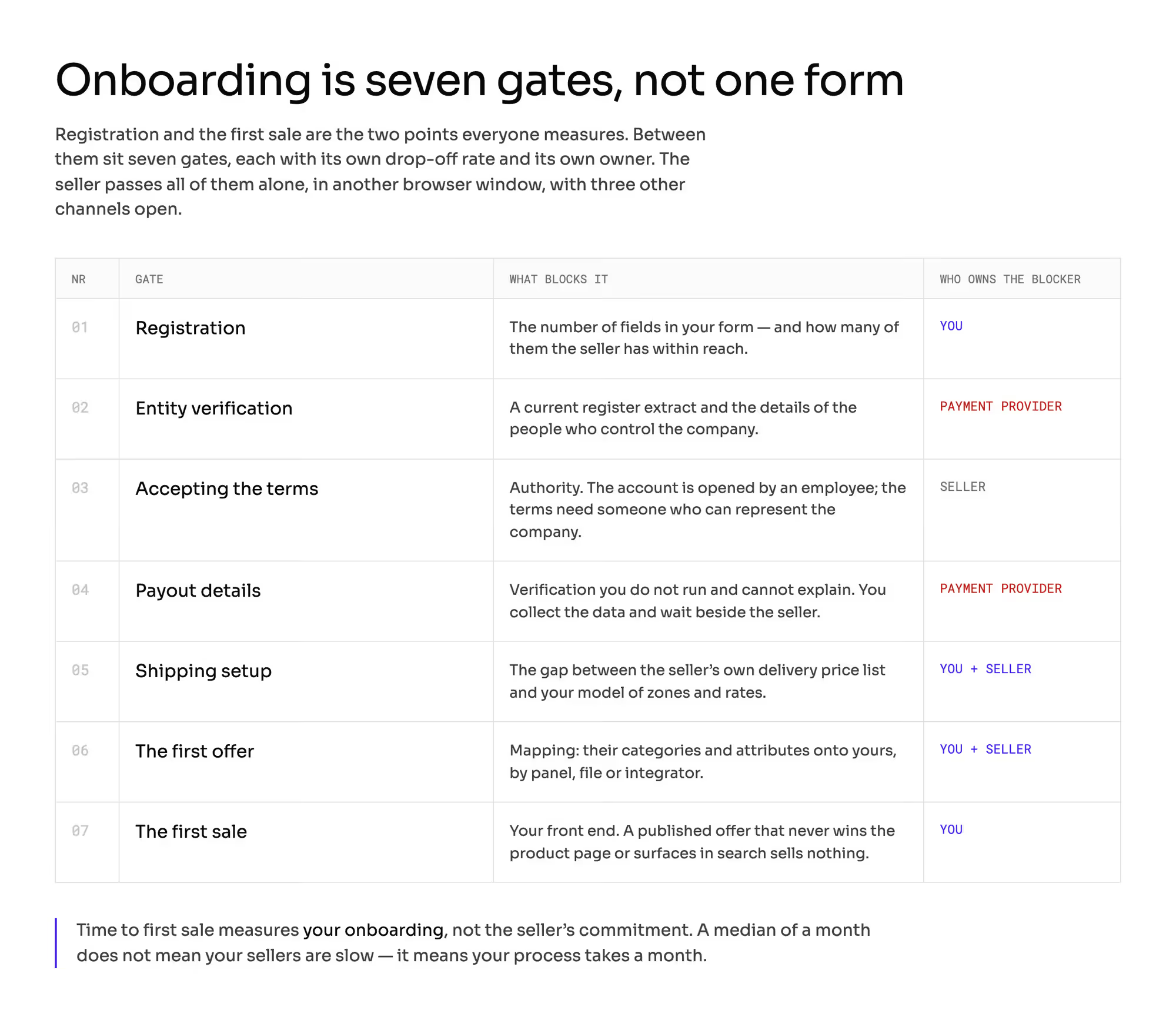
Most operators measure two points: how many registered and how many sell. Between them sit seven gates, each with its own drop-off rate and its own culprit.
That is the entire job of onboarding.
- Registration. Blocked by your form: the number of fields, and how many of them the seller has within reach while filling it in.
- Entity verification. Blocked by registry documents and by the details of the people who control the company. Most often, what is missing is a current extract from the register and the beneficial owner details (verifying a seller at the entrance).
- Accepting the terms. Blocked by authority. The account is opened by an employee, and the terms have to be accepted by someone who can represent the company (the documents you sign with a seller).
- Payout details. Blocked by your payment provider rather than by you.
- Shipping setup. Blocked by the gap between the seller's delivery price list and your model of zones and rates.
- Uploading the first offer. Blocked by mapping: their categories and attributes onto yours.
- The first sale. Here the culprit is you. A published offer that does not win the product page and does not surface in search sells nothing, however hard the seller works (the rule that picks the winning offer and search and filtering).
Two things about this list matter more than the list itself. The first: the seller passes every one of these gates without you, in another browser window, in the evening, with three other sales channels open.
The second: time to first sale measures your onboarding rather than the seller's commitment. A median of a month does not mean your sellers are slow.
It means your process takes a month.
How much supply does the onboarding funnel lose?
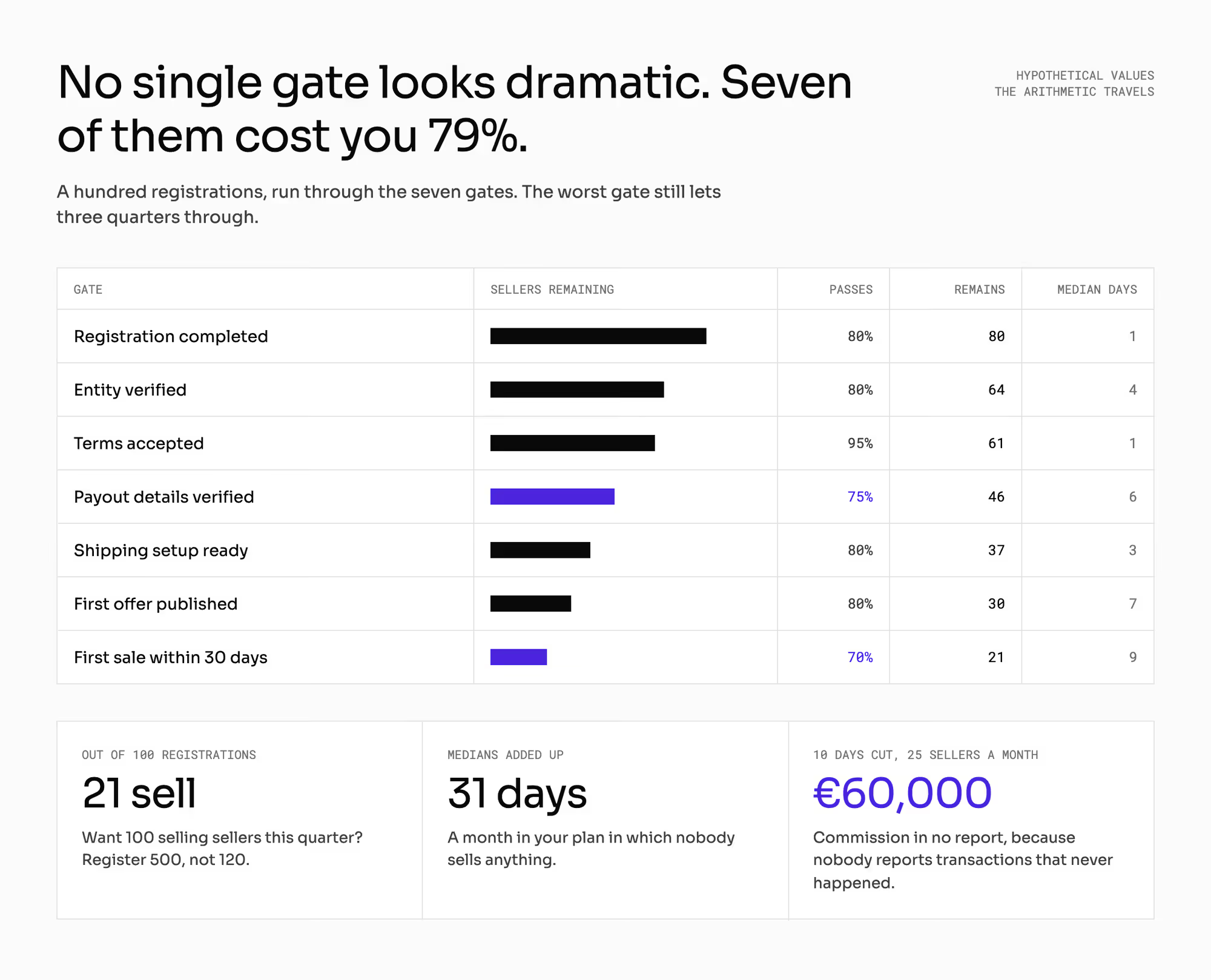
Run the numbers on a hundred registrations. The figures below are openly hypothetical. What travels is the arithmetic rather than the values.
No single gate looks dramatic. The worst one still lets three quarters through.
Multiply seven gates like that, and you land at 20%. Out of a hundred registrations, twenty-one sell.
The medians add up to 31 days, a rule of thumb rather than a forecast, but it says one thing plainly: your plan contains a month in which nobody sells anything.
This table changes two conversations. The recruitment conversation: if the committee wants a hundred selling sellers this quarter, this funnel means registering five hundred rather than a hundred and twenty.
And the money conversation: at a cart of €1,000, a commission of 12% and the seller taking €880 per cart, cutting ten days off the path for a seller who does two orders a day is 20 carts: €20,000 of GMV, €2,400 of your commission and €17,600 of their revenue. On a cohort of 25 new sellers a month, that is €60,000 of commission which appears in no report, because nobody reports the transactions that never happened.
To count any of it, onboarding has to be an object with a state rather than a checklist in a spreadsheet. You need three answers per seller: which gate they are standing at, what is blocking them, and who owns the blocker (your team, the seller, or an outside provider).
The requirement to leave a trail on decisions toward a seller belongs to the rules on decisions about sellers. What matters here is simpler.
Without state, you cannot calculate a single one of the seven rates, and without the rates you do not know which gate to fix.
Which 3 gates lose the most sellers?
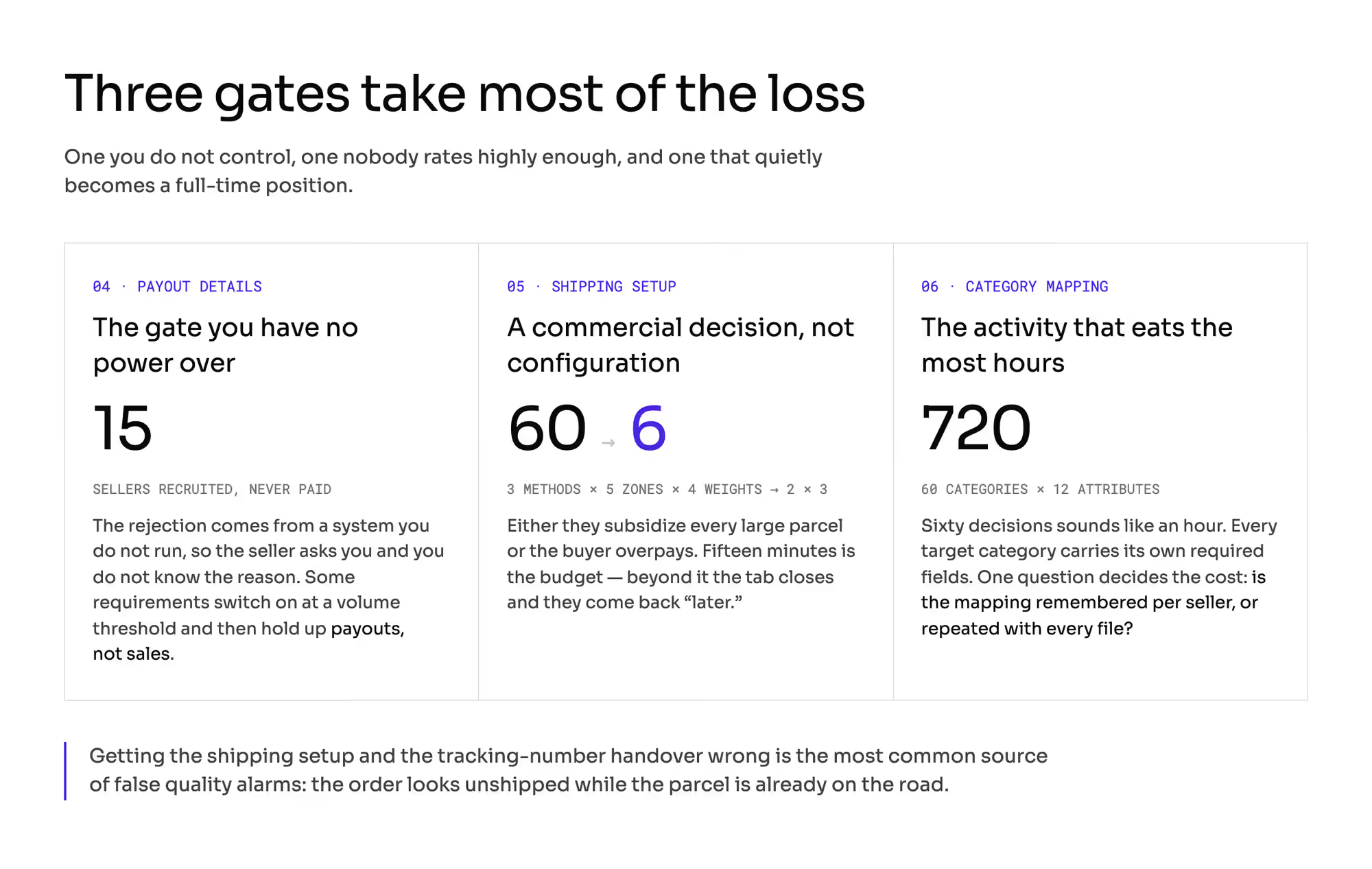
Payout details. The gate you have no power over.
Your payment provider verifies the company and the people who control it rather than you. You collect the data, pass it on and wait alongside the seller.
Three consequences follow, and none shows up in a feature matrix. First, the rejection message comes from a system you do not control, so the seller asks you, and you do not know the reason.
Second, there is an open decision here that nobody puts on the table: do you collect the full set of data at registration, or incrementally, as the seller's volume grows. Collecting everything up front lengthens the first gate and shortens the fourth; the incremental version does the opposite and moves the risk into the period when the seller is already selling.
Third, and most expensive: some requirements switch on once volume crosses a threshold, and then they hold up payouts rather than sales. Commission keeps accruing, the seller does not see the money, and the first question comes to you.
In the funnel above, this gate is fifteen sellers you recruited and will not be paying.
Shipping setup. The most underrated gate in the whole funnel.
The seller is not "setting up delivery." They are reproducing their own price list inside your model, and those two rarely have the same shape. Say they run 3 shipping methods, 5 zones, and 4 weight thresholds at home, which is 60 combinations.
Your model gives 2 methods and 3 zones with no weight thresholds, which is 6 rates. Bringing 60 down to 6 is not configuration.
It is a commercial decision: either they subsidize every large parcel, or they raise the rate for everyone and the buyer overpays. A seller who cannot settle that in fifteen minutes closes the tab and comes back "later." A seller who settles it badly comes back as a support ticket after the first loss on a shipment.
Practitioners running onboarding point to the other side of this gate too. Getting the shipping setup and the tracking number handover wrong is the most common source of false quality alarms.
The order looks unshipped while the parcel is already on the road.
Mapping categories and attributes. The most expensive activity in onboarding, measured in hours.
Every sales channel has its own category tree and its own attributes required inside each branch, a property of the market rather than of your platform, which makes the translation between two trees a separate data artifact rather than something you settle in a phone call. The scale surprises people.
A seller with 4,000 items in 60 categories of their own maps them onto your tree. Sixty decisions sound like an hour of work, but every target category carries its own set of required fields: at twelve attributes per category, that is 720 decisions about matching one field to another.
Practitioners running onboarding describe it as the activity that eats the most time with every new seller. Hence one question for your vendor worth more than the whole rest of the conversation about imports: is the mapping remembered once per seller, or repeated with every file?
The mechanics of categories and attributes belong to the category tree.
Self-service or a dedicated manager: which does the arithmetic favour?
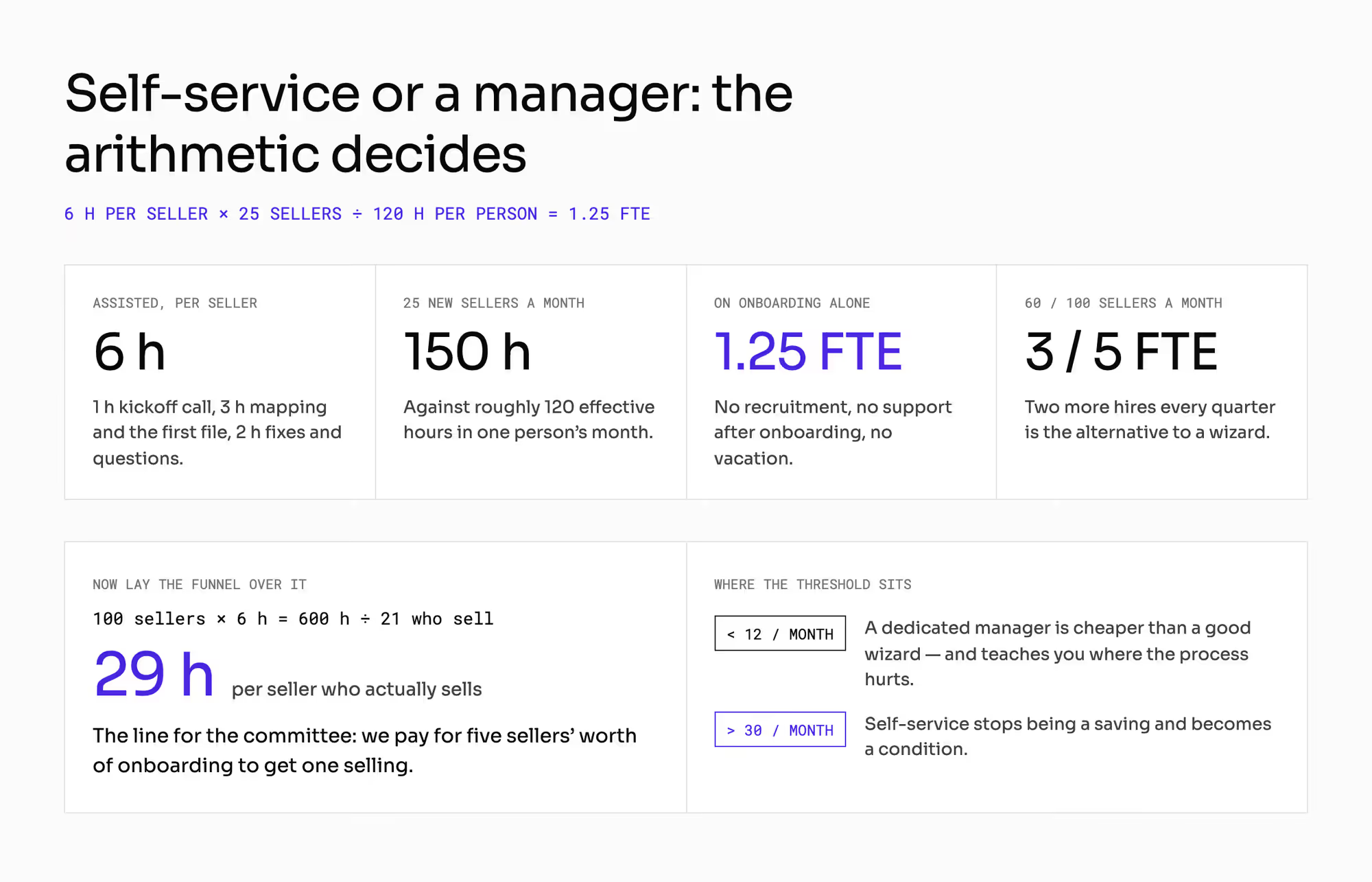
Do this one out in the open. Taking one seller to their first sale in an assisted model costs 6 hours of a manager's time in our example: an hour on the kickoff call, three hours on the mapping and the first file, two hours on fixes and questions.
On a plan of 25 new sellers a month, that is 150 hours. A realistic month for one person is around 120 effective hours (6 hours × 20 days), so you are at 1.25 full-time people on onboarding alone, and that number covers no recruitment from finding your first sellers, no support after onboarding, and no vacation.
At 60 sellers a month, it is 360 hours, or 3 full-time people. At 100, it is five.
Now lay the funnel over that. You spend the six hours on everyone who enters and collect the value from the ones who sell: 100 × 6 hours is 600 hours, divided by the 21 who make it, which is almost 29 hours of onboarding per seller who sells.
The line for the committee: we pay for five sellers' worth of onboarding to get one selling.
That gives you the threshold. Below a dozen or so new sellers a month, a dedicated manager is cheaper than a good wizard and teaches you where the process hurts.
Above roughly thirty, self-service stops being a saving and becomes a condition. That is less about modernity than about the alternative: a conversation about two more full-time hires every quarter.
Staffing models used across the industry say the same from the other end: the size of your onboarding team follows from how much of the process is self-service.
How should a seller upload their first offer?
The sixth gate is the moment of truth, because the route a seller takes first stays with you for years. The panel is good for ten items and for learning the system; at a thousand it is unusable.
A file works at any scale and is the only route a seller will repeat after you reject a few hundred items, though the data quality depends on what they typed in themselves. An integrator, the tool they already run their other channels from, brings in the most items for the least effort and accounts for the bulk of offer inflow in many rollouts.
It also brings somebody else's mapping and somebody else's description quality, and you will not change that later with one command. The tools belong to the seller panel, the requirements for content to what you can enforce on content.
One assumption is worth defusing right away: the seller will not hand you their whole catalog. Experienced sellers run a different assortment per channel, so a supply forecast built as "number of sellers × their item count" is inflated, and your import has to support picking a subset as well as a full feed.
And the thing not to do: do not let a seller start selling before their data is complete. An account that is active without verified payout details and without shipping configured sells once, then produces a support ticket, an argument about the shipping cost, a return and a bad memory on both sides at once.
This is the most common mistake of the first quarter, because then every activation looks like a win. Define the activation set as a list of fields rather than as the manager's intuition.
What does the onboarding funnel change about the rest of your build?
1. The onboarding funnel belongs to the supply plan rather than to operations
A target of "a hundred selling sellers" has to be run through all seven rates before it becomes a promise. Otherwise, the recruitment from finding your first sellers delivers numbers you cannot find in the revenue.
2. Two of the seven gates are not yours
Verification of the entity and of the payout details sits with your payment provider, and the last gate depends on your own front end (the rule that picks the winning offer and search and filtering). Spend the budget on the gates you control end to end.
3. The data you collect during onboarding then serves three other things
The payout (payout cycles, holds and reserves), the information telling the buyer who they are contracting with (whether you are an intermediary or a seller), and the measurement of seller quality, which without an activation date has nothing to count its time windows from (seller quality thresholds).
4. Onboarding ends with a handover
If the moment of moving from the onboarding manager to regular support is not defined out loud, managers service their own cohorts forever, and onboarding throughput drops month after month (seller support and education).
How do you check seller onboarding with a vendor?
Six questions, each of them answered on a live system rather than described in a proposal.
- Run a registration in front of me, from the empty form to an active account, with nobody from your side touching it. I will count the fields and the steps. Usability research on forms agrees on one point: the number of fields weighs more than the number of steps, and a field you do not need for the next gate costs you, sellers.
- Where do I see which gate each seller is standing at and what is blocking them? If the answer is a status called "in onboarding," you do not have seven rates. You have one.
- What does the seller see when verification at the payment provider stalls or gets rejected? Who unblocks them, and how long is the longest path you have on record?
- How does a seller enter shipping rates: by import, or by retyping them one by one? And how many zones and thresholds can your model reproduce?
- Is the category and attribute mapping remembered per seller? Show me the second file from the same seller.
- Can I hold activation until the data is complete, and which fields count as complete? If the set is hardwired in code, your activation policy is somebody else's policy.
Add one number measured from the first month onward: the median time from registration to first sale, per registration cohort. Measure it in cohorts rather than as an average over your whole history, because after two years an average shows improvement where there is none.
Which mistakes do operators make about seller onboarding?
1. Activation based on registration rather than on a complete data set
The seller sells once, and you get a support ticket, a return, and a seller who already knows something on your platform does not work.
2. A form built as the sum of every department's wishes
Legal adds three fields, finance four, marketing two, and nobody subtracts. The cost is measurable at exactly one place, the first gate, and nowhere else.
3. Onboarding reported as a count of sellers recruited
The chart goes up, the revenue does not, and the cause sits in a gate that appears in no report. The hardest mistake on this list to spot, because all the numbers agree.
4. Category mapping done for the seller with every new file
It looks like a courtesy from the onboarding manager. It is a full-time position in your fixed costs, growing in a straight line with recruitment.
5. No handover point after the first sale
Managers drag their old cohorts along, new sellers wait, and the median time to first sale climbs with nothing changing in the system.
What do you still have to settle about your own onboarding?
This article does not say where to find sellers, nor what identity and beneficial owner verification is as a process. All that counts here is that the gate stands on the path and takes days.
This article does not settle which data you are allowed to require at registration, or what you have to deliver to the seller when they accept the terms. The scope of the data and the form of delivery depend on your market and on who you contract with.
The mechanism of obligations toward sellers belongs to the rules on decisions about sellers, and you confirm the list of fields with a lawyer before you design the form. Adding fields after launch costs more than one conversation before it.
All the numbers in this article are openly hypothetical. The seven rates, the medians in days, and the six hours of onboarding are a skeleton to fill in with your own data.
Our values show one thing only: how these gates multiply through one another.
Summary: What stands between a signature and the first sale?
Seven gates, two of which are not yours. Registration, entity verification, accepting the terms, payout details, shipping setup, the first offer, and the first sale: none of them look dramatic on their own, and multiplied together they turn a hundred registrations into about twenty sellers and a month of calendar time.
The three that cost the most are the ones you can only partly control: the payout verification that sits with your payment provider, the shipping setup where a seller has to fold their own price list into your model, and the category mapping that is counted in hundreds of field decisions per seller. The arithmetic also settles the staffing question on its own, because six hours per registration becomes twenty-nine hours per seller who earns you a commission.
Ask a vendor to show you which gate each seller is standing at and what is blocking them. Building a marketplace where onboarding is an object with a state, so you can see the seven drop-off rates instead of one status called "in onboarding"?
Frequently asked questions on marketplace seller onboarding
How long does marketplace seller onboarding take?
Marketplace seller onboarding takes about a month end to end in our worked example, because the medians of the seven gates add up to roughly 31 days. That number measures your process rather than the seller's commitment, and the only honest way to track it is the median from registration to first sale per registration cohort.
What is vendor onboarding on a marketplace?
Vendor onboarding on a marketplace is the same work seen from the other side of the contract: collecting the company's details, verifying who controls it, and setting up how it gets paid. It differs from vendor onboarding inside a buying company in what it ends with.
There, the vendor is onboarded so you can pay them an invoice. Here, the vendor is onboarded so they can sell, which means the process is not finished until an offer is live and a buyer can order it.
Why do sellers drop out during onboarding?
Sellers drop out at the gates where the work is theirs, and the rules are yours. Payout verification stalls at a provider you do not control, the shipping setup asks them to reproduce 60 of their own rates inside your 6, and category mapping turns 60 categories into hundreds of decisions about matching one field to another.
A seller who cannot settle one of those in fifteen minutes closes the tab and comes back later.
Ready to build?
We build marketplaces where onboarding is an object with a state, so you can see which gate a seller is standing at and what is blocking them.