
How to Announce a Marketplace Launch to Buyers and Suppliers

A marketplace launch announcement is the message that tells your buyers, suppliers, and staff that third-party sellers now sell in your store. You can choose how loud it is. You still have to tell buyers who sells each offer.
You can launch third-party sales without a single press release, and sometimes that's the right call. You can't launch them without telling the buyer who they're buying from.
Companies often make one decision for both. Usually they decide about the press release and stop there.
This article breaks down:
- What must you tell buyers even without an announcement?
- Which 3 launch announcement strategies can you choose?
- Who should hear about third-party sales before your buyers?
- Who owns the adoption of third-party offers?
Key insights
- Even without an announcement, you must tell every buyer who sells the offer before they buy. An announcement reaches 300,000 people, and the seller disclosure applies to 2,400 orders in the first year. For every buyer of a third-party offer, 125 people hear the announcement and never see a seller's offer.
- The 3 launch announcement strategies you can choose from are loud, quiet, and staged. A loud launch reaches all 300,000 addresses and takes about 25 person-days. A quiet one sends no campaign and takes 6 person-days, and a staged one reaches 54,000 people per category.
- Your suppliers, your sales team, and your customer service should hear about third-party sales before your buyers. With 2,400 third-party orders a year and 40 people in service, each person gets about one such question a week. Train them before the external message goes out.
- The adoption of third-party offers needs one owner with one measure: the first third-party order per buyer. A campaign to 300,000 addresses brings about 115 orders. A target of 2,400 orders a year then needs 21 campaigns.
What must you tell buyers even without an announcement?
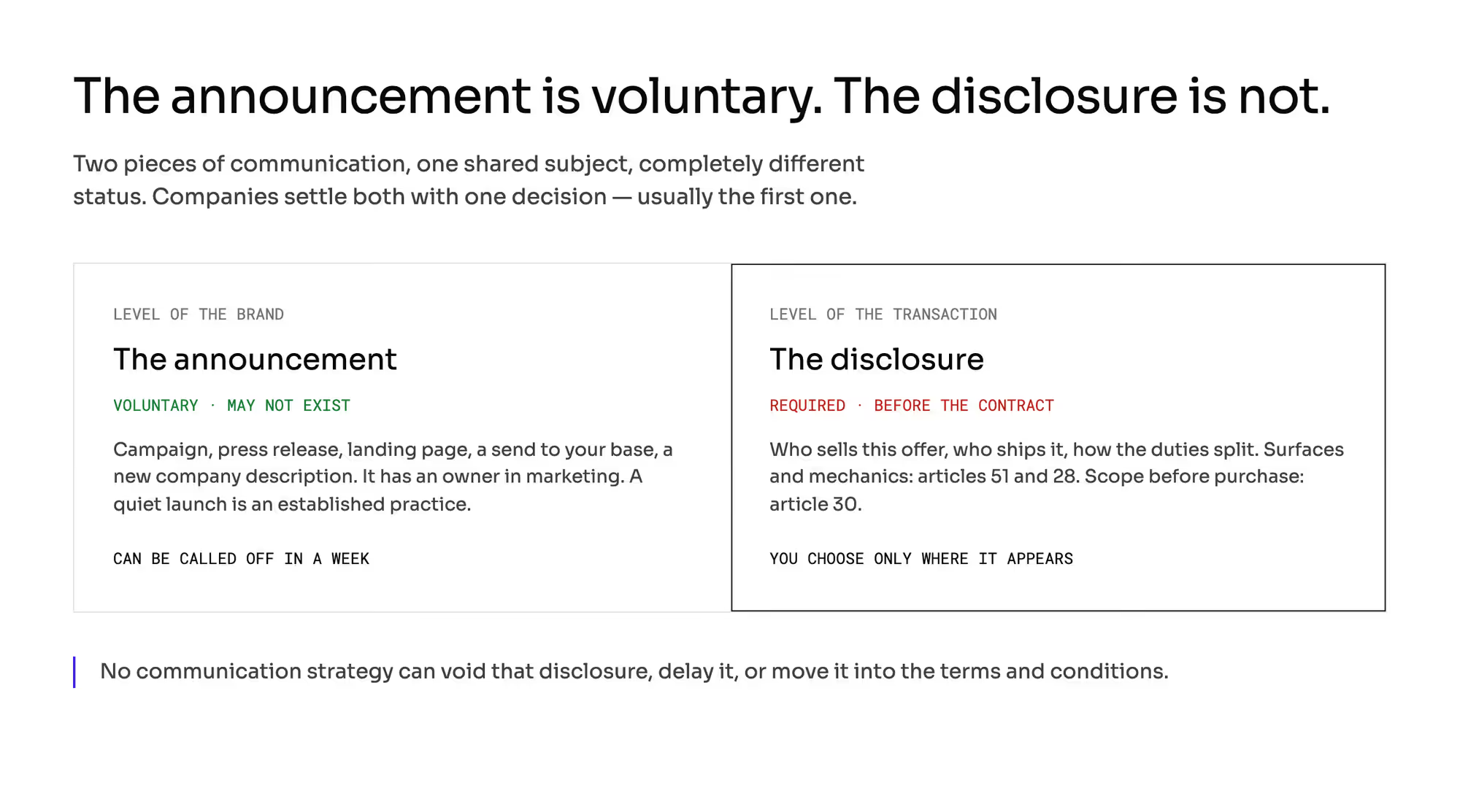
You have two kinds of communication to settle. Both cover the same subject, but their status is very different.
The first is brand communication: a campaign, a press release, a landing page, an email to your base, or a new company description. It's voluntary, and marketing owns it. You may skip it entirely.
A quiet launch is an established practice. You roll out with little or no communication and check that everything works before people notice.
The second is transaction information: who sells the offer, who sends it, and who carries which duties. By law, the buyer has to know this before they enter into the contract.
The chapters on marketplace seller identity and marketplace liability cover how and where the seller appears. The chapter on marketplace consumer rights covers the information you owe before the purchase.
No communication strategy can cancel that disclosure, delay it, or hide it in the terms and conditions.
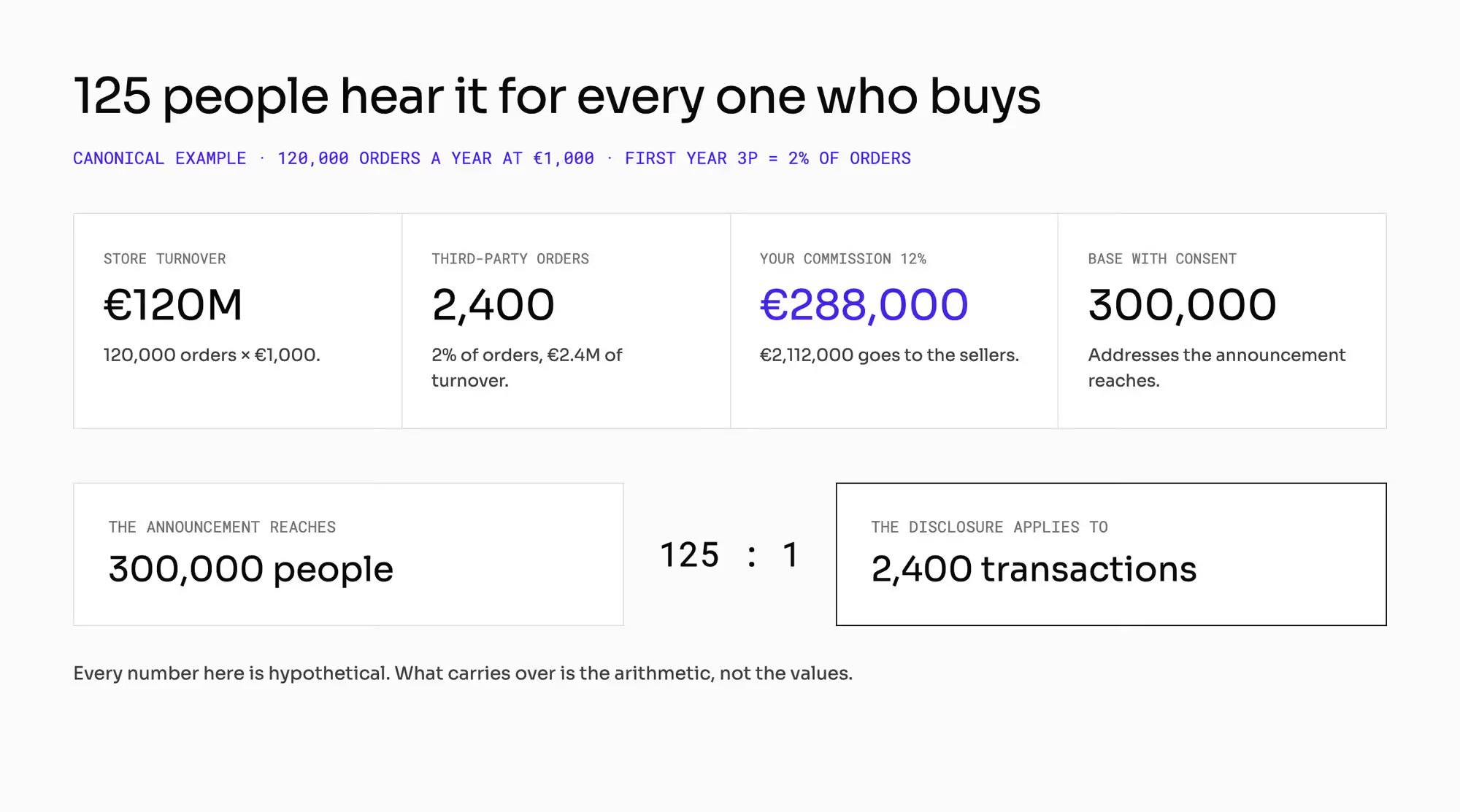
Take the standard example of this series: a store with 120,000 orders a year at €1,000 each. That's €120 million of turnover and a base of 300,000 addresses with consent to contact.
In the first year, third-party sales are 2% of orders. That's 2,400 orders and €2.4 million of turnover. At a 12% commission, you earn €288,000, and the sellers get €2,112,000.
The announcement reaches 300,000 people, and the disclosure applies to 2,400 orders. For every person who buys from a seller this year, 125 people hear the announcement and never see a seller's offer.
You can cancel a campaign within a week. You can't cancel the disclosure. You only decide where the buyer sees it on the way to the purchase.
Which 3 launch announcement strategies can you choose?
Every strategy has a trade-off. The table compares them on a base of 300,000 addresses.
Strategy | Reach of the first message (people out of 300,000) | Work to launch (person-days) | Who the buyer hears it from first (channel) | What it costs you | When you choose it (condition) |
|---|---|---|---|---|---|
Loud | 300,000 | 25 | from you, before they reach the site | a promise of choice wider than the assortment | the brand promises choice, availability and price |
Quiet | 0 in the campaign, 100% on the offer page | 6 | from the offer page, the parcel and the document | no leverage in seller recruitment | the brand promises selection and curation |
Staged | 54,000 per stage (18% of the base in the category) | 9 per category, 27 for three | from you, in one category only | three times the work and mixed messages on the front end for longer | categories differ in promise and in service |
1. Loud launch
A loud launch treats the marketplace as a change of positioning. You used to be a store with a curated range, and now you're the place to find everything.
It gives you awareness among buyers. It also gives you an argument for recruiting sellers, because sellers ask about traffic. The chapter on marketplace seller recruitment covers that side.
You pay with a promise your assortment can't keep on day one. If you open 3 categories out of 40, you still announce choice to your whole base. Only 7.5% of the assortment backs it up.
2. Quiet launch
A quiet launch keeps the message unchanged. The assortment grows, and the brand says what it said a year ago.
Your front end stays calm, and you get time to fix the problems of the first weeks. You pay twice for it.
You lose your strongest argument with sellers. Buyers also learn about the change from the parcel or the sales document, and you can't edit either of those.
3. Staged launch
In a staged launch, you announce the change one category at a time. Each message goes to the buyers in that category. You get relevance and three attempts instead of one.
You pay with more work. Every stage needs its own materials and its own answers. Your front end also shows two different messages for longer.
Choose by what your brand promises today. If the promise is curation, a loud announcement of thousands of new sellers contradicts years of building that promise. And it happens faster than you can raise the quality of supply.
If the promise is choice and availability, a quiet launch wastes your strongest argument.
Who should hear about third-party sales before your buyers?
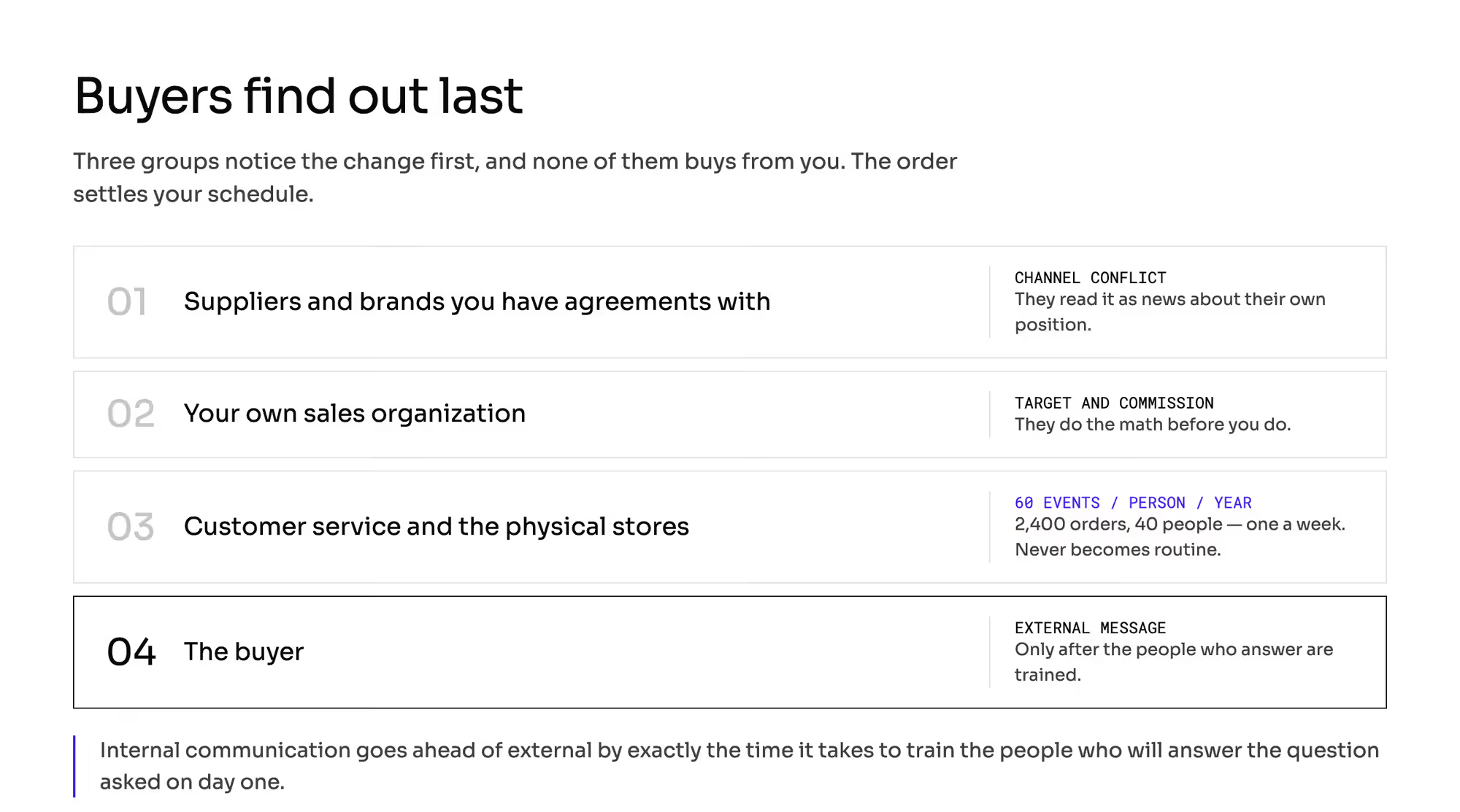
Three groups notice the change first, and none of them buys from you.
1. Your suppliers and brands
Channel conflict is well documented outside eCommerce. When a new channel reaches the same customers as an existing one, the existing channel feels threatened and pushes back.
The reaction ranges from harder negotiations to walking away. A supplier reads your announcement as news about their own position. The chapter on channel conflict covers its types.
2. Your own sales team
A salesperson with a target and a commission does the math on third-party offers before you do. If they learn about the change from a message aimed at customers, you've already got it wrong.
3. Customer service and your stores
Practitioners describe the same thing every time. Staff get questions about products they can't see in their own systems, and they learn about the change from the buyer.
With 2,400 third-party orders a year and 40 people in service, each person gets 60 such questions a year. That's about one per working week.
At once a week, those questions never become routine. Training that works for a daily process isn't enough, and the first answer gets made up on the spot.
The order is always the same. Tell your own people first. Send the external message only once the people who'll answer the first question are trained.
The chapter on the P2B Regulation covers what you must tell sellers along the way and in what form.
What do you have to settle about your own email channel?
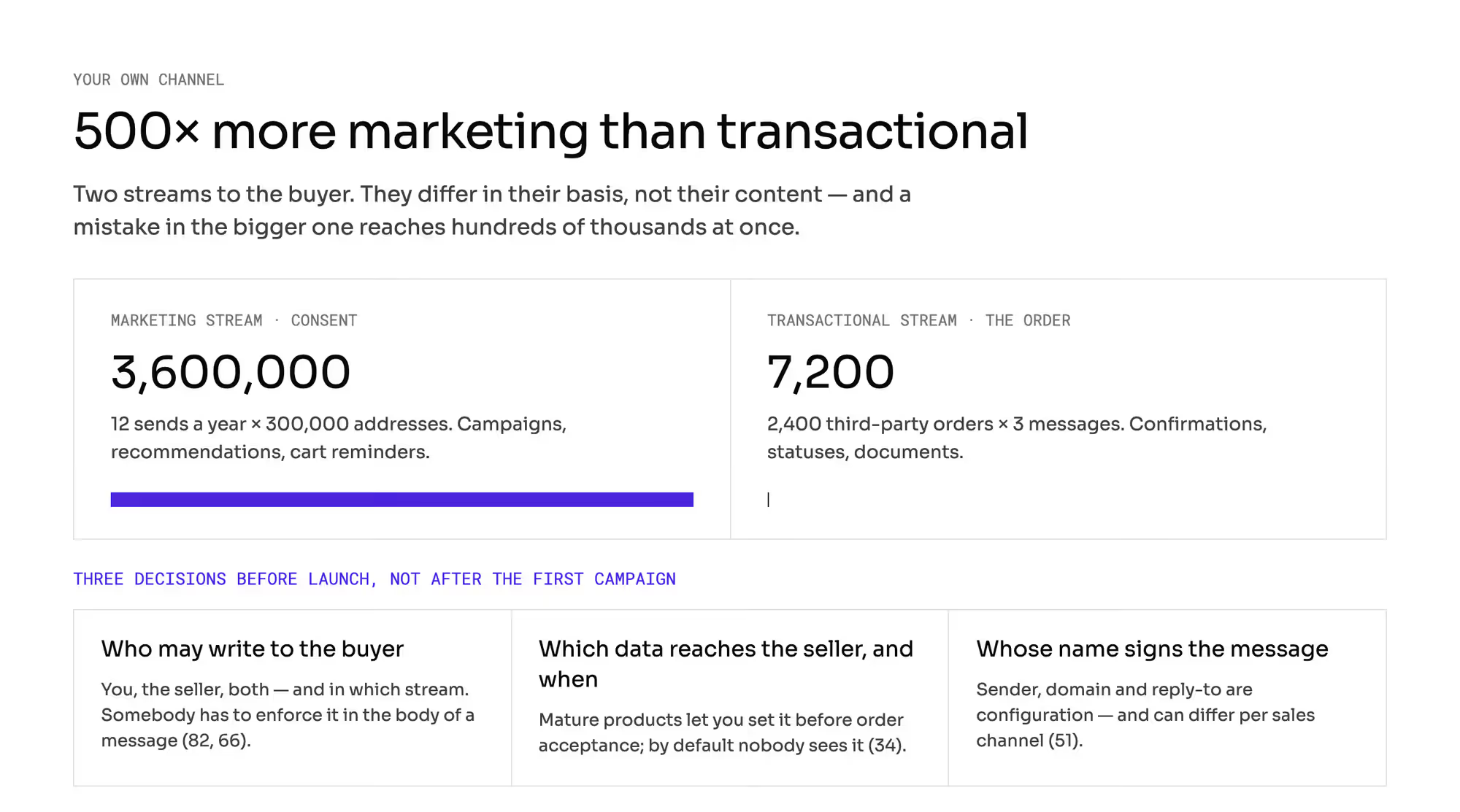
You send the buyer two streams of messages, and each one has a different basis. The transactional stream comes from the order: confirmations, statuses, and documents.
The marketing stream comes from the relationship and the consent: campaigns, recommendations and cart reminders.
Twelve emails a year to 300,000 addresses make 3,600,000 marketing messages. With 2,400 third-party orders and three messages per order, you send 7,200 transactional messages.
That's 500 times more marketing messages. A mistake in that stream reaches hundreds of thousands of people at once. Make three decisions before launch.
1. Who may write to the buyer
Decide whether you, the seller, or both may write to the buyer, and in which stream. The rule that the seller writes only about the order sounds reasonable. It gets hard when someone has to enforce it in the body of a message.
The chapters on marketplace customer service and marketplace disintermediation cover both sides of that rule.
2. Which data reaches the seller, and when
For the legal side (consent, legal basis and scope), read the chapter on marketplace GDPR and ask your lawyer. The operational side is yours.
In mature products, you can set whether the seller sees buyer data before accepting the order. By default, no one sees it.
That setting changes your service and data models. Ask about it before implementation.
3. Whose name is on the message
You set the sender, the domain, and the reply-to address in configuration. You can set different ones for each sales channel.
Even in a quiet launch, some of those messages are about goods you didn't send. The buyer still reads your name on them.
Who owns the adoption of third-party offers?
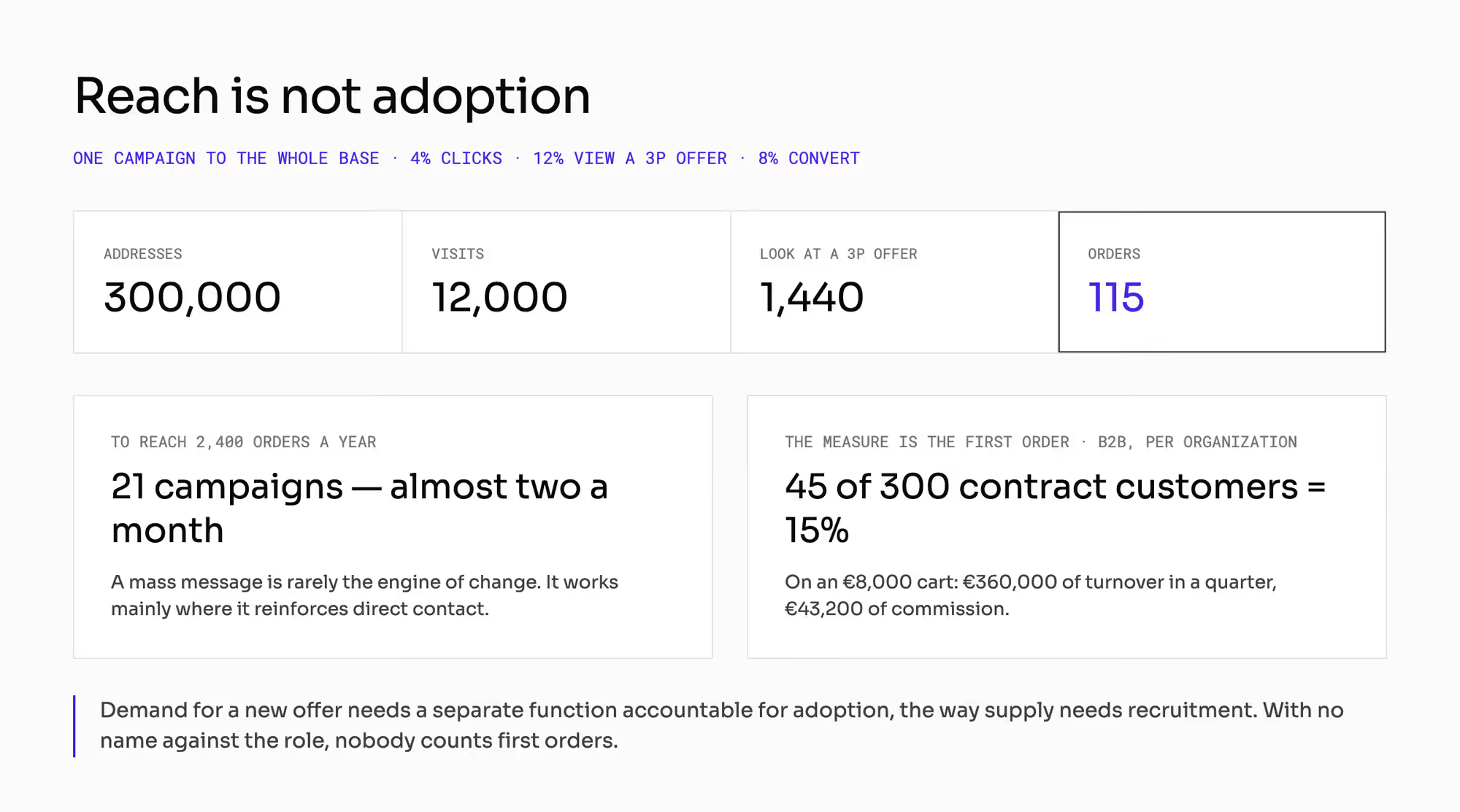
A campaign to 300,000 addresses with a 4% click rate brings 12,000 visits. If 12% of visitors look at a third-party offer, that's 1,440 people.
At an 8% conversion rate, you get 115 orders. A target of 2,400 orders a year then needs 21 campaigns, almost two a month.
Decades of research on adoption show that a mass message rarely changes behavior on its own. It works mainly when it backs up direct contact.
Supply has recruitment. Demand for a new offer needs its own role too, with one person who answers for adoption. If no one's named for that role, adoption ends up shared between marketing, service, and sales.
Each of them has its own plan, and the marketplace is an add-on in all three.
Measure the first order. Reach and registrations don't show adoption.
In B2B, you count first orders per organization. In a buying company, the person who decides isn't the person who clicks.
The standard €1,000 cart doesn't describe company purchasing. Here it's eight times larger: €8,000 at a 12% commission, with €7,040 for the seller and €960 for you.
If 45 of your 300 contract customers place a first third-party order in a quarter, that's 15% of the base. It's €360,000 of turnover and €43,200 of commission.
That number tells you more than an email open rate. It means someone went through a whole buying process inside their company.
The chapter on marketplace metrics covers success for the whole project. This chapter covers a measure of adoption.
What do you do when buyer satisfaction drops after launch?
Practitioners see satisfaction and conversion drop in the first months after third-party sales go live. They see it often enough that companies plan for it before launch.
The chapter on marketplace buyer protection covers what the drop costs and what balances it out. The chapter on marketplace reviews and ratings covers ratings.
Taking an announcement back costs more than the announcement did. The correction goes to the same 300,000 people, and it tells them something didn't work.
If you narrow the promise instead, it takes operational work but no email at all. It means fewer categories, a clearer line between your own offers and third-party ones, and a stricter quality threshold.
Write the first announcement so you can narrow it without taking it back. Talk about specific categories and about choice in one place. Don't announce that the company itself is changing.
What does the launch announcement change in your marketplace?
The announcement connects to four decisions that each have an owner of their own.
1. Disclosure comes first
Your communication strategy always follows the disclosure. Plan where the seller appears on the offer before you plan the campaign.
2. Your own channel
Personal data, keeping the buyer on the platform, and after-sales contact each have their own chapter. You'll find the links above.
3. Paid visibility
The chapter on the retail media network covers selling visibility to sellers. Until you have adoption, you have no traffic to sell there.
4. Prices in the message
In B2B, the prices a buyer sees are part of the message. A wider range means one thing to a customer with a contract price list and another to a walk-in buyer. The chapter on contract prices covers that side.
How do you choose a launch strategy in 5 questions?
Answer these five questions before you plan the campaign:
- What does your brand promise today: curation or choice? If it's curation, a loud campaign works against you until you have a quality threshold for sellers.
- What share of the assortment will third-party sales cover in month three? Below the mid-teens, the announcement promises something the buyer won't find.
- Will your suppliers hear about it from the announcement or from a conversation? You decide that order once.
- How many people will answer the customer's first question, and when will they be trained? That sets the earliest date for the external message.
- Whose job is the buyer's first order? If no one's, choose a quiet launch and come back to this question.
Ask your platform vendor three questions:
- Can you set which buyer data the seller sees, and at what stage?
- Can you configure the sender and the reply-to address separately for each sales channel?
- Besides total orders, does reporting show the first third-party order per buyer or per organization?
Which mistakes do operators make when announcing a marketplace?
Each of these mistakes looks like a success in the first report.
1. Treating the announcement as the disclosure
The campaign says you have a marketplace, and the offer page doesn't mention the seller. Formally, the buyer got the information.
But the buyer doesn't have it when they decide to buy. When something goes wrong, that argument sounds like an excuse.
2. External message before the internal one
Service, stores, and the sales team learn about the change from customers. Their first answers get made up and stay in the reviews.
3. Measuring a campaign by reach
The report looks good, but adoption doesn't grow. After two quarters, no one knows which side of the funnel is broken.
4. Emailing the whole base before testing returns and contact paths
Your most loyal buyers land in the least tested part of the front end. You pay for it in the same metrics the announcement was meant to improve.
5. Adoption with no owner
Marketing counts reach, sales counts its target, and service counts tickets. No one counts first orders.
What do you still have to settle about your announcement?
This chapter doesn't settle the duty to disclose the seller, consents, or what the seller receives. Those topics have their own chapters, linked above.
It gives no benchmarks. Every number here is hypothetical.
Open rates, click rates, and conversion rates from another category won't fit yours. You already have your own numbers.
It isn't legal advice. Before the first email goes out, ask your lawyer about these areas:
- Personal data protection: the basis for contacting the buyer and the data you pass to the seller.
- Electronic communication and direct marketing: when a message counts as a commercial communication and what an objection requires.
- Consumer protection: what you must say before the contract and in what form.
- Fair commercial practices, because the buyer relies on an announcement when buying.
- Platform-to-business transparency, because sellers read your message about sellers too.
You can only launch quietly once. If you announce the change a year later, it isn't news anymore. You're explaining why you kept quiet to an audience that already knows.
Summary: How do you announce a marketplace launch to buyers and suppliers?
Settle the disclosure first. Every buyer has to know who sells the offer before they buy, whatever you announce.
Then choose the announcement based on what your brand promises. A loud launch suits a brand that promises choice.
If your brand is built on curation, start quietly. If your categories differ in promise and service, use a staged launch.
Tell suppliers, sales and service before the buyers. Give adoption one owner and measure it by first orders.
Frequently asked questions on announcing a marketplace launch
Should you announce a marketplace launch?
You should announce a marketplace launch only when your brand promises choice and your assortment can back it up. If your brand promises curation, a quiet or staged launch protects that promise. Either way, you must tell every buyer who the seller is.
What is a soft launch for a marketplace?
A soft launch for a marketplace means opening third-party sales with little or no communication. You check that the process works before many people know about it. The seller disclosure on every offer still applies from day one.
Who should you tell first about a marketplace launch?
Tell your suppliers, your sales team, and your customer service before you tell buyers. Suppliers read the announcement as news about their own position. Your staff needs training before the first question arrives.
Ready to build?
We build marketplaces that tell buyers who the seller is on every offer, whatever your launch campaign says.