
Marketplace Buyer Protection: What You Promise and Who Funds It

Marketplace buyer protection is the operator's own promise to make a failed purchase good, and because it pays before fault is settled, it prices like an insurance product: frequency times average payout, plus handling, minus whatever you recover from the seller.
"If anything goes wrong, we will sort it out" is usually the only sentence a buyer remembers from your marketplace. It is also a cost line, and companies announce it before anyone has costed that line.
This article breaks down:
- Which 3 events should the promise cover?
- What does the promise cost per order?
- Which 3 budgets can fund it?
- How fast does it have to pay out?
Key insights
- The three events worth covering are goods that never arrived, goods that do not match the description, and a seller who stops responding, and you set the frequency of the third one yourself through the waiting time after which you step in.
- The promise costs €2.80 per order before recovery and €1.12 after it: 400 events a year at €700 is €280,000, which is 2.33% of commission revenue, and a single seller with a 3% loss rate can take 37.5% of the whole fund.
- The three budgets are your margin, a deduction from the seller, and a fund fed by a premium on every transaction, and only the fund scales: 0.3% of GMV covers €280,000 of payouts at a 93% loss ratio, which leaves 7% for handling.
- The promise has to pay out before fault is settled, which makes the refund and the recovery two separate records: automating the 70% of events below the settling threshold takes 140 hours a year off the desk and turns weeks into hours for the buyer.
Why is an operator guarantee an insurance product?
An operator guarantee has four parameters: event frequency, average loss, a liability cap, and an owner of the budget. No insurer writes a policy without the first three.
A marketplace can announce the promise knowing none of them. That is a conversation about pricing rather than about company values.
The pricing mechanics are public and trivially simple. The premium is the expected value of losses plus the cost of handling and a buffer, and the expected value of losses is frequency times average payout.
Self-insurance, which means your own fund instead of a policy, adds one condition: the risk has to be predictable and measurable in aggregate, and the fund is filled up front rather than out of the result in the month of the loss.
The second mechanism is less comfortable. A party cut off from the consequences of a risk changes its behavior, and the standard remedy is a deductible. Here the party cut off from the consequences is the seller.
And the boundary: an operator guarantee is a commercial commitment rather than an assumption of legal liability for someone else's goods. What you are in the eyes of the law is set out in the chapter on whether you are an intermediary or a seller.
What the buyer can claim no matter what you promise is explained in the chapter on who delivers the buyer's rights. Your promise is the surplus over that minimum, and only the surplus is priced here.
Which 3 events should buyer protection cover?
Scope is defined by an event rather than by an adjective. "We will sort it out" is not a scope, because you can neither cost it nor refuse it.
1. The goods never arrived
The most frequent class and the cheapest to settle, because the evidence sits on your side: the shipment status.
The loss equals the value of the order, and the quality of your "delivered" sets the cost of this class (the delivery date you promise).
2. The goods do not match the description
Rarer but more expensive: it takes a judgment on who is right, and part of the value comes back as goods you never see anyway, because they go to the seller's warehouse.
3. The seller does not respond
A service event rather than a goods event.
It is also the only class whose frequency you set yourself, through the waiting time after which you step in. Halve that time and the number of events rises, though nothing changed in any warehouse.
A fourth class is usually worth excluding on purpose: the seller disappears along with their balance. The loss is the whole order at zero recovery, and the problem goes back to reserves on the balance (payout cycles, holds and reserves and the ledger behind a balance).
What does buyer protection cost per order?
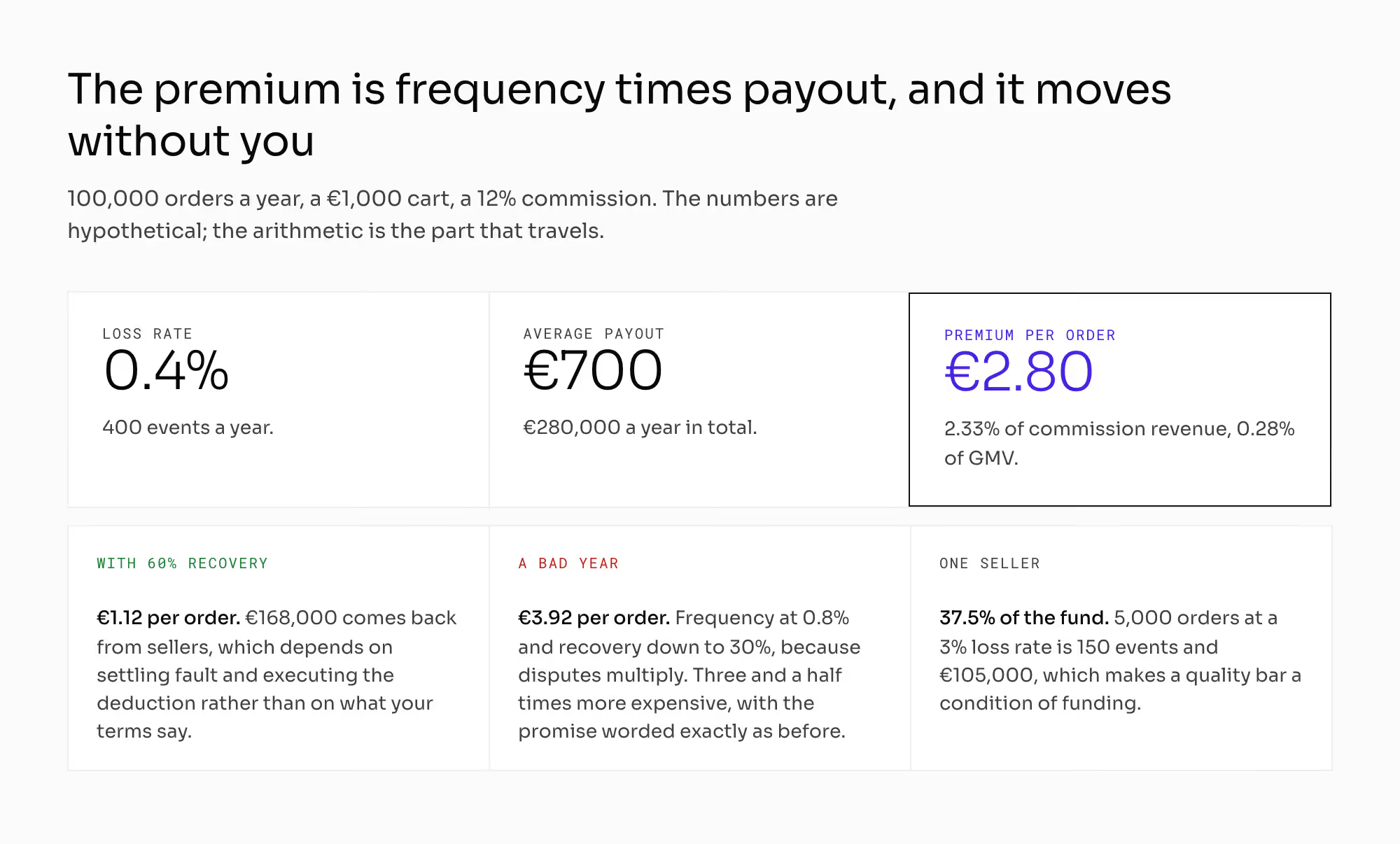
The numbers are openly hypothetical. The arithmetic travels.
The base: 100,000 orders a year, an average cart of €1,000, so €100,000,000 of GMV. At a 12% commission, that is €12,000,000 of revenue.
The loss rate on the promise: 0.4% of orders, so 400 events a year, at an average payout of €700. That is €280,000.
Divided by 100,000 orders, it gives €2.80 of premium per order: 2.33% of commission revenue and 0.28% of GMV.
Now, the same calculation with recovery from the seller. At 60% effectiveness, €168,000 comes back and €112,000 stays with you, which is €1.12 per order.
The difference between €280,000 and €112,000 has little to do with what your terms say. It is whether you can settle fault and execute the deduction.
That is covered in the chapter on the commission on a refunded order, payout cycles, holds and reserves, and the ledger behind a balance.
Two scenarios alongside that number. Frequency rises to 0.8%: 800 events times €700 is €560,000, or 4.67% of commission.
On top of that, recovery falls to 30%, because disputes multiply: you are left with €392,000. You start at €1.12 per order, and you land at €3.92.
Three and a half times more expensive, with no change in the wording of the promise.
And the number that changes the conversation about sellers: one seller with 5,000 orders and a 3% loss rate produces 150 events, which is €105,000. That is 37.5% of the whole fund on one account.
Which 3 budgets can fund a buyer promise?
What does each way of funding the promise cost? | Your margin | Deduction from the seller | A fund built from a per-transaction premium |
|---|---|---|---|
Where the euro of a payout comes from | commission revenue | the seller's balance, per event | a premium charged on every transaction |
Annual cost of payouts at 400 events of €700 (EUR) | 280,000 | 280,000 | 280,000 |
Your net result at 60% recovery effectiveness (EUR/year) | −280,000 | −112,000 | +20,000 at a premium of 0.3% of GMV |
Effective commission after the promise (% of GMV, starting point 12.00) | 11.72 | 11.89 | 12.00 |
What it does to the seller relationship | nothing, and that is the problem | a dispute over every event | predictable cost, the healthy pay for the sick |
The condition under which it breaks | a loss rate above assumptions | a seller with a zero balance or one on the way out | a premium not differentiated by risk |
The first option is the simplest and the worst in year two: you pay out of commission, so the only party able to reduce the number of events has no reason to.
The second option is the healthiest for incentives and the heaviest to run: it needs a decision on fault with reasons and an audit trail, plus a separate settlement document (the rules on decisions about sellers, who issues which invoice and corrections and credit notes). Practitioners describe a workaround that shows what the absence of that capability looks like: the system returns the commission automatically with the refund, so the operator gives it back first and takes it back afterwards, with a correcting document against the balance.
The third option is the only one that scales without a conversation about every case. A premium of 0.3% of GMV is €300,000 against €280,000 of payouts, so the fund runs at a 93% loss ratio.
That leaves 7% for handling and buffer, and a ratio above one hundred percent means a product that subsidizes itself.
The recommendation: the fund as the payout mechanism, fault as the recovery mechanism, margin as the buffer for the tail. Differentiate the premium by the seller's history, or you fund the worst sellers with the money of the best.
And they will work that out faster than you.
Why does a buyer promise need a cap and exclusions?
Without a cap per event, one case can eat a quarter of the fund. An order worth €40,000 is 14.3% of the annual payouts in the example above.
That is one case. A cap per event protects against a single loss.
An annual cap on the whole program protects against a run of them. You need both.
The exclusions used on comparable products are predictable: commercial use, damage caused by the holder, normal wear, accidental events. The same principle governs your list.
You exclude what you cannot settle cheaply, and what has no upper bound on the loss: high unit value, used and refurbished goods, services and installation, orders paid for outside the platform.
Three exclusions are of a different nature and do not belong in the pricing: product safety and recalls (product safety and recalls), categories that require a license (restricted and prohibited products), and a claim raised with the card issuer, which has its own path and its own clock (chargebacks and an empty seller balance).
How fast does a buyer promise have to pay out?
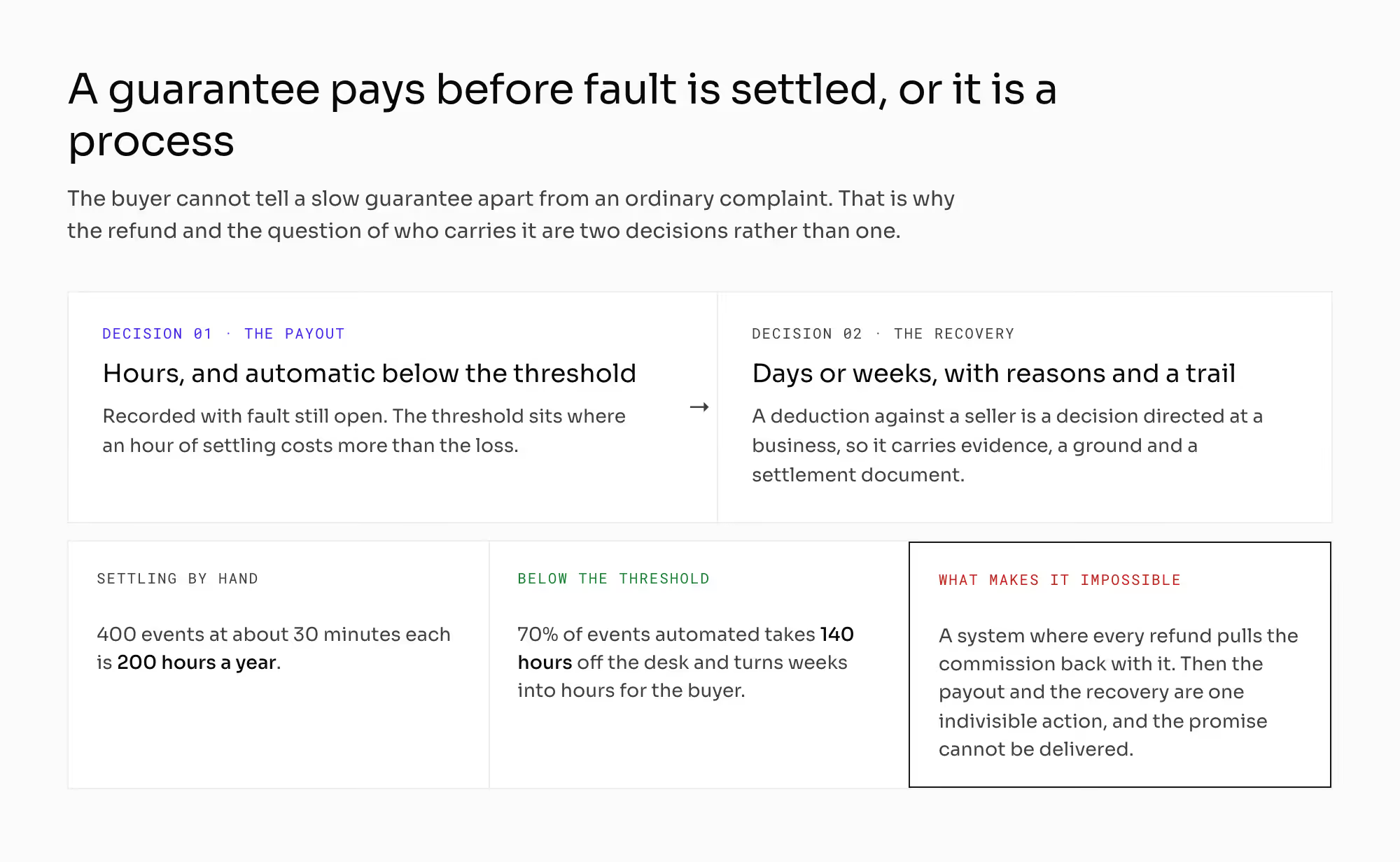
This is the heart of it rather than an implementation detail. A buyer who gets the money once the process has ended did not get a guarantee.
They got a process. The value of the promise comes from one thing only: the refund and the decision on who bears it are two separate decisions, taken at different moments and by different people.
The consequence is systemic: the data model has to be able to record a payout with the fault unsettled and add the settlement later. If the two operations are one indivisible thing, the promise cannot be delivered.
And this happens in practice: in some products, every refund automatically pulls the commission back with it.
Cost the gain from a threshold for automatic payout. Settling one event by hand takes about 30 minutes, so 400 events is 200 hours a year.
If 70% of events fall below the threshold at which settling costs more than paying, automation takes 280 cases and 140 hours off the desk. And the buyer gets a decision in hours instead of weeks.
The mechanics of the refund are set out in the chapter on who pays for a refund. The returns policy and the way a dispute is settled are explained in the chapters on the return window and who pays for the return leg and who decides a disputed case.
By definition, your promise runs ahead of both and independently of their outcome.
Why do satisfaction and conversion dip when third-party selling starts?
Practitioners from large rollouts describe the same phenomenon over and over: the moment third-party selling goes live, buyer satisfaction measures and conversion fall. That is an observation from practice rather than a rule of the market.
It repeats often enough that you put it in the plan before launch instead of explaining it afterwards. The reason is structural: the number of parties delivering promises you do not control goes up.
Cost it and set it against the price of the promise. At 2,000,000 sessions a year and a conversion rate of 2.00%, you have 40,000 orders.
A relative drop of 5%, to 1.90%, gives 38,000 orders. That is 2,000 orders fewer, or €2,000,000 of GMV.
A promise costing €280,000 gross and €112,000 net of recovery is then cheaper than the phenomenon it counters. That is how it goes to the board, in place of an investment in trust.
There is one condition: measure the baseline before launch. Conversion, the share of orders that generate a case, and time to resolution, separately for your own sales and third-party sales.
Without it, by month three you argue about the cause instead of the size.
Who is allowed to approve a payout?
A payout with fault unsettled needs an explicit owner of the budget, or the most determined caller decides it. Three levels are enough: automation up to the first threshold, the operations duty officer up to the second, the owner of the budget above that.
Each of them records the decision in the same register: who, when, on what basis, and out of which budget.
Plus one crisis switch. A mass event (a faulty batch, a seller who has stopped shipping, a carrier outage) is handled by one group decision rather than by 300 separate cases.
Write down the review condition as well: a loss rate above assumptions for an agreed number of periods triggers a revision of the cap, the premium, or the list of exclusions. A review clause is more than a formality.
The promise is the only policy in a marketplace you cannot correct quietly. Narrowing it is itself a message to the market, stronger than the announcement was.
A review clause written in from day one is the only form of retreat that does not look like retreating.
What does a buyer promise change about the rest of your build?
1. The promise is a speed limit on seller recruitment
If one seller with a high loss rate can take up more than a third of the fund, a quality bar becomes a condition of funding rather than a soft policy.
2. The scope of the promise goes into the seller contract before it goes on the storefront
The right to deduct, the definition of fault, and the appeal route are three clauses you cannot add retroactively.
3. The promise moves the conversations to you, and that is its hidden cost
Who talks to the buyer and at what cost is covered in the chapter on who answers the buyer. How events translate into ratings is set out in the chapter on reviews and ratings.
4. The fund is a balance sheet item rather than a headline in a deck
Someone provisions it and accounts for the unused part, and payouts and deductions end up in documents (who issues which invoice and corrections and credit notes).
How do you cost a buyer promise?
- Pull three numbers out of the last year of your own sales: the share of orders with a problem, the average cost of an event, the share of cases with a recovery from the supplier.
- Multiply frequency by average loss and divide by the number of orders. That is your premium. If it runs above the low teens as a share of commission, the scope is too wide rather than the budget too small.
- Run the scenario with double the frequency and half the recovery. If it does not fit the budget, the promise needs an annual cap before you announce it.
- Set the threshold for automatic payout at the amount where an hour of settling costs more than the loss.
- Measure the baseline for conversion and satisfaction before launch, separately for your own sales and third-party sales.
Three questions for the vendor:
- Are the refund and the charge to the seller separate operations or one?
- Is the decision on fault an object with reasons and an audit trail, or an annotation?
- Can you charge a premium per transaction and run a fund balance alongside the seller balances?
Which mistakes do operators make about buyer protection?
1. A promise announced before anyone costed the loss rate
The first bad quarter turns a marketing decision into a budget fight, and the only way out left is narrowing the scope in public.
2. A scope described with an adjective
"We always help" has no boundary, so it gets set by the first buyer who disagrees. In a public channel.
3. Funding it purely out of your own margin
The only party able to reduce the number of events does not carry their cost, so the number does not fall.
4. A payout blocked until fault is settled
You have the cost of a guarantee, and you do not have a guarantee, because the buyer cannot tell it apart from an ordinary complaint.
5. No annual cap
One bad seller or one faulty batch turns the program into an open cost line you cannot close inside the accounting year.
What do you still have to settle about your own buyer promise?
This article does not say what the buyer is entitled to. That is the minimum you build the promise on, and who delivers the buyer's rights covers it.
Nor does it settle whether and when you answer for the goods themselves. An operator guarantee is a commercial commitment, and it does not change your legal position.
This article does not settle the returns policy (the return window and who pays for the return leg) or the way a dispute is handled (who decides a disputed case). The promise is the surplus over both processes.
This article does not touch the delivery date at all, nor the definition of success and the strategic measures ("Why Build a Marketplace, and Which Metrics Prove It Worked?").
All the numbers here are openly hypothetical, and the only ones that matter are yours: frequency, average loss, and the effectiveness of recovery.
Families of regulation worth asking a lawyer about before the promise goes on the storefront:
- Consumer protection law. Your promise cannot narrow or obscure what the buyer is entitled to without it.
- Rules on transparency between platform and seller. A deduction and a decision on fault are decisions directed at a business.
- Rules on commercial warranty and on conformity of the goods. They decide whether your promise counts as a warranty statement.
- Rules on fair commercial practices. The promise is a message the buyer acts on when buying.
- Rules on personal data. A history of cases is a profile of how a buyer behaves (who controls the personal data).
- Rules on out-of-court resolution of consumer disputes, known as ADR. Your program runs alongside them and not in their place.
Whether and how far they apply to your case is for a lawyer to settle. Our claim is narrower: a promise with no costed loss rate is announced once and withdrawn in public.
Summary: What does your promise to the buyer cost?
Around €2.80 per order gross and €1.12 after recovery, on the frequencies used here, and that number moves three and a half times without a single word of the promise changing. Which is the whole argument for costing it first.
An operator guarantees prices like an insurance product: frequency times average payout, plus handling, minus what you can take back from the seller, and the last term is a capability rather than a clause, because deducting from a seller needs a decision on fault with reasons and a trail behind it. Fund the payouts from a premium, recover through fault, keep the margin for the tail.
Then cap it twice: per event, so one €40,000 order cannot eat a seventh of the year, and per year, so a run of them cannot eat the program.
Ask a vendor whether the refund and the charge to the seller are two operations or one. Building a marketplace where the promise to the buyer is a costed fund rather than a sentence on the storefront?
Frequently asked questions on marketplace buyer protection
What is buyer protection on a marketplace?
Buyer protection on a marketplace is the operator's own promise to make a failed purchase good, over and above what the buyer is entitled to anyway. It is a commercial commitment rather than an assumption of liability for someone else's goods, and only the surplus over the legal minimum is what you price.
Who pays for a marketplace buyer protection claim?
A buyer protection claim is paid from your margin, from a deduction against the seller, or from a fund built on a per-transaction premium. Paying from margin leaves the only party able to reduce the number of events with no reason to do so.
The fund is the one mechanism that scales without a negotiation over every case.
Should a marketplace pay before fault is settled?
A marketplace should pay the buyer first and settle fault afterwards, or the promise is indistinguishable from an ordinary complaint. That needs a data model where a payout can be recorded with fault still open and the recovery added later.
In some products, every refund pulls the commission back automatically, and then the promise cannot be delivered at all.
Ready to build?
We build marketplaces where a payout to the buyer and the recovery from the seller are two records, so a promise can pay out before fault is settled.