
Marketplace Order Splitting: How One Order Becomes Several

Marketplace order splitting is the rule that decides how many separate orders, shipments, documents, and payouts one purchase produces, and changing it after launch means migrating history rather than changing a setting.
The buyer does one thing: they pay. In that same second, your system creates several orders, and each one has its own shipment, its own document, its own status, and its own point of contact with support.
The split rule settles how many of those objects come into existence, and changing it after launch means renumbering your history rather than changing a setting.
This article breaks down:
- Which 5 axes split an order?
- Which 4 rights does a suborder carry?
- Which 3 levels of numbering do you need?
- What does each extra axis cost?
Key insights
- The five axes that split an order are the seller, the warehouse it ships from, the logistics class, availability, and the fulfillment model, and only the first one is unavoidable.
- Every suborder carries four rights of its own: who can cancel it, who can return it, who issues the document, and who may change the address, which is why "cancel the whole order" is three operations rather than one.
- The three levels of numbering are the commercial order the buyer quotes, the suborder per seller where the commission, the payout, and the document hang, and the line where partial cancellations and returns live.
- Each extra axis costs parcels rather than documents: three of the five take 13,000 shipments to 17,264 on the same sales, which is 33% more parcels and about 213 more "where is my parcel" contacts a month.
- The five axes that split an order are the seller, the warehouse it ships from, the logistics class, availability, and the fulfillment model.
- Every suborder carries: who can cancel it, who can return it, who issues the document, and who may change the address.
- The three levels of numbering are the commercial order the buyer quotes, the suborder per seller where the commission, the payout, and the document hang, and the line where partial cancellations and returns live.
- Each extra axis costs parcels rather than documents: three of the five take 13,000 shipments to 17,264 on the same sales, which is 33% more parcels and about 213 more "where is my parcel" contacts a month.
What does one €1,000 order produce?
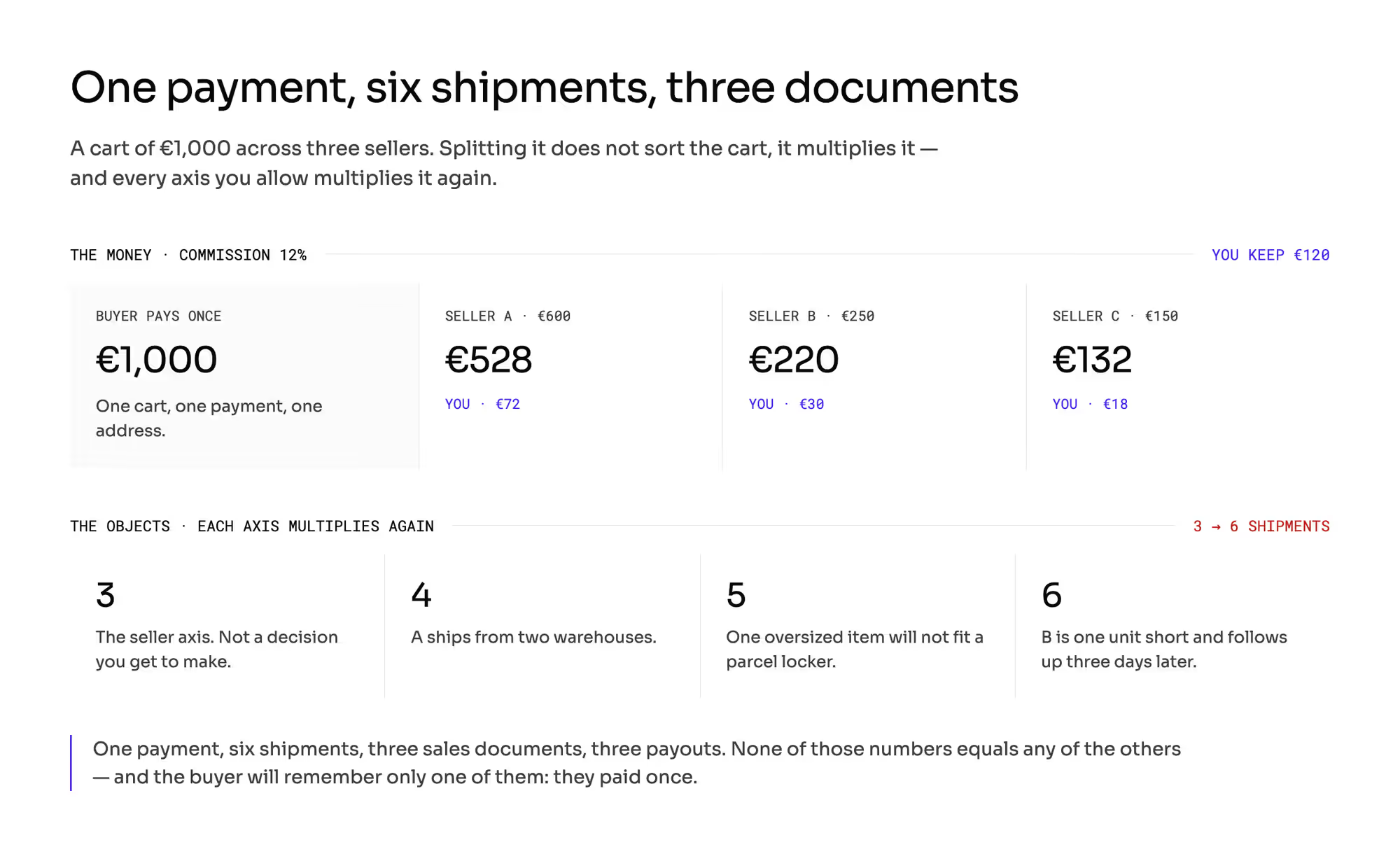
Splitting a cart does not sort it, it multiplies it. Every axis you allow multiplies the number of suborders, and every suborder is a separate shipment, a separate status, a separate chance to get something wrong, and a separate question for support.
Take a cart of €1,000: €600 with seller A, €250 with B, €150 with C. At a 12% commission, you keep €120 (€72, €30 and €18) and the sellers take €880: €528, €220 and €132.
The mechanics of splitting the money are carried out by split payments and who pays the fees. What counts here is how many objects have just come into existence.
- The seller axis: 3 suborders, and this is not an axis you choose;
- A ships from two warehouses: 4;
- One item at A is an oversized piece that will not fit in a parcel locker: 5;
- B is one unit short and sends it three days later: 6.
One payment, six shipments, three sales documents, three payouts. None of those numbers equals any of the others, and that is the whole difficulty of this chapter.
The buyer will remember one of them: they paid once.
Which 4 rights does every suborder carry?
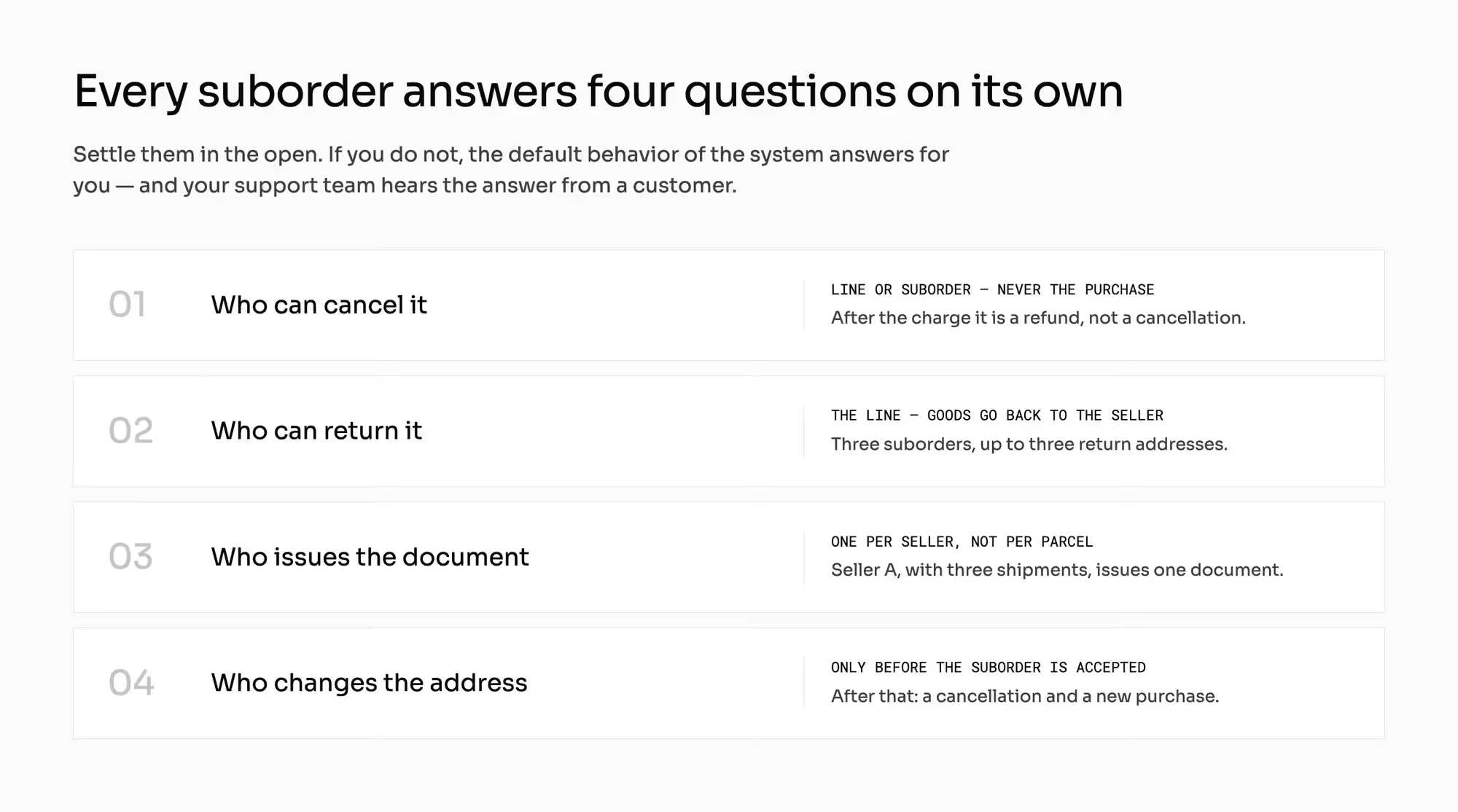
The split is also a quiet handing out of rights. From the moment the order comes apart, every suborder has its own answer to four questions, and it is those answers rather than the database schema that decide how much manual work is left in your support team.
Settle them out in the open. If you do not, the default behavior of the system answers for you, and your support team hears the answers from a customer.
1. Who can cancel it?
Cancellation lives at the level of the line or the per-seller suborder, never at the level of the whole purchase.
In the products we know, the cancellation window closes the moment the buyer is charged, and a seller cannot cancel what they never accepted. After the charge, a cancellation stops being a cancellation and becomes a refund (who pays for a refund).
The practical consequence: "cancel the whole order" is not one operation but three, and each of them can succeed on its own.
2. Who can return it?
A return applies to the line, and the goods go back to the seller rather than to your warehouse.
Three suborders mean potentially three different return addresses and three separate decisions. What happens to the commission when a single item comes back is carried by the commission on a refunded order.
3. Who issues the document?
The document follows the seller rather than the parcel.
Seller A, who sent three shipments, issues one document rather than three. Who issues it and in whose name is settled by who issues which invoice.
What happens to the document when a line is canceled, or a follow-up shipment goes out, is corrections and credit notes.
4. Who changes the address?
The address is given once, for the whole purchase, and three sellers act on it independently.
When the buyer asks to change the address an hour after buying, one suborder has not been accepted yet, the second has a label printed, and the third is already with the carrier. This is a question to settle before you build rather than a ticket for support.
The answer we see most often: an address change is possible only before the suborder has been accepted for fulfillment, and after that it is a cancellation and a new purchase.
Which 5 axes split a marketplace order?
1. The seller, the axis you do not choose
The rest are your decisions, or consequences of what you allowed into the catalog and into your shipping setup.
2. Warehouse and dispatch point
This one appears the moment a seller ships from more than one location.
It multiplies neither documents nor payouts. It multiplies shipments and statuses, and nothing else.
3. Logistics class and size
A treadmill and a pair of socks will not travel by the same delivery method, so two lines from one seller can come apart into two suborders before anybody makes a decision.
The classes, zones, and rates themselves are zones, methods and shipping rates. What counts here is only that a logistics class is a split axis rather than a price list.
4. Availability
One missing unit gives you three possible answers: cancel the line, hold the whole thing, or ship part of it and send the rest on later.
The third is the best one for the buyer and the most expensive one for you.
5. Fulfillment model
A mixed cart, where some of the goods are yours and some belong to sellers, usually comes apart before the marketplace layer sees it at all: your own order system cuts off its own part and passes on the sellers' part alone.
Practitioners describe this plainly as two separate orders from the first second.
One thing stands apart, because it is a boundary rather than an axis: one delivery address means one commercial order. A buyer who wants shipping to two locations places two purchases, even if they click only once.
In B2B, that is a standard request rather than an edge case.
Which 3 levels of numbering does a split order need?
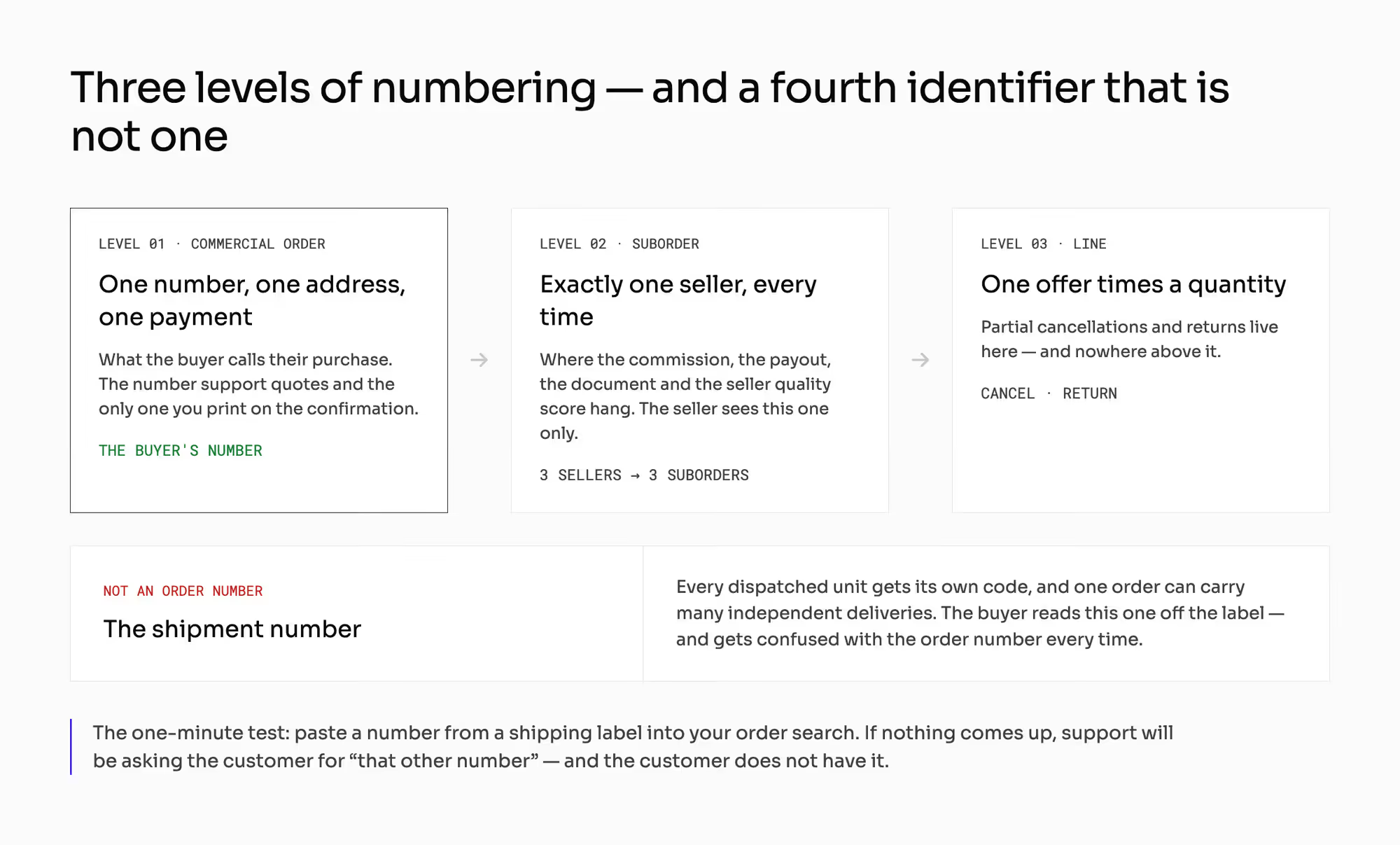
The market convention has three levels, and it lines up with public standards for describing orders, in which an order carries its own number while every line has a number, a status and a delivery of its own.
1. The commercial order
What the buyer thinks of as their purchase.
One number, one address, one payment. This is the number your support team quotes, and the only one you print on the confirmation.
2. The suborder, one per seller
Always exactly one seller.
This is where the commission, the payout, the document, and the seller quality score hang. The seller sees their own suborder and usually does not see the rest of the purchase, which is the right default.
How much buyer data you pass on to them is a separate question, and it belongs to who controls the personal data.
3. The line
One offer times a quantity.
Partial cancellations and returns live at this level.
There is a fourth identifier, which is not an order number and gets confused with one: the shipment number. Logistics standards give every dispatched unit its own unique code, and data description standards allow a single order to have many independent deliveries, each with its own number, status, and date.
The operational rule: the buyer gets one number, and every other identifier they see anywhere has to be searchable in the support panel. The test takes a minute.
Take the number from a shipping label and paste it into your order search. If nothing comes up, your support team will be asking the customer for "that other number", and the customer does not have it.
What does each extra split axis cost?
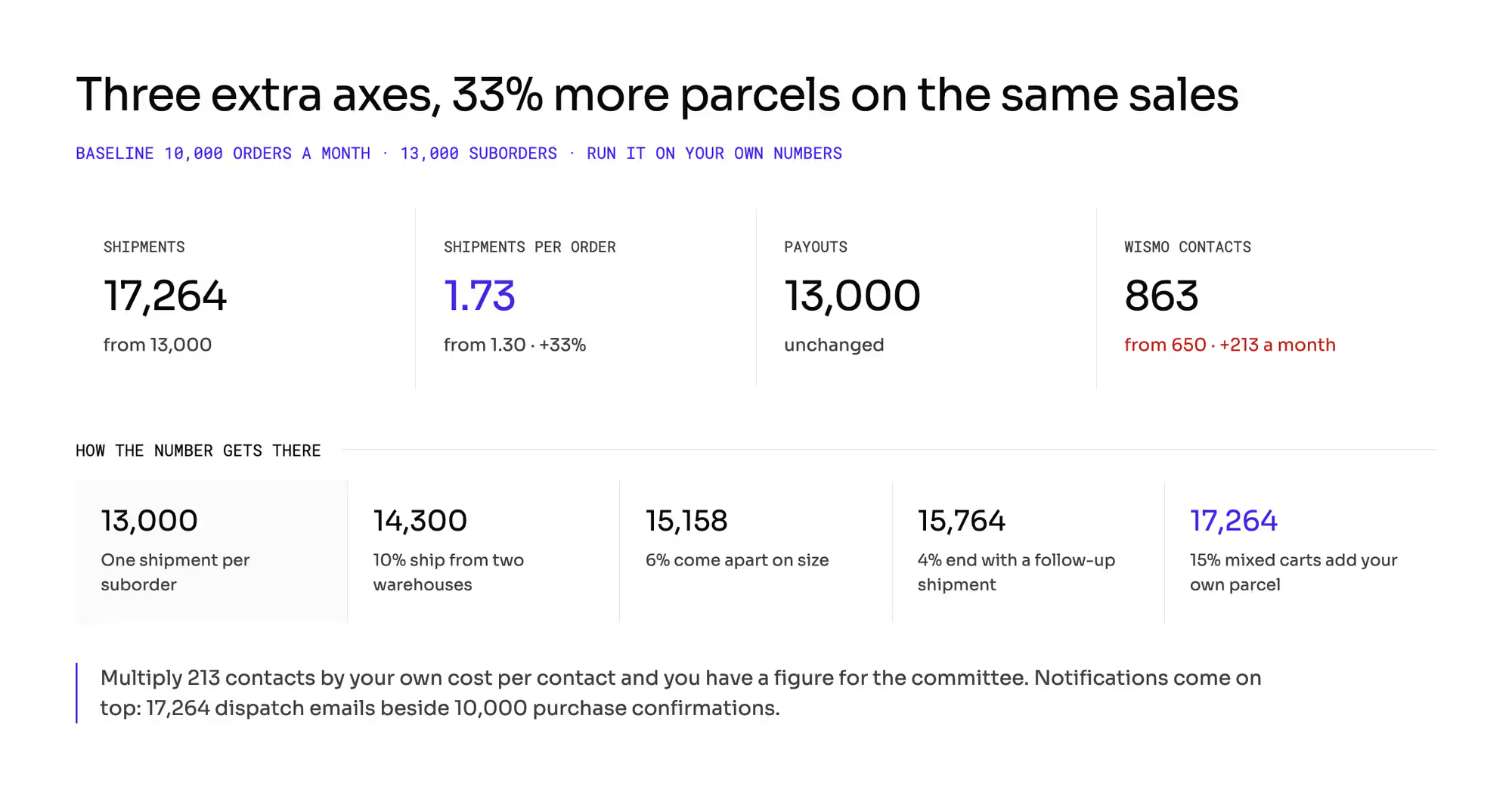
Run this on your own numbers. It is the only way to stop the conversation about axes from being a matter of taste.
The baseline. 10,000 orders a month.
Assume 7,500 of them have one seller, 2,000 have two, and 500 have three. That gives 7,500 + 4,000 + 1,500 = 13,000 suborders, which is 1.3 per order, and the same number of documents and payouts.
You add three axes. If 10% of suborders go out from two warehouses, it becomes 14,300.
If 6% of those come apart on size, 15,158. If 4% end with a follow-up shipment, 15,764 shipments.
On top of that, 1,500 mixed carts (15% of orders) add one shipment each for your own part of the goods: 17,264 shipments and 14,500 documents.
The result. 1.3 shipments per order has become 1.73, which is 33% more parcels for the same sales.
The number of payouts has not moved: still 13,000. Three of the five axes add not a single document and not a single payout.
They add shipments, statuses, and questions, and nothing else.
The price of those questions. Assume one shipment in twenty produces a "where is my parcel" question (the industry calls this WISMO, from where is my order).
At 13,000 shipments, that is 650 contacts. At 17,264, it is 863.
The difference of 213 contacts a month is what you buy along with the three extra axes. Multiply it by your own cost per contact and you have a figure for the committee.
Notifications come on top: in the products we know, the buyer gets a separate message for every dispatch, so 17,264 shipments means 17,264 emails alongside 10,000 purchase confirmations.
Split axis | Who forces it | Extra shipments (units per 10,000 orders) | Extra sales documents (units) | Extra payouts (units) | The condition on which you allow it |
|---|---|---|---|---|---|
Seller | the structure of a marketplace | +3,000 | +3,000 | +3,000 | always, it is not a choice |
Warehouse and dispatch point | the seller | +1,300 | 0 | 0 | your sellers genuinely have several locations |
Logistics class and size | the physics of the goods | +858 | 0 | 0 | you sell oversized goods next to small items |
Availability and follow-up shipments | missing stock | +606 | 0 | 0 | the alternative is canceling the line |
Fulfillment model (your goods next to someone else's) | you | +1,500 | +1,500 | 0 | you run your own sales on the same site |
When should a marketplace deliberately not split an order?
1. An axis you cannot show in the cart or narrate through statuses
A cart that promises one delivery and produces three parcels is a cart with several sellers.
Who is the source of truth for the status of each of them is who is the source of truth for a status.
2. A line split by quantity when you do not have to
You can spread three different products across parcels.
A thousand pairs of socks sitting in one line is another matter, and the piece you cut off such a line usually cannot be given a different logistics class. Practitioners solve it somewhere else: with a product variant, a case pack, or a pallet, for instance, created when the product page is set up.
An axis you did not build into the product is one you cannot add at the order.
3. A split that happens earlier than it has to
If your system cuts the cart into separate orders before they reach the marketplace layer, the suborders usually have no relationship left between them.
Nobody can answer the question "what else was in this purchase" afterward, because there is no object that knows.
4. Follow-up shipments from sellers you do not measure
A follow-up shipment looks like a courtesy.
It is a second-order deadline commitment that nobody watches until it starts showing up in complaints.
What does the split rule change about the rest of your build?
1. The split rule is a decision you make before you build
It determines the data model, the numbering of documents, and your integration contracts, so it belongs to the same gate as the payment model. Later on, you do not change it with a setting, you change it by migrating history.
2. The split is a reporting boundary
Conversion and cart value are counted at level 1, commission and seller quality at level 2, returns at level 3, and logistics cost per shipment. Two teams quoting two different order counts are usually both right, they are simply counting different things.
3. The split propagates into the money and the documents
The payment split, refunds, the commission on a refund, documents, and corrections each have a chapter of their own. So does the shipping setup, which fixes one of the axes for you.
How do you check order splitting with a vendor?
Six requests for your vendor, all of them demonstrated on screen.
- Place an order with three sellers, one of whom splits their part into two parcels. How many numbers does the buyer see, how many does support see, and which one do they quote on a complaint?
- On which axes does an order split by default, and which of them can I turn off? Ask plainly as well whether a change to the rule works backward on orders already placed.
- Is splitting a shipment a default feature, or one switched on by request? In the products we know it is sometimes one and sometimes the other, and the difference surfaces only with the first oversized item.
- What does your order list API return when a suborder has three shipments? The question sounds technical, and what it tests is whether you can add an axis without rewriting the integration.
- Does the seller see the whole commercial order, or only their own suborder?
- Change the delivery address fifteen minutes after the purchase, with one seller having accepted the order and the other not.
Which mistakes do operators make about order splitting?
1. An axis added after launch
This is the quietest failure in this chapter and for that reason the most expensive one. Once a suborder starts having several shipments, older integration calls return no error, only an incomplete answer (in the products we know, simply the first shipment).
Nothing raises an alarm, and for weeks your emails, your carriers and your reports describe a part of reality.
2. A number you cannot search for
The buyer reads an identifier off the label that does not exist in the support panel. The consequence is three minutes of conversation on every ticket, and a customer convinced you do not know what you shipped.
3. A document counted per shipment
Three parcels from one seller turn into three documents, and one follow-up shipment turns into a correction nobody planned.
4. Cancellation designed as one operation
With three suborders, it succeeds partially, and that is when it turns out there is no screen that shows this to the buyer or to support.
5. Allowing every axis at once, because each one on its own looks cheap
The price is a product rather than a sum, and you see it only in the number of parcels per order.
What do you still have to settle about your own split rule?
This article does not settle statuses. Who is the source of truth for the fact that a shipment went out and arrived, and why events come in an order different from the one in which they happened, is carried by who is the source of truth for a status.
This article does not settle the shipping setup either, meaning the zones, methods, rates, and logistics classes that fix one of the axes, nor what the cart promises the buyer before payment and what that cart becomes at checkout.
This article is not a legal opinion. An order split between several sellers touches information duties and buyer rights on each of the parts separately.
The mechanisms are carried by who delivers the buyer's rights and the rules on decisions about sellers, and the document side by who issues which invoice and corrections and credit notes. Confirm the form with a lawyer.
All the numbers above are openly hypothetical. The arithmetic travels, the values do not.
Two numbers you will not find in any documentation, because only your own store knows them: the distribution of sellers per order and the share of mixed carts. Without them, every decision in this article is a bet.
With them it is a calculation.
Summary: What decides how many orders one purchase becomes?
A rule you set once and renumber history to change. One cart of €1,000 across three sellers is already three suborders, and every axis you allow on top of that multiplies shipments without adding a single document or payout: the warehouse, the logistics class, a missing unit shipped on later, and your own goods travelling beside the sellers'.
The buyer remembers one thing, which is that they paid once, so the numbering has to give them one number while everything else stays searchable in your support panel. And the price of the extra axes is countable before you allow them: 33% more parcels on the same sales, with the contacts and notifications that come with them.
Ask a vendor to place an order with three sellers, one of whom splits their part into two parcels, and count the numbers the buyer sees. Building a marketplace where the split rule is a decision rather than a side effect of the cart?
Frequently asked questions on marketplace order splitting
What is order splitting on a marketplace?
Order splitting on a marketplace is the rule that turns one purchase into several orders, each with its own shipment, document, status, and point of contact. The seller axis is unavoidable, because one suborder can only ever belong to one seller.
Everything beyond that is a decision you make, or a consequence of what you allowed into the catalog and the shipping setup.
How many order numbers should a buyer see?
A buyer should see one number, and every other identifier they come across has to be searchable in your support panel. The test takes a minute: take the number from a shipping label and paste it into your order search.
If nothing comes up, your support team will be asking the customer for a number the customer does not have.
Should a marketplace allow partial shipments?
A marketplace should allow partial shipments only where it can show them in the cart and narrate them through statuses. Shipping part of an order and sending the rest later is the best outcome for the buyer and the most expensive one for you, because it adds a second deadline that nobody watches until it arrives as a complaint.
Ready to build?
We build marketplaces where the split rule is a decision: one number for the buyer, and every shipment, document, and payout traceable back to it.