
B2B Payment Terms on a Marketplace: Credit Limits, the Funding Gap, and Unpaid Invoices
B2B payment terms are the conditions under which a business buyer pays after delivery, for example, 30 days after the invoice. On a marketplace, you also have to settle who lends money to your buyer when the goods come from a third-party seller.
Business buyers often expect deferred payment terms before they place a first order. Decide whether those terms also cover goods from third-party sellers. If you don't, you'll get the answer with the first large unpaid invoice.
This article breaks down:
- Whose money funds a deferred payment term?
- What does one unpaid invoice cost on third-party goods?
- Which 3 ways can you handle credit risk on seller goods?
- What has to happen before you set a credit limit for a buyer?
Key insights
- Your money funds a deferred payment term on seller goods when you invoice the buyer. With the payout on day 10 and the buyer's payment on day 30, the gap is 20 days. On €24 million of third-party turnover a year, that freezes €1,157,260 of your capital.
- One unpaid invoice on third-party goods costs you the full €20,000. It costs the same on your own goods. You earn it back from a €2,400 commission instead of a €6,000 margin. You need 8.33 carts instead of 3.33 to earn it back. That's 2.5 times the turnover.
- The 3 ways to handle credit risk on seller goods are to carry it yourself, pass it to the seller, or offer no deferred terms on third-party goods. The fourth option is the default. The risk stays with you, but no one made that decision.
- Before you set a credit limit for a buyer, attach it to the organization and count orders that aren't invoiced yet. Say the limit is €100,000, with €70,000 of open invoices and €25,000 of accepted orders. Then only €5,000 is left. A system that counts invoices alone lets exposure reach €115,000.
Whose money funds a deferred payment term?
Deferred terms on a seller's goods exist only when you invoice the buyer. If the seller issues the invoice, the seller gives the credit and carries the risk.
Invoicing in your own name is a separate platform model. The chapters on marketplace platform models and the merchant of record explain the roles.
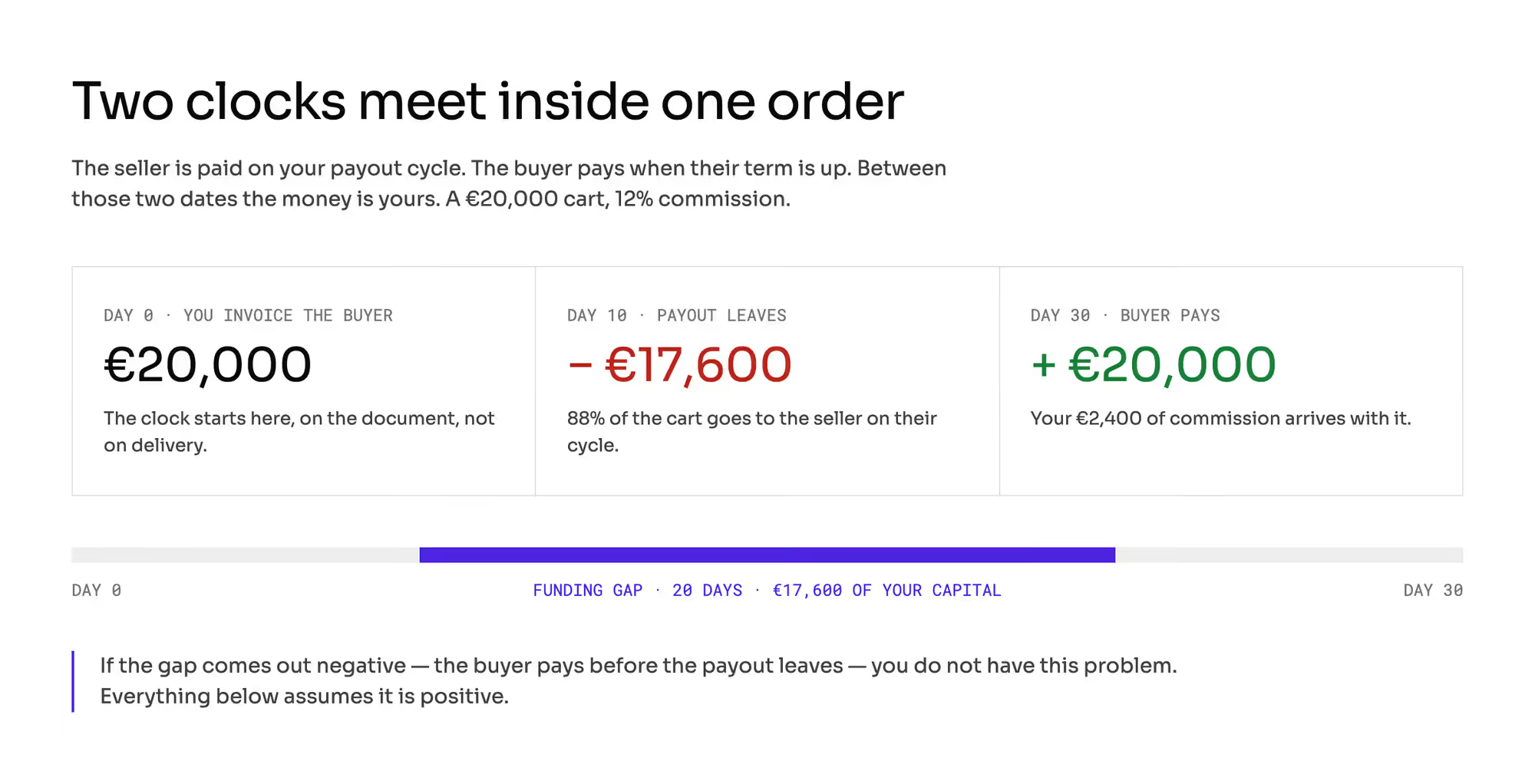
Assume you invoice. Then one order has two separate payment dates. The seller wants a payout on your payout cycle, and the buyer pays you when their term ends.
You fund the order between those two dates.
This series uses a €1,000 cart and a 12% commission as its standard example. Company carts are bigger.
This chapter uses a cart 20 times larger, at €20,000. You get €2,400, and the seller gets €17,600.
Start the clock on the day you issue the invoice. The payout to the seller leaves on day 10, and the buyer's transfer arrives on day 30.
For those 20 days, the €17,600 is your money.
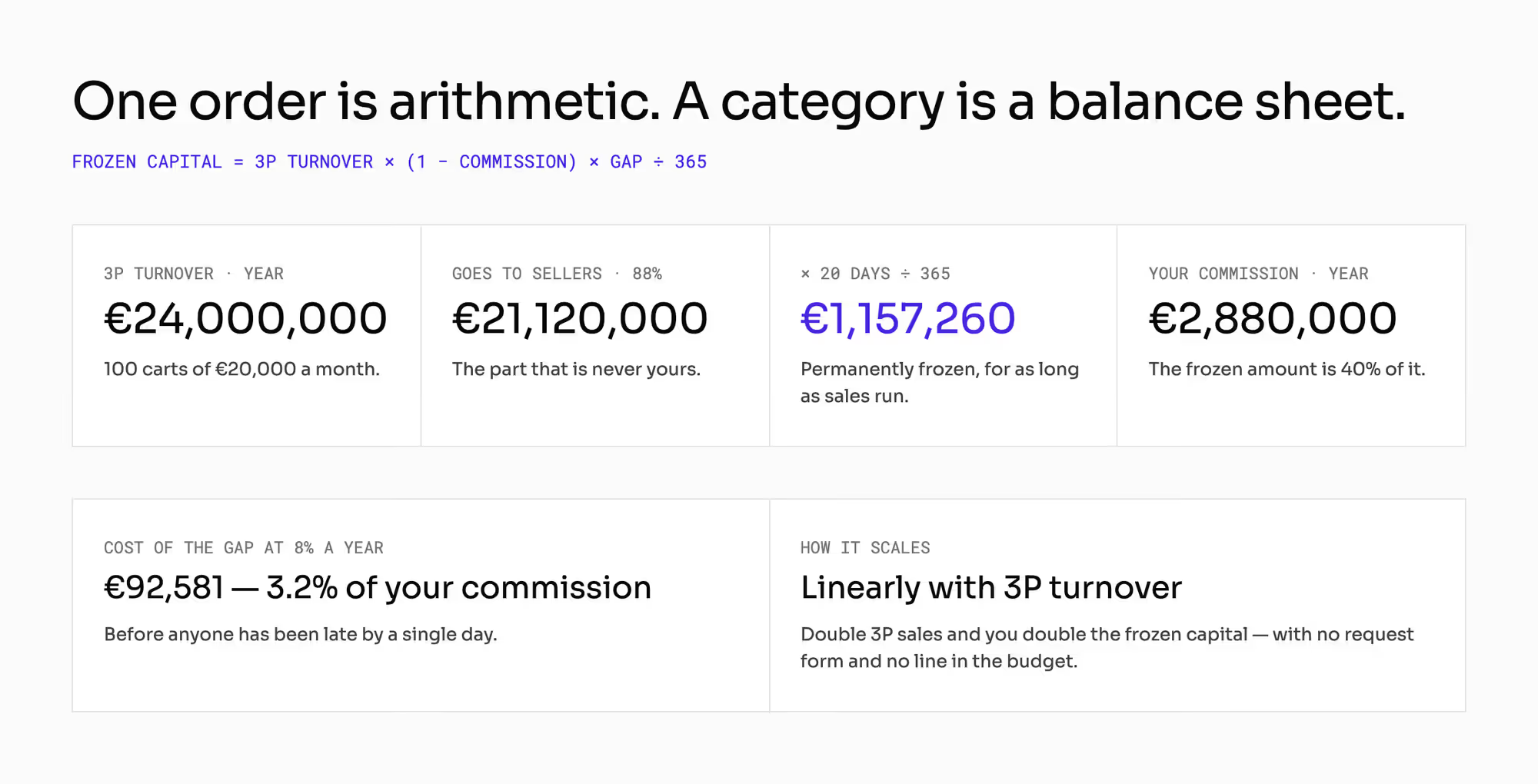
Now count a whole category. 100 carts like that a month make €2 million of turnover a month and €24 million a year. Sellers get 88% of it: €21,120,000.
The capital frozen in the gap is €21,120,000 × 20 ÷ 365 = €1,157,260. It stays frozen for as long as the sales continue.
Your annual revenue on that volume is €24,000,000 × 12% = €2,880,000. To earn that revenue, you tie up capital worth 40% of it.
At an 8% cost of capital, the gap costs €92,581 a year. That's 3.2% of your commission before anyone pays late.
The frozen amount grows in line with third-party turnover. Double your third-party sales, and you double the frozen capital. No one asks for this money, and it doesn't appear in any budget.
What does one unpaid invoice cost on third-party goods?
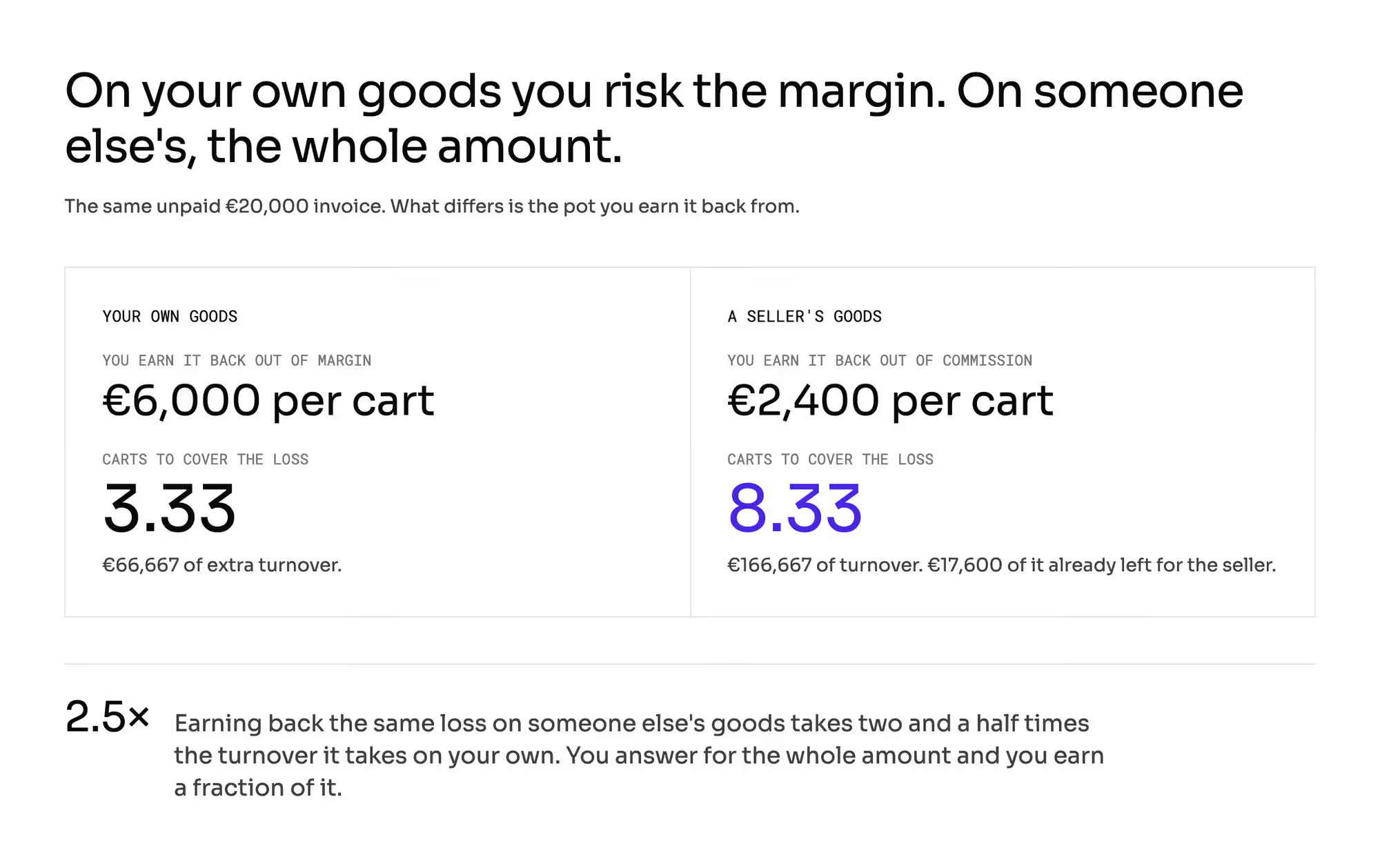
On your own goods, you sell a €20,000 cart that cost you €14,000. Your margin is €6,000.
An unpaid invoice costs you €20,000, and you earn it back from margin. You need 3.33 more carts to do that. That's €66,667 of extra turnover.
On a seller's goods, the same invoice costs you the same €20,000. €17,600 of it has already gone to the seller, and you never saw your own €2,400.
You need 8.33 carts at a €2,400 commission to earn it back. That's €166,667 of turnover.
Earning back the same loss on someone else's goods takes 2.5 times the turnover. You're liable for the whole amount, but you only earn a small share of it.
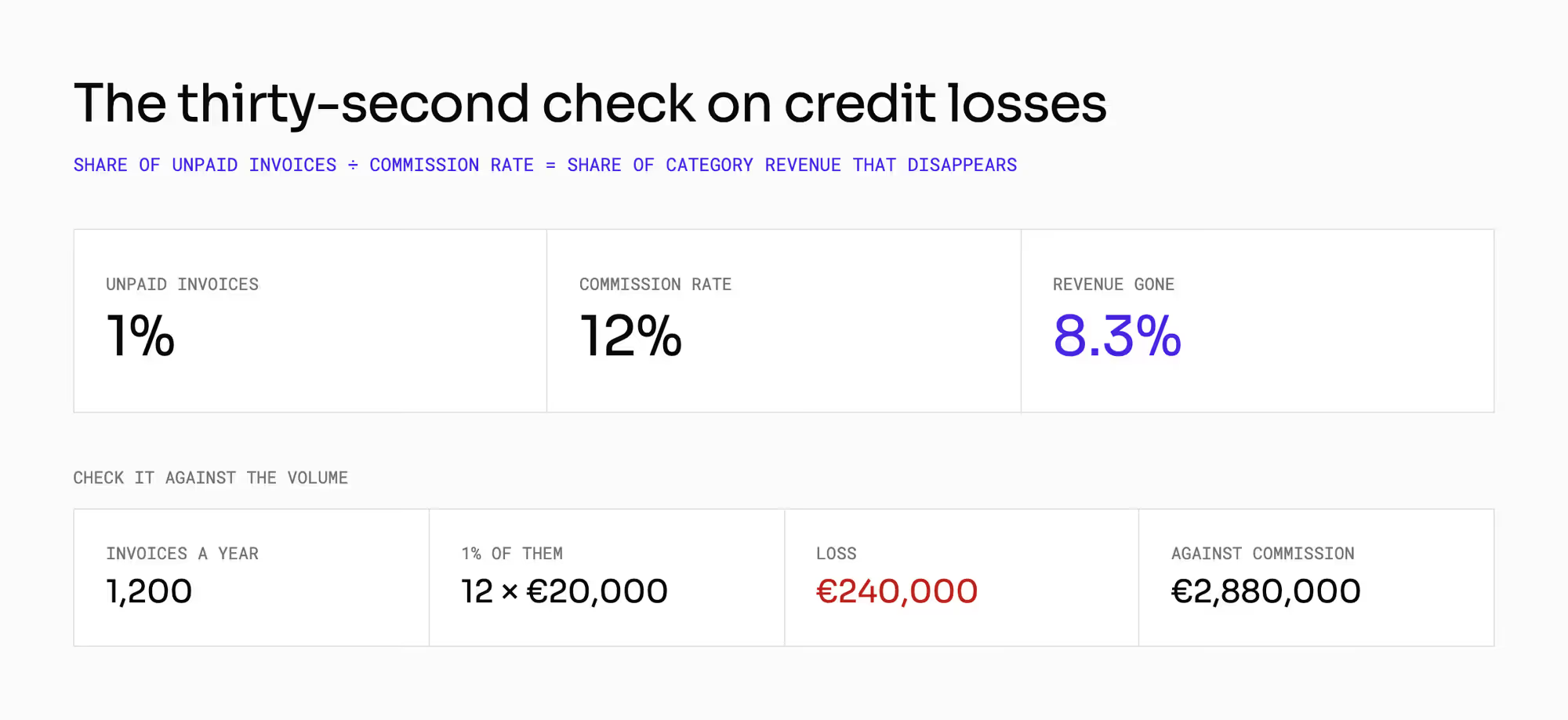
Divide your share of unpaid invoices by your commission rate. The result is the share of your commission revenue you lose. At 1% of invoices unpaid and a 12% commission, you lose 8.3% of your revenue from the category.
Check it against the volume. €24 million is 1,200 invoices a year, and 1% of them is 12 invoices of €20,000. That's €240,000 in losses against €2,880,000 in commission.
Which 3 ways can you handle credit risk on seller goods?
With each option, someone covers the loss. The table compares the options on the same €24 million of third-party turnover and a 20-day gap.
Decision | Who covers the unpaid €20,000 (party) | Capital frozen at €24m of 3P turnover and a 20-day gap (EUR) | Capability you have to have (process) | Who gives something up (party) |
|---|---|---|---|---|
Risk with you | you | ~1,160,000 | assessment, limits, collection | no one |
Risk with the seller | the seller | 0 | communicating the change of terms | sellers on a short cash cycle |
No deferred terms on 3P | no one (paid up front) | 0 | separate payment methods in one cart | buyers who can't pay up front |
Left unsettled | you, without knowing it | ~1,160,000 | none | no one, until the first loss |
1. You carry the risk
You become the buyer's lender. You need everything that comes with that job: assessment, limits, monitoring, and collection. The seller and the buyer don't notice any change.
2. You pass the risk to the seller
The payout happens only after the buyer's money arrives. The seller then lends to your customer. They don't know the customer and have no say in picking them.
Changing the payout cycle changes the seller's terms. The chapter on the P2B Regulation covers your disclosure duties, and the chapter on marketplace seller payouts covers the cycle.
3. You offer no deferred terms on third-party goods
Your own goods keep the credit terms you already give. Seller goods go out against payment up front.
This option makes more sense than it seems at first. On someone else's goods, you earn only a commission. You still answer to the buyer for the full invoice and owe the seller at the same time.
A mixed cart then needs two payment methods. The chapter on multi-vendor checkout covers that split.
You get the fourth option by default. Deferred terms work everywhere because someone set them up for your own sales. No one changed the setting when third-party offers went live.
You carry the risk, but no one ever decided you should.
What has to happen before you set a credit limit for a buyer?
You assess a buyer's creditworthiness from registry data, financial statements, and a credit bureau report. Your own payment history with that buyer tells you more than any of them.
You manage counterparty risk the same four ways a bank does: scoring, a limit, a shorter term, and passing the risk to someone else.
1. Limit belongs to the organization
Many people inside a company place orders, but the credit goes to one legal entity. Attach the limit to the buying organization and keep it off the user account.
The chapter on the B2B buyer journey covers the roles on the buyer's side.
2. Exposure includes orders you haven't invoiced yet
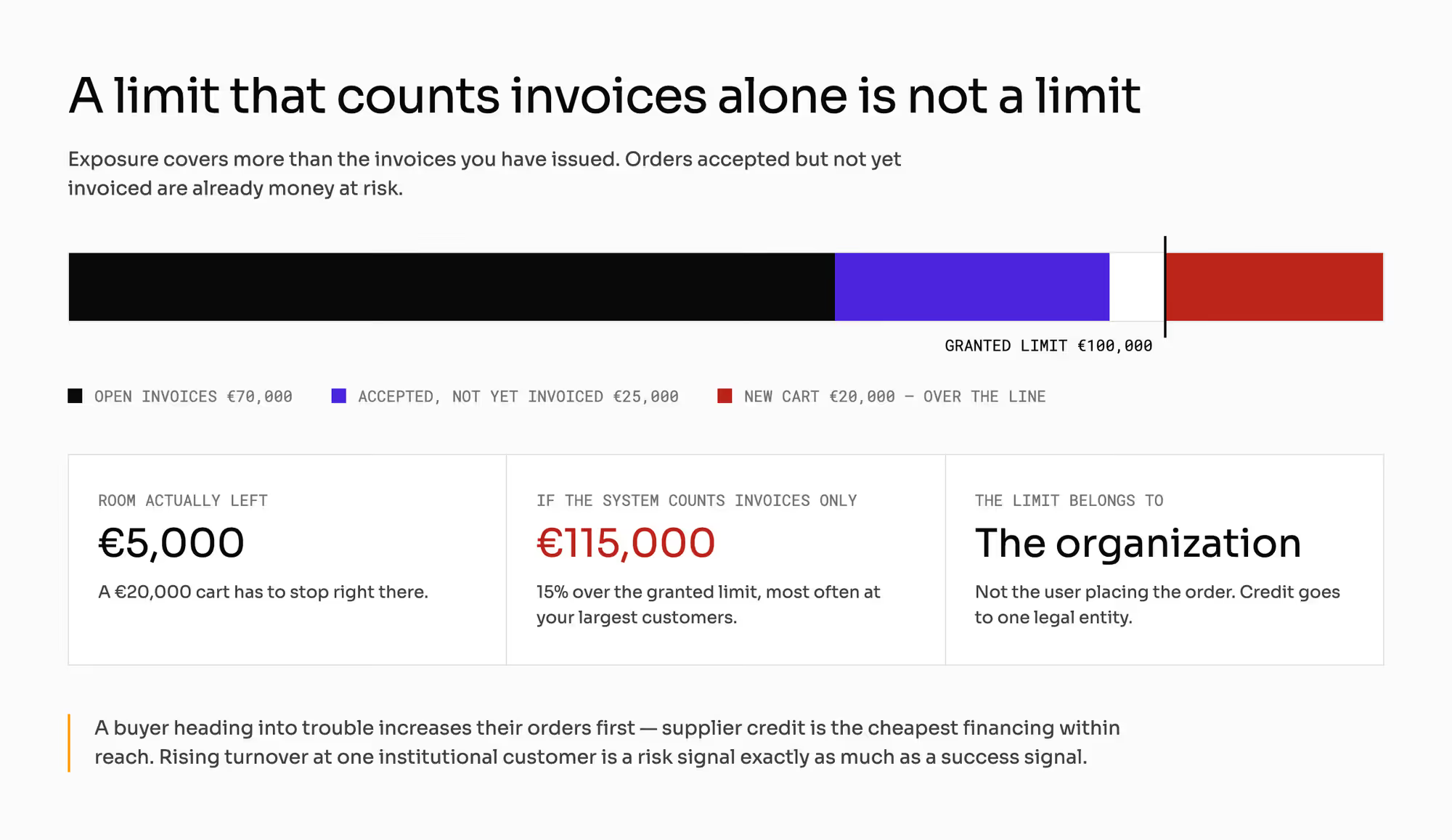
Take a €100,000 limit with €70,000 of open invoices and €25,000 of accepted orders that aren't invoiced yet. Only €5,000 is left. A €20,000 cart has to stop there.
A system that counts invoices alone lets that cart through. Exposure reaches €115,000. That's 15% over the limit.
This happens most often at your largest customers, because their order queue is the longest.
Don't expect your sales team to flag the next warning sign. A buyer heading into trouble increases their orders first.
Deferred payment from a supplier is usually the cheapest and fastest financing a company can get. When turnover rises at one company customer, it can mean trouble as well as success. A salesperson sees only the success, and their bonus is tied to it.
What do factoring and receivables insurance each solve?
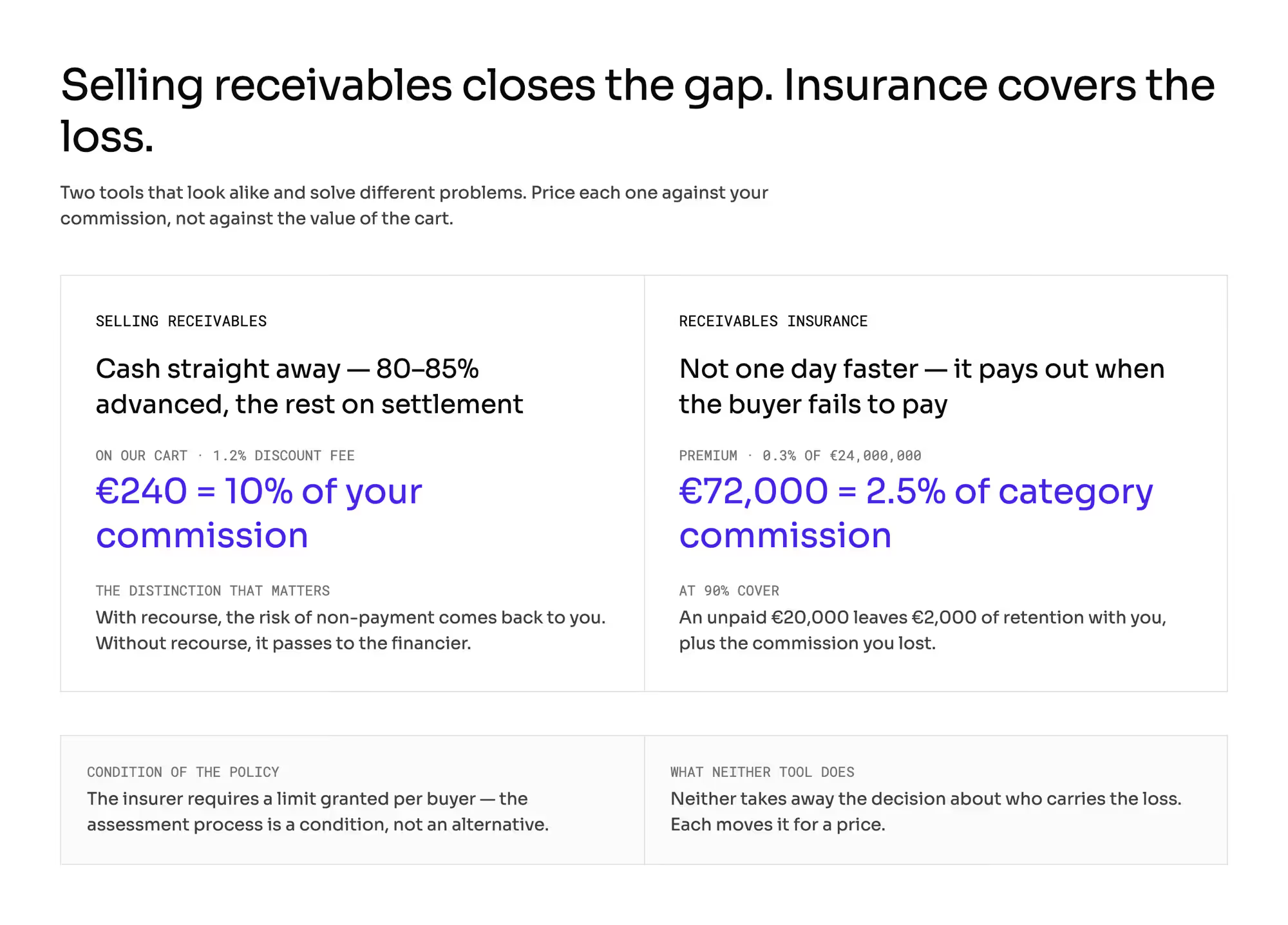
Selling receivables and insuring them look alike, but they solve different problems. If you mix them up, you either pay too much premium or get too little cover.
1. Selling receivables
Selling receivables turns an invoice into cash at once. People also call it factoring.
The financing company advances about 80 to 85% of the invoice. After the buyer settles it, they pay you the rest and keep a discount fee.
With recourse, the risk of non-payment comes back to you. Without recourse, it passes to the financier.
On our cart, a 1.2% discount fee on €20,000 is €240. That's 10% of your commission on the order.
2. Receivables insurance
Insurance doesn't speed up your cash flow at all. It pays compensation when the buyer fails to pay.
The premium is a percentage of turnover or of balances, and the policy covers an agreed share of the invoice. A 0.3% premium on €24 million is €72,000 a year. That's 2.5% of the commission from the category.
At 90% cover, an unpaid €20,000 leaves you €2,000 of your own retention. You also lose the commission.
The insurer requires a credit limit for each buyer. Your assessment process then becomes a condition of the policy.
You still have to decide who carries the loss. Each tool shifts it for a price, and you compare that price with your commission instead of the cart total.
Why is collection harder on a marketplace?
Collection needs an owner, a schedule, and the authority to stop selling to an account. You usually have it for your own goods and assume it covers the rest.
1. Dispute over goods holds up the whole invoice
The buyer withholds €20,000 because one line worth €800 arrived damaged. Your money arrives only after the seller handles the case.
Your recovery speed depends on a company you don't control. The chapter on marketplace dispute resolution covers how those cases close.
2. Stopping sales to a debtor is a decision about the customer
The person who makes that call usually manages the customer and has a sales target. If you don't name a role and set a threshold, they'll usually pick the relationship over the money.
What do B2B payment terms change in your marketplace?
Payment terms affect four parts of your build.
1. Two independent clocks
The payout cycle and the buyer's payment term are set in different departments. You fund the days between them with your own capital.
2. Regulatory perimeter
If you hold the payout until the buyer pays, you're handling money that isn't yours. If you pay out earlier, you're putting up your own.
The chapter on the marketplace payment license covers which arrangement needs a license.
3. Two bookkeeping entries
The receivable from the buyer and the liability to the seller reconcile separately. The chapter on the marketplace ledger explains how.
Capture, and the payment split also look different on deferred terms than on a card. The chapters on payment capture and split payments cover both.
The chapters on marketplace invoicing and marketplace credit notes cover the documents.
4. Risk in the commission grid
The cost of credit risk belongs in the commission grid. If a category has weaker buyers, charge a different rate there. The chapter on how much commission a marketplace can charge covers the grid.
An annual contract usually sets the price and the payment term together. The chapter on contract prices covers the price side.
How do you work out the funding gap on your own numbers?
Start with the dates and amounts you already have:
- Count the gap in days: the day the buyer's money arrives minus the day the seller's payout leaves. If the result is negative, you don't have this problem.
- Count the frozen capital: third-party turnover on deferred terms × (1 − commission) × gap ÷ 365.
- Compare that result with your annual commission from the same volume. The frozen amount on its own doesn't tell you much.
- Count the loss threshold: your share of unpaid invoices ÷ your commission rate.
- Pick one of the three options and write it down as a decision with a review date. If you don't pick one, you get the fourth option by default. It's always the worst choice.
- Check whether exposure counts orders in progress before you set any limit.
Ask your platform vendor five questions:
- Is the credit limit an object attached to the buying organization, and does it stop checkout?
- Does exposure include orders that are accepted but not invoiced?
- Can you switch payment methods on separately for your own offers and for third-party offers?
- Is the payment term a field on the order, and does the due date on the document come from it?
- Can the buyer's payment of the invoice trigger the seller's payout?
Which mistakes do operators make with B2B payment terms?
Each of these mistakes stays invisible until the first large loss.
1. Deferred terms switched on globally
Terms built for your own goods end up covering someone else's goods. No one asked the question. It gets settled by default, and you find out at the first large loss.
2. Limit calculated from issued invoices alone
Real exposure goes over the limit at the customers you most wanted to watch.
3. Payout cycle set without the buyer's term
The gap grows in line with turnover, and the financial plan doesn't include it.
4. Collection with no owner and no threshold
The debt stays open until someone has to choose between the money and the relationship.
5. Credit losses booked as general overhead
In the report, the category with the worst buyers looks best because it has the largest turnover.
What do you still have to settle about B2B payment terms?
This chapter doesn't tell you how long a payment term may be or what happens when the buyer goes past it. It covers commercial policy and the math behind it.
Confirm allowed term lengths, late-payment consequences, and collection costs with a lawyer. Do it for your own country and year. Ask about these areas of law:
- Payment terms in commercial transactions and the rules against late payment.
- Payments regulation, if you hold money that isn't yours.
- Data protection in credit assessment and profiling. The chapter on marketplace GDPR covers the marketplace side.
- Your duties to sellers when payout terms change.
- Naming the seller when you invoice in your own name. The chapter on marketplace seller identity covers how to show it.
- Credit rules for buyers who aren't businesses.
This chapter gives no benchmarks for credit losses. Every number above is hypothetical. Your own share of unpaid invoices in 1P sales is a better starting point than a market figure.
Card chargebacks don't arise when the buyer pays an invoice. You lose the money in a different way, so the chapter on marketplace chargebacks doesn't apply here.
Summary: How do B2B payment terms work on a marketplace?
When you invoice the buyer, your money funds the payment term on seller goods. A 20-day gap on €24 million of third-party turnover freezes €1.16 million. One unpaid invoice takes 8.33 carts of commission to earn back.
Choose who carries the risk: you, the seller, or no deferred terms on third-party goods. Attach the credit limit to the organization and count accepted orders in the exposure. Put the cost of risk into the commission grid.
Ask a vendor whether a credit limit can stop checkout before an order goes through. Building a marketplace where you decide who lends to your buyers?
Frequently asked questions on B2B payment terms
What are B2B payment terms?
B2B payment terms are the conditions under which a business buyer pays after delivery, for example, 30 days after the invoice. Net terms such as net 30 are a common form. On a marketplace, the company that issues the invoice also gives the credit.
Who carries the credit risk on a marketplace?
The company that invoices the buyer carries the credit risk. If you invoice in your own name, an unpaid invoice costs you the full amount. That includes the seller's share. You can pass the risk to the seller by paying out only after the buyer pays.
What is the difference between factoring and credit insurance?
Factoring turns an unpaid invoice into cash at once, and credit insurance pays out only when the buyer fails to pay. Factoring closes the funding gap. Insurance covers the loss, usually for an agreed share of the invoice.
Ready to build?
We build marketplaces where a credit limit belongs to the buying organization and stops checkout before exposure goes over it.