
Contract Prices on a Marketplace: Price Lists, Volume Breaks, and Expiry Dates
A contract price is a price you agree with one business customer for a fixed period, usually a year. It overrides your catalog price on every order that customer places while the contract lasts.
A company signs a price list for a year and expects the prices to hold for the whole year. Third-party offers in your catalog change every day.
Decide whether seller offers can go into a contract price list before a salesperson decides it for you. Otherwise, someone promises a price on goods you don't control.
This article breaks down:
- Why do a contract price and a seller's offer change at different speeds?
- What does a contract price list need in your data model?
- Which 3 arrangements bring a seller's offer into a price list?
- What happens when an item disappears, or the price list expires?
Key insights
- A contract price and a seller's offer change at different speeds. The contract price holds for twelve months, and a repricing bot can change the seller's price every day. Someone on your side still signs a price they don't set.
- A contract price list needs a buying organization, a buyer group, and a price with a validity period in your data model. With a default price of €1,000, a group price of €920 and an organization price of €880, a logged-in buyer from that organization sees €880.
- The 3 arrangements that bring a seller's offer into a price list put the cost of the discount on the seller, on your commission, or on your turnover. If the item sells 1,200 times a year, the first one costs the seller €126,720 and costs you €17,280. Covering half the gap yourself leaves you with €72,000 instead of €144,000.
- When an item disappears, or the price list expires, the buyer falls back to your catalog price. On expiry, the price rises from €880 to €1,000 overnight. That's 13.6% more. The customer's purchasing system usually spots the jump before you see it in your reports.
Why do a contract price and a seller's offer change at different speeds?
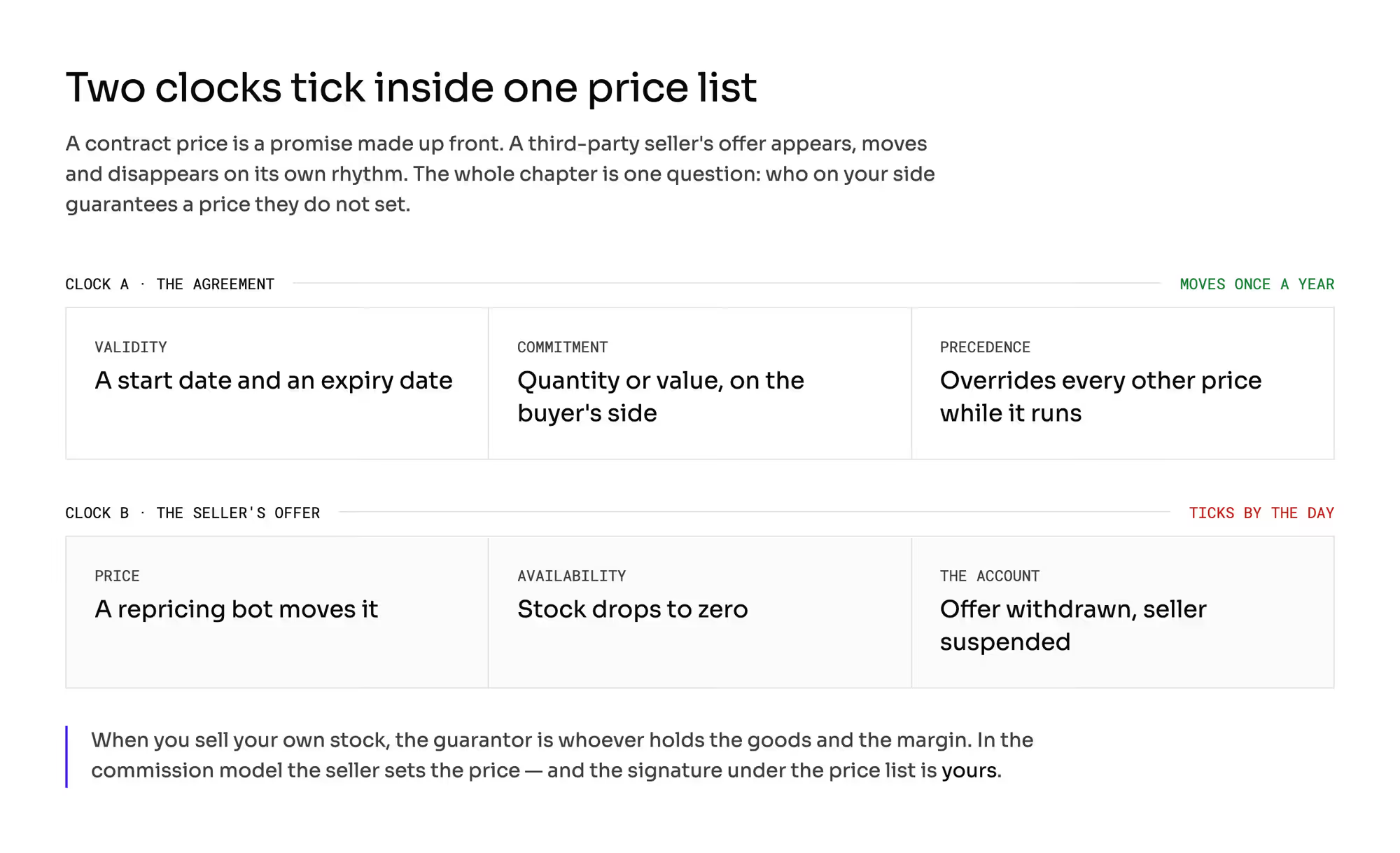
A contract price is a promise made up front. For twelve months, an item costs what the annex to the agreement says. The customer's purchasing department builds its budget on that number.
Framework agreements in sales systems work the same way. They have a start date and an expiry date. The buyer also commits to a quantity or an amount of money.
The agreed price overrides every other price while the agreement lasts.
A third-party seller's offer changes on a different schedule. It appears and disappears, and a repricing bot changes the price. Stock drops to zero, and sometimes the seller's account gets suspended.
So someone on your side signs a price list for prices they don't set. When you sell your own stock, you hold the goods and the margin, so you can guarantee the price.
In the commission model, the seller sets the price. Your signature is still on the price list. The chapter on marketplace platform models covers the commission model.
What does a contract price list need in your data model?
First, check whether the platform knows a buying organization at all. That's the object that holds the customer's employees, registration numbers, and orders.
A contract price belongs to the company that signed the contract. Without an organization object, your system has no place to attach it.
Products differ a lot here. Depending on the product, you'll either configure it or build it as a project.
More mature products have three levels. There's the buying organization and a buyer group of several organizations on shared terms. Each of them can carry its own price with a validity period.
Some products only have customer groups. In others, the B2B edition is a separate product that's switched on by request.
In that case, you have to build a price list per organization yourself.
Several prices usually match one offer. Check which one the system picks first.
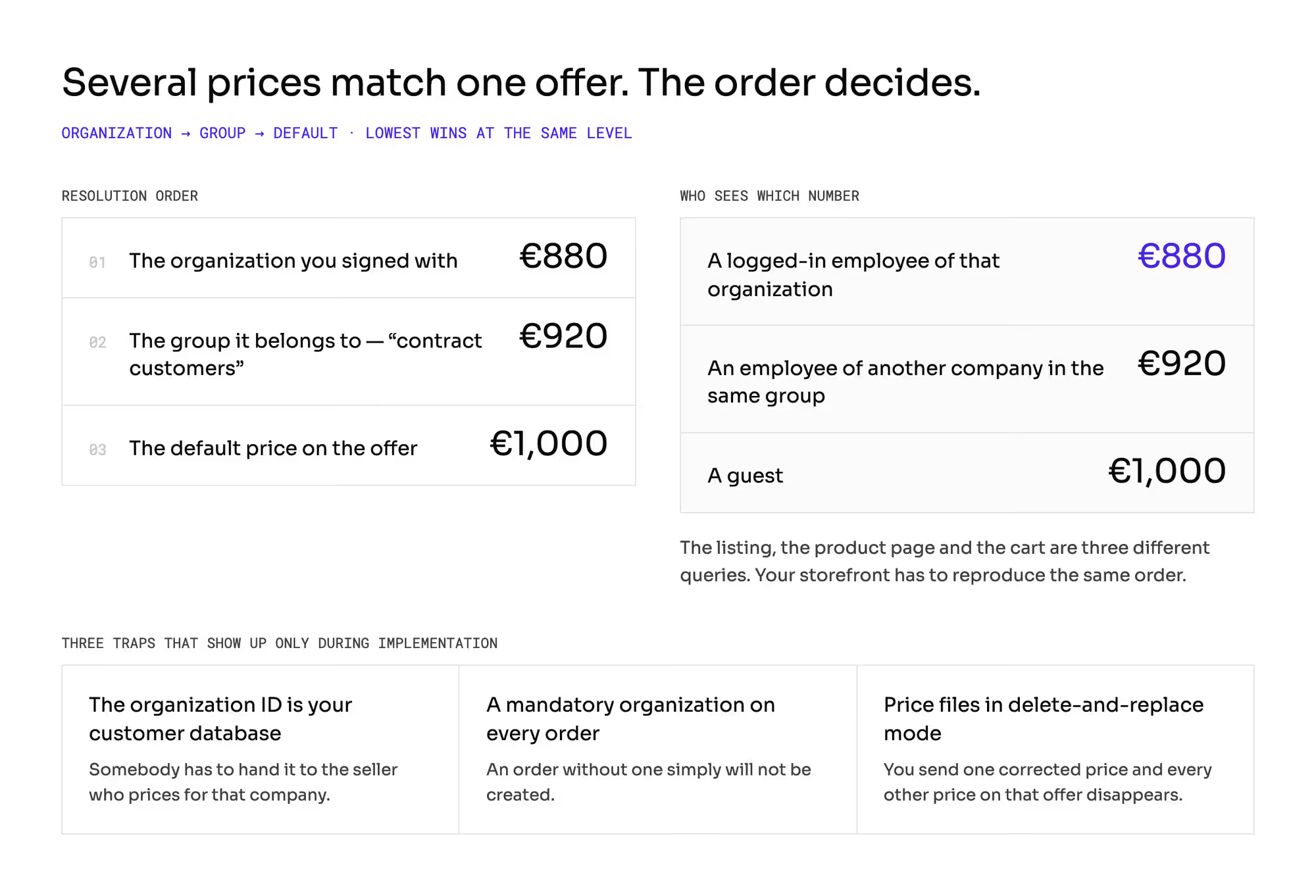
The common order is the price for the organization first, then the group price, then the default price. When two prices match at the same level, systems usually take the lower one.
Take an offer with a default price of €1,000. The group of contract customers has €920, and the organization you signed with has €880.
A logged-in employee of that organization sees €880. An employee of another company in the same group sees €920, and a guest sees €1,000.
Your storefront has to follow the same order. The listing, the product page, and the cart are three separate queries.
The chapter on showing prices on a marketplace covers the gap between the price you show and the price you charge.
1. Organization ID is your customer data
If you want a seller to set a price for a specific company, someone has to give them that company's ID. The chapter on marketplace GDPR covers what you may pass on.
2. Mandatory organization blocks orders without one
If you make the organization mandatory, the system won't create an order without one. Decide this before your first contract customer places an order.
3. Delete-and-replace imports
Some products accept a price list file in delete-and-replace mode. You send one corrected price, and every other price on that offer disappears.
How do volume breaks and net prices change the bill?
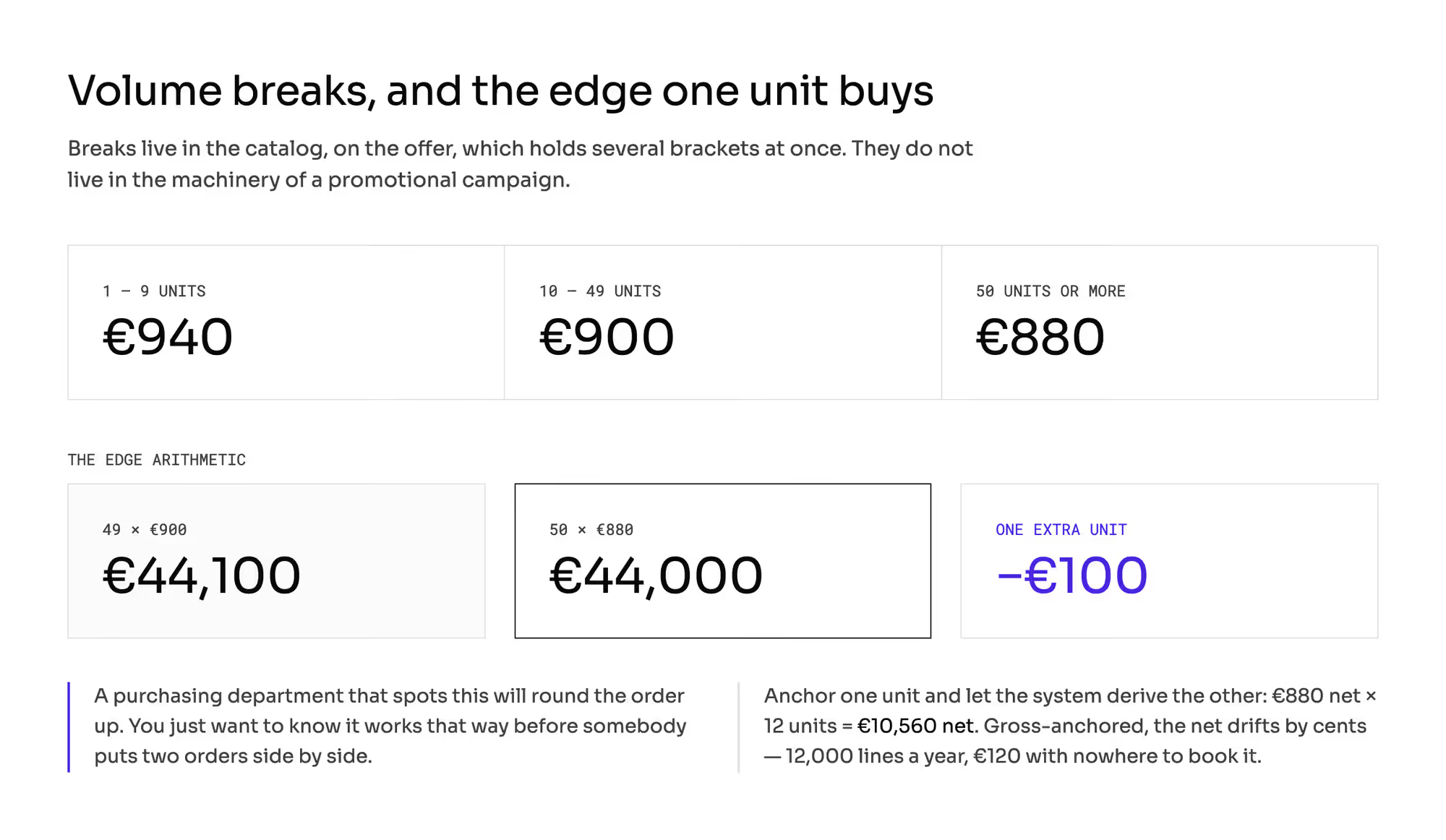
A contract price list is rarely one number. It usually has volume breaks: €940 for 1 to 9 units, €900 for 10 to 49 and €880 for 50 or more.
The breaks live on the offer in the catalog. One offer can hold several brackets at once. Keep the breaks out of your promotion engine.
Watch the math where one break ends and the next one starts. 49 units cost 49 × €900 = €44,100, and 50 units cost 50 × €880 = €44,000.
One extra unit lowers the bill by €100. A purchasing department that spots this rounds the order up.
That's fine. Just know it before someone puts two orders side by side.
There are two ways to count breaks on annual volume. One of them costs you more. The chapter on marketplace commission exceptions works through the numbers for the commission a seller pays you.
Keep the two topics apart. That chapter covers what the seller pays you, and this one covers what the buyer pays.
The second issue is the unit. A B2B agreement is usually written in net amounts, and a consumer catalog usually shows gross amounts.
Decide which number you anchor. The system calculates the other one from it.
A contract at €880 net on an order of 12 units comes to €10,560 net. That's exactly what the document has to show.
If the gross amount is the anchor, the system works the net amount out backwards. It can be a cent off on a line.
At 300 orders a year with 40 lines each, that's 12,000 lines and €120 of difference with no account to book it to. The chapters on marketplace invoicing and marketplace credit notes cover the documents.
Which 3 arrangements bring a seller's offer into a price list?
All the arithmetic below uses one item. Its default price is €1,000, and the commission is 12%. The seller keeps €880.
The contract price agreed with the customer is €880. That happens to be what the seller keeps at the default price.
The gap you have to close is your whole commission. The item sells 1,200 times a year.
Arrangement | Price for the buyer (EUR/unit) | Left for the seller (EUR/unit) | Your commission (EUR/unit) | Your annual revenue at 1,200 units (EUR) | Who pays for the discount |
|---|---|---|---|---|---|
No contract, default price | 1,000 | 880 | 120 | 144,000 | no one |
1. Seller accepts the price list | 880 | 774.40 | 105.60 | 126,720 | the seller |
2. You cover the whole gap | 880 | 880 | 0 | 0 | you |
2a. You cover half the gap | 940 | 880 | 60 | 72,000 | you |
3. Item outside the price list | 1,000 | 880 | 120 | 144,000 or 0 | no one, or you lose the turnover |
1. Seller accepts the contract price
The seller sells at €880, and the 12% commission is €105.60. They keep €774.40 instead of €880.
Over a year, turnover is €1,056,000. Your commission falls from €144,000 to €126,720, and the seller's share falls from €1,056,000 to €929,280.
The discount costs the seller €126,720 a year and costs you €17,280. Sellers agree only if they get volume they couldn't win on their own.
Make it a condition of joining the program. It changes the terms you work with sellers on. The chapter on the P2B Regulation covers how to make that change and how much notice to give.
2. You cover the difference from your commission
The seller is meant to come out whole and keep €880, and the buyer pays €880. To make that work, you give up the whole €105.60 of commission and earn zero on the item. Over a year, that's €0 instead of €144,000.
The realistic version splits the gap. The contract price is €940, the commission is €112.80, and the seller would keep €827.20.
You top the seller up by €52.80 and keep €60. That's 6.4% instead of 12%, or €72,000 a year.
The seller never has to know about it. You finance someone else's price from your own revenue on every order until the contract ends.
3. Item stays outside the price list
The customer sees two kinds of prices at once: 400 contract items at the agreed price and the rest of the catalog at market price. You don't pay anything directly. You lose the turnover the customer takes elsewhere.
Say the customer orders €2.4 million a year, and 30% of that is goods outside the price list. That's €720,000 of turnover and €86,400 of commission.
If the customer's policy says to buy only from the price list, those items don't exist for the buyer.
There's a risk in the other direction too. The same item from a seller at €850 undercuts your contract price of €880 in your own store.
The chapter on whether a marketplace can control seller prices covers pricing policy toward sellers.
What happens when an item disappears, or the price list expires?
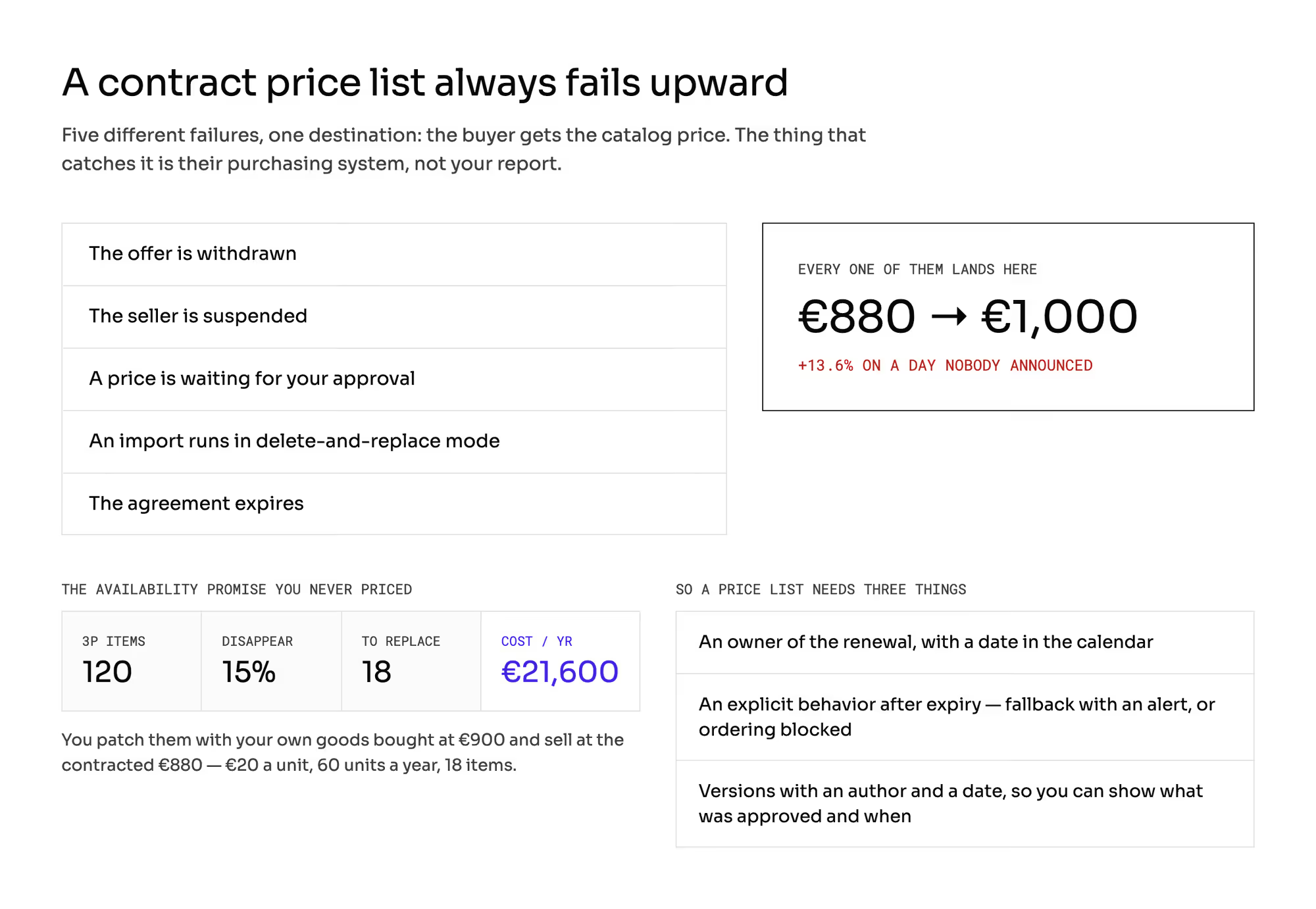
When something goes wrong with a contract price list, the buyer pays the higher default price. Five events end the same way:
- An offer is withdrawn.
- A seller is suspended.
- A price waits for your approval.
- An import replaces the whole price list.
- The agreement expires.
In all five cases, the buyer gets the catalog price instead of the contract price. Their purchasing system usually spots it before you do.
The contract covers 400 items, and 120 of them come from sellers. Say 15% of those disappear during the year. That's 18 items to replace.
You replace them with your own goods bought at €900, but the agreement still says €880. Every unit then costs you €20.
At 60 units a year per item, that's €21,600 you never planned for when you promised the items would stay available.
Expiry works the same way across the whole price list at once. The price goes back from €880 to €1,000. That's a 13.6% increase, and no one announced it.
A price list needs three things:
- An owner for the renewal, with a date in the calendar.
- A defined behavior after expiry: a fallback to the default price with an alert, or a block on ordering the item.
- Versions with an author and a date, so you can show the customer what they approved and when.
What do contract prices change in your marketplace?
Contract prices touch three parts of your build.
1. Catalog
A contract price list has to be built into the catalog. If the platform has no buying organization, no group, and no dated price, you have nowhere to store what you promised the customer. Adding all of that after launch touches every offer in the catalog.
2. Renewal
The arrangement you choose sets who you have to negotiate with at renewal. In arrangement 1, you negotiate with the customer and the sellers at once. In arrangement 2, the discount comes out of your own P&L. In arrangement 3, you lose part of the customer's orders without any negotiation.
3. Channel and the terms
A price list helps only if it reaches the customer's purchasing system. The chapter on the punchout catalog covers that channel.
The chapter on B2B payment terms covers the credit side of the same contract.
How do you cost a price list before you promise it?
Start with your three biggest items:
- Count the gap on each one: the default price minus the contract price. Put it next to the commission. If the gap is bigger than the commission, you can't cover it from commission at all.
- Count the share of third-party items in the price list. If they're only a few percent, keep them outside the list and tell the customer.
- Count the cost of replacement: third-party items × expected disappearance rate × annual volume × the difference between your cost and the contract price.
- Set the behavior after expiry for each price list in the system. A spreadsheet won't do it.
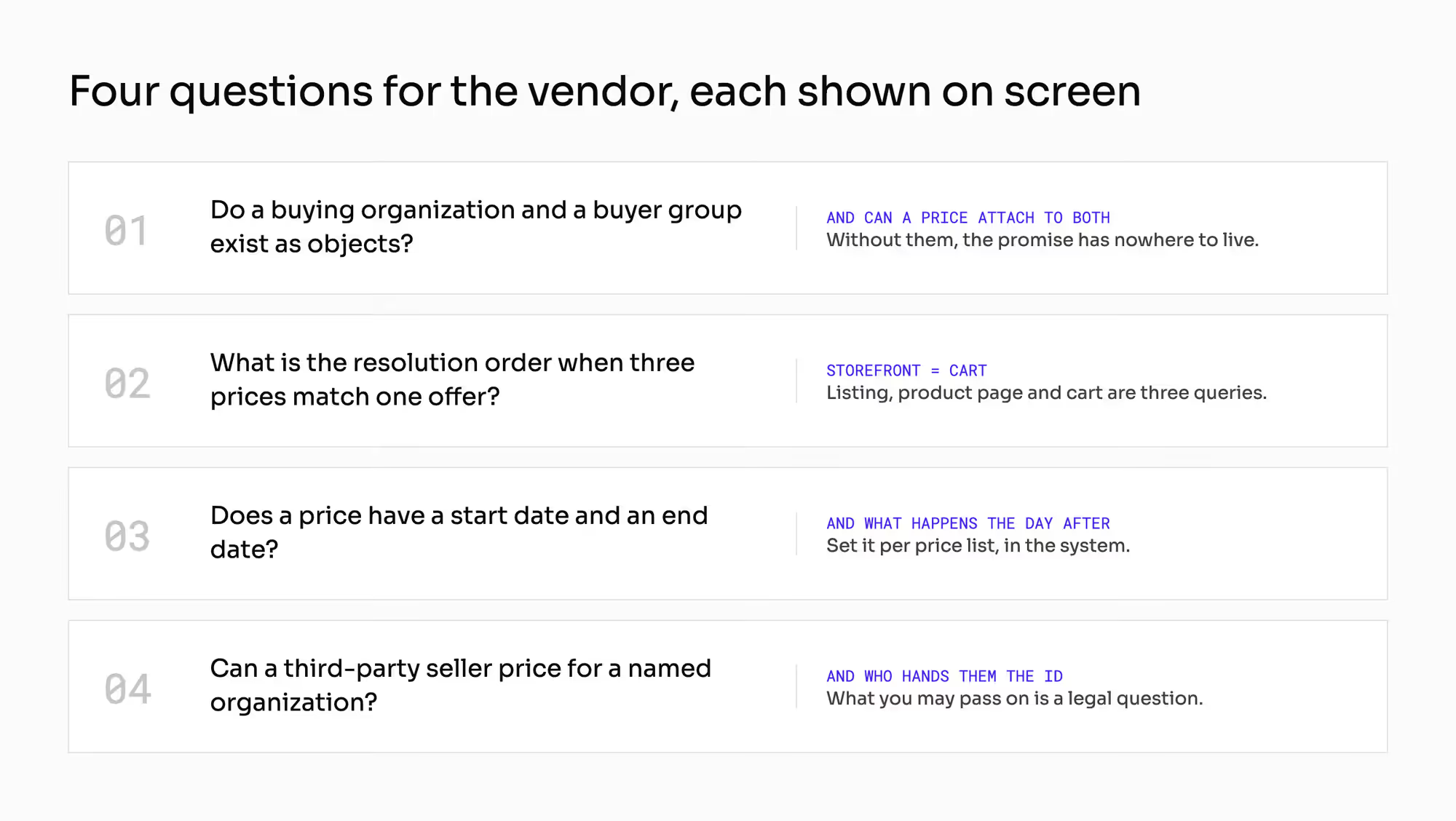
Ask your vendor four questions, and ask to see each answer on screen:
- Do a buying organization and a buyer group exist as objects, and can a price be attached to both?
- In what order does the system pick a price when three prices match one offer, and does the storefront show the same number as the cart?
- Does a price have a start date and an end date, and what happens the day after it ends?
- Can a third-party seller set a price for a named organization, and who gives them its ID?
Which mistakes do operators make with contract prices?
In each of these mistakes, the customer finds the problem first.
1. Price list promised before anyone checked the data model
A salesperson signs an annex covering 400 items, and the platform only knows the default price. The price list then lives in a spreadsheet, and someone types it into every order manually.
2. Topping up from commission without a yearly total
One item looks like small change. The real rate on that customer drops to zero, and no one can point to the decision behind it.
3. No behavior defined after expiry
The price goes up without an announcement, and the customer's purchasing department catches it. You end up explaining what an automated system did.
4. One item at two prices
The item has one price in the price list and another in the open catalog. The buyer asks what the contract is for, and they're right to ask.
5. One-price update in delete-and-replace mode
Every other price on that offer quietly disappears. The customer falls back to the default price.
What do you still have to settle about contract prices?
This chapter doesn't cover the commission you charge sellers. It also leaves out price display, price history, discount codes and your price policy toward sellers.
The chapters on the Omnibus Directive and marketplace discount codes cover price history and discounts.
This chapter doesn't settle whether you may charge two buyers two prices for the same item. Take that question to a lawyer before you sign the first price list.
Ask about these areas. This chapter doesn't say which of them apply to you:
- Competition law on different terms for different buyers.
- Platform-to-business transparency rules, if joining the price list is a condition of working with you.
- Personal data protection, when you pass customer identifiers to a seller.
All the numbers above are hypothetical. You can reuse the method with your own numbers.
Summary: How do contract prices work on a marketplace?
A contract price holds for a year, and a seller's offer changes every day. Your signature is on the price list either way.
Build the buying organization, the buyer group, and a dated price into the catalog before you promise anything. Then choose one of three arrangements for seller items. In each one, someone different pays for the discount.
When a contract price list breaks, the buyer always pays the higher price. Decide what happens on the day after expiry.
Ask a vendor to show you what a buyer pays the day after their price list expires. Building a marketplace where a contract price is part of the catalog?
Frequently asked questions on contract prices
What is contract pricing in B2B?
Contract pricing is a price agreed with one business customer for a set period, usually a year. It overrides the catalog price on that customer's orders. It often comes with volume breaks and a payment term.
What is customer-specific pricing?
Customer-specific pricing shows each business customer the price agreed for their organization. The system picks the organization's price first, then the group price, then the default price. A guest still sees the default price.
Who pays for a contract discount on a seller's item?
The arrangement you choose decides who pays for a contract discount on a seller's item. If the seller accepts the contract price, the discount comes out of their share. If you cover the gap, it comes out of your commission. If the item stays outside the list, you lose the turnover instead.
Ready to build?
We build marketplaces where a contract price list lives in the catalog, with an organization, a validity date and an owner.