
Can a Marketplace Control Seller Prices?

A marketplace does not set the price and moves it every day: the rule that picks the winning offer, the commission rate, campaigns, and the platform model all push the number on the page, so the question is which of your settings already interfere with it.
Price is the one number on your platform that you do not set. It is also the number you move every day, with several tools at once.
So the question is which of your settings already interfere with the price, who switched them on, and whether anybody ever counted the effect.
This article breaks down:
- Which settings already move the price?
- Which 3 levels of interference exist?
- What does a price range delete?
- What does parity cost to police?
Key insights
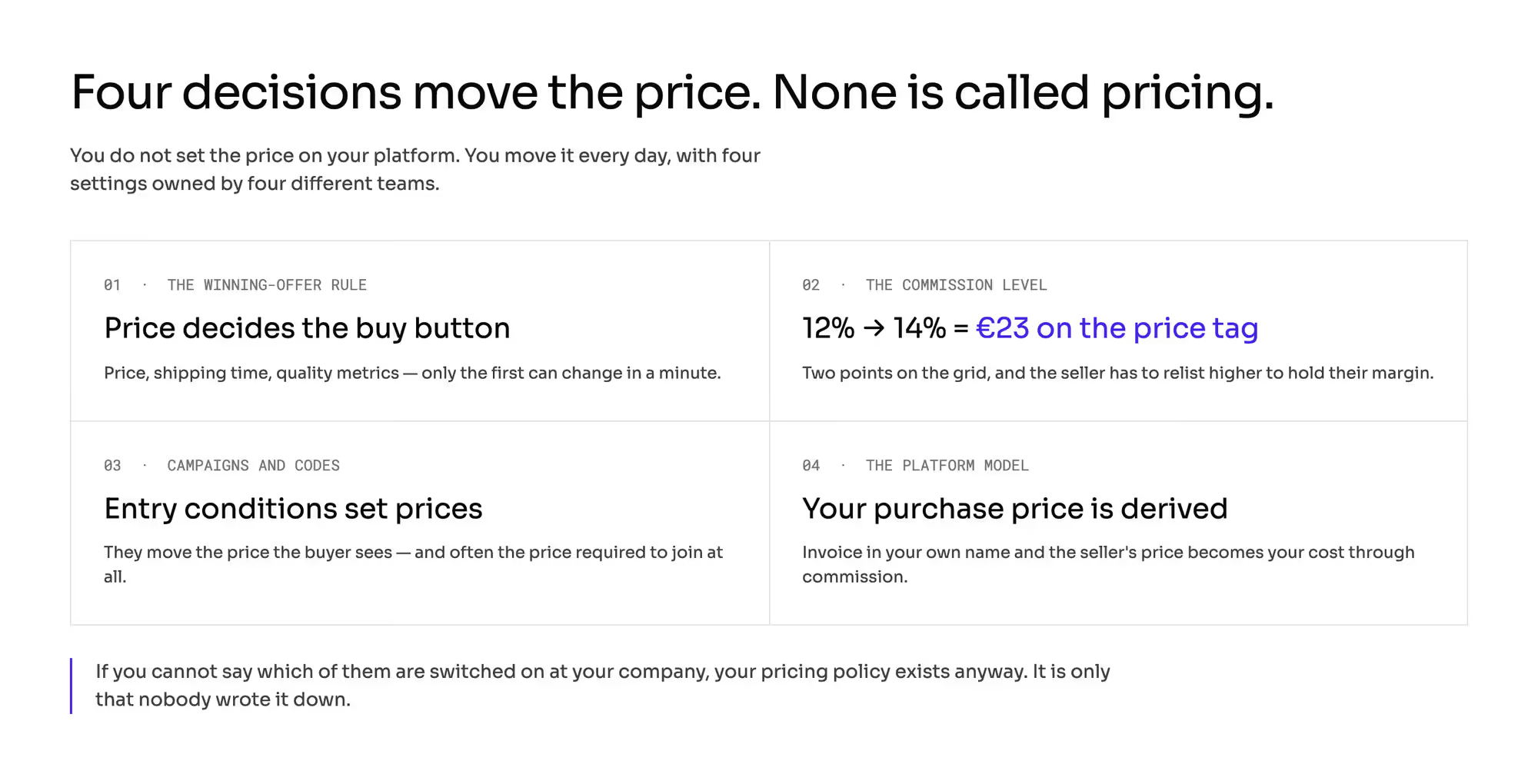
- Four settings move the price without anyone calling it a pricing decision: the rule that picks the winning offer, the commission rate, campaigns and codes, and the platform model you chose, where two points on the grid are €23 on the price tag.
- The three levels are no interference, a soft layer of monitoring and match buttons, and the hard layer of ranges and approval, and the hard one is headcount: 60,000 price decisions a month at 20 seconds each is 333 hours.
- A price range sometimes deletes the offers below it rather than blocking them: 3% of 40,000 offers is 1,200 gone with no trace, and reversing the threshold restores the setting and none of the offers.
- Policing parity costs 133 hours a month before you buy the price data: 40,000 offers across three channels is 120,000 comparisons, and 2% of discrepancies leaves 800 cases at ten minutes each.
Which 4 settings already move the price for you?
The canonical example of this series: a cart of €1,000, a commission of 12%, so €120 stays with you and €880 goes to the seller. Let us add one more number.
That seller carries €700 of purchase cost and €60 of shipping on those goods, so their own profit is €120. That is exactly what you make.
The whole article runs on that pair.
The rule that picks the winning offer. If price is mostly what decides the buy button, you have handed sellers the one lever that works instantly.
Practitioners agree on three criteria that really count: price, shipping time, and quality metrics. Only the first one can change in a minute.
The rule itself is covered in the chapter on the rule that picks the winning offer.
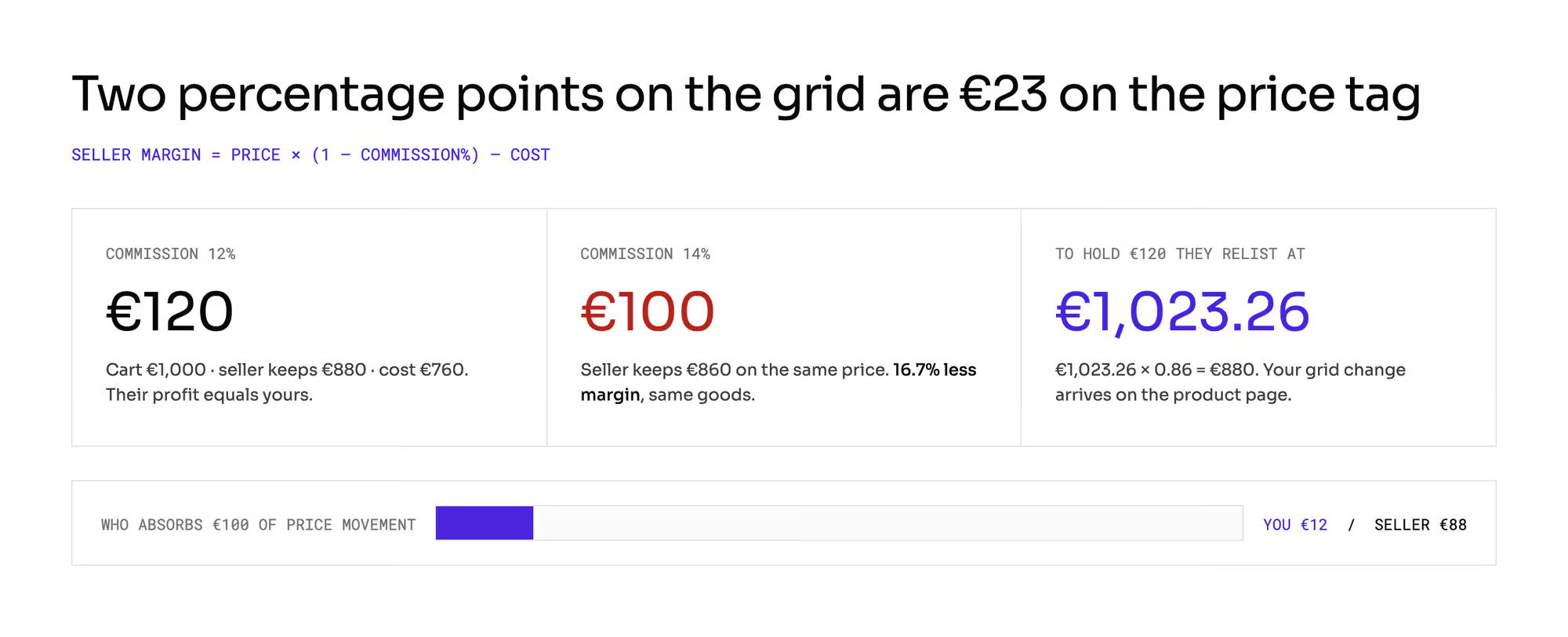
The level of the commission. Raising the rate from 12% to 14% leaves the seller €860 instead of €880, which is €100 of margin instead of €120.
That is 16.7% less. To get back to their own €120, they have to list the same goods at €1,023.26, because €1,023.26 × 0.86 = €880.
Two percentage points on the grid are €23 on the price tag.
Campaigns and codes. They move the price the buyer sees, and often the price a seller has to set before they can join the campaign at all (campaigns on somebody else's assortment and discount codes and who funds them).
The platform model you chose. When you invoice the buyer in your own name, the seller still sets the selling price, and your purchase price is derived from it through the commission ("Which marketplace platform model should you choose").
Four decisions, four different teams, and not one of them is called a pricing decision. If you cannot say which of them are switched on at your company, your pricing policy exists anyway.
Which 3 levels of price interference can you run?
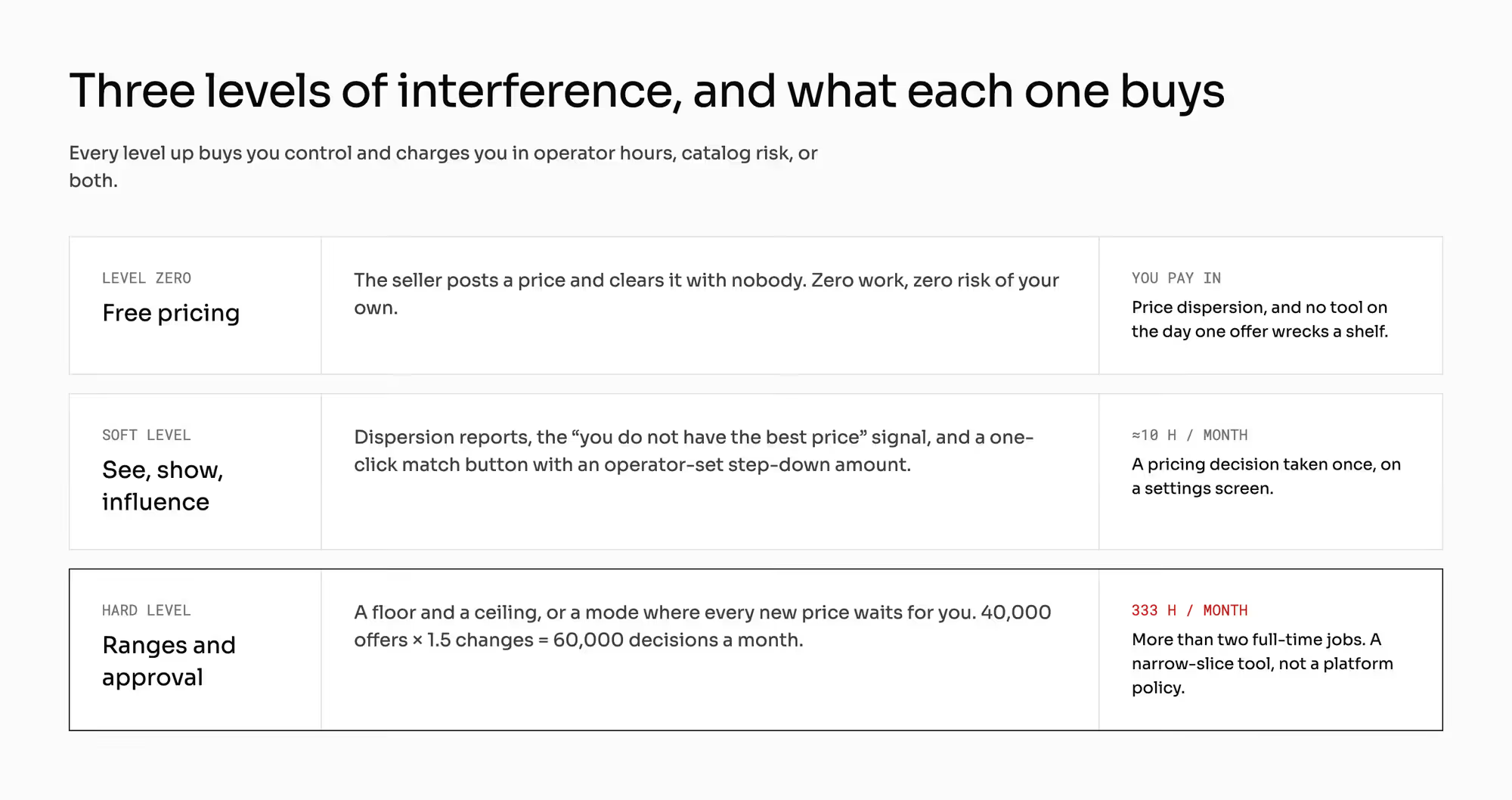
1. Level zero: the seller sets the price freely
That is how most marketplaces work.
The seller posts a price and a promotional price and clears them with nobody. You buy zero work and zero risk of your own.
You pay for it with price dispersion inside a category, and with having no tool on day one, offer wrecks the positioning of a whole shelf.
2. The soft level, where you see, show and influence
This is where price dispersion reports live, together with the signal "you do not have the best price on this page" and the button that matches a seller's price to the lowest one in one click.
Some systems go a step further: the operator sets a step-down amount, and the button sets a price that much below the lowest existing one. It looks like a convenience for the seller, and it is your pricing decision, taken once, on a settings screen.
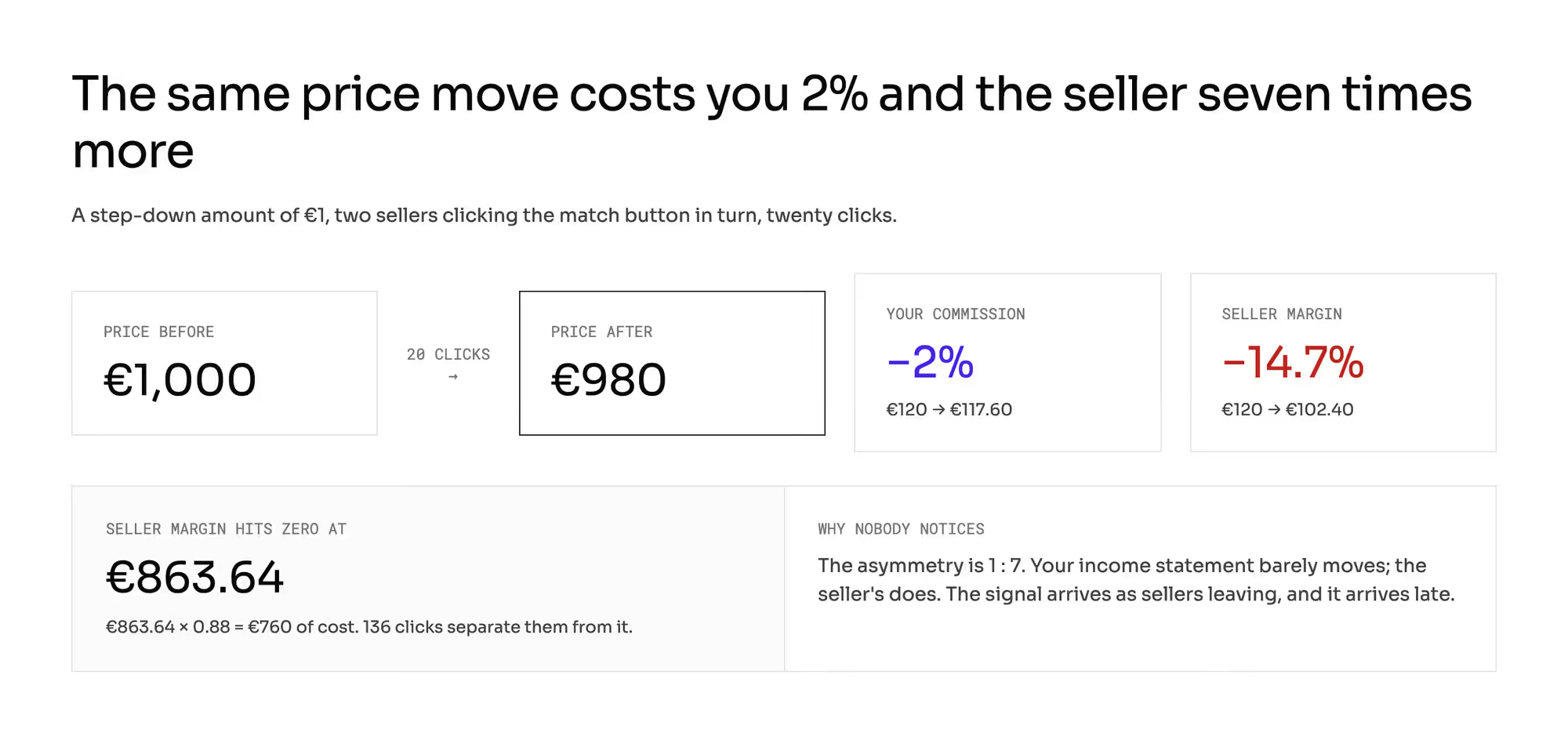
Count what it does. A step-down amount of €1, two sellers clicking in turn, twenty clicks: the price walks from €1,000 down to €980.
Your commission falls from €120 to €117.60, which is 2%. The seller's margin falls from €120 to €102.40 (€980 × 0.88 = €862.40, minus €760 of cost), which is 14.7%.
The same price move costs you 2% and costs the seller seven times more. That is exactly why nobody in your company notices it.
This seller hits zero at €863.64, because €863.64 × 0.88 = €760, and 136 clicks separate them from it.
3. The hard level, price ranges, and approval
A price range is a floor and a ceiling on the price.
Approval is a mode in which every new price waits for you to accept it, and until then the offer sells at the old price or does not sell at all. The second one sounds like full control and is above all a headcount cost: 40,000 offers and an average of 1.5 price changes per offer per month come to 60,000 decisions; at 20 seconds each that is 333 hours, which is more than two full-time jobs.
This mode makes sense on a narrow slice of the catalog, where prices were negotiated in a contract, and it makes a poor policy for the platform.
What does a price range do to offers below it?
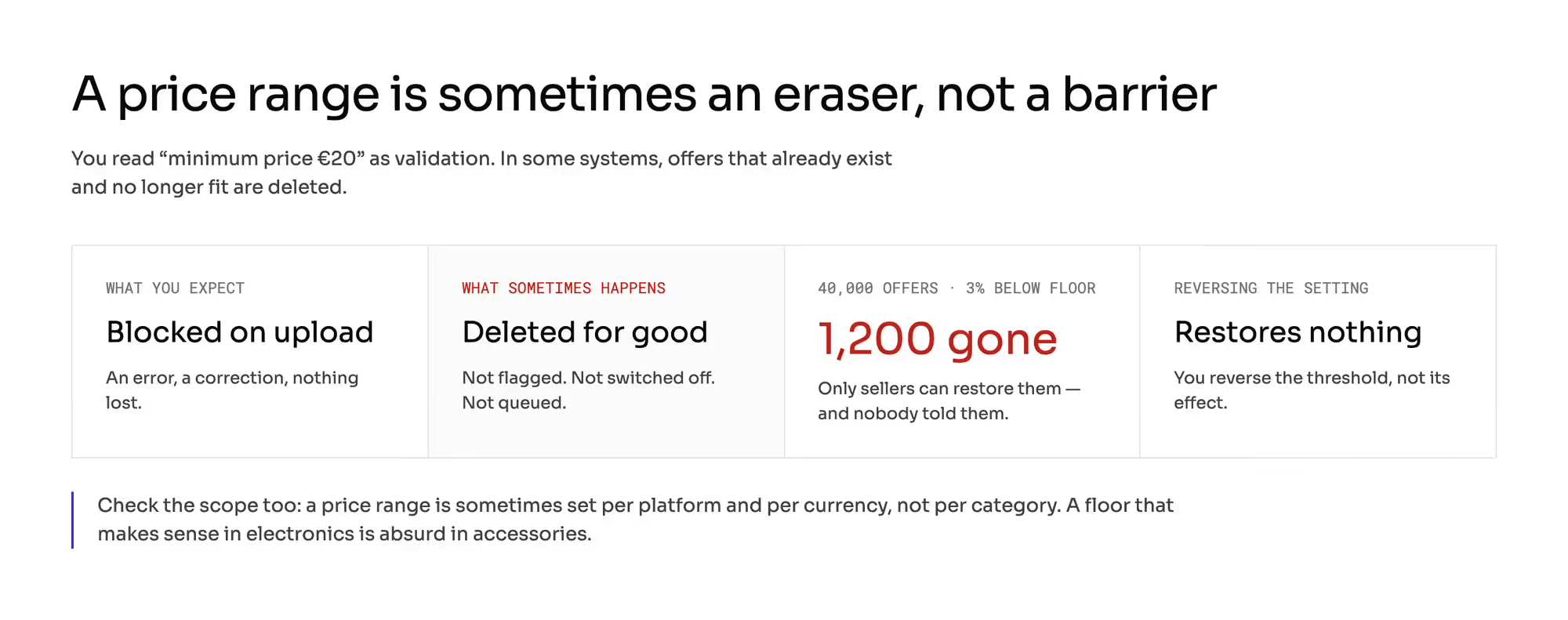
Your instinct reads "minimum price €20" as validation: the seller tries to list below it, gets an error, and corrects it. In some systems, that rule works differently: offers that already exist and no longer fit the new range are deleted.
Not flagged. Not switched off.
Not queued for correction. Deleted.
With 40,000 offers and 3% of them below the floor, 1,200 offers vanish, and the only way back is for sellers who know nothing about it to upload them again. Reversing the setting restores nothing, because what you reverse is the threshold and not its effect.
Then there is the scope. A price range is sometimes a setting for the whole platform, per currency, rather than per category and per offer.
A floor that makes sense in electronics is absurd in accessories, so one number serves both shelves. Either it protects nothing, or it erases assortment you never meant to touch.
And now the point that matters most, because it cancels the reason operators think about price ranges at all. A price threshold is absolute, and expensive pricing mistakes are relational.
A pack of 24 units at €100.80 is €4.20 per unit. The seller uploads €4.20 for the whole pack.
It passes every price range you could set, because €4.20 is a perfectly normal price. A thousand packs sold produce €4,200 of turnover instead of €100,800: your commission is €504 instead of €12,096, and the seller loses €85,008 (€96,600 of difference × 0.88).
A price range will not catch this, because it knows nothing about the relation between the price and what is in the box. What does catch it is a comparison against the offer's own price history and against the unit price in the category.
What to do with the orders that already landed is settled by a seller accepting or rejecting an order.
What does automated repricing do to your platform?
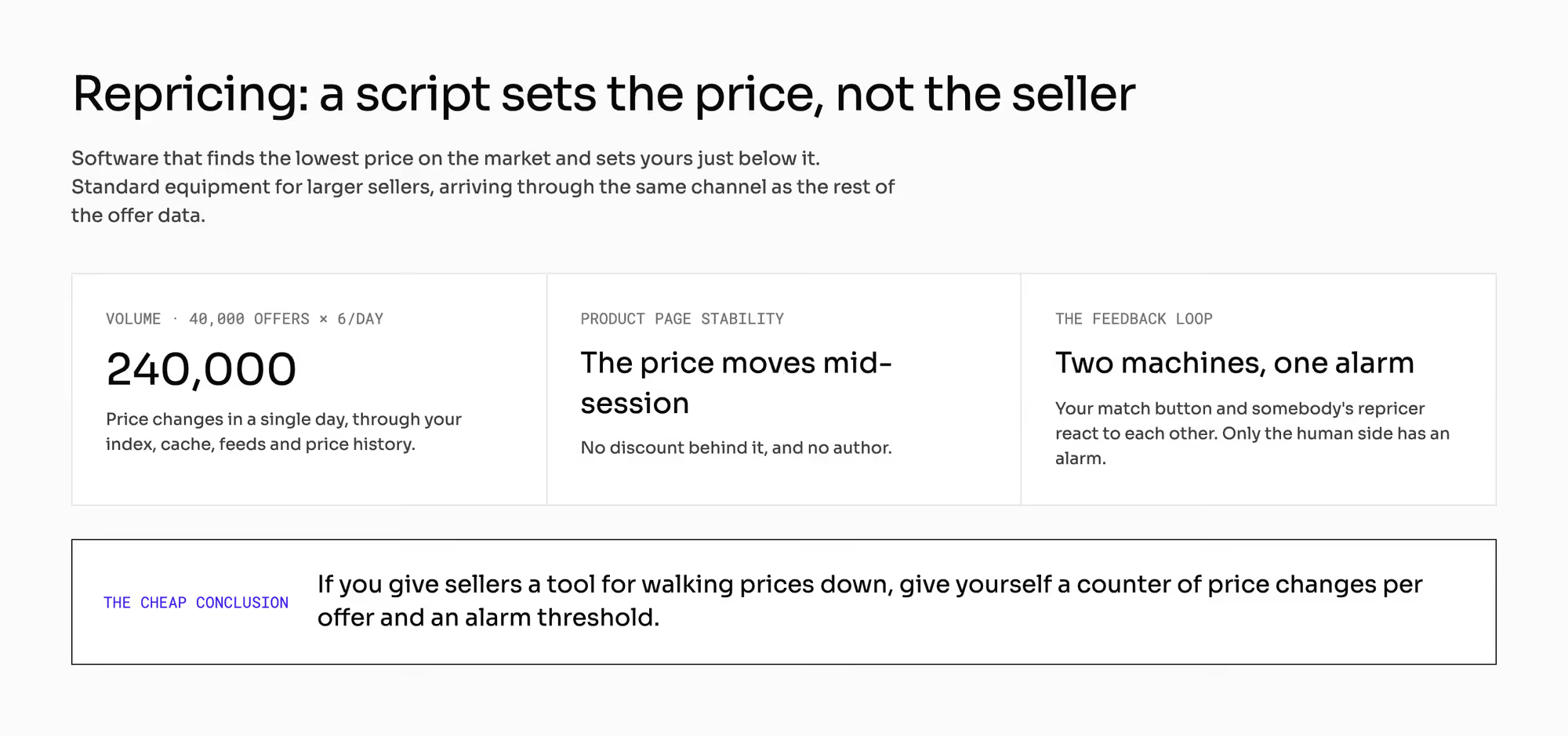
Automated repricing means software that detects the lowest price on the market on its own and sets yours just below it. It is standard equipment for larger sellers.
It does not ask your opinion, and it arrives through the same channel as the rest of the offer data.
There are three consequences, and all are measurable. The volume of pricing events: 40,000 offers and six changes a day make 240,000 price changes in a single day, passing through your index, your cache, your feeds, and your price history series (price history and discount messages).
The stability of the product page: the amount under the buy button changes in the middle of a buyer's session, with no discount behind it and no author. The feedback loop: your button for going below the lowest price and somebody else's repricer are two machines reacting to each other.
Practitioners observe that a loop like this walks down faster than anyone can spot it. Both sides are driven by machines, and only the human side has an alarm.
The conclusion is cheap: if you give sellers a tool for walking prices down, give yourself a counter of price changes per offer and an alarm threshold.
What does policing price parity cost?
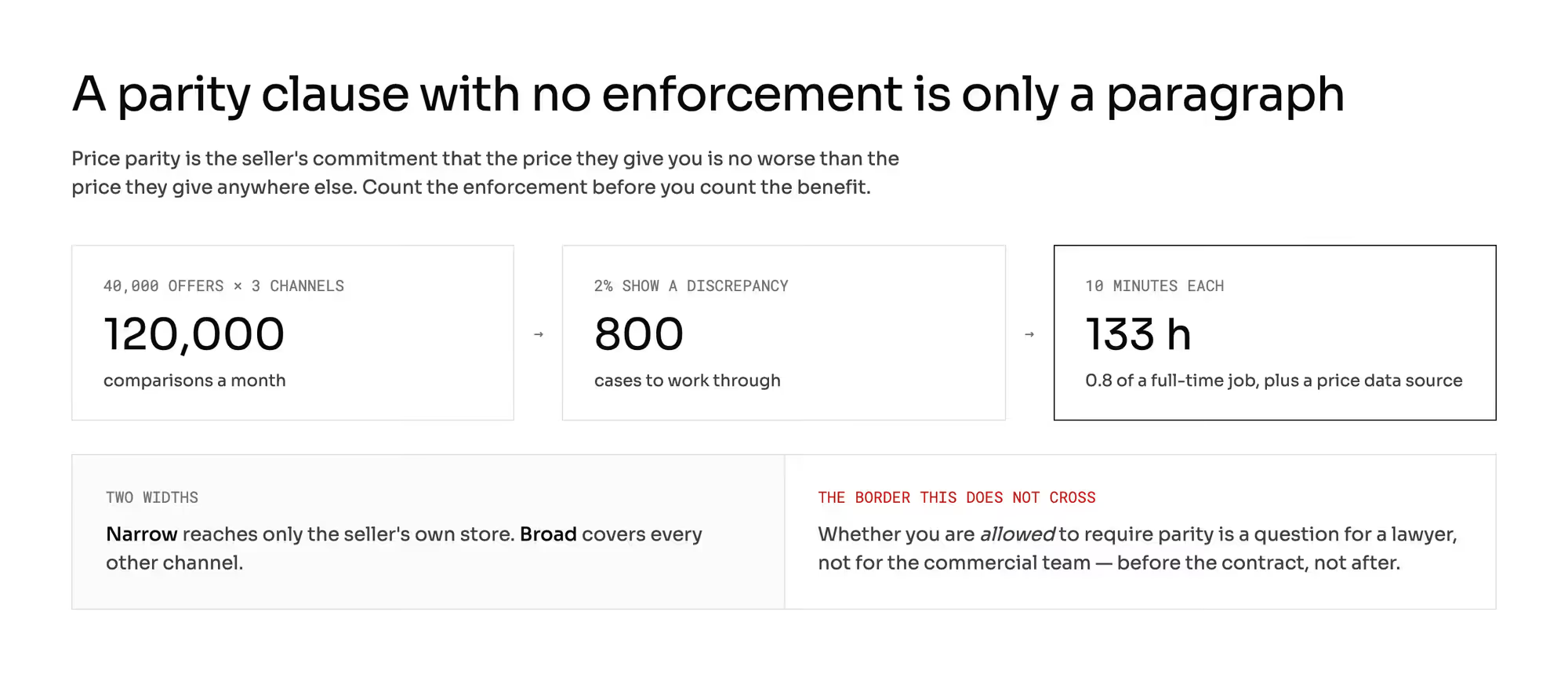
Price parity is a contractual commitment from the seller that the price they give you will not be worse than the price they give anywhere else. Commercial practice distinguishes two widths: a narrow one, which reaches only the seller's own store, and a broad one, which covers every other channel.
The temptation is the same in both variants: you fund the traffic, the service and the trust, and the buyer compares you with a channel that funds none of it.
Before you count the benefit, count the enforcement, because a clause with no enforcement is only a paragraph. 40,000 offers checked across three channels add up to 120,000 comparisons a month; with 2% of offers showing a discrepancy, that leaves 800 cases.
Each case takes 10 minutes of conversation, evidence, and decision, so you land on 133 hours a month, which is 0.8 of a full-time job, plus the cost of a price data source that the platform will not hand you. That is a real line in a budget rather than a sentence in a contract.
And here is the border this article does not cross. Whether you are allowed to require parity is a question for a lawyer rather than for the commercial team.
The answer depends on the market, on your position in it and on the width of the clause, and not on what you call it in your terms. The rules on decisions about sellers describe the procedure for changing terms.
The contract itself is set out in the chapter on the documents you sign with a seller.
Where does a minimum advertised price come from?
MAP (minimum advertised price) is the lowest price at which a brand allows its goods to be advertised. It is a separate phenomenon for one reason: it is set neither by your seller nor by you, but by a party you often have no contract with.
The pressure still lands on you, because it is your page that shows the number.
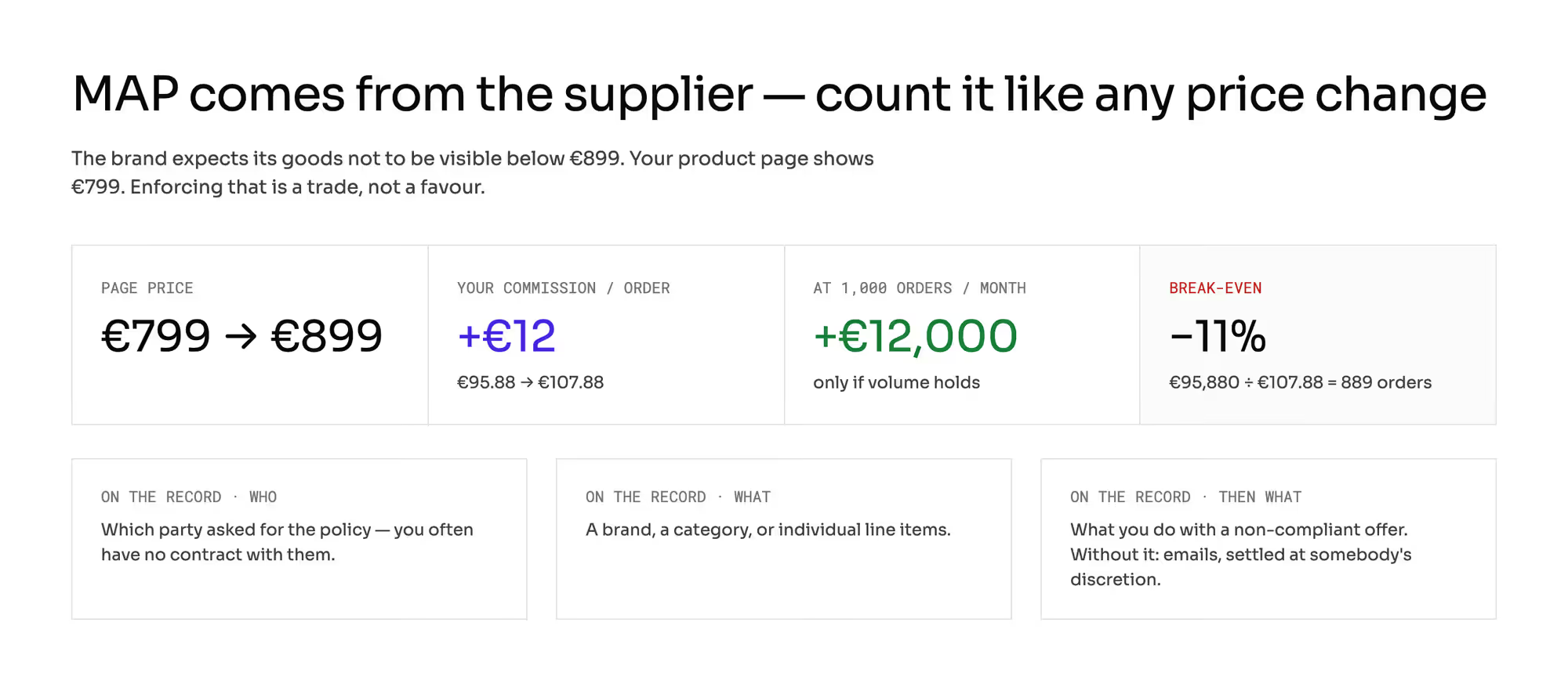
Count it the way you count any other price change. The brand expects its goods not to be visible below €899, and your product page shows €799.
Enforcing that lifts your commission from €95.88 to €107.88 (€12 per order), and the seller keeps €791.12 instead of €703.12. At a thousand orders a month, that is €12,000 more commission.
It holds only if the volume does not change. The break-even point falls at a drop of 11%: €95,880 ÷ €107.88 comes to 889 orders.
Operationally, you need three things on the record: who asked for it, what it covers (a brand, a category, individual line items), and what you do with an offer that does not comply. Without that, you get emails, and you settle them at somebody's discretion.
Practitioners add an observation that saves a quarter: exclusivity and brand policies are a sensitive subject on an open platform, and in some tools they are switched off by default and turned on only on request.
What does each pricing tool cost in operator hours?
Tool | What you set (unit) | Operator work (hours per month at 40,000 offers) | A non-compliant offer | Who feels the effect | A question for a lawyer |
|---|---|---|---|---|---|
No interference | nothing | 0 | none | the buyer (price dispersion) | no |
Monitoring and a match button | the step-down amount (EUR) | ~10 | none | the seller (margin down 14.7% on a 2% price cut) | no |
Min/max price range | the floor and the ceiling (EUR, per currency) | ~2 per threshold change | sometimes deleted for good | the catalog (1,200 offers at 3%) | no |
Approval of every price | nothing directly, everything indirectly | ~333 (2 full-time jobs) | waits, inactive | the buyer (empty product pages) | yes |
Contractual parity | the relation to other channels (%) | ~133 (0.8 of a full-time job) plus a data source | a commercial matter | the seller | yes, before the contract |
MAP from the supplier | a floor per brand (EUR) | depends on the number of brands | depends on your rule | the seller and your volume | yes |
What does price control change about the rest of your build?
1. Every pricing tool is a change of terms for your sellers
Price ranges, approval, and parity change what a seller can do with their own goods, so they go through the procedure for changing terms, with a date and a version.
2. The price a seller sets and the number a buyer sees are two different things
What you include in the displayed amount is settled by showing the price. Whether you may put a discount percentage next to it is settled by price history and discount messages.
3. Your revenue depends on price less than it looks, and that is the problem
At 12%, every €100 of price movement is €12 for you and €88 for the seller. The signal about a bad pricing policy comes from sellers leaving rather than from the income statement.
It will also come late.
How do you check price control with a vendor?
- Set a minimum price and show me what happens to the offers below the threshold. A block, a flag, or a deletion? If it is a deletion: is there a preview of the effect before saving, and a list of what disappeared?
- At what level does a price range work: the platform, the currency, the category, the seller, the offer?
- Does the seller panel have a button that matches the lowest price, and who sets the step-down amount?
- How many price changes per offer per day does the system accept, and where do I see the counter and the alarm threshold?
- Show me the price approval mode. What does the buyer see while a price waits for acceptance, and what happens to offers with no approved price on the day you switch that mode off?
- Where do I record a brand's pricing policy, and how do I enforce it? With a rule in the system, or by email?
Which mistakes do operators make about seller prices?
1. A price range entered as validation that behaves like an eraser
Somebody types a threshold into a settings screen to avoid a price of €0. The consequence: part of the catalog disappears without a trace, and sellers learn about it from a drop in sales.
2. The button for going below the lowest price, switched on without anyone counting the asymmetry
It looks like a feature for the seller. The consequence: your commission falls slightly, seller margins fall materially, and you blame the departures on the competition.
3. Parity written into the contract with no enforcement counted
The clause is there, the price data source is not, the procedure is not. The consequence: a dead provision that damages the relationship the first time anyone tries to use it.
4. A brand's pricing policy handled by email
Every case decided at somebody's discretion, and a different somebody each time. The consequence: you cannot answer why you told one seller to raise a price and did not tell another.
What do you still have to settle about your own pricing policy?
This article does not settle the admissibility of any of the tools described here. Price parity, a minimum price requirement and the enforcement of a supplier's pricing policy sit in an area where the answer depends on the market, on the position of the parties and on how the provision is drafted.
Ask a lawyer before you write it into a contract or into a system. The family of regulations worth naming, with no view on which part of it reaches you: competition law, in the sections on vertical agreements and on imposing resale prices.
Our claim is narrower and independent of what the lawyer answers: an operator who cannot name from memory the pricing tools switched on in their own platform has not given up influence over the price. They have handed it to the default settings.
Summary: How far can you control a seller's price?
Further than most operators realise, and usually by accident. You do not set the price, and four of your settings move it every day: the rule that picks the winner, the rate on the grid, every campaign, and the model you chose at the start.
None of them is called a pricing decision, and together they are your pricing policy. Above that sit the explicit tools, and each one has a price of its own.
The button that matches the lowest price costs you 2% of commission and the seller 14.7% of margin on the same move. A minimum price typed into a settings screen deletes offers in some systems rather than blocking them.
Parity is a clause until somebody buys the data and staffs the comparisons, and the expensive pricing mistakes are relational anyway: €4.20 for a pack of 24 passes every threshold you could set.
Ask a vendor to set a minimum price and show you what happens to the offers below it, on screen. Building a marketplace where every pricing tool has a counter and an alarm rather than a default?
Frequently asked questions on marketplace price control
Can a marketplace set prices for sellers?
A marketplace rarely sets prices and routinely shapes them through the winning-offer rule, the commission rate, campaigns, and price tools in the seller panel. Whether you may go further, with a required price or a parity clause, is a question for a lawyer rather than for the commercial team, because the answer turns on your position in the market.
What is price parity on a marketplace?
Price parity is a commitment from the seller that the price they give you will not be worse than the price they give elsewhere, in a narrow or a broad form. The clause is the cheap part.
Enforcing it on 40,000 offers across three channels is 800 cases a month and roughly 0.8 of a full-time role, plus a price data source nobody hands you.
What is a minimum advertised price?
A minimum advertised price is the lowest price at which a brand allows its goods to be advertised, set by a party you often have no contract with. The pressure still lands on you, because it is your page showing the number.
Record who asked for it, what it covers, and what happens to an offer that does not comply.
Ready to build?
We build marketplaces where every pricing tool has a counter and an alarm, so a price range never erases a catalog by surprise.