
B2B Buyer Journey on a Marketplace: Roles, Approvals, and Buying Organizations

The B2B buyer journey is the path a company follows from the first purchase request to the paid invoice. Most of that path happens inside your customer's systems, and your marketplace sees only a small part of it.
When someone buys on behalf of a company, the decision is made outside your store. The person who adds items to the cart usually isn't the one who approves the purchase.
If you don't plan for that, your store only serves the person placing the order. You never reach the person who approves it.
This article breaks down:
- Where does your funnel end in a B2B purchase?
- Which 5 roles does a company split one purchase into?
- Which 3 B2B buyer segments need different paths?
- What counts as the start of a new B2B customer?
Key insights
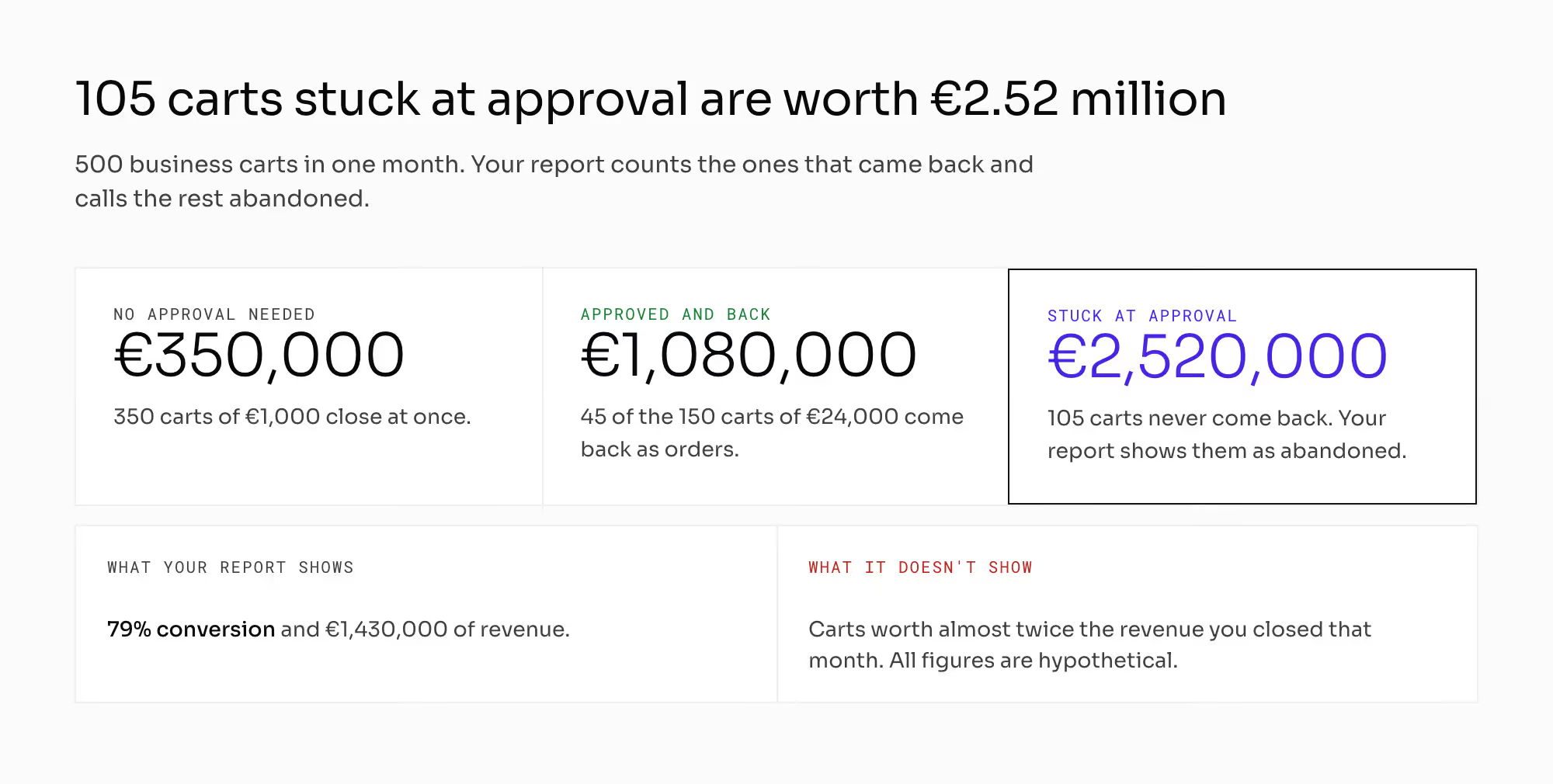
- Your funnel in a B2B purchase ends at your customer's approval step. Say you get 500 business carts in a month. The 105 that never come back from approval are worth €2.52 million. That's almost twice the revenue you closed that month.
- A company splits one purchase into 5 roles: the user, the orderer, the approver, the payer, and the negotiator. In a consumer purchase, one person holds all five. In a company, the person who decides usually has no account with you.
- The 3 B2B buyer segments that need different paths are buyers with no procedure, buyers with an approval step, and buyers with a contract. Out of 4,000 accounts, the 400 buyers on a contract bring in half the revenue. Your analytics can't see where their purchases end.
- The start of a new B2B customer is their first order. A registration only tells you that one person was curious. If 300 of 900 organizations place an order, activation is 33%. If you count per account instead, the same data gives you 7.5%.
Where does your funnel end in a B2B purchase?
You track conversion on your own site from the product page to the payment. In B2B sales, that measurement stops when the buyer has to ask a manager for approval.
After that, the purchase goes through your customer's internal approval process. You don't see that process, and your analytics don't record it.
Companies followed this process long before eCommerce existed. It starts with an internal requisition that a manager approves against a budget. After approval, the requisition becomes a purchase order to the supplier.
Then the company receives the goods and checks the invoice before it pays. Your cart is only one step in that chain. The decision happens at the approval step.
When a cart gets stuck at approval, your report shows it as an abandoned cart. Your system doesn't know the purchase stopped. It doesn't know why, either.
Often the requester never comes back. Or they order from their current supplier because it's easier.
This series uses a €1,000 cart and a 12% commission as its standard example. The seller keeps €880 of that cart.
Company orders are usually much bigger. In this example, the cart is 24 times larger.
A €24,000 cart at the same 12% earns you €2,880, and the seller keeps €21,120. Now take one month with 500 carts from business customers. 350 of them are small €1,000 purchases that close at once and bring in €350,000.
The other 150 are €24,000 carts that need approval. 45 of them come back as orders and add €1,080,000.
Your report shows 79% conversion and €1,430,000 of revenue. It doesn't show the 105 carts that never came back from approval.
Those carts are worth €2,520,000. That's almost twice the revenue you closed that month.
The figures are hypothetical. You can apply the proportion between them to your own business.
Which 5 roles does a company split one purchase into?
Researchers in industrial marketing have written about how companies buy since the late 1960s. Companies buy as a team. Textbooks call that team the buying center or the decision-making unit.
Consumer purchases have the same roles: the initiator, the influencer, the decider, the buyer, and the user. In a private purchase, one person usually plays all of them within a minute.
In B2B, each of those roles goes to a different person. That split comes from your customer's internal rules. A better checkout won't remove it.
Each of the five roles below can stop a purchase for a different reason.
Role on the buyer's side | Who usually holds it | Account with you | What stops the purchase | What they need from you |
|---|---|---|---|---|
Uses the goods | technician, warehouse worker, shift supervisor | sometimes | doesn't know the catalog name or the part number | search by application |
Orders | assistant, coordinator, office manager | yes: this is the person who clicks | can't approve their own cart | a cart they can save, name and pass on |
Approves | manager, budget owner | rarely | a value limit, a spent budget or a missing reason | a readable summary of line items, amounts and sellers |
Pays | accounting, the finance team | no | a document they can't match to the order | the customer's own order number on the document |
Negotiates terms | purchasing manager, procurement department | sometimes | a supplier outside the approved list | company details and terms in a form they can load into their own system |
Look at the third row. The person who approves the purchase usually has no account with you and never visits your site. Your product pages, reviews, and offer comparisons reach that person only through the requester. Most often they arrive as a screenshot or a printout.
Why does a B2B purchase take days instead of minutes?
A private buyer decides and pays within a minute on one device. A company spreads that over several days and several people.
The cart is created on Wednesday and approved on Monday. The order leaves the customer's system on Tuesday.
Your offer has to stay unchanged for that whole week. If the offer in the cart disappears or its price changes, your customer's procedure starts again from the beginning.
1. Cart validity
A consumer cart can expire after a few hours without anyone noticing. A company cart has to survive a weekend and somebody's vacation. So cart validity and offer validity become two separate settings.
2. Documents for each role
The requester only needs an order confirmation. Finance needs your document to quote the company's own order number. The chapter on marketplace invoicing covers what goes on that document.
3. Orders from several sellers
An order from several sellers gets checked line by line on the customer's side. Order splitting, the multi-vendor shopping cart, and multi-vendor checkout all get harder in B2B.
The document goes to somebody else's accounting department, and every line has to match there. Changing how a customer buys is a separate problem. The chapter on B2B buyers who order by email covers it.
Which 3 B2B buyer segments need different paths?
Segments by industry and company size don't change anything in your system. Segment business buyers by who controls the budget, who is allowed to place orders, and who has a framework agreement with you.
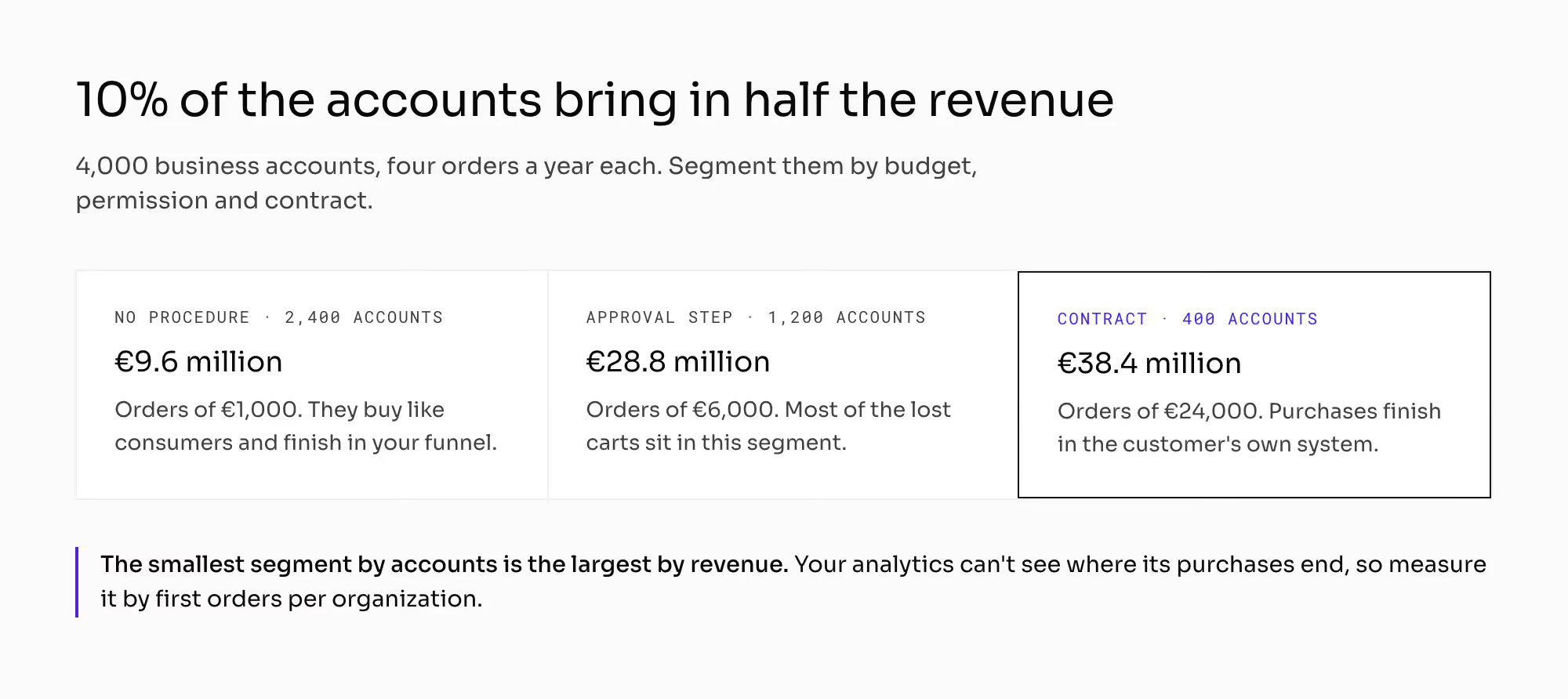
Revenue doesn't split the same way accounts do. Take 4,000 business accounts that order four times a year.
2,400 small buyers at €1,000 an order bring in €9.6 million. 1,200 buyers with an approval step at €6,000 bring in €28.8 million. 400 contract buyers at €24,000 bring in €38.4 million.
Ten percent of the accounts bring in half of the €76.8 million. Your analytics can't see where their purchases end.
1. Buyers with no procedure
A small company buys through its owner or one person with a card. These buyers act like consumers, and the whole purchase happens in your funnel. You measure them the standard way.
2. Buyers with an approval step
Here the budget belongs to a department, and the requester and the manager are two different people. In this segment, the cart leaves your system. Most of the lost revenue goes here too.
3. Buyers with a contract
These orders come out of the customer's own system on terms agreed earlier. Your product page sometimes plays no part in the purchase at all.
These buyers need three things, and each one has its own chapter: a punchout catalog, B2B payment terms, and contract prices.
Why does the buying organization need its own record in your system?
Before the build, make the buying organization a separate object in your system.
It needs its own identifier, its registration and tax numbers, an address, and a list of the people attached to it. Every order has to point to it.
Mature platforms treat the organization as a first-class entity. You can filter customers, orders, tickets and messages by it. In strict mode, the platform won't create an order without an organization on it.
Even so, vendors often turn it on only when you ask. Ask the vendor about it even when the product looks mature.
Without that object, the company details end up in spare fields on the order. The company name and the tax number sit inside the address. That's enough to issue an invoice, and it doesn't help with anything else.
If you type a company into an address field, it's only a line of text. Your system can't treat it as a customer.
Two spellings of the same name become two customers in your reports. If fifty people from one company place orders, you get fifty accounts with no link between them.
You can't count what that company bought from you, and you can't set a shared limit for it. Your account manager can't answer the most basic question they get each quarter. A typo raises no error, so you find out at the first review with the customer.
The chapter on marketplace GDPR covers which data about these people you store and how much of it the seller sees.
What counts as the start of a new B2B customer?
A registration tells you that one person was curious. An order shows that the whole company got through its procedure. That includes the steps you can't see.
Only the first order proves that the organization can buy from you.
The unit you count in matters more than it looks. Say 4,000 accounts belong to 900 organizations. That's 4.4 accounts per company.
If 300 organizations have placed a first order, activation is 33% per organization. Per account, the same data gives 7.5%.
Your board would read the same customers two different ways. Count activation per organization.
In the first year, track the share of organizations with at least one order. Also track how long each segment takes from account creation to the first order.
The second metric measures the length of your customer's process. It shows that the problem starts after your funnel ends. Your product page has little to do with it.
The chapter on marketplace metrics shows how to tie both numbers to the success criteria and phase gates of the whole project.
What does the B2B buyer journey change in your marketplace?
The B2B buyer journey changes your build in four places. All four are cheaper to settle before launch than after it.
1. Owner for demand
Supply usually has its own team. Demand often lands with marketing, and they look at it when they have time. No one has the first order as their target.
The chapter on channel conflict covers your own sales team. The chapter on announcing a marketplace launch covers how you tell buyers about third-party offers.
2. Data model
Organizations, roles, and permissions belong in the schema. You can't handle them with a setting. Adding them a year later means migrating accounts and order history.
3. Scope of the first release
Half your revenue may come from customers who order out of their own systems. In that case, the procurement integration, payment terms and contract prices belong in the first release.
4. Seller disclosure
A business buyer also has to know who they're buying from. The chapter on marketplace seller identity covers how to show the seller. The chapter on marketplace consumer rights covers the information you owe before the purchase.
How do you measure the B2B buyer journey on your own numbers?
You can check most of this on data you already have:
- Compare the share of business accounts in your customer base with their share of your revenue. If the gap is large, your metrics cover only a small share of your revenue.
- Call ten customers and ask who clicks, who approves, and how long it takes. Ten calls are enough to see how their buying works.
- Measure the time from account creation to the first order in each of the three segments.
- Ask your system how much one company has bought from you. See if it can answer without a spreadsheet. If it can't, your system stores the organization as a plain line of text.
- Count the business carts above a set amount that never became an order. Compare what they're worth with that month's revenue.
Ask your platform vendor three questions:
- Is the buying organization a separate object?
- Can one account belong to several organizations?
- Can you block every order that has no organization on it?
Which mistakes do operators make with B2B buyers?
Each of these mistakes can look fine in the report for months.
1. One conversion rate for all buyers
Consumers push the average up. The approval segment gets lost in it. The report looks fine for four quarters.
2. Registration as the start
Accounts grow while revenue stays flat, and no one can explain why. You're counting the base in one unit and the result in another.
3. One account per organization
It's easy to set up, but it's a pain to use day to day. The password travels by email, and no one knows who placed an order. When one person leaves, the whole company loses access.
4. Designing only for the requester
The approver gets a screenshot instead of a summary. So the approver decides based on the weakest document in the whole process.
5. Treating the role split as a UX problem
The split comes from your customer's internal rules. Adding a button won't change those rules. Your design team can lose a quarter trying.
6. Copying the sales team's segmentation
Sales splits customers by industry and by account manager. Your system needs a split by budget, permission and contract.
You end up with two ways of splitting the same customers. Then people argue about which one goes into the report.
What do you still have to settle about your B2B buyers?
This article gives no benchmarks. Every number above is hypothetical. You can reuse the arithmetic with your own numbers.
Work out the segment split on your own customer base. It differs from one industry to the next.
This article isn't legal advice. Before you design company accounts, ask a lawyer about three areas:
- Personal data protection: who controls the data of the people attached to an organization, and how much of it the seller sees.
- Consumer law: when a buyer acting for a business still counts as a consumer. The answer sets your obligations. Your interface design can't change it.
- Sales documents: the chapter on marketplace e-invoicing covers the rules for a marketplace.
We don't set any thresholds here.
Summary: How does the B2B buyer journey work on a marketplace?
A company buys through a procedure that starts and ends outside your store. The person who builds the cart passes it to a manager for approval.
The order comes back days later. Sometimes it doesn't come back at all.
In your report, every cart that stalls at approval looks like an abandoned cart.
Make the buying organization an object in your data model before the build. Segment buyers by budget, permission, and contract. Count activation per organization and start at the first order.
Ask a vendor to show you an order the system refuses because it has no organization on it. Building a marketplace for buyers who order through an approval process?
Frequently asked questions on the B2B buyer journey
What are the stages of the B2B buyer journey?
The B2B buyer journey stages are the internal requisition, approval, purchase order, goods receipt, invoice matching, and payment. Your marketplace sees the cart and the order. The approval steps happen inside your customer's systems. Measure the journey from the first order.
What is a buying center in B2B?
A buying center is the group of people inside a company who take part in one purchase. It usually includes the user, the orderer, the approver, the payer, and the negotiator. In a consumer purchase, one person holds all of these roles.
How is the B2B customer journey different from B2C?
A B2C customer decides and pays in one session. In the B2B customer journey, one purchase takes several days and involves several people. The company's approval process sits in the middle of the journey. Your offer and your price have to stay valid until the order comes back.
Ready to build?
We build marketplaces where the buying organization is an object with its own people, roles and order history.