
Marketplace Seller Identity: How to Show the Buyer Who They Buy From

Seller identity disclosure on a marketplace is what you tell the buyer about who is selling to them. A buyer who does not know who they bought from will find that out at the worst possible moment: when something has already gone wrong, from your support team, in the form of an excuse.
This article breaks down:
- Which disclosure surfaces change a decision?
- What does the parcel tell the buyer anyway?
- Which 3 levels of disclosure can you choose?
- Why are "sold by" and "shipped by" two fields?
Key insights
- The disclosure surfaces that change a decision are the product page and checkout, because the confirmation email and the parcel reach the buyer after the money has moved.
- The parcel tells the buyer who sold it through the sender on the label, the sales document inside, the box itself, and any insert, so either standardise the shipment or disclose early enough that the box is no surprise.
- The three levels of disclosure are the seller's name alone, the name plus what helps the buyer choose, such as rating and shipping country, and full identity with legal form, address, and registration number.
- "Sold by" and "shipped by" are two fields because your own warehouse can ship somebody else's sale, and the buyer reads one parcel as one company.
When does telling the buyer who sells still matter?
Nobody reads who the seller is. The buyer reads the price, the delivery date, and the photo.
They process the seller's name only when something fails to work out: the parcel did not arrive, the goods are different, an invoice is needed.
The problem is that the same information given at two different moments means two different things. "Sold by X" on the product page is a heads-up.
The buyer knows what they are agreeing to and decides with that knowledge in hand. The same sentence during a complaint is a handoff of responsibility.
"It was not us, it was the seller" reads that way even when it is true, and it usually is.
So the question is not "where do we put the seller's name?" It is this: at which point on the path is that information still useful, and from which point on is it an alibi. The line runs where the buyer's decision closes, which means at checkout.
Everything before it buys you informed consent. Everything after it buys you credibility at best, and done badly it loses credibility instead.
Which disclosure surfaces change a decision?
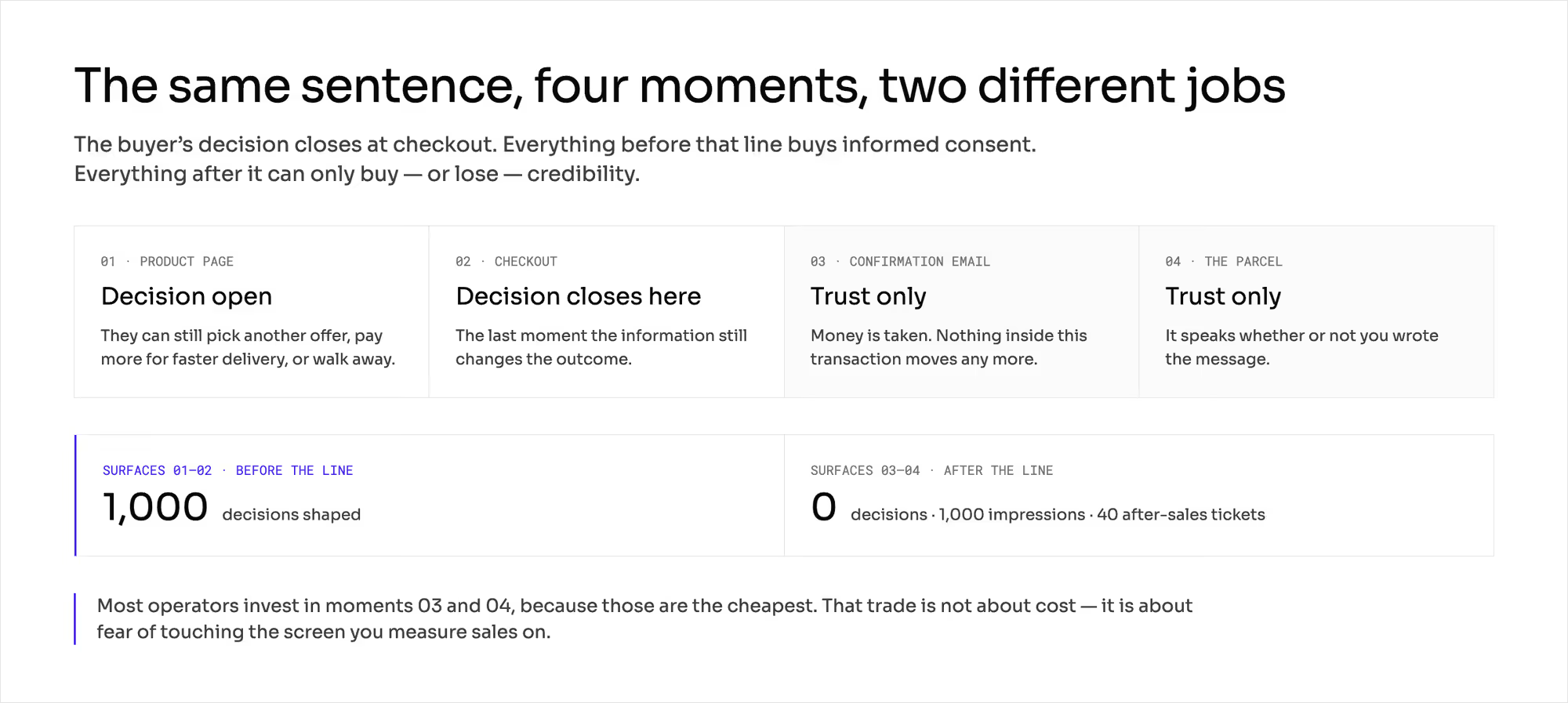
Disclosure has four places, and it pays to keep them apart, because budgets mix them up.
1. The product page and checkout affect the decision
The buyer can still pick a different offer, pay more for faster delivery from another seller, or walk away. The information has value there because it changes the outcome.
2. The confirmation email and the parcel affect trust only
The decision is made, and the money is taken. The seller's name no longer changes anything inside that transaction.
It changes what the buyer says about you after it.
Assume 1,000 orders a month and 40 after-sales tickets. All four surfaces reach the same 1,000 people and differ in one thing: whether the decision is still open.
The message in the first two places shapes 1,000 decisions. The same message in the last two shapes 0 decisions and 1,000 impressions.
In those 40 conversations, it is by then nothing more than an answer to the question, "why did you not tell me this?"
Most operators invest in the third and fourth moment, because those are the cheapest. Changing an email template is a day of work and carries no risk to conversion.
Adding the seller's name to the product page and to checkout means changing the screen you measure sales on. So it goes to the back of the queue and never comes back.
That trade is not about cost, it is about fear: you are saving money on the one place where this information does the work.
What does the parcel tell the buyer about the seller?
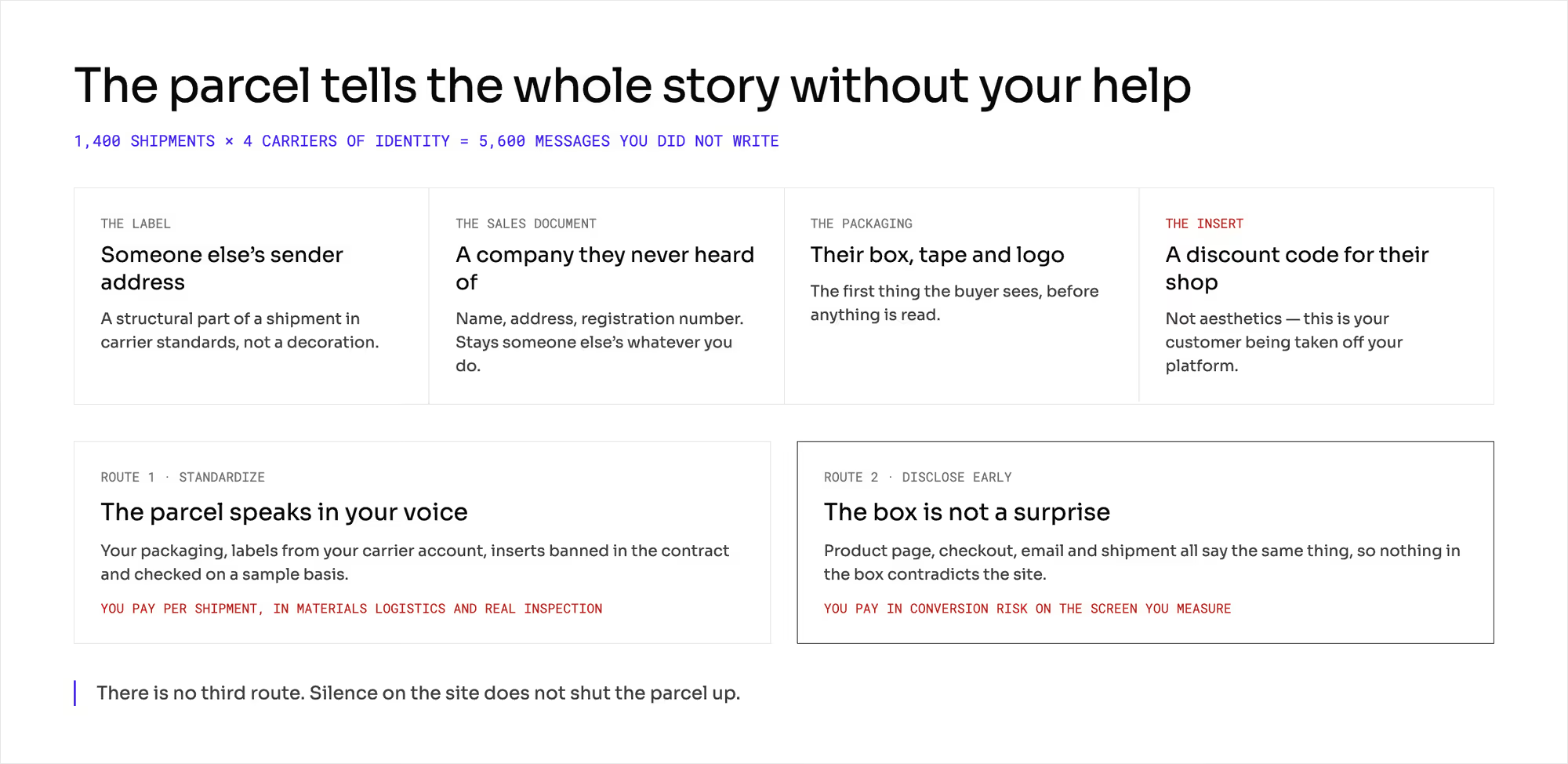
The buyer opens the box, and the shipment tells them the whole story without any help from you.
Four things give the seller away, whatever you wrote on the site.
The sender on the label: a dispatch address is a structural part of a shipment, with a defined place and requirements of its own in carrier standards.
The sales document inside: the name, address, and registration number of a company the buyer has never heard of. The packaging: someone else's box, someone else's tape, someone else's logo.
And the promotional insert with a discount code for someone else's shop.
Count it at scale. At 1,000 orders and an average of 1.4 shipments per order (a cart with two sellers means two parcels), you get 1,400 shipments a month and four carriers of identity inside each one, which is 5,600 messages that nobody on your side wrote.
You have two honest routes. You can standardize: your packaging, labels from your own carrier account, a ban on inserts written into the contract and checked on a sample basis.
The parcel then speaks in your voice, but you pay for it per shipment, in the logistics of getting materials out to sellers, and in a real inspection process. The sales document stays someone else's anyway.
Or you can disclose early and consistently: the product page, checkout, the email, and the shipment all say the same thing, so the box is not a surprise. There is no third route, because silence on the site does not shut the parcel up.
The insert deserves a sentence of its own, because this is not a matter of aesthetics. It is taking your customer off your platform.
Practitioners describe it as continuous enforcement work rather than a clause in the terms. Sellers add their own links wherever they can, and detection is reactive: some solutions do not even let you filter the content going out to the buyer.
Inside a parcel, nobody lets you.
Which 3 levels of seller disclosure can you choose?
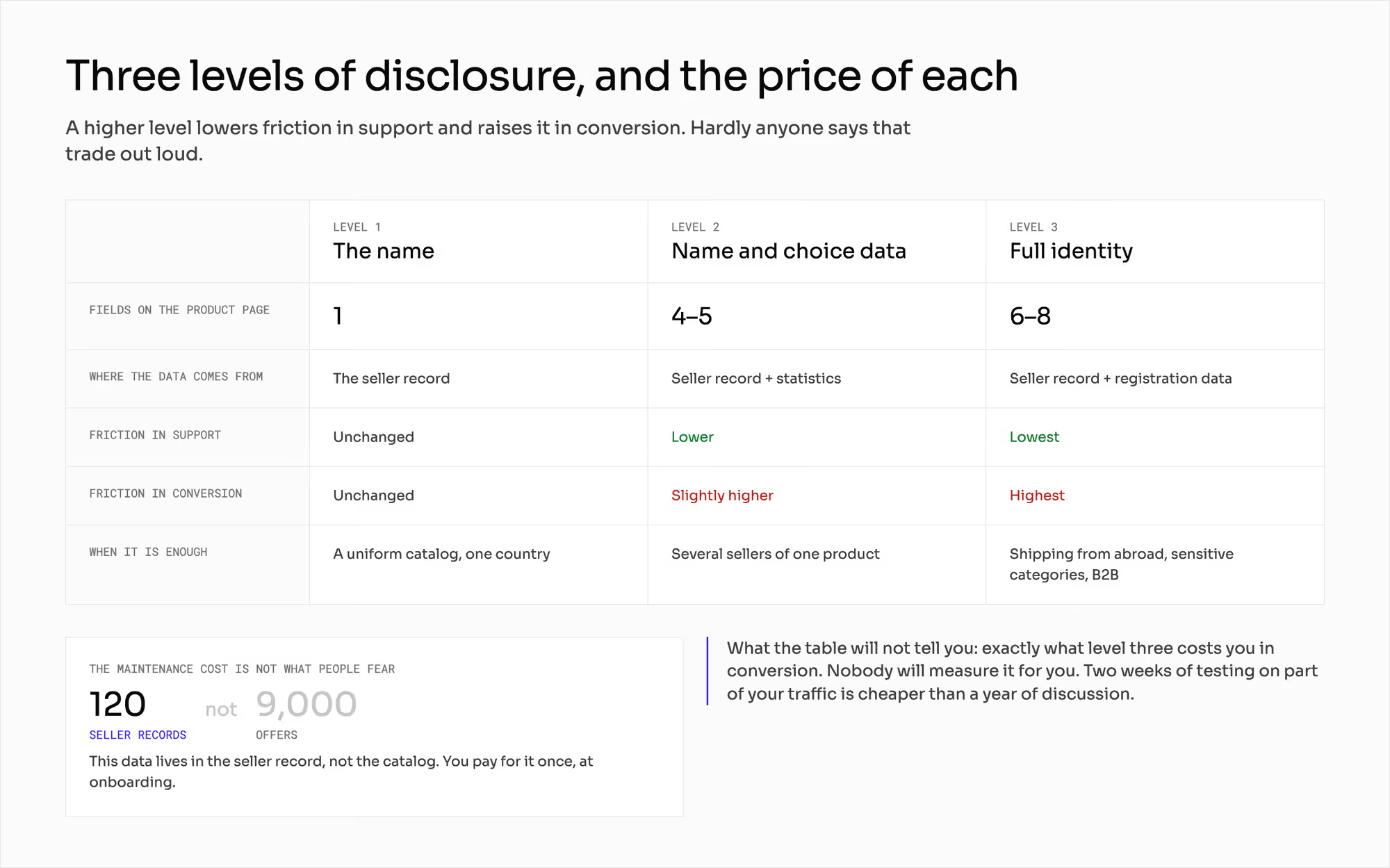
Level one is the name alone.
Level two is the name plus the data that helps the buyer choose: the rating, shipping time, shipping country, and the number of orders handled.
Level three is full identity: legal form, address, registration number, contact details.
The trade is simple and hardly anyone says it out loud: a higher level lowers friction in support and raises it in conversion. A buyer who saw the shipping country and the company name before buying does not call about them later.
A buyer who sees six extra lines of small print gets a reason to hesitate that they did not have before. With three offers on the product page they are choosing between two or three proposals anyway and not between twenty, so every line that stops them is competing with the rest of the page.
The good news sits on the maintenance side: this data does not live in the catalog, it lives in the seller record. With 9,000 offers and 120 sellers, the six fields of level three come from 120 records and not from 9,000.
You pay for them once, at onboarding.
What the table will not tell you: exactly what level three costs you in conversion. We do not know, and nobody will measure it for you, because it depends on your category and your traffic.
It is one of those changes you can settle with a test on part of your traffic in two weeks. That is cheaper than a year of discussion.
Why are "sold by" and "shipped by" two different fields?
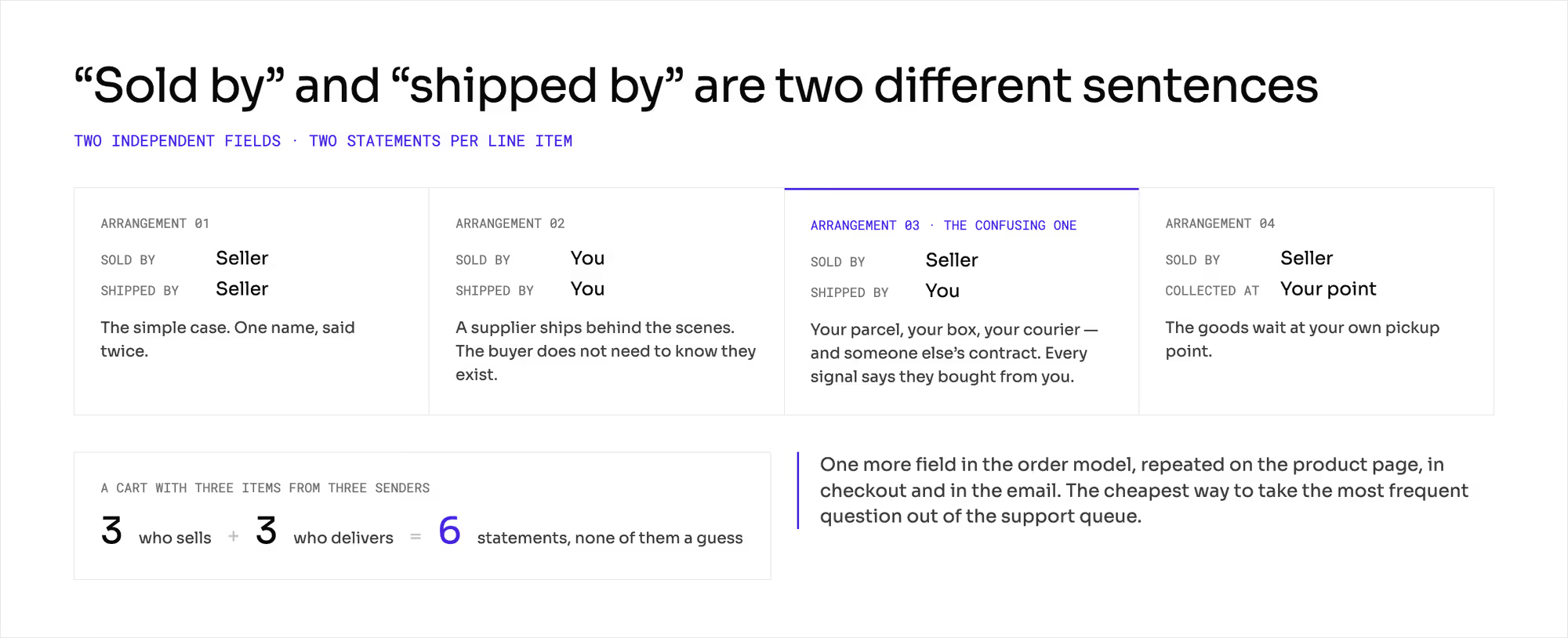
Buyers confuse these two roles systematically, and it is not their fault. In an ordinary shop, it is always one entity.
On your platform, the roles come apart in four arrangements: the seller sells and ships; you sell and a supplier ships, and the buyer does not need to know that the supplier exists; the seller sells, and you ship from your own warehouse; or the goods wait for collection at your own pickup point.
The third arrangement is the most confusing and the one most often left unsaid. Your parcel, your box, your courier.
The contract belongs to someone else. The buyer has every signal that they bought from you, and one line of text saying they did not.
The pattern that solves this is not expensive: two separate fields and two separate sentences on the product page, in checkout, and in the email. A cart with three items from three senders then produces six statements: three about who sells and three about who delivers.
None of them has to be a guess. That is one more field in the order model and the cheapest way to take the most frequent question out of the support queue.
Delivery dates and how they add up in the cart are a separate subject. That is "Delivery Dates on a Marketplace: What You Can Promise".
What does labelling only third-party offers tell the buyer?
If you label seller offers and leave your own unlabeled, the buyer will not read that as a legal distinction. They will read it as a split into safe and unsafe.
They will be right about your storefront, even if they are wrong about your intentions.
On a page with three offers, one of them yours, a "third-party seller" badge on the other two hands the third one a free quality signal. If you add default exposure on top of that, it stops being free in the other direction.
Treating your own offers differently from seller offers is a separate obligation with a separate audience.
The call is binary: you label both, or you label neither. The "neither" option barely exists in practice, because the buyer has to know before the purchase who they are entering into a contract with ("Marketplace Consumer Rights: Who Delivers Them?").
That leaves one sensible answer: every offer carries the same seller field, and your own offer fills it with your own name.
And here is the warning that carries the most weight in this article. Silence is not neutral: it is a promise of equal treatment that your own rules do not keep.
In the implementations we know, the rules for third-party offers and for your own really do differ: a different return window, a different return address, discount codes valid on part of the assortment only. If the storefront says nothing about the difference, the buyer discovers it at the return.
What they are dealing with at that point is not a different offer. It is the feeling that they were misled.
Whose voice should a marketplace's transactional email speak in?
After-sales communication is three decisions that the template usually makes for you: whose domain, whose signature, and where a reply goes.
At 1,000 orders and 1,400 shipments, you send at least 2,400 transactional messages a month. If all of them go out from your domain, say "your order" and carry your team's signature, then 1,400 of them concern goods you did not ship.
Masking the contact channel has a side effect here that is worth counting in advance: the buyer has no way to write to the seller except through you, so every thread becomes your ticket, even when there is nothing in it for you to do. Masking as a personal data regime is about who controls the personal data. What counts here is that it translates directly into support headcount.
What does seller disclosure change about the rest of your storefront?
1. The seller's name has to be data
If the storefront pulls it in from a separate request, then it is missing from the email, from the mobile app, and from external channels. In the standards for describing offers, "who sells" is a separate, named field attached to every offer rather than a property of the page.
1. This message depends on the catalog model and on how the offer is picked
Without a shared product page, there is nothing to label side by side, and the rule that picks the winning offer settles who gets the default exposure. The cart and checkout have chapters of their own: a cart with several sellers and checkout with several sellers. Offer visibility in search is search and filtering.
2. Legal effect cannot be worked around with a message
Disclosure is interface design; losing the intermediary exemption is a consequence of how you behave. That is "Marketplace Liability: Are You an Intermediary or a Seller?".
3. Seller ratings change the economics of level two
Without ratings, level two is empty and disclosure hands the buyer a name that means nothing. That is why the chapter on reviews reads together with this one.
How do you check seller disclosure with a vendor?
Put the first four questions to the vendor on screen. Put the last two to your own team.
- Where does the storefront get the seller's name from? Show us the system's response to a request for an offer and point to the field inside it. If it takes a separate request, every channel will do it its own way.
- Which seller data is in that response? Name, rating, shipping country, address, legal form. Ask for a list.
- Are "sold by" and "shipped by" two independent fields? Show us an order where the two hold different values.
- Show us the emails for a cart with two sellers. How many messages, who the sender is, whose signature they carry, and where a reply goes.
- Do your own offers fill the same seller field? If they do not, your storefront already splits the assortment into two classes.
- Who decides what goes into the parcel? Does the contract ban inserts, who checks that, and what happens after a second breach?
Which mistakes do operators make about seller identity?
1. The seller's name painted into the storefront template
It looks exactly like the correct solution. The first new channel is where the difference shows. Consequence: the app, the emails, and external channels say nothing about the seller, and nobody notices, because the line of text is right there on the site.
2. Disclosure moved into the terms and conditions
Formally, the information exists. In decision terms, it does not. Consequence: the buyer finds out when something goes wrong and hears an alibi instead of an explanation.
3. The parcel sent out with no disclosure decision
Consequence: 1,400 shipments a month carry a message you did not write, and the complaints come to you.
4. Labeling only the third-party offers
Consequence: your storefront itself tells the buyer that part of the assortment is less safe. It cuts sales for the sellers you have just recruited.
5. Masking the contact channel without counting the support queue
Consequence: support gets threads where there is nothing to do but copy and paste, and response times rise across the whole queue.
What do you still have to settle about disclosure?
This chapter does not settle the legal effects. Three questions sit next to this one, and none of them is a question about the design of a message:
- What has to be given before the purchase, and in what form?
- What makes you lose intermediary status, and what does an audit of your own storefront look like?
- Masking contact details as a regime, which is who controls the personal data.
It does not settle the execution either. Where to put the badge, in what typeface and at what contrast, is work for an interface designer and for the people responsible for accessibility, and how to expose this data externally without hurting visibility is work for search specialists and for SEO on pages with many offers. Your decision is narrower and earlier: what you promise, who chooses, what you show, and what you deliberately will not build.
The most important number is the one no documentation has: what disclosure costs you in conversion. It is a measurement on your own traffic. What practitioners do observe is a drop in buyer satisfaction when third-party sales go live, and that drop comes from the experience. Hiding the label does not stop it. It only moves the moment when you find out about it.
Summary: When does seller disclosure do its work?
Before the buyer's decision closes, which means on the product page and in checkout. Everything after that buys credibility at best and reads as a handoff of blame at worst.
The parcel is the part teams forget: a box with somebody else's tape, a document with an unfamiliar company on it, and an insert with a discount code for another shop all say who sold it, whatever the site said. That leaves two honest routes, and both cost money: standardise the shipment so it speaks in your voice, or disclose early and consistently so the box is no surprise.
Open your own product page and count how many clicks it takes a buyer to learn who is selling. Building a marketplace where the seller's name is a field in the offer rather than a flourish in the template?
Frequently asked questions on marketplace seller identity
Where should a marketplace show who the seller is?
A marketplace should show who the seller is on the product page and in checkout, because those are the only places where the buyer can still act on it. The confirmation email and the parcel reach the same people and do not change decisions. Most teams invest in the last two because they are the cheapest to change.
What is the difference between "sold by" and "shipped by"?
The difference is that "sold by" names the party to the contract and "shipped by" names whoever puts the parcel in the post. They come apart in four arrangements, and the confusing one is your warehouse shipping somebody else's sale. Keep them as two fields and two sentences, on the page, in checkout, and in the email.
Should a marketplace label third-party offers?
A marketplace should label all of its offers or none of them. A badge on seller offers with nothing on your own reads as a split into safe and unsafe rather than a legal distinction, and it hands your own offers a quality signal you never argued for.
Ready to build?
If you want to walk your own purchase path and check at which moment it tells the buyer who they are buying from, let's talk.