
Marketplace Warranties, Repairs, and Spare Parts: Who Carries the Obligation

A marketplace warranty policy settles who takes a broken unit in, who pays for its journey, and how long you owe spare parts for it, and the one thing that separates it from a return is that the same individual unit has to come back.
A repair is the only event after the sale in which the goods disappear from both sides at once. Neither the buyer nor the seller has them, and it goes on for weeks.
If there is no place for that state in your data, the unit drops out of your records for a quarter, and the answer to "where is my equipment" becomes "we will ask the seller."
This article breaks down:
- Why does a repair need its own object?
- Which 4 paths can a repair take?
- What do spare parts do to your catalog?
- When is replacing cheaper than repairing?
Key insights
- A repair needs an object of its own because an order has terminal states and a repair has none: it carries a serial number, its own life cycle, and its own clock, and 280 units in circulation at €900 each is €252,000 of goods sitting in nobody's records.
- The four paths a repair can take are the seller, the manufacturer's network, you as the intake point, and a visit to the customer, and they differ by two shipments: €60 a case through the seller against €120 through you, which is €172,800 a year at 8 cases a day.
- Spare parts turn into catalog debt the day a model stops selling: 400 models at 12 service parts each is 4,800 items, 90% of which never turn over, and every one of them needs a compatibility relation that a product page does not normally have.
- Replacing is cheaper than repairing above the point where the repair bill approaches the device: €330 of diagnosis, labor, part, and two shipments is 82.5% of a €400 device and 27.5% of a €1,200 one, so the threshold follows the price rather than the fault.
Why does a repair need an object of its own?
An order describes a one-way journey of the goods and has terminal states (who is the source of truth for a status). A repair has neither.
The unit travels to a service center, waits for a diagnosis, then for a part, comes back, and sometimes goes out a second time.
The market tries to fit this into a ticket pinned to an order line. It does not fit there.
In products of this class, opening a ticket on a line freezes that line's status, while the other lines run on as usual. Freezing is sensible for settlement and useless for the repair, because a repair has a progression of its own: received, diagnosed, waiting for a part, repaired, sent back, cannot be repaired.
The state "frozen" answers none of the questions the buyer will ask.
That is why a repair needs an object of its own, loosely anchored to the order: its own case number, its own life cycle, its own clock, its own owner. The order is its context rather than its container.
One more difference settles the data model. On a return, any unit of the same item comes back; on a repair, it has to be exactly the same one.
A service case therefore needs an identifier for the individual unit, the serial number, and an order does not usually record it.
Why is a repair queue inventory rather than tickets?
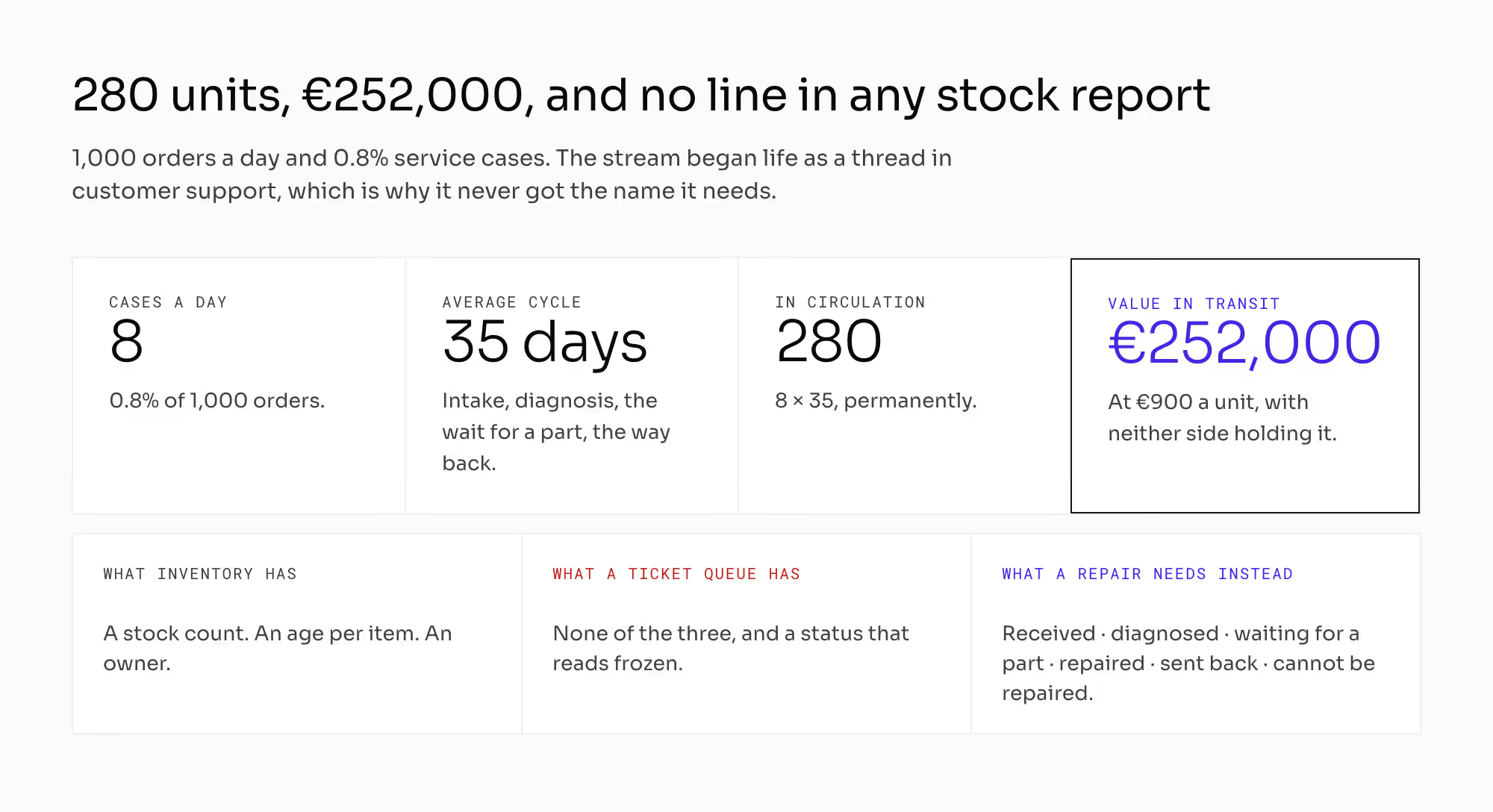
Assume 1,000 orders a day and 0.8% service cases: that is 8 cases a day. At an average cycle of 35 days, 280 units are permanently in circulation (8 × 35).
At an average value of €900, that is €252,000 of goods that, in your data, sit neither with the buyer nor with the seller.
This is inventory. The stream simply never got that name.
Inventory has stock counts, an age per item, and an owner. Service cases have none of those three, because they began life as a thread in customer support.
Which 4 paths can a repair take?
Choosing the path is choosing who pays for shipping in both directions and who carries the goods in transit.
1. The seller
The goods go back where they came from: to the seller rather than to your warehouse.
It is the shortest route and the cheapest, and also the state in which you know about the case exactly as much as the seller tells you. Practitioners from large rollouts name it as the first thing that surprises an organization used to its own warehouse.
2. The manufacturer's service network
The buyer ships the unit directly, going around both the seller and you.
That takes the cost away but moves the event off the platform: the order simply says nothing for a month.
3. You as the intake point
Best for the buyer and the most expensive: there are four shipments instead of two, and in between you hold someone else's goods that you never sold.
Settle who carries the item in transit and who insures it in your contract with sellers (the documents you sign with a seller; what to watch for when you take the handling on yourself is a question about your role toward the goods).
4. Repair at the customer's place
There are no shipments at all, only a technician traveling out.
The cost changes character from freight to labor.
Run it on one assumption: €30 per shipment. The path through the seller costs €60 per case; the path through you costs €120.
At 8 cases a day, the difference is €480 a day, which is €14,400 a month and €172,800 a year for the convenience of a single intake point.
What does each repair path cost? | The seller | The manufacturer's network | You as the intake point | Repair at the customer's place |
|---|---|---|---|---|
Shipments per case (count) | 2 | 2 | 4 | 0 |
Transport cost per case (€, at €30 per shipment) | 60 | 60 | 120 | a call-out instead of a shipment |
Cycle used in the calculation (days) | 18 | 32 | 36 | 7 |
Who carries the goods in transit | the seller and the carrier | the buyer or the manufacturer | you, on the leg that runs through you | nobody, the goods do not travel |
What you have in your own data | as much as the seller reports | usually nothing | a full trail | a record of the visit, if you collect it |
Main risk | the case stays invisible until it escalates | the event happens off the platform | cost and liability for someone else's goods | a second and a third visit |
Which 2 claim paths does a buyer have?
The buyer usually has more than one route, and the buyer picks it. For you, these are two processes that look like one button only on the storefront.
1. The seller as the party to the transaction
The intake point is the seller, the payer is the seller, and the time depends on whether they run their own service operation or send the unit on.
2. The commercial warranty
It is a voluntary, extra commitment from whoever issued it, most often the manufacturer or the importer.
The intake point is then their network, the payer is them, and the conditions are sometimes tied to the repair being done by a named service partner. What the buyer can demand independently of that warranty, and for how long, is explained in the chapter on who delivers the buyer's rights and a conversation with your lawyer. All that counts here is that these are two queues, with a different payer and a different clock.
The product consequence is the one people miss: data about a commercial warranty belongs to the offer rather than to the product page. The same model sold by three sellers can carry three different commitments.
A different issuer, a different network, a different scope. If you hold it as an attribute of the shared page, two sellers out of three display a promise they never made (ownership of the data is covered in the chapter on field ownership).
What do spare parts do to your catalog?
A model stays on sale for something over a year. Availability of parts for it runs many times longer.
For some categories, the rules require it; which ones and for how long is a question for a lawyer. Outside those, this is a commercial commitment: it holds for as long as you promised, and only because you promised it.
Three things it does to your catalog:
Every part is a separate commercial item with its own identifier. A part is not a variant of the device.
At 400 models and 12 service parts per model, that is 4,800 items, most of which sell less often than once a year. If 90% never turn over, you are carrying 4,320 product pages that go through approval, take up room in search, and feed catalog debt (the approval queue, catalog debt, and retiring what does not sell).
A part is described by a relation that a product page usually does not have: "fits." Without a list of compatible models, the buyer orders the wrong thing, and you get a return (offer matching and the category tree).
A missing part turns a repair into a replacement or into cannibalization. The missing element gets taken off another device.
For you, that means one thing: waiting for a part is a separate state of the case rather than an extension of the repair, because it is the only state in which the service operation is doing nothing and it is not their fault.
Which 7 fields does a service case need?
The minimum, without which you cannot answer a single question: the case number, the identifier of the individual unit, where the item physically is, who is holding it right now, the intake date, the expected return date, and the decision with its reasoning. Seven fields.
The sentence to say to the board plainly: in the repair window, the buyer has neither the goods nor the money. A refund gives the money back, a replacement gives the item back, and a repair gives nothing back for weeks on end.
It is the only state after the sale in which you hold both at once. That is why the only currency you have in that window is a status message.
A case with no visible progress does not age in a straight line. It breaks on the day the promised date passes, and nobody gets in touch.
There is also a trap straight out of closing an order: if closing an order shuts down the contact channel, a case that runs longer than the closing window leaves you with no way to answer the buyer. Repair is the strongest argument for separating the date settlement becomes final from the date a case is closed, because it regularly outlasts any reasonable window.
When is replacing cheaper than repairing?
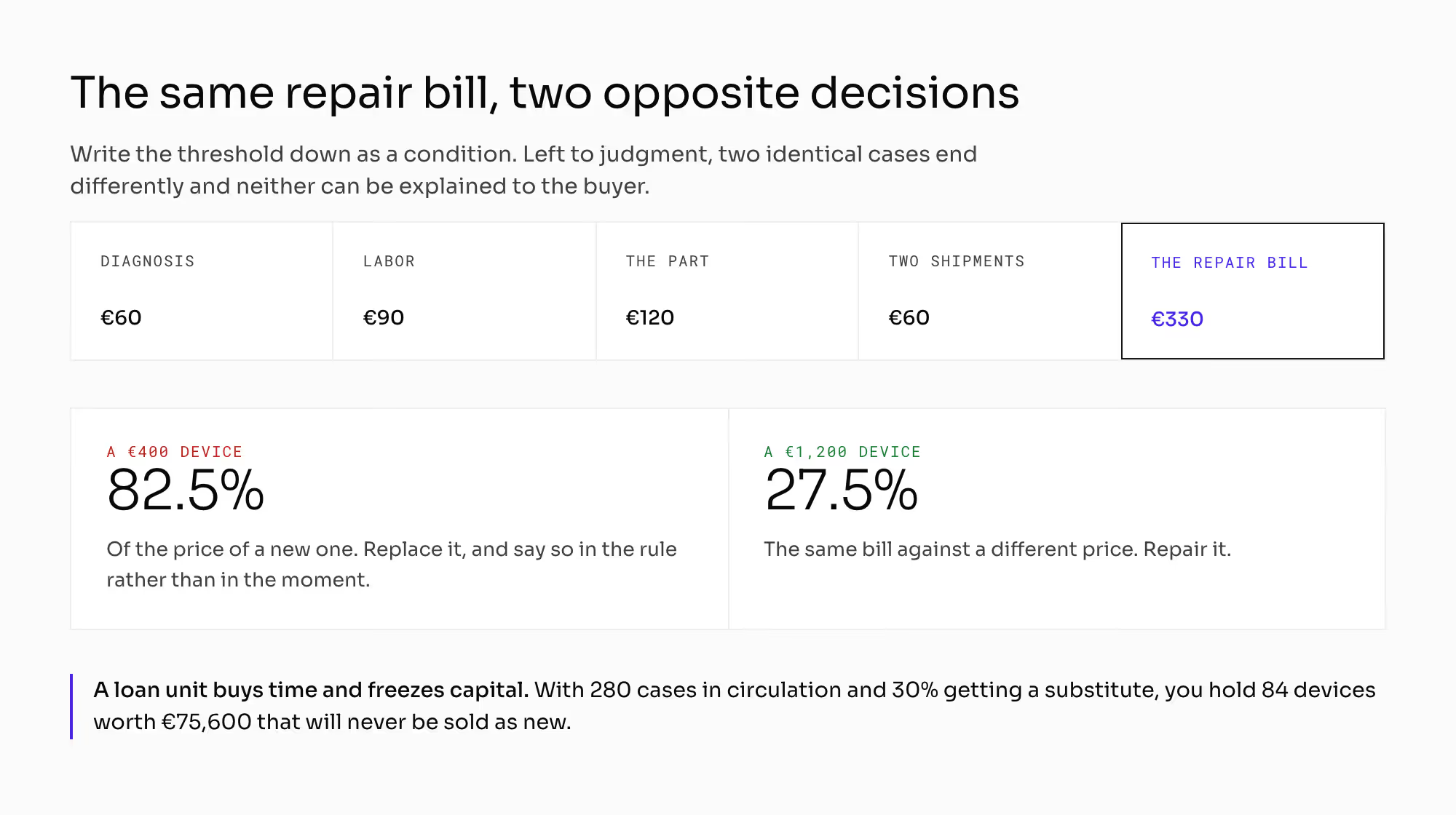
A loan unit buys you time and costs you frozen capital. With 280 cases in circulation and 30% of them getting a substitute, you hold 84 devices worth €75,600 (84 × €900) that you will never sell as new.
There is a harder version of this. You ship the replacement before the faulty unit arrives, which cuts the perceived wait to zero and moves the risk onto you.
Calculate the replacement threshold once and write it down as a rule rather than as a matter of judgment. Take a device at €400: diagnosis €60, labor €90, the part €120, two shipments €60.
That is €330 in total, or 82.5% of the price of a new one. The repair makes no economic sense.
The same calculation on a device at €1,200 comes to 27.5%, and the decision goes the other way. The threshold is a function of the price rather than of the fault, so it can be written down as a condition.
A replacement also creates a stock movement invisible in stock levels (stock levels and overselling), and it moves money that a repair leaves alone. On a €1,000 cart at a 12% commission, the seller keeps €880.
Whether that commission stays where it is gets settled by the commission on a refunded order.
How do you service products nobody can send back?
A built-in washing machine, equipment mounted on a roof, furniture assembled on site. Here the sentence "send the parcel back" does not exist.
The repair travels to the goods: instead of a shipment you have a visit, and instead of a tracking number you have a time window and a technician with parts in the van.
There is one metric here, and it pays to know it before you talk to a vendor: the share of cases closed on the first visit. Assume a visit costs €180.
At 65% first-visit success, a case costs €277 on average (1.54 visits × €180). At 85% it costs €212 (1.18 visits × €180).
At 300 cases a month, the difference is €19,500 a month, and it comes down mostly to whether the technician arrived with the right part.
The visit is often performed by a company that is not on your platform at all (fulfillment models). Selling and settling that kind of service, extended protection included, is covered by "Bundles, Sets, and Services on a Marketplace: One Purchase, Several Returns"; here it is only about performing it.
The address of the visit does not have to be the delivery address, and the contact channel to the buyer is sometimes masked (who controls the personal data).
What do repairs change about the rest of your build?
1. A service case outlasts the window in which you measure quality
Recalculate seller thresholds separately (seller quality thresholds and closing an order).
2. The repair path changes your payout exposure
When the decision to replace or to refund lands two months in, the seller's money left long ago, and you have nothing to deduct from (payout cycles, holds, and reserves).
3. Spare parts are a catalog decision rather than a service decision
Who lists them, who describes compatibility, and who cleans up after a discontinued model.
4. Documents multiply along with the case
A replacement, a surcharge for parts, and a paid repair are separate documentary events: who issues which invoice, corrections and credit notes, and the documents an order leaves behind.
How do you check service handling with a vendor?
1. On your own data
- Count the share of service cases and the average cycle in days. That product times the unit value is the amount of goods sitting outside your inventory reports.
- Take ten cases from the last quarter and check whether you can reconstruct where the unit was in each week. If you cannot, you do not have a record. What you have is correspondence.
- Check how many technical offers carry the warranty commitment as offer data, rather than as a sentence in the page description.
2. For the vendor
- Open a service case on an order from six months back, already settled.
- Show the state "waiting for a part" and whether it counts toward the seller's handling time.
- Show where the serial number of the individual unit lives and whether it is tied to the order line.
- Send out a loan unit and show what happens to stock levels and to the settlement.
- Is a service case a separate object with its own statuses, or a tag on a ticket? If it is a tag, the rest is theoretical.
Which mistakes do operators make about repairs and spare parts?
1. Running a repair on order statuses
An order has terminal states and a repair does not. The consequence: the unit drops out of your records, and the case lives on in an account manager's inbox.
2. No identifier for the individual unit
The consequence: you cannot prove that the same unit came back, and you lose every dispute about a swap.
3. A commercial warranty described on the shared product page
The consequence: you make a promise on behalf of sellers who promised nothing. And you are the one explaining the promise.
4. Spare parts with no compatibility data
The consequence: returns for "it does not fit", counted against seller quality, when they come from a missing field.
5. The replacement threshold left to judgment
The consequence: two identical cases end differently, and you cannot justify the difference to anyone.
What do you still have to settle about your own service policy?
This article does not say what the buyer is entitled to, for how long, or what starts the clock. That is set out in the chapter on who delivers the buyer's rights and a conversation with your lawyer. A service policy has to fit that window rather than set it.
This article does not describe the returns policy (the return window and who pays for the return leg) or the resolution of a dispute and the assignment of fault (who decides a disputed case). A repair is the execution of a decision rather than the decision.
This article does not cover withdrawing a product from the market (product safety and recalls), categories that require permits, or the form of documents on a paid repair.
Families of regulation worth asking your lawyer about by name:
- consumer protection in the part on conformity of the goods with the contract and on commercial warranties
- transparency in the platform-to-seller relationship, when you put service obligations on sellers (the rules on decisions about sellers)
- product liability and whether you enter the chain of responsible parties
- spare part availability and repairability requirements for your categories
- data protection when you pass an address to an outside service partner
Every number above is openly hypothetical. The calculation travels, and the result does not: put in your own share of service cases, your own cycle, and your own shipping cost.
Summary: Who carries the obligation after the sale?
Whoever your service policy names, and the policy has to name somebody for a state the order model has no room for. A repair is the only event after the sale where the goods are with neither side for weeks, so it needs its own case number, its own progression, and the serial number of the individual unit, because the same one has to come back.
Treat the queue as inventory rather than as tickets and the numbers arrive on their own: units in circulation times unit value is goods missing from your reports, and the repair path you pick is a transport bill that doubles between the seller and yourself. Spare parts carry the obligation past the sales life of the model, and the replacement threshold is arithmetic you write down once rather than a judgment two people make differently.
Ask a vendor to open a service case on a settled order from six months ago, and to show where the serial number lives. Building a marketplace where a repair is an object with its own clock rather than a tag on a ticket?
Frequently asked questions on marketplace warranties and repairs
Who handles a repair on a marketplace?
A repair on a marketplace is handled by the seller, by the manufacturer's network, by you as the intake point, or by a technician at the customer's place. The seller is the shortest route and tells you only what they choose to report; taking the intake yourself gives you a full trail and doubles the transport bill, because there are four shipments instead of two.
Does a marketplace have to stock spare parts?
A marketplace does not stock spare parts itself, and it does have to carry them in the catalog long after the model stops selling. Each part is a separate commercial item with its own identifier and a list of the models it fits.
Without that compatibility data, the buyer orders the wrong part, and the return is counted against the seller.
Should a marketplace warranty live on the product page?
A commercial warranty belongs to the offer rather than to the shared product page. The same model sold by three sellers can carry three different commitments, with a different issuer, a different network, and a different scope, so an attribute held on the page makes a promise on behalf of two sellers who never made it.
Ready to build?
We build marketplaces where a repair is an object with its own clock and a serial number, so the unit never drops out of your records.