
Marketplace Consumer Rights: Who Delivers Them?

Marketplace consumer rights are the buyer's statutory rights against whoever sold them the goods, and on a marketplace, the seller holds them while your platform is what makes them reachable.
The buyer has one set of rights and does not have to know that somebody else sold them the goods. You have several hundred sellers, each responding at their own pace.
That tension breaks after-sales service on a marketplace.
This article breaks down:
- Which 3 rights does a customer call by one word?
- Who should receive the report, you or the seller?
- What do you do when the seller says nothing?
- Which information must reach the buyer before the purchase?
Key insights
- The buyer has one set of rights. You have hundreds of sellers answering at their own pace. That gap is yours to cover.
- "I want to return this" can mean three different things, with three different payers. One form and a dropdown hides all three.
- Two clocks run at once. The buyer's starts when the parcel arrived. Yours starts when a seller opened the case. Nobody pays you for the difference.
- Deciding on a seller's behalf costs a different amount before and after you have paid them. Before, you deduct it. After, it is your money.
- Four things have to reach the buyer before they pay: who is selling, how to withdraw, who pays return postage, and where to send it.
Why does a marketplace run two clocks on one buyer's window?
The duty toward a consumer cannot be divided. A customer does not lose rights by landing on a difficult seller.
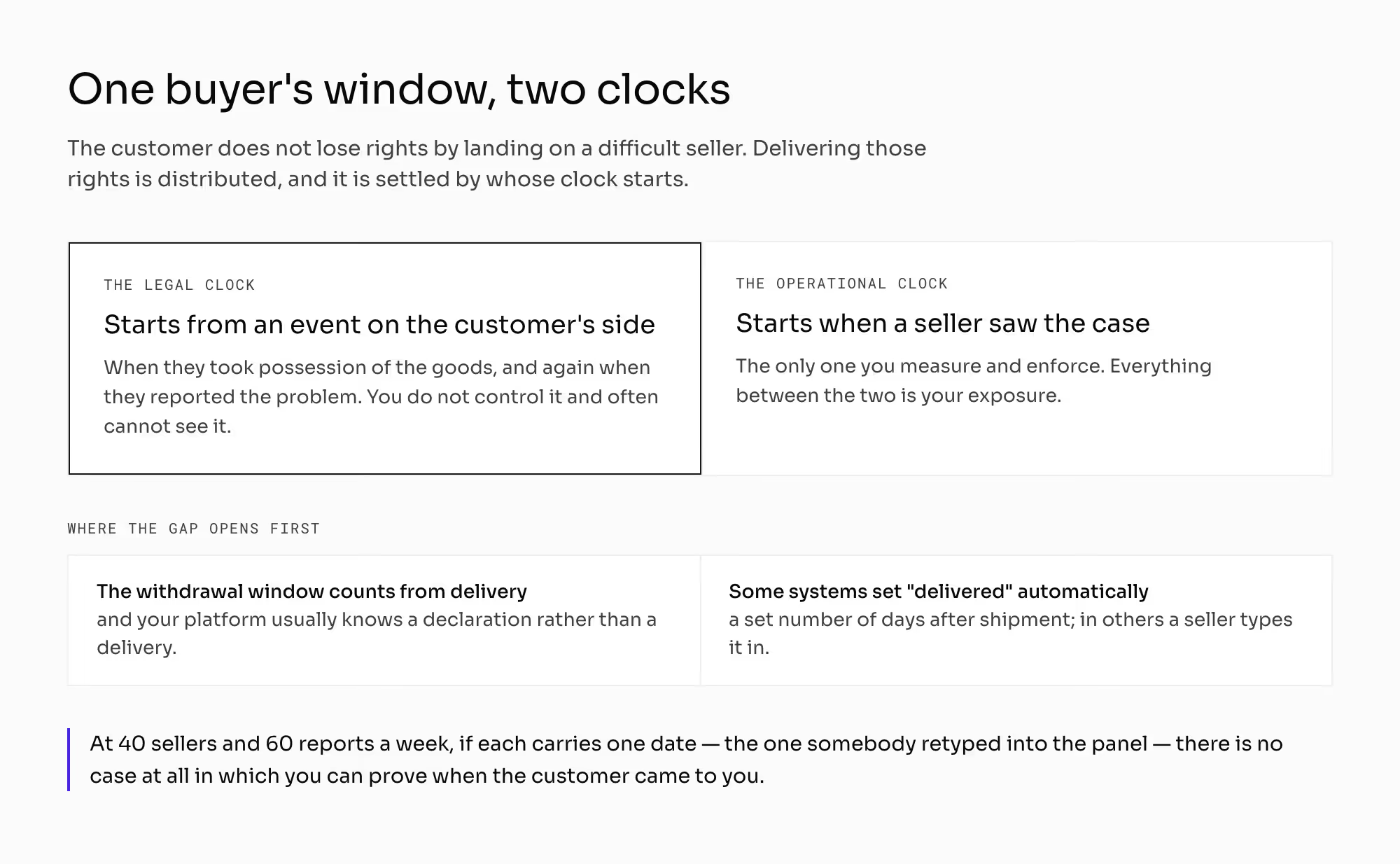
Delivering them is distributed, though, and it gets settled outside your terms: by who receives the report first and whose clock starts at that moment.
The legal clock runs from an event on the customer's side. It starts when they took possession of the goods, and again when they reported the problem.
The operational clock runs from the moment a seller saw the case. That second clock is the only one you measure and enforce.
The gap between them is your risk in full.
The divergence starts early. The window for withdrawal counts from delivery, and your platform usually does not know the date of delivery: it knows a declaration.
Some systems set the status "delivered" automatically a set number of days after shipment. In others, the seller sets it by hand.
Either way, the system generates a fact it never measured, and somebody else's rights run from it.
Take a modest scale: 40 sellers and 60 reports a week. If each carries one date, the one on which somebody retyped it into the panel, you have no case at all in which you can prove when the customer came to you.
Which 3 rights does a customer call by one word?
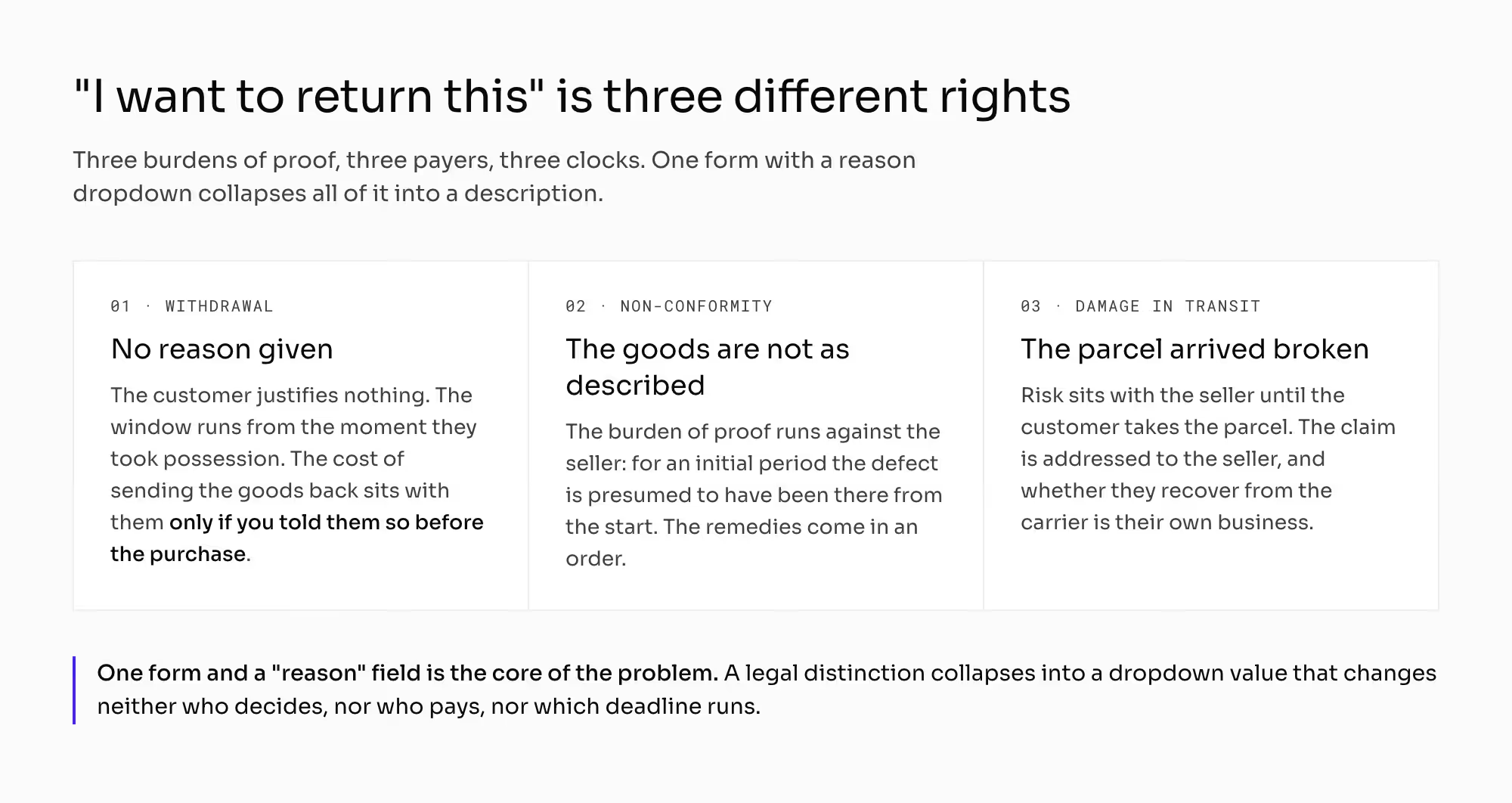
The customer writes, "I want to return this." Behind it stand three rights, each with a different burden of proof and a different payer.
1. Withdrawal from the contract, with no reason given
The customer justifies nothing. The rules set a window counted from the moment they took possession of the goods.
Confirm its length with a lawyer. The cost of sending the goods back sits with the customer, but only if you told them so before the purchase.
Missing information about the right of withdrawal costs more: the window stretches to a multiple of the base one.
2. Goods not in conformity with the contract
The burden of proof is reversed against you here: for an initial period after delivery, the defect is presumed to have been there from the start, and the seller has to show otherwise. The remedies come in an order.
Conformity first, then a price reduction or withdrawal. This is not the same thing as withdrawal, and it does not sit inside the same window.
The customer uses one word for both.
3. Goods damaged in transit
The risk of loss and damage sits with the seller until the customer takes the parcel, or a person the customer named other than the carrier. The claim is addressed to the seller, and the courier is their problem.
Whether they later recover the money from the carrier is their own business, and it does not release them from their deadline toward the customer.
The market handles all three with one form and a "reason" field. That is the core of the problem: a legal distinction collapses into a dropdown value that changes neither who decides, nor who pays, nor which deadline runs.
On some platforms the list is not even editable. Where it is, the reason often affects one thing only: whether the report is accepted automatically.
What separates the three rights? | Withdrawal, no reason | Lack of conformity | Damage in transit |
|---|---|---|---|
What the customer says | "I changed my mind" | "it does not work, it is different from the description" | "it arrived smashed" |
Who has to prove it | nobody, because no reason is required | the seller, for an initial period after delivery | the seller, that the goods left in working order |
What the deadline runs from | taking possession of the goods | the defect coming to light | delivery, or the absence of it |
Who pays for sending it back | the customer, if they were told | the seller | the seller |
What it demands of your data | date of delivery, date of the declaration | date the defect came to light, repair history | proof of dispatch, condition of the parcel |
Who should receive the report, you or the seller?
1. The operator's channel
Everything comes to you, and you pass the case to the seller. You control the quality of the communication and keep a trail of events.
You pay with people, and with one more thing: your own SLA becomes the buffer for somebody else's deadline.
2. The seller's channel
The customer writes to them directly. It is cheap, but the clock runs where you cannot see it, and you hear about the case when it escalates.
Practitioners note the effect on quality: what the seller writes back can fall below a standard the operator spent years defending, and you can only step in afterward.
3. Both at once, which is where most implementations land
This is not a compromise. It is two registers of the same event with no shared identifier: duplicates, contradictory decisions in one case, and no single date you can show anyone.
The recommendation: one register, many entry points.
One register. A form, an email, a phone call, and a message on the order all create the same object with the same date of receipt.
In implementations we know, an ordinary product question and a formal complaint land in one inbox with nothing to tell them apart, so "number of complaints" counts something nobody ever defined.
Check one more thing: the clocks that keep running without you. Automatic closure of a report after a set time, which does not stop when the case is in dispute, is a default setting in products we know.
At 60 reports a week and eight percent of cases in dispute, that is five a week closing themselves mid-argument.
What do you do when a marketplace seller says nothing?
Sooner or later you will decide on a seller's behalf. Practitioners observe that operators uphold reports more often than sellers do.
Your quality policy sits higher than one seller's interest in one case. On some platforms, a seller cannot reject a report alone and has to ask the operator.
The decision comes back to you either way.
1. The threshold for stepping in
After how much silence you step in, up to what amount you decide without asking the seller, and who may cross it. With no threshold, the decision is an agent's courtesy, and six months later nobody can explain why one customer got their money back, and another did not.
2. Where the money comes from, and why one day decides it
Take the canonical cart: €1,000, a 12% commission, €880 owed to the seller. Decide before you have paid them, and you deduct it from their balance.
Decide after the payout, and you pay your own money, left holding a receivable. Same scenario, two different lines on the balance sheet, and the only difference is the day of the decision versus the day of the payout.
"Marketplace Refunds: Who Pays for Them and Out of What?" describes the mechanics of the transfer. "Who Keeps the Marketplace Commission on a Refunded Order?" covers the commission and the settling of fault.
3. The recovery path
A deduction from the next payout, a reserve, a debit note, or debt collection. Whatever you pick, the decision and the claim have to be two separate records: the first says who decided, when, and on what basis, and the second what you recover and out of what.
Call it by its name. Here you are a guarantor in fact.
That does not make you a party to the contract ("Marketplace Liability: Are You an Intermediary or a Seller?"), but the customer remembers you and the board remembers the cost.
Which information must reach the buyer before the purchase?
Four pieces of information have to reach the customer before the contract is concluded: who the seller is, the right of withdrawal with its conditions and deadline, who pays for sending the goods back, and the return address. Add the seller's contact details, including the address where they do business.
This duty is discharged on the offer page and at the checkout. It has to be easy to reach from the screen where the customer decides, and terms are where things get hidden.
Two things surprise operators most often.
You have to disclose whether the party behind an offer is a trader, on the basis of their own declaration. If they are not, you warn the customer that consumer rights do not apply to that contract.
So "trader yes or no" is a field declared at onboarding, with a date and a version ("Marketplace Seller Verification: KYC, Beneficial Owners, and Sanctions").
You also have to explain how the obligations under the contract are split between the seller and you. Your division of labor becomes disclosed content.
You will not be changing it quietly.
The return address is an attribute of the seller: a cart with three sellers means three addresses and three return shipments, and the goods go back to the seller. For an organization with its own logistics, this is often the project's most painful discovery.
And one thing you cannot add later. You have to be able to say what the customer saw on the day of purchase.
The order stores a copy of the commercial information. Without that, one edit to one field wipes out the evidence for the whole history.
An empty field about return shipping cost on two thousand offers is a liability spread over every order from them.
Where does a marketplace buyer go when your process fails?
Outside the courts, there is out-of-court resolution of consumer disputes: specialized bodies running mediation or arbitration. Taking part is sometimes voluntary, but if you have committed to it, or you are required to, you have to tell the customer.
That belongs on your website and in your contract terms. An outcome binds a party only where that party accepted it in advance.
There is a lesson about the volatility of law here too. The central European dispute platform that shops had to link to was switched off, and the duty to link to it was lifted.
Customers now reach those bodies through an official register. The duty did not disappear.
It moved, and "Marketplace Compliance: Adding a Required Attribute to a Million Offers" develops the thread.
The consequence is blunt: in proceedings like that, you lose on a missing date. Your evidence is five things: when the report arrived, through which channel, what the customer saw on the page on the day of purchase, who took the decision and when, and what you sent the customer and when.
Settle one more thing openly. Who faces the customer in a dispute?
The seller, or you in the seller's name. That is a clause in your contract with the seller ("Marketplace Seller Agreement and Terms: Which Documents Do You Need?") and a field in your data.
What do marketplace consumer rights decide?
1. Closing an order becomes a three-way compromise
It sets accounting finality against the window for returns and complaints against your ability to measure service quality. On some platforms, closing after a set time cuts off the path to a return and a report, and the workaround the market uses is exactly what it sounds like: not closing orders for years.
Settle it as a decision: what closes an order, whether closing blocks the after-sales paths, and what happens to a report that arrives afterward.
2. Seller quality metrics stop being a report and become enforcement
Share of returns, share of reports, response time. But a threshold set without simulating its effects suspends half your seller base in the first week, and every suspension needs a reason you can show ("P2B Regulation on a Marketplace: Ranking, Terms Changes, and Suspension").
3. Onboarding collects more than payout details
It also takes the declaration of trader status, the return address, the contact channel, and the response deadline. All four block the publication of offers.
4. The returns policy itself gets a chapter of its own
The window, who pays, the taxonomy of reasons. Complaint handling as a process with an SLA gets another.
Unsafe products and recalls are "GPSR for Marketplaces: Product Safety, Traceability, and Recalls".
How do you check marketplace consumer rights with a vendor?
Five questions for the platform vendor. Ask to be shown on screen.
- Show me an order where the customer reported a problem through two channels. Is that one object or two? Which date is the date of receipt?
- What does the choice of reason change beyond the description? Who decides, who pays, and which deadline starts? If it changes only the description, you have one process serving three rights.
- Which clock starts from the fact of delivery and which from time passing? Show me an order whose status was generated automatically.
- How does the system know what the customer saw on the offer page on the day of purchase? From a copy stored with the order, or from a live read?
- Where does an operator decision taken against the seller get recorded, together with the claim against their balance?
A question for yourself: can I reconstruct the five dates from the previous section off one screen? If not, your after-sales service works until the first dispute.
Which mistakes do operators make about marketplace consumer rights?
1. One form for three rights
Everything arrives as a "return", so you handle a lack of conformity inside the withdrawal window and reject reports you are not allowed to reject. The cost is not one case.
It is a systematic practice, and that is easy to demonstrate.
2. Information duties hidden in the terms
Missing information about return shipping cost moves that cost to the seller, and missing information about the right of withdrawal stretches the window to a multiple of itself. It does that on every order from that offer at once.
3. A clock counted from an event in your system
The customer's deadline runs from delivery and from their own declaration. Every day of that difference is your risk.
4. A report kept as a message
A message has content. An object has a date, a channel, an owner, a decision, and a status.
You cannot count messages or show them in a dispute.
5. The operator fallback as a courtesy
With no threshold, no budget, and no recorded claim, a guarantee in fact turns into a liability invisible in your results until the first month-end close.
What do you still have to settle yourself about marketplace consumer rights?
This guide is a map of a process and of data. It carries no dates, no thresholds, and no article numbers, and that is deliberate, because this part changes faster than documents like this one.
Four families of regulation to take to a lawyer, as a list of topics for that conversation: rules on consumer rights in contracts concluded at a distance · rules on the conformity of goods with the contract and on guarantees · rules on out-of-court resolution of consumer disputes, known in the trade as ADR and ODR · rules on digital services and on the traceability of traders on platforms, known in the trade as the DSA.
Confirm five things by name: who is party to the contract in each of your flows; what event each of the three windows runs from and how long each lasts; how to word the information about the cost of sending goods back and where it has to sit; whether you may act in a dispute in a seller's name; whether you are required to take part in out-of-court dispute resolution and what you have to disclose as a result.
Our claim is narrower than any of those answers: whichever answer you get, what delivers it is a register of reports with one date of receipt, one owner and a trail of decisions. You cannot top that up retroactively, because dates you never recorded cannot be reconstructed.
Summary: What does a consumer dispute turn on?
Five dates and one register. When the report arrived and through which channel, what the customer saw on the offer page on the day of purchase, who decided and when, and what you sent back and when.
Every one of them is a field somebody either captured at the time or did not, and a date never recorded cannot be reconstructed.
Ask whether your platform can show those five dates for one order, on one screen. Building a marketplace that has to hold one register of reports with one date of receipt? Talk to us about the build.
Frequently asked questions on marketplace consumer rights
Who is responsible for consumer rights on a marketplace, the platform or the seller?
The seller is a party to the contract, so the rights run against them. Your platform decides whether the buyer can reach those rights at all: which channel the report lands in, which date gets recorded, and what the buyer was told before the purchase. The duty cannot be divided even though delivering it is.
Does a marketplace have to refund a buyer if the seller refuses?
Not as a matter of law, and in practice you often will. Operators uphold reports more often than sellers do, because a quality policy sits above one seller's interest in one case.
Set the threshold in advance: after how much silence you step in, up to what amount, and who may cross it.
What must a marketplace tell buyers before they buy?
Who the seller is, the right of withdrawal and its window, who pays for sending the goods back, and the return address. On top of that: whether the party behind the offer is a trader, and how the obligations split between them and you. All of it belongs on the offer page and at checkout.
Ready to build?
We build marketplaces that hold one register of buyer reports, with one date of receipt and one clock running per case.