
Retiring Products on a Marketplace: When to Delist What Does Not Sell

Retiring a product on a marketplace is taking a dead offer or page out of circulation, and the only question that matters is which of four rungs you use, because one of them cannot be undone.
A catalog takes up no warehouse space, so dead items look free. They are not.
The cost just does not sit where you look for it, and that is why the tidy-up rule gets switched on in the version that cuts out what you needed.
This article breaks down:
- Which 3 lists hide behind "not selling"?
- Which 4 traps break a naive retirement rule?
- Which 4 rungs does the retirement ladder have?
- Which 2 numbers does a committee need?
Key insights
- A dead offer costs nothing in shelf space and plenty in promises. Every live offer swears four things at once: the price is current, the goods exist, the data is complete, the delivery date is real.
- "Not selling" is three different lists. Pages with no buyable offer are safe to remove. Items nobody ever saw are a search problem. A slow-selling tail may be the reason people come to you at all.
- A six-month rule fired on 1 September looks back to March, so skis last sold in February drop out two months before the peak. Count year over year instead.
- Never delete. On some platforms, deleting one page takes down every seller's offer under it, and a refund three months later cannot be recalculated without the record.
- Of 120,000 offers with no sales, 9,000 had traffic. Those are the commercial problem and the only ones worth reviewing one by one.
What does a dead product cost a marketplace?
A warehouse has an obvious bill: square meters plus tied-up capital. A catalog has none, so retiring items looks like tidying for the sake of tidying.
The bill exists. It just does not sit on the space side.
Every active offer is a promise made of four independent things at once: the price is current, the goods are available, the data meets the requirements, the delivery date is real. At five hundred thousand offers, that is two million live promises.
Against dead items, you keep none of them, because nobody complains about a product they did not buy.
The cost surfaces the moment something touches the whole catalog. Adding one new mandatory field means 120,000 rows to resolve in a migration you would not have had to run.
Reviewing those 120,000 items by hand at twenty an hour is 6,000 hours, three years of work for one person. So the question is not "should we tidy up." It is "which items stopped being a promise worth keeping".
That is a question about assortment.
Which 3 lists hide behind "not selling"?
The first mistake happens at the definition: one word merges three sets that lead to three different decisions. The example is openly hypothetical: 500,000 active offers, 210,000 product pages, 2,400 sellers.
What does each list need? | No sales | No views | No offer at all |
|---|---|---|---|
What you measure | no order in a time window | no views of the product page | the page exists with nothing buyable under it |
How many in the example | 120,000 offers (24% of the catalog) | 34,000 product pages | 6,400 product pages |
What it usually means | a healthy long tail or dead ballast; the number does not say which | a visibility problem: search, category, name, photo | a phantom product: the buyer sees it and cannot buy it |
Default decision | split further, do not move in bulk | fix visibility, do not retire assortment | retire without a second thought |
Risk of moving too fast | you cut out your value proposition | you cut out what you never showed | none |
The third group is the only one worth touching without discussion. A phantom product is not an offer.
It is a page promising something that cannot be bought. It comes about in three ways: a page loaded from an external data source with no offer ever attached to it; a page whose last offer disappeared along with the seller; and a page that in some systems is not buyable by design, because it is a template grouping offers rather than merchandise.
The first kind is waste. The second comes back to life within a week if you recruit the next seller.
The second group is the product of your own work. An item nobody ever saw never had a chance to sell.
Retiring it sweeps the cause under the rug, and the cause sits in search or in one bad photo.
Which 4 traps break a naive retirement rule?
"Not sold in six or twelve months, out it goes" is the default proposal in every conversation about a catalog, and it has four failure modes. Each can be worked around with a single parameter.
You just have to know you need it.
1. Seasonality
A six-month rule fired on September 1 looks at the window that opens on March 1.
Skis last sold on February 20 drop out of the catalog two months before the November peak. They drop out quietly, because the report shows only the absence of orders.
A twelve-month window catches a full season and avoids this trap, but not the next one: an item that stood a whole season with no stock behind it did not fail to sell because nobody wanted it. Workaround: count year over year.
2. The long tail of spare parts and professional assortment
Research into how sales are distributed across broad online catalogs keeps returning the same result: low-turnover items, each one insignificant on its own, together account for a meaningful share of revenue, and the broader the catalog, the larger that share.
In service categories, the mechanism is stronger. A filter sold three times in four years is not ballast.
It is the reason the buyer found you: they arrived with a part number and bought four other things while they were there. Workaround: exclusions per category, reviewed once a year.
3. New offers with no history
An offer added three weeks ago has zero sales by definition.
A rule with no age condition cuts first into what you just recruited. Workaround: a minimum offer age as a condition of entry.
At the 180-day threshold from the example, 18,000 offers drop out that are not even worth looking at.
4. Pre-orders and announcements
An item that by design does not sell before launch is indistinguishable in the data from a dead one.
Offer description standards treat this as a separate availability state: "pre-order", "made to order," and "discontinued" are three different values there. Workaround: exclude by availability state.
When does an automatic retirement rule make sense?
I will put this plainly, because it runs against the instinct to tidy up. Automatic retirement makes sense with a narrow, curated assortment.
One category you know well: buyers coming for the typical item, breadth not used as an argument. Then the rule is cheap, and it genuinely raises catalog quality.
Practitioners from large rollouts set this limit themselves, as the first condition for the rule making any sense.
With the ambition of a broad catalog, that same rule does more harm than good. If your promise is "you will find everything here", then the long tail is the product, and retiring the long tail is retiring your own value proposition.
You lose twice: the items people came for, and the argument you use to recruit sellers.
The test is one sentence: does the word "everything" or "any" or a count of items appear in your own communication? If it does, do not build an automation.
Build a report and the ladder from the next section, and leave the decision to a human.
Which 4 rungs does a product retirement ladder have?
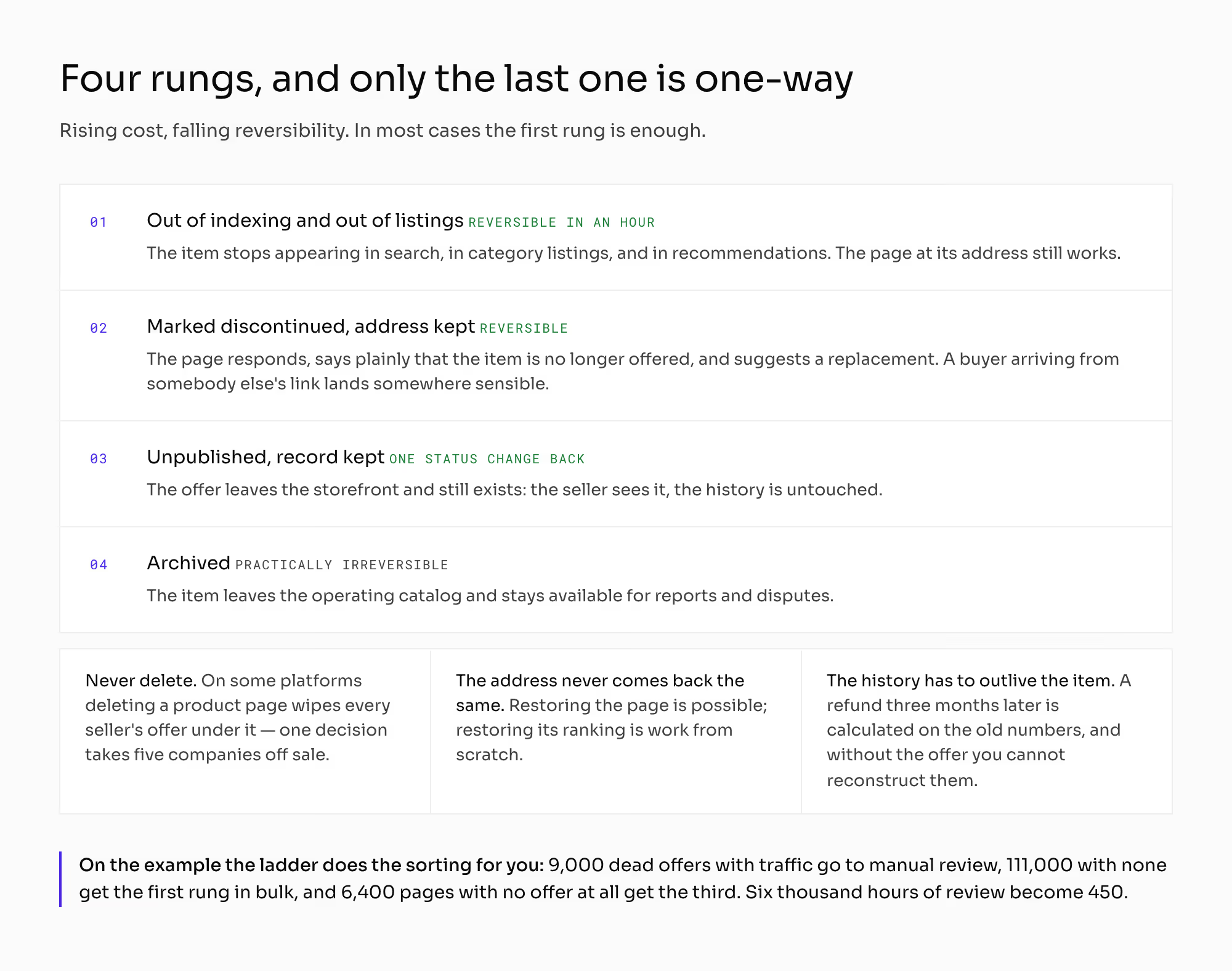
Retiring is not one operation. It is four rungs of rising cost and falling reversibility.
In most cases, the first rung is enough.
- Take it out of indexing and out of listings. The item stops appearing in search, in category listings, and in recommendations; the page at its address still works. Reversible within an hour.
- Mark it as discontinued and keep the address. The page responds, says plainly "no longer offered," and suggests a replacement. A buyer arriving from someone else's link lands somewhere sensible.
- Unpublish it and keep the record. The offer disappears from the storefront but still exists: the seller sees it on their side, the history is untouched, and bringing it back is one status change.
- Archive it. The item leaves the operating catalog and stays in a set available for reports and disputes. Practically irreversible, though not destructive.
The overriding rule: never delete. This is the only irreversible operation in this article and the only one that breaks things outside the catalog.
Three reasons:
- In some systems, deleting a product page wipes out every offer from every seller that hung under it. One decision about one item takes five companies off sale.
- You will not get the address back in the same state. The web protocol standard distinguishes "I did not find it" from "this is gone, probably for good", and search engines read both as a signal to drop the address from the index. Restoring the page is possible. Restoring its ranking is work from scratch.
- The history has to outlive the item. A refund arrives three months after retirement and is calculated on the old numbers: a €1,000 cart, a 12% commission, €880 paid out to the seller. Without the offer, you cannot reconstruct that calculation.
In the example, the ladder falls out like this. Of the 120,000 offers with no sales, 9,000 have traffic and go to manual review, the 111,000 with no traffic get the first rung in bulk, and the 6,400 pages with no offer at all get the third rung straight away.
Instead of 6,000 hours of review, you are left with 450 hours: thirteen times less work for the same number of decisions.
How do you bring the seller into a retirement decision?
Retiring an offer without asking its owner is technically simple and operationally the most expensive, because it generates disputes that eat category manager time.
One move takes most of them off the table: ask, and give a choice with a deadline. The message reads, "These offers have not sold since X.
Confirm within 14 days that they should stay, or we will hide them." You are not asking for permission; you are announcing the default outcome. That moves the decision to the person who knows their assortment better than you do.
Those 111,000 offers belong to 2,400 sellers, an average of 46 each. One message per seller is 2,400 messages.
Most replies come back as "go ahead and take them down", because an experienced seller curates what they list in a given channel anyway.
Silence is judged by a human. Silence from a seller with three dead offers means something different from silence from one with twelve thousand.
The owner of that decision is the category manager: they have the commercial context, and they carry the consequences. An automation that retires everything indiscriminately once the deadline passes will come back as a sales outage.
Which 2 numbers does a committee need about dead products?
The first: the share of items with no sales. For us that is 120,000 out of 500,000, or 24% of the catalog.
It sounds alarming, and on its own it justifies nothing.
The second and more important question: how many of them have traffic? For us, that is 9,000 out of 120,000, or 7.5%.
This number changes the conversation, because an item with no sales but with views is a problem with the offer. The buyer saw it and did not buy, so what decides is price, delivery cost, copy, or the photo.
Those 9,000 are worth going through one by one. The remaining 111,000 are not, because you know nothing about them beyond the fact that nobody saw them.
The sentence to quote: "a quarter of the catalog did not sell in a year, but barely one thirteenth of that quarter was ever seen, and only that part is a commercial problem."
What does retiring products change about the rest of your catalog?
1. A different programme from clearing catalog debt
Catalog debt deals with items that are broken and fixing them. You are dealing with items that are dead.
One queue for both means you fix things nobody wants and retire things you only needed to correct.
2. Your rules engine decides configuration or project
The question from catalog rules is the only one here that changes the schedule: can the rule act on an already published catalog, and is its output a flag or a removal from the storefront? Some systems run rules only on the way in, so they will never touch a dead item.
3. A dead item is sometimes a duplicate of a live one
Before you retire it, check whether the same thing is selling next door under a different name. If it is, the right operation is the merge from duplicates and merging.
4. Four similar-looking things to keep apart
"Out of stock" is not "discontinued", and stock synchronization belongs to the chapter on orders and logistics. Retiring an item because it lacks a field required by regulation is a compliance migration.
Taking an offer down after a safety warning is a withdrawal from the market, product safety, and recalls. Improving what stays is what you can enforce on content.
How do you test a product retirement rule safely?
- Three queries, one afternoon. How many offers have not sold in 12 months? How many of those had a view in 90 days? How many product pages have no buyable offer under them? If any of them need a person and a spreadsheet for two days, that is your first result.
- A dry run with nothing saved. Take one category, count how many items would drop out at a 6-month and at a 12-month window, and show the list to the category manager. Their reaction to twenty specific items will tell you more than a week of arguing about thresholds.
- Test the way back as well as the way out. Retire one item on the fourth rung and restore it. What came back: the data, the reviews, the address, the order history? Whatever did not come back is the price of your retirement.
Four questions for your platform vendor, and ask them to show it on screen:
- A rule on an already published catalog. Ask directly: does it flag items or take them off the storefront?
- A preview of the effect before saving: how many items, at how many sellers, in which categories.
- Unpublishing versus deletion: what happens to orders, reviews, and the page address.
- Exclusions: category, seller, minimum offer age, year-over-year window, availability state.
Which mistakes do operators make about retiring products?
1. One list instead of three
One report and one decision for three different problems: you retire a healthy tail while the phantom products stay, because nobody ever counted them.
2. A rule with no minimum offer age
It cuts first into what has just arrived, and it hits new sellers. You see the effect in supply recruitment.
3. A rolling window instead of year over year
Seasonal categories always drop out at the worst possible moment: a few weeks before the season, when you can no longer rebuild the assortment.
4. Retirement implemented as deletion
The only irreversible operation here, usually chosen because it was the easiest to reach. The consequences land outside the catalog: in returns, in reviews, and in addresses.
5. An automated retirement rule in a catalog that sells breadth
It deletes the reason people come to you. The deletion is invisible, because average quality goes up in the reports.
What do you still have to settle about your own long tail?
It does not settle where your own line runs between a healthy long tail and a junk drawer. That is not a function of a number or a threshold.
It is a function of the promise you make to the buyer. That is why nobody from outside can hand you the windows and the exclusions.
Anyone who gives you a threshold without asking about your category is selling you somebody else's configuration.
It also does not settle three things that sit outside our competence. The first is what retirement does to visibility in search engines.
That is the domain of front-end specialists, and our one claim there is that deleting an address is irreversible. The second is the retention of order data and reviews after retirement.
The regimes regarding who controls the personal data apply there, and you take that question to a lawyer. The third is the commercial value of a specific category, because that is known by your category manager and not by a model.
Our claim is narrower and independent of those answers: split the three lists, start with the phantom products, and for everything else use the lowest rung of the ladder and ask the seller. That is safe at whatever threshold you choose later.
Summary: What makes retiring products safe?
Splitting one word into three lists, then using the lowest rung that does the job. Pages with nothing buyable under them can go today.
Items nobody ever saw are a search problem wearing an assortment costume. And the long tail is where the care belongs, because in a broad catalog it is the promise you recruit sellers on.
Whatever you choose, take the item out of indexing rather than out of the database: that is reversible within an hour, while a deleted address, a lost order history, and five sellers' offers vanishing under one page are not.
Run three queries this afternoon: no sales in twelve months, those with a view in ninety days, and pages with no buyable offer. Building a marketplace where retiring an item is four rungs with a way back from three of them?
Frequently asked questions on retiring marketplace products
When should a marketplace retire a product?
When it stopped being a promise worth keeping, which is a question about assortment rather than about tidiness. An automatic rule fits a narrow curated range. If your own marketing says "everything" or quotes a catalog size, the long tail is the product, so build a report and leave the decision to a person.
Why is a "no sales in six months" rule dangerous?
It has four failure modes: seasonality, the long tail of spare parts, offers too new to have sold, and pre-orders. Each one needs a parameter: a year-over-year window, category exclusions, a minimum offer age, and an exclusion by availability state.
Should you delete a retired product?
No. Take it out of indexing, mark it discontinued, unpublish it, or archive it. Deletion is the one irreversible step, and on some platforms it removes every seller's offer under the page. You can restore a page; restoring its search ranking is work from scratch.
Ready to build?
If you want to split those three lists on your own catalog and find out how many dead items have traffic, let's talk.