
Marketplace Reviews and Ratings: What to Attach Them To, and How to Moderate Them

Marketplace reviews and ratings are three measurements wearing one costume: the buyer leaves a single rating for a purchase, and you need it on the product page, on the seller profile, and against the carrier, which are objects that fill up at wildly different speeds. If you do not settle where that rating lands, a default setting settles it for you.
This article breaks down:
- Where does a rating of a late parcel land?
- How many ratings does each object collect?
- What may moderation rule on?
- What do you show before the first review?
Key insights
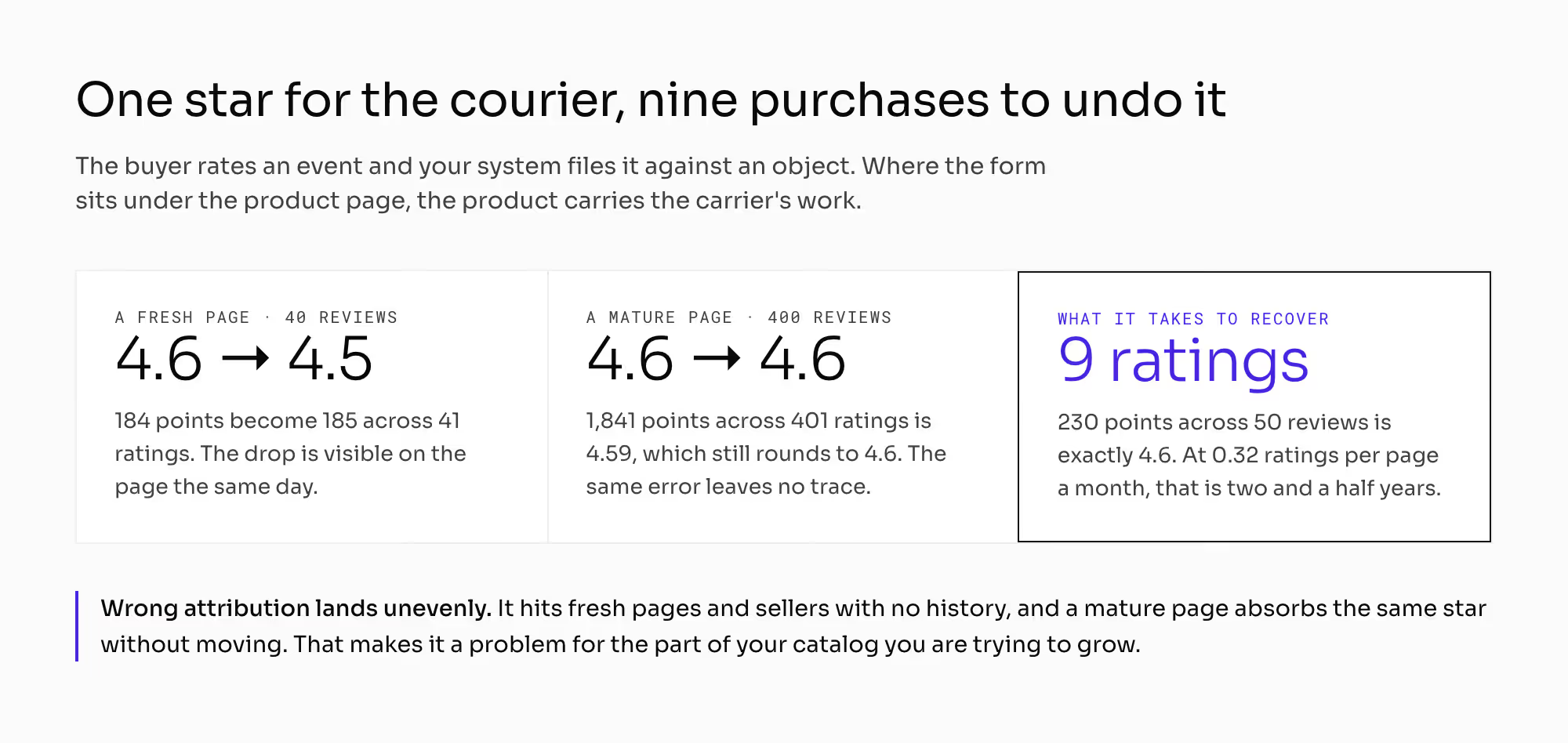
- A rating of a late parcel lands wherever the form puts it, and on a product page it takes nine flawless purchases to undo: 40 reviews at 4.6 drop to 4.5 on one star, and at 0.32 ratings per page a month those nine take two and a half years.
- Each object collects the same 960 monthly ratings at a different speed: 0.32 on a product page, 8 on a seller, 320 on a carrier, so one page needs 63 months to reach twenty reviews while a seller needs 2.5 and a carrier needs under one.
- Moderation may rule on form and never on the number of stars: personal data, obscenity, content about something other than this purchase, an attempt to move the contact off the platform, plus the action worth more than removal, which is attaching the review to the right object.
- Before the first review, a page shows the facts it has rather than an average of one vote: publish from five ratings up, always with the count beside it, because three fives make 5.0 and that says less than 4.4 from three hundred.
Where does a rating of a late parcel land?
The buyer rates an event, and you record that rating against an object. The two come apart on every purchase where something went wrong outside the goods themselves: a parcel a day late, a torn carton, no answer from the seller.
The buyer has one field and one scale, so the whole experience goes into it. If that field sits under the product page, the product gets one star for the courier's work.
Work out what that costs. The page has 40 reviews and an average of 4.6, which is 184 points.
One star for the delay gives 185 points across 41 reviews, so 4.5. To climb back to 4.6, you need nine more ratings at five stars: 230 points across 50 reviews is exactly 4.6.
One event the product had no influence over cost nine flawless purchases.
The same star on a page with 400 reviews gives 1,841 points across 401 ratings, so 4.59. Rounded, that is still 4.6.
Wrong attribution does not spread evenly: it hits only fresh pages and sellers with no history. A mature page absorbs the same error without a trace.
And there is one thing you cannot get around with your terms. You do not edit a rating.
You can publish it or remove it, because its author sits outside your organization. It is the only object in your system with that property.
How many ratings does each object collect in a month?
Take a platform with 12,000 orders a month, 3,000 product pages, and 120 sellers. At an 8% response rate on the review invitation, you get 960 ratings a month.
That single number means three completely different things depending on what you attach it to.
What does each kind of rating measure? | Product rating (object: the page) | Seller rating (object: the order) | Delivery rating (object: the shipment) |
|---|---|---|---|
What it really measures | whether the thing is what was promised | how fulfillment went: packing, contact, dispatch on time | the carrier, the pickup point, the state of the parcel |
Who can fix it by their own action | the manufacturer and whoever wrote the page | the seller | you, because you choose the carriers |
Ratings one object collects (per month) | 0.32 | 8 | 320 |
Time to 20 ratings on one object (months) | 63 | 2.5 | under one |
What breaks when you merge them | the product carries someone else's mistakes | the seller answers for someone else's page | the signal disappears into noise |
Where the number has a right to work | page content and the buying decision | the corrective conversation with a seller | choosing carriers and promising a date |
The conclusion is arithmetic: the average page needs five years to gather twenty reviews. A seller has that many after two and a half months, a carrier after a week.
One question will not serve three densities that far apart, and that is the real reason to separate the ratings. It is a stronger reason than conceptual tidiness.
Now go back to that one wrong star: nine corrective ratings at this pace is two and a half years.
The market settles this more firmly than most teams assume. In mature solutions of this class, the rating is attached to an order from a single seller, and it has three parts: an overall rating on a scale of 0 to 5, a comment, and answers to a handful of criteria defined by the operator, some yes/no, some scored.
One order is one rating. The product rating does not exist at all in that model.
It is a separate system that you buy or build alongside.
The second trap is one of naming. Some solutions show a "seller rating" on a five-star scale that contains not a single buyer review.
That number is a calculation from dispatch punctuality, cancellations, returns, and tracking completeness, rescaled to five points. Two numbers in identical costume: one is the voice of buyers, the other is your own measurement.
Seller quality thresholds cover the operator's own measurement and its thresholds, and that boundary is worth keeping sharp. If a star average starts triggering sanctions, you have to know which of the two numbers you are firing.
When should a marketplace ask for a review?
Ask about what the person you are asking can judge at that moment. A day after delivery, the buyer knows everything about the courier, the packaging, and the contact with the seller, and almost nothing about the product itself.
An invitation sent then collects mostly a rating of logistics, so if that rating lands on the product page, you are manufacturing the wrong attribution yourself.
Hence the practical split: you collect the seller and delivery ratings shortly after delivery, and the product rating in a second invitation, sent after the interval the category calls for. You can work out the payback yourself: at 12,000 orders, a second invitation with a 3% response gives 360 product ratings a month, which triples the pace at which pages fill up.
The form has two parameters that decide whether the data is usable. The number of criteria: the longer the list, the fewer the answers.
Vendors in this layer advise defining very few. And the answer type: a yes/no criterion is immune to interpretation; a scored one is not.
"Packed carefully: yes/no" can be compared across sellers. "Care in packing: 3" means nothing without a definition of what a three is.
The most expensive mistake in this layer is a late one rather than a bad one. Changing the question zeroes the history without zeroing the average.
If you add a criterion or change the scale a year in, the counter runs on and shows one number, but from that day it measures something else. Old ratings do not disappear.
They simply stop meaning the same thing. So you design the set of criteria once, version every change with a date, and show that version next to the average.
Remember too that the review invitation is an ordinary transactional email: eight percent of responses turn into four when half the invitations land in spam.
What may review moderation rule on?
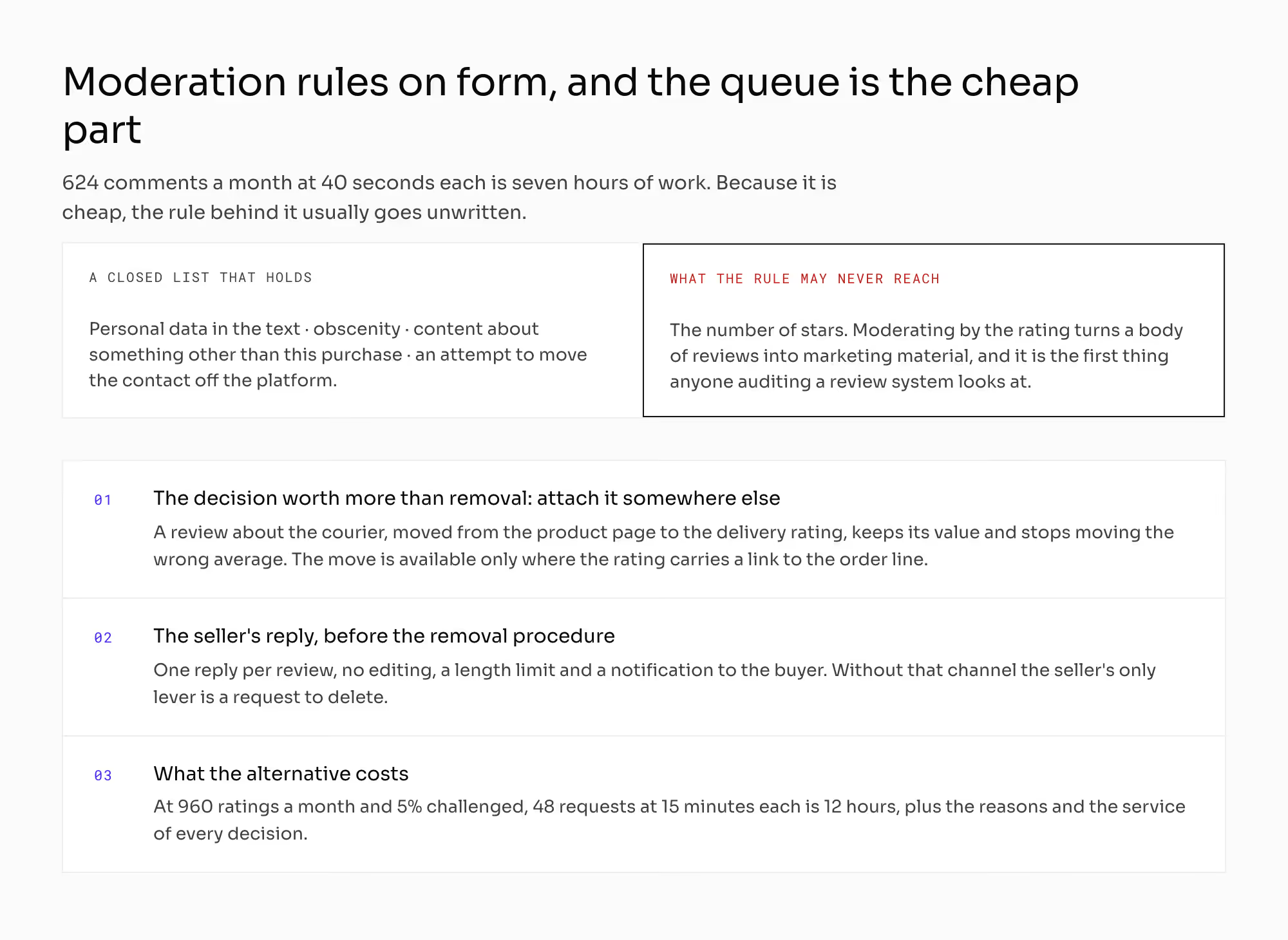
The intuition from the catalog does not apply here. 960 ratings a month, 65% of them carrying text, is 624 comments; at 40 seconds each, that is 7 hours of work a month.
One person with six effective hours a day gets through about 540 comments, so 11,000 a month, which is the volume produced by roughly two hundred thousand orders. Moderation before publication does not fall over on cost, and that is its trap: because it is cheap, nobody writes a rule for it.
The rule has to be about form rather than about the number of stars. A closed list of reasons can be short: personal data in the text (who controls the personal data), obscenity, content that is not about this purchase, an attempt to make commercial contact off the platform.
Moderating by the rating turns a body of reviews into marketing material, and it is exactly what regulators of the review market look at. What those requirements are and whether they reach you is a conversation for your lawyer.
The most valuable decision a moderator makes goes beyond "publish or remove". That decision is "attach it somewhere else".
A review about the courier, moved from the product page to the delivery rating, keeps its value and stops poisoning the average. That move is only available if the rating carries a link to the order line in the data model.
The seller's right of reply is cheaper than any removal. The market standard is narrow and sensible: one reply per review, no editing, with a notification to the buyer and a length limit.
Without that channel, the seller's only lever is a request to delete. Work out what it costs: at 960 ratings and 5% challenged, that is 48 requests a month, at 15 minutes each, so 12 hours, plus the justification and delivery of the decision, which the rules on decisions about sellers cover.
Which fields make a review auditable?
The public standards for describing reviews say what common sense says: a review is an object that points to the thing being rated, the author, the rating, and the date. Search engines reject ratings an entity collects about itself, and ratings aggregated from other people's sites.
You have to be able to say where every review came from. The minimum: a link to the order and to the seller, the acquisition channel, a flag for whether it was solicited by an invitation, a flag for whether the person who left it got a benefit, and the moderation decision with its reason and date.
A review with no link to an order is anonymous content, and that is how you label it to the buyer.
Reviews imported from a ratings collection service, or carried over from a seller's own shop, have no order in your system to attach them to. If those run at 12% of 960, that is 115 ratings a month whose origin you cannot confirm.
Three answers can be defended (do not accept them, accept them with a visible label, accept them without counting them into the average). A fourth cannot: drop it quietly into the common pool.
And one thing easy to miss: ratings are a channel for detecting product safety incidents. Three comments about a charger that overheats are a report rather than marketing content.
The chapter on product safety and recalls covers how that signal gets handled.
What should a page show before it has reviews?
At 0.32 ratings per page per month, the average page has just under four reviews after a year. So "zero" is not an edge case.
Zero is the state of most of your catalog.
Set an explicit threshold for publishing the average. Five ratings, to put a number on it.
And always show the review count next to the average. Three fives make 5.0, and that is weaker information than 4.4 from three hundred ratings.
This is a different use of minimum volume than the one behind the quality thresholds in seller quality thresholds: there it decides a sanction, here, what you are allowed to display.
Below the threshold, you have three honest options: show no widget at all, say plainly that there are no reviews, or show the facts you do have. Those facts are the declared dispatch time and the number of orders fulfilled.
What you may not do: borrow ratings across objects. Reviews collected on one seller's offer are not a rating of another, and a shared page with 200 reviews shows an average earned by a seller who is not behind the buy button today.
How a rating weighs in the choice of the winning offer is settled by the rule that picks the winning offer.
What do reviews change about the rest of your build?
Your own satisfaction score and the marketplace average are two measurements with different denominators. Practitioners on large rollouts observe that switching on third-party selling pushes buyer satisfaction down in the first months.
Splitting your own sales from other people's inside that denominator has to happen before launch, because history cannot be split retroactively.
1. A review is sometimes a complaint in disguise
The comment "arrived damaged, nobody answers" is a report that landed in the wrong place. On a €1,000 cart at a 12% commission, it ends in a €1,000 refund to the buyer and a question about whether the €120 commission goes back to the seller.
The chapter on who pays for a refund covers the mechanics, the commission on a refunded order settles the decision about the commission.
2. A body of reviews is someone else's content that you host
The way you select it and display it feeds into the same assessment of your role as the layout of a product page. That is covered in the chapter on whether you are an intermediary or a seller.
How do you set marketplace reviews up?
- Work out three numbers on one sheet of paper: ratings per month, ratings per page, ratings per seller. If the second one comes out below one, the decision to separate the ratings has already been made.
- Separate the objects in the data model before you separate the forms. A rating attached to an order line can be moved later. A rating attached only to a page cannot.
- Design the set of criteria once, with room to spare, and record its version with the date it takes effect.
- Set the publication threshold for the average, and the count beside it. Without it, the first five on a new page lies harder than no ratings at all.
- Write a closed list of moderation reasons that are about form, and add the "attach it somewhere else" action to it.
- Turn on the seller reply before you turn on the removal procedure. The reply is cheaper and less contested.
- Every quarter, measure the share of ratings removed and how they spread across the stars. If you are mostly removing one-star ratings, your rule is about the rating, whatever it says on paper about form.
Four questions for the vendor:
- what the rating is attached to in the data model
- whether it can be moved between objects without being removed
- whether the seller reply and the moderation decision are objects with a history
- who calculates the average, the platform or the front end
Which mistakes do operators make about marketplace reviews?
1. One question for three needs
The form collects the experience of the purchase, and the result lands under the product. The consequence: the page carries someone else's mistakes for two and a half years.
2. Moderating by the number of stars
It starts with removing "unfair" one-star ratings and ends with a body of reviews that measures nothing.
3. Changing the criteria without versioning them
The average flows on, comparability disappears, and nobody can point to the day the question changed.
4. Importing outside ratings into the common pool
Dropped in without a label, they vanish into an average you cannot defend when someone asks where you got it.
5. Publishing the average from the first rating
A new page at 5.0 off a single vote looks better than a mature one at 4.6.
What do you still have to settle about your own review system?
This article does not settle how a rating weighs in the choice of the winning offer (the rule that picks the winning offer), nor what quality thresholds and sanctions follow from your own operator measurement (seller quality thresholds). It does not touch the quality of descriptions (what you can enforce on content) or the fairness of promotions and price history (price history and discount messages).
Justifying a decision to remove a review and delivering it to the seller is covered by the rules on decisions about sellers. Information duties toward the buyer are covered by who delivers the buyer's rights.
This article settles no legal requirement about reviews at all, and it deliberately carries no deadlines, no thresholds, and no names of rules. The families of regulation worth asking a lawyer about, with no judgment on which of them reach you: consumer protection, in the part about the authenticity of reviews: hence the duty to say whether and how you check that a review came from someone who bought, and the ban on fabricated reviews and on selective publishing; transparency in the platform-to-seller relationship: hence the justification of a decision to remove content about a seller; liability of intermediary services: hence reports of unlawful content in comments; protection of personal data: hence a name, an address and photographs inside the text of a review; product safety: hence the reaction to a signal that arrived in a comment.
Every number above is openly hypothetical. The arithmetic travels, the values do not: put in your own order volume, your own number of pages and your own response rate, and every conclusion recalculates itself.
Summary: What should a rating be attached to?
An order line from one seller, with the product rating collected separately and later. The buyer rates an event, and your system files it against an object, and those two come apart on every purchase where the parcel was late, or the carton was torn.
The arithmetic settles the argument faster than any principle: the same 960 ratings a month are 0.32 per product page and 320 per carrier, so one question cannot serve densities three orders of magnitude apart. Two further decisions follow from the same place.
Moderation rules on form, because the moment it rules on stars, the body of reviews stops measuring anything. And a review with no link to an order is anonymous content, which is how you label it rather than how you average it.
Ask a vendor what a rating is attached to in the data model, and whether it can be moved between objects without being deleted. Building a marketplace where reviews are separated by object before the first one arrives?
Frequently asked questions on marketplace reviews and ratings
What should a marketplace rating be attached to?
A marketplace rating should be attached to the order line, which is the only anchor that lets you move it later. From there, it can feed the seller profile, the product page, and the delivery score separately.
A rating attached only to a page cannot be moved at all, so the courier's mistake stays on the product for years.
Can a marketplace remove a bad review?
A marketplace can remove a review for its form and should never remove one for its rating. A closed list of reasons is short: personal data, obscenity, content about a different purchase, an attempt to make contact off the platform.
The cheaper tool is the seller's right of reply, one per review, with a length limit and a notification to the buyer.
How many reviews does a product page need?
A product page needs about five ratings before an average means anything, and the count has to stay visible next to it. At 0.32 ratings per page per month, the average page has under four reviews after a year, so the honest options below the threshold are no widget, a plain statement that there are none, or the facts you do have.
Ready to build?
We build marketplaces where a rating is attached to the order line, so it can feed the seller, the product and the carrier separately.