
Fulfillment Models on a Marketplace: Seller, Operator, Dropship, Click and Collect
The fulfillment model settles who holds the stock, who does the physical work, and who pays the bill for that work. You will not settle it once, because in the end you will be running several models at the same time.
And the bill does not grow from which model you pick. It grows from how many of them you keep running side by side.
This article breaks down:
- How many models will you run at once?
- Which 4 questions define a model?
- What do the same goods earn in two models?
- Why is click and collect three models?
Key insights
- You will run several models at once, and one more costs four sets of things rather than one setting: its own order states, its own documents, its own line in settlement, and its own exception path.
- The four questions that define a fulfillment model are who holds the stock, who does the moving and may say "shipped", whose carriage contract it is, and what enters settlement beyond the commission.
- The same goods earn €120 when the seller ships and €124 when you do, because a €25 fulfillment fee is eaten by €15 of carriage and €6 of picking, so one person running that stream at €8,000 a month needs 2,000 orders to break even.
- Click and collect is three models rather than one, and each of them needs data you do not collect today, starting with a collection point identifier on the order.
How many fulfillment models will a marketplace run at once?
The question is not "which fulfillment model is the right one." It is "how many models will we keep running in parallel, and what for." Every mature operator ends up with several: sellers ship on their own, part of the assortment goes out of your warehouse, premium brands run on dropship, and in cities where you have stores you add in-person collection. You cannot avoid that, and you do not have to.
You do have to know what it costs.
The price of one more model is four sets of things rather than one setting: its own set of order states, its own documents, its own line in settlement, and its own exception path for when something goes wrong. Three models are not three configurations.
They are twelve things, and each needs an owner and a procedure.
There is also a consequence invisible during the workshops. The fulfillment model is an axis of the order split, exactly as the seller is.
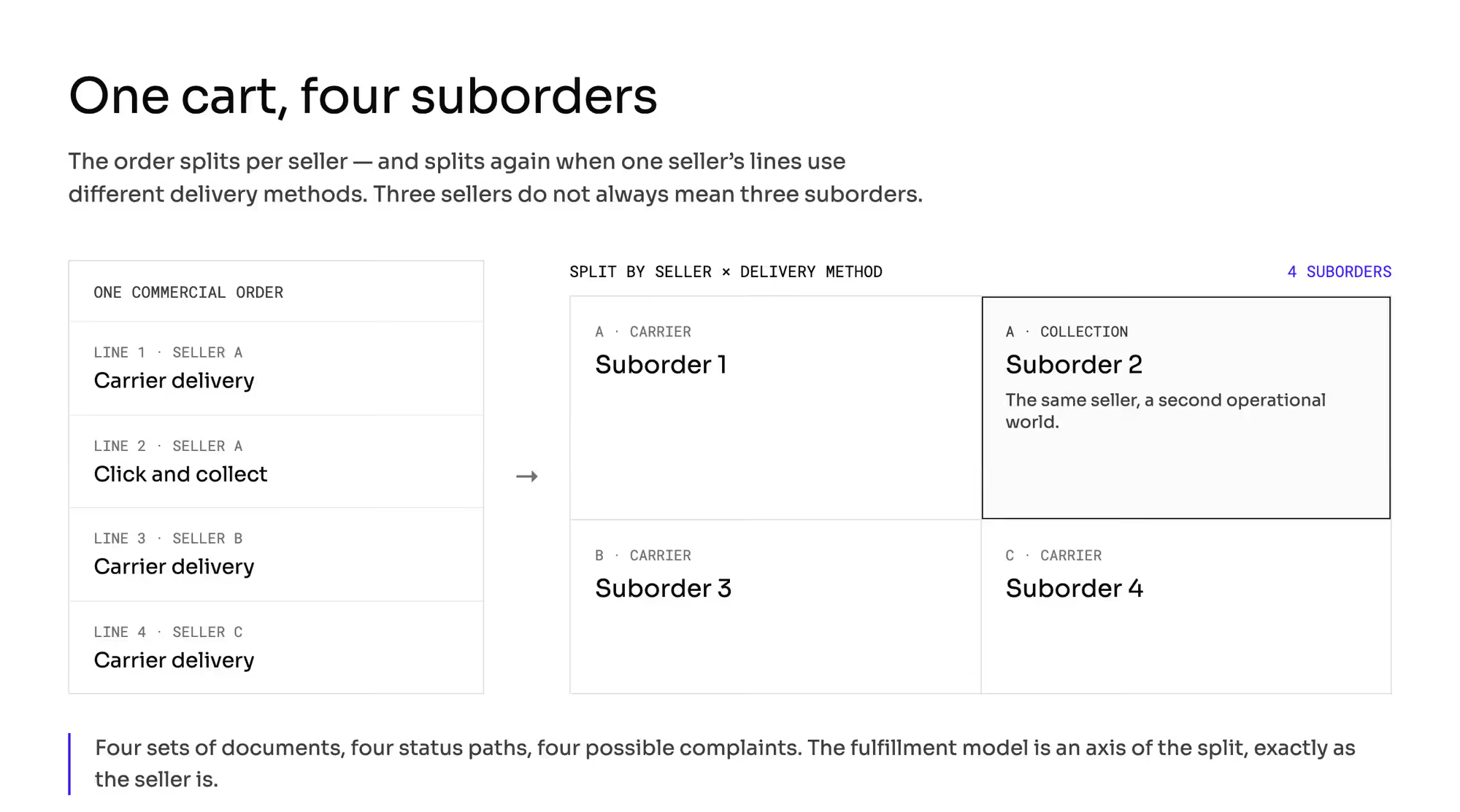
In solutions of this class, one commercial order breaks into parts per seller, and a seller's part breaks down further if their lines have different delivery methods: separately what goes by carrier, separately what waits for collection. Do the math on a cart.
Three lines from three sellers make three suborders, but if one of those sellers also has a line for click and collect, you get four: four sets of documents, four status paths, four possible complaints. The split itself and the numbering are how one order becomes several.
The status map is who is the source of truth for a status.
That is why the order of decisions runs against intuition. First you settle how many parallel operational worlds your team can carry.
Only then do you settle which ones they should be.
Which 4 questions define a fulfillment model?
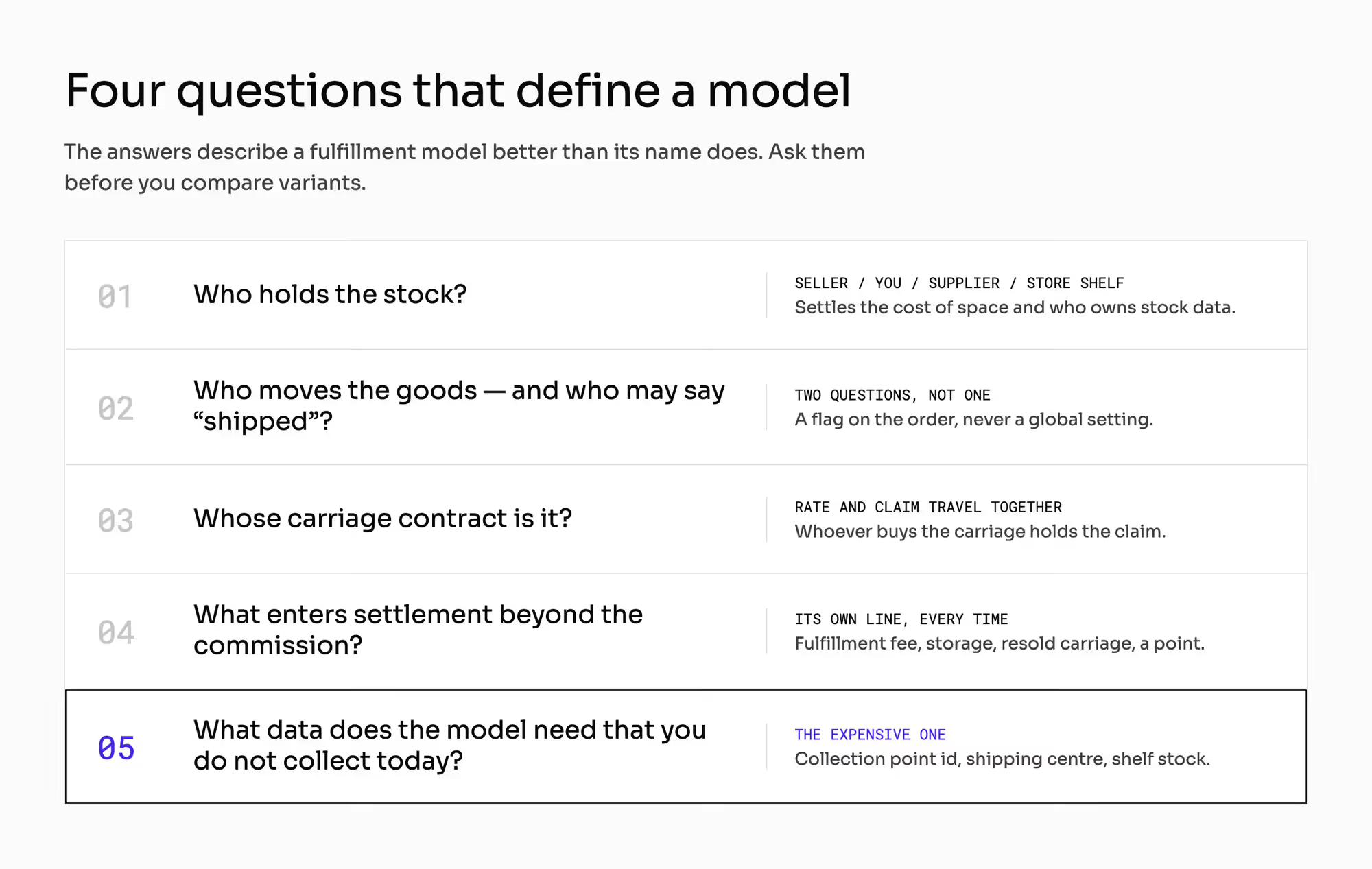
Instead of walking through seven variants one by one, ask about four things. The answers define a model better than its name does.
1. Who holds the stock
The seller at their place, you in your warehouse, the supplier in dropship, or a shelf in a physical store.
That settles who carries the cost of the space, who holds the data on stock levels, and what happens when that data is false (stock levels and overselling).
2. Who does the moving, and who may say “shipped”
Those are not the same question. Sometimes the seller picks and packs while your own network does the dispatch, so the shipment confirmation button has to be taken away from them.
In the solutions we know, that is done with a flag on the order rather than with a global setting. Who is the source of truth about delivery is carried by when an order counts as delivered.
3. Whose carriage contract it is
In dropship and in shipping on your own network, you are the one buying the carriage, so you hold the rate and the claim against the carrier.
When the seller ships, both of those are theirs. Who sets the rate the buyer sees is zones, methods and shipping rates.
Carriers and labels are carriers, labels and tracking.
4. What enters settlement beyond the commission
A fulfillment fee, a storage fee, resold carriage, running a collection point.
Each of these items needs its own line, because otherwise, a quarter later, you cannot answer whether the model makes money.
The fifth question is technical and expensive: what data does the model need that you do not collect today? Click and collect needs a collection point identifier on the order.
Fulfillment out of your warehouse needs a marker for the center the line ships from. Selling off a shelf needs the stock level of that shelf rather than of the network.
Which 7 fulfillment variants can a marketplace run?
What does each fulfillment variant cost and risk? | Who holds the stock | Who does the moving | Whose carriage contract | What enters settlement beyond the commission | States above the base model (count) | Main operational risk |
|---|---|---|---|---|---|---|
The seller ships on their own | the seller | the seller | the seller's | nothing | 0 | you control neither the date nor the quality of the parcel |
Fulfillment from your warehouse | you, but the goods are someone else's | you | yours | a fulfillment fee and a storage fee | 2 | stock you never bought, sitting there |
Shipping on your carrier contract | the seller | the seller packs, you dispatch | yours | resold carriage | 1 | a delay in your network lands on the seller |
Dropship | the supplier | the supplier | usually yours | margin instead of commission | 0 | the promise is yours, the work happens at someone you cannot see |
Click and collect | the seller | the seller ships to the point, you hand over | the seller's | running the collection point | 3 | uncollected parcels |
Selling off the store shelf | the store | the store | none, or a local one | a handling cost instead of carriage | 2 | shelf stock is not warehouse stock |
Same-day delivery | the seller, locally | a city courier | usually yours | a surcharge for the time window | 2 | the cutoff hour; a delay voids the model |
What do the same goods earn in two different models?
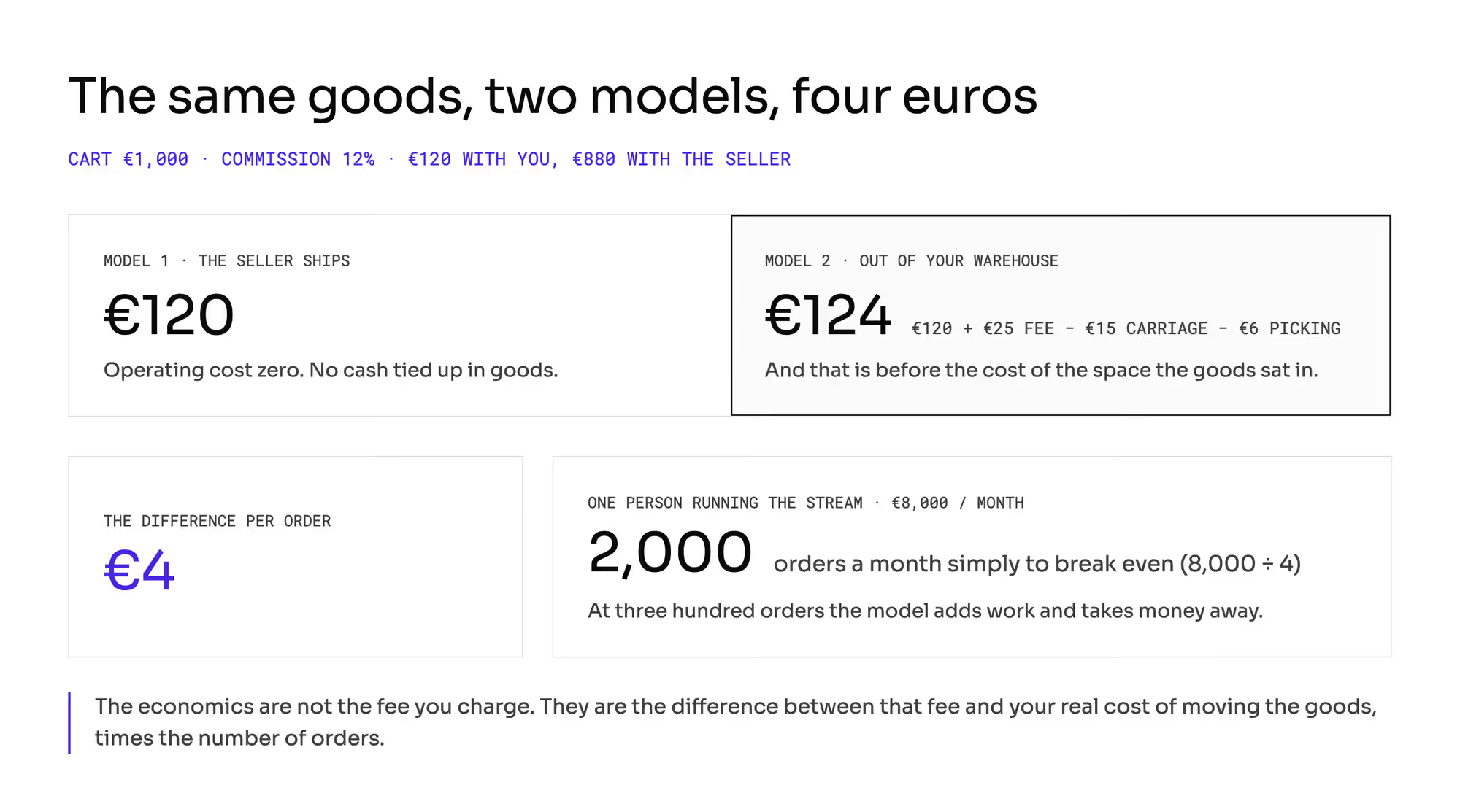
Take the canonical cart: €1,000 at a 12% commission, which is €120 with you and €880 with the seller.
Model one: the seller ships on their own. Your revenue is €120, your operating cost is zero, and your cash tied up in goods is zero.
Model two: the same line ships out of your warehouse. You add a fulfillment fee of €25, so revenue rises to €145, and the seller is left with €855.
But now you also pay €15 for carriage and €6 for picking, €21 together. That leaves €124, which is €4 more than in model one.
And that is still before the cost of the space the goods sat in before they sold.
Four euros is not a failure. It is a number to put next to the cost of the process.
One full-time person running that stream, at €8,000 a month, needs 2,000 orders a month simply to break even (8,000 ÷ 4). If you do three hundred, the model adds work and takes money away.
The economics of this model are not the fee we charge. They are the difference between that fee and our real cost of moving the goods, times the number of orders.
What do you take on when you take over the shipping?
Fulfilling someone else's goods out of your warehouse looks like a natural extension: you have the hall, the people, and better carrier rates than a small seller. Three things spoil that calculation.
Quality metrics stop measuring the seller. If you are the one packing and dispatching, and the late shipment rate still counts against the seller, you are punishing them for your own warehouse.
In the solutions we know, those orders have to be excluded from the seller's statistics explicitly, and that is a separate action, the kind that gets forgotten. Thresholds and the consequences of metrics are carried by seller quality thresholds.
What you owe the seller by way of explanation is the rules on decisions about sellers.
Pricing it is harder than running it. Practitioners from large rollouts describe attempts that were shut down not because they failed, but because the numbers never came together: space, turnover, and handling the goods that came back cost more than any fee you could charge.
And a risk that exists in no other model: the turnover of your warehouse is decided by your own offer selection algorithm. You take in a seller's goods, and a week later a different seller drops their price and takes over the default offer on that product page.
The goods sitting with you stop selling. Not because demand went away, but because your own rule for presenting offers pointed at somebody else (the rule that picks the winning offer).
You are paying to store a decision you made yourself, in a different module. Before you switch this model on, settle two things: after how many days without a sale the goods go back to their owner, and who pays for the trip back.
Why is click and collect three models rather than one?
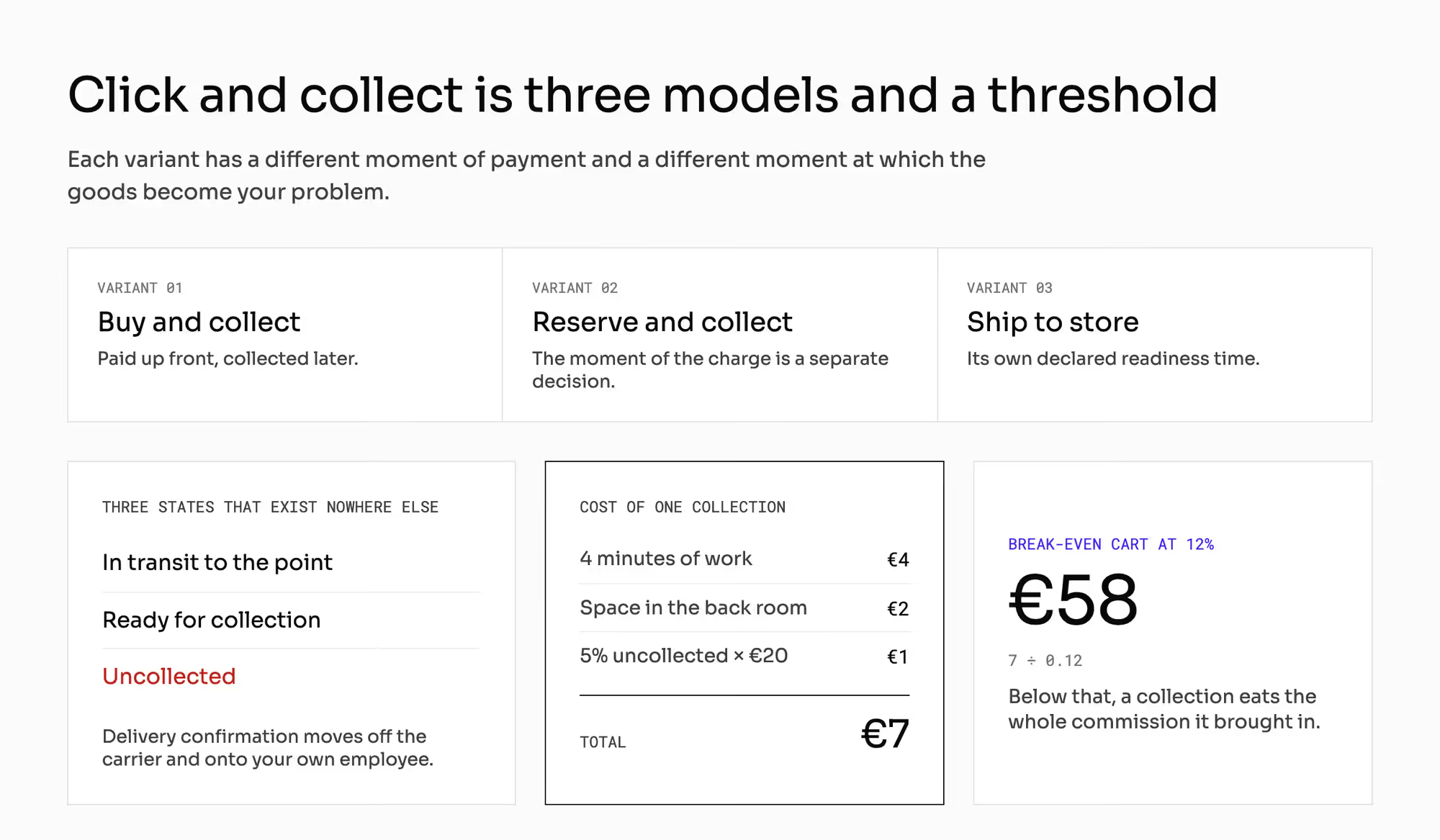
Public standards for describing offers treat in-person collection as a separate delivery method attached to the offer rather than to the store, and they distinguish at least three variants: buy and collect, reserve and collect, and ship to store, each with its own declared readiness time. This is not a dictionary nicety: each of the three has a different moment of payment and a different moment at which the goods become your problem.
In the marketplace variant, the seller sends a parcel to your point with the buyer's details on the label, and your employee takes it in, matches it to the order, notifies the customer and hands the goods over. You add at least three states that exist nowhere else (in transit to the point, ready for collection, uncollected), and you move delivery confirmation off the carrier and onto your own employee, who has to be trained for it separately.
There is also a limit that catches people out at launch: not every seller has access to every network of collection points. The list of points shown to the buyer has to be narrowed to the ones this particular seller ships to.
Otherwise, you are selling a collection that cannot be performed.
Work out the break-even point before you decide this is free footfall in the store. Assume four minutes of work at €1 a minute, €2 for the space in the back room, and 5% of parcels going uncollected, each of them costing €20 to send back and handle.
That is 4 + 2 + 1 = €7 per collection, so at a 12% commission the threshold lands on a cart of about €58 (7 ÷ 0.12). Below that amount, a collection eats the whole commission it brought in.
The reservation variant adds a separate question about the moment of the charge and about payment on handover.
Can one seller run in two fulfillment models at once?
This is the default case rather than the exception. The same seller ships the bulky items themselves and hands you the small stuff for fulfillment.
The design conclusion: the fulfillment model has to be a property of the offer or of the order line rather than a property of the seller. Both solutions of this class that we know settle it exactly that way.
If the model is pinned to the seller's account in your setup, every change needs a second account, and the reports stop agreeing with each other.
Three obligations follow. The per-seller report has to have a model filter, or you are comparing their punctuality with your own.
Fees have to be chargeable per model, because a line you shipped costs something different from a line they shipped (split payments and who pays the fees). The buyer has to see the difference wherever it is real.
The delivery date and the way goods are collected differ between models of the same seller inside one cart (a cart with several sellers and the delivery date you promise).
The selection criterion is the assortment category rather than the platform. What settles it is size, unit value, turnover, how prone the goods are to being returned, and whether they need assembly.
Small fast-moving items make the case for fulfillment from your warehouse; bulky equipment never will. So you pick the model per category, but you calculate profitability per model, across its whole volume.
What do fulfillment models change about the rest of your build?
1. The number of models enters the rollout budget as a multiplier
Each additional one is a full set of statuses, documents (78), and order closing rules (73).
2. The fulfillment model changes the axis of the order split
The decision is taken before you design checkout rather than after it (checkout with several sellers).
3. It also changes whose metrics you are measuring
Everywhere you do the moving yourself, the seller's statistics have to be switched off or corrected.
4. What it does not change is who is party to the contract
Shipping out of your warehouse does not make you the seller, and dropship does. That call belongs to "Which marketplace platform model should you choose", and liability for the goods belongs to whether you are an intermediary or a seller.
How do you choose a fulfillment model?
- Count how many models you can carry. The realistic answer at launch is one, exceptionally two. Design the data model for all of them, and switch them on one at a time.
- For each candidate, answer the four questions from this article. If any of the answers is "we do not know yet," the model is not ready to launch.
- Work out the difference between the fee and the cost of the movement, and multiply it by a realistic volume. A result below the cost of one full-time person means the model is a favor to sellers rather than a line of business. That can be a deliberate decision.
- Set a cart value threshold for in-person collection and check what share of your orders falls below it.
- Ask your vendor for five things, shown on screen: the fulfillment model set on the offer and not on the seller · taking the shipment confirmation right away from the seller on selected orders · excluding those orders from the seller's statistics · a list of points narrowed to the ones available to that particular seller · the fulfillment fee as a separate settlement line rather than as a commission correction.
Which mistakes do operators make about fulfillment models?
1. Treating the choice of model as a one-time decision
A year later you have three of them, and not one counted separately.
2. The model pinned to the seller instead of to the offer
The first seller working in two models forces a second account, and their results stop being comparable.
3. Taking over the shipping without taking over the attribution
Your delay lands in the seller's metric, and they find out about it at suspension.
4. In-person collection launched with nobody costing out the point
Footfall in the store is a real benefit, but it has to be measured rather than assumed.
5. Storing someone else's goods with no exit rule
With no written deadline for sending them back to their owner, your warehouse turns into somebody else's depot, and its turnover is steered by your own offer algorithm.
What do you still have to settle about your own models?
This article settles nothing about shipping setup: zones, methods, logistics classes and rates are zones, methods and shipping rates, carriers, labels and tracking are 76, and stock levels and selling above stock are 77.
Who answers to the buyer for the goods is whether you are an intermediary or a seller. When the withdrawal window starts running on in-person collection is who delivers the buyer's rights, and that one you confirm with a lawyer.
Who issues which document is who issues which invoice, and the mechanics of a refund and of the commission on a refund are who pays for a refund and the commission on a refunded order.
All the numbers in this article are openly hypothetical. Carry the arithmetic across, not the values: substitute your own picking cost, your own carriage rate and your own share of uncollected parcels.
And one number that appears in no documentation you will have to measure yourself: what percentage of your orders goes through each of the models. Without it, every calculation above is an exercise.
Summary: How many fulfillment models can you afford?
Fewer than you will end up with. Sellers ship their own parcels, part of the assortment goes out of your warehouse, premium brands run on dropship, and the moment you have stores, somebody asks for collection in person.
None of that is avoidable; what is avoidable is discovering the price afterwards. Each model brings its own states, documents, settlement lines, and exception paths, and it also becomes another axis of the order split, so one cart can come apart into four parts instead of three.
The arithmetic of taking the work in-house is worth doing before the warehouse is involved: on the canonical cart, the difference between the seller shipping and you shipping is four euros.
Ask a vendor to show an order where the seller packs and your network dispatches, and find the button that says shipped. Building a marketplace where each fulfillment model has its own states, documents, and settlement line from the start?
Frequently asked questions on marketplace fulfillment models
What are the fulfillment models on a marketplace?
The fulfillment models on a marketplace are defined by four answers rather than by their names: who holds the stock, who moves the goods, whose carriage contract it is, and what enters settlement beyond the commission. Seller-shipped, operator-fulfilled, dropship, and collection in person are the familiar labels, and each of them is a different set of answers.
Should a marketplace fulfil orders from its own warehouse?
A marketplace should fulfil from its own warehouse once the volume covers the people doing it. On a €1,000 cart, a €25 fulfillment fee leaves €4 after carriage and picking, so a single full-time person on that stream needs around 2,000 orders a month before the model stops taking money away.
What happens to seller quality metrics when you ship for the seller?
When you ship for the seller, their quality metrics stop measuring them and start measuring your warehouse. Those orders have to be excluded from the seller's statistics explicitly, which is a separate action and the kind that gets forgotten until the first suspension for somebody else's late dispatch.
Ready to build?
We build marketplaces where every fulfillment model has its own states, documents, and settlement line from the first release.