
AI for Marketplaces: Where It Is Worth Using and What It Costs

AI for marketplaces means models that read your marketplace data and return an answer: a filled-in product field, a category, or a risk score. A "model" in this chapter means any such tool from any vendor.
Every AI vendor brings a demo, and the demo shows the model on its best case. It doesn't show what one wrong answer costs you. It also doesn't show how long it takes you to notice.
You have to decide where AI starts in your marketplace and where it stays out. Work out the cost of a mistake before the rollout. Otherwise, you find it later in your catalog or in your seller payouts.
This article breaks down:
- Which two numbers decide whether AI for marketplaces pays off?
- Which AI use cases should a marketplace start with?
- What makes human review of AI output work on a marketplace?
- What does AI cost at marketplace volume?
Key insights
- Two numbers decide whether AI for marketplaces pays off: the price of one mistake and the time it takes you to notice it. A catalog model that gets 5% of items wrong costs you about 200 minutes of corrections a day. A payout model with the same error rate costs you €44,000 a month.
- A marketplace should start its AI use cases with catalog data cleanup and with mapping seller files onto your fields. A mistake there costs a minute or a reimport, and you see it within hours. Money decisions come last.
- Human review of AI output works on a marketplace when you set a confidence threshold, count a fixed control sample, and give someone the hours to fix errors. A sample of 200 items a week shows you the difference between a 5% and a 10% error rate.
- AI cost at marketplace volume is the unit price times the number of items times the number of passes. Recomputing 200,000 items every night at a hypothetical 3 cents each costs €2.16 million a year. Recomputing only the 4,000 items that change each day costs 50 times less.
Which two numbers decide whether AI for marketplaces pays off?
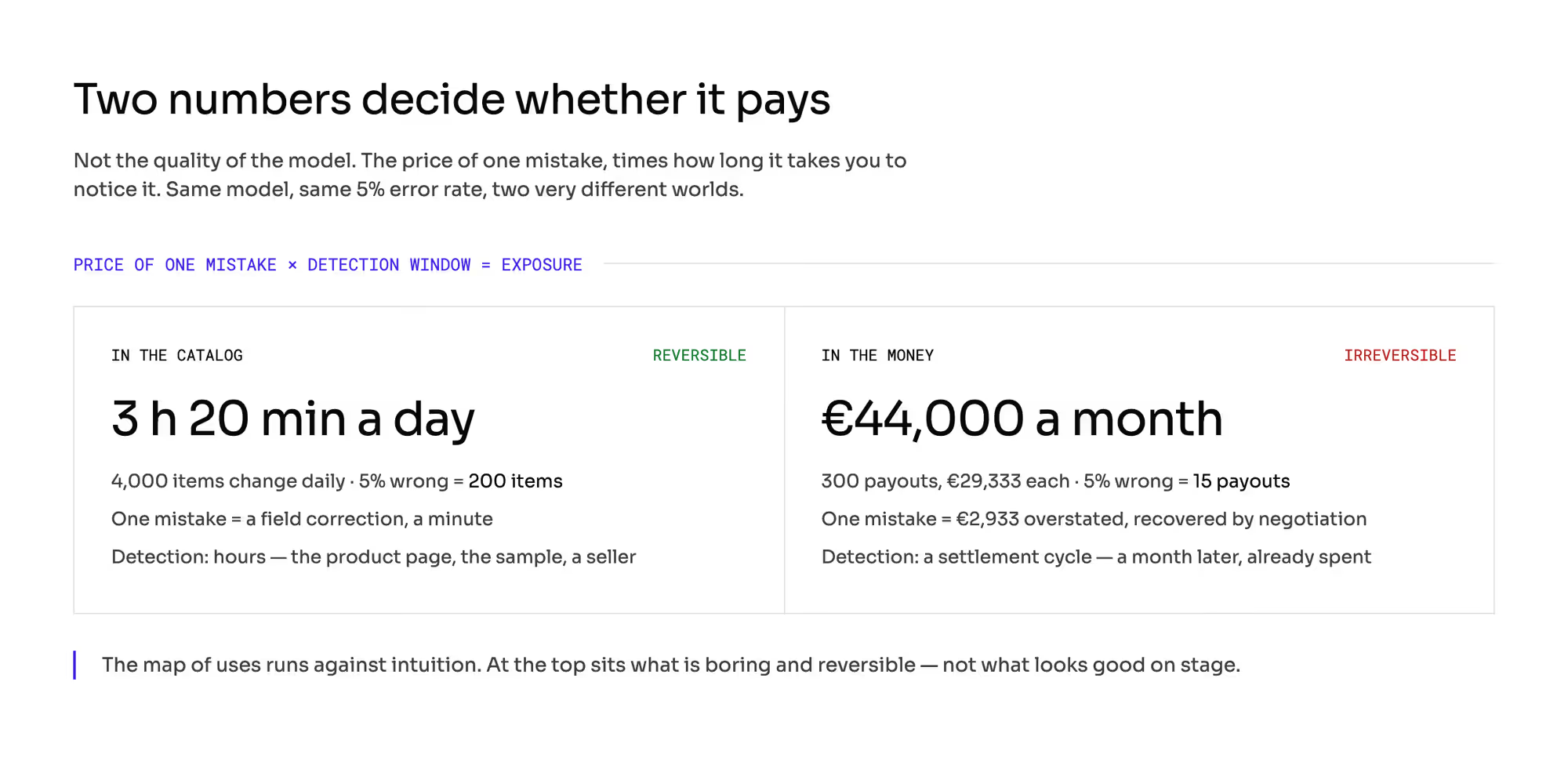
The price of one mistake is the work it takes to undo one bad result. The detection window is the number of bad results that pile up before you notice them. Multiply the two, and you get your exposure.
Exposure depends on your data and on your processes. Use it to choose where to start with AI.
This series uses one hypothetical marketplace for its arithmetic. It has 300 sellers and 200,000 active offers. Buyers place 10,000 orders a month.
The average cart is €1,000, and your commission is 12%. That gives you €10 million of turnover a month.
Say 2% of the catalog changes every day. That's 4,000 items, and the model gets 5% of them wrong.
How much does a 5% AI error rate cost in the catalog?
The model gets 200 of the 4,000 daily items wrong. Each one needs a field correction of about a minute.
The detection window is short. The error shows up on the product page, in your control sample, or in a message from the seller.
The catalog mistake costs you 200 minutes of work a day, just under three and a half hours.
How much does a 5% AI error rate cost in seller payouts?
Sellers receive 88% of turnover. That's €8.8 million a month across 300 accounts. The average payout is €29,333.
Say a model calculates part of each payout and gets the same 5% wrong. That's 15 payouts, each overstated by 10%.
Each one is €2,933 too high. Together they add up to €44,000 a month.
The detection window here is a settlement cycle. You find out a month later, and by then the sellers have spent the money. You have to negotiate with each seller to get it back.
The chapter on marketplace payment reconciliation covers how you find such a difference.
The model and its accuracy are the same in both cases. The same model costs you €44,000 a month and 15 difficult conversations in seller payouts.
Which AI use cases should a marketplace start with?
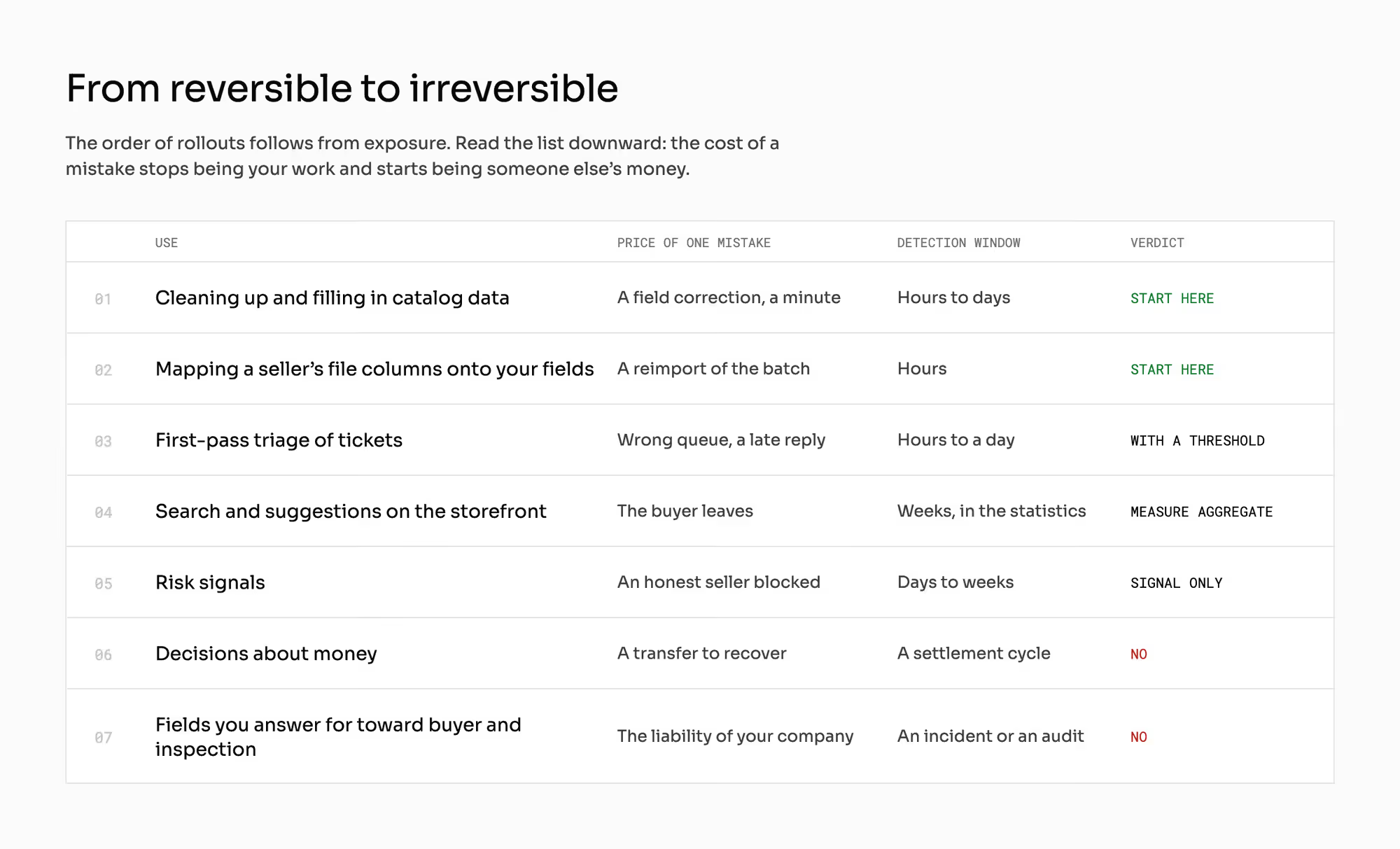
Rank each AI use case by the price of one mistake and by the detection window. Start with boring work you can reverse. The first two groups below pay back fastest, because a mistake costs a correction and shows up straight away.
1. Catalog data cleanup
AI has the most work to do in your product data. Rejected and unfinished offers pile up every month your marketplace is live. No one goes back to them, because fixing them manually doesn't fit into anyone's job.
AI can fill in missing attributes and assign categories. A wrong field costs a minute to correct. You see it within hours or days on the product page.
The chapter on catalog debt covers how big that stock of offers gets and who owns it. The chapter on product data quality covers what you can require from sellers and how to generate a description from attributes.
2. Mapping seller files onto your fields
A seller has their own product file with their own column layout. They'll either retype it into your template or skip your marketplace.
A file that doesn't fit your template is one of the biggest reasons a seller doesn't list their assortment. AI can map their columns onto your fields. This is sometimes the cheapest way to add supply.
A mistake here costs a reimport of the batch. You see it on the first preview of the batch, before the offers reach buyers.
3. First-pass ticket triage
Ticket triage works when the model proposes a queue and a priority, and a person writes the answer. A mistake puts a ticket in the wrong queue or delays the reply. You notice within hours, or within a day at most.
Set a confidence threshold before you switch triage on. The chapter on seller requests covers the queue itself, from brand approvals to category exceptions.
4. Search and suggestions in your online store
You'll never see a single search mistake. A buyer doesn't find the product and leaves. The loss shows up weeks later in your conversion rate.
Measure search in the aggregate, because a handful of examples tells you very little. The chapter on faceted search covers filtering across sellers' offers.
5. Risk signals
A risk score from a model is an input to a human decision. It should never block a seller or a buyer on its own. A wrong score blocks an honest seller or lets a fraudster through, and you find out after days or weeks.
The chapter on marketplace fraud prevention covers buyer fraud, seller fraud, and collusion.
Every seller you restrict will ask you for the reason, and you need the record behind it. The chapter on the P2B regulation covers suspension and the reasons you owe sellers.
6. Decisions about money and fields you answer for
Leave two groups for later: decisions about money and the fields you answer for to buyers and inspectors. A mistake in these areas costs someone else's money or creates liability for you.
A wrong payout comes back after a settlement cycle as a transfer you have to recover. A wrong safety warning comes back after an incident or an inspection. The model may handle both tasks well, but each error here costs you the most.
What makes human review of AI output work on a marketplace?
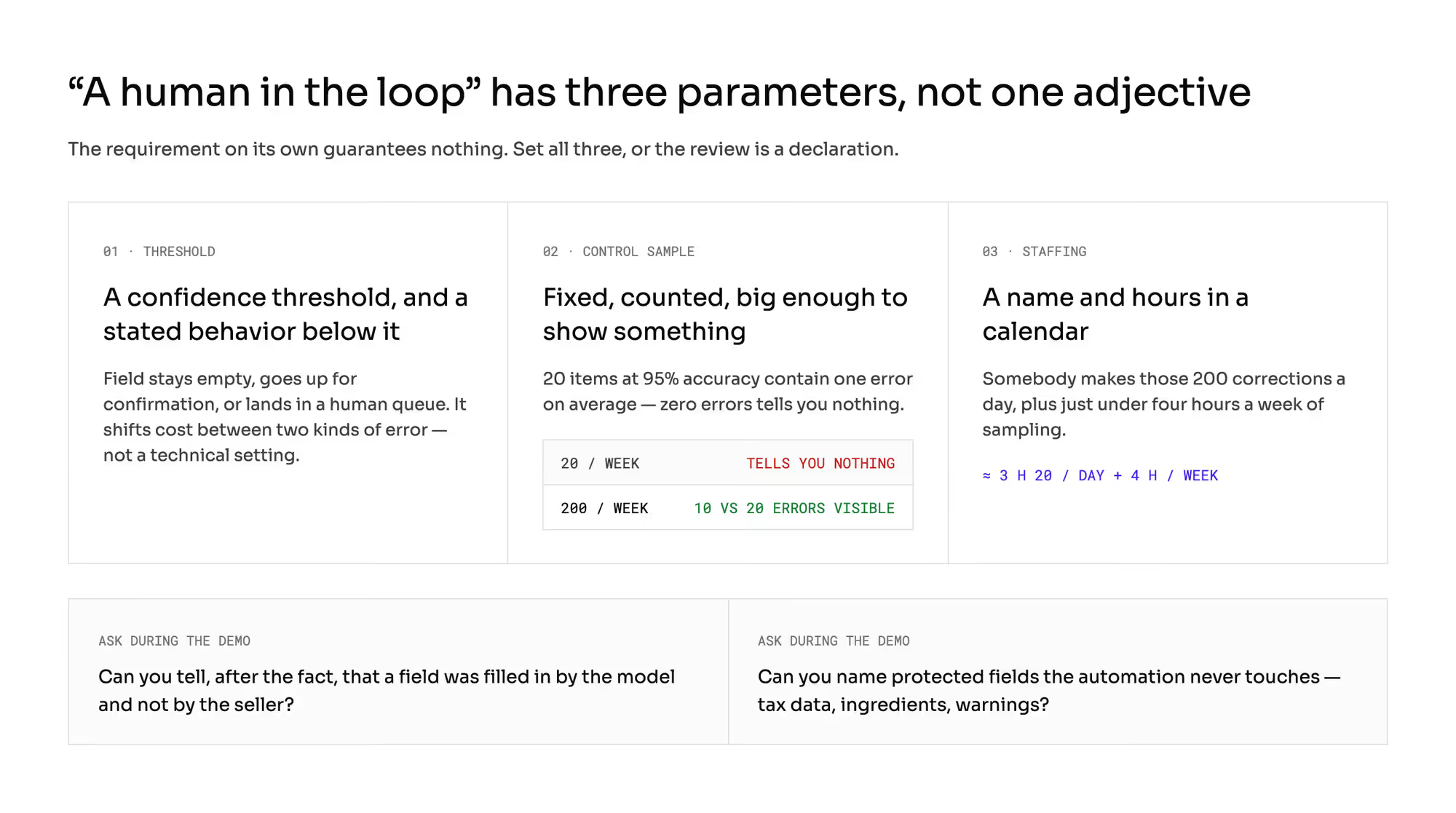
A human in the loop means a person reviews the result before it takes effect. Vendor decks list it as a feature.
A rule that a person reviews the output doesn't protect you on its own. The person checking an automated system often can't judge its output. A review step can also make people trust a tool before anyone has measured its accuracy.
Set these four things before you switch review on.
1. Confidence threshold with a rule for weak results
The model returns an answer with a measure of how sure it is, and you decide what happens to a weak result. A weak result can leave the field empty or wait as a suggestion for confirmation. It can also go to a human queue.
You trade one kind of error for the other when you set the threshold. A high threshold sends more items to people. A low threshold lets more mistakes through to buyers.
Machine learning researchers call this learning to defer: the model learns when to hold back and hand the case to an expert. The chapter on product matching covers thresholds for matching an offer to a product page and both kinds of error.
2. Control sample with a fixed size
A spot check helps only if the sample is big enough to show something. If the model is 95% accurate, a sample of 20 items holds one error on average. Zero errors in that sample tells you very little.
A sample of 200 items a week holds about 10 errors at a 5% error rate and about 20 at 10%. You can see that difference without any statistics. The sample costs just under four hours a week, about half a day of one person's time.
3. People with hours for the corrections
Someone has to fix the 200 wrong items a day from the catalog example. The review doesn't happen until you name that person and book their hours.
The chapter on product approval shows how to size the throughput of such a queue.
4. Provenance marker and protected fields
Ask whether you can tell after the fact that the model filled in a field. You can't roll back a batch or measure accuracy if you don't have that marker. You also can't answer a seller who asks why their data looks different from what they sent.
Better tools also let you name protected fields that the automation never touches. Tax data, ingredient lists, and safety warnings belong there. Ask about this setting during the demo.
What does AI cost at marketplace volume?
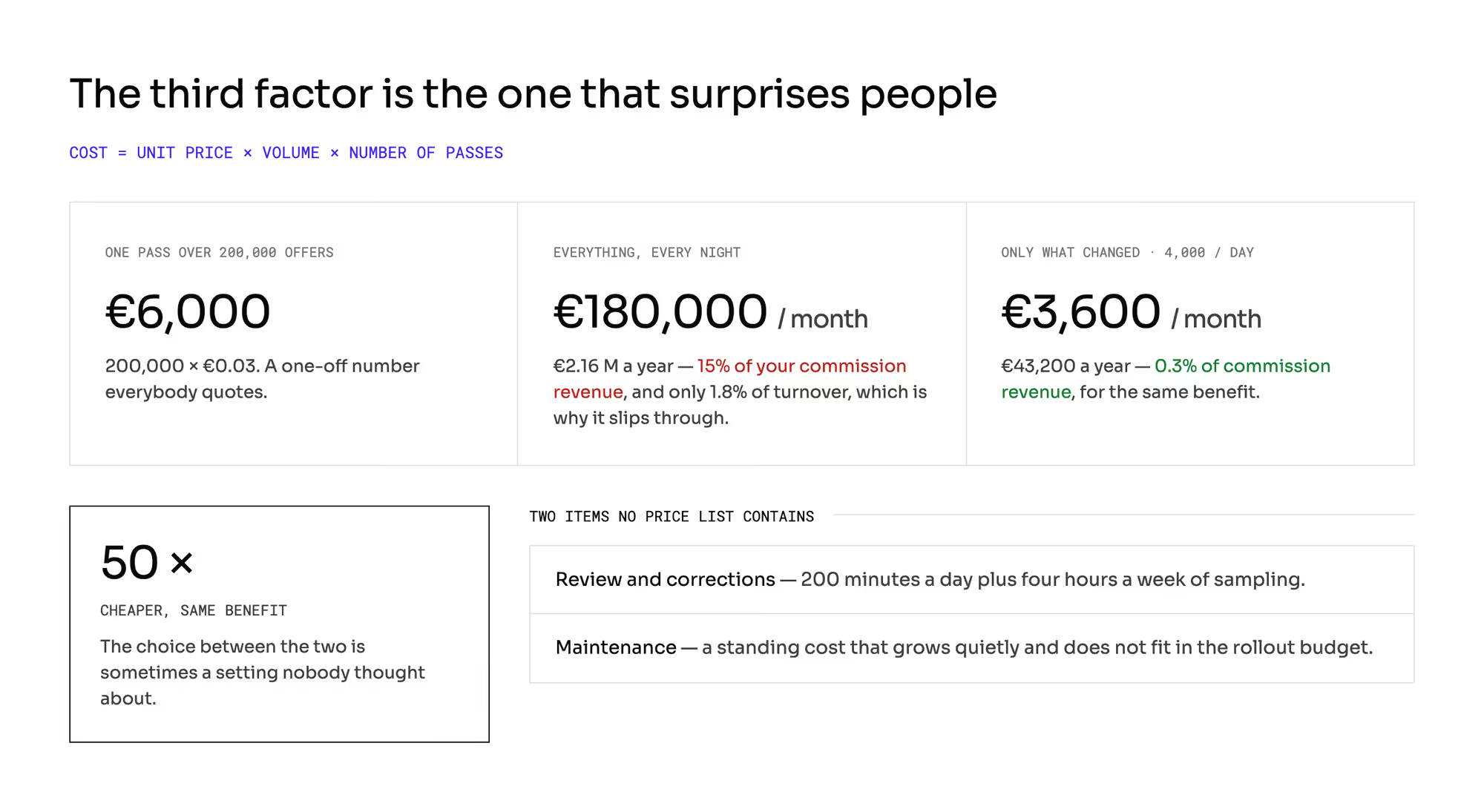
AI cost is the unit price times the number of items times the number of passes. The number of passes makes the biggest difference.
Take a hypothetical unit cost of 3 cents per item. Replace it with the one from the quote in front of you.
How much does AI cost per pass over a marketplace catalog?
A single pass over the whole catalog costs €6,000. That's 200,000 items at €0.03 each.
Recomputing the same catalog every night, the cost becomes €180,000 a month. That's €2.16 million a year for the same answers on items that didn't change.
Recomputing only the 4,000 items that change each day costs €120 a day. That's €3,600 a month.
The yearly total is €43,200. You get the same benefit for one-fiftieth of the cost.
How does AI cost compare with your commission revenue?
AI cost looks smaller than it is when you set it against turnover. Your marketplace turns over €120 million a year, and your 12% commission brings in €14.4 million.
The nightly full pass costs €2.16 million a year. That's 15% of your commission revenue, even though it's only 1.8% of turnover. The changed-items version costs 0.3% of commission revenue.
Which AI costs don't appear on a vendor's price list?
Review and correction don't appear on any price list. This chapter's example needs four hours a week for the sample and 200 minutes a day for fixes.
Maintenance doesn't appear there either. A system built on a model pays off fast, and then you keep paying to maintain it. That cost grows over time, and the rollout budget rarely covers it.
The price of computing at a fixed quality level falls fast and unevenly across tasks. It drops tens of times in a year on some tasks. It falls much more slowly on others, and the fastest drops are the least certain.
This chapter quotes no rates, because a printed rate would go out of date before your rollout ends. The method of counting stays valid, and you can reuse it with each new quote.
How do AI use cases on a marketplace compare by risk?
Mistakes in the top rows cost less, and you see them sooner. Start at the top and work down as your measurement improves.
Where do you use AI? | What does it take to undo one mistake? | How long until you notice? | What should you do? |
|---|---|---|---|
Cleaning up and filling in catalog data | a field correction, about a minute | hours to days | start here |
Mapping seller file columns onto your fields | a reimport of the batch | hours | start here |
First-pass ticket triage | a ticket in the wrong queue, a late reply | hours to a day | use it with a threshold |
Search and suggestions in your online store | a buyer who doesn't find the product and leaves | weeks, and only in aggregate statistics | use it and measure the aggregate |
Risk signals | an honest seller blocked or a fraudster let through | days to weeks | use it only as a signal into a queue |
Decisions about money | a transfer to recover from a seller | one settlement cycle | keep it out for now |
Fields you answer for to buyers and inspectors | your company's liability | an incident or an inspection | keep it out for now |
What marketplace data may you send to an outside AI vendor?
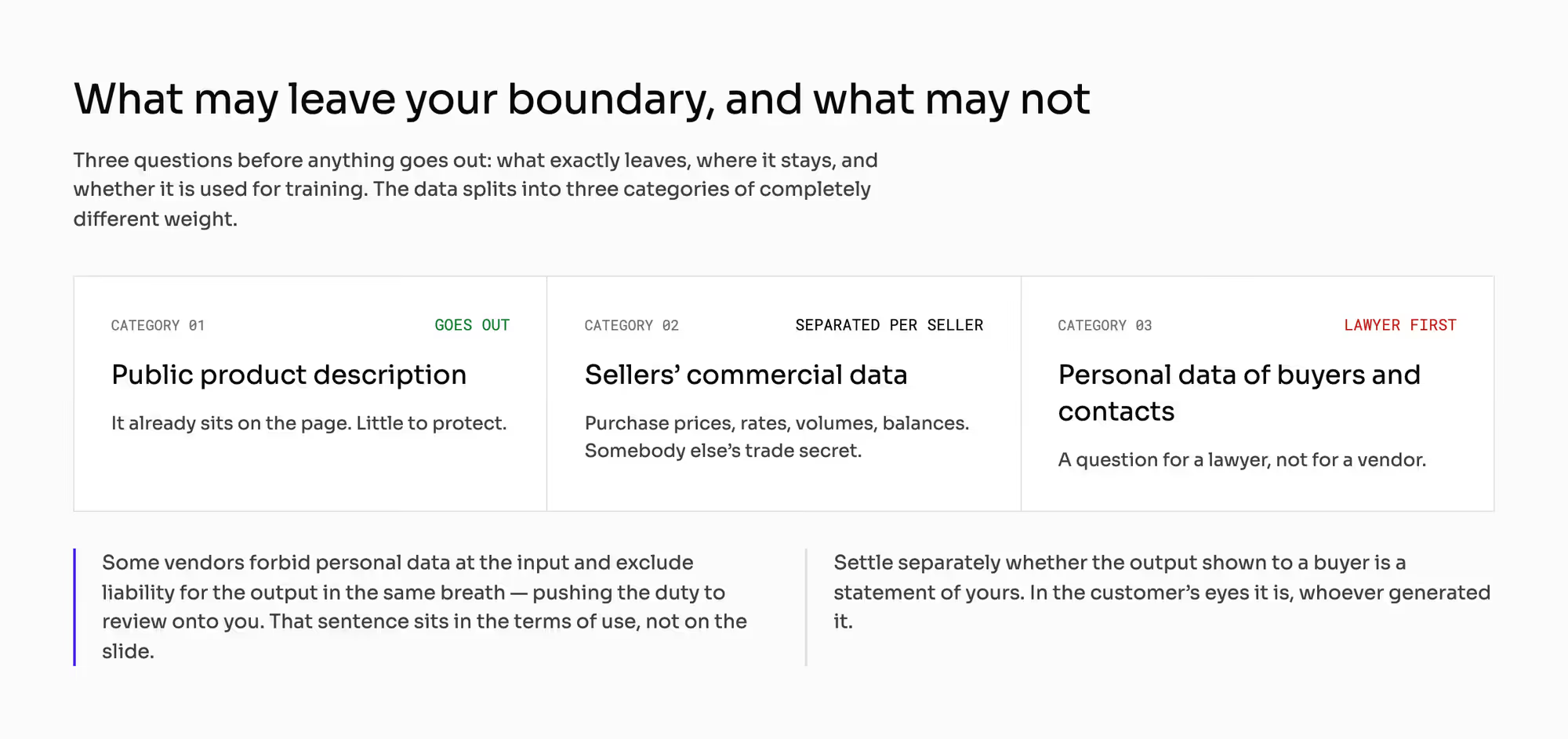
Ask three things before any data leaves your system: what goes out, where it's stored, and whether the vendor trains on it. The answers depend on which data the feature needs.
Also decide who answers for AI text that goes back to buyers. The buyer reads any text on your marketplace as yours, whoever generated it. The chapter on marketplace liability covers the limits of an intermediary's liability.
1. Public product descriptions
A public product description can go out without much risk. It's already on your product page for anyone to read.
2. Sellers' commercial data
Your sellers' purchase prices and balances are their trade secrets. The same goes for their rates and sales volumes.
Treat an outside AI vendor like another seller when you decide which of this data to send. The chapter on data isolation between sellers covers how you keep it apart.
3. Personal data of buyers and contact people
Ask your lawyer about personal data before you ask a vendor. The chapter on marketplace GDPR covers your role as controller or processor.
Some vendors forbid personal data in the input of their AI features. Their terms of use often exclude liability for the output and leave the review duty with you.
What does AI change in your marketplace?
Use exposure to decide the order of your AI rollouts. Start where a mistake costs a minute and shows up within a day. It's the only place where you can learn to measure a model's quality without risk.
Every AI use case adds human work to your team. Work shifts from producing data to reviewing and correcting it. Put that line in the budget, or the rollout ends with the threshold set to let everything through.
Vendors' models catch up with each other quickly, and the same quality gets cheaper within months. Vendors differ in the terms around the model.
Compare the confidence threshold and the provenance marker. Then compare the recomputation counter and the liability clause.
You need a record of which fields the model filled in and when. You can't undo a bad batch without it. The chapter on the marketplace audit log covers what to record and how long to keep it.
How do you check an AI feature with a vendor?
Ask these five questions, and ask to see each answer on your own data:
- Can you test it on my file? Take one night's batch from your real catalog, with its dirty data and empty columns.
- What does it do when data is missing? Give it an item without a required attribute. "It leaves the field empty" and "it fills in the most likely answer" describe two different products.
- What happens to a wrong result? Ask who undoes it and whether you can see which fields came from the automation. Ask whether you can restore what the seller sent and name the fields it never touches.
- Who answers for the output? Ask for that clause in the contract terms and read it before you sign.
- What does it cost at my volume? Ask for the billing unit and whether it recomputes everything or only changes. Ask where you see the counter and whether you can set a monthly cap.
Then do one piece of homework for the fifth question. Work out the exposure for two AI use cases someone is proposing to you now, and set it against the price. Work out the price of one mistake before you buy.
Which mistakes do operators make with AI on a marketplace?
Each of these mistakes shows up months after the rollout. By then, the wrong data is live, or the money has gone out.
1. Treating a vendor demo as a measurement
Accuracy depends on your assortment and on your sellers' files. A number from someone else's demonstration doesn't carry over to your data.
2. Human review with no hours behind it
The review is in the project plan, but it isn't in anyone's calendar. After a few weeks, the queue grows, and someone changes the threshold to clear it. The automation then works with no review, and no one formally decided to stop it.
3. Starting with decisions about money
The biggest savings show up in money processes because they're the most expensive ones. You also notice mistakes there last. You then have to talk to someone about a refund.
4. Paying per recomputation with no counter or cap
A full nightly pass in this chapter's example costs 50 times more than recomputing changes. The difference is sometimes a single setting no one thought about.
5. AI output you can't tell apart from seller data
You lose track of which fields came from the model within six months. You can't roll back a batch, and you can't defend your data when a seller objects.
What do you still have to settle about AI on your marketplace?
This chapter doesn't tell you what accuracy you'll reach. That depends on your categories, on your sellers' files, and on how you define an error. Measure it on one category and one batch before you sign for the whole catalog.
This chapter doesn't forecast what AI tools will do in a year. It covers what's routine today.
This chapter isn't legal advice. Before your first rollout, write down three areas for your lawyer:
- Rules on artificial intelligence systems.
- Personal data protection. The chapter on marketplace GDPR covers the marketplace side.
- Information duties toward buyers and sellers, including whether and how to label generated content. The chapter on P2B regulation covers what you owe sellers.
Every number in this chapter is hypothetical and shows the method. Put in your own volume and unit cost. Then add your own price of one mistake and calculate your exposure.
Summary: Where is AI for marketplaces worth using?
AI for marketplaces is worth using where a mistake costs a minute and shows up within a day. Catalog cleanup and seller file mapping come first. Ticket triage and search follow with a threshold or an aggregate measure.
Risk scores only feed a human queue. Decisions about money and the fields you answer for wait until you can measure quality.
A 5% error rate costs 200 minutes a day in the catalog and €44,000 a month in payouts. Recomputing only what changed costs 0.3% of your commission revenue, against 15% for a nightly full pass.
Building a marketplace that uses AI where a mistake is cheap and keeps people on the decisions that cost money?
Frequently asked questions on AI for marketplaces
What are the best AI use cases for a marketplace?
The best AI use cases for a marketplace are catalog data cleanup and mapping seller files onto your fields. A mistake there costs a minute of correction or a reimport. You also see it within hours, and that lets you measure the model's quality without risk.
How is AI in eCommerce different on a marketplace?
AI in eCommerce usually works on one retailer's own data, and AI on a marketplace works on data from hundreds of sellers. A wrong field or a wrong payout affects a seller's business. You also need to know which fields the model filled in and which ones the seller sent.
How much does AI cost for a marketplace?
AI cost for a marketplace is the unit price times the number of items times the number of passes. Recomputing 200,000 items every night at a hypothetical 3 cents each costs €2.16 million a year. Recomputing only the 4,000 items that change each day costs 50 times less.
Ready to build?
We build marketplaces that start AI on catalog data, with a confidence threshold and a monthly cap on computing cost.