
Ecommerce Promotions on a Marketplace: Who Runs Them and Who Funds Them

Ecommerce promotions on a marketplace run on an assortment you do not own: you announce a date, invite several hundred independent sellers, and whatever they submit before the list closes is the campaign you get.
You announce a campaign with a date on it, and the assortment for it does not belong to you. You collect it from companies under no obligation to answer.
If you have not counted this out as a recruitment funnel, you find out three days before the start that the page is ready and there are a hundred offers on it rather than a thousand.
This article breaks down:
- Why is a campaign a recruitment problem?
- What does the funnel do to your offer count?
- Who funds the discount?
- What happens when 3 discounts stack?
Key insights
- A campaign is recruitment because the assortment belongs to somebody else: between the invitation and a full page stand several hundred independent businesses, and the date is announced before any of them have answered.
- The funnel eats a third of the list: 500 invitations give 125 submitting sellers and 1,500 offers, moderation rejects 20%, another 15% falls away before the start, and 1,020 offers open the campaign.
- Nobody decides who funds the discount, and it gets funded anyway: on a −15% campaign with the commission taken from the discounted price, you give up €18 and the seller €132, which is €36,000 of difference across 2,000 orders.
- Three discounts on one offer differ by €30 a unit: multiplicative stacking lands at €680, additive at €650, and a fixed −€100 on top leaves the seller €510.40 instead of €880, which nobody approved.
Why is a marketplace campaign a recruitment problem?
In your own store, a campaign is a decision: you pick the products, set the prices, publish. In a marketplace, it is an invitation.
Between the invitation and a page full of offers stand several hundred independent businesses, each of which answers or does not, submits what it wants, and pulls out when it wants.
Everything else in this article follows from that. An operator campaign has a funnel, a deadline, and a conversion rate, so you plan it like recruitment rather than like a feature.
It has a moment for sending invitations, closing the list, moderating submissions, and publishing the campaign page: a landing page, meaning a separate page you send traffic to. That page has to be ready no matter how much you collected, because you announced the date earlier.
This is the only area of marketing where your team publicly promises something that does not yet exist in the system.
Which 3 sources can a discount come from?
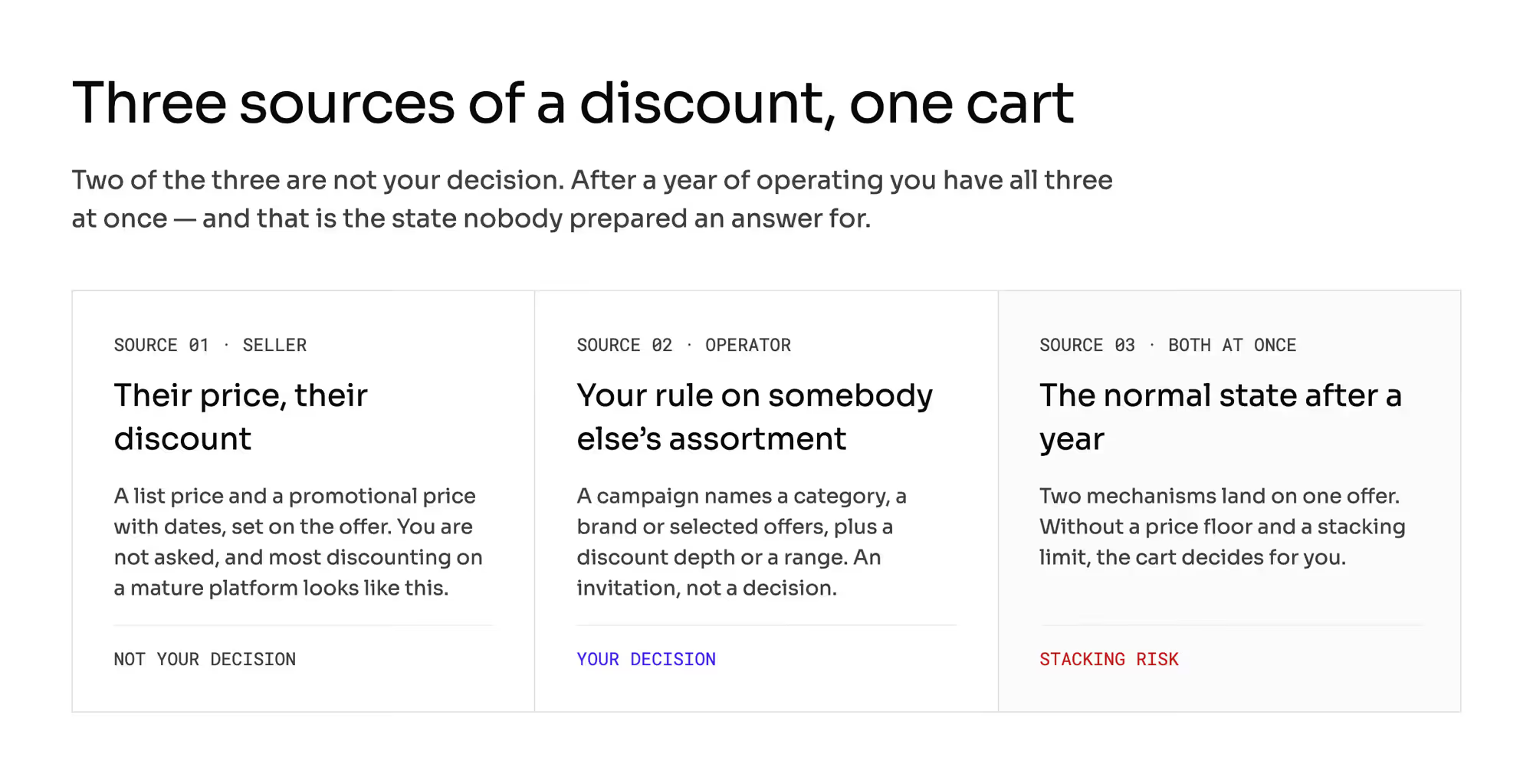
The seller runs a promotion on their own side and does not ask your opinion. They hold a list price and a promotional price with dates on the offer, and that is what most discounting on a mature platform looks like.
That is no flaw: the seller sets the price, so the seller sets the discount too. You run a campaign on their offers: your rule descends onto somebody else's assortment.
It names a category, a brand, selected offers, a discount depth, or a range. Both at once is the most common state after a year of operating, and it is the one that raises questions with no prepared answer.
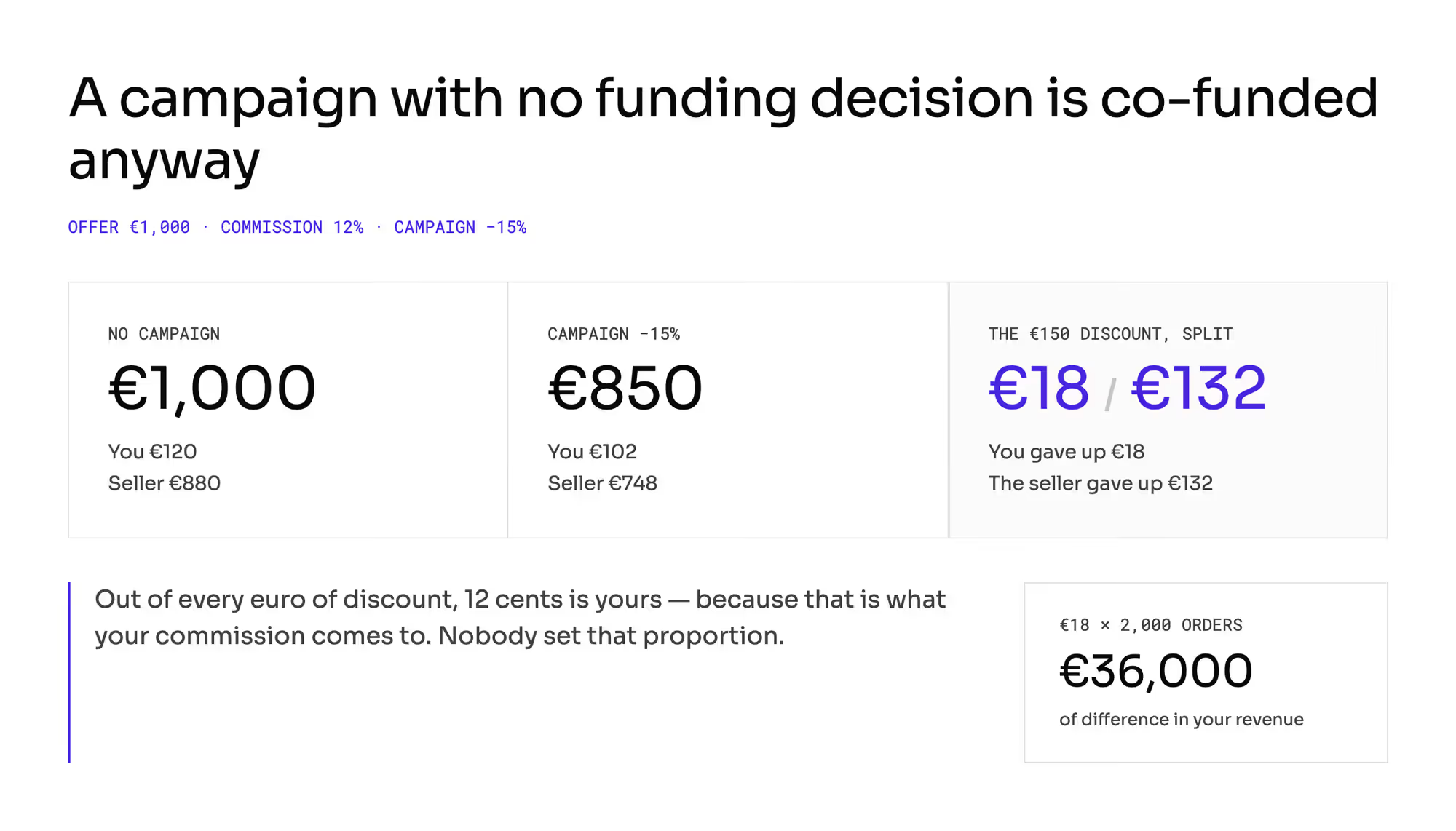
Start with the canonical example of this series. The offer costs €1,000, and the commission is 12%, so you have €120, and the seller receives €880.
A campaign of −15% comes in, and the price drops to €850.
If you calculate the commission from the discounted price, you have €102, and the seller has €748. The discount comes to €150, and it has already been split: you gave up €18, and the seller gave up €132.
Nobody set that proportion. Out of every euro of discount, 12 cents is yours, because that is what your commission comes to.
A campaign with no funding decision behind it is co-funded anyway, in a proportion nobody approved.
The amount you calculate the commission from after a discount is settled by split payments and who pays the fees. What matters here is the price of that decision: €18 on an order, across 2,000 orders, is €36,000 of difference in your revenue.
What does the campaign funnel do to your offer count?
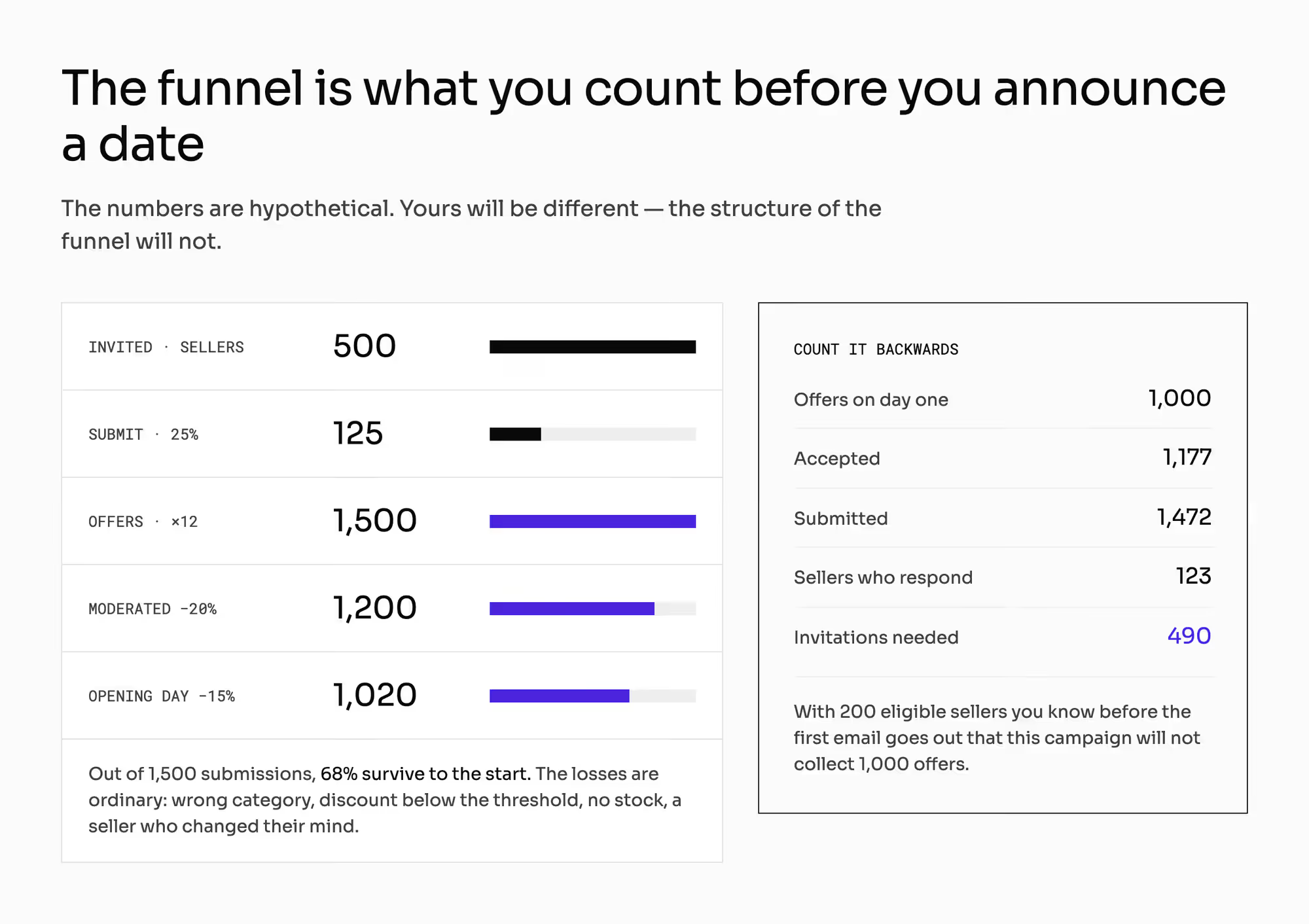
A seasonal campaign, categories selected. The numbers below are hypothetical.
Yours will be different, but the structure of the funnel is the same, and the funnel is what you have to count before you announce a date.
- 500 invited sellers who have assortment in the campaign categories.
- 25% submit something, so 125 sellers. The rest will not open the email or will not come down on price.
- An average of 12 offers per submitting seller, so 1,500 offers submitted.
- Moderation rejects 20%, so 1,200 offers. Wrong category, discount below the threshold, offer not cleared for sale, no stock.
- Another 15% falls away before the start, so 1,020 offers on opening day. The seller changed their mind, sold the stock elsewhere or raised the price.
Out of 1,500 submissions, 1,020 survive to the start, which is 68%. Count it backwards, because that is how the decision gets made: to have 1,000 offers on day one you need 1,177 accepted, which means 1,472 submitted, which means 123 sellers who respond.
That is around 490 invitations. With 200 eligible sellers, you know before the first email goes out that this campaign will not collect 1,000 offers.
Set the minimum threshold together with the date rather than after the fact. A page with 90 offers is a different product rather than a smaller version of the campaign: an editorial selection instead of a grid, one list instead of filters.
Plan B has to be ready, because that decision gets taken when the media plan is already bought.
What does campaign moderation check?
Moderation answers one question: does this offer meet the conditions of this campaign? Market Solutions turn that into an entry gate with a checklist: the offer is cleared for sale, the category is in scope, the discount sits in the declared range, and nothing else overlaps on the same offer.
There are known configurations in which moderation is off by default: convenient on your first campaign, expensive on your tenth. The mechanics of taking submissions are covered by requests from sellers.
Three things to settle before you send the invitations:
The list closes earlier than the campaign starts, and that earlier date is the real project deadline. Moderation, building the page, and producing the creative all have to fit between the two.
One date in the calendar is one date too few.
Pulling out after the page goes live is a normal event rather than an incident. A seller stops taking part in three ways: withdrawing the offer, selling the stock out, or raising the price so far that the discount no longer holds.
There is one answer: the campaign page reads the current state of the campaign rather than a copy of a spreadsheet from two weeks ago.
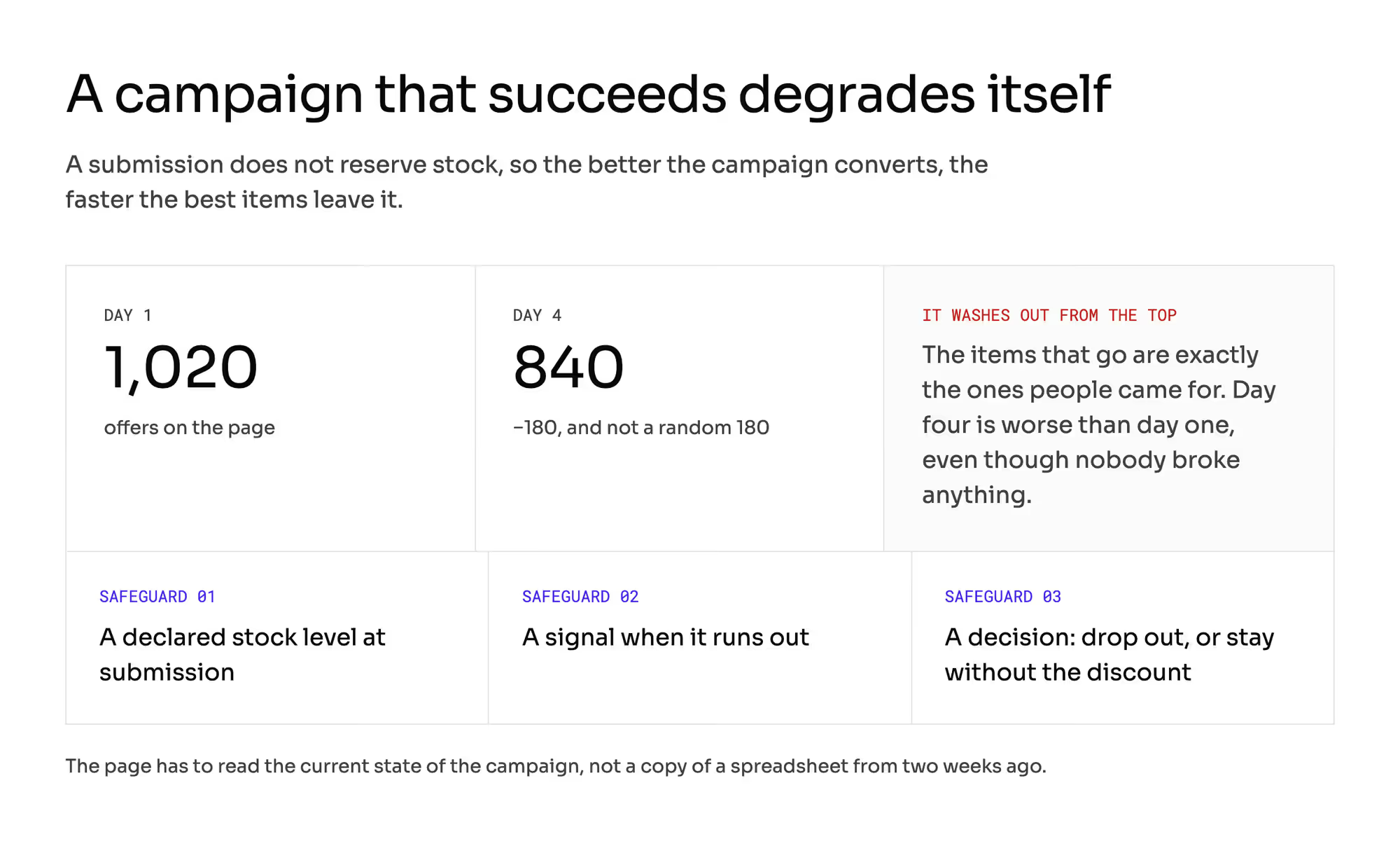
A campaign that succeeds degrades itself, and that is the warning this article carries. A submission does not reserve stock, so the better the campaign converts, the faster the best items disappear from it.
After two days, those 1,020 offers become 840, and the 180 that went are not random items. They are exactly the ones people came for.
The campaign washes out from the top, so the page on day four is worse than on day one, even though nobody broke anything. The safeguard is cheap: a declared stock level at submission, a signal when it runs out, and a decision on whether the item drops out or stays without the discount (stock levels and overselling).
Who funds the discount in a campaign?
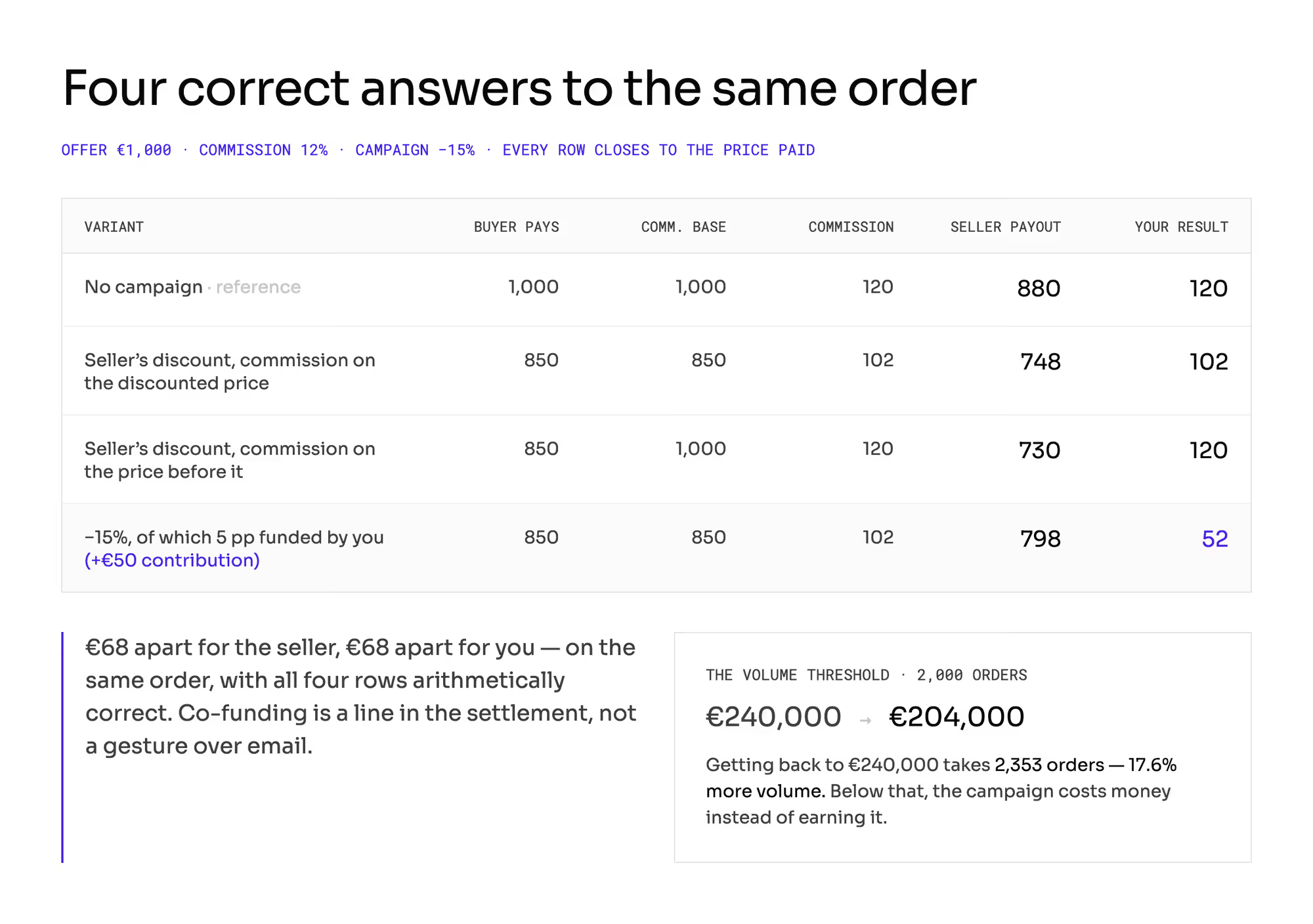
Co-funding is a line in the seller's settlement rather than a gesture. In solutions of this class, it is an explicit field on the promotion.
In solutions of this class, it is an explicit field on the promotion: what share of the discount is charged to the operator and what share to the seller. That value passes straight to the payout amount and into a report with separate columns for both sides.
The same −15% campaign on an offer priced at €1,000, in four settlement variants:
Every row closes to the price paid: 748 + 102 = 850, 730 + 120 = 850, 798 + 52 = 850. Four correct answers to the same order, differing by €68 for the seller and by €68 for you.
Two conclusions for your P&L. A campaign cuts your commission, so it has to lift volume: at 2,000 orders the commission drops from €240,000 to €204,000, and getting back to €240,000 takes 2,353 orders, which is 17.6% more.
That is arithmetic rather than a forecast. It is the threshold below which the campaign costs money instead of earning it.
And the second thing: the operator contribution is an amount paid out to the seller rather than a discount granted to the buyer, so it enters the ledger as its own line (the ledger behind a balance) and calls for a decision on whether it reduces revenue or is a marketing cost ("Marketplace Revenue Recognition: Do You Book the Commission or the GMV?"). What happens to it on a refund is handled by the commission on a refunded order.
What happens when 3 discounts land on one offer?
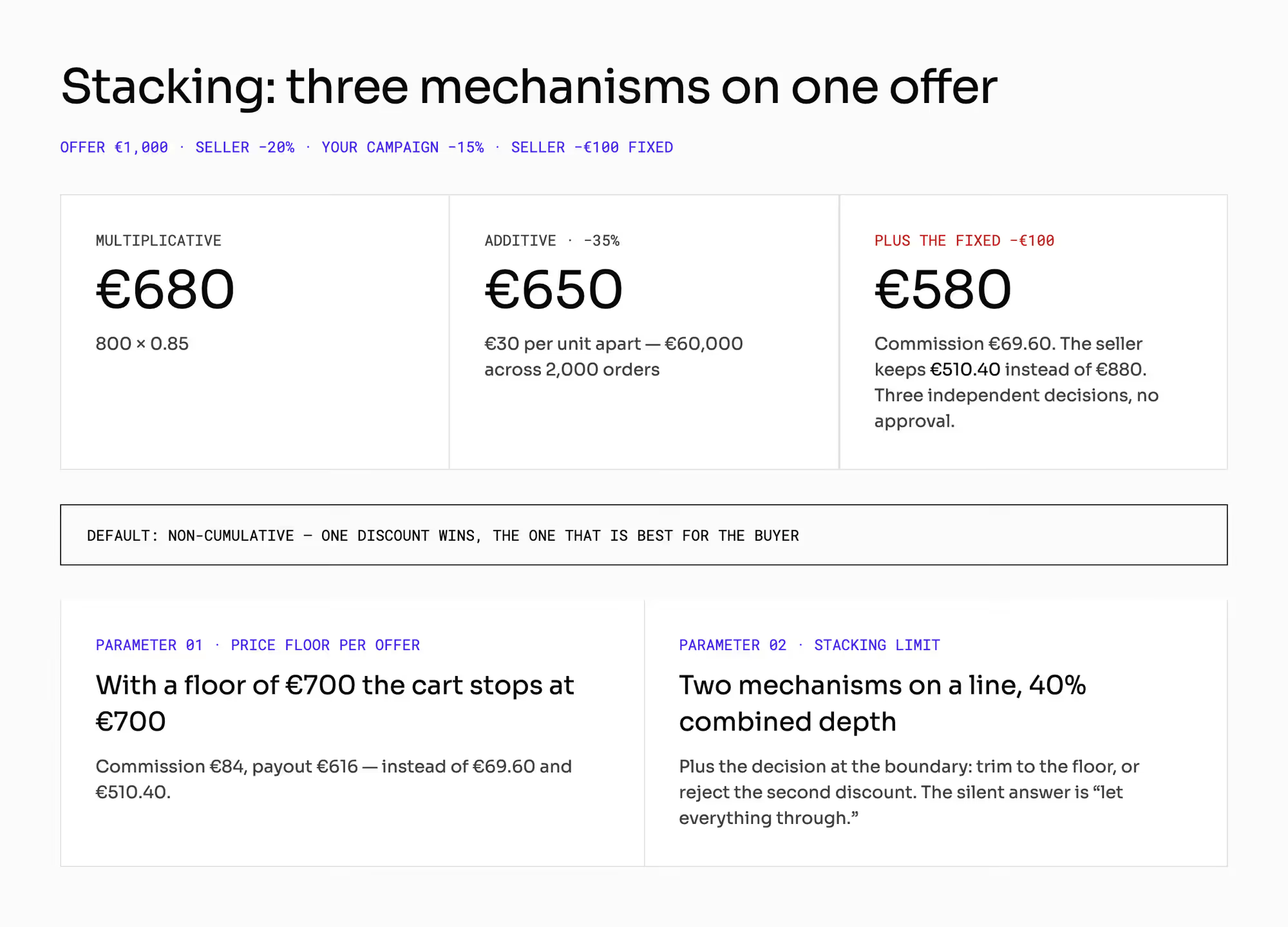
This is where money is easiest to lose with no trace of a decision. An offer at €1,000, the seller has their own promotion at −20% (€800), and your campaign comes in at −15%.
- Multiplicative stacking: 800 × 0.85 = €680.
- Additive stacking, meaning −35% off the starting price: €650.
- A difference of €30 per unit. Across 2,000 orders, that is €60,000. This is not a configuration detail.
Add a third mechanism, a fixed-amount seller promotion of −€100: 680 − 100 = €580. A 12% commission gives €69.60, and the seller is left with €510.40 instead of €880.
Nobody approved that. Three independent decisions just stacked up.
Default to non-cumulative: one discount wins, the one that is best for the buyer. That is how market solutions behave and what their own documentation recommends, and it warns outright that cumulative mode combined with seller promotions can drive a cart to zero.
The wider market confirms it. In e-commerce tooling, combining discounts is off by default and gets switched on separately for each pair, and the limiters take the form of a rule priority, a "do not apply further rules" switch, and a cap on the units the discount covers.
You need two parameters rather than good intentions. The first is a price floor per offer: the minimum below which stacked discounts will not go.
With a floor of €700, the cart above stops at €700, the commission comes to €84, and the payout is €616. The second is a stacking limit: the number of mechanisms and the maximum combined depth, for example, two mechanisms on a line and no more than 40%.
Add an explicit decision on what the system does once that boundary is crossed: trim to the floor, or reject the second discount. The silent answer is "let everything through."
Monitoring abuse is a report rather than a policy. You need one listing: offers whose price went up in the window before the campaign starts.
Whether such a discount is fair, and which price you may calculate the percentage from, belongs to price history and discount messages. How to show that percentage to the buyer belongs to showing the price.
How many hours does one campaign take today?
In most organizations, a campaign still consists of a spreadsheet and manual work: the operator sends out a template, the sellers send back SKUs with a list price, a promotional price, and sometimes a declared stock level, the spreadsheets go to marketing, and the page gets built by hand.
One campaign from the funnel above: invitations 2 hours, merging 123 spreadsheets 10 hours, checking 1,472 rows for compliance 8 hours, building and linking the page 6 hours, corrections along the way 4 hours.
That comes to 30 hours. At four campaigns a month, it is 120 hours, three quarters of a full-time job.
At eight, it is 240 hours, one and a half people retyping data from one format into another. Hence the question for your vendor: "How many hours does a campaign on 1,000 offers take with your tool?" rather than "do you have promotions".
What do campaigns change about the rest of your build?
1. A campaign changes the winner on the product page
If the rule that picks the default offer looks at price, one seller's discount reshuffles the BuyBox. That is the quiet side effect of every campaign (the rule that picks the winning offer).
2. The campaign calendar is a commitment to your sellers
The submission deadline, the admission criteria, the reason for a rejection, and the way terms get changed belong to your relationship with them, rather than to the marketing backlog, which is where the rules on decisions about sellers and the documents you sign with a seller pick this up.
3. A promotion pinned to an offer and a code pinned to a cart are two different things
A campaign acts on assortment, a code acts on the transaction, and the two are funded differently
Loyalty points on somebody else's offers are set out in the chapters on loyalty points on somebody else's offers, and paid visibility inside a campaign is explained in the chapter on selling paid visibility.
How do you count a campaign before you announce it?
- How many sellers are eligible for this campaign? Not all of them, only the ones with assortment in their categories. That is the numerator of your funnel.
- Run the funnel backwards from the number of offers that makes the page worth having. If the result exceeds the number of eligible sellers, change the scope or the format of the campaign.
- Set the minimum threshold and plan B before the invitations go out.
- Settle the commission based on a discounted price and calculate the difference on your expected volume, then the volume threshold at which the campaign earns back the commission revenue it gave away.
- Ask the vendor to show you rather than to describe: where you see the participation status of everyone invited, what the moderation queue looks like, where you set the price floor and the stacking limit, what happens to an item once its stock sells out, and which line carries co-funding into the payout and into reconciliation (payment reconciliation).
Which mistakes do operators make about campaigns?
1. A campaign planned from the page instead of from the funnel
The creative is finished, the media plan is bought, and the assortment is 200 items instead of 1,000. The page goes out into the world in a version nobody designed.
2. One date in the calendar instead of two
The list then closes on the day of the start, and moderation happens in a rush or not at all.
3. No price floor and no stacking limit
With one mechanism, everything works. It costs you at the third one, on your best-selling items.
4. Co-funding agreed over email
With no line of its own in the settlement, it comes back as a dispute over a payout and a manual correction at month close.
5. A campaign page built out of an export
Correct at the moment it was built, dead after the first withdrawal.
What do you still have to settle about your own campaigns?
This is not legal advice, and it deliberately contains no threshold, no deadline, and no name of a regulation. Five questions for a lawyer, on which the team needs answers in the form of a parameter rather than a principle:
- Whether, and how far, you may require a particular price or discount depth from a seller as a condition of taking part. This is competition law territory, and the answer changes how the invitation is built.
- On what basis you choose whom to invite, and whether eligibility has to rest on an objective criterion that sellers can see.
- How you document the rejection of a submission and a change to the terms of a campaign in progress.
- Whether items whose exposure somebody paid for have to be labeled on the campaign page. The duty to label paid content is carried by price history and discount messages, and the mechanics of selling visibility by selling paid visibility.
- What you promise the buyer if an announced offer disappears mid-campaign (who delivers the buyer's rights).
Families of regulation to put in front of a lawyer, without settling which apply to you: rules on competition protection in the part about setting resale prices, on the transparency of platform-to-seller relations, on the announcement of price reductions, on unfair commercial practices, and on digital services in the part about labeling paid messages.
Our claim is narrower and independent of those answers: a campaign whose funnel you did not count before you announced the date is a date rather than a promotional campaign.
Summary: What does a campaign on somebody else's assortment cost?
It costs a funnel you have to count before the date goes out, and a split of the discount that happens whether or not anybody decided it. In your own store, a campaign is a decision; here it is an invitation, and 1,500 submissions become 1,020 live offers by opening day.
Count that backwards and 1,000 offers on day one needs around 490 invitations, which tells you before the first email whether this campaign is possible at all. The money works the same way.
A −15% campaign with the commission taken from the discounted price gives up €18 of your margin per order without a funding decision behind it, and the volume needed to earn that back is 17.6% more orders. Then there is the part that only shows up on the best-selling items: a price floor and a stacking limit, or three mechanisms meet on one offer, and the cart lands somewhere nobody chose.
Ask a vendor how many hours a campaign on 1,000 offers takes in their tool, and where the price floor lives. Building a marketplace where a campaign is a funnel with a deadline rather than a spreadsheet?
Frequently asked questions on marketplace campaigns
How do marketplace campaigns work?
A marketplace campaign is an invitation with a deadline: you name the categories and the discount range, sellers submit offers, moderation checks them, and the page publishes whatever survived. That makes the submission deadline the real project date, because moderation, the page, and the creative all have to fit between it and the start.
Who pays for a discount on a marketplace?
The seller pays for most of it unless you decide otherwise, and your share is whatever your commission takes from the discounted price. On a −15% campaign, that split is €132 to €18 on a €1,000 offer.
Co-funding has to be a field on the promotion that reaches the seller's statement, rather than an agreement in an email.
Should discounts stack on a marketplace?
Discounts should not stack by default, and the usual rule is that the best single discount wins. Where stacking is allowed, two parameters keep it finite: a price floor per offer and a limit on how many mechanisms and how much combined depth one line accepts.
Ready to build?
We build marketplaces where a campaign is a funnel with two dates, a moderation queue, and a price floor on every offer.