
Marketplace Business Models 2026 Guide: Types, How They Work & Which One to Choose
Most retailers reach a point where the next step of growth costs more than the last one. Every new product line means more stock to buy, more warehouse space, and more people to run it.
The marketplace business model breaks that link. Someone else owns the stock, someone else ships it, and you earn a share of every sale you make possible.
That sounds simple until you have to choose a version of the model and commit to it. There are four main types, six common ways to charge for the service, and a set of trade-offs that decide whether the model works in your category or quietly drains money for two years.
This guide walks through all of them and ends with the questions that settle the choice.
Key insights
- A marketplace business model connects buyers with independent sellers and earns money from the transactions it makes possible. The operator builds the platform and sets the rules, but does not own the goods.
- 4 types of marketplace business model are: B2B, B2C, C2C, and C2B. The type follows from who sells and who buys, and that single choice shapes your pricing, operations, and legal duties.
- 6 marketplace revenue models are in common use: commission, subscription, listing fee, lead fee, freemium, and mixed. Most platforms end up mixing two or three once volume arrives.
- Growth compounds because more sellers bring more selection, more selection brings more buyers, and more buyers bring more sellers. Classic retail has no equivalent loop, which is why it slows down as it grows.
What is a marketplace business model, and how does it work?
A marketplace business model is a way of running an online business where a marketplace platform brings buyers and independent sellers together and takes a share of the value it creates.
The online marketplace model treats the transaction itself as the product. The digital platform handles discovery, trust, payment, and the rules of engagement, and it serves two distinct user groups at the same time. The sellers handle their own stock, pricing, and shipping.
The defining feature is that the operator sits between the two sides without buying the goods. The platform operator earns by facilitating transactions, so revenue tracks volume. It no longer tracks purchasing decisions made months earlier.
A classic retailer buys stock, holds it, and hopes it sells. A marketplace operator never takes that bet.
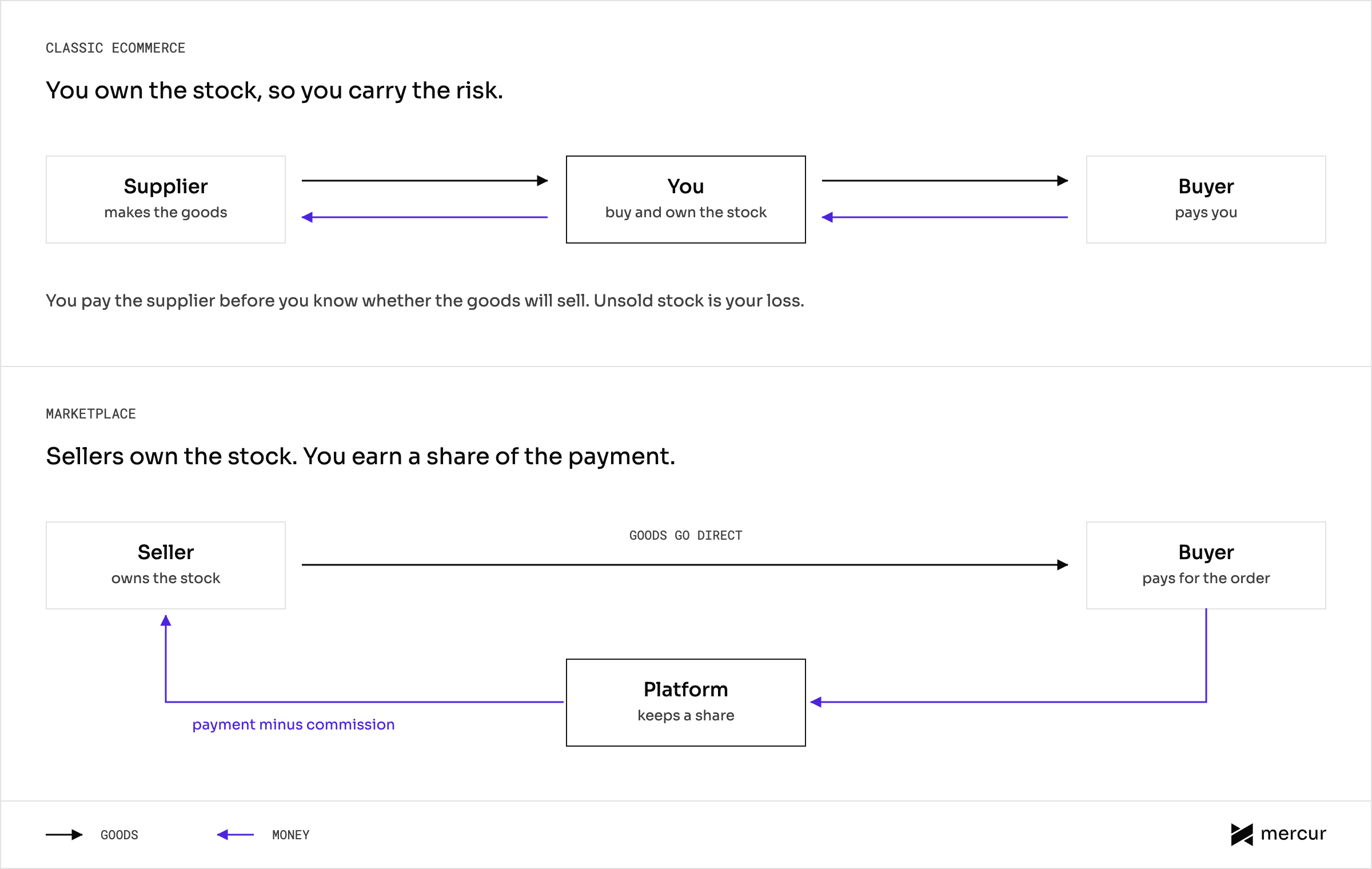
That difference changes what the business spends money on. Instead of working capital tied up in inventory, the spend goes into technology, seller acquisition, and the trust layer that makes strangers comfortable transacting.
If the model is new to you, our guide to what an online marketplace is covers the ground floor before the business model questions start.
Marketplace vs eCommerce: How does the online marketplace business model differ from traditional retail?
What changes | Classic eCommerce | Marketplace |
|---|---|---|
Who owns the stock | You do | The sellers do |
Who loses money when stock does not sell | You do | The sellers do |
Cost of adding one more product line | Buying stock, storage, and staff | Close to zero |
Where the money goes | Working capital tied up in inventory | Technology, seller acquisition, and trust |
Where revenue comes from | Margin on goods you bought | A share of the transactions you make possible |
Who ships orders and handles returns | You do | The sellers do |
Warehouse needed to open a new country | Yes | No |
What stops your growth | Capital and warehouse space | Demand and seller quality |
In classic eCommerce, you buy stock, you own it, and managing inventory is your job as well as your risk. Growth means buying more, which means more capital and more warehouse space.
In a marketplace, sellers carry that risk, and your growth comes from adding sellers instead of adding stock. The cost of one more product line drops close to zero.
Marketplaces need far less physical infrastructure, so they can open a new category or a new country without a warehouse and recruit sellers globally from the start. That is the main reason the model spreads quickly once a team has run it successfully once.
An eCommerce platform runs out of capital and warehouse capacity, while a marketplace platform runs out of demand or seller quality.
Our comparison of marketplace vs eCommerce models goes through the six points where classic retail stops scaling, and our write-up of inventory risk covers what owning stock does to a growing business.
What does the marketplace owner do and what do the sellers do?
The split of duties between the marketplace owner and the sellers is the part most teams underestimate. Writing it down early prevents arguments later, because every unclear duty ends up on the operator's desk by default.
Responsibility | Marketplace owner | Seller |
|---|---|---|
Platform, search, and checkout | Yes | No |
Rules on who can sell and what | Yes | No |
Product stock and pricing | No | Yes |
Listing content and product data | Sets the standard | Supplies the content |
Packing and shipping | No | Yes |
Buyer disputes and refunds policy | Owns the policy | Applies it |
Seller acquisition and onboarding | Yes | No |
The platform operator builds and runs the online platform: the storefront, search, seller onboarding, payment flow, dispute handling, and the policies that govern who may sell what.
The operator also owns the buyer relationship, which means the operator absorbs the complaints even when the fault sits with a seller.
Operators set a standard and then discover that enforcing it across hundreds of sellers is a job in itself, which is the subject of our guide to marketplace catalog management.
Sellers own their products. They set prices, manage their own stock levels, write their listings, pack the orders, and handle returns for the goods they sold.
This is why sellers keep control of their fulfillment process, and why they can join a marketplace without rebuilding how they operate. For most sellers, that freedom is the reason they join at all.
What are the four types of marketplace business models?
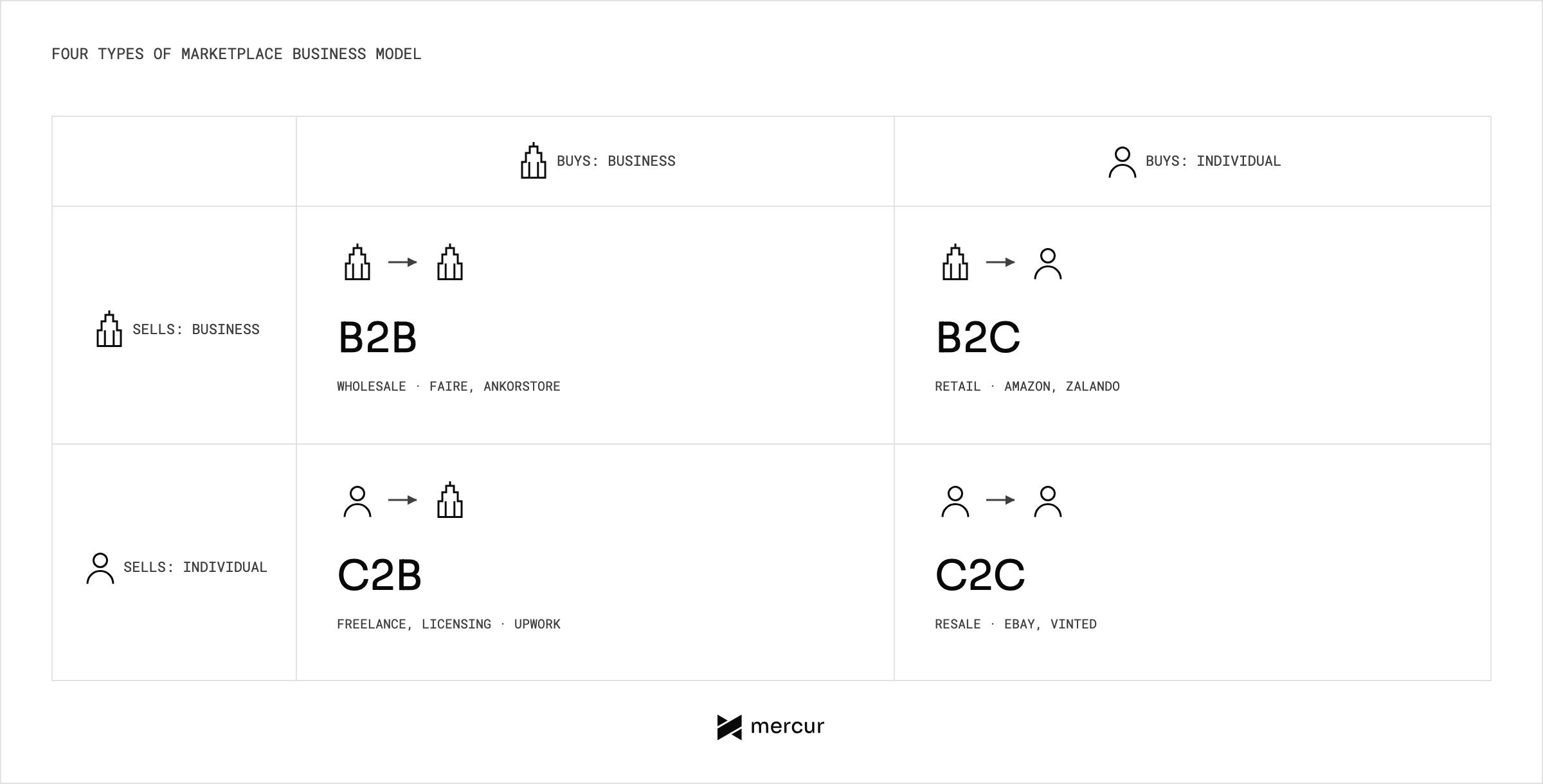
There are 4 different marketplace models, and these types come from a single question: is each side a business or an individual?
That gives you business-to-business (B2B), business-to-consumer (B2C), consumer-to-consumer (C2C), and consumer-to-business (C2B).
1) What is a B2B marketplace business model?
A B2B marketplace connects businesses that sell with businesses that buy, and no consumers take part. Wholesale, industrial supply, and procurement platforms all sit here.
B2B changes the shape of the product in ways that surprise teams coming from consumer retail. Buyers expect account-specific pricing, credit terms, purchase orders, approval flows, and repeat ordering.
A single customer may negotiate its own price list, which means the platform has to support prices that differ per buyer instead of one public price per product. Order values are high, and purchases repeat on a schedule, so a small number of accounts can carry a large share of revenue.
That concentration cuts both ways: winning one account moves the numbers, and losing one hurts. Our guide to building a B2B marketplace covers the flows that consumer platforms do not need.
2) What is a B2C marketplace business model?
A B2C marketplace lets businesses sell directly to consumers through one platform. This is the type most people picture when they hear the word marketplace, and it is the most common starting point for retailers adding third-party sellers.
The buyer expects the experience of a single shop even though many companies are selling. That expectation puts weight on consistent product data, predictable delivery promises, and one place to ask for help.
Sellers gain access to a broad range of buyers they could not reach alone, and a well-run platform gives them global reach without a single new warehouse.
Revenue almost always starts with commission because it scales with volume and asks nothing of a seller before their first sale. Consumer platforms also tend to add an ads model and promoted placement later, once there are enough sellers competing for attention to make the auction worth entering.
3) What is a C2C marketplace business model?
A C2C marketplace lets individuals sell to other consumers, which is why the type is often described as peer-to-peer commerce. Second-hand goods, collectibles, tickets, and local sales are the classic categories.
The economics are different because sellers are casual. They list one item, they may never list again, and they will not tolerate onboarding that takes an afternoon.
- Everything has to be effortless: photograph, price, publish.
- Payment protection matters more here than anywhere else, because neither side has a reputation to protect outside the platform.
- Low order values mean a commission on a single sale rarely covers the cost of handling a dispute about that sale.
C2C platforms therefore lean on volume, on paid visibility, and on optional services such as authentication or shipping labels.
4) What is a C2B marketplace business model?
A C2B marketplace turns the usual direction around: individuals offer something, and businesses buy it. Freelance work, stock photography, licensed content, and influencer services all run this way.
The platform's job becomes assessment, and logistics disappears from it. Buyers need a way to judge quality before committing, because the services sold here cannot be inspected in advance, which is why ratings, portfolios, and test tasks carry so much weight.
Payment is often held until work is accepted, which turns the platform into a guarantor. That role brings duties. Once you hold money between two parties, you are responsible for what happens when they disagree.
Which marketplace models exist beyond the four main types?
The four types describe who trades with whom. Several other patterns describe how the trade is organised, and they apply on top of any of the four without replacing them.
A B2B marketplace can be vertical and direct. A B2C marketplace can be hybrid and horizontal.
The table below sorts these types by what makes each one distinct, and the sections that follow go into the trade-offs.
Pattern | What makes it different | Works when | Struggles when |
|---|---|---|---|
Hybrid | Operator's own stock sits beside third-party offers | You already have a catalogue and an audience | Internal teams compete with sellers |
Service | Labour or expertise is sold, no goods change hands | Quality is hard to judge without help | Delivery cannot be standardised |
Rental or subscription | Access is sold, the seller keeps the asset | Items are expensive and used occasionally | Damage and recovery costs are high |
Direct or indirect | Platform either completes the sale or passes a lead | Depends on who owns payment | Buyers expect one place to pay |
Vertical or horizontal | Assortment is narrow and deep or wide and shallow | Depends on how buyers shop the category | Narrow markets cap total demand |
1) What is a hybrid marketplace model?
In a hybrid marketplace model, the operator keeps selling its own products while third-party sellers list theirs on the same platform. Most large retailers that opened a marketplace run this way, because giving up an existing catalogue was never on the table.
The commercial logic is strong. Your own products anchor quality and margin, and third-party sellers extend the range without extra stock. Buyers see one wide catalogue and rarely care who ships what.
The difficulty is internal, and technology has little to do with it. A category buyer with a target for own-stock sales now competes with the sellers on the same platform, and both sides pull toward their own plan, a friction covered in our write-up of a real marketplace transition.
When multiple sellers offer the same product, competitive pricing decides who wins the sale, so you also need a rule for which offer gets shown, and our guide to the marketplace buy box covers what that rule has to do.
2) What is a service marketplace?
A service marketplace matches people who need work done with people who can do it. Home repair, cleaning, tutoring, logistics, and professional consulting are typical.
- Instead of tracking parcels, it has to help buyers judge quality, agree on scope, and settle disputes about work that was delivered in person.
- Scheduling and location matter more than stock levels.
- Pricing is harder than in goods marketplaces because every job is slightly different.
Platforms respond either by standardising the offer into fixed packages or by moving to a lead fee model, where the platform charges for the introduction and steps back from the transaction itself.
3) What is a rental or subscription marketplace?
A rental or subscription marketplace sells access instead of ownership. Equipment hire, fashion rental, holiday lets, and machinery sharing all work this way.
The model suits items that are expensive to buy and used occasionally, because renting spreads one asset across many users. Revenue per item is much higher over time than a single sale would be, which is the appeal for sellers.
The costs sit in the parts of the journey that a normal sale does not have: deposits, damage assessment, cleaning, and getting the item back. Every one of those steps needs a policy, and every policy needs someone to apply it. Teams that underprice this work discover the gap in the first busy season.
4) What is the difference between a direct and an indirect marketplace model?
In a direct model, the transaction completes on the platform. The buyer pays there, the platform takes its share, and the seller receives the rest.
In an indirect model, the platform hands over a qualified lead and the two parties settle between themselves.
Direct gives you data, control, and a reliable link between value delivered and revenue earned. You know what sold, at what price, and whether the buyer came back. It also gives you responsibility for payment, refunds, and everything that follows.
Indirect is cheaper to run and easier to launch, and it fits categories where the price cannot be fixed in advance, such as construction or bespoke manufacturing. The cost is blindness: you cannot see whether the deal happened, so you charge for the introduction and lose the ability to earn from repeat business.
5) What is the difference between a vertical and a horizontal marketplace?
A vertical marketplace covers one category in depth, and niche marketplaces are the narrowest version of that idea. A horizontal marketplace covers a broad range of categories with less depth in each.
Vertical marketplaces win on relevance, because the value proposition is obvious to both sides. You can build product data that fits the category properly, attract sellers who recognise themselves in the positioning, and rank for the searches that matter. The ceiling is the size of the category itself, so a narrow market caps how large the business can get.
Horizontal wins on total demand and on the chance that one buyer visit turns into several purchases. The price is that everything has to be generic enough to work everywhere, which usually means product data, search, and seller rules that suit nothing perfectly.
Most successful platforms started vertical and widened once one category worked. Widening is a decision you can make later, while narrowing after launching broad means telling existing sellers they no longer fit.
How do marketplace business models make money? 6 revenue models
Choosing a type tells you who trades on your platform. It does not tell you how you get paid.
Six revenue models cover almost all of the market. They differ in when the money arrives, in how marketplace fees are presented to sellers, and in how much risk a seller takes before seeing value.
Revenue generation comes from transaction fees, from access, or from visibility, and most platforms end up using more than one of the three.
Revenue model | Who pays | When you get paid | Best for | Main risk |
|---|---|---|---|---|
Commission | Seller | After each sale | Most marketplaces | Sellers route large orders off-platform |
Subscription | Seller | Monthly or yearly | Steady, high-volume sellers | Blocks small sellers at the start |
Listing fee | Seller | On publishing an item | High-value or scarce items | Punishes wide catalogues |
Lead fee | Buyer or seller | On introduction | Services and custom work | No link to whether the deal closed |
Freemium | Seller | Only for extras | Platforms needing supply fast | Free tier can be enough forever |
Mixed | Both sides | Several points | Platforms at scale | Complexity buyers and sellers resent |
1) How does the commission model work?
In the commission revenue model, the platform takes a percentage of each completed sale. Nothing is charged before a seller earns something, which is why this is the most common model and the easiest one to recruit against.
The rate has to reflect the value you provide, and the structure has to fit your category, which can be a percentage or flat fee, a rate per category, or a rate per seller.
Our guide to commission structures covers how the commission engine itself has to be built.
2) How does the subscription model work?
In the subscription revenue model, sellers pay a fixed monthly fee, or a yearly one, for access to the platform, and the platform takes little or nothing per transaction. Payment processing fees still apply on top, so the seller feels both.
Subscription fees make revenue predictable, which makes planning easier and rewards your best sellers by letting them keep the upside of a strong month. A monthly subscription fee also tells a seller exactly what the platform costs them.
The trade-off is at the other end of the range. A new seller with no sales still pays, so the model pushes away exactly the long tail that gives a young marketplace its selection.
3) How does the listing fee model work?
In the listing fee model, sellers pay for each item they publish, whether it sells or not, and listing fees are often paired with additional selling fees at the point of sale.
The fee acts as a filter. Sellers think before listing, which keeps obvious junk out and suits categories where items are valuable or scarce.
In categories where sellers carry thousands of items, the same fee reads as a tax on having a wide catalogue, and those sellers list only their best guesses.
That narrows your selection, which is the one thing a young marketplace cannot afford.
4) How does the lead fee model work?
In the lead fee model, the platform charges a referral fee for a qualified introduction instead of taking a share of a completed sale. Common in services, construction, and any category where the final price is agreed between the two parties.
It works when the transaction genuinely cannot happen on the platform. The weakness is that revenue stops tracking value: you get paid the same whether the lead turned into a large contract or went nowhere. Sellers notice the mismatch quickly, and the ones who convert poorly complain loudest.
5) How does the freemium model work?
In the freemium model, basic services are free, and the platform charges for premium services such as better visibility, analytics, more listings, or advanced tools.
Free access removes every reason not to join, so supply builds fast. That is valuable at the start, when selection matters more than revenue.
The risk is that the free tier is good enough for most sellers forever, so conversion stays low, and the premium features have to be worth buying on their own merit, and artificial limits on the free plan will show through.
Offering premium services works only when the paid services solve a problem a growing seller really has.
6) How does a mixed revenue model work?
A mixed revenue model combines several revenue strategies: a commission plus a subscription for larger sellers, or a commission plus paid placement.
Nearly every marketplace platform at scale ends up here, because no single way to generate revenue fits every seller and no single stream survives price pressure forever.
The discipline required is to keep the whole thing explainable. A pricing page that needs a spreadsheet to understand costs will lose you sellers who would otherwise have joined.
Why does the marketplace model scale better than owning inventory?
The four types and six revenue models describe the mechanics. The reason the model attracts so much investment is a growth pattern that classic retail cannot copy.
In a traditional business model, each new product costs money and each new customer costs money, and both costs keep rising as you grow.
In a marketplace, sellers add products at no cost to you, and those products attract buyers who then attract more sellers.
Growth stops being something you buy and becomes something the platform produces.
What is the marketplace flywheel and how do network effects build it?
A network effect means the platform gets more valuable to each user as more users join. On a marketplace platform, it works in both directions at once, so buyers and sellers alike gain from every new participant. A seller who used to chase one customer at a time reaches multiple buyers from a single listing.
Chained together, those two effects form what people call the flywheel. More sellers mean more selection, more selection attracts more buyers, more buyers make the platform more attractive to sellers, and the loop turns again with less push each time.
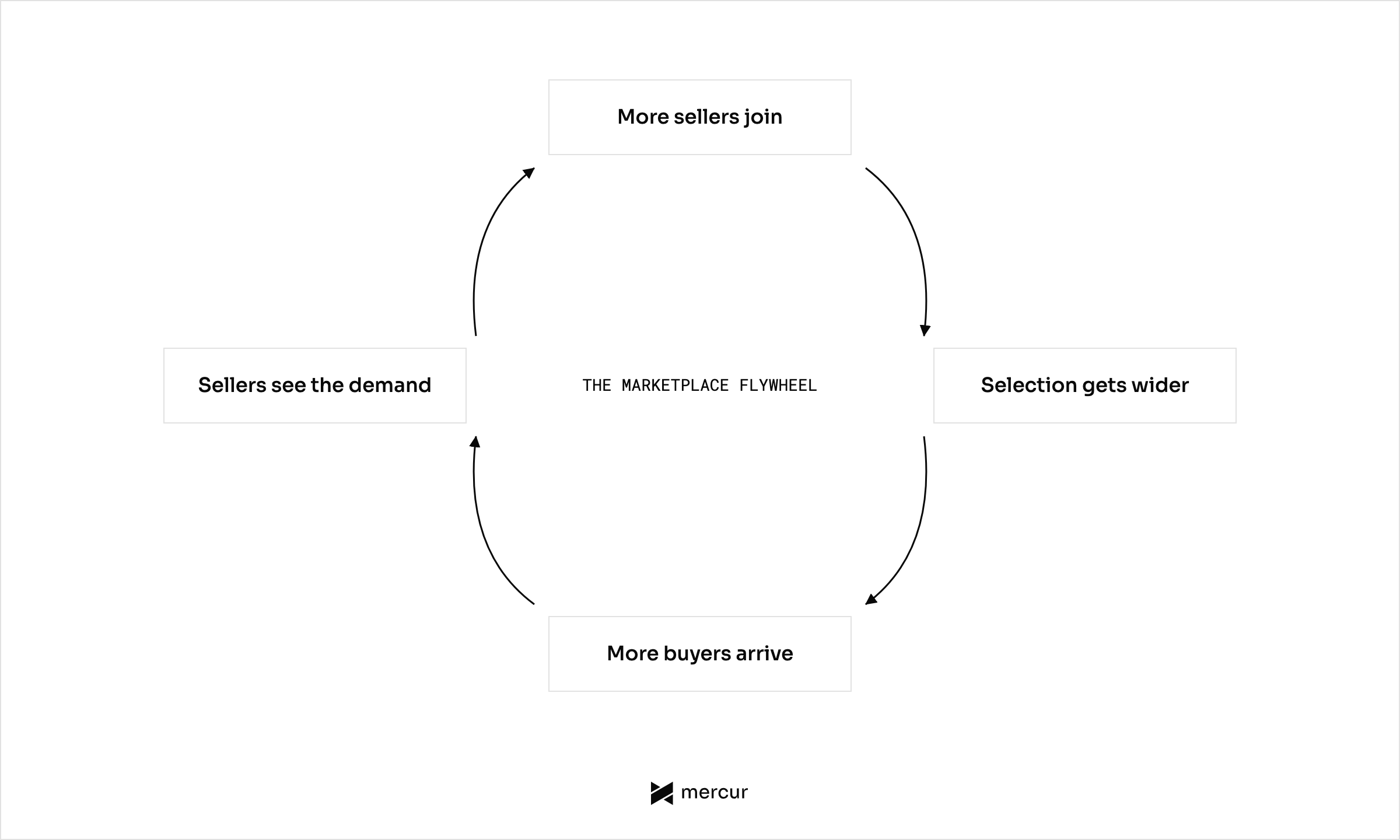
The payoff shows up in acquisition cost. In classic retail, you buy demand again for every stage of growth, and the price of that demand rises as the cheap channels saturate, which is the subject of our breakdown of why customer acquisition cost rises as you scale.
In a marketplace, part of your growth comes from selection and word of mouth that you did not pay for directly.
What are the main challenges of the marketplace business model and how to overcome them?
The online marketplace business model has real advantages, but it also has 4 failure patterns that show up again and again.
1) How to build trust between buyers and sellers?
Verify sellers before they can list anything. Check the company registration, confirm that the bank account belongs to that company, and get a named contact person. In the EU, this stopped being a choice: under the Digital Services Act, online marketplaces have to obtain and verify identifying information from traders before those traders can sell, display seller contact details to buyers, and make reasonable efforts to check the products on offer.
Hold the buyer's money until delivery is confirmed. The buyer's exposure then lasts only from payment to delivery, and a seller who disappears cannot take the payment with them.
Show seller performance on the offer itself. Rating, dispatch time, and how often orders end in a dispute, visible where the buyer decides and not buried in a profile page. Sellers who see their own numbers beside their competitors' improve without being asked.
Decide disputes yourself, against a deadline. A buyer who has to negotiate with a stranger will not come back, whatever the outcome. Set thresholds for dispute rate and late dispatch, and remove the sellers who cross them, because a rule you do not enforce costs you the trust of everyone who kept it.
Sellers hand you commercial information, and buyers hand you personal information, so where both are stored becomes part of the same question. Our write-up on marketplace data security covers what that obligation looks like in practice.
2) What makes a marketplace hard for a competitor to copy?
Three things take time to build and cannot be bought quickly.
Seller relationships are the slowest to copy and the most durable. A seller who has built their listings, their pricing rules, and their fulfillment process around your platform pays a real cost to move, and the sellers you helped grow recruit the next ones for you.
Depth of product data in one category beats breadth across ten. Attributes that fit the category, filters that match how buyers shop it, and complete specifications take months of work per category, and they are what make a buyer choose you over a general catalogue.
Repeat purchase. A buyer who comes back without a paid click costs almost nothing to serve again.
Discovery is moving as well. Forrester expects a third of retail marketplace projects to be abandoned as answer engines take traffic, because AI assistants reach the assortments of the largest platforms more easily than those of independent ones. That points the same way: a general catalogue competes with everyone, while a defined category gives buyers a reason to come to you specifically.
3) How do you run operations for buyers and sellers at the same time?
Buyers want fast delivery, easy returns, and one place to complain. Sellers want low fees, quick payment, and few rules. Serving both means settling four things before launch instead of during your first busy week.
Write down who owns each failure before you sign your first seller. A late shipment is the seller's fault and your problem, so the agreement has to say who refunds the buyer, who pays the return postage, and how long the seller has to respond.
Calculate the delivery promise from each seller's own dispatch time. One promise per offer, generated from data you already hold, so a buyer never sees a date the seller cannot meet.
Split the order at checkout. One basket containing three sellers becomes three orders, three shipments, and three return paths, which is the mechanism our write-up on the split basket problem works through.
Keep one support queue facing the buyer, with a response deadline for sellers behind it. The buyer talks to you and never to a stranger, and the seller's obligation becomes measurable.
The load grows with combinations instead of with sales, so automate the work that scales with seller count, which means onboarding and catalogue validation, and keep people on disputes. Our guide to retail digital transformation covers what that reorganisation looks like operationally.
4) Why does the cost of running a marketplace grow faster than its revenue?
Revenue grows with sales, and running costs grow with the number of sellers, whether those sellers sell anything or not.
Building is the smaller and more predictable half. Seller onboarding, catalogue rules, offer handling, commission logic, payment splitting, and a seller-facing panel all exist in marketplace software already, so the question is how much you configure and how much you write.
Running the platform is the half that never stops, and it scales with seller count. Every seller has to be onboarded, have their catalogue checked, have their data quality chased, and have their disputes handled. A seller who lists 400 products and sells three costs you money every month.
The number to watch is cost per active seller against revenue per active seller. When the gap closes, you have two levers: automate the work that repeats for every seller, or remove the sellers who do not trade.
Most business plans model neither, which is why ongoing cost is the line they underestimate. Our guide to custom marketplace development breaks down the build side, and creating your own marketplace covers costs by approach, along with the hidden items most teams miss.
How to choose the right marketplace business model?
To choose your marketplace business model, answer these 5 questions.
Work through them with the people who will run the platform as well as the people funding it. The operational answers change the commercial ones.
1) Who are your buyers and who are your sellers?
Your target audience decides the type, and the type decides most of what follows.
- Businesses buying from businesses need account pricing and purchase orders.
- Consumers buying from businesses need a single, consistent shop experience.
- Individuals selling to individuals need a listing to take a minute.
Be specific about the seller as well as the buyer.
2) Should you start niche or broad?
Start with the narrowest category that still contains enough demand to matter. Depth is what makes a young platform visibly better than a general one, and it makes seller recruitment easier because your pitch describes the seller's own market.
Our own research points the same way: a quarter of the operators and consultants we surveyed expect competitive advantage to shift toward specialisation and deeper vertical focus.
Widening later is a normal path. Narrowing later means asking sellers to leave.
3) Which is harder for you to get, sellers or buyers?
Every marketplace has two groups to recruit. Sellers supply the products, and buyers pay for them.
One of the two is always harder to win, and that group is where your launch budget and your founders' time have to go.
Three questions tell you which group is harder in your case.
How much work does joining cost each group? A buyer spends two minutes creating an account. A seller may have to export a catalogue, agree commercial terms, and change how they pack orders. The group that has to do more work is usually the harder one to recruit.
How many possible participants exist on each side? If your category has 300 potential sellers and 300,000 potential buyers, then sellers are the scarce group, and every single one of them matters.
What does each group lose by saying no? A buyer who declines shops somewhere else and loses nothing. A seller who declines gives up a sales channel, which means a seller can be persuaded with numbers.
In most retail categories, the answer is sellers. Retailers have a head start here, because they already have the buyers.
If buyers turn out to be the harder group, the whole plan inverts. You recruit sellers by offering exclusivity or better terms than they get elsewhere, and you spend your budget on reaching buyers.
Getting this the wrong way round is the most expensive mistake at launch, because you pay to acquire one group and it leaves before the other one arrives.
4) Which revenue streams fit your cost structure?
Match the model to how sellers experience risk.
If your sellers are small and cautious, a commission asks nothing upfront and gets you selection. If they are large and steady, a subscription gives them predictable costs and gives you predictable revenue.
Then check the arithmetic against your own costs. If handling one dispute costs more than the revenue on the order that caused it, the model needs a second stream.
Our guide to marketplace monetization models covers how the mix should change between launch, growth, and scale.
5) Which technology can carry the model you picked?
The platform decision comes last, once you know what it has to support, because the reverse order forces the business model to fit the software. Ask whether the marketplace platform can express your commission rules, your onboarding flow, and your product data standard without a rebuild.
Almost every marketplace changes its revenue model within two years, and platforms that hard-code pricing rules make that change expensive.
Our comparison of marketplace software works through the options by architecture, and our guide to eCommerce growth strategy covers the signs that tell you the moment has arrived.
How do you move from an eCommerce model to a marketplace model without a full migration?
Retailers reading this material usually have a working shop, a real audience, and no appetite for replacing everything. The good news is that the marketplace model does not require replacing everything.
The workable path is to add a marketplace layer beside what you already run. Your existing storefront keeps serving customers, and third-party offers appear alongside your own catalogue as sellers come on board. You learn which categories work with borrowed stock before committing to more.
Start with the parts that will not change. Seller onboarding, offer handling, and commission rules are needed in every version of the model, so building them first gives you something to test with real sellers while the commercial questions are still open.
Mercur
Mercur is an open-source marketplace platform you fully own. It provides a storefront for buyers, a vendor panel, an admin console, and integrations into your stack – with enterprise-grade security. Mercur Enterprise adds the financial controls, vendor integrations, and support a larger programme needs.
Around 80% of marketplace functionality is ready on day one. That covers seller onboarding and the seller lifecycle, seller teams and roles, an offer model that separates the master product from individual seller offers, and configurable commission rules.
It sits beside an existing storefront instead of replacing it, and it is extensible by design: capabilities arrive as modules. Talk to our marketplace expert about scope, constraints, and a walkthrough.
What is changing in marketplace business models in 2026?
The mechanics of the model are stable. Where operators are putting their money is not, and the direction has shifted noticeably in the last two years.
The future trends below are the four changes worth planning around. The first draws on our own research with marketplace operators and consultants. Download the whole report here!
1) Which trends are marketplace operators investing in for 2026?
We asked more than thirty marketplace operators and consultants what they are struggling with and where their budgets are going. The answers cluster tightly around the supply side.
Finding | Share |
|---|---|
Reported challenges relating to seller onboarding complexity and retention | 20% |
Naming seller onboarding and portal automation as their main investment area for 2026 | 32% |
Expecting competitive advantage to shift toward specialisation and deeper vertical focus | 25% |
The pattern behind those numbers is a move away from short-term expansion and toward retention, repeat purchase, and control over core workflows. Teams are being more selective about technology and are judging it on measurable impact.
The full picture, including regional differences and the framework we built for designing seller onboarding, is in the Marketplace Trends 2026 report. It runs to 43 pages and is free to download.
2) Why are vertical and niche models gaining ground?
Two forces push in the same direction. Niche marketplaces get better results for buyers because the platform understands one category properly, and operators find it easier to build product data, search, and seller rules for a single market.
The second force is competitive. As general discovery moves toward AI assistants that favour the largest catalogues, being one more broad platform is a weaker position than it was. A defined category gives both buyers and sellers a reason to choose you.
3) How is AI changing the way marketplaces run?
Two changes are underway at once, and they affect different parts of the business.
On the buying side, AI agents are starting to research, compare, and place orders on behalf of people and companies. Deloitte reports that nearly 40% of B2B buyers already use agentic AI for purchasing tasks while only 24% of suppliers use agents in sales, with 67% planning to. Forrester expects a fifth of B2B sellers to face agent-led quote negotiations.
What both point to is that machines are becoming a customer type, and machines read structured product data instead of persuasive copy. Marketplaces with clean attributes and reliable availability data are the ones agents will be able to buy from.
On the operating side, the same technology is being used for catalogue work: filling in missing attributes, mapping seller feeds to a platform's own template, and categorising products automatically.
That work has always been the least glamorous part of running a marketplace and the most damaging when neglected. Worth keeping in perspective: Deloitte also found that only 11% of enterprises had agents running in production, so most of this is early.
4) What are API and data marketplaces?
Not everything traded on a marketplace is a physical product. Two variants have grown into categories of their own.
An API marketplace lets providers publish programmable services and lets developers subscribe to them, with the platform handling authentication, usage metering, and billing. A data marketplace does the same for datasets, adding licensing terms and delivery.
Both follow the models described earlier, usually a commission on usage or a subscription. What differs is the unit being sold. Usage is measured, nothing is shipped, and that pushes the platform's technical work toward metering and rights management.
Frequently asked questions
How does a marketplace make money?
A marketplace makes money by charging for the transactions and the visibility it provides, most often as a commission on each completed sale. Other common streams are seller subscriptions, listing fees for each published item, lead fees for qualified introductions, and paid placement. Platforms at scale usually run two or three of these together, because no single stream suits every seller.
What are the 4 types of marketplace?
The four types are B2B, B2C, C2C, and C2B, and the difference between them is whether each side of the transaction is a business or an individual. B2B connects businesses with business buyers, B2C lets businesses sell to consumers, C2C connects individuals with other individuals, and C2B lets individuals sell to businesses. Patterns such as hybrid, vertical, or service marketplaces apply on top of these four without forming a fifth type.
What is a commission-based business model?
In a commission-based business model, the platform takes an agreed percentage of each completed sale and charges nothing before a seller earns something. That makes it easy for sellers to join, and it ties the platform's revenue directly to the volume it helps create. The rate has to reflect what the platform genuinely provides, and it can be set flat, per category, or per seller, which our guide to commission structures covers in detail.
What is the difference between a marketplace model and a platform model?
A marketplace is one kind of platform: the kind where the transaction between two sides is the product. Platform is the wider term and covers any business whose value comes from connecting groups of users, including app stores, payment networks, and social media platforms where no purchase takes place. If money changes hands between a buyer and a seller and the operator takes a share, you are looking at a marketplace.
What is an example of a marketplace business?
Amazon is the most widely recognised example, because most of what it sells comes from third-party sellers instead of its own stock. Other clear examples across the four types are Faire and Ankorstore in B2B wholesale, Zalando in B2C fashion, eBay and Vinted in C2C resale, and Upwork in C2B services. Each one earns money from the transactions it makes possible, never from goods it buys and owns.
More articles


Ready to build?
See the product – open the demo, or book a walkthrough with our experts.