
Ecommerce Growth Strategy: 5 Signs Your eCommerce Is Ready to Become a Marketplace
There’s a moment when eCommerce stops scaling even when everything is “done right”. Your eCommerce site still functions well, but growth no longer compounds the way it once did.
What makes this phase particularly challenging is the absence of a clear problem to solve. There is no single process or metric that would obviously explain what went wrong.
As a result, most teams respond by doubling down on optimization. They refine user experience, launch additional marketing initiatives, expand product categories, or invest in new features.
These are rational decisions - often the same ones that previously drove growth. But over time, the impact of each new initiative becomes smaller.
This moment is rarely about poor execution. More often, it signals that the current eCommerce model is approaching its natural limits of scalability.
For many businesses, this is where an eCommerce marketplace strategy becomes relevant. Rather than tying revenue growth only to products you source and stock yourself, a marketplace introduces third-party sellers into your ecosystem and expands product categories without increasing inventory exposure.
In this article, you will learn how to recognize the signals that indicate this shift and how to evaluate if evolving your eCommerce growth strategy toward a marketplace model makes sense for your business.
Key insights
- Slowing revenue growth in eCommerce is often a structural issue, not an execution problem.
- When optimization improves metrics but does not accelerate scale, your eCommerce growth strategy may be reaching its limits.
- Inventory exposure, rising customer acquisition cost, and growing operational complexity are common signals of model constraints.
- A marketplace changes how growth works by adding third-party sellers and reducing dependence on owned inventory.
- Marketplace expansion only makes sense when demand, brand strength, and operational readiness are already in place.
- Extending your existing eCommerce with a marketplace layer can shift your growth model without requiring full replatforming.
Why is the slow growth in an eCommerce store rarely an execution problem
When growth slows in your eCommerce store, the first reaction is usually operational. You review marketing performance, analyze the conversion funnel, revisit pricing, audit UX, and look for inefficiencies across the customer journey. These actions make sense – execution problems are common, measurable, and usually fixable.
In the early and mid stages of an eCommerce business, this approach works:
- Improving campaigns lowers customer acquisition cost.
- Optimizing checkout increases average order value.
- Refining retention strategies improves customer lifetime value.
- Performance improvements translate directly into revenue growth.
At a more mature stage, the dynamic changes.
You can still improve metrics, but the overall impact on growth becomes limited. Each new initiative requires more coordination and budget, yet the increase in revenue becomes incremental.
At this point, the issue is often misinterpreted. The assumption is that the team has not optimized enough, or that another round of adjustments will unlock the next phase of growth.
In reality, execution operates within the boundaries of the underlying model. If your eCommerce growth strategy depends entirely on selling products you own, stock, and promote, then scale is tied to internal resources. Optimization can stretch that model, but it cannot remove its structural limits.
Recognizing this distinction is uncomfortable. It challenges the belief that better performance is always the answer. Yet in practice, this moment often signals that the eCommerce model itself is becoming the limiting factor.
Before looking for new solutions, it is worth asking a different question: “What exactly is limiting our ability to scale?”
With this perspective in mind, the next step is to look for concrete signals that indicate when an eCommerce business has reached this point.
5 signs your eCommerce has reached its structural limits and is ready to become a marketplace
The shift from execution-driven growth to model-limited growth rarely happens overnight. It is usually a gradual process, visible only when looking at multiple areas of the business at once.
Individual issues may seem manageable in isolation. But when similar patterns appear across growth, operations, and resource allocation, they often point to a deeper structural constraint.
The following signals are not problems to fix. They help you assess whether your current eCommerce growth strategy is still built for scale.
Seeing one of them does not automatically mean your eCommerce needs to change its model. Seeing several at the same time, however, usually means the business has entered a new phase of maturity.
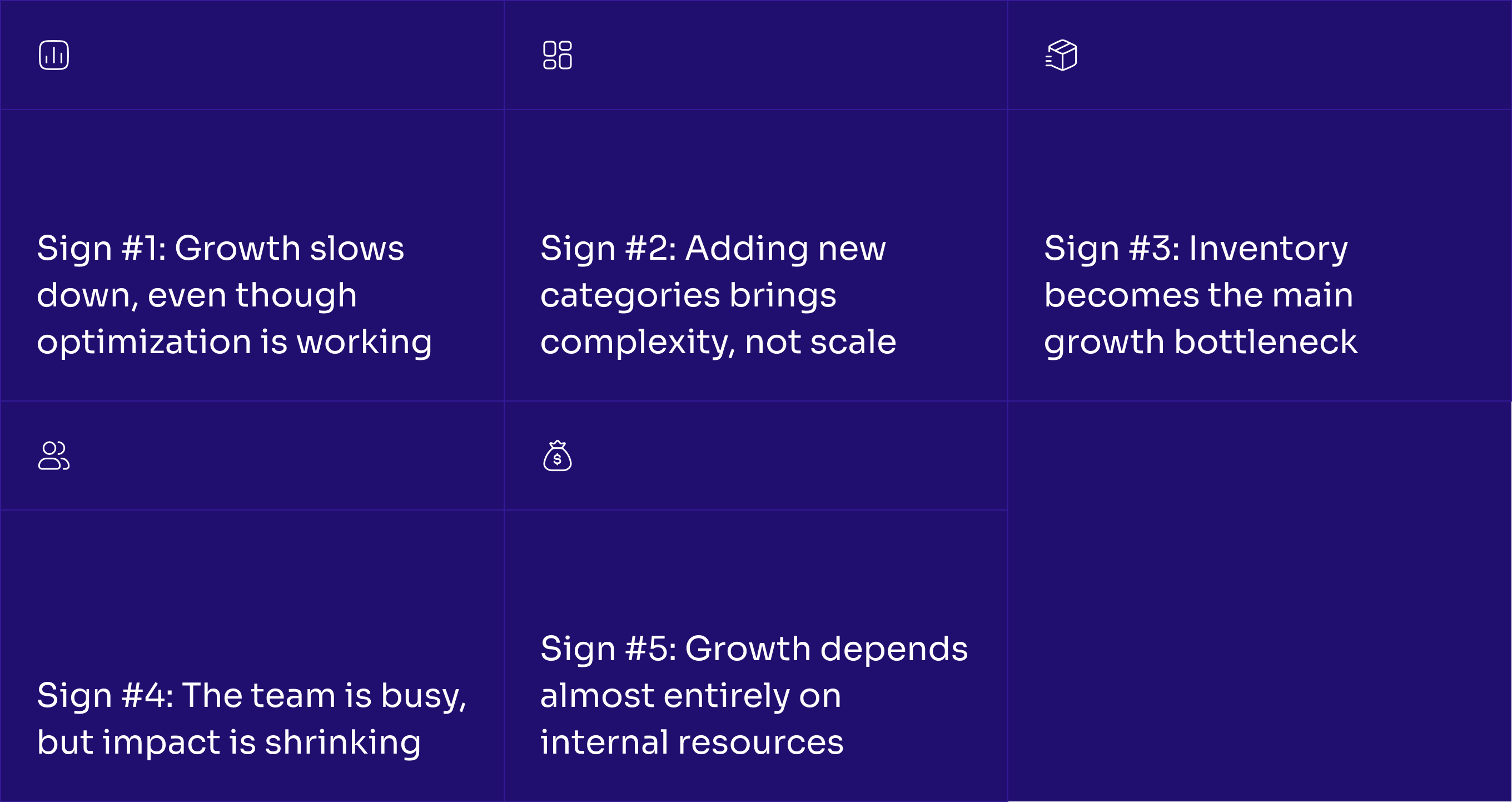
Sign #1: Growth slows down, even though optimization is working
Earlier in your journey, performance improvements translated directly into revenue growth:
- Lowering customer acquisition cost increases profitability.
- Improving conversion rates raises revenue.
- Optimizing retention lifts customer lifetime value.
In a mature eCommerce, this relationship weakens. You can still improve these metrics, but the impact on total growth becomes limited.
This is often misinterpreted as a need for even more optimization. In reality, it is a sign that the core growth engine is operating close to its maximum efficiency.
Additional improvements no longer unlock proportional scale, because the limiting factor is no longer execution, but the structure of the model itself.
At this point, growth slows not because the business is underperforming, but because it is performing as well as the model allows.
Sign #2: Adding new categories brings complexity, not scale
Expanding into new categories is one of the most common growth strategies in eCommerce. It feels intuitive: more products should mean more opportunities to capture demand.
In practice, each new category adds operational weight:
- Sourcing becomes more fragmented.
- Inventory planning becomes less predictable.
- Marketing efforts spread across more segments.
- Coordination costs rise.
Revenue may increase, but margins tighten, and internal workload grows. The problem is not the number of categories themselves, but the fact that every new category must be fully owned by the business.
The organization spends more time managing complexity than generating leverage. If every new category must be owned, stocked, and financed by you, scale becomes expensive.
When category expansion adds complexity faster than it adds leverage, it often signals that the existing eCommerce model is reaching its structural limits.
Sign #3: Inventory becomes the main growth bottleneck
In many eCommerce businesses, inventory is initially a growth enabler. Having products in stock allows the company to respond quickly to demand, control customer experience, and scale revenue with confidence.
As you scale, inventory planning becomes a strategic constraint. Growth becomes increasingly dependent on how much stock the company can afford to purchase, store, and manage. Capital gets tied up long before revenue materializes, and forecasting mistakes become more expensive with scale.
Demand may exist, but your ability to meet it depends on how much risk you are willing to take upfront.
This dynamic slows growth in subtle ways: expansion decisions are delayed, assortment changes become conservative, and innovation is constrained by inventory exposure.
When inventory availability and inventory risk begin to dictate the pace of growth more than market demand, it is a strong signal that the eCommerce model is approaching its natural limits.
Sign #4: The team is busy, but impact is shrinking
Full roadmaps and active teams can create the impression of progress. However, the tangible impact of each new initiative becomes harder to see.
Projects are delivered on time, improvements are shipped, and KPIs move – but rarely in ways that meaningfully affect overall growth.
If each initiative requires significant coordination but produces limited strategic impact, your organization may be maintaining complexity rather than creating scale. Over time, internal effort increases while external growth slows.
A consistently busy team with declining marginal impact is often a signal that the eCommerce model itself has become operationally heavy and difficult to scale further.
Sign #5: Growth depends almost entirely on internal resources
At early stages, relying on internal resources is a strength. Owning products, inventory, pricing, and operations gives eCommerce businesses control and speed.
As scale increases, that structure creates linear growth, meaning revenue expands in proportion to internal investment.
When growth depends entirely on what the company can buy, build, stock, and operate on its own, expansion is inherently constrained. Every new initiative requires upfront investment, additional operational capacity, and increased risk exposure.
Ask yourself, can your business continue to grow without fundamentally changing how value is created and distributed?
When internal capacity defines the ceiling of growth, the limitations of the traditional eCommerce model become difficult to ignore.
What these signals have in common
Individually, each of these signals can be explained away:
- Slower growth can be attributed to market conditions.
- Operational complexity can be seen as a temporary phase.
- Team overload may feel like a normal side effect of scale.
Taken together, however, they often point to the same conclusion: your eCommerce is no longer constrained by execution quality, but by the structure of its growth model.
Recognizing this doesn't mean you must become a marketplace, but you need clarity about where the real constraint lies.
Some business owners decide to continue to grow successfully within a classic eCommerce setup, especially when market conditions, margins, or operational advantages support it. Optimizing execution can still be the right path forward.
In other cases, adjusting the eCommerce growth strategy requires reconsidering how revenue is generated and how scale is achieved.
Before exploring alternatives such as an eCommerce marketplace strategy, use these signals to assess your current position.
When the marketplace makes strategic sense
If you recognized several of the five signs described earlier, it does not automatically mean you should have eCommerce and marketplace.
Those signs show that your current eCommerce growth strategy may be reaching its limits. They point to pressure in areas like revenue growth, inventory exposure, or internal capacity. But spotting slower growth is only the first step.
Before changing your model, you need to check whether your business is ready for it. Demand, brand strength, operational readiness, and platform capability matter just as much as slower growth.
A marketplace makes sense only when two things are true: your current model shows structural limits, and your business has the foundation to support a multi-vendor setup.
Strong and stable customer demand
If your eCommerce site consistently attracts customers, generates repeat purchases, and keeps customer acquisition cost under control, you already have a stable base.
A marketplace works best when you have steady traffic, strong customer relationships, and a clear target audience.
Recognizable brand and clear target audience
Sellers join platforms that give them access to a defined customer segment. If your brand image is strong, your customer testimonials build trust, and your audience is well understood, a marketplace can build on that position.
In this case, your existing customer base becomes attractive not only to new customers but also to sellers.
Growth limited by internal resources
If revenue growth depends mainly on how much inventory you can buy and manage, your model is capital-heavy. Expanding product categories requires more stock, more cash, and more operational work.
A marketplace can reduce that pressure by allowing third-party sellers to expand the assortment without increasing your inventory risk.
Operational readiness and platform capability
You need clear rules for sellers, control over the entire customer journey, and a payment process that supports multiple vendors.
Your eCommerce platform must handle marketplace integration without damaging the on-site experience. Without the right setup, a marketplace creates confusion instead of scale.
Need to diversify revenue sources
If your eCommerce growth strategy depends only on selling products you own, your revenue is tied directly to sourcing and stock.
A marketplace adds another revenue stream through commissions or transaction fees. It does not replace your eCommerce store. It adds a second growth engine alongside it.
How the marketplace changes your eCommerce growth strategy
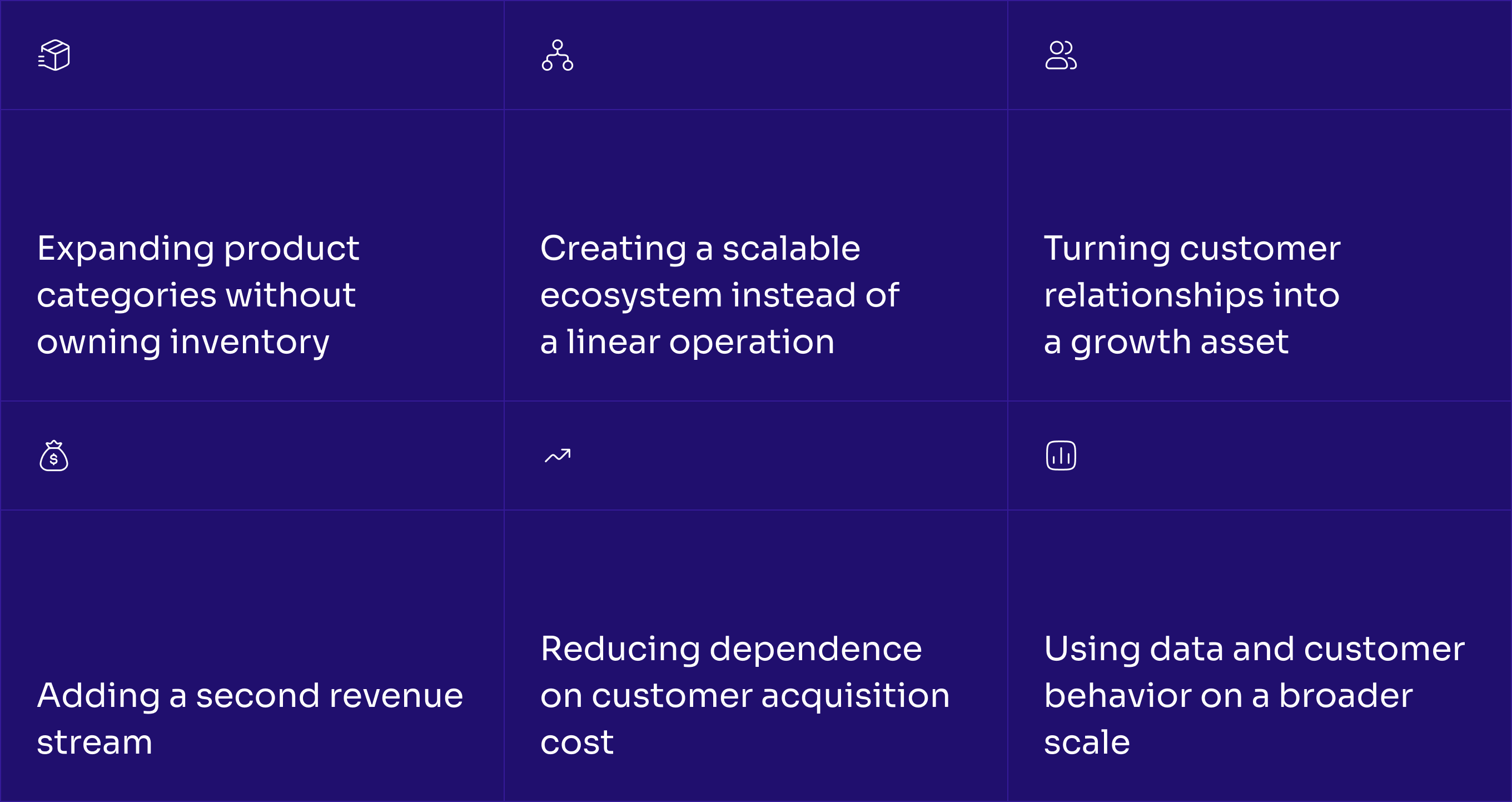
Having an eCommerce and marketplace changes how growth works. Instead of relying only on what you own, stock, and promote, you create a structure where customers and third-party sellers both contribute to scale.
Below are the main ways a marketplace reshapes your eCommerce growth strategy, with practical use cases.
Expanding product categories without owning inventory
In a traditional eCommerce business, adding new product categories requires sourcing, forecasting demand, and investing in stock. Growth is limited by working capital and operational capacity.
With a marketplace model, third-party sellers list products on your platform. You expand the assortment without increasing inventory exposure. This changes your eCommerce growth strategy from inventory-led expansion to ecosystem-led expansion.
Use case: Your eCommerce store sells sports equipment and has strong traffic in the running category. Instead of buying new inventory in adjacent categories like nutrition or wearable accessories, you onboard specialized sellers. Customers see a broader offer, average order value increases, and you avoid additional stock risk.
Creating a scalable ecosystem instead of a linear operation
In a classic model, growth is linear. To increase revenue, you need more inventory, more staff, and more marketing spend.
In a marketplace, growth becomes less dependent on internal resources. Sellers expand their assortment, while customers generate demand. Your role shifts toward platform governance, eCommerce marketplace management, and quality control.
Use case: Instead of planning expansion only around how much stock you can finance next quarter, you plan around which new seller categories fit your brand and customer segment. Growth planning moves from capital allocation to ecosystem design.
Turning customer relationships into a growth asset
In a classic setup, you improve the customer journey, run a loyalty program, and offer exclusive discounts to increase customer lifetime value.
In a marketplace model, your existing customer base becomes attractive to sellers. Customer relationships are no longer only about retaining buyers. They also help attract supply.
Use case: Your eCommerce site has strong brand recognition and a defined target audience. Instead of pushing traffic to a third-party platform, you invite external brands to sell within your ecosystem. Sellers gain access to your customers, while you keep control over the entire customer journey and maintain direct communication.
Adding a second revenue stream
In a traditional growth strategy for eCommerce, revenue comes from selling products you own. Increasing revenue requires more inventory, more marketing campaigns, and higher operational capacity.
A marketplace introduces commission-based income. This allows revenue growth without proportional increases in inventory investment.
Use case: Your platform processes 100,000 monthly visits. In a classic model, revenue depends on your own product margins. In a marketplace structure, every transaction from third-party sellers generates commission revenue. Even if you do not own the product, you participate in the transaction.
Reducing dependence on customer acquisition cost
In many eCommerce businesses, customer acquisition cost increases over time. Paid channels become more competitive, and marketing efforts require larger budgets to reach new customers.
Our breakdown of why customer acquisition cost keeps rising in eCommerce sets out what drives that, and how to read CAC against customer lifetime value.
A marketplace can reduce pressure on acquisition in two ways. First, a broader assortment attracts more potential customers organically. Second, sellers may bring their own traffic. Your growth strategy for eCommerce shifts from fully paid growth to partially network-driven growth.
Use case: You onboard niche brands with strong social media communities. They promote their products and link back to your platform. Your sales channels expand beyond your own marketing campaigns, and customer acquisition becomes partially shared.
Using data and customer behavior on a broader scale
An eCommerce store collects data mainly about customer behavior and product performance.
In a marketplace model, this data expands across more product categories and sellers. Marketplace structure allows you to use valuable insights from your existing customer base to shape supply more dynamically.
Use case: You identify that a specific customer segment frequently purchases eco-friendly products. Instead of developing your own line, you onboard third-party sellers that match this demand. You respond faster to customer expectations without investing in product development.
Rethink your eCommerce growth strategy and add a marketplace layer without disrupting your core
If, after reading this article, you identify that your eCommerce growth strategy is reaching structural limits, do not abandon what already works. In most cases, the stronger approach is to extend your current eCommerce with a marketplace layer that changes how scale is generated.
For many businesses running on Shopify, Magento (Adobe Commerce), or custom ERP-driven systems, the ceiling appears as rising maintenance costs, performance constraints, or growing complexity. Replatforming feels risky and expensive. Yet staying within the same structure limits future revenue growth.
Mercur is designed to solve that tension. Instead of replacing your core eCommerce platform, Mercur adds multi-vendor marketplace capabilities on top of it,
- Your existing commerce engine continues to handle products, checkout, and customer experiences.
- Marketplace logic – vendor onboarding, commission rules, seller workflows, and transaction orchestration – operates as a separate layer.
This ecommerce marketplace solution allows you to introduce third-party sellers without disrupting your current eCommerce store. There is no need for a full migration, no pause in development, and no forced platform lock-in. You can start with a narrow marketplace scope, validate the economics, and expand only when the model proves itself.
A short architectural discussion can clarify how a multi-vendor model should fit into your current ecosystem and prevent long-term technical debt and unnecessary rework.
To explore how a marketplace layer could extend your eCommerce growth strategy, book a marketplace consultation with the Mercur team.
FAQ on eCommerce marketplace strategy
What is the growth strategy of eCommerce?
An eCommerce growth strategy defines how your eCommerce business plans to increase revenue over time. At the beginning, growth usually depends on customer acquisition, marketing campaigns, and expanding product categories. You focus on reaching potential customers through social media channels, influencer partnerships, and paid marketing efforts in order to attract shoppers and maximize sales.
As your eCommerce store matures, the strategy shifts. Instead of focusing only on new customers, you work on retention strategies, repeat purchases, and increasing customer lifetime value. You analyze customer behavior, gather customer feedback, and optimize the entire customer journey to create exceptional customer experiences.
What is an eCommerce marketplace?
An eCommerce marketplace is a platform where third-party sellers offer products alongside your own eCommerce store. Instead of only selling products you own, you allow external vendors to list their product categories and reach customers within your ecosystem.
In this model, you manage the eCommerce platform, the payment process, customer segment, and the on-site experience, while sellers manage their own inventory. Revenue can come from commissions or service fees rather than only from selling products directly.
An eCommerce marketplace can expand your assortment without increasing inventory exposure. It can also help attract new customers and strengthen brand recognition. For businesses with a strong customer base and established brand image, a marketplace can become an additional growth engine rather than a replacement for their own eCommerce.
What is marketplace integration?
Marketplace integration is the process of connecting marketplace functionality with your existing e-commerce business. It allows third-party sellers to operate within your ecosystem while you maintain control over the entire customer journey.
Strong eCommerce marketplace integration ensures that adding a marketplace layer does not disrupt customer relationships or customer expectations. Instead, it expands product categories and sales channels while keeping control within your own eCommerce business rather than pushing customers to a third-party platform.
How to create an eCommerce marketplace?
To create an eCommerce marketplace, start by deciding how to build it. You can extend your existing online business with eCommerce marketplace integration, add a dedicated marketplace extension, or adopt a specialized multi-vendor ecommerce marketplace solution designed for multi-vendor operations.
The right choice depends on your technical resources, long-term e-commerce growth strategy, and how much control you want over eCommerce marketplace management and the payment process.
What is the difference between eCommerce platform and marketplace?
An eCommerce is a platform where you control inventory, pricing, and product selection. Growth depends on how effectively you execute your eCommerce strategy, optimize key performance indicators, retain customers, and convert potential customers into repeat customers.
A marketplace allows third-party sellers to operate within your platform, while you manage the infrastructure, payment process, and customer experiences. Instead of relying only on selling products you own, you facilitate transactions between customers and vendors.
More articles


Ready to build?
See the product – open the demo, or book a walkthrough with our experts.