
Sharetribe Alternatives in 2026: Comparison of 9 Marketplace Platform Competitors with Costs
Sharetribe got you live fast. It was the right call to validate the idea. Now you are probably hitting the wall every Sharetribe marketplace eventually hits: the customization you need is out of reach, and the bill grows with every transaction you process.
Looking for Sharetribe alternatives usually means you have outgrown a starter platform. Sharetribe is built for speed to launch, which is what an early marketplace website needs, and which becomes a constraint once you have traction and a roadmap.
This guide covers when teams outgrow Sharetribe, what to look for in an online marketplace platform, and how nine Sharetribe competitors compare for a marketplace that has moved past validation.
Place | Platform | Type | Pricing |
|---|---|---|---|
1 | Mercur | Open source | Free on Open Source edition, commercial licence for Enterprise edition, no GMV fee |
2 | CS-Cart Multi-Vendor | Self-hosted licence | |
3 | Kreezalid | No-code SaaS | |
4 | FlyCommerce | No-code SaaS | $29 per month after the first + 1% of revenue |
5 | Arcadier | No-code with API access | Quote-based pricing model |
6 | Nautical Commerce | Full-stack SaaS | Free tier, paid scales with usage |
7 | Marketplacer | SaaS marketplace overlay | Licence negotiated per deal + separate commerce platform |
8 | Mirakl | SaaS marketplace overlay | Licence + share of GMV + separate commerce platform underneath |
9 | Bubble | No-code app builder |
Prices are quoted only where the vendor publishes them, and every figure was checked on the vendor's own pricing page in September 2026. The fuller comparison, with what each one fixes against Sharetribe, is further down.
Key insights
- Sharetribe charges a monthly subscription plus a fee per transaction above a free allowance. Plans run from $99 to $299 per month billed yearly, with 50 to 500 free transactions a month and $0.19 or less per transaction after that.
- 9 alternatives split into three groups: no-code marketplace builders, hosted SaaS platforms for scale, and platforms you run yourself with the code in your hands.
- Which group you need follows the constraint you hit. Customization limits point to owning the code, transaction fees point to a flat cost model, and both together point away from no-code entirely.
- Leaving Sharetribe is a rebuild, because you never held the code.
What is Sharetribe and what is it good at?
Sharetribe is a hosted marketplace builder. You set up listings, vendor accounts, search, and payments in a browser. Sharetribe runs the software on its own infrastructure, and you pay a monthly subscription plus a fee for every transaction above your plan's allowance. Nothing is installed on your side, and there is no codebase to maintain.
What it is good at is speed. A non-technical founder can test a marketplace idea in weeks, with vendor accounts, listings, and payments handled out of the box, no code and no coding skills required.
Thousands of founders in more than 100 countries have launched on it, from rental marketplaces like Drive lah and Local Trailer Hire to service marketplaces like Studiotime and product marketplaces like Sugarlift. For idea validation and early traction, that speed is the right trade. Sharetribe is a strong place to start and a predictable place to outgrow.
Sharetribe pricing in 2026
Above the allowance, you pay $0.19 or less per initiated transaction. Custom domain arrives on Pro, and access to the code and the API on Extend, so the plan you need is usually set by one feature and not by your volume.
Plan | Price | Free transactions a month |
|---|---|---|
Build | $39 per month | Test only, cannot run a live marketplace |
Lite | $99 per month billed yearly | 50 |
Pro | $199 per month billed yearly | 250 |
Extend | $299 per month billed yearly | 500 |
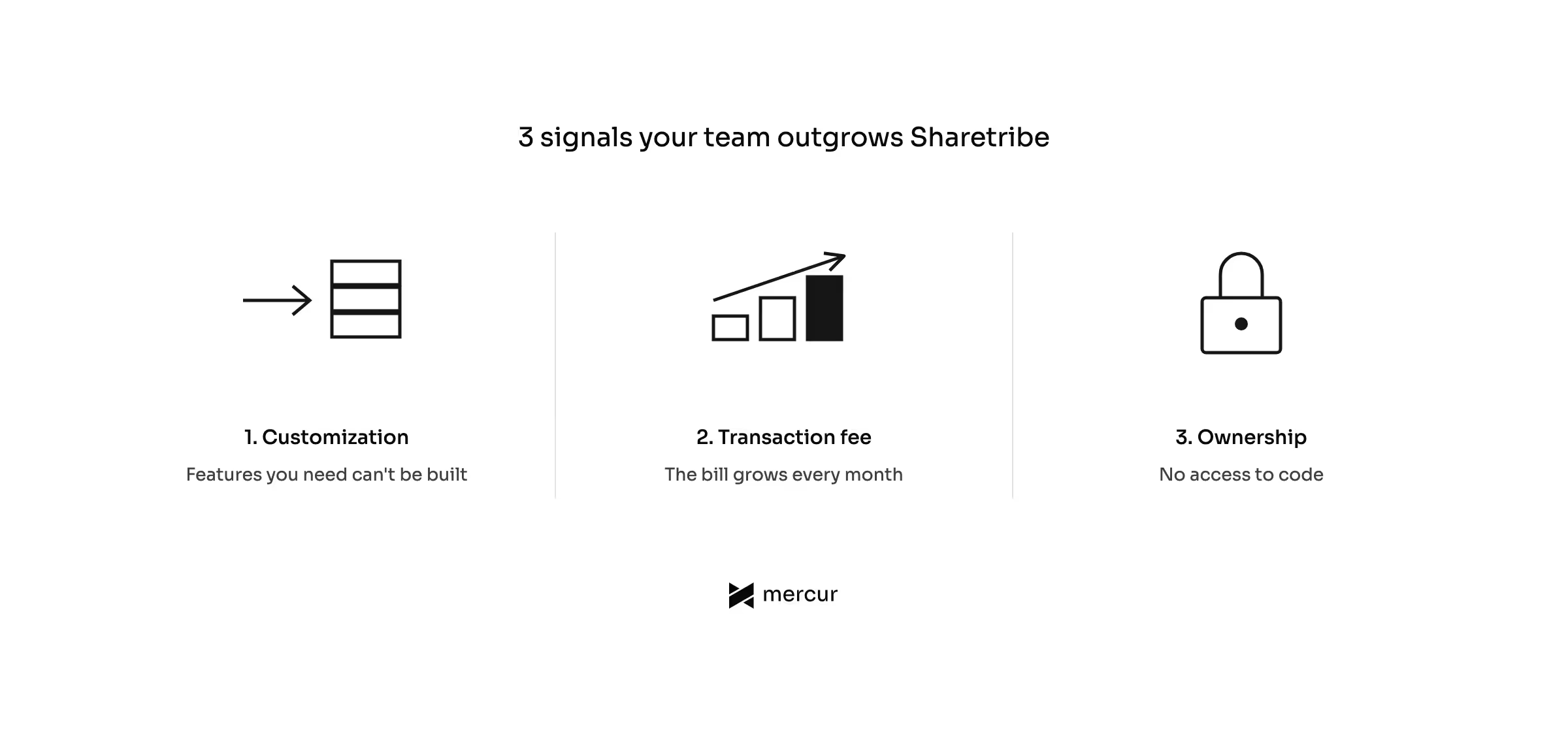
3 signals your team outgrows Sharetribe
In the migrations off Sharetribe I have worked on, the same three reasons come up. You cannot build the feature you need. The bill grows every month. You do not own the code. Below is what each one looks like, so you can check which one you have hit.
Customization hits a wall
Sharetribe works within defined extension points. When your roadmap needs flows the platform does not anticipate, like custom pricing logic, a negotiation or RFQ flow, or deep integration with your ERP or PIM, you reach limits you cannot engineer around.
A real example: a B2B marketplace needing features like per-buyer pricing, size-linked variant pricing, and an RFQ negotiation flow finds these either impossible or heavily worked around on a starter platform. The platform that made launch fast now makes the next new feature impossible.
The transaction fee grows with your volume
Sharetribe's plans include a monthly allowance of transactions and charge for every one above it. On the published plans, that is 50 free transactions a month on Lite, 250 on Pro, and 500 on Extend, and $0.19 or less per initiated transaction after the allowance.
As your volume grows, you are paying more every month for infrastructure whose cost to run has not changed. You end up paying more because you succeeded, with nothing extra to show for it.
You don't own the code
On a hosted starter platform, you do not own or fully control the codebase. You cannot audit how your data is handled, you cannot run it on your own infrastructure, and migrating off later is a full rebuild.
For a marketplace, that lack of ownership is a strategic risk and not just a technical inconvenience.
What to look for in a Sharetribe alternative
The right alternative depends on why you are moving. Match the platform to the constraint you have hit.
- If your constraint is customization, you need a platform you can extend without fighting it, ideally one whose code you control.
- If your constraint is the transaction fee, you need pricing that does not grow with your success.
- If your constraint is ownership, you need full code and data control.
Most teams leaving Sharetribe reach all three at once.
Be honest about your technical capacity, too. A more powerful platform needs developers or a delivery partner. The trade for removing limits is taking on more build responsibility.
9 Sharetribe best alternatives compared
These Sharetribe competitors fall into three groups, each resolving a different subset of Sharetribe's limits.
Prices are quoted only where the platform publishes them, and every figure below was checked against the vendor's own pricing page in September 2026.
Place | Platform | Type | What it fixes vs Sharetribe | Pricing |
|---|---|---|---|---|
1 | Mercur | Open source | Full customization, ownership, and no fee on growth | Free on Open Source edition, commercial licence for Enterprise edition, no GMV fee |
2 | CS-Cart Multi-Vendor | Self-hosted licence | Ownership and a flat cost | |
3 | Kreezalid | No-code SaaS | More customization options inside a builder | |
4 | FlyCommerce | No-code SaaS | A cheaper entry for product marketplaces | $29 per month after the first + 1% of revenue |
5 | Arcadier | No-code with API access | Extensibility through an API, no default transaction fee | Quote-based pricing model |
6 | Nautical Commerce | Full-stack SaaS | Multi-vendor operations at mid-market scale | Free tier, paid scales with usage |
7 | Marketplacer | SaaS marketplace overlay | Adding sellers to a site that already sells | Licence negotiated per deal + separate commerce platform |
8 | Mirakl | SaaS marketplace overlay | Enterprise scale and an ecosystem of partners | Licence + share of GMV + separate commerce platform underneath |
9 | Bubble | No-code app builder | Freedom of design at the cost of building it |
1) Mercur
Mercur is an enterprise-grade marketplace platform that resolves all three Sharetribe constraints at once:
- no GMV fee, so growth doesn't tax you
- full code ownership, so you can audit and control your data
- extensible codebase, so the customization Sharetribe blocks becomes possible
The open-source edition carries no licence fee, and Mercur Enterprise (with enterprise features) is licensed separately – both editions take no share of your sales, so the costs stay at zero no matter how much you sell. Your data sits on your own servers.
Around 80% of marketplace functionality is ready on day one: vendor panel, admin dashboard, storefront for buyers, vendor onboarding, commission engine, order splitting, split payments, and a catalogue per vendor. You build only the 20% of the custom part that is specific to your business.
It's the migration target for teams that validated on a starter platform and now need a foundation that scales with them. Mercur is deployed across 30+ enterprise commerce projects with $6B+ in client trade volume. See the full platform comparison and the marketplace development guide for migration planning.
What to check: you need developers or an implementation partner.
2) CS-Cart Multi-Vendor
CS-Cart Multi-Vendor gives you the source code for a fixed price. You get the source code, you run it on your own servers, and nobody takes a share of your transactions. The price is published: $725 a year for Standard, rising to $1,449 and $3,599, or a one-time licence from $3,590.
It is a mature PHP product, and it looks its age next to newer platforms. Launching on it takes real technical understanding, so the savings on licence fees come back as setup and maintenance work. For a straightforward product marketplace on a fixed budget, this is a fair place to land.
What to check: whether your team can host and maintain PHP.
3) Kreezalid
Kreezalid is a marketplace builder with a drag-and-drop setup, aimed at teams that want to launch without coding skills and still change how the marketplace looks and works. It publishes its prices: €249, €299, and €379 per month, rising with staff accounts, user accounts, and listings.
Among the no-code alternatives, it offers the most customization options, with a theme editor and user groups on every plan. It stays a hosted builder, so the ceiling is higher than Sharetribe's, and it is still a ceiling.
What to check: whether the flows you could not build on Sharetribe are configurable here or still out of reach.
4) FlyCommerce
FlyCommerce is a hosted platform for product marketplaces, with an online store and a multi-vendor marketplace in one place, plus payments, tax integration, and reporting. Entry pricing is the lowest on this list: $1 for the first month and $29 a month afterwards on the Launch plan, then $69 and $299 on higher tiers.
Read the fee line before the price line. The Launch plan also takes 1% of your revenue, which is the same mechanism you are leaving Sharetribe to escape, charged on a different basis.
What to check: what the revenue share costs at three times your current volume, and whether custom features can be added at all.
5) Arcadier
Arcadier is a no-code marketplace builder with API access, now positioned for enterprise deployments that plug into an existing stack. It supports product, service, and rental marketplaces, and the API is how you extend it past the builder.
On pricing, it takes the opposite position to most of this list. Arcadier's own page says it does not default to transaction fees and that its pricing does not scale against your GMV growth. Pricing is quote-based, so the number comes from a conversation.
What to check: what the API can reach and what it cannot. On a hosted builder, the API is the whole of your extensibility, so its limits are your limits.
6) Nautical Commerce
Nautical Commerce is a full-stack SaaS platform aimed at mid-market operators who want marketplace and commerce in one hosted product. There is a free tier for testing and paid plans that scale with usage.
It sits between a builder and an enterprise platform: more capable than Sharetribe on multi-vendor operations, still a hosted product where the roadmap belongs to the vendor.
What to check: what usage-based means for your numbers. Model it against your own growth plan before you sign.
7) Marketplacer
Marketplacer is an overlay that adds marketplace capability to a site that already sells, and it supports marketplaces focused on products and on services. The eCommerce platform stays where it is, and Marketplacer runs the seller side on top.
Pricing is agreed deal by deal and nothing is published. Like any overlay, it assumes you already have, and keep paying for, a commerce platform underneath.
What to check: it has more retail experience than complex integrations. Ask for a live example that resembles your case.
8) Mirakl
Mirakl is the largest enterprise marketplace overlay on the market, with a marketplace API and a global ecosystem of implementation partners. If your programme has to clear enterprise procurement, this is the name that clears it fastest.
You pay a licence plus a share of marketplace GMV, and Mirakl publishes no figure. It also expects an eCommerce platform underneath that you license and implement separately, so the quote you compare is two platforms and not one. Our Mercur vs Mirakl comparison sets the two side by side.
What to check: the GMV share against your own three-year plan, and which second platform you need live on day one.
9) Bubble
Bubble is a general no-code app builder and not marketplace software. You build the marketplace yourself from its building blocks, which means no feature ceiling of the kind Sharetribe has, and no marketplace infrastructure waiting for you either.
Pricing starts free, then runs $59, $209 and $549 per month, charged against a bundled workload allowance with add-ons when you exceed it.
What to check: that you are ready to build vendor onboarding, commission logic, order splitting, and payouts yourself. Those are solved problems on every other platform on this list.
How to migrate off Sharetribe: 4-step framework
Because you do not own the Sharetribe codebase, leaving is a rebuild, since there is nothing to lift and shift. The work is manageable when you treat it as four stages.
1. Map what you actually use
List the flows your marketplace runs today, from onboarding and listing to checkout and payouts, and mark which are standard and which are custom.
The 80% of standard flows are mostly out of the box on a purpose-built platform. The custom ones are where your migration effort concentrates.
This map also surfaces the workarounds you built to get around Sharetribe's limits. Many of those disappear on an extensible platform, which shrinks the rebuild instead of recreating it.
2. Export and model your data
Pull your sellers, listings, orders, and payout history out of Sharetribe early.
Data export is also a test of ownership: how cleanly you can extract everything tells you how locked in you were, and how locked in you would be on the next platform.
Model that data against the new platform's structure before you build, so you catch mismatches in catalogue or commission structure while they are cheap to fix.
3. Rebuild the custom 20%
With marketplace infrastructure already provided, your build focuses on the logic specific to your business: the pricing rules, negotiation flows, or integrations Sharetribe could not support. This is where you finally ship the roadmap the starter platform blocked.
The migration is worth doing precisely when the features you could not build on Sharetribe are the ones now driving your growth.
4. Run in parallel, then cut over
Run the new platform alongside Sharetribe with a subset of sellers before full cutover. A staged switch lets you validate onboarding, checkout, and payouts with real transactions before you move your whole seller base.
Summary: Which Sharetribe alternative fits your marketplace?
Pick by the limit that pushed you off Sharetribe.
If you have no developers and want to stay in a builder, Kreezalid is the closest move up, and Arcadier is the one to look at when integrations matter. You gain room to configure. You do not gain the code.
If the transaction fee is the problem, look for a flat cost. CS-Cart publishes a licence price and takes no share of your sales, and an open-source platform, like Mercur, keeps the licence line at zero at any volume.
If you have hit all three limits at once (customization, fees, and ownership), only owning the code settles all three. That is where Mercur sits, and the condition attached to it is real: you need developers or an implementation partner.
If you would rather start from your own situation, talk to the marketplace experts about scope, timeline, and what a migration off Sharetribe would cover.
Frequently asked questions on Sharetribe alternatives
What is the best Sharetribe alternative?
The best Sharetribe alternative depends on the constraint you need to resolve. For teams hitting customization limits, transaction fees, and ownership concerns at once, an open-source platform like Mercur resolves all three. For staying fully managed, a hosted platform like Nautical Commerce or a SaaS solution like Mirakl is an option with its own cost trade-offs.
What is the best no-code Sharetribe alternative?
The best no-code Sharetribe alternatives for most teams are Kreezalid and Arcadier. It keeps the drag-and-drop setup that made Sharetribe easy, publishes its prices at €249 to €379 per month, and gives more room to change how the marketplace works. Arcadier is the better answer when integrations matter, because it pairs the builder with an API.
What companies use Sharetribe?
The companies using Sharetribe are mostly small and mid-sized marketplace businesses. Sharetribe says thousands of founders in more than 100 countries have launched on it. Its own founder stories name rental marketplaces such as Drive lah and Local Trailer Hire, service marketplaces such as Studiotime and Vennu, and product marketplaces such as Sugarlift and GearSource.
Is Sharetribe free?
Sharetribe is not free. It offers a free trial and a Build plan at $39 a month for testing, which cannot run a live marketplace. The cheapest plan that can is Lite at $99 per month billed yearly.
Is Sharetribe a good platform?
Sharetribe is a good platform for what it is designed for, which is launching a marketplace fast to validate the idea, especially for non-technical founders. It becomes a constraint later, when you need deep customization or your volume makes the per-transaction fee significant.
How much does Sharetribe cost?
Sharetribe costs $99 per month for Lite, $199 for Pro, and $299 for Extend, all billed yearly, on top of which you pay for transactions above your plan's allowance. That allowance runs from 50 transactions a month on Lite to 500 on Extend, with $0.19 or less per initiated transaction after it.
What is the best marketplace software?
There is no single best marketplace software. The software splits into types with different cost curves and customization limits, and the type decides more than the brand does. Our comparison of 13 marketplace platforms covers all of them, and there is a separate guide to the best B2B marketplace platforms if your buyers are companies.
More articles


Ready to build?
See the product – open the demo, or book a walkthrough with our experts.