
Best Marketplace Software in 2026: Top 13 Platforms Compared & How to Choose One for Your Business
Updated September 2026. Every price in this comparison was checked against the vendor's own pricing page in September 2026, and the platform list now runs to 13.
Choosing marketplace software is a decision that usually locks you in for at least 3 to 5 years. Most comparison articles list features and pricing tiers, while the real difference between marketplace solutions sits one layer deeper – in architecture.
Whether you pick a SaaS overlay, a self-hosted licence, or an open-source platform, that choice sets your cost structure, your customisation ceiling, and your exit options for years.
# | Platform | Architecture | Entry price (checked Sep 2026) |
|---|---|---|---|
1 | Mercur | Open-source | $0 licence |
2 | Mirakl | SaaS Overlay | License cost + % of GMV + a commerce platform underneath |
3 | Marketplacer | SaaS Overlay | Not published |
4 | Sharetribe | Full-stack SaaS | $39/mo Build (test only); $99/mo Lite billed yearly is the cheapest live plan |
5 | VTEX | Full-stack SaaS | Not published |
6 | Nautical Commerce | Full-stack SaaS | Free tier, paid scales with usage |
7 | CS-Cart Multi-Vendor | Self-hosted | $725/yr Standard; lifetime from $3,590 once |
8 | Yo!Kart | Self-hosted | Not published |
9 | Magento / Adobe Commerce | Self-hosted + extensions | Not published |
10 | Bagisto | Open source | $0 licence |
11 | Dokan | Plugin | Lite free; $149/yr Starter up to $999/yr Enterprise |
12 | Webkul | Plugin | Per module |
13 | WooCommerce plugins | Plugin | Varies by plugin |
The marketplace concept itself is simple. Marketplace software lets multiple independent sellers transact with buyers on one platform, and it automates the work that a single-seller eCommerce store never has to do: vendor onboarding, commission calculation, vendor payouts, and orders that span multiple vendors.
Marketplaces now carry the majority of online trade, at 83.4% of global eCommerce revenues and 60.8% in Europe on a GMV basis, which is why so many retailers are looking at this software category for the first time.
This comparison groups 13 multi-vendor marketplace platforms by how they work, with cost data and operator insights from teams running these platforms.
If the model itself is new to you, our guide to what an online marketplace is covers the ground floor first.
What this article covers
- Marketplace software is not one category. It is five architecture models with fundamentally different cost curves, customization limits, and scaling characteristics.
- SaaS overlay platforms like Mirakl cost a license fee plus a percentage of GMV, and they require a second eCommerce platform underneath, doubling real cost.
- Open-source platforms like Mercur eliminate license fees and GMV taxes entirely, so your cost stays flat as your marketplace grows.
- Plugin-based approaches (Dokan, Webkul) offer the cheapest entry point but hit a ceiling fast for any marketplace beyond basic multi-vendor commerce.
- Three different products are sold as marketplace software: a full platform, an operations layer, and an overlay for the commerce engine you already run. Which one you need depends on whether that engine is already in production.
- The same 13 platforms shortlist differently once you sort them by the marketplace you are building. B2B, B2C, enterprise, wholesale, C2C and service each reward a different platform.
- B2B adds five requirements a consumer marketplace never has to meet: punchout, contract pricing, payment terms, buyer approval levels, and quoting.
What is marketplace platform software?
Marketplace platform software is the system that runs a multi-vendor marketplace: the storefront buyers browse, the portal sellers work in, the admin console your team operates, and the engine that splits an order across sellers and settles the money behind it.
Three products are sold under that name, and the difference decides how many systems you pay for. The category names are part of the confusion: Gartner files the whole area under Marketplace Operation Applications, vendors such as AppDirect sell the operations layer on its own, and most "best marketplace software" lists drop all three into one table with a single price column.
One question resolves it. If you already run a commerce engine, you are shopping for an overlay or an operations layer, and that licence sits on top of the platform you keep; if you do not, you need full platform software, because an overlay has nothing to stand on.
What does marketplace platform software cover?
Marketplace platform software covers the whole engine: storefront, checkout, catalogue, seller portal, commission rules, and payouts in one codebase. It is what you buy when there is no commerce engine to build on, because nothing else has to run underneath it.
What is marketplace operations software?
Marketplace operations software is the layer your team works in every day: seller onboarding, catalogue ingestion, moderation, order routing, commission calculation, and settlement. It runs the marketplace and assumes a commerce engine is already there to serve the storefront and take the payment.
What is a marketplace overlay?
A marketplace overlay is an operations layer packaged to sit on top of the eCommerce platform you already run. Your storefront and checkout stay where they are, and your budget carries two systems.
What are the categories of marketplace software?
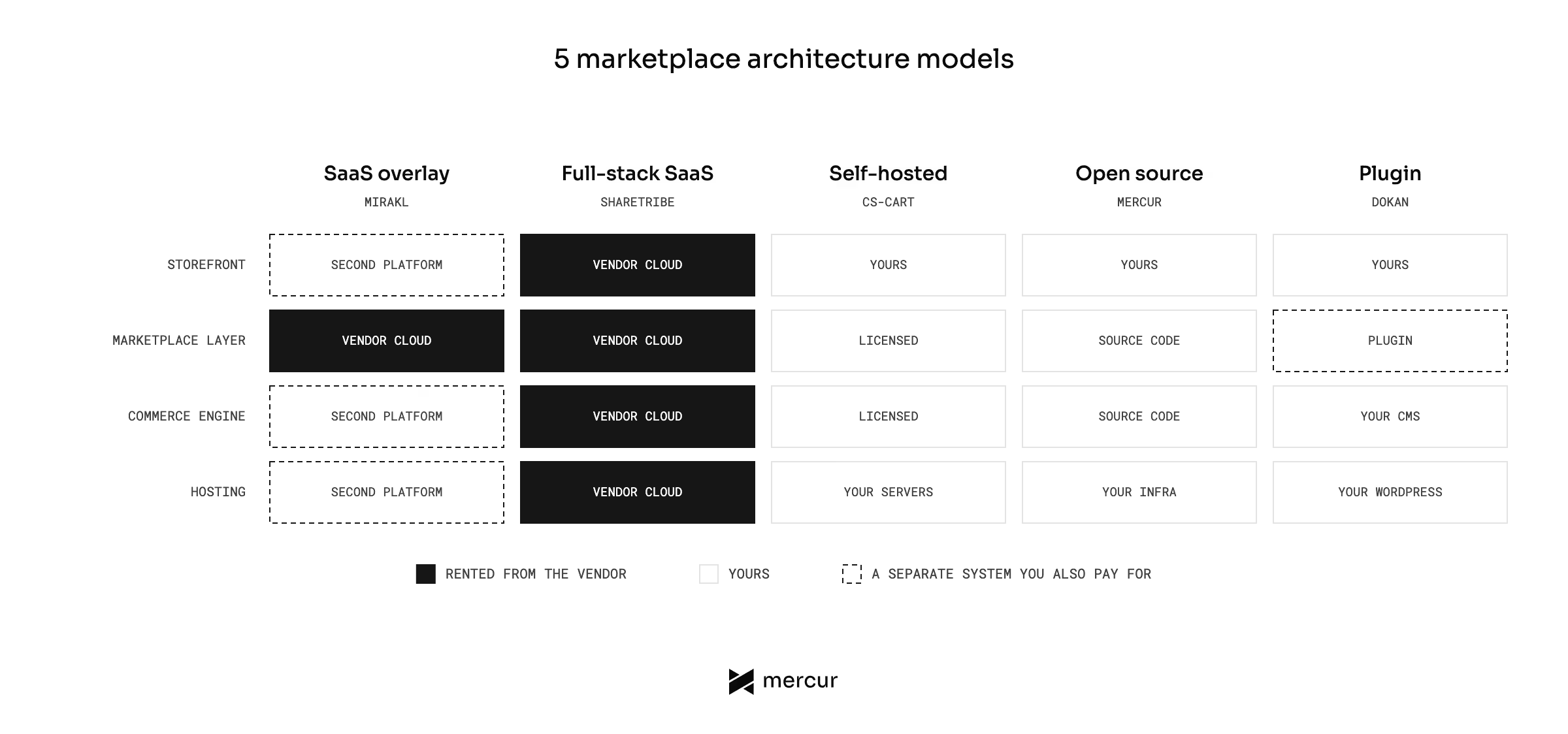
Before comparing individual platforms, understand that "marketplace software" is not one market.
It is five fundamentally different architecture models, and each one carries a different cost curve, a different customisation limit, and different scaling characteristics. Picking the wrong model costs more than picking the wrong vendor within a model.
Architecture | Example | Cost structure | Customization | Data ownership | Best for |
|---|---|---|---|---|---|
Open-source | Mercur | No license fee, implementation + hosting only | Unlimited (full code ownership) | Your servers + DB | Teams with tech capacity |
SaaS overlay | Mirakl, Marketplacer | license + GMV fee + second platform | Limited (API only) | Vendor cloud | Enterprise at scale |
Full-stack SaaS | Sharetribe, VTEX | $99/mo to enterprise contracts | Limited (config only) | Vendor cloud | Founders, SMBs |
Self-hosted | CS-Cart, Yo!Kart | Annual subscription or lifetime licence + hosting | Moderate (source access) | Your servers | Mid-market retailers |
Plugin | Dokan, Webkul | Free to $999/yr + CMS hosting | Very limited | Depends on host | MVPs, testing the model |
The model you pick is one layer of a wider decision about how the business itself works, which our guide to marketplace business models sets out in full.
All five categories can run B2B, B2C, C2C, or hybrid models:
- B2B marketplaces connect businesses with suppliers and manufacturers,
- B2C marketplaces deliver a shopping experience to consumers,
- C2C marketplaces let individual users transact with each other,
- Service marketplaces sell time and expertise instead of goods.
SaaS marketplace overlays
Platforms like Mirakl and Marketplacer provide the marketplace layer as a hosted service: vendor management, order routing, and commission structures. They do not handle the storefront, checkout, or payments. You need a separate e-commerce solution underneath (Salesforce, Adobe, SAP).
Trade-off: fastest enterprise deployment, but double-platform cost, GMV-based fees that scale with your success, and architectural lock-in.
Full-stack marketplace SaaS
SaaS solutions like Sharetribe, VTEX, and Nautical Commerce handle both the marketplace logic and the commerce layer in one hosted platform. No second platform needed, and you get a fully functional marketplace with a faster time to market than any other category.
Trade-off: simpler stack, but limited customization, vendor-controlled roadmap, and data lives in their cloud.
Self-hosted and license-based
Marketplace management software like CS-Cart Multi-Vendor, Yo!Kart, and Magento with marketplace extensions. You buy a license, host it yourself, and own the deployment, which gives you full control over data and configuration.
Trade-off: more control than SaaS, one-time or annual license cost, but aging tech stacks, heavy maintenance burden, and you need your own DevOps.
Open-source marketplace platforms
Platforms like Mercur (built on Medusa.js) and Bagisto (built on Laravel). No license fee, full access to the source code, MIT or similar licensing.
Trade-off: zero licensing cost, unlimited customization, full data ownership, but requires a technical team to deploy and maintain.
Plugin and extension model
Dokan (on WordPress/WooCommerce), Webkul (on Shopify/Magento), MultiMerch (on OpenCart). These add multi-vendor capability to an existing eCommerce CMS, usually alongside a library of third-party apps.
Trade-off: cheapest starting point, but low ceiling for scale and marketplace logic is an afterthought bolted onto a single-store architecture.
What core features should marketplace software have?
The seven areas below are the ones that decide whether the software can really run core platform operations, and they are worth walking through with the people who will operate the platform daily.
Area | What to check | Where platforms fail |
|---|---|---|
Vendor portal | Self-service onboarding, inventory management, order tracking, sales analytics | Vendors depend on your team for routine work |
Payments | Split payments, refunds, multi-party payouts, multi-currency support | Payouts are manual or need a separate provider |
Integrations | Accounting, CRM, fulfilment, ERP, shipping, marketing tools, open API | Integration exists as a roadmap item |
Order management | One basket that spans multiple vendors, split shipments, per-seller returns | One order equals one seller in the data model |
Buyer side | Marketplace storefront, SEO controls, marketplace app | Storefront is a template you cannot change |
Security | PCI-DSS, GDPR, fraud monitoring, authentication | Compliance lands on you and never on the vendor |
Customisation and scale | Deep customization, core infrastructure that carries growth | Minor changes need custom development |
1) What does a vendor portal need to do?
The vendor portal is where your supply side spends its working day, so its quality decides whether sellers stay. Robust vendor portals cover inventory management, order tracking, and sales analytics without anyone from your team touching a record.
Give independent vendors self-service tools and your operations cost stops growing with every seller you add. Weak vendor tools push that work back onto the marketplace owner, which is the fastest way to turn seller growth into headcount growth. Our guide to finding and keeping sellers covers what the rest of that relationship needs.
2) How should payments and vendor payouts work?
A marketplace takes one payment from a buyer and owes money to several parties, so payment handling is structurally different from single-seller commerce. The platform has to support split payments, refunds against a single seller's share, and multi-party payouts on a schedule you control.
Check which payment providers are supported natively, since most platforms integrate with payment gateways like Stripe and stop there. If you sell across borders, confirm multi-currency support at the payout level and not only at the price-display level, because that is where the gap usually hides. Commission logic sits on the same layer: our guide to commission structures covers what the engine underneath has to resolve.
3) Which third-party integrations does a marketplace need?
Marketplace software never runs alone. It has to integrate with the accounting system, the CRM, and the fulfilment stack you already use, and enterprise platforms like Mirakl extend that to ERP and CRM systems for streamlined operations.
Ask for the list of native integrations and, separately, for the API documentation. Many platforms support API integrations for third-party tools, and that is a different promise from a maintained native connector. Native shipping provider integrations and marketing tools are worth checking by name, one at a time, because "integrates with your stack" is the least falsifiable sentence in enterprise software.
4) How does order management work when one basket spans multiple vendors?
This is the test that separates right marketplace software from eCommerce software with a vendor plugin. When a buyer orders from three sellers at once, the platform has to split the order, track three fulfilments, and handle three separate returns paths.
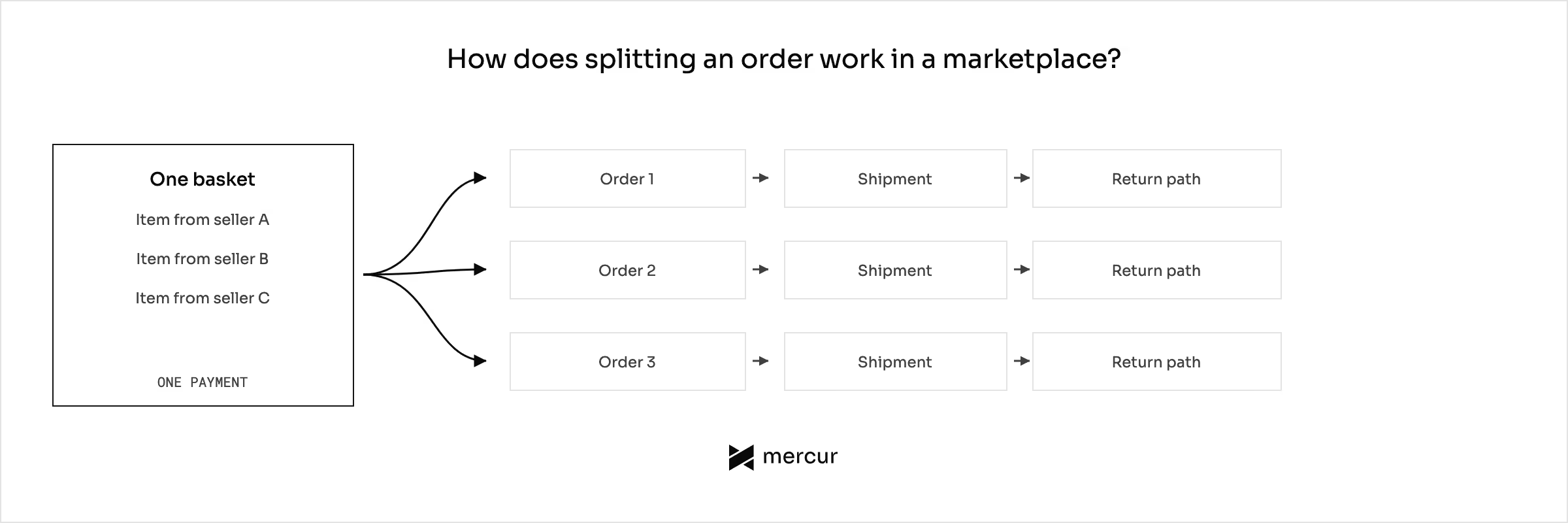
Ask to see it happen in the admin, with an order that has multiple sellers on it. A data model where one order belongs to one seller will fight you for the life of the marketplace, and no amount of configuration fixes it later. Our write-up on the split basket problem covers the operational side of the same question.
5) What does the platform give you on the buyer side?
The marketplace storefront is what buyers judge you on, so check how much of it you control: templates, page structure, and the SEO capabilities that drive organic traffic. Marketplaces live or die on discovery, and a storefront you cannot change is a ceiling on acquisition.
Ask separately about mobile. Some platforms ship a marketplace app, some support native mobile apps as a paid add-on, and some leave it entirely to you.
6) What security and compliance standards apply?
Marketplace software must comply with the standards that apply to anyone holding payment data and personal data, which in practice means PCI-DSS for card handling and GDPR for anyone with European buyers or sellers.
Fraud monitoring and user authentication belong in the platform, and never in a spreadsheet your team maintains. Ask which of the two the vendor owns contractually, because a marketplace holds seller identity data as well as buyer data, and both sides are your liability. Our write-up on marketplace data security covers what that obligation looks like in practice.
7) How much customisation will you need, and will the platform scale?
Customisation flexibility varies significantly across platforms, and the gap only shows up when you push your own workflows through. Open-source platforms allow full access to source code, API-first marketplaces enable advanced customization through documented endpoints, and self-hosted solutions provide greater control than any hosted product. At the other end, some platforms require custom development for minor changes.
Scale is the second half of the same question. Software scalability decides whether the core infrastructure can handle increased traffic, higher order volumes, and a larger product catalogue as the business grows, and for cloud-based marketplace software, high uptime and fast load times belong in the contract. Ask what customization capabilities exist without a developer, what needs one, and what the platform cannot do at all.
Is marketplace software different for B2B?
Yes, a B2B marketplace naturally differs from a B2C one because business buyers order differently, so you have to add features for them on top of everything above. Five of them come up in every B2B project.
- Punchout. Your buyer's procurement system opens a session inside your catalogue and hands the cart back as a requisition. That handover runs on cXML or OCI, so the platform has to speak the protocol.
- Contract pricing. One price per product stops being enough. Each customer carries a negotiated price list, and the platform has to resolve which one applies.
- Payment terms. Payment moves from a card at checkout to net terms. Credit checks, invoicing, and dunning come inside the platform with it.
- Buyer accounts and approval levels. One buying organisation arrives as many accounts. A purchase can need a second signature before it becomes an order, so the approval chain has to exist in the data model.
- Quotes and reorders. The basket is often a request for quote, or a repeat of last quarter's order. Both are order paths of their own.
Whatever the platform does not do natively becomes custom development, so all five belong in the requirements before the shortlist.
Top 13 multi-vendor marketplace platforms compared
Below is a deeper look at each platform, organized by architecture category. For each one: what it does, who it fits, what it costs (where data is available), and what to consider before committing.
Every entry price was checked against the vendor's own pricing page in September 2026.
# | Platform | Architecture | Hosting | Pricing model | Entry price (checked Sep 2026) | Best for |
|---|---|---|---|---|---|---|
1 | Mercur | Open-source | Your infrastructure | No licence fee, no GMV fee | $0 licence | Teams wanting full control |
2 | Mirakl | Overlay | Vendor cloud | Licence + GMV fee | license cost + % of GMV + a commerce platform underneath | Enterprise retail at scale |
3 | Marketplacer | Overlay | Vendor cloud | Licence, undisclosed | Not published | Mid-market retail adding a channel |
4 | Sharetribe | Full-stack SaaS | Vendor cloud | Subscription + per transaction | $39/mo Build (test only); $99/mo Lite billed yearly is the cheapest live plan | Founders and small teams |
5 | VTEX | Full-stack SaaS | Vendor cloud | Enterprise, undisclosed | Not published | LATAM-first commerce suites |
6 | Nautical Commerce | Full-stack SaaS | Vendor cloud | Usage-based | Free tier, paid scales with usage | Mid-market operators |
7 | CS-Cart Multi-Vendor | Self-hosted | Your servers | Subscription or lifetime | $725/yr Standard; lifetime from $3,590 once | Proven PHP self-hosting |
8 | Yo!Kart | Self-hosted | Your servers | One-time licence | Not published | Marketplace-native mid-size |
9 | Magento / Adobe Commerce | Self-hosted + extensions | Your servers | Licence + extensions | Not published | Complex B2B on an existing stack |
10 | Bagisto | Open source | Your infrastructure | No licence fee | $0 licence | Laravel and PHP teams |
11 | Dokan | Plugin | Your WordPress | Annual or lifetime | Lite free; $149/yr Starter up to $999/yr Enterprise | Cheapest way to test the model |
12 | Webkul | Plugin | Host platform | Per module | Per module | Teams already on Shopify or Magento |
13 | WooCommerce plugins | Plugin | Your WordPress | Per plugin | Varies by plugin | WordPress teams building an MVP |
1) Mercur
Mercur is an enterprise-grade open-source marketplace platform with zero license fees, zero GMV fees, and full code ownership. Built on Medusa.js (MIT), it covers vendor onboarding, commission management, order splitting, split payments, and product catalog natively, so no second commerce platform is needed.
80% of marketplace functionality ships out-of-the-box. The remaining 20% is customizable for your specific business model: your business logic, your vendor workflows, and your data model, without API workarounds or vendor roadmap dependencies.
Deployed across 30+ enterprise commerce projects with $6B+ in client trade volume. Named clients include Bestway (UK) and Marcura/ShipServ. Best fit for companies with technical capacity building B2B or B2C marketplaces who want full ownership and no transaction tax on growth. See Mercur features and Mercur enterprise.
2) Mirakl
The largest enterprise marketplace overlay by market share. Mirakl handles vendor onboarding, order routing, and catalog management as a hosted service, and integrates with ERP and CRM systems. It requires Salesforce Commerce Cloud, Adobe Commerce, or SAP Commerce Cloud underneath.
Base license is negotiated individually. On top of that, Mirakl charges a percentage of all marketplace GMV as a transaction fee.
3) Marketplacer
Australian-based SaaS marketplace platform positioning itself as more flexible and less corporate than Mirakl. Handles both B2C and B2B marketplace models in a single platform.
SaaS pricing is not publicly disclosed, and the entry point sits significantly lower than Mirakl, usually as negotiated pricing per deal. Stronger for mid-market deals and retailers adding a marketplace channel. Less proven in complex enterprise B2B deployments with heavy integration requirements. See our Mercur vs Marketplacer comparison for the head-to-head.
4) Sharetribe
No-code marketplace builder targeting founders and small teams. Sharetribe handles both marketplace logic and the storefront, so you can launch in days without writing code.
Paid plans start at $39 per month, but the Build plan cannot run a live marketplace. The cheapest plan that can is Lite at $99 per month billed yearly, then Pro at $199 and Extend at $299. Each plan includes a monthly allowance of transactions, with additional ones charged at $0.19 or less. The platform covers rental, service marketplaces, and product marketplace models out of the box. Our Mercur vs Sharetribe comparison sets the two side by side.
Limited customization beyond configuration options. There is a ceiling for complex B2B use cases or marketplaces that need deep integration with external systems. If you have outgrown that ceiling, our comparison of alternatives to Sharetribe covers where teams go next.
5) VTEX
Commerce platform with marketplace capabilities built in. VTEX has the strongest presence in Latin America and is expanding into EU and US markets.
Enterprise pricing is not publicly disclosed. Mixed technical reviews from enterprise evaluators outside LATAM. The marketplace module is one part of a broader commerce suite, so you buy the suite to get it.
6) Nautical Commerce
Multi-vendor marketplace platform targeting mid-market operators. Full-stack approach that handles commerce and marketplace logic in a single product.
Free tier available for testing. Paid plans scale with usage. Positioning as an alternative to both Sharetribe (more technical) and Mirakl (more accessible and lower cost).
7) CS-Cart Multi-Vendor
Established self-hosted marketplace platform, PHP-based, with strong vendor management tools that run on your servers.
CS-Cart moved to subscriptions, so the entry point is now $725 per year for the Standard edition, rising to $1,449 for Plus and $3,599 for Ultimate. A lifetime licence is still available from $3,590, billed once. The UI and codebase feel dated compared to modern headless platforms, and CS-Cart is proven and stable for traditional retail marketplace use cases.
8) Yo!Kart
Purpose-built marketplace software designed from the ground up for multi-vendor commerce instead of being retrofitted from a single-store platform. Self-hosted, license-based, with built-in payment splitting and commission handling.
Mid-range pricing sits between plugin-level entry costs and enterprise SaaS. Smaller community and integration options compared to CS-Cart. Strongest for mid-size marketplaces that need marketplace-native features without enterprise overhead.
9) Magento (Adobe Commerce) with extensions
Enterprise-grade eCommerce solution with marketplace functionality added through extensions like Webkul. Handles complex B2B and B2C commerce.
The challenge: marketplace features are not native to Magento. They are bolted on through third-party extensions, which creates maintenance complexity, upgrade friction, and dependency on extension vendors. Development and ongoing maintenance costs are high.
For a detailed breakdown of these limitations, see why you should not create a multi-vendor marketplace in Magento.
10) Bagisto
Open-source marketplace built on Laravel (PHP). Developer-friendly for teams already working in the Laravel stack. Community-driven with a growing extension marketplace.
Smaller feature set and community compared to Medusa-based alternatives. Requires significant technical expertise to deploy and maintain at scale. Strongest for PHP teams building custom marketplace experiences within a familiar framework.
11) Dokan for WooCommerce
Multi-vendor marketplace plugin for WooCommerce. Turns any WordPress site into a marketplace with vendor dashboards, commission management, and order splitting.
A free Lite tier exists. Paid plans list from $149 a year for Starter up to $999 for Enterprise, and Dokan discounts them almost continuously, so the price on the page today is usually lower than the list. Lifetime deals appear periodically. The WordPress and WooCommerce plugin library provides a massive extension library for payments, shipping, and marketing. Performance degrades with large vendor counts, and security depends on WordPress core and plugin maintenance discipline.
12) Webkul
Multi-vendor extensions for existing eCommerce platforms. Webkul adds marketplace logic on top of Shopify, Magento, or BigCommerce through dedicated modules.
Quick to deploy for teams already running one of these platforms. But limited by the host platform's architecture and data model. For the full analysis, see why the Webkul multi-vendor marketplace was never built to run your business.
13) WooCommerce with multi-vendor plugins
Open-source eCommerce on WordPress with various marketplace plugins beyond Dokan, including WC Vendors, WCFM, and YITH. Familiar territory for WordPress teams.
Multi-vendor logic is always an add-on and never core architecture. This means vendor management, order splitting, and commission handling depend on third-party plugin quality and compatibility. Viable for MVPs and testing the marketplace model, though it will not scale.
Which marketplace software is best for your marketplace model?
You do not need all 13. The list above is sorted by architecture, which is the right view when you compare costs and the wrong one when you already know what you are building. Below, it is sorted by marketplace type, three platforms per type.
Marketplace model | Best fit | Why |
|---|---|---|
B2B | Mercur, Magento, Mirakl | Prices differ per customer, orders need approval, and invoices replace cards |
B2C | Mercur, Marketplacer, VTEX | You compete on the storefront and on search, with a catalogue that keeps growing |
C2C | Sharetribe, CS-Cart Multi-Vendor, Mercur | Small transactions, so first-year cost and moderation tools decide |
Enterprise | Mirakl, Mercur, Marketplacer | The platform has to fit the ERP, PIM, and commerce engine already running |
Wholesale and distribution | Mercur, Mirakl, CS-Cart Multi-Vendor | Tier prices, order minimums, and repeat orders that reconcile with the ERP |
Service | Sharetribe, Mercur, Yo!Kart | Bookings, calendars, and provider profiles instead of stock |
1) Best marketplace software for B2B marketplaces
If your buyers are companies, three things decide the platform: prices that differ per customer, payment on invoice, and an approval step before an order is placed. Check how the platform stores a price. If the answer is one price per product, every negotiated deal turns into custom development or a spreadsheet.
- Mercur
- Magento (Adobe Commerce) with extensions
- Mirakl
Mercur comes first because all three live in your own code. You can model a price list per customer, an approval chain inside one buying organisation, and net terms. The storefront, the admin panel and the vendor panel come out of the box, and around 80% of marketplace functionality ships with it.
Magento with marketplace extensions works when the B2B catalogue already lives there, at the price of maintaining marketplace logic that was bolted on.
Mirakl is the choice when procurement wants a name it already knows, and you run Adobe or SAP underneath.
Our guide to building a B2B marketplace covers the sequence.
If B2B is the whole of your case, we compare ten platforms built for it in our guide to the best B2B marketplace platforms.
2) Best marketplace software for B2C marketplaces
If your buyers are consumers, you compete on the storefront and on search. A hosted storefront gives you settings and little else, so have the vendor show you which templates and URLs you can change before you commit.
- Mercur
- Marketplacer
- VTEX
Mercur comes first because the storefront, the admin panel, and the vendor panel come out of the box, and the frontend code is yours. Templates, URLs, and page structure are yours to change, and around 80% of marketplace functionality is there on day one.
Marketplacer adds a marketplace layer to a brand site that already sells, so the storefront stays where it is.
VTEX puts commerce and marketplace on one contract and is strongest in Latin America.
3) Best marketplace software for C2C marketplaces
If individuals sell to individuals, transactions are small, and volume arrives slowly. The first year has to be cheap to run, and listing moderation has to come with the platform.
- Sharetribe
- CS-Cart Multi-Vendor
- Mercur
Sharetribe was built for this model, so a C2C marketplace goes live fast. Listings, user profiles, messaging, and payments arrive wired together, and you set them up in a browser. The cheapest live plan is $99 a month billed yearly. Two costs to watch. Every plan includes a transaction allowance and charges for everything above it, and the marketplace runs on Sharetribe's own stack, so moving off it later means building the marketplace again somewhere else.
CS-Cart Multi-Vendor is the self-hosted step once volume pays for running your own stack.
Mercur's open-source edition carries no licence fee and gives you the same storefront, admin panel and vendor panel. It needs a technical team to deploy and maintain, which pays off once the marketplace needs its own trust, ranking, or matching rules.
4) Best marketplace software for enterprise marketplaces
Enterprise marketplaces usually add third-party sellers next to a first-party catalogue, which is how Gartner defines the category. The platform has to fit the systems already running: the ERP, the PIM and the commerce engine.
- Mirakl
- Mercur
- Marketplacer
Mirakl is the honest first answer. It is the largest overlay in the category, with the reference customers and the implementation partners that enterprise procurement asks for. However, Mirakl's licensing is relatively expensive, and its fees also include a percentage of GMV, so total costs can be substantial as your marketplace grows. Model those costs against your GMV plan for the next three years before you sign.
Mercur is the cheaper and more flexible enterprise alternative: no GMV fee, and no vendor lock-in, because the code and the data stay yours. It needs an engineering team to run.
Marketplacer is the middle option, an overlay with pricing negotiated per deal and a lower entry point than Mirakl.
5) Best marketplace software for wholesale and distribution marketplaces
If you are putting a distributor network online, pricing and quantities do the work: tier prices per customer group, order minimums, and repeat orders that reconcile with the ERP. Have the vendor show you a repeat order in their admin. If a buyer has to type it from scratch, they will keep phoning your sales team and the marketplace stays empty.
- Mercur
- Mirakl
- CS-Cart Multi-Vendor
Mercur comes first because those rules live in your own code, so a price list can follow the agreement you signed with each customer group.
Mirakl fits a large distributor network already integrated with SAP.
CS-Cart Multi-Vendor is the self-hosted option from $725 a year for a regional wholesaler with a small team.
6) Best marketplace software for service marketplaces
If you sell time instead of products, the platform has to handle availability, provider profiles, and bookings. A platform built for product models stock, and a booking is not stock. Without an availability model in the platform, scheduling becomes a second system you have to integrate and maintain.
- Sharetribe
- Mercur
- Yo!Kart
Sharetribe leads because service and rental are two of the models it ships as templates, so a booking marketplace goes live quickly and without a deployment.
Mercur fits when the service carries its own rules: a quote before a booking, multi-visit jobs, or payment released in stages. You build those in code you own, on the open-source edition with no licence fee.
Yo!Kart is a self-hosted licence for a mid-size operator who wants marketplace features without a subscription.
How much does marketplace software cost?
Pricing pages tell one story and the total cost of ownership over three years tells another. The gap between the two is where most procurement decisions go wrong, because the entry price gets evaluated without modeling how costs scale with marketplace growth.
Platform type | Example | Year 1 cost | 3-year TCO | Cost trajectory |
|---|---|---|---|---|
Open-source | Mercur | Implementation + hosting | Fixed infrastructure cost | Flat, no license or GMV fees as you scale |
SaaS overlay | Marketplacer | license + GMV fee + underlying platform | $1.5M+ | Scales with GMV, gets more expensive as you grow |
Full-stack SaaS | Sharetribe | $1.2K entry, five figures at enterprise tiers | $4K-60K + transaction fees | Scales with usage and transaction volume |
Self-hosted | CS-Cart | $725/yr subscription or $3,590 lifetime + hosting | $15K-50K | Mostly flat, scales with maintenance needs |
Plugin | Dokan | $149-999/yr + WP hosting | $5K-15K | Flat but limited scalability ceiling |
The cost trajectory matters more than the starting price. SaaS overlay platforms get more expensive as your marketplace grows because GMV-based fees scale with revenue. Open-source and self-hosted platforms carry a flat cost curve because infrastructure cost does not increase proportionally with transaction volume.
Total cost of ownership has three lines, and pricing pages show one. Implementation is the second, and ongoing maintenance is the third: platform updates, integration upkeep, and the people who run vendor operations every day.
A low initial cost frequently produces the highest three-year total, because hidden fees accumulate from plugins, third-party integrations, and add-on modules that were not in the original quote.
For a concrete example of how these layers compound: an enterprise marketplace running on Mirakl pays for the license, a share of GMV, the underlying commerce platform, and implementation. Over several years, these become a substantial investment, with GMV-linked fees rising alongside sales. An open-source deployment shifts the cost base to implementation, infrastructure, and maintenance. Those costs can grow with scale, but they are driven by operational needs rather than a percentage of every sale.
Timelines belong in the same budget conversation. SaaS solutions typically go live in weeks, while self-hosted and open-source deployments take months and need technical expertise for setup and maintenance.
Enterprise deals also arrive as negotiated pricing instead of a list price, so the number you compare is the number you agreed on. The build side is covered in our guide to custom marketplace development.
How to choose the best marketplace software for your business? Framework for CEOs
Before committing to any platform, run through this framework. It covers the blind spots that marketplace operators wish they had caught before signing multi-year contracts.
Picking the wrong model costs more than picking the wrong vendor inside the right one. Selecting marketplace software without a structured evaluation is how teams end up paying for a costly migration two years later.
# | The question | A bad answer sounds like | What it decides |
|---|---|---|---|
1 | Does it handle commerce natively? | "You will need a commerce platform underneath." | Total cost: 2 to 3 times |
2 | What does it cost at 10x your GMV? | "Let's talk about that at renewal." | Whether the model survives your growth |
3 | Where is the customisation ceiling? | "That is on the roadmap." | Whether you fight the platform for years |
4 | Can you export everything and leave? | "We can discuss a data extract." | Whether this decision is reversible |
5 | What do the contract terms say? | "Standard three-year term, auto-renews." | What an exit costs you |
6 | How hard is seller onboarding? | "Our team handles vendor setup for you." | Whether supply can scale without headcount |
1) Does the platform handle commerce natively, or does it need a second engine underneath?
This is the first question because it changes the price of everything after it. A marketplace overlay supplies vendor management, order routing, and commission logic, and then expects a separate commerce platform to supply the storefront, the checkout, and the payments.
Two platforms mean two licences, two integration projects, and two upgrade cycles owned by your team. Ask the vendor to name, in writing, every system you need in production on day one. If that list has a second commerce platform on it, add its licence and its implementation to the quote before you compare anything.
2) What will you pay at 2x, 5x, and 10x your current GMV?
Entry price tells you almost nothing about a marketplace platform, because the fee that matters is usually a share of what flows through it. A percentage of GMV grows exactly as fast as your success does.
Model three scenarios against your own plan and check whether the unit economics still work at the top one. A platform that breaks your margin at the volume you are aiming for is already the wrong platform, however attractive year one looks.
3) Where is the customisation ceiling on your own business logic?
Every vendor demo is built to look flexible. The ceiling only shows up when you push your own rules through it: your category structure, your approval flows, your seller tiers, your data model.
Bring three real requirements to the evaluation and ask for each one to be built in front of you. Testing real workflows before you commit is the only way to separate configuration from custom development. The answer you are listening for is a mechanism, and the answer that should worry you is a roadmap date.
4) Can you export your sellers, orders, and catalogue if you leave?
Data portability is what makes the decision reversible, and it is the question that gets asked last, usually during an exit nobody planned for.
Ask what happens on the day you give notice. Can you export seller records, transaction history, catalogue data, and customer information in a documented format, without a paid professional-services engagement?
A platform that holds your seller relationships hostage has priced its renewal for you in advance. Switching platforms is always more expensive than it looks, and vendor lock-in is the mechanism that makes it so.
5) What do the contract terms say about length, exit, and renewal pricing?
Read the terms line by line, and treat the summary slide as marketing. Term length, exit clauses, auto-renewal windows, and the cap on renewal price increases are four separate questions with four separate answers.
A five-year commitment with exit penalties is a different kind of decision from a rolling annual agreement, even at the same headline price. Operators at large European retailers report three to five year lock-ins with exit penalties and near-zero customisation, agreed before their own technical teams finished evaluating.
6) How much friction does seller onboarding put in front of your supply side?
A marketplace grows when sellers join and stay, so onboarding is a growth mechanism instead of an administrative detail.
Run the whole flow yourself as if you were a seller: sign up, get approved, upload a catalogue, receive an order, fulfil it, get paid. Count the manual approvals and the places where you would have to email someone. If a seller cannot get from signup to first listing without your team touching it, the platform is your growth ceiling and no amount of demand will lift it.
Summary: Which marketplace software fits your business?
Marketplace software is not one category. It is five architecture models: SaaS overlay, full-stack SaaS, self-hosted, open-source, and plugin-based, each with fundamentally different cost structures, customization limits, and scaling characteristics.
The list of top marketplace software you should shortlist therefore depends on which model your eCommerce business needs, and not on which vendor ranks highest in a generic list.
- Enterprise SaaS overlays like Mirakl give you brand credibility and fast deployment, but extract a growing share of your revenue through GMV fees and require a second commerce platform underneath.
- Full-stack SaaS platforms like Sharetribe offer the fastest launch for founders, and carry customization ceilings.
- Self-hosted solutions like CS-Cart give you control with an aging tech stack.
- Plugin approaches offer the cheapest entry but hit limits fast.
- Open-source marketplace software solutions like Mercur take a different approach entirely, with zero license fees, zero GMV fees, and full code ownership. Your cost stays flat as your marketplace scales. The trade-off is that you need technical capacity or an implementation partner to deploy and maintain it.
The right choice depends on where you sit: your team's technical capacity, growth trajectory, integration requirements, and how much of your marketplace economics you want to own.
The one step worth taking before any of that is the one this article keeps recommending: run the seller flow yourself and see where the friction sits. Mercur's demo is open, so you can score it against all six questions in an afternoon and use the result as the baseline you hold every other vendor to.
If you would rather start from your own constraints, talk to the marketplace experts about scope, timeline, and what the first version would cover.
Frequently asked questions on best marketplace software
How to choose the right marketplace software?
Choose the architecture model before the product, then score every shortlisted platform on the same six questions: native commerce, cost at 10x GMV, customisation ceiling, data portability, contract terms, and seller onboarding. The architecture model decides your cost curve and your customisation limit, so it changes the answer more than any feature comparison does. The scoring table earlier in this article puts all six on one page.
What is the best multi-vendor marketplace software?
For enterprise B2B/B2C at scale, Mirakl leads on brand recognition. For founders and MVPs, Sharetribe offers the fastest launch. For teams wanting full ownership with no license or transaction fees, Mercur provides 80% of marketplace features out-of-the-box as open-source software built on Medusa.js.
What is the cheapest multi-vendor marketplace software?
The cheapest entry points are Dokan's free Lite tier on WooCommerce and open-source platforms with no licence fee at all. Neither is free to run: a plugin needs WordPress hosting and maintenance, and an open-source deployment needs infrastructure and a technical team. Licence cost is the smallest line in a marketplace budget, and running cost grows with the number of sellers.
How much does a multi-vendor marketplace platform cost?
The range spans from free, open-source software (Mercur) to substantial annual licensing and GMV-based fees for enterprise platforms like Mirakl. The real cost depends on the architecture model. SaaS overlays require a second commerce platform underneath, adding a significant platform cost on top. Open-source platforms like Mercur have zero license fees, so cost is implementation and hosting only.
What is the difference between an online marketplace platform and e-commerce software?
E-commerce software manages one seller's catalog, checkout, and fulfillment, while marketplace software adds multi-vendor management on top. That means commission structures, order splitting across sellers, split payments, and vendor onboarding. Some platforms (Mercur, Sharetribe) handle both natively. Others (Mirakl) only provide the marketplace layer and require a separate eCommerce engine underneath. Our breakdown of marketplace vs eCommerce goes through the six points where classic retail stops scaling.
Can I add marketplace functionality to my existing eCommerce site?
Yes, and with an enterprise-grade platform like Mercur, you add the marketplace layer beside your current storefront instead of replacing it. Mercur runs vendor onboarding, commission rules, order splitting, and the seller portal as its own layer, so your existing shop keeps serving customers while third-party offers come online alongside it. Around 80% of marketplace functionality ships out of the box, and there is a Magento connector if that is the stack you run today. The other route is a plugin or an overlay bolted onto your current platform, and both hit the same ceiling: marketplace logic stays constrained by a data model built for one seller.
Is an open-source marketplace solution enterprise-ready?
Yes, for example, Mercur is enterprise-ready and deployed across 30+ enterprise commerce projects handling $6B+ in trade volume. Open-source means you own the code, database, and roadmap. It does not mean the software is unsupported. The trade-off is that you need a technical team or implementation partner to deploy, customize, and maintain it.
What is the difference between marketplace platform software and marketplace operations software?
Marketplace platform software runs the whole marketplace, storefront and checkout included, so nothing else has to sit underneath it. Marketplace operations software runs the marketplace side only: seller onboarding, catalogue ingestion, order routing, commissions, and settlement, with your existing commerce engine still serving the store and taking the payment. Gartner catalogues that second group as Marketplace Operation Applications, which is why an overlay and a full platform end up in the same comparison table at very different prices.
More articles
Ready to build?
See the product – open the demo, or book a walkthrough with our experts.