
Best Marketplacer Alternatives in 2026: 8 Marketplace Platform Competitors Compared
Marketplacer describes itself as a marketplace platform and dropshipping solution for mid-market and enterprise companies, and its pitch fits in one sentence: expand your storefront into a curated marketplace without rebuilding or replatforming. It runs the seller side on top of the eCommerce platform you already have, and it brings a seller community you can recruit from on day one.
Most teams looking for Marketplacer alternatives are not unhappy with the software. They are unhappy with the shape of the deal underneath it. The cost follows your sales, the code stays with the vendor, and the storefront your customers buy from is a second platform with a second contract.
This guide covers what Marketplacer is, what its cost is made of, and how 8 multi-vendor marketplace platforms compare on the two things that decide a long contract: what the cost does as you scale, and how much of the platform you end up owning.
Place | Platform | Type | Source code | Cost model |
|---|---|---|---|---|
1 | Mercur | Open-source | Public MIT core, Enterprise source for licensees | No licence fee on the open-source edition, commercial licence for Enterprise, no GMV fee on either |
2 | Spree Commerce | Open-source | Open | No licence fee on the open-source edition, Enterprise Edition priced on request |
3 | CS-Cart Multi-Vendor | Self-hosted | Available to licensees | |
4 | Spryker | Self-hosted | Available to licensees | Negotiated per contract |
5 | VTEX | Full-stack SaaS | Closed | Negotiated per contract |
6 | Mirakl | SaaS overlay | Closed | Licence + share of GMV + separate commerce platform underneath |
7 | Nautical Commerce | Full-stack SaaS | Closed | Free tier, paid plans scale with usage |
8 | Sharetribe | Full-stack SaaS | Closed | $259 monthly + usage-based fee above 1M credits a month |
Prices are quoted only where the vendor publishes them, and every figure was checked on the vendor's own pricing page in October 2026. The fuller comparison, with what each one fixes against Marketplacer, is further down.
Key insights
- Marketplacer publishes no pricing. There is no price list on its site, and the software directories that track it record no figure either, so every comparison you read is working from the same gap.
- The seller community is the part no competitor can copy quickly. If you need a ready network of sellers, that is a real reason to stay.
- Marketplacer is a layer. The storefront, the checkout, and payment processing stay in the eCommerce platform underneath, which you license and implement separately.
- 8 competitors split into: open-source platforms you run with the code in your hands, self-hosted platforms you license and run on your own servers, and SaaS where the vendor runs everything.
What is Marketplacer and who is it for?
Marketplacer is a multi-vendor marketplace layer that adds third-party sellers to a store that already sells. You keep your eCommerce platform, your catalogue, and your checkout. Its own site names the platforms it connects to: Adobe Commerce Cloud, BigCommerce, Salesforce, Shopify, and Commercetools.
Marketplacer handles the marketplace model on top: seller onboarding, vendor management, product import, order management across multiple vendors, and the commission rules, subscription plans, or listing fees that decide what each seller pays you.
It is built for mid-market and enterprise retailers. There is no self-serve sign-up and no price list.
The use cases it leads with tell you who it is for. Range extension, category testing, and dropshipping all describe the same business move: a retailer who wants a wider range without buying the inventory to back it.
Putting multiple vendors on the same product page also produces competitive pricing without the retailer touching a price list. A marketplace owner in that position is not trying to build a marketplace business from nothing. They are trying to add sales opportunities to a business that already works.
Where Marketplacer is genuinely strong
The seller community is the product. Marketplacer's own site describes access to thousands of premium global sellers through a network of operators that collectively draws 2 billion annual visitors and generates $35 billion in annual eCommerce sales. A seller joins once and becomes discoverable to many operators, which is why the network keeps growing on both sides.
If you do not have your own suppliers, that network is worth more than any feature list. You can recruit sellers from a curated pool, filter their catalogues, and get a wider range live without the months of business development it would otherwise take.
Everything in this guide is written for the other case: a retailer or distributor who already has supplier relationships and wants the platform on their own terms.
What does Marketplacer cost?
Marketplacer does not publish pricing. There is no pricing page on the site, and the software directories that profile it record no figure. The call to action is a conversation with sales.
One caution before you read any number online. Marketplacer's own site carries a lot of material about commissions, commission packages, and commission invoices. That is about the commission you charge your sellers, and it has nothing to do with what Marketplacer charges you. The same confusion runs through most comparison articles about this platform.
What buyers and competitors consistently report is a five-part model:
- Implementation fee to get the platform live.
- Subscription for the platform itself.
- Share of transaction volume.
- Usage fees for the integration products that connect sellers and storefronts.
- eCommerce platform underneath, with its own licence and its own implementation
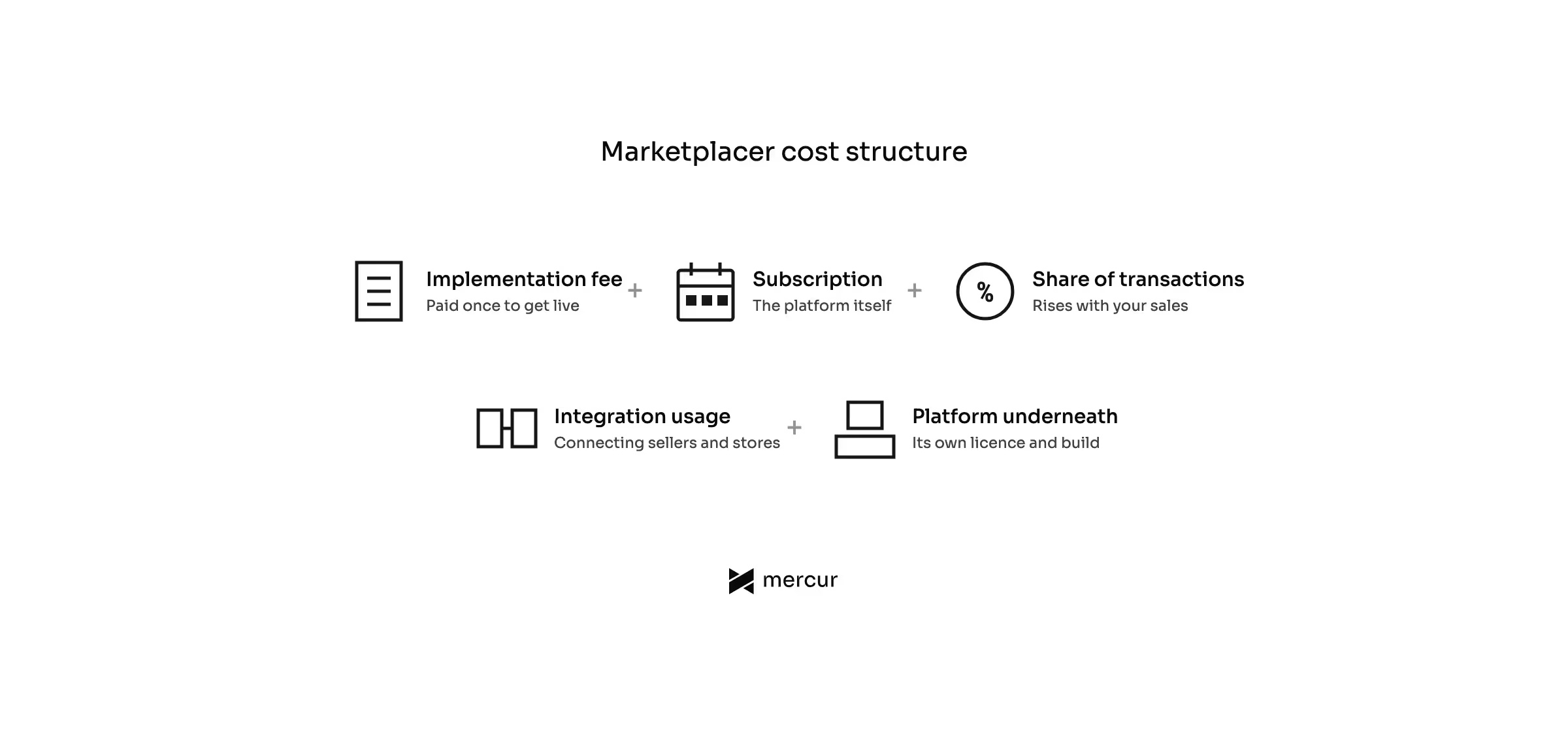
A share of transaction volume is the only item on that list that rises without giving you anything new, and it rises fastest exactly when the marketplace is working.
Why teams look for Marketplacer alternatives for multi-vendor marketplace platform
I have been building marketplaces for 7+ years, and the pattern is consistent. Teams do not leave because the platform stopped working, but because three things that were fine at launch stop being fine at scale.
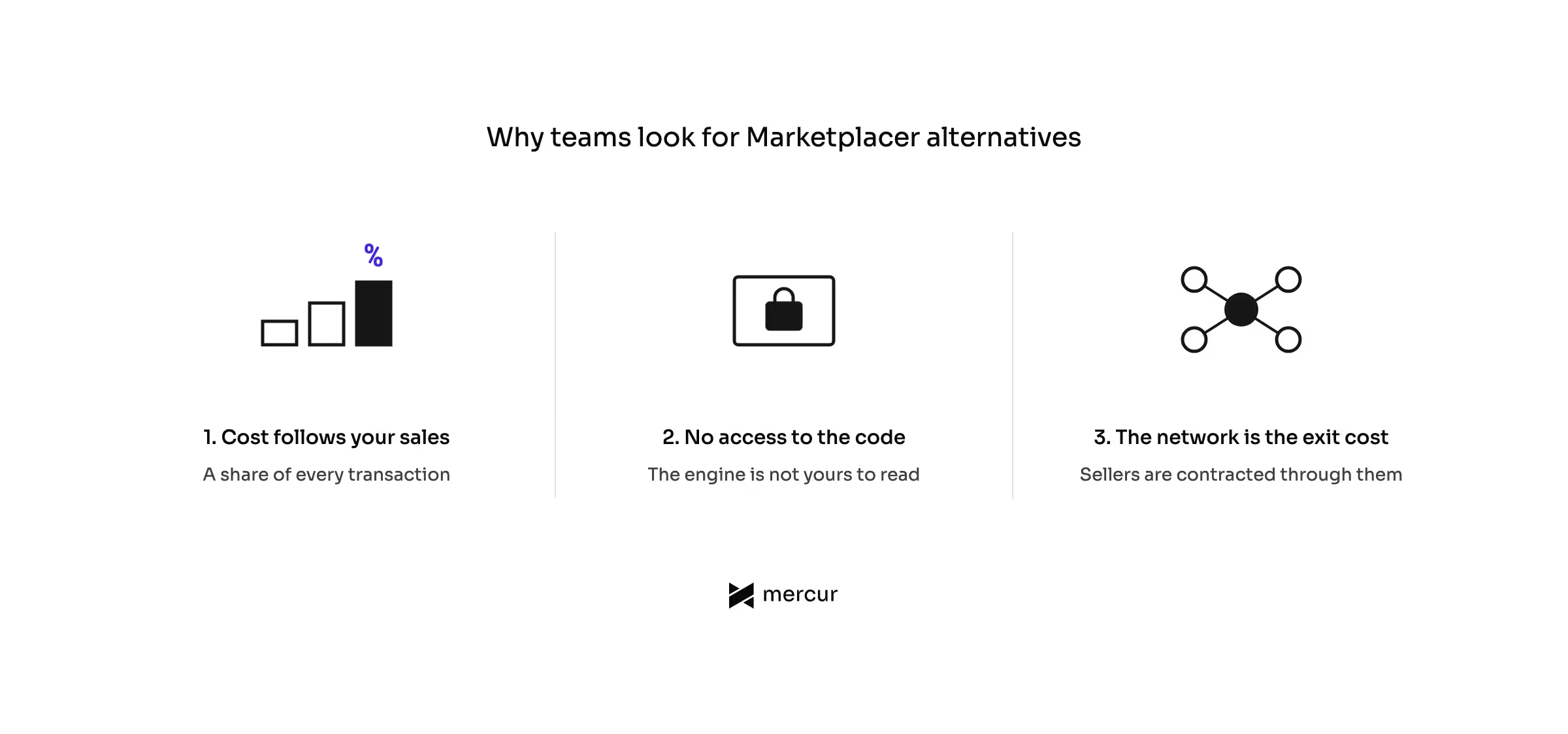
1) Cost follows your sales
A cost tied to transaction volume means the better your marketplace does, the more you pay for the same platform. At scale it becomes one of the largest lines on the bill, and it is the line you can do least about, because it is written into the contract instead of into your infrastructure.
2) You do not hold the code
Marketplacer is a closed SaaS on the vendor's cloud. You can configure it, and you can integrate with it, but the engine itself is not yours to read. Customisation runs on the vendor's roadmap, so anything the platform does not anticipate becomes a request you file instead of work your team schedules.
For a marketplace that has become a real business, that is more than a technical detail. It decides how fast you can respond when the law changes, when a large seller asks for something specific, or when you want to migrate to a different platform.
3) Seller network is the exit cost
If you built your supply on Marketplacer's seller community, those relationships run through the platform. Leaving Marketplacer means re-contracting sellers directly, one at a time, while the marketplace keeps trading. It is a fair trade on the way in and an expensive one on the way out.
What to look for in a Marketplacer competitor
Match the platform to the reason you are leaving.
- If the problem is cost at scale, look for a platform that charges for the software. A licence you can predict beats a share of revenue you cannot.
- If the problem is the customisation ceiling, look for a platform whose code your own developers can read and extend.
- If the problem is running two platforms, look for marketplace software that handles commerce natively, so one platform covers the storefront, the checkout, and the seller side.
Your own business model decides a lot of this too:
- B2B marketplaces need bulk ordering, approval workflows, and vendor management that B2C platforms do not cover.
- Marketplaces that sell across borders need multi-currency support and tax handling in the platform instead of in a plugin.
- Operators with complex integrations into an ERP, a PIM, or a warehouse system need extension points that are documented and stable, plus analytics and automation they can reach from their own stack.
Be honest about your technical capacity too. A platform you run yourself removes the ceiling and hands you the operational work. Budget for it as headcount or as a partner retainer, because the work does not disappear.
8 Marketplacer alternatives compared by cost and ownership
The list runs from the platforms where you own the most to the platforms where you own the least. Cost follows the same line, because the platforms that take no share of your sales are the ones you run yourself.
Place | Platform | Type | What it fixes vs Marketplacer | Cost model | Best for |
|---|---|---|---|---|---|
1 | Mercur | Open-source | No GMV fee, full code ownership, commerce and marketplace in one platform | No licence fee on the open-source edition, commercial licence for Enterprise, no GMV fee on either | Teams with in-house developers who want ownership of the code and a predictable cost |
2 | Spree Commerce | Open-source | No licence fee and no share of sales on the open-source edition | Open source, Enterprise Edition priced on request | Ruby teams who want an open-source base |
3 | CS-Cart Multi-Vendor | Self-hosted | A published price and no share of your sales | Straightforward product marketplaces on a fixed budget | |
4 | Spryker | Self-hosted | Composable architecture your developers build on directly | Negotiated per contract | Strong engineering teams with complex B2B logic |
5 | VTEX | Full-stack SaaS | One platform instead of a layer plus a commerce engine | Negotiated per contract | Retailers replatforming commerce and marketplace together |
6 | Mirakl | SaaS overlay | A larger seller network | Licence + share of GMV + separate commerce platform underneath | Enterprise programmes that have to clear procurement |
7 | Nautical Commerce | Full-stack SaaS | Multi-vendor commerce without an enterprise contract | Free tier, paid plans scale with usage | Mid-market operators who want it hosted |
8 | Sharetribe | Full-stack SaaS | Fast setup, no developers needed | $259 monthly + usage-based fee above 1M credits a month | Founders and small teams launching fast |
1) Mercur
Mercur is a multi-vendor marketplace platform with enterprise-grade security. There is no fee on your sales, so growth does not raise the bill. The core is public under MIT, and Enterprise licensees get source access to the Enterprise modules, so the engine is one your team can read and extend. It runs on your own infrastructure, so data residency is your decision.
It also removes the second platform. Mercur handles commerce and the marketplace in one engine, so the storefront, the checkout, and the seller side sit in one system instead of two contracts.
Around 80% of marketplace functionality is ready on day one: seller onboarding, a vendor panel, an admin dashboard, a buyer storefront, a commission engine, order splitting, split payments, and a catalogue per vendor. Your build is the 20% that is specific to your business.
It runs on standard JavaScript and TypeScript, so any web developer can work on it, and you are not recruiting certified specialists.
Mercur is deployed across 30+ enterprise commerce projects with $6B+ in client trade volume. Our Mercur vs Marketplacer comparison sets the two side by side on architecture.
What to check: you need developers or an implementation partner, and you need your own sellers. Mercur gives you the platform, and the supply side is yours to bring.
2) Spree Commerce
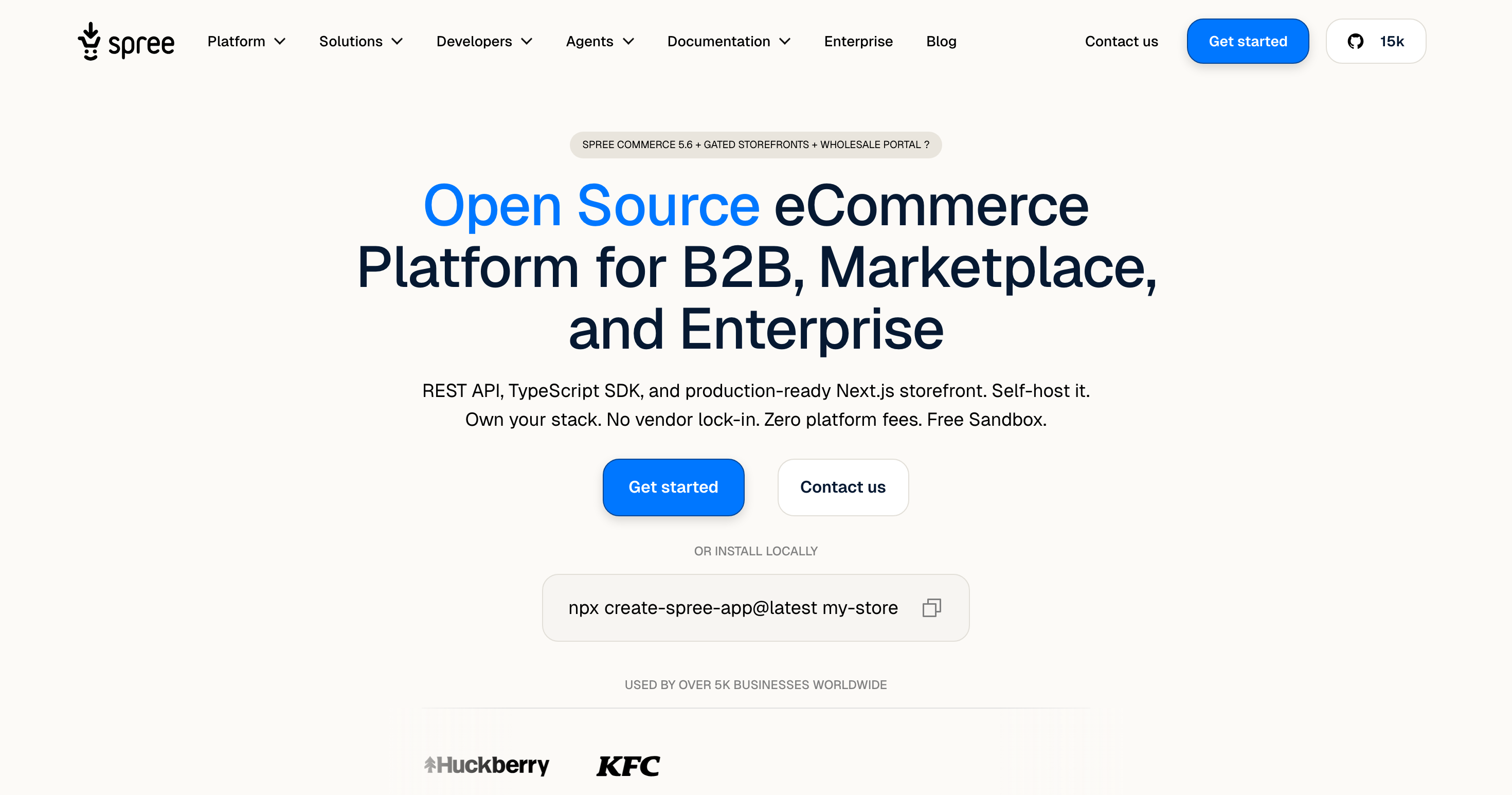
Spree Commerce asks you to own the storefront as well as the sellers. Marketplacer leaves your eCommerce platform alone and bolts the seller side on. Spree goes the other way: it is an open-source commerce platform written in Ruby on Rails, and the multi-vendor layer sits inside it, so the shop and the marketplace come from the same codebase.
That is a bigger project and a smaller bill. The code is open, you deploy it where you want, and nobody takes a share of what you sell. An Enterprise Edition adds SLA-backed support, long-term support releases, and role-based access control, and its price is not published.
What to check: whether you are ready to move the storefront too. If your eCommerce platform is staying exactly where it is, this is the wrong shape of answer, and the Ruby stack is the second question your engineering lead will ask.
3) CS-Cart Multi-Vendor
CS-Cart is the one platform here that will tell you the price before you talk to anyone. $725 a year for Standard, rising to $1,449 and $3,599, or a one-time licence from $3,590. After that, nothing on the bill moves with your sales, which is the opposite of every negotiated contract on this list.
It is also a step down in ambition from what Marketplacer sells. CS-Cart is a complete marketplace you host yourself, mature, PHP, with over 1,600 third-party extensions behind it and a codebase that looks its age. It runs a straightforward online marketplace well, and it is not built for the integration-heavy enterprise programmes Marketplacer targets.
What to check: whether your catalogue and your integrations are simple enough that a fixed licence is a real saving instead of a rebuild in disguise. Also whether anyone on your team wants to own PHP hosting.
4) Spryker
Spryker is the deliberate opposite of "without replatforming". Marketplacer's entire pitch is that you keep what you have. Spryker assumes you are rebuilding, and gives your developers a modular, headless, API-first platform to build on, licensed commercially and run on your own infrastructure.
That trade only pays off if your business logic is the reason you are moving. Spryker earns its place where the requirements break simpler platforms: an ERP that has to stay authoritative, dynamic pricing per customer, bulk ordering, and approval workflows on the buying side. Pricing is negotiated per contract.
What to check: how many developers you can put on this for how long, and whether the marketplace is the thing they should be building.
5) VTEX
VTEX is the answer to the second contract. The cost of Marketplacer is that your budget covers two platforms: the seller layer and the commerce engine under it, each with its own licence, its own implementation, and its own roadmap. VTEX collapses that into one, covering B2C, B2B, marketplace, and omnichannel from a single system.
VTEX publishes no pricing, the contract is negotiated per deal, and the marketplace module is one part of a broader commerce suite, so you buy the suite to get it. Its strongest presence is in Latin America.
What to check: ask what the price is tied to before you compare the two. Trading one undisclosed contract for another fixes the architecture and can leave the economics exactly where they were.
6) Mirakl
Mirakl is the same architecture one size up. It is a marketplace layer over a commerce platform you license separately, and it brings a curated seller network of its own.
The second platform underneath stays. The code stays closed. The commercial model is a licence plus a share of marketplace GMV. Mirakl publishes no figure for the marketplace platform, and the products around it are sold separately. Our guide to Mirakl alternatives covers it in full.
What to check: whether the seller network you would be joining is better for your categories than the one you already have. That is the only part of this swap that cannot be replaced by software.
7) Nautical Commerce
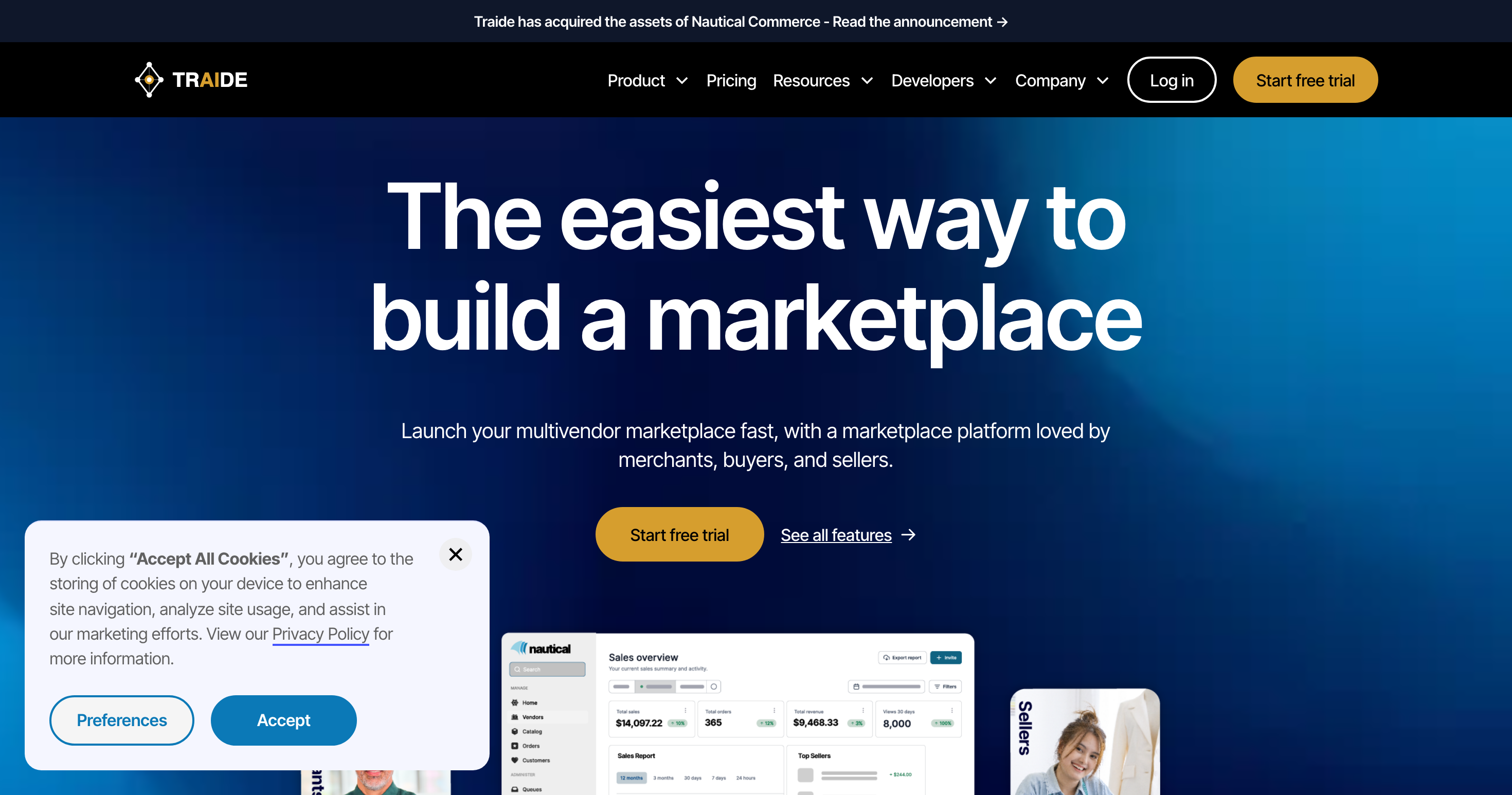
Nautical Commerce competes for the same buyer as Marketplacer and answers them differently. Both target mid-market operators adding sellers. Marketplacer runs the seller layer over your commerce platform. Nautical hosts both, so there is one vendor, one contract, and one roadmap instead of two.
There is a free tier for testing and paid plans that scale with usage, against an enterprise contract and an implementation project. The ceiling is lower too: it is a hosted product where the roadmap belongs to the vendor, and the seller network you would be giving up has no equivalent here.
What to check: what usage-based means in your numbers, modelled against your own growth plan. A price that scales with usage is similar to a price that scales with sales, and it is the thing you came here to get away from.
8) Sharetribe
Sharetribe is a hosted marketplace builder and the fastest way on this list to get your platform live. A non-technical team can launch in weeks with seller accounts, listings, and payment processing handled for them.
Plans run $259 monthly, and billing moved to usage in October 2026: 1 million credits a month are included, and API usage above that is billed separately.
It is on this list because some teams shopping for Marketplacer alternatives are smaller than the platform they are shopping for.
What to check: the customisation ceiling and the usage bill, which are the two reasons teams outgrow it. Our guide to Sharetribe alternatives covers what happens next.
How to migrate off Marketplacer in 4 steps
Marketplacer is a layer on top of your commerce platform, so leaving it is a migration of the seller side plus a decision about everything underneath.
1. Separate your sellers from the network
List every seller trading on your marketplace and mark which ones you brought and which ones came from the seller community.
2. Export your catalogue, orders, and commission rules
Pull seller records, product data, orders, and the commission packages that decide what each seller is paid. How cleanly you can extract all of it is a measure of how locked in you were.
Commission rules are the piece most teams forget. They encode years of individual seller agreements, and they rarely map one-to-one onto another platform's model.
3. Decide whether the storefront moves too
If you move to another marketplace layer, you keep your eCommerce platform and its contract. If you move to a platform that handles commerce natively, the second system comes off the books.
4. Run in parallel, then cut over
Move a subset of sellers to the new platform and run both for a period. A staged switch lets you validate seller onboarding, order management, and payouts with real transactions before you move your whole seller base and end the contract.
Summary: Which Marketplacer alternative fits your marketplace?
The right Marketplacer alternative follows from the reason you are leaving:
- If the problem is a cost that follows your sales, you need a cost tied to the software instead of your turnover. CS-Cart publishes a licence price and takes no share of sales. An open-source platform such as Mercur or Spree Commerce keeps the licence line at zero at any volume.
- If the problem is running two platforms, you need marketplace software that handles commerce natively. VTEX does that as a hosted suite. Mercur does it as code you own.
- If the problem is the customisation ceiling, you need the source in your own repository. Mercur, Spree Commerce, and Spryker each give you that, with different stacks and different amounts of work.
And if none of this is your problem, stay where you are. Marketplacer's seller community is a genuine advantage, the connectors to the major eCommerce platforms are built and maintained, and a retailer without supplier relationships of their own will struggle to replace that with any platform on this list.
If you would rather start from your own situation, talk to the marketplace experts about scope, timeline, and what a migration off Marketplacer would cover.
Frequently asked questions on Marketplacer alternatives
What is Marketplacer?
Marketplacer is a multi-vendor marketplace platform for mid-market and enterprise retailers that adds third-party sellers to an existing online store. It runs seller onboarding, vendor management, and order management across multiple vendors on top of the eCommerce platform you already use, and it connects that platform to a seller community operators can recruit from.
How much does Marketplacer cost?
Marketplacer does not publish pricing. What buyers consistently report is a model combining an implementation fee, a subscription, a share of transaction volume, and usage fees for the integration products, on top of the eCommerce platform you license separately.
What is the best Marketplacer alternative?
The best Marketplacer alternative depends on the constraint you need to resolve. For teams hitting a cost that grows with sales, a customisation ceiling, and a second platform underneath all at once, an open-source platform such as Mercur resolves all three. For staying with a hosted layer at a larger scale, Mirakl is the closest comparison. For staying hosted at mid-market scale, Nautical Commerce is the lower-commitment option.
Is Marketplacer a good platform?
Marketplacer is a good platform for what it sells. It is proven with large retailers, its connectors to the major eCommerce platforms are built and maintained, and its seller community is a real advantage for an operator without supplier relationships of their own. The questions buyers weigh are commercial: a cost reported to follow transaction volume, a closed codebase, and a second platform underneath that carries its own licence.
Does Marketplacer replace your eCommerce platform?
Marketplacer does not replace your eCommerce platform. It is a layer that adds multiple vendors to a store that already sells, so the storefront, the checkout, and payment processing stay where they are. That is the point of the product, and it is also why a Marketplacer budget covers two platforms. A platform like Mercur or VTEX handles both in one system.
More articles


Ready to build?
See the product – open the demo, or book a walkthrough with our experts.