
7 Marketplace Trends That Will Improve Your Online Business in 2027
Marketplace trends show where online marketplace operators will spend their time and budget in the coming year.
If you want to bet on one thing in your 2027 marketplace strategy, bet on product data. For 2027, 70% of the operators choose GMV growth as their main goal, and 74% plan to invest in AI-driven search to get it.
That plan only works with complete product data. AI search, personalization, and AI shopping agents all choose products by the attributes in your catalog.
So how do you get your product data ready, and which other trends deserve a place in your plan for 2027?
This article is based on Mercur's Marketplace Trends 2027 Report, made up of insights from 50+ marketplace operators and consultants. The respondents include practitioners from companies such as Amazon, eBay, Allegro, and OTTO.
I co-authored the report and picked the 7 trends that give you something to act on. Below is the shortlist of all trends in this article:
Trend in marketplaces | What should you do in 2027? |
|---|---|
Investing in AI-driven search and personalization | Fix product data in your top categories before you buy a search tool. |
Optimizing your marketplace for AI shopping agents | Define required attributes per category and publish structured product data. |
Automating catalogs and seller onboarding with generative AI | Automate attribute extraction and check listings when sellers submit them. |
Choosing seller quality over seller count | Write qualification criteria and track GMV per seller. |
Specializing in one vertical or niche | Pick the categories you know best and set stricter listing rules there. |
Growing GMV from customers you already have | Measure repeat purchases and build a loyalty program. |
Selling inside social media and other apps | Make product data, prices, and stock available through an API or a feed. |
The full report has the complete rankings, quotes from marketplace experts, and a readiness checklist for AI agents. You can download it for free.

Key insights
- AI-driven search and personalization is the top investment area for 2027. 74% of the surveyed operators selected it.
- 61% expect AI agents to be the biggest change in marketplaces over the next 2-3 years.
- Growth is the first goal again. 70% want to increase GMV, and most plan to get it from existing customers.
- Finding good sellers is now harder than onboarding them. 48% name it as their biggest challenge.
- Only 22% plan to replace their platform. Most teams add AI to the marketplace software they already have.
7 marketplace trends for 2027 and how to apply them on your platform
The most significant trend is AI-driven search. It jumped from 6th place in the 2026 edition of the report to 1st place in this one. After the numbers, you will find why each trend matters for an operator and what to do about it in 2027.
Below is the shortlist of all 7 trends:
- Investing in AI-driven search and personalization.
- Optimizing your marketplace for AI shopping agents.
- Automating catalogs and seller onboarding with generative AI.
- Choosing seller quality over seller count.
- Specializing in one vertical or niche.
- Growing GMV from customers you already have.
- Selling inside social media and other apps.
1. Investing in AI-driven search and personalization
AI-driven search and personalization is the most selected investment area for 2027. 74% of the operators chose it.
AI search uses machine learning and natural language processing to understand what a shopper means. A buyer can type "light waterproof jacket for cycling" and get matching offers from many sellers. Personalization then adapts the results to individual preferences and to past customer behavior.
Online shoppers leave when they can't find a product after a few tries. On a marketplace, this happens more often than in a traditional online store because every seller describes the same kind of product in a different way.
When an operator tells me that their search doesn't work, I ask to see the product data first. In my experience, the search engine is usually fine, and the attributes are missing. In search, a complete description of the product plays a bigger part than the design of the page.
To get a return on AI search in 2027, start with the data:
- List the attributes each of your top categories needs, with units and allowed values.
- Measure how many live listings have those attributes filled in.
- Add search that understands full sentences, synonyms, and typos.
- Show personalized product recommendations on the product page and in the cart, then track average order value.
- Check that your filters work across the offers of all sellers. The Marketplace Academy chapter on faceted search on a marketplace explains how.
Better search results increase sales from the traffic you already have. Buyers also come back more often when they get a personalized shopping experience.
2. Optimizing your marketplace for AI shopping agents
AI shopping agents are the change in marketplaces that operators expect most over the next 2–3 years. 61% of the operators chose it.
An AI shopping agent is software that shops for a person. The buyer describes what they need. The agent reads product data from many sellers, compares the offers, and recommends one product or buys it.
Consumers are increasingly turning to AI assistants for help with online shopping, and for these buyers, digital commerce starts in the assistant. Software now often reads your product page before a person does.
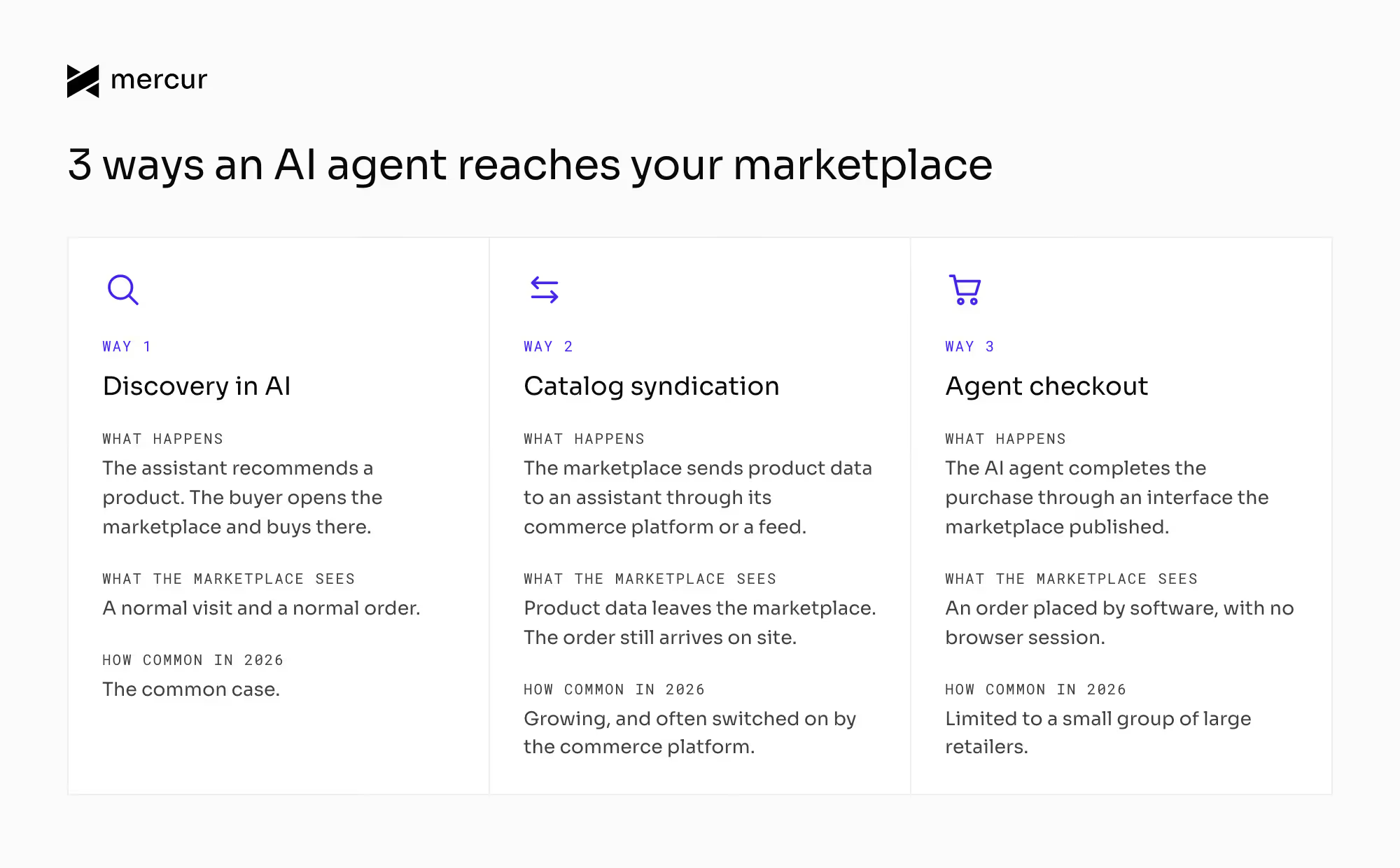
An AI agent can reach your marketplace in 3 ways:
- Discovery in AI. The assistant recommends a product, and the buyer opens your marketplace to buy it. This is the common case today.
- Catalog syndication. Your marketplace sends product data to an assistant through a feed or through your commerce platform. The order still arrives on your site.
- Agent checkout. The agent completes the purchase through an interface you published. In 2026, this was limited to a small group of large retailers.
An agent doesn't browse your store. It asks for products that meet a set of conditions, removes every offer that fails one of them, and ranks the rest. A person can work around a missing size or an unclear return policy, but an agent drops the listing and goes to the next seller.
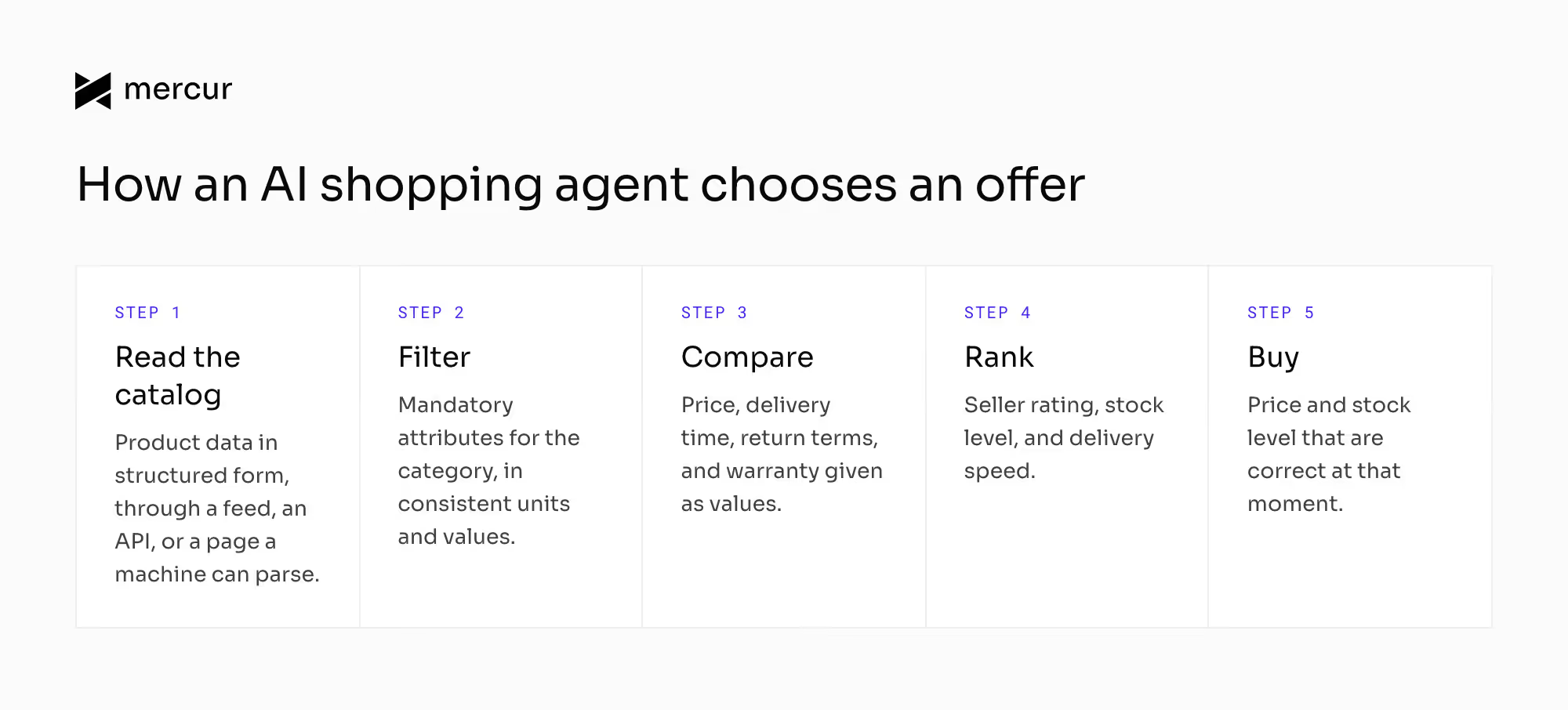
AI agents may be the game-changer of the next few years. In 2027, prepare for them in your catalog:
- Define the required attribute set for each of your top categories.
- Keep units, sizes, and condition values in one standard across all sellers.
- Update prices and stock often enough to be correct when an agent reads them.
- Store delivery, return, and warranty terms as values in separate fields.
- Add schema.org Product and Offer markup to your product pages.
- State in your robots.txt file and in your terms whether AI agents may read your pages and buy products.
The report contains a 10-point checklist that shows whether AI agents can buy from your marketplace today.
3. Automating catalogs and seller onboarding with generative AI
65% of the operators expect generative AI for supply-side automation to have the biggest impact in marketplaces over the next 2–3 years.
Supply-side automation covers the work between a seller's product file and a live listing. Generative AI can read a messy product feed, extract the attributes, assign a category, and write a missing description. It can also flag the listings that break your rules.
Every new seller and every new order adds catalog work, seller support, and payout handling. Automation keeps that work from growing as fast as your sales volume.
In the projects I work on, catalog cleanup takes more of the team's time than operators expect at the start. AI saves more hours on catalog cleanup today than on any other part of eCommerce operations.
To automate the catalog without losing control of it:
- Check every listing automatically when the seller submits it.
- Ask sellers for a GTIN on every product. With it, you can match the same item from different sellers.
- Use AI to fill in missing attributes. Let a person approve the changes in regulated categories such as pharmacy and health.
- Connect to the systems your sellers already use. They shouldn't have to type the same data twice.
- Track catalog readiness by category and by seller.
Automate onboarding too. A seller should be able to register, upload documents, and list the first product without an email to your team. The steps are described in the article on marketplace seller onboarding.
4. Choosing seller quality over seller count
Attracting and retaining high-quality sellers is the most cited challenge for 2027. 48% of the operators chose it.
Operators now struggle more with finding sellers who meet their standards than with onboarding them. A weak seller takes your team's time because your people fix listings and handle complaints.
The buyer then blames your marketplace for the late delivery. After one bad order, the buyer judges the customer experience of the whole store, and customer satisfaction drops. More products in the catalog don't help when shoppers can't trust them.
Good sellers also choose where they sell. Sellers join a marketplace to reach more customers than their own store can. Brands and retailers then compare platforms by what they earn after fees, advertising, delivery, and returns. Your best sellers stay when their sales on your marketplace are repeatable and profitable.
I ask every operator how much GMV their median seller brings. Many businesses know their total number of sellers, but they don't know the GMV of the median one.
To build a seller base, you can rely on:
- Write down your qualification criteria before you recruit. Include catalog size, delivery times, return rate, and required documents.
- Watch the first weeks of every new seller: the first listing, the first order, and the first complaint.
- Report GMV per seller, and review the bottom of the list every quarter.
- Score sellers on returns, complaints, and response time. The article about marketplace seller quality metrics shows what to measure and when to suspend.
- Show sellers their own numbers. They should see their sales potential on your marketplace and what holds it back.
A smaller base of reliable sellers means less support work for your team and a store that buyers trust.
5. Specializing in one vertical or niche
48% of marketplace operators expect vertical and niche marketplaces to rise over the next 2–3 years. 30% expect generalist marketplaces to lose market share to specialized ones.
A vertical marketplace sells in one industry or one category, and its team knows that category better than a generalist's team can. Amazon and eBay compete by listing everything. A niche marketplace keeps its focus on one group of buyers and competes with a selected assortment and with the product information those buyers need.
Vertical catalogs need more data than general ones because each category needs its own attributes, compliance fields, and service terms. Generative AI makes that work affordable, and a small team can now maintain a specialized catalog.
39% of the operators also expect service-enabled marketplaces to grow. A marketplace for building materials can sell delivery and installation next to the product. Services are harder to copy than a product listing, and they often carry a better margin.
Some niches come from consumer habits. Resale and refurbished goods are one example because eco-conscious consumers buy used products for the lower price and out of environmental concerns.
To specialize in 2027:
- Choose the categories in which your team has real expertise and supplier contacts.
- Set stricter listing rules than a generalist does. Require the attributes, images, and documents that buyers in your category expect.
- Add the services that buyers order with the product, such as installation or maintenance.
- Decide which products you refuse to list, and publish that policy.
- Collect user-generated content such as reviews and buyer photos. It helps other buyers with their purchasing decisions.
A generalist can't quickly copy your expertise in one category, so it's your competitive edge. If you are still choosing a model, the guide to marketplace business models compares vertical and horizontal marketplaces.
6. Growing GMV from customers you already have
For 70% of experts, increasing GMV is the most selected goal for 2027.
Profitability was the first goal a year ago. Operators still want profit, and they plan to reach it through more orders from repeat customers in the markets they already serve.
43% of the operators name rising customer acquisition cost and retention as a challenge. When potential customers cost more to win, a second and third order from an existing buyer costs you less than a first order from a new one. I explain the mechanism in the article on CAC in eCommerce.
The operators I talk to usually have traffic data. Most can't tell me which customers come back and what those customers buy the second time. Loyalty programs and recommendations drive sales without new ad spend.
Look at checkout next. Buyers expect to pay with the method they prefer, and for many that's a digital wallet or a buy now, pay later plan. They also expect fast delivery and simple returns, and they come back to a marketplace that offers this convenience.
Retailers with physical shops can show the marketplace assortment on kiosks as part of their in-store experiences. A retailer grows online sales this way without buying more stock.
Advertising also earns revenue from the same traffic. In a retail media network, sellers and brands pay for visibility inside your marketplace.
To grow GMV from existing customers in 2027:
- Measure the repeat purchase rate and the contribution of each customer cohort.
- Launch a marketplace loyalty program that works across all sellers.
- Offer several payment methods at checkout.
- Recommend products from other sellers in the cart to raise average order value.
- Test sponsored listings with a small group of sellers before you build a full advertising product.
Each of these steps raises revenue from buyers you have already paid to acquire.
7. Selling inside social media and other apps
Operators expect marketplaces to become layers inside social media, banking apps, and procurement systems. 39% of the operators chose it, and 26% chose social commerce and live selling.
TikTok Shop is the clearest working example. The product appears in the feed, and users complete the purchase in just a few clicks without leaving the app. Sellers list products and sell without the buyer ever opening a storefront.
Most of these purchases happen on mobile phones. Social commerce is mostly mobile commerce, so the whole shopping process has to work on mobile devices. Gen Z and other younger shoppers often discover a product in a social media feed before they search for it.
For an operator, the customer journey can now start and end in an app you don't own. The host app decides how your product is shown, and you don't design the page there. Your offers compete on data quality, price, and delivery.
Social media platforms, embedded marketplaces, and AI agents are one change in consumer behaviors. Buyers choose a product outside your site, and your marketplace supplies it.
To sell where your buyers already spend their time:
- Make product data, prices, and stock available through an API or a feed that partners can use.
- Keep one product record that works across markets, channels, and partners.
- Attribute the orders that start outside your marketplace, so you know what each channel brings.
- Start with one social channel and give it its own budget line.
- Add short product videos because a social feed mostly shows video. Augmented reality previews can help in categories such as furniture or eyewear, and I'd add them after the product data is in order.
Each channel you add this way uses the same product data you prepared for search and for AI agents.
Which marketplace trend should you start with?
To stay competitive in 2027, you don't have to follow all 7 trends at once. Start with the trend that fits the stage of your business.
Retailers who add third-party sellers to an existing eCommerce store should start with seller quality and catalog rules. Your buyers already trust your store. One weak seller can lose you that trust. Write the qualification criteria and the required attributes before you invite anyone.
A new marketplace should start with one niche. A narrow assortment lets a small team know its sellers and its buyers well. It also keeps the data work small enough to do properly.
An established marketplace should start with AI search and repeat customers. You already have the traffic and the catalog. Better discovery and a loyalty program raise GMV without a higher acquisition budget.
A B2B marketplace should start with product data for procurement systems and AI agents. Business buyers compare specifications, minimum order quantities, and lead times. Those fields have to be complete before any software can read them.
Whatever your stage, define the required attribute set for your top categories. Then measure the share of live listings that meet it. AI search, personalization, and AI agents all select products from those attributes. Operators who fix this first will stay ahead of other marketplaces when agent traffic grows.
Which marketplace platform lets you act on these trends?
To use any of these 7 trends, you need a marketplace platform that lets you change how your catalog, sellers, and checkout work. Every action in this article ends in the platform.
- A required attribute has to be enforced when a seller submits a listing.
- A product feed for AI agents needs an API.
- Seller scoring needs order and return data in one place.
Before you plan the budget for 2027, check what your current software allows:
- Can you add a required attribute to a category without a request to the vendor?
- Can you check listings automatically when sellers submit them?
- Can you make product data, prices, and stock available through an API or a feed?
- Can you connect an AI tool for search or catalog enrichment through an integration?
- Can you see GMV, returns, and complaints for each seller?
- Does the cost of the platform grow with your GMV?
If most of the first five answers are yes, you can add these trends to the platform you have. Only 22% of the operators in the survey plan to replace their core engine in 2027.
If most answers are no, each trend will cost you custom work or a wait for the vendor's roadmap. In that case, compare the best marketplace platforms before you fund the first AI project.
How does Mercur help you apply these marketplace trends?
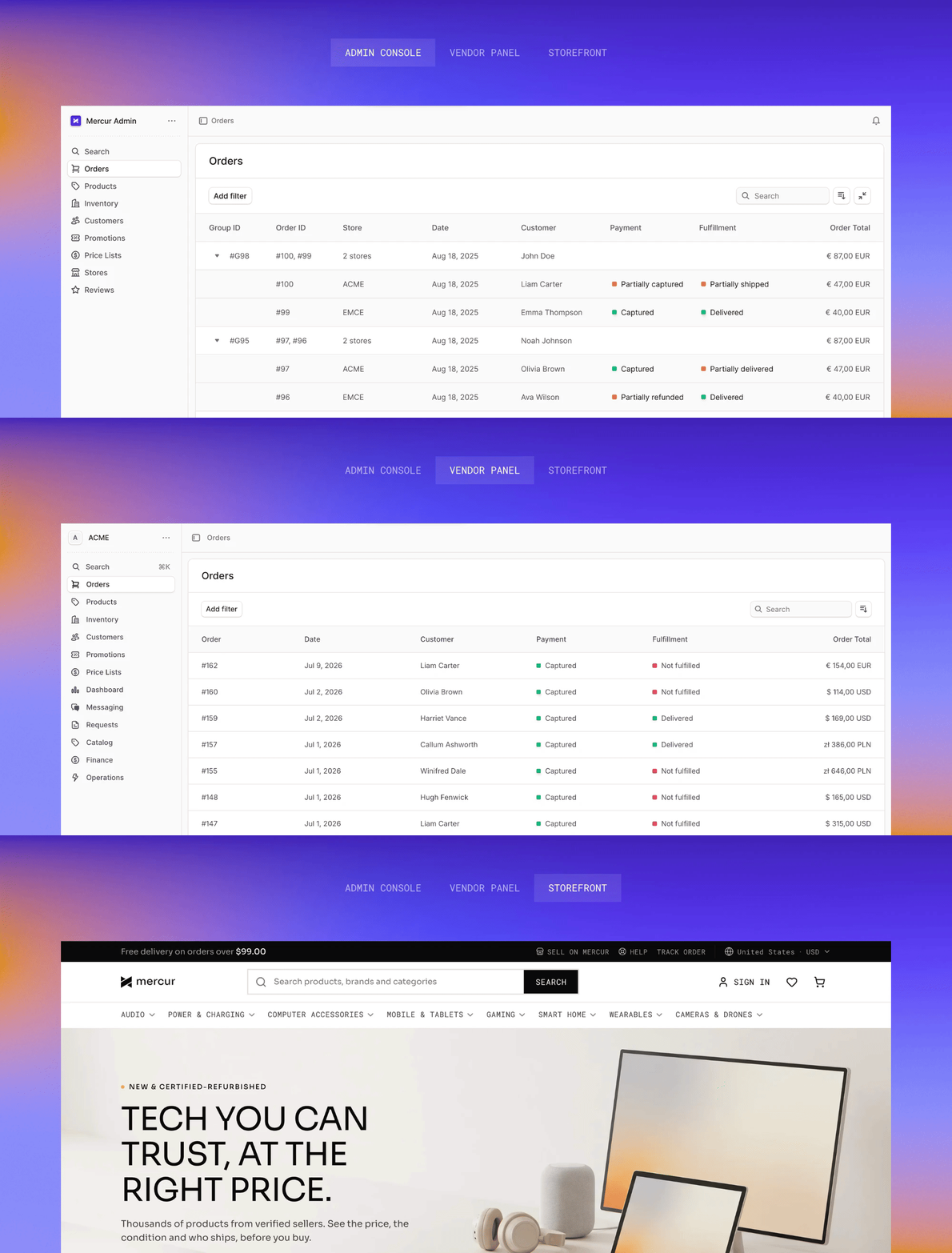
Mercur is an open-source marketplace platform with a storefront for buyers, a vendor panel for sellers, and an admin panel for your team. It comes with a comprehensive suite of marketplace features, and each one below supports a trend from this article:
- The catalog has typed product attributes, so you can define the attribute set that AI search and AI shopping agents read (trends 1 and 2).
- The Enterprise edition includes AI data enrichment, so attributes are extracted from seller feeds and products are categorized automatically (trend 3).
- Sellers register on their own and wait for your approval, so you decide who sells before the first listing goes live (trend 4).
- Enterprise seller scoring tracks returns, complaints, and response time, so weak sellers are flagged and suspended without manual reviews (trend 4).
- You own the code, so your team can build the listing rules, the services, and the checkout your niche needs without waiting for a vendor (trend 5).
- Mercur doesn't charge a fee on your GMV, so the growth you get from repeat customers stays in your business (trend 6).
- Mercur is headless and API-first, so product data, prices, and stock can reach social apps, partners, and AI agents (trend 7).
You don't have to replace your store to use any of this. You can add a marketplace to your existing eCommerce platform, such as Shopify or Magento, and keep the store you have. Your team can also add new technological advancements such as agent checkout when they're ready.
Do you want to see how Mercur works on a live marketplace?
Summary: Which marketplace trends will improve your business in 2027?
All 7 marketplace trends for 2027 depend on product and seller data. They will improve your business only if your team does something different next quarter. Choose the one trend that matches your stage, take the first action from its list, and measure the result before you add the next one.
The Marketplace Trends 2027 Report has even more valuable insights – the full rankings, the comparison with the 2026 edition, and the readiness checklist for AI agents – that you'll find here.
Are you planning a marketplace for 2027, or adding sellers to the eCommerce store you already have?
FAQ on marketplace trends
Which marketplace trend should you invest in first in 2027?
Invest in product data first. The three AI trends depend on it. Search engines and AI agents both select products by the attributes in your catalog. Define the required attributes for your top categories and measure how many listings meet them. After that, choose the trend that fits the stage of your marketplace.
Do you need to replace your marketplace platform to use AI?
In most cases, you don't. Only 22% of the operators in the Marketplace Trends 2027 survey plan to replace their core engine in 2027. Most teams add AI features on top of the platform they have. You need integration points, clean product data, and a way to extend the platform. Replace the platform only when it blocks those three things.
How do AI shopping agents change an online marketplace?
AI shopping agents recommend your offers only when the product data is complete. An agent filters offers by attributes, price, stock, and delivery terms, and it drops listings with missing fields. The agent doesn't see your storefront design. Operators prepare for this with attribute standards, current prices, and structured markup on product pages.
Is social commerce worth the investment for a marketplace operator?
Social commerce is worth a test when your buyers already discover products on social media. In the survey, 26% of operators chose social commerce and live selling. Start with one channel, a small group of sellers, and a separate budget. Expand when you can attribute orders to that channel.
How can a niche marketplace compete with Amazon and eBay?
A niche marketplace competes on expertise, curation, and product information in one category. Generalists can't apply strict listing rules to every category they sell. A specialized marketplace can require the attributes and documents its buyers need, and it can add services such as installation. 30% of the surveyed operators expect generalists to lose market share to specialized platforms.
More articles


Ready to build?
See the product – open the demo, or book a walkthrough with our experts.