
Comparison of The Best Open Source Marketplace Platforms in 2026 (License, TCO, Security)
When you search for a comparison of open source marketplace platforms, most of what you see is actually a list of open source eCommerce platforms. Magento, Shopware, PrestaShop, Bagisto: excellent projects, but none of them are multi-vendor marketplace platforms.
They enable you to sell your catalogue, but a marketplace platform must sell other vendors' catalogues through your storefront, which means you need: vendor accounts, commission rules, order splitting, and payouts that reach several sellers from one checkout.
Once you apply that filter, the list of platforms gets short. There are only 4 open source projects that provide the multi-vendor logic model, are actively maintained, and have a community large enough to support you.
The rest of what appears on these lists is an eCommerce platform with a marketplace extension bolted on, usually sold by somebody other than the people who maintain the platform.
This guide compares those 4 platforms on the open source license each one uses, what the total cost of ownership looks like, and how secure they are. All information was checked from the platforms' own repositories in October 2026.
Place | Platform | License | Stack |
|---|---|---|---|
1 | Mercur | MIT | Medusa-based, TypeScript / Node |
2 | Spree Commerce | BSD-3-Clause | Ruby on Rails |
3 | nopCommerce | nopCommerce Public License 4.0 | C# / .NET |
4 | Dokan for WooCommerce | GPL | PHP / WordPress |
Key insights
- Open source is a license and not a business model. Three different license families appear on this short list, from permissive MIT and BSD to the GPL to a project's own bespoke terms, and they place different obligations on what you build.
- Most platforms sold as "open source marketplace software" are single-vendor eCommerce platforms where the marketplace is a paid extension.
- A free license does not make a free platform. The cost moves to hosting, implementation, and maintenance.
- Self-hosting hands you the security posture. The code is auditable, which is a real advantage, and patching it on time becomes your job.
What is an open source marketplace platform?
Open source marketplace platform is software for running a multi-vendor marketplace whose source code is published under a license that lets you read it, run it, change it, and redistribute it.
Vendor accounts, commission rules, order splitting, and payouts to several sellers come with the product you install.
For a marketplace operator, it means:
- The code behind all of it is yours to read and change.
- You can host it where you want with full control over the infrastructure under it.
- You can change the parts that do not fit your business and create the ones that are missing, without waiting for a vendor's roadmap.
- You can integrate the capabilities you already pay for, from the ERP to the payment provider, against an API nobody can close to you.
- Nobody takes a share of your sales, because there is no contract with creators of the platform.
What are the differences between open source and source-available?
Both terms mean you receive the source code. Only one of them lets you run it without paying anyone, fork it if the project turns in a direction you dislike, and keep operating if the company behind it closes.
- Open source means an OSI-approved license: MIT, BSD, GPL, and their relatives. You can run it, modify it, fork it, and keep what you build on top, and no permission is required for any of that.
- Source-available means you get the code under terms that restrict what you may do with it. For example, CS-Cart Multi-Vendor sells you the source and the right to run it on your own servers, under a commercial license with an annual price – that's why it's not in our comparison.
Check the LICENSE file in the repository before you look at the feature list. That file is the only place this question gets answered.
Which open source platforms are for marketplace and which are for eCommerce?
Open source solutions on the market split into two groups: platforms where the multi-vendor model is in the product, and eCommerce where it is an extension somebody sells you.
An open source eCommerce platform gives you a catalogue, a cart, a checkout, and an admin panel for one seller: you. It sells your own products and builds an online store.
A marketplace adds a second class of user with their own interests, and almost everything downstream changes.
- Vendor accounts and onboarding. Someone who is not you registers, gets approved, and manages their own listings.
- Order splitting. One basket can hold items from three sellers and has to become three fulfilments without your customers seeing the seam.
- Commission and payouts. Money arrives in one place and leaves in several, with the right amount withheld and an invoice each seller can reconcile.
- Catalogue governance. Multiple vendors listing the same product is the normal case, and deciding what the buyer sees becomes a product decision you own.
List of open source platforms where the marketplace is a paid extension
These platforms appear on nearly every list of open source marketplace software. All of them are genuinely open source, all of them are genuinely good, and in every case the same sentence applies: the platform is a classic shop, and the multi-vendor layer is an extension you buy from somebody else.
Platform | License | What it is | The marketplace layer |
|---|---|---|---|
OSL-3.0 for Magento Open Source | The large PHP commerce platform, with Adobe's commercial edition above it | Third-party extension. Webkul's Magento 2 Multi Vendor Marketplace is $349, and wallet, dropship, and GDPR modules are priced separately on top | |
Shopware | MIT | PHP commerce platform with a strong B2B story and commercial editions | Third-party extension. Webkul's Shopware Multi Vendor Marketplace is $299 |
PrestaShop | OSL-3.0 core, AFL-3.0 modules | Lightweight PHP shop with a large official addons marketplace | Third-party extension. Webkul's PrestaShop Advanced Multi-Vendor Marketplace is $99 |
Bagisto | MIT | Laravel eCommerce with a wide free feature set | The Laravel Multi Vendor Marketplace Extension is $449 |
Three of these four marketplace layers come from the same vendor, and we looked at what a business gets when it runs on one and why the Webkul multi-vendor marketplace was never built to run your business.
Saleor, Sylius, Vendure, and OpenCart belong in the same bracket with one difference: there you are more likely to be writing the vendor accounts, commission logic, and payouts yourself than buying them.
None of that makes them wrong choices. It makes them a different decision: either you buy a marketplace layer that somebody else maintains on a release cycle you do not control, or you build it.
What is the cost of an open-source marketplace platform?
The license to use the open-source platform costs nothing. Your budget goes to hosting, implementation, integrations, and maintenance.
However, every platform type has these four lines. A SaaS platform folds hosting into the subscription and still charges you for implementation and integrations, and a licensed platform puts its fee on top of all four.
What an open source license buys you is the absence of a tax on growth. No percentage of GMV, no per-transaction fee, and no renegotiation when the marketplace starts working. Against a SaaS platform, the real comparison is a fixed cost you control against a variable cost that rises with your success.
Hosting and infrastructure
The database, the application, the search index, and the media storage. This is the smallest of the four and the easiest to predict.
Implementation
The highest cost in the first year of your business activity. Development time depends on how much of your business the platform already models, so a platform with multi-vendor in the core starts you much further along than a framework you extend into a marketplace.
Integrations
The ERP, the PIM, the warehouse system, and the accounting stack each need a connection that works both ways. Ready-made connectors, migration tools, and an API you can develop. Check whether they exist for your systems before you choose the platform.
Maintenance
Upgrades, dependency updates, and security patches.
An open source project gives you community forums and issue trackers. Paid support and professional services cost extra, and someone on your team still has to understand the platform well enough to use either one.
Is open source marketplace software secure?
Yes, open source marketplace software is secure, as long as the project behind it is actively maintained and someone applies the patches. It also gives you something a hosted platform does not: you can read the code that pays your sellers before you trust it with that job.
What open source platforms make better
- You can read the code that handles payments, vendor data, and payouts, so you are checking the software instead of trusting a description of it from a marketing page.
- Your security team can audit it before go-live and after every change.
- You choose the infrastructure it runs on, so you decide where your data sits.
- Vulnerabilities are published openly, so you hear about them at the same time as everyone else.
What open source platforms make harder
Nobody patches your deployment for you. When a vulnerability is published, attackers read the same announcement you do, so someone on your side has to watch advisories and apply updates quickly. That only works if the project behind the platform is still being maintained.
You can check that before you choose. Every platform in this guide had code pushed within days of this article being written.
Top 4 open source marketplace platforms compared by license, cost, and security
The list runs from the platforms built as marketplaces to the platform where the marketplace is the plugin. All information was checked from the platforms' own repositories in October 2026.
Place | Platform | License | Multi vendor | Best for |
|---|---|---|---|---|
1 | Mercur | MIT | In the core | Teams that want a marketplace on day one with the code in their hands |
2 | Spree Commerce | BSD-3-Clause | Maintained extension on an open core | Ruby teams building commerce and marketplace from one codebase |
3 | nopCommerce | nopCommerce Public License | Vendor accounts and multi-store in the core | .NET organisations that want vendor accounts without leaving their stack |
4 | Dokan for WooCommerce | GPL | The plugin is the marketplace | Teams already on WordPress who want the shortest path to a marketplace |
1) Mercur
Mercur is an open-source marketplace platform where multi-vendor logic is included in the core. The license is MIT, the code is on GitHub, and the documentation is public.
Around 80% of marketplace functionality is ready on day one: seller onboarding, a vendor panel, an admin console, a buyer storefront, a commission engine, order splitting, split payments, and a catalogue per vendor. Your build is the 20% specific to your business, which is a materially different starting point from a commerce framework you extend into a marketplace.
It is built on Medusa and runs on standard JavaScript and TypeScript, so any web developer can work on it. It runs on your own infrastructure, so data residency is your decision.
Mercur is deployed across 30+ enterprise commerce projects with $6B+ in client trade volume. There is also the Enterprise license that gives you source access to the Enterprise modules, and neither edition takes a share of your sales.
What to check: you may need developers or an implementation partner. Mercur gives you the platform; the supply side is yours to bring.
2) Spree Commerce
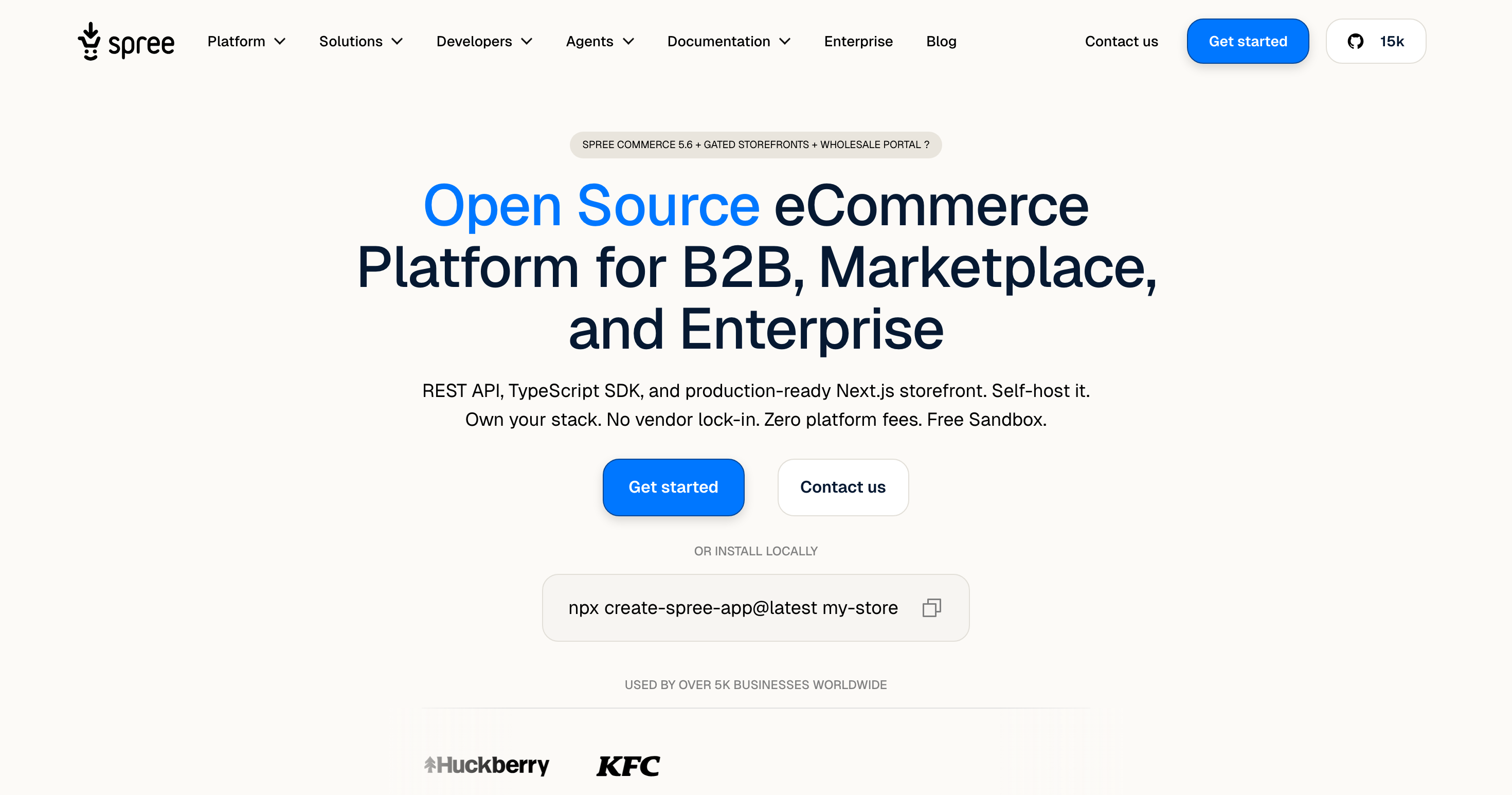
Spree Commerce is a BSD-3-Clause commerce platform in Ruby on Rails, sold and documented as a multi-vendor marketplace platform.
The code is on GitHub, and the documentation is public. Its own site leads with vendor onboarding and Stripe Connect payouts, and the multi-vendor code lives in a maintained extension beside the core instead of inside it, which is worth knowing before you plan upgrades.
BSD-3 is permissive, so whatever you build on top stays yours to keep closed. Enterprise Edition adds SLA-backed support and long-term support releases, priced on request.
What to check: whether your team writes Ruby, and which repository holds the marketplace functionality you need. An open source platform is only as maintainable as your ability to hire for its stack.
3) nopCommerce
nopCommerce is a .NET platform with vendor accounts and multi-store management in the core, under its own nopCommerce Public License.
The code is on GitHub, and the documentation is public. The license file describes it as based on the GPL with additions, so read it instead of assuming it behaves like MIT.
It lets you run several storefronts from one admin panel, each with its own catalogue. A marketplace needs the same thing, with the catalogues belonging to your sellers, so part of the work is already done for you. For an organisation already standardised on .NET, that removes an entire hiring question. The project is large and long-running, with over ten thousand stars and active commits.
What to check: the license terms against what you plan to build, and whether the vendor model in the core matches the commission and payout structure your marketplace needs. nopCommerce was built as a store with vendors, so the commission and payout model is thinner than on a platform designed around it.
4) Dokan for WooCommerce
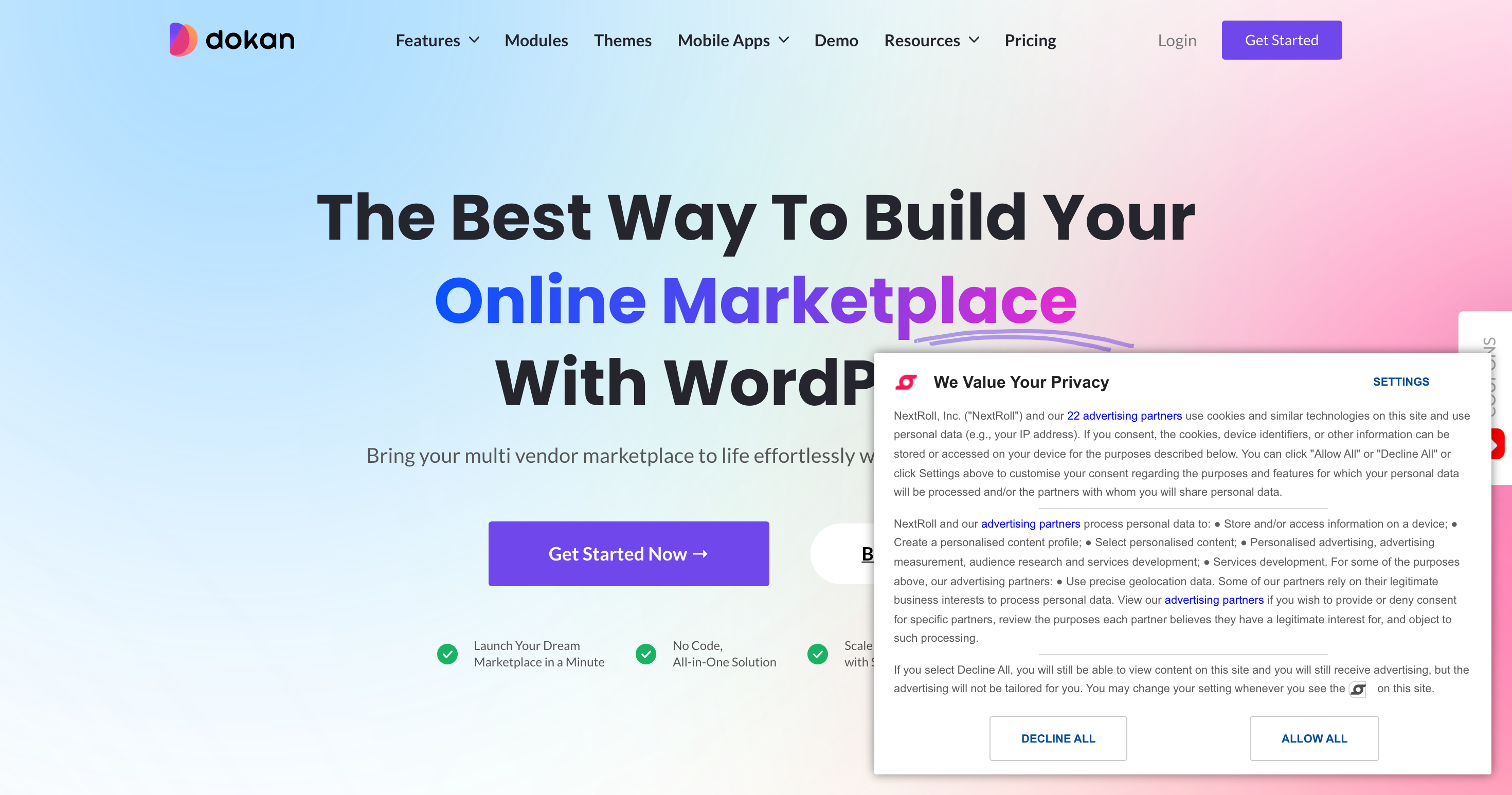
Dokan turns a WooCommerce shop into a multi-vendor marketplace, under the GPL that WordPress and WooCommerce already use.
The plugin is on GitHub, and the documentation is public. It is the shortest path on this list from nothing to a working marketplace, and for a modest catalogue and seller count it is a sensible answer in its own right.
The trade is a stack of dependencies: WordPress, WooCommerce, Dokan, and the plugins each of them needs. Every layer has its own update cycle and its own security surface, and they all have to stay compatible with each other.
The free Lite tier runs unlimited vendors, and the features most marketplaces reach for sit in the paid plans, which list from $745 a year for Starter up to $4,995 for Enterprise.
What to check: your plugin count at the start and your honest estimate of where it will be in a year. This is the option where maintenance cost grows fastest with complexity.
How to choose the best open source marketplace platform
The best platform for you is the one your developers can maintain and the one that enables the marketplace model you need. Answer these 4 questions to choose.
- Is the marketplace part of the platform, or is it something you add? If it is an extension, the part of your system that pays your sellers follows a roadmap you do not control. This question eliminates more candidates than any other.
- What language does your team write? An MIT license on a stack you cannot hire for is not an advantage. Node points to Mercur, .NET to nopCommerce, Ruby to Spree, WordPress to Dokan.
- What does the license require of what you build? MIT and BSD-3 let you keep your work closed. The GPL attaches conditions. Bespoke project licenses need reading.
- Who installs the security updates? Name the person or the partner before go-live, while there is still time to argue about it.
Summary: Which open source marketplace platform fits your business?
Four projects ship the marketplace model under an open source license, are actively maintained, and have a community you can hire from. The choice between them is mostly a choice of stack.
- For a Node team that wants the marketplace ready instead of built, Mercur is the shortest route, and it keeps the licence line at zero on the open source edition at any volume.
- For a Ruby team, Spree answers the same question in Rails with a large community behind it.
- For a .NET organisation, nopCommerce is the established option.
- For a team already on WordPress, Dokan is the fastest path and the heaviest maintenance.
If what you are looking at is Magento, Shopware, PrestaShop, Bagisto, Saleor, Sylius, Vendure, or OpenCart, you are looking at an eCommerce platform. That can still be the right decision, and you should make it knowing the marketplace layer is either a purchase or a build.
And if you have no developers and no delivery partner, none of these is the right answer yet. An open source license hands you the control and the work in the same motion, and the trade only pays when someone is there to do the work.
If you would rather start from your own situation, talk to the marketplace experts about scope, timeline, and what an open source marketplace build would cover.
Frequently asked questions on open source marketplace platforms
What are open source multi-vendor marketplace platforms?
The actively maintained open source platforms that ship multi-vendor are Mercur, Spree Commerce, nopCommerce, and Dokan for WooCommerce. Magento, Shopware, PrestaShop, Bagisto, Medusa, Saleor, Sylius, Vendure, and OpenCart are open source eCommerce platforms where the marketplace is a paid extension or a build. All of them publish their source under a license you can read on GitHub.
Is open source marketplace software free?
Yes, the software is free to download, run, and change, and a running marketplace still costs money. There is no licence fee and no share of your sales. You pay for hosting, implementation, integrations, and maintenance, and you pay for those on every platform. On the eCommerce platforms that need a marketplace extension, that extension costs from $99 to $449 depending on the platform. A SaaS platform charges you more as your marketplace grows, and an open source platform leaves your costs where you put them.
What is the best open source marketplace platform?
For most marketplace operators, the answer is Mercur. Multi-vendor logic is in the core, the licence is MIT, and nobody takes a share of your sales, so your developers start on your own business rules instead of building vendor accounts and payouts first.
What is the difference between an open source eCommerce platform and an open source marketplace platform?
An eCommerce platform sells your own catalogue; a marketplace platform sells other sellers' catalogues through your storefront. The marketplace adds vendor accounts, commission rules, order splitting across several sellers in one basket, and payouts that reconcile for each of them.
More articles
Ready to build?
See the product – open the demo, or book a walkthrough with our experts.