
Announcing Mercur 2.0: AI-native marketplace architecture
Version 2.0 introduces a new foundation for building marketplaces – structured not only for developers, but also for AI. This release shifts Mercur from a framework into a system that can be safely extended, modified, and evolved using predictable patterns and composable building blocks.
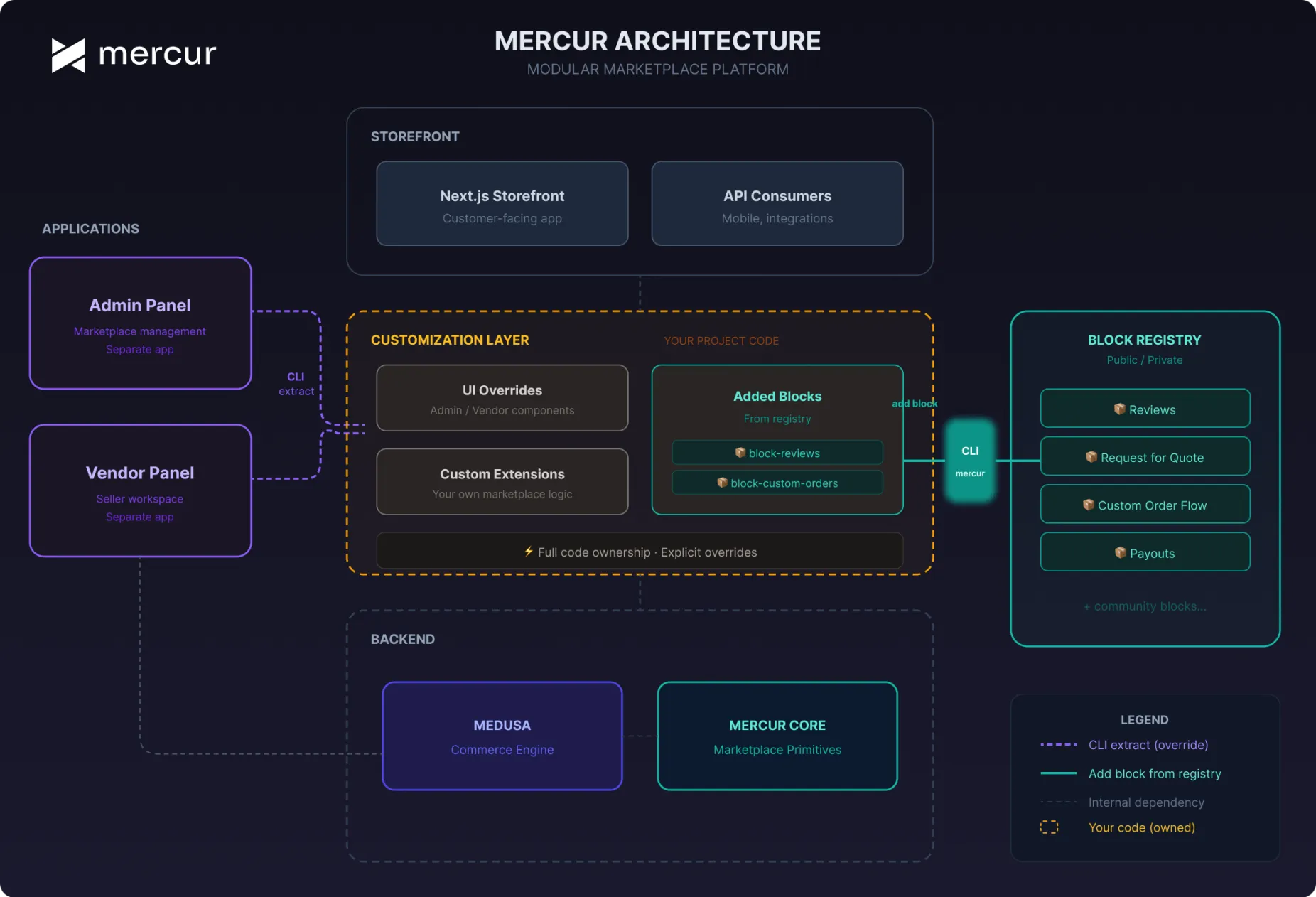
Mercur 2.0 is a ground-up redesign. Every layer has been rethought based on real feedback from development teams – covering architecture, developer experience, extensibility, and AI-native workflows.
Area | Mercur 1.x | Mercur 2.0 |
|---|---|---|
Architecture | Monolithic, tightly coupled | Modular blocks, core plugin + registry |
Customization | Fork the repo | CLI installs blocks you own |
CLI | Basic scaffolding | Full lifecycle: create, add, diff, search, build, codegen |
Admin Panel | Single app, external repo | In-monorepo, file-based routing, dashboard SDK |
Vendor Panel | Separate repo | In-monorepo, same SDK and patterns as admin |
API Client | Generic JS SDK | Typed router shared between server and client |
Code Ownership | Dependency on packages | Code copied into your project — full ownership |
AI Integration | None | Governance skills, structured blocks |
Payments | Basic Stripe | Native marketplace payouts with Stripe Connect |
Documentation | Basic guides | Full docs with API reference |
Monorepo | None | Turborepo with clear workspace boundaries |
AI-Native Development
Now, Mercur lets AI work at the system level: composing APIs, modifying workflows, extending UI, and evolving your marketplace architecture.
It provides clear, predictable patterns that AI can reason about:
Typed API Client
API specifications are shared between the server and the client. AI can read types and generate correct integrations without guessing.
Block Registry with CLI
Like shadcn/ui, but for your marketplace backend. Features are modular blocks that can be added, updated, and diffed. The CLI is native for AI agents, so they can safely add, extend, and modify your system – not by guessing, but by working with structured building units.
Monorepo Setup
Everything lives in one consistent system. AI has full context across backend, admin, vendor, and shared packages.
Core Workflows as Programmable Building Blocks
Cart, orders, pricing, and vendors are exposed as structured logic that can be extended, replaced, or hooked into. AI doesn't need to rebuild flows – it can modify steps, inject logic, and adapt them to new business models.
Extensible Panels
Admin and vendor panels are extended through file-based routing and a block registry – add custom pages, replace entire sections, or swap out specific components using compound components, all wired in automatically by the dashboard SDK.
Native Marketplace Payments
Pluggable payout providers with Stripe Connect out of the box. Swap or extend providers as your marketplace evolves.
Built on MedusaJS
A structured commerce framework with modules, workflows, links, and subscribers as first-class building blocks. This gives AI context, so it can safely modify real systems.
New Architecture
Block-Based System
Inspired by shadcn/ui, code is copied directly into your project for full ownership. No black-box dependencies.
Block types:
- Modules – Data models and business logic.
- Links – Relationships between modules.
- Workflows – Multi-step business processes.
- API Routes – HTTP endpoints.
- Admin Extensions – Admin dashboard customizations.
- Vendor Extensions – Vendor portal customizations.
Core Plugin
Marketplace fundamentals that every project needs, shipped as a single plugin.
8 Modules: Seller, Commission, Payout, Custom Fields, Admin UI, Vendor UI, Codegen, and core MedusaJS integrations.
13+ Workflow Categories:
- Seller management – create, invite, update sellers.
- Commission – batch rules, CRUD rates, refresh order commission lines.
- Payouts – create payouts, onboarding, process webhooks.
- Cart – split orders by seller, seller shipping methods, seller promotions.
- Orders – order groups with detail and list views.
- Inventory, campaigns, price lists, promotions, shipping, stock locations.
19 Module Links: Connecting sellers to products, orders, customers, payouts, campaigns, inventory, fulfillment, and more.
Full API Surface:
- Admin routes: products, order-groups, commission-rates, payouts, sellers.
- Vendor routes: products, categories, inventory, fulfillment, price-lists, promotions, customers, orders, payments, regions, currencies, sales-channels, campaigns, reservations.
- Store routes: marketplace-aware cart and checkout.
Official Block Registry
8 pre-built blocks ready to install.
Block | Description |
|---|---|
reviews | Product and seller review system with ratings |
product-import-export | Bulk CSV import/export for products |
team-management | Multi-user teams with role-based access |
wishlist | Customer wishlist functionality |
vendor-notifications | Event-driven notification system |
algolia | Algolia search integration and indexing |
requests | Request/quotation workflows |
vendor-chat | Real-time vendor messaging |
Each block includes modules, links, workflows, API routes, and UI extensions — installed with a single command.
Admin Panel
35+ pages covering every marketplace operation:
- Products – Products, variants, categories, collections, types, tags.
- Orders – Orders, order groups, fulfillment, shipping profiles.
- Inventory – Stock levels, locations, reservations.
- Pricing – Price lists, promotions, campaigns.
- Sellers – Seller management, commission rates, payouts.
- Customers – Customers, groups.
- Regions – Regions, tax regions, currencies.
- System – Users, API keys, settings.
Vendor Panel
19+ pages for seller self-service:
- Products – Full CRUD with variants and categories.
- Orders – Order management with payment capture/refund.
- Inventory – Stock management with batch operations.
- Pricing – Price lists and promotions.
- Finance – Payout tracking and management.
- Settings – Store configuration.
Shared UI Library
Components and hooks shared between admin and vendor:
- Data grids, tables, forms, modals, filtering, localization.
- Custom hooks:
use-data-table,use-query-params,use-date,use-command-history. - Query key factories for TanStack React Query.
Try Mercur 2.0 Today
Mercur 2.0 gives you everything you need to build a powerful AI-native marketplace platform.
Contact the Mercur team if you want to see a custom demo, get help finding the right Mercur usage for your Marketplace or find answers to frequently asked questions.
- Explore the Docs
- Join the Discord Community
- Launch your Marketplace – contact us if you want to see a custom demo
More product updates
Ready to build?
Read the release notes, then see the product – open the demo, or book a walkthrough on your terms.