
Excess Inventory: Why It's Killing Your Growth (and How Marketplaces Solve It)
Your warehouse might be slowing your growth more than your competition. According to McKinsey, companies allocate about $300 billion each year to warehouse operations.
Surplus inventory often looks like a valuable asset in financial statements. In practice, it creates unnecessary expenses and financial losses.
Nearly $1.5 trillion worth of merchandise sits in an overstocked state globally every year, generating lost revenue instead of contributing to sales.
When excess inventory builds up, you deal with tied-up capital, limited cash flow, rising storage costs, and valuable warehouse space filled with slow-moving items instead of products that match actual customer demand.
Slow-selling items and excess products continue to accumulate because your model depends on predicting future customer demand in advance.
More warehouse space doesn’t fix that structure.
Owning excess inventory storage means you take on the risk when market trends shift. When demand drops, unsold items remain in storage and tie up cash that could support growth in other areas of your business.
In this article, you will learn what excess inventory is, how it happens, how to identify and calculate it, and how a marketplace business model helps you reduce excess inventory without expanding your warehouse space.
Key takeaways
- If your inventory levels consistently exceed actual customer demand, you are likely dealing with excess inventory that ties up capital and limits your ability to invest in growth.
- Holding surplus stock increases storage costs, carrying costs, and reduces profit margins as unsold inventoryremains in your warehouse for an extended period.
- Calculating how much capital is tied up in excess products helps you understand the direct impact of unsold stock on your cash flow and business operations.
- A marketplace model allows you to expand your product offering without increasing inventory levels, which reduces dependence on owned stock and warehouse space.
- Extending your eCommerce with a marketplace layer allows external suppliers to fulfill part of the customer demand that would otherwise require you to purchase and store extra inventory.
What is excess inventory, and how does it happen? (4 common scenarios)
Excess inventory refers to stock that goes beyond actual demand within a given period. It includes unsold items, slow-moving items, and products that stay in storage long after their expected sales cycle.
You planned to sell them. Customer demand didn’t follow your sales forecasts.
This often starts with inaccurate demand forecasting based on historical data that no longer reflects current market trends.
Your inventory management process assumes stable demand, while customer demand changes due to price sensitivity, seasonal trends, or new competitors offering similar products at competitive prices.
Here are 4 common scenarios where excess stock builds up:
1. Overestimated demand
Your sales team expects increased demand for a product line based on last year’s sales data. You increase stock levels to prepare for the upcoming quarter. Then:
- customer demand shifts to newer alternatives,
- a competitor launches similar products at a slightly lower price,
- market demand drops due to macroeconomic changes.
You now hold surplus stock that doesn’t move. Inventory levels stay high, and unsold inventory occupies valuable storage space.
2. Supply chain disruptions
You increase safety stock to protect your supply chain from delays. Later: suppliers stabilize deliveries, logistics timelines improve, and your inventory needs decrease.
Yet extra inventory already sits in your warehouse. What was meant to protect business operations becomes too muchstock, which increases storage costs and carrying costs over time.
3. Seasonal products that miss the window
You prepare inventory for a seasonal trend such as winter apparel. Customer demand peaks for a short period. After the season ends, slow-selling items remain as surplus inventory.
You now manage excess inventory that requires selling online at a discounted price, running a flash sale, or offering bundles at a slightly lower price.
All of these actions reduce profit margins and increase financial losses.
4. Bulk purchasing incentives
Suppliers offer better pricing when you order large quantities. You align supply with expected demand to reduce unit costs.
However, actual demand stays lower than projected, and unsold stock accumulates.
Lower purchase cost per unit leads to increased costs in storage space and unnecessary expenses related to inventory tracking and storage.
Excess inventory management ties up capital that could support marketing, product development, or expansion into new sales channels. Instead, it sits in storage, generating carrying costs and limiting your ability to react to demandchanges.
What are the consequences of excess inventory?
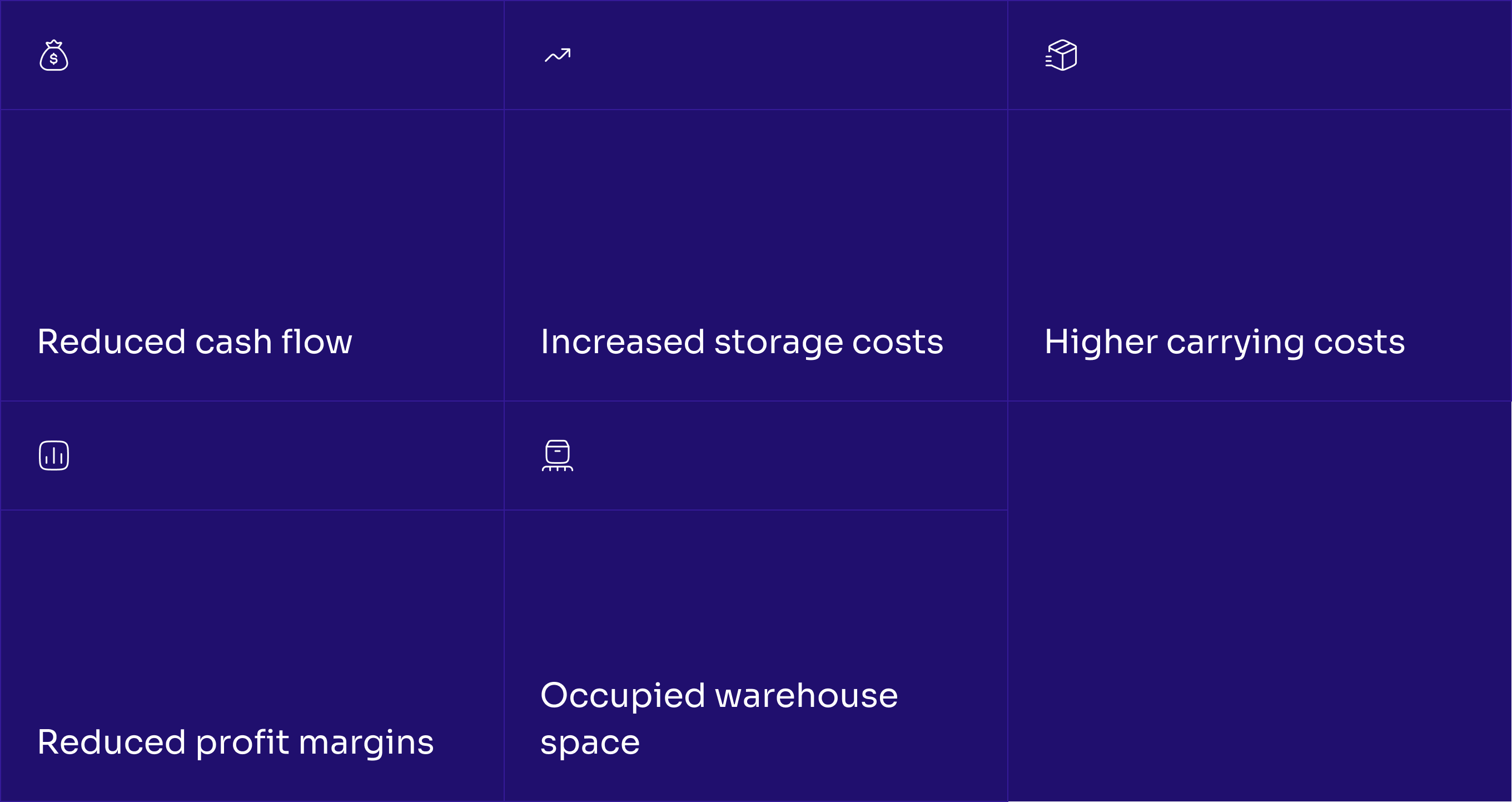
When excess inventory builds up, the impact goes far beyond warehouse operations.
Unsold inventory starts to affect your cash flow, storage space, financial statements, and your ability to respond tocustomer demand.
96% of businesses fail to recover even 75% of what they paid for surplus stock, and in most cases, they lose half of the product’s cost or more when trying to clear unsold inventory.
Over time, surplus stock becomes a source of increased costs that slows down growth across multiple areas of your business.
Reduced cash flow
When too much inventory sits in storage, your working capital stays locked in unsold stock instead of funding daily business operations.
Tied-up capital limits your ability to react to changes in customer demand or shifting market trends.
Increased storage costs
As inventory levels grow beyond actual demand, you may need to expand your warehouse space, rent external storage, or reorganize valuable storage space.
This leads to increased costs related to rent, utilities, inventory tracking systems, insurance, and warehouse operations.
Higher carrying costs
Managing excess inventory comes with ongoing carrying costs, such as handling, packaging, depreciation, and insurance.
Even when products don’t sell, they continue to generate unnecessary expenses across your supply chain.
Reduced profit margins
To sell excess products, you often lower prices through flash sales, bundles, or clearance campaigns.
Selling online at a slightly lower price helps move inventory quickly, but it also reduces profit margins and may impact perceived product quality over time.
Occupied warehouse space
Too much stock limits your ability to introduce new product lines, increase stock levels for bestsellers, or adapt inventory needs to seasonal trends.
How to identify excess inventory? Checklist for Operations Leaders
You usually see the first signals of excess inventory challenges in cash flow, storage space, or financial statements before anyone flags it inside inventory management reports.
As an operations leader, you don’t need to review every SKU to understand when surplus inventory starts to build up. You can spot excess stock by asking a few business-level questions across sales, finance, and supply chain teams.
Use this checklist to identify when unsold inventory begins to affect growth.
1. Your cash flow is tightening while inventory levels increase
If revenue stays stable but tied-up capital grows in financial statements, you may already be holding extra stock that doesn’t match actual demand.
2. Your warehouse space fills up without a rise in sales
If storage space utilization increases but customer demand remains unchanged, slow-moving items or unsold stock may be accumulating across product categories.
3. Your carrying costs increase quarter over quarter
If storage costs, insurance, handling, and inventory tracking expenses continue to grow, managing excess inventorymay already be affecting your margins.
4. You rely on sales forecasts that don’t match real-time data
If demand forecasting is based on historical data instead of real-time sales data, inaccurate forecasting may lead to too much inventory across multiple SKUs.
5. Your sales team frequently requests discounted price campaigns
If teams regularly ask for flash sales or clearance campaigns to sell excess products, this often signals a mismatch between stock levels and customer demand.
6. You increase safety stock due to supply chain uncertainty
Supply chain disruptions often lead to higher safety stock. If supply stabilizes but inventory needs remain unchanged, surplus stock may stay in storage for an extended period.
7. You delay new product launches due to a lack of storage space
If unsold inventory occupies valuable storage space that could support new product lines, excess inventory may already limit business operations.
8. You notice growing write-offs in financial statements
If unsold items require tax write-off or tax deduction decisions more often than before, excess and obsolete inventorymay already be generating financial losses.
9. Your inventory turnover rate declines across product lines
If products take longer to sell despite stable market demand, inventory levels may exceed actual demand.
If you answer yes to several of these questions, you may already be managing excess inventory that affects cash flow, profit margins, and your ability to align supply with customer demand.
If the surplus is spread across too many products rather than concentrated in a few, SKU rationalization is the process that decides which ones to stop carrying.
How do you calculate excess inventory cost?
Once you’ve identified that you’re dealing with excess inventory, the next step is to understand its financial impact on your business operations.
To manage excess inventory properly, you need to calculate how much of your inventory goes beyond actual demand within a given period.
Start with a simple comparison between your current stock levels and your forecasted demand.
Step 1: Define your expected demand.
Use your sales data and recent sales forecasts to estimate how many units of a product you expect to sell within a specific timeframe. This could be:
- 30 days,
- 60 days,
- one sales quarter,
- a full season for seasonal products.
This number reflects expected customer demand based on your demand forecasting models.
Step 2: Review your current inventory levels.
Check how many units of the same product you currently hold in storage.
Your inventory tracking system should provide real-time inventory tracking data for each SKU.
Step 3: Apply the excess inventory formula.
You can calculate excess inventory using the following formula:
Excess Inventory = Current Inventory - Forecasted Demand
If you currently hold 5,000 units of a product but expect to sell only 3,000 units within the next quarter, your excess stock equals 2,000 units.
These 2,000 units represent:
- tied up capital,
- additional carrying costs,
- increased storage costs,
- and unsold items that may require discounted price campaigns later.
Step 4: Calculate financial exposure.
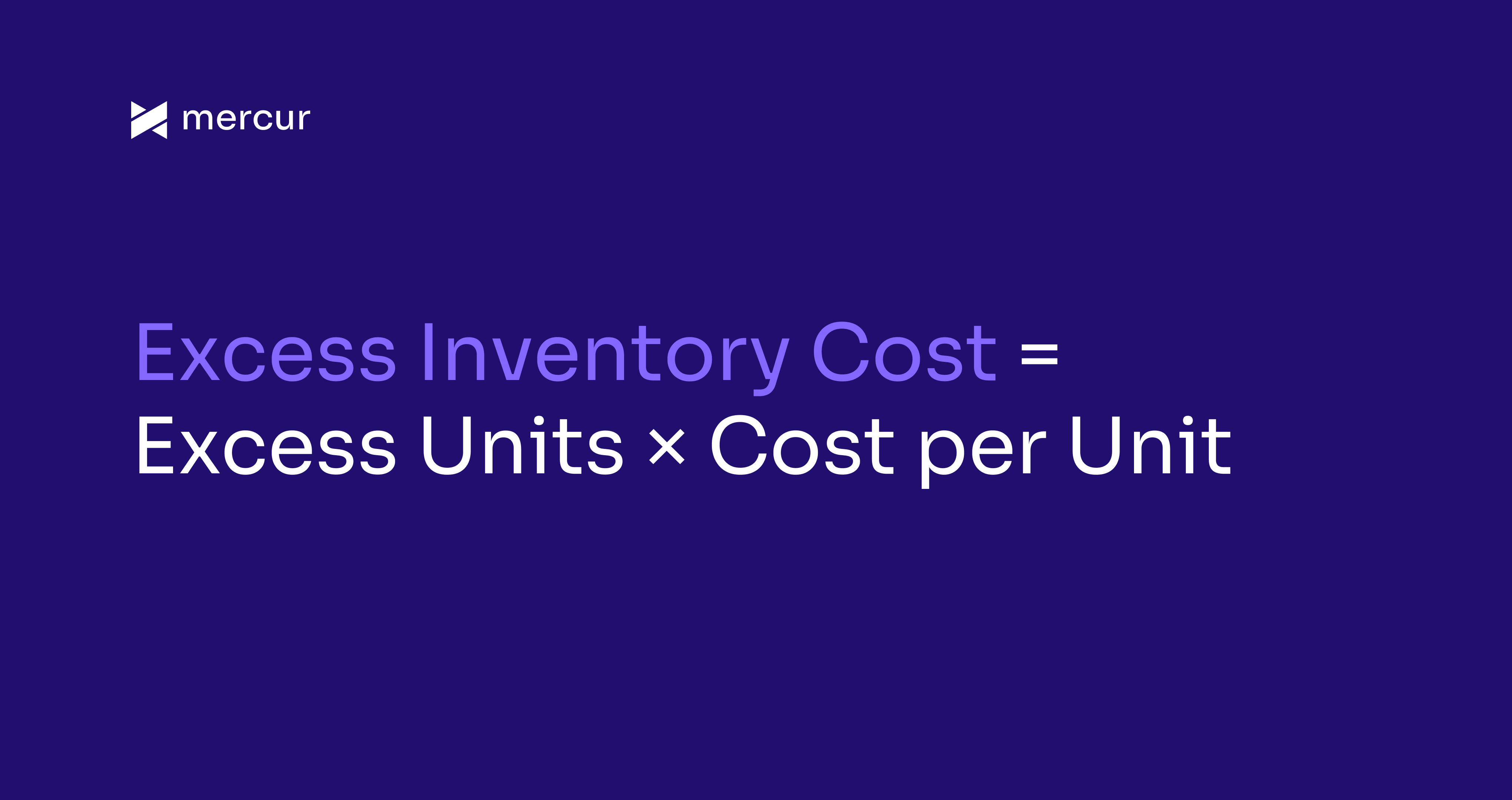
To understand how excess inventory affects cash flow, multiply the number of excess products by the cost per unit.
Excess Inventory Cost = Excess Units × Cost per Unit
If your 2,000 excess units cost $50 each, you now hold $100,000 in tied-up capital that doesn’t generate revenue.
This $100,000 reflects unnecessary expenses in storage space and capital that could support marketing or expansion!
Now that you know excess inventory exists in your business and how much it costs you, it’s time to solve the problem.
How to reduce excess inventory with the marketplace business model?
Don't worry, there are many excess inventory solutions that will prevent your cash flow and storage space. Most of them focus on clearing unsold stock after the problem already exists.
Excess Inventory Management Method | What it does? | Trade-off |
|---|---|---|
Discounted price campaigns | Helps sell excess products faster | Reduces profit margins |
Flash sale events | Moves unsold items quickly | Impacts brand perception |
Bundling slow moving items | Increases sales of surplus stock | Lowers average product margin |
Selling through liquidation channels | Clears warehouse space | Generates financial losses |
Donations to charitable organizations | May allow tax deduction | No revenue recovery |
Recycling programs | Removes excess and obsolete inventory | No cash flow recovery |
Bulk sales to resellers | Moves large stock levels | Requires lower unit pricing |
Increasing marketing spend | Attempts to increase demand | Raises customer acquisition cost |
Each of these methods helps you sell excess items and manage inventory. None of them changes how excess stock builds up in the first place.
Instead of focusing on excess inventory management after it appears, you can change how your eCommerce growth engine works. A marketplace business model allows you to grow your product offering and revenue without increasing your inventory needs or storage costs.
Check out this 5 signs to see if your eCommerce is ready do become a marketplace!
What is a marketplace, and how does it reduce excess inventory?
A marketplace is an eCommerce platform that allows you to sell products from third-party sellers without owning the inventory yourself.
Instead of purchasing stock in advance and storing it in your warehouse, you give external vendors access to your sales channel. Sellers list their products in your store, manage their own inventory levels, and handle fulfillment when an order is placed.
Because sellers manage their own inventory and shipping, you minimize financial losses and reduce the need to maintain high inventory levels. You expand your catalog with new product categories without increasing storage space.
Your warehouse holds only the products you decide to own strategically. Everything else can be offered through vendor inventory, which reduces tied-up capital and the risk of excess and obsolete inventory.
Instead of forecasting demand months in advance, you sell products that already exist in vendor warehouses.
In a marketplace model, your role changes from inventory owner to platform operator. You onboard and manage third-party sellers, commission rules for transactions, product approval workflows, catalog quality across multiple sellers, and payouts.
As a result, your growth becomes less dependent on how much inventory you can store and more dependent on how much demand your platform can capture.
Financial benefits of the marketplace model
Once you reduce your dependence on owned inventory, the financial impact becomes visible across your operating costs and cash flow.
A marketplace model changes how capital is used in your business. Instead of investing in stock that may remain unsold, you invest in customer acquisition, vendor relationships, or expanding your product offering.
That shift also changes what winning a customer costs you, which our breakdown of customer acquisition cost in eCommerce works through.
Explore how the business model changes the cost curve in marketplace vs eCommerce!
Reduced operational costs
When you reduce ownership of physical inventory, you also reduce storage costs related to warehouse space, handling, packaging, and insurance.
You no longer need to maintain extra stock to cover demand fluctuations or supply chain disruptions. Carrying costs drop because fewer products remain in storage for an extended period.
Improved cash flow
When you shift part of your catalog to marketplace supply, fewer funds stay locked in unsold items, and inventory purchases decrease.
Working capital becomes available for growth initiatives, such as customer acquisition or expanding into new product categories.
You move from inventory-based growth to commission-based growth.
Additional revenue streams
Marketplace models allow you to generate revenue through commission on each transaction, listing fees, vendor subscriptions, or promotional placements for sellers.
You increase sales without increasing inventory needs or expanding warehouse space.
How to extend your eCommerce with a marketplace layer
At this stage, you already know that excess inventory exists in your business and how much tied-up capital sits in unsold stock. The next step is to change how inventory enters your sales channel.
Our breakdown of the operational shift from retailer to platform covers the six functions that change once part of your assortment stops being yours.
This is achievable through dedicated marketplace platforms or integrations that allow you to connect third-party sellers directly to your eCommerce.
One of these platforms is Mercur, which can integrate with your existing Shopify, Magento, or any custom eCommerce system. Mercur allows you to introduce multi-vendor marketplace capabilities without replacing your current eCommerce platform or interrupting daily business operations:
- Your existing commerce engine continues to handle owned inventory, checkout, and customer experience as before.
- Marketplace logic (vendor onboarding, commission rules, seller workflows, and transaction orchestration) operates as a separate layer that connects external supplier inventory to your platform.
- Your eCommerce store continues to operate, while the marketplace supply absorbs part of the customer demand that would otherwise require you to increase inventory levels.
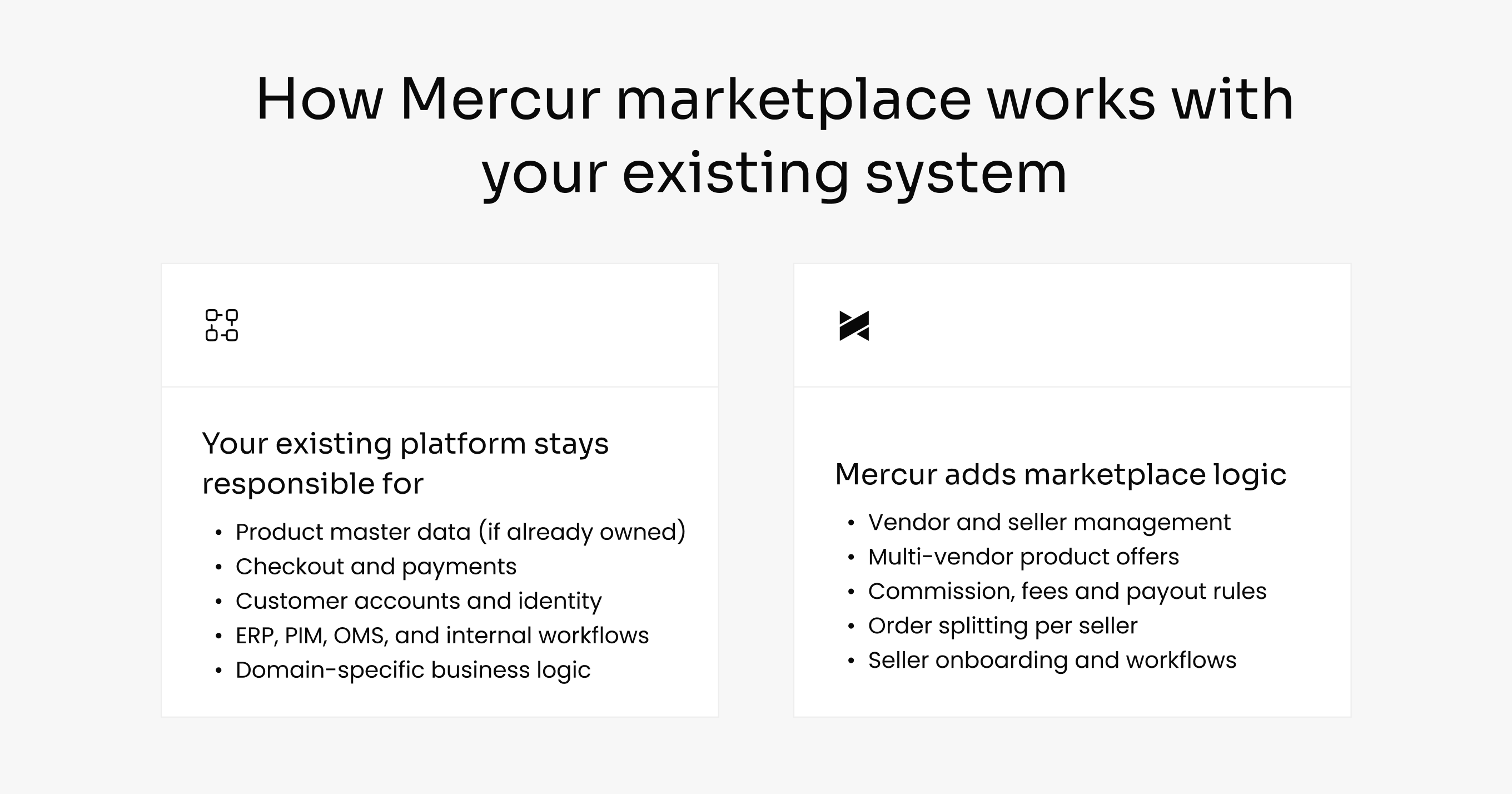
This separation of concerns ensures that the marketplace logic is isolated and extensible, allowing for the independent scaling of vendors and workflows without slowing down the core performance.
- No migration, no replatforming, no vendor lock-in.
- No need to pause current eCommerce development.
- Works with custom and legacy platforms.
- Clear separation between commerce and marketplace logic.
- API-first, event-driven integration.
If you’re considering the marketplace as your growth engine shift, don’t start with development!
Before building anything, it’s worth validating how a multi-vendor marketplace should live in your ecosystem. A short architecture conversation can save months of development and years of technical debt. Book a marketplace consultation!
Summary: Your warehouse and excess stock doesn’t have to define your growth
Excess inventory ties up cash, increases storage costs, and limits your ability to respond to real customer demand.
After reading this article, you’ve seen how surplus stock builds up. You’ve calculated how much capital sits in unsold inventory. You understand how carrying costs and storage space quietly reduce your profit margins.
The core issue is structural. When your growth depends on purchasing stock in advance, you take on forecasting risk, supply chain risk, and obsolescence risk.
Those three are part of a wider set. Our breakdown of the seven types of inventory risk covers how to measure each one before it reaches your P&L.
The more you scale, the more inventory you need. The more inventory you need, the more capital stays locked in your warehouse.
A marketplace model changes that structure. You expand your catalog without increasing stock levels.
If you want to explore how a marketplace layer could reduce excess inventory in your specific category, we can help you define a safe MVP scope. You’ll clarify what to build first, what to postpone, and which guardrails to set so you don’t damage your core business. Talk to a marketplace expert!
FAQ on managing excess inventory
What is inventory excess?
Inventory excess refers to stock levels that exceed actual customer demand within a given period. It includes unsold inventory, slow-moving items, and surplus stock that remains in storage longer than expected based on your sales forecasts.
This often happens when demand forecasting relies on outdated historical data or when market trends shift faster than your inventory planning cycle. As a result, you hold too much inventory that ties up cash and occupies valuable warehouse space.
What is excess inventory management?
Excess inventory management is the process of identifying, tracking, and reducing surplus inventory before it leads to financial losses.
It involves monitoring inventory levels using real-time inventory tracking, comparing stock levels with actual demand, and adjusting purchasing decisions based on updated sales data.
The goal is to minimize carrying costs, reduce storage costs, and prevent tied-up capital from accumulating in unsold stock.
What to do with excess inventory?
When excess products build up, companies often try to sell excess inventory through flash sales, bundles, or clearance campaigns. Some businesses move surplus inventory through liquidation partners or sell online at a slightly lower price to recover part of their investment.
Other options include bulk sales to resellers, donations to charitable organizations for potential tax deductions, or recycling programs for excess and obsolete inventory that can no longer be sold.
In some cases, companies also introduce third-party sellers to help increase sales without increasing inventory needs in the future.
What is a best practice for managing excess or expiring inventory?
One common approach for managing excess or expiring inventory is to monitor slow-selling items early using real-time sales data and inventory tracking tools.
Reviewing stock levels regularly helps you identify unsold items before they become excess and obsolete inventory.
You can also adjust safety stock levels based on seasonal trends and recent customer demand rather than relying only on historical data.
Many companies also align supply with actual demand by reducing bulk purchases and introducing flexible supply through vendor networks or marketplace models.
Why is holding excess inventory bad?
Holding too much inventory increases storage costs, insurance, and handling expenses over an extended period.
Surplus stock ties up capital that could otherwise support marketing, hiring, or expansion into new product categories. It may also reduce profit margins if you need to sell excess products at a discounted price.
Over time, excess inventory limits your ability to react to changes in customer demand and slows down business growth.
More articles



Ready to build?
See the product – open the demo, or book a walkthrough with our experts.