
Online Marketplace VAT: When Does the Platform Become the Deemed Supplier?

The deemed supplier rule is a legal fiction: for VAT, one sale on your marketplace counts as two, and you become the taxable person on a sale you never made.
You picked a model in which the seller sells, and you only sit in the middle. The law can decide otherwise.
It does not do that across your whole business, only on part of your orders, and it never asks your opinion. It is a legal fiction that fires on its own once its conditions are met.
This is a map of mechanisms. What exactly turns the fiction on in your case depends on the country and the year, and your tax advisor settles it.
Not this article, and not your platform. But one thing depends on you alone, and you have to settle it before you build: does your system even collect the data your advisor needs to answer, and can you defend that answer two years later?
This article breaks down:
- What is the deemed supplier fiction?
- Which 3 questions decide whether it fires?
- Which data has to sit on the order line?
- What does it change in your reporting?
Key insights
- The fiction fires when you facilitate the sale, and the seller or the goods sit outside the tax area. Facilitating means setting the terms, authorizing the charge, or arranging the shipment.
- One commercial sale becomes two supplies for tax: the seller to you, usually relieved of tax, and you to the buyer, taxed where the buyer is. The money itself moves exactly as before.
- Two identical orders can settle differently, and the only difference is the seller's establishment and where the goods sat. Nothing on the order itself shows it.
- A line can be in three states: the seller accounts for the tax, you are the deemed supplier, or you carry joint and several liability. The third makes you the payer of somebody else's debt.
- The attribute belongs to the order line, with the basis and the date frozen on it. Read it from the seller profile, and the first change of establishment rewrites your history.
What is the deemed supplier fiction, and how does one sale become two?
In every version we know, the mechanism looks the same. The law says: for the tax on that sale, we treat you as if you had bought the goods from the seller and resold them to the buyer.
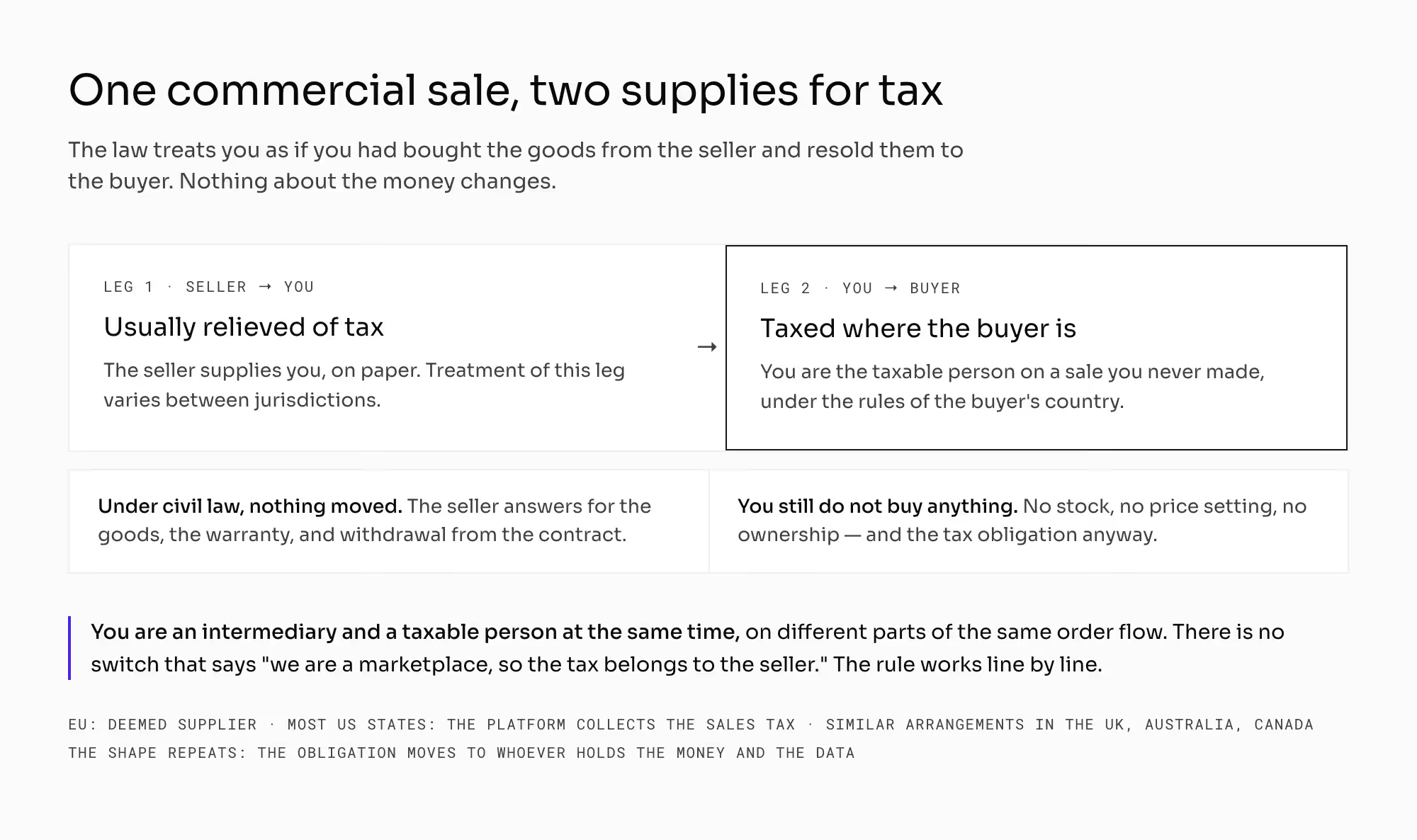
One commercial transaction turns into two supplies for tax: the seller to you (a leg usually relieved of tax) and you to the buyer (taxed under the rules of the buyer's country).
Nothing else changes. Under civil law, the seller is still the seller.
They answer for the goods, for the statutory warranty, and for withdrawal from the contract. You do not buy the goods, you do not hold them in stock, you do not set the price, and you are the taxable person anyway, on a sale you never made.
The consequence that surprises people most: you are an intermediary and a taxable person at the same time, on different parts of the same order flow. There is no switch that says "we are a marketplace, so the tax belongs to the seller." There is a rule that works line by line.
"Marketplace VAT: Are You the Agent or the Principal?" lays out the map of roles. Here we deal only with what happens when the law overrides that map.
Two identical orders, two tax worlds: the worked example
We keep the running example of the series: a cart of €1,000, a commission of 12%, and €880 left for the seller.
Order A. The seller is established where you sell.
You are the intermediary: you issue them a commission invoice for €120, and the tax on the €1,000 sale is their business. Your own tax filing shows €120.
Order B. The same product, the same price, the same commission.
But the seller is established outside the area where you sell, and the goods sit in a warehouse on the spot. The fiction fires.
For tax the seller sold €1,000 to you, and you sold €1,000 to the buyer. The money moves exactly as before: the seller receives €880, and you earn €120.
But the whole €1,000 now passes through your tax filing, and the document for the buyer has to originate on your side.
The buyer sees no difference at all. Your profit and loss statement probably does not change either.
Only the tax layer changes. And the only thing separating A from B is an attribute of the seller and the location of the goods, neither of which is visible on the order itself.
If that attribute is missing from your data, there is no way to pull the two orders apart. Not today, and not looking back.
Which 3 questions decide whether the fiction fires?
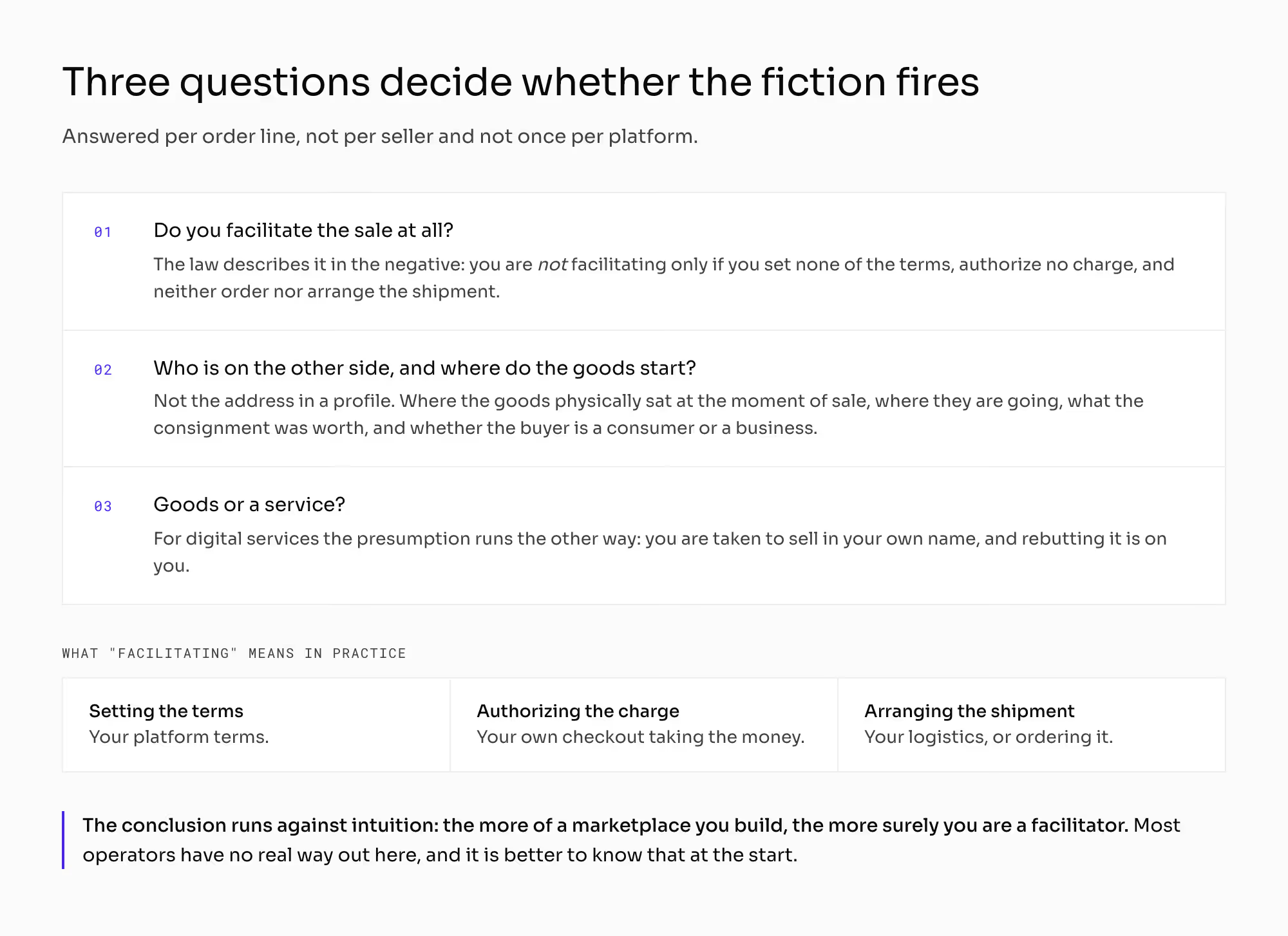
1. Do you facilitate the sale at all?
EU law describes this in the negative: if you do not set the terms of the sale, you do not authorize the charge to the buyer, and you neither order nor arrange the shipment, then you are not facilitating. You are displaying listings or processing a payment.
The conclusion runs against intuition: the more of a marketplace you build, the more surely you are a facilitator. Your own checkout that takes the money is exactly "authorizing the charge." Your platform terms are "setting the terms." Most operators have no real way out here, and it is better to know that at the start than during an inspection.
2. Who is on the other side, and where do the goods start?
In the EU version, the fiction aims at two arrangements: sales to consumers by a seller with no establishment inside the tax area, and goods brought in from outside in consignments below a certain value threshold, which you confirm with your advisor. So what settles it is not the address in a profile.
It is where the goods physically sat at the moment of sale, where they are going, what the consignment was worth, and whether the buyer is a consumer or a business.
3. Goods or a service?
For digital services, the logic is separate and harder. The law presumes that you sell in your own name, and you can rebut that presumption only where the actual supplier is named outright on the document for the buyer, and you do not authorize the charge, do not authorize delivery of the service, and do not set the general terms.
The burden of proof sits on your side. The mechanism keeps extending to further service industries.
Check where it stands today with your advisor.
This is not a quirk of one market. The European Union calls it the deemed supplier.
Most US states have their own construction in which the platform collects the sales tax instead of the seller, and similar arrangements run in the United Kingdom, Australia, and Canada. The shape is the same: the law moves the obligation onto whoever holds the money and the data.
With more than one country, assume you will meet several versions of the rule at once.
Which 3 states can a single order line be in?
What does the setup decide? | The seller accounts for it | You are the deemed supplier | Joint and several liability |
|---|---|---|---|
Who is the taxable person | the seller | you | the seller |
Does the €1,000 pass through your filing | no, only the €120 | yes, the whole €1,000 | no |
Who has to issue the document to the buyer | the seller | you | the seller |
What turns it on | the default state | an attribute of the seller, the goods, and the buyer | usually a signal from an authority, or your own knowledge of an unpaid tax |
What it exposes you to | nothing | an unpaid tax on your side | you pay someone else's tax, though it was never charged to you |
Data you cannot answer without | none | seller establishment, location of the goods, buyer status | proof of what the seller declared, and when |
The third column is a separate mechanism, easy to mistake for the fiction. Joint and several liability makes you the payer of someone else's debt, usually after you found out (or should have known) that the seller is not accounting for the tax, and you did nothing.
You can fall into it without falling into the fiction.
Which data has to sit on the order line?
This is the one part of the article you move into a specification. Your platform is there to make that decision possible and provable. So the following has to be recorded on the order line:
- the seller's country of establishment at the moment of sale, and with it the basis on which you determined it and the date;
- where the goods physically were at the moment of sale (not the same thing as the seller's address) and where they are going;
- whether the goods came in from outside the tax area and what the consignment was worth;
- the buyer's status (consumer or business), because that decides whether the line falls under the rule at all;
- your own conduct in that flow: whether you set the terms, whether you authorized the charge, whether you ordered the shipment. This differs between channels of the same platform;
- the moment payment was accepted: under this fiction the tax point can arise right then rather than on shipment. If your system knows only the order date and the shipping date, you are missing a third date;
- the decision your system applied and the basis for it: frozen on the line the way "Marketplace Ledger: Why Balances Must Match the Transfer" freezes an exchange rate on an entry.
- The last point is the most important, and the most often skipped. The protection the law gives a platform acting in good faith on information from the seller is worth exactly what you can show: that the seller declared this and that, on this date, that you checked it in this way, and could not reasonably have known the declaration was untrue.
It is a record that either came into being at the moment of the order or never came into being at all.
That is why the attribute has to belong to the line, because an account holds only its current state. Sellers move their establishment, change warehouses, convert from a sole trader into a company.
If your rule reads the current state of the profile, then after the first such change, the history starts lying about the past.
What does the deemed supplier rule change about your other decisions?
1. This is a decision about the data model
You can replace a tax engine in a quarter. A missing attribute on two hundred thousand historical orders you cannot fill in at all.
It is the same asymmetry "Marketplace Ledger: Why Balances Must Match the Transfer" describes for the ledger.
2. Your tax filing stops matching your revenue
You can carry €120 of commission in the books and €1,000 in the filing at once. The tax fiction does not automatically settle how you recognize revenue in your financial statements.
That is a separate test, built on who controls the goods before they are handed over, and a separate conversation with your accounting team. "Marketplace Revenue Recognition: Do You Book the Commission or the GMV?" develops it.
Here, it is enough to know that these are two separate questions, and that a board shown both numbers without warning will assume somebody made a mistake.
3. Your reporting has to be able to cut one seller into two streams
The same seller will have orders covered by the fiction and orders outside it in one month. If the statement for a period adds all of it into one number, you are back in a spreadsheet.
4. Refunds and corrections inherit all of this complexity
A refund on order B reverses both legs of the chain, and it lands in some period. Which period that is, "Marketplace Credit Notes: Which Period Does a Correction Belong To?" settles.
"Marketplace Invoicing: Who Issues Which Invoice, and When?" handles the documents on both legs, "Cross-Border VAT on a Marketplace: Foreign Sellers, Imports, and Customs" the operational side of foreign sellers and imports.
How do you brief your advisor and check a vendor? 7 questions
1. Ask your tax advisor about criteria
The outcome changes with the first new seller you sign. Criteria you can put into code.
- "Which of our flows fall under this fiction today, and which will fall under it once we admit sellers from outside the country?" Ask for the conditions as a checklist.
- "What data do we have to collect and keep so we can prove the basis on which we applied a given rule?" That question turns a legal defense into a system requirement.
- "Does the way we run checkout settle our status before we get to the question about sellers?"
- "Which period does a correction in this chain land in, and which document carries it?"
2. Ask your platform vendor to show you
- "Show me two identical order lines with different tax treatment. Then show me where I can see why."
- "Where do you store the seller's country of establishment and the location of the goods: on the seller account or on the order line?" The answer "on the account" means the history will change with the first profile update.
- "What does the report look like that splits the same orders into the stream where we are the taxable person and the one where the seller is?"
Which mistakes do operators make about the deemed supplier rule?
1. "We are only an intermediary" as the answer to a tax question
Your role under civil law does not answer the tax question. The fiction operates alongside it.
That is exactly the mistake that surfaces during an inspection rather than in the system.
2. A flag on the seller account instead of an attribute on the order line
Convenient, cheap, and it falsifies the history beyond repair the first time a seller's data changes.
3. Parking the subject until "we go abroad."
Your first seller from outside the country usually does not arrive through a strategic project. They arrive through a salesperson's recruiting in the third month after launch.
4. Treating this as tax engine configuration
The engine will calculate if you give it the data. Without the data, it will calculate confidently and wrongly.
5. Counting on good faith with nothing to prove it
The protection assumes you will show what the seller declared and how you verified it. Without that, all you have is an assertion.
What do you still have to settle yourself about the deemed supplier rule?
This is a map of mechanisms, not a tax or legal opinion. In this chapter, that boundary is sharper than anywhere else in the series.
Confirm five things by name before you fix the data model:
- Which of your flows fall under the fiction in your country and in the current year: the value thresholds, the exceptions, and what will change in the years ahead. Tax advisor.
- Whether your sales architecture already settles that you "facilitate." This question sits where the rule meets the way you built the process. Tax advisor together with a lawyer.
- Where and under which procedure you will account for it: whether one consolidated filing covers several countries, whether you need local registrations, and who represents you then. Tax advisor.
- Which document arises on which leg of the chain, who issues it, and whether you are allowed to issue it in someone else's name. This matters most where invoicing is mandatorily electronic. *Tax advisor and lawyer.
- Whether and when you are exposed to joint and several liability for a seller's tax, and what response on your side switches it off. Lawyer.
Our claim is narrower and independent of all five answers: the data has to let you answer each of those ways, because your advisor picks the rule. If the data model closes one of those routes, their answer stops meaning anything. And that is the only part of this problem you settle on your own, before you launch.
Summary: What do you owe your advisor?
A record rather than an answer. Which seller, established where, goods sitting where at the moment of sale, a buyer of which status, what you yourself did in that flow, and which rule you applied on what basis, frozen on the line. Collect that, and every answer stays available to you.
Ask a vendor to show two identical order lines with different tax treatment, and then to show where you can see why. Talk to a marketplace expert if you want to know whether your order line can carry the attribute.
Frequently asked questions on the deemed supplier rule
What is a deemed supplier?
A deemed supplier is a platform that the law treats as the seller for tax purposes, on a sale it never made. One commercial transaction becomes two supplies: the seller to the platform, usually relieved of tax, and the platform to the buyer, taxed under the buyer's rules. Nothing changes under civil law, where the seller still answers for the goods.
When does a marketplace become the deemed supplier?
When it facilitates the sale and the seller or the goods sit outside the tax area. Facilitating means setting the terms, authorizing the charge, or arranging the shipment, and a marketplace with its own checkout usually does all three. The exact thresholds and exceptions belong to your country and your year, so confirm them with a tax advisor.
Does the deemed supplier rule change how a marketplace reports revenue?
The tax fiction decides who accounts for the tax. Revenue recognition is a separate test built on who controls the goods before they are handed over. You can carry €120 in the books and €1,000 in the filing on the same order, correctly.
Ready to build?
If you want to check whether your order lines record where the seller was established and where the goods sat at the moment of sale, so your advisor has something to rule on, let's talk.